





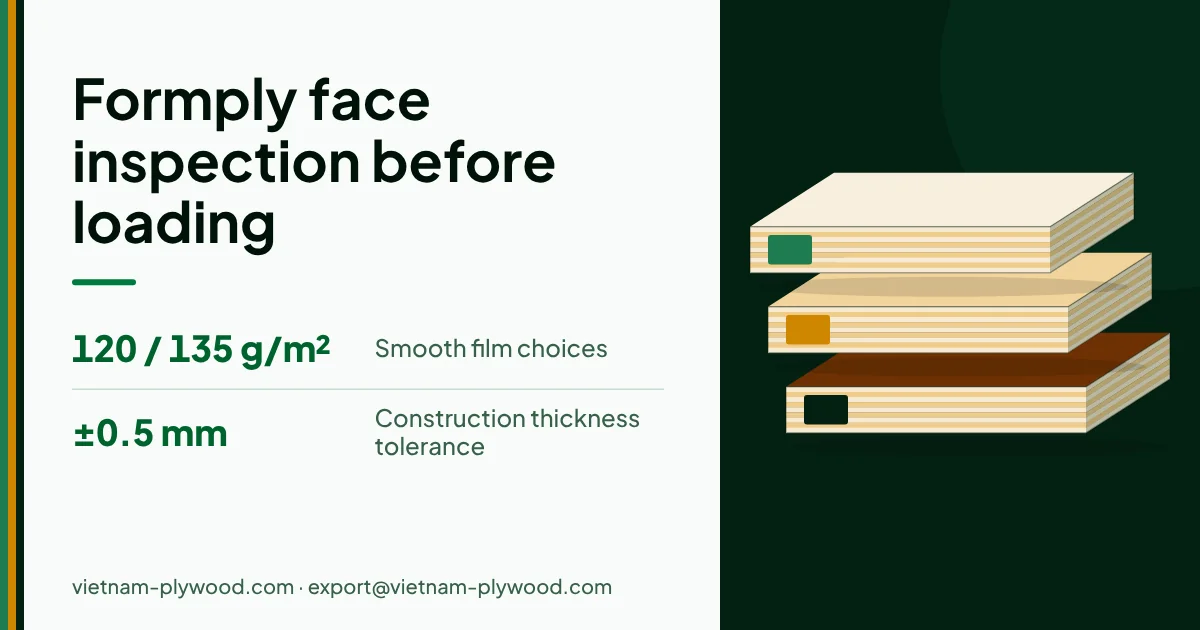
HCPLY selects smooth film-faced panels for an off form concrete finish by matching face condition, flatness and the project’s acceptance sample. The wrong panel can leave visible defects that cost repair time and delay acceptance. HCPLY’s construction line makes the concrete-contact sheets; the required finish class must be specified and checked on the completed concrete.
What are the AS 3610 off form concrete finish classes?
AS 3610 finish classes run from Class 1, the most demanding visual finish, to Class 5, where appearance matters least. They describe acceptance of the concrete surface, rather than a grade printed on plywood. For an off form concrete finish, the drawing and agreed reference panel must define what is acceptable.
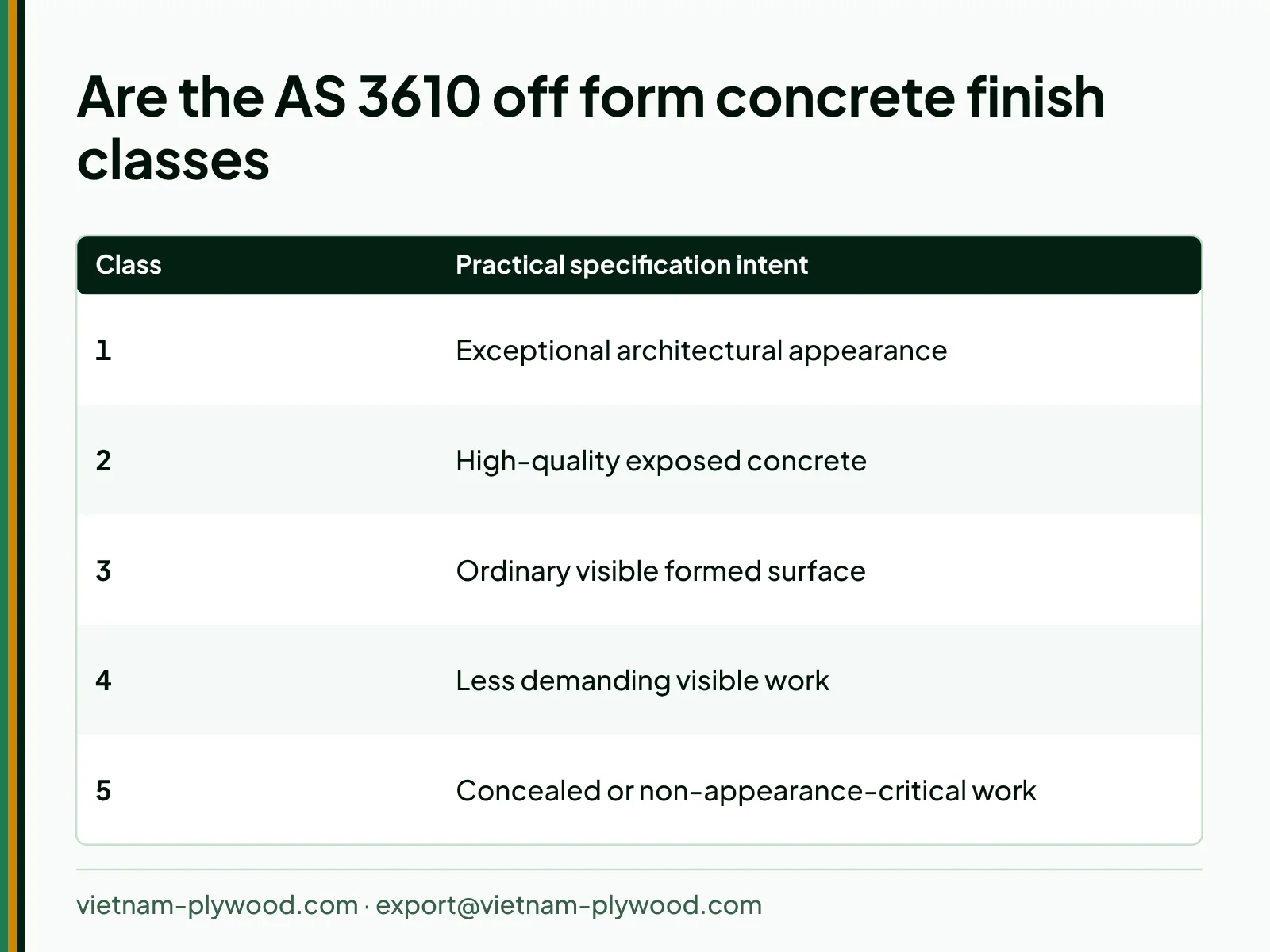
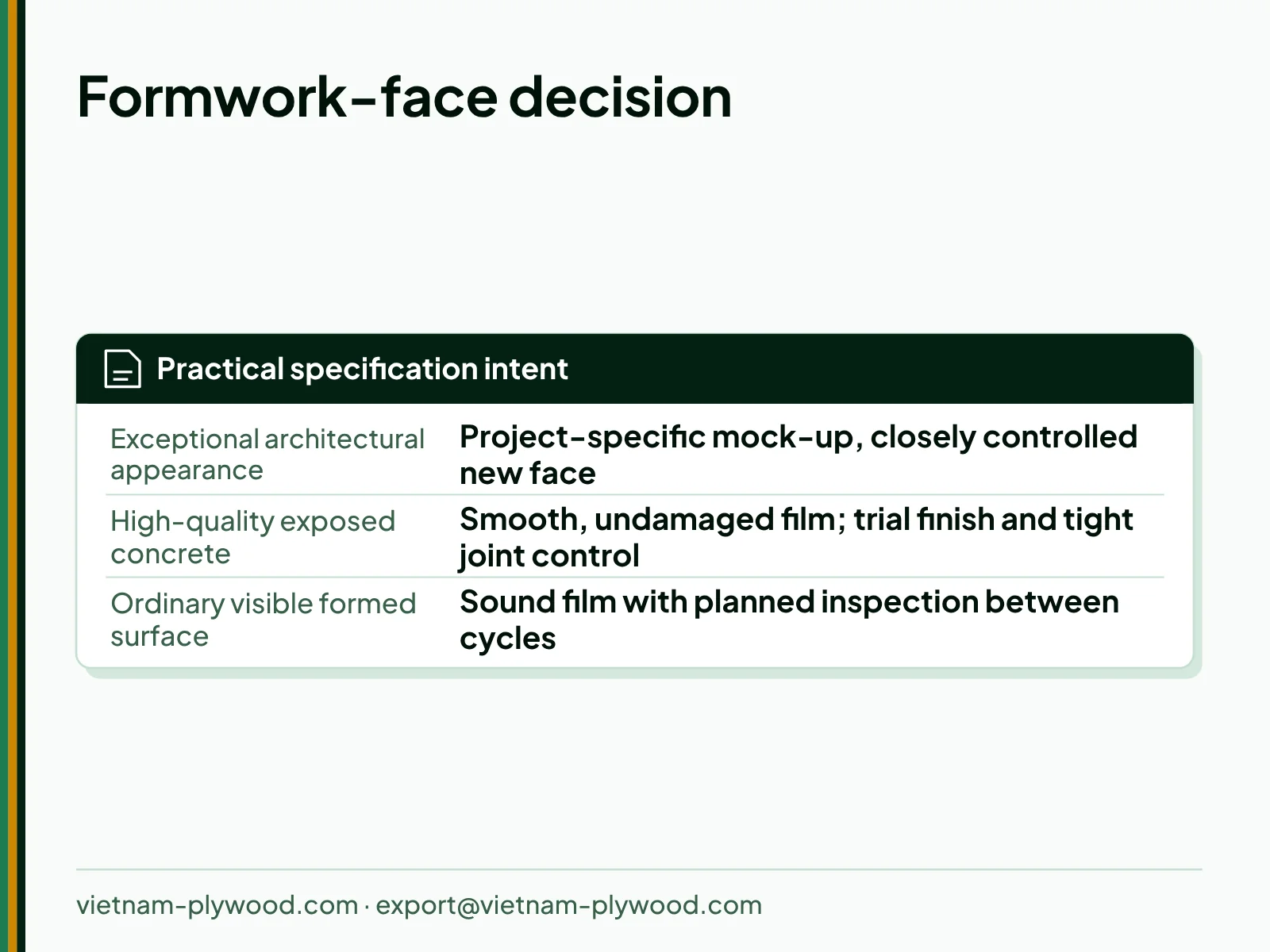
| Class | Practical specification intent | Formwork-face decision |
|---|---|---|
| 1 | Exceptional architectural appearance | Project-specific mock-up, closely controlled new face |
| 2 | High-quality exposed concrete | Smooth, undamaged film; trial finish and tight joint control |
| 3 | Ordinary visible formed surface | Sound film with planned inspection between cycles |
| 4 | Less demanding visible work | Appearance defects assessed against the contract |
| 5 | Concealed or non-appearance-critical work | Structural suitability and safe forming remain necessary |
These are purchasing interpretations, not a substitute for the standard’s detailed surface tolerances, colour and blowhole criteria. Standards Australia’s AS 3610.1:2018 is the relevant formwork reference; its full acceptance tables should be consulted through an authorised copy. For the wider material choice, see the fair-faced concrete specification.
Who specifies the finish class?
The architect or engineer sets the required class in the project drawings and contract; the formwork contractor translates it into a panel and pour method. An importer should ask for the surface schedule before ordering.
Write down which faces remain exposed, whether a reference mock-up governs acceptance, and how joints, tie holes, colour and blowholes will be judged. A class label on a purchase order does not replace the project engineer’s structural design. The US Occupational Safety and Health Administration’s 29 CFR 1926.701 addresses construction loads on concrete structures; this safety requirement is separate from visual acceptance.
Which formply should be ordered for Class 2?
For Class 2, start with smooth, intact film-faced plywood, a supported formwork design and an approved trial pour. Our construction line presses 120 g/m² standard or 135 g/m² premium film, with acacia or eucalyptus cores. The heavier smooth film is the preferred quotation starting point where face wear across repeated pours is a concern.
Neither film weight nor glue designation alone assigns an AS 3610 class. The contractor must qualify the complete assembly and concrete procedure against the project’s criteria. A Class 1 architectural face warrants a separate sample-and-acceptance programme rather than a claim based on film weight. Our construction plywood page covers the available face builds.
How do the three factory lines differ?
Our construction line presses the smooth film face used against wet concrete; the other lines serve different end uses. At the same nominal 18 mm thickness, core preparation, surface and tolerance change what the buyer receives.
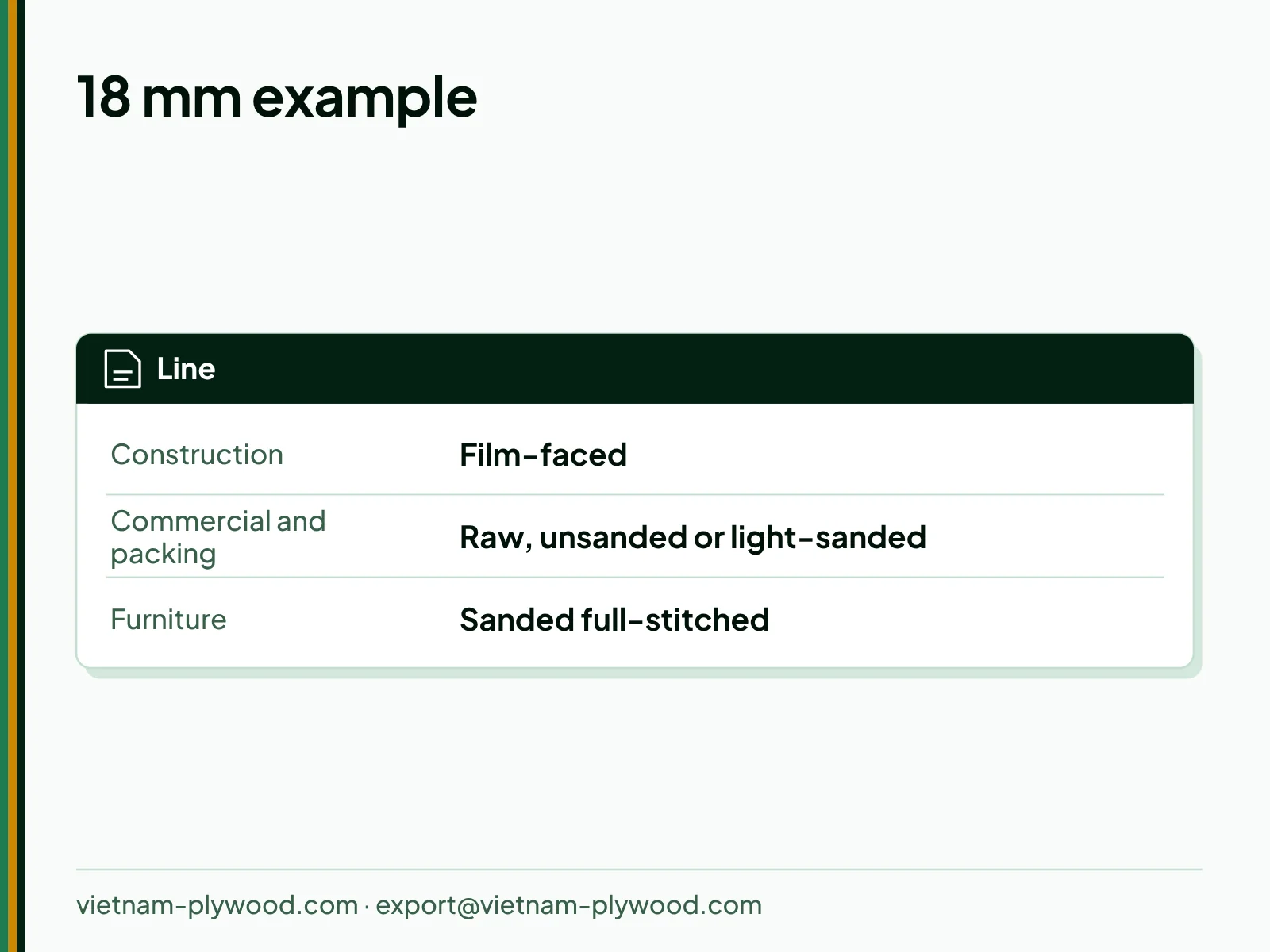
| Line | 18 mm example | Surface / core | Thickness tolerance | Appropriate use |
|---|---|---|---|---|
| Construction | Film-faced | 120 or 135 g/m² smooth film; acacia or eucalyptus | ±0.5 mm | Concrete-contact form face |
| Commercial and packing | Raw, unsanded or light-sanded | Acacia, MR glue | ±0.5 mm; packing ±0.5–1.0 mm | Crates, backing, protection |
| Furniture | Sanded full-stitched | Styrax or eucalyptus, E0/E1 | ±0.2 or ±0.3 mm as ordered | Cabinet and furniture components |
The packing or commercial plywood and distributor supply programmes pages cover the other purchasing routes. We produce each specification at the appropriate producing factory in Phu Tho or Hai Phong.
How do film weight and flatness affect the finish?
Film condition governs what texture can transfer to the concrete; flatness governs whether the formed surface stays even between supports. A scratch, pinhole, raised patch or open joint can print through. Panel stiffness and support spacing must be assessed together under wet-concrete pressure.
Our 120 g/m² smooth film is the standard face, while 135 g/m² is the premium face. The 220 g/m² anti-slip film is textured and belongs on walking surfaces, not a smooth architectural concrete face. The core density is 580 kg/m³ for acacia and 650 kg/m³ for eucalyptus; density follows the core, not the face.
A heavier film cannot correct poor bracing, excessive spans, incorrect vibration or incompatible release agent. The US Occupational Safety and Health Administration’s 29 CFR 1926.700 defines formwork as the entire support system, including its sheeting and bracing; this is distinct from appearance classes.
How many pours keep a Class 3 concrete finish?
No fixed number of pours preserves Class 3: acceptance must be checked on the resulting concrete and on the face before reuse. With proper handling, a release agent on every pour and sealed edges including cut edges, melamine-glue film-faced panels deliver about 12–15 pours; phenolic-glue panels up to about 25.
Those are reuse expectations under stated care conditions, not counts of Class 3-compliant surfaces. Record face damage after stripping, clean without gouging the film, reseal cuts and retire panels from exposed work when they stop meeting the approved reference. A panel can remain serviceable for less visible work after its exposed-face duty ends.
What defects cause rejection of the face?
Reject or segregate sheets whose defects exceed the signed face sample and purchase criteria. Look for film tears, raised blisters, embedded debris, scratches, damaged corners, uneven edges and local face depressions. Inspect both sides if the order permits either side against concrete.
Blowholes, colour variation, honeycombing and tie-hole marks can also come from concrete placement and release practice. Industry discussions of surface defects raise panel movement and moisture damage; a receiving inspection should also distinguish a factory film defect from an on-site assembly or pouring defect. The agreed reference pour resolves disputes more clearly than a marketing finish label.
What can the buyer witness before loading?
The buyer can witness a face-and-dimension inspection at the producing factory before the container is sealed. HCPLY’s on-site quality-control team checks the agreed film and core build against the written order, then records nonconforming sheets for segregation.
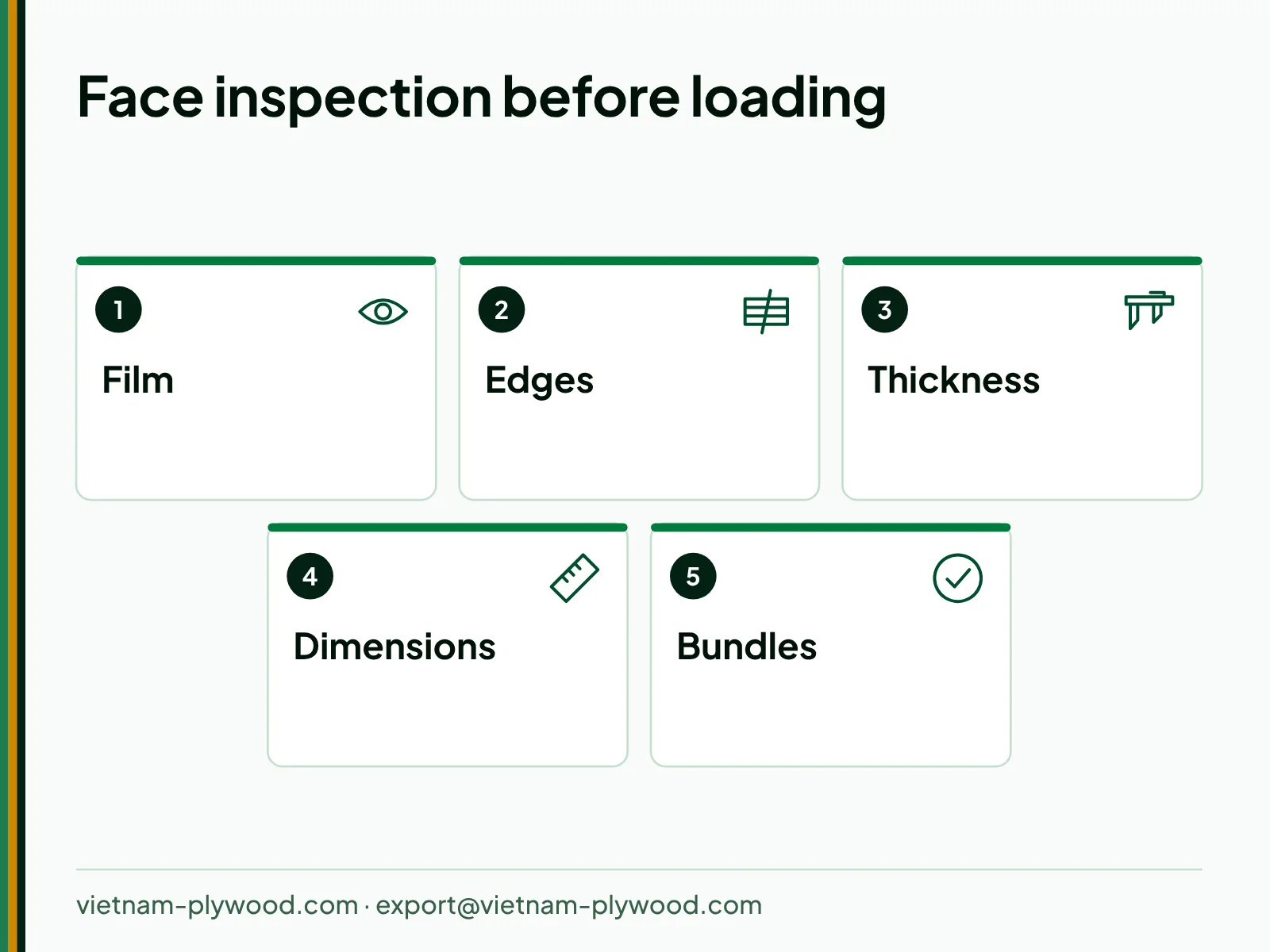
- Confirm pallet identification, core species, glue type and smooth-film weight against the purchase specification.
- Inspect face appearance under consistent light, checking tears, pinholes, dirt, dents and blistering.
- Check edge sealing and any cut edges; reject exposed core where the agreed edge treatment is missing.
- Measure thickness against ±0.5 mm and length and width against ±2 mm; check flatness against the buyer’s agreed method and limit.
- Verify bundle counts, protection and loading photographs before release.
The factory inspection verifies the shipped sheet; the contractor still checks formwork assembly and the finished concrete on site.
How should a mixed container be planned?
A 40HC order can mix specifications within the 28.5 t payload limit. For 18 mm sheets at 1220 × 2440 mm, an all-acacia reference load is 880 sheets, 47.15 m³ and 27.35 t; an all-eucalyptus reference load is 795 sheets, 42.60 m³ and 27.69 t. Film weight is excluded from these reference calculations.
For a mixed specification, list the sheet count and core for each bundle, then check the actual gross mass including film and pallets against the container payload limit. Use the container loading calculator for the dedicated loading topic.
What should the purchase specification record?
The written order should identify the concrete face, core, glue, film, dimensions and inspection acceptance criteria. Phenolic glue is weather and boil proof (WBP, 72-hour boil); melamine is moisture resistant (MR, 12-hour boil). Glue and formaldehyde emission class are separate fields.
Specify the project finish class as a required concrete outcome, with a trial-panel protocol and responsible site approver. Ask for the applicable test report if a structural grade is required; Ask for engineering evidence accepted by the project designer for any required structural grade. The formwork designer must select the panel using accepted engineering evidence. The order should also define flatness measurement and permissible face blemishes, since film weight does not set those limits.
Which shipping record connects the inspected face to the order?
The packing list connects identified bundles and quantities to the shipment; the agreed specification and inspection record connect those bundles to the face requirement. Draft shipping documents are sent for buyer approval after loading.
The shipment paperwork includes the commercial invoice, packing list, bill of lading and certificate of origin, with additional documents according to destination and order. For a visible-face contract, keep the signed face sample, factory photographs and acceptance notes with the purchase records. A certificate of origin describes origin, rather than surface-finish performance.
What should happen before the first pour?
Approve a trial concrete panel and a pre-pour inspection against the project specification before relying on a finish class. Check face cleanliness, joints, release agent, tie layout, support spacing and the engineer’s approved loading arrangement.
The US Occupational Safety and Health Administration’s 29 CFR 1926.703 requires formwork to support anticipated vertical and lateral loads. Neither replaces the architect’s finish acceptance schedule. After the first strip, record surface appearance and use that evidence to decide whether the same panel can remain on exposed work.
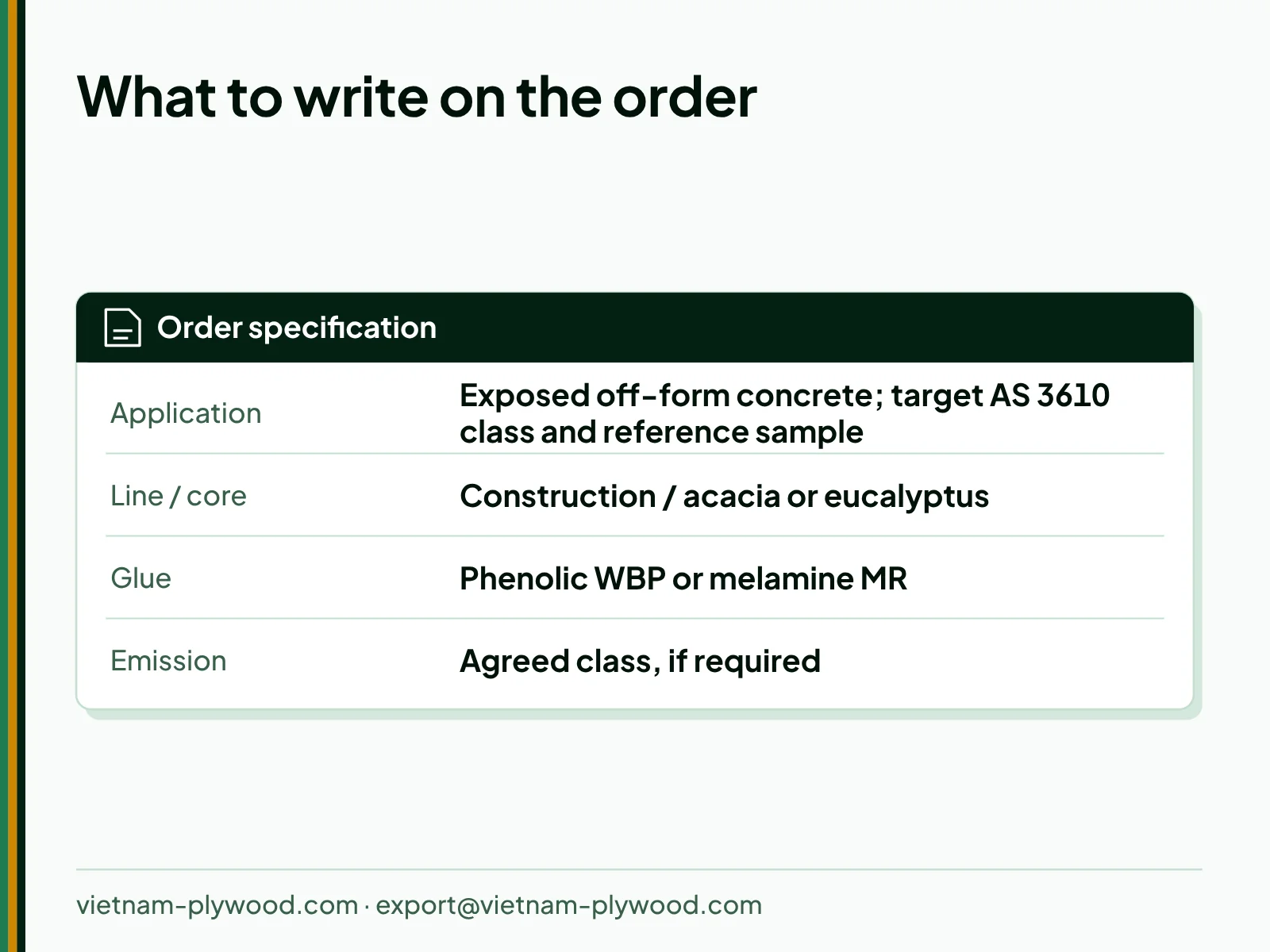
Send Lucy the following build details at export@vietnam-plywood.com:
Application: Exposed off-form concrete; target AS 3610 class and reference sample
Line / core: Construction / acacia or eucalyptus
Glue: Phenolic WBP or melamine MR
Emission: Agreed class, if required
Face and grade: Smooth film 120 or 135 g/m²; face acceptance sample
Thickness and tolerance: 18 mm; ±0.5 mm
Size: 1220 × 2440 mm; length and width ±2 mm
Quantity: Sheets and mixed-specification breakdown; minimum one 40HC
Destination port: [port]; delivery term FOB Hai Phong / CFR / CIF
Next step: book a factory visit to witness the face inspection.