





What makes a plywood chair seat suitable for moulding?
A plywood chair seat intended for moulding starts with thin veneers arranged around a defined tool radius, adhesive selected for the exposure, and a trial pressing that retains its shape after release. A flat furniture sheet can be a useful blank for a gently curved component, but its nominal thickness alone cannot establish a safe bend radius. The chair maker must specify the finished contour, grain direction, support points and acceptance tests before ordering production material.
For a seating factory, the expensive error is ordering flat panels against a curved-shell drawing without agreeing whether the producer will supply flat blanks or shaped components. HCPLY’s furniture line makes full-stitched, sanded veneer-core furniture plywood; a custom chair-shell moulding capability and minimum production radius require a separate engineering review. The Applications library places this decision alongside other end-use specifications.
How is moulded plywood made?
Moulded plywood is made by coating selected thin veneers with adhesive, arranging the grain orientations, pressing the stack against a shaped tool, and holding it until the bond and contour are established. The shell is then trimmed and inspected.
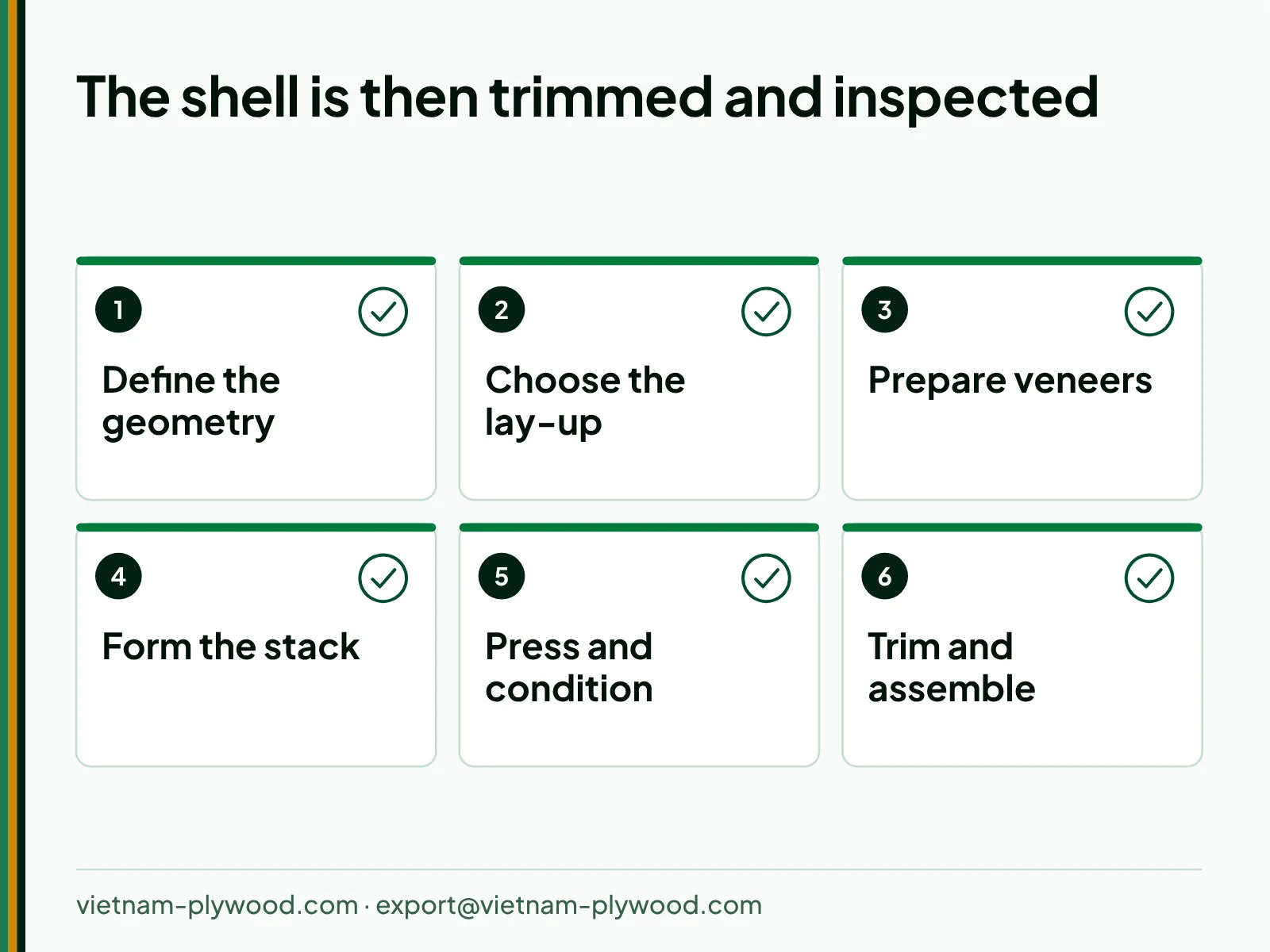
- Define the geometry. Supply a dimensioned section through the tightest curve, a finished shell drawing, the intended seat-to-back arrangement and a physical master when available.
- Choose the lay-up. Specify veneer species, veneer thickness, face orientation, ply sequence and whether the shell has a symmetric construction.
- Prepare veneers. Sort for splits, open joints and grain defects; control veneer condition and adhesive spread before stacking.
- Form the stack. Register the layers in the tool so they do not slip or bridge over the deepest curve.
- Press and condition. Use a validated adhesive cycle, release the shell and check for springback, twist and local delamination.
- Trim and assemble. Cut edges and attachment openings to the drawing, finish the exposed surface and test the complete seat assembly.
Bending a finished thick sheet around a jig is different from pressing individual thin veneers into a new shape. Laminating two flat panels increases section thickness, but does not reproduce a moulded shell. Qualify the stack and tooling before repeat batches.
What is the best plywood for chair seats?
Choose full-stitched furniture plywood matched to the seat geometry. For a flat or gently profiled seat blank, a sanded panel gives the furniture maker a predictable surface. For a tight compound curve, specify individual veneer lay-up and tooling trials rather than assuming a stock sheet can be bent into shape.
Our furniture line uses styrax or eucalyptus cores, full-stitched construction, and E0 or E1 emission classes. Its common face options include bintangor, okoume and engineered veneer; the appearance grade and finish should be written separately. The core determines density, while the face names the product. A face veneer commonly measures 0.2–0.4 mm; that decorative layer does not set the entire panel’s bending performance.
For visible edges, inspect internal gaps and ply alignment; upholstered seats need sound attachment zones. See furniture plywood.
How do the three factory lines approach an 18 mm seat blank?
An 18 mm chair blank belongs on the furniture line when surface finish, full-stitched core and precise thickness matter. The commercial and packing line is better matched to utility panels, while the construction line builds film-faced formwork panels. These are different builds even at the same nominal thickness.
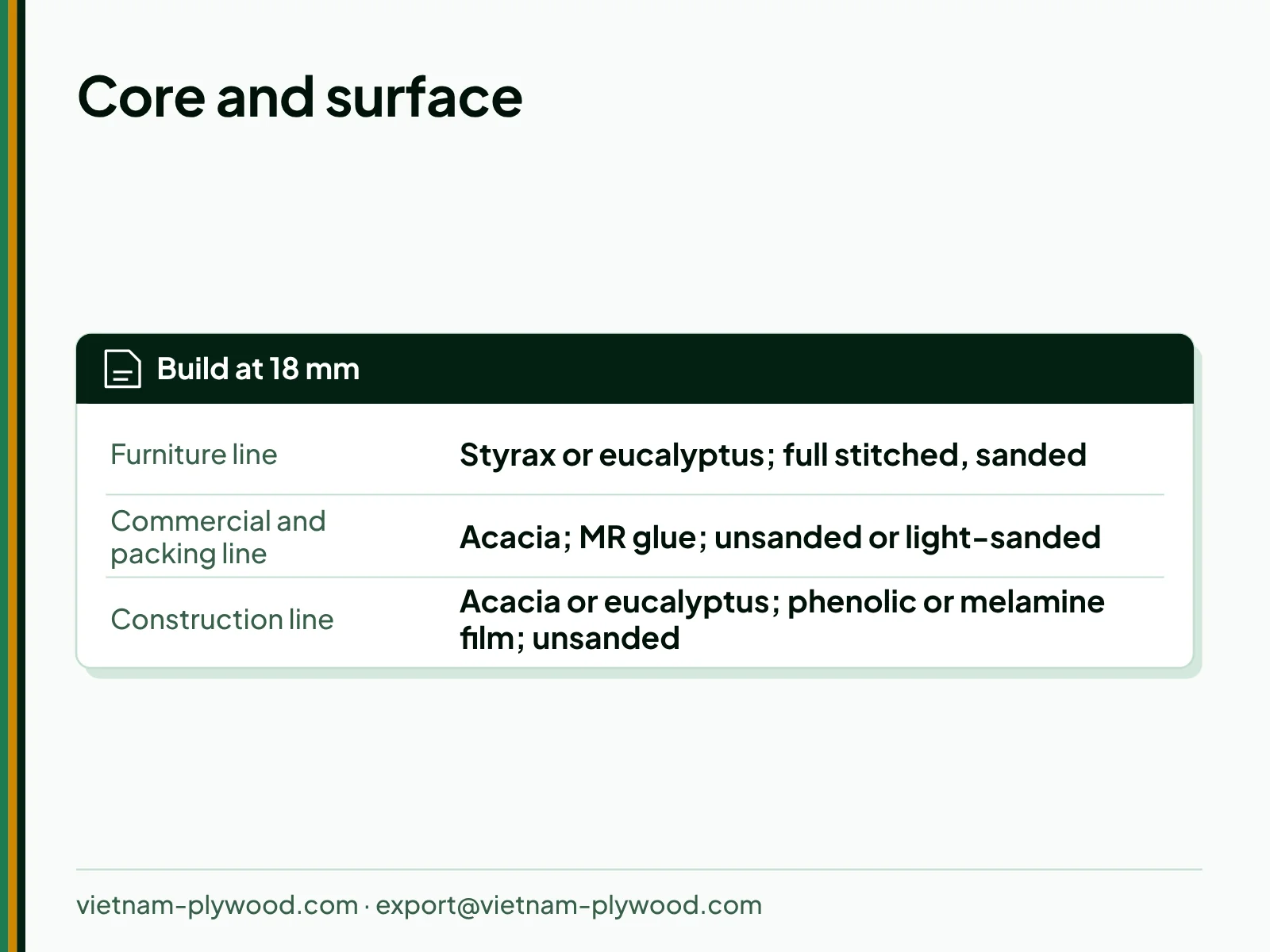
| Build at 18 mm | Core and surface | Thickness tolerance | Seat-making verdict |
|---|---|---|---|
| Furniture line | Styrax or eucalyptus; full stitched, sanded | ±0.2 or ±0.3 mm as ordered | First choice for machined, flat seat blanks; curved shells need a tooling trial |
| Commercial and packing line | Acacia; MR glue; unsanded or light-sanded | Commercial ±0.5 mm; packing ±0.5–1.0 mm | Utility or packing components, not the preferred visible chair seat |
| Construction line | Acacia or eucalyptus; phenolic or melamine film; unsanded | ±0.5 mm | Formwork-facing duties, not finished seating |
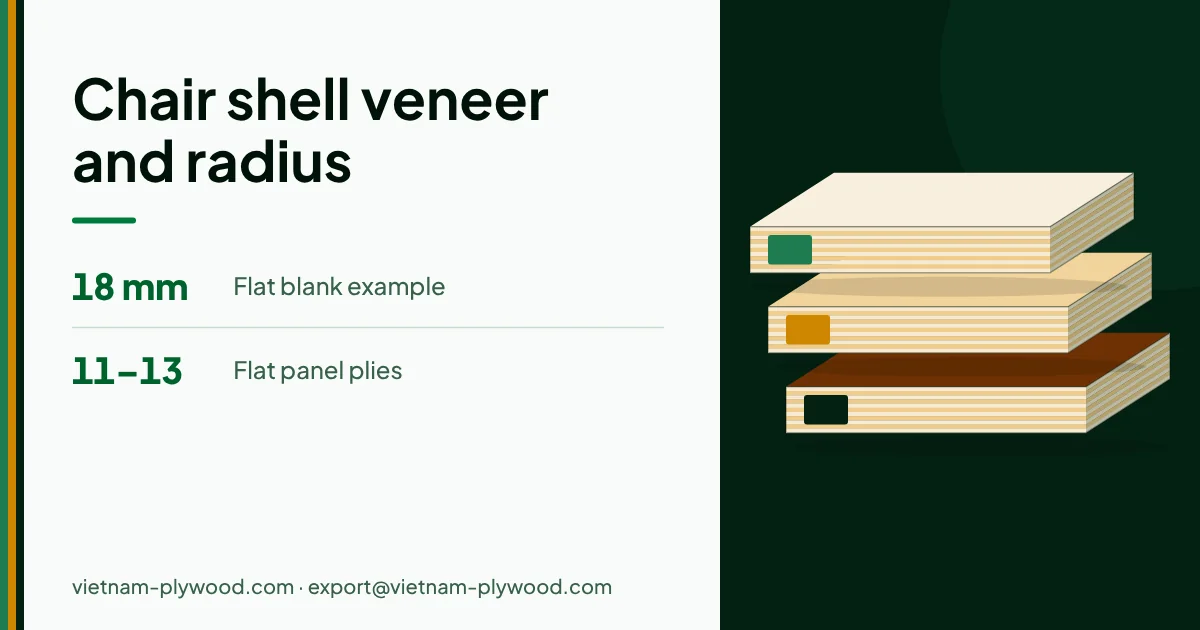
The standard 18 mm panel uses 11–13 plies because core veneer thickness ranges from 1.4–2.0 mm. Those figures describe flat-panel construction; a moulded shell’s veneer count is an engineering selection driven by radius and target thickness. Compare the factory-line grades before mixing specifications.
How tight a radius can the veneers take?
The minimum radius is the smallest curve that passes a trial without veneer fracture, bond separation, excessive springback or distortion. A numerical minimum radius cannot be assigned from thickness and species alone: veneer orientation, moisture condition, ply count, adhesive cycle and tool shape all change the result.
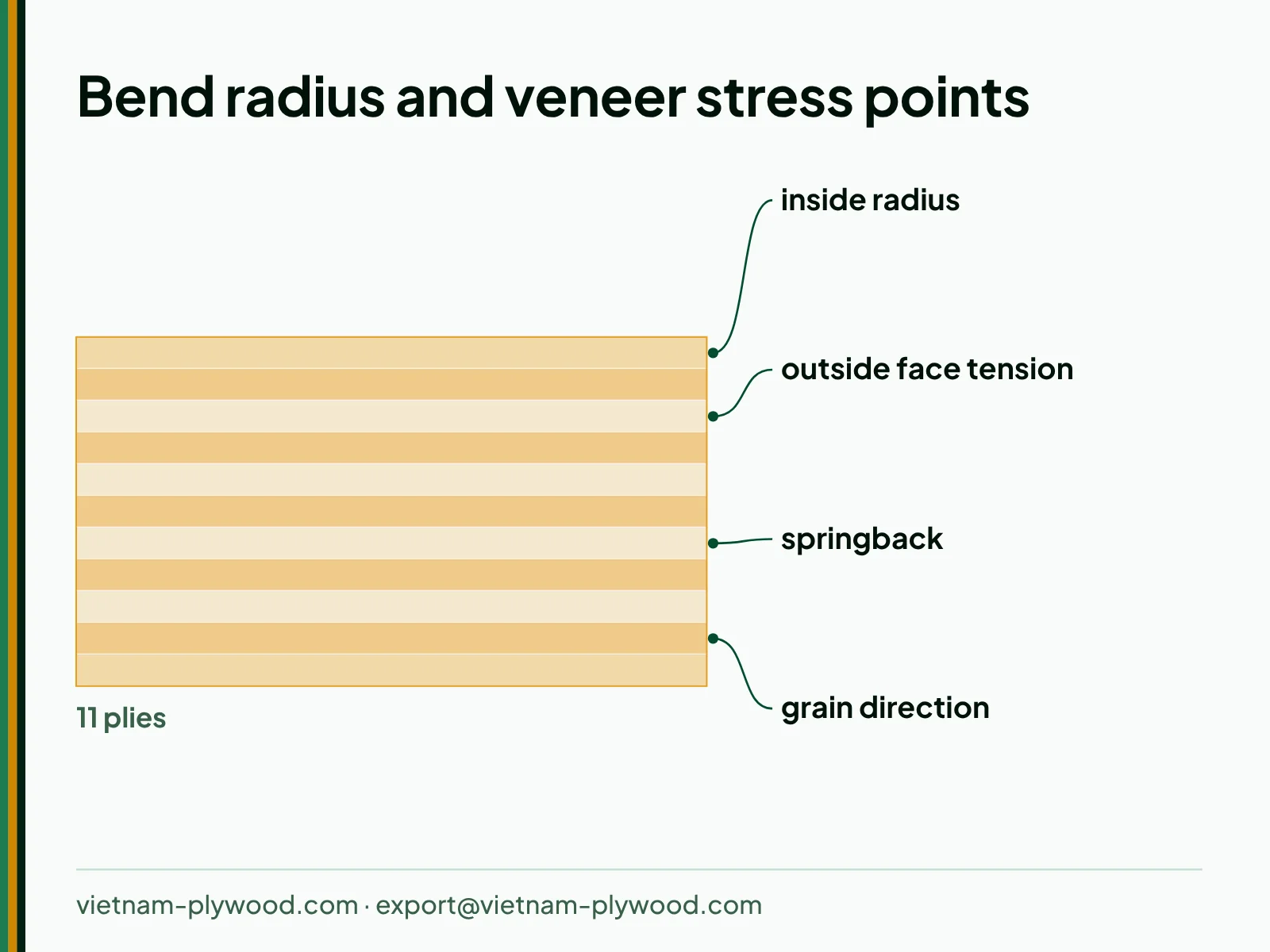
Specify inside radius, outside radius, arc length and whether the curve is single-axis or compound. Mark the face-grain direction relative to the bend and identify any return flange or abrupt transition. Tight bends risk veneer damage.
Ask the producing factory to make a representative sample using the proposed veneer stack and actual forming tool. Measure the released shape against a template, then repeat after conditioning. If a design requires a sharp junction between seat and back, separate panels and a designed connector can be a more practical construction than forcing a continuous shell.
What should an inspector witness at the producing factory?
An inspector should witness the agreed veneer stack, the pressing record and the released component against a signed chair-shell drawing. HCPLY coordinates on-site quality control at the producing factory; buyers can visit the factory office and inspect the goods where their order is made.
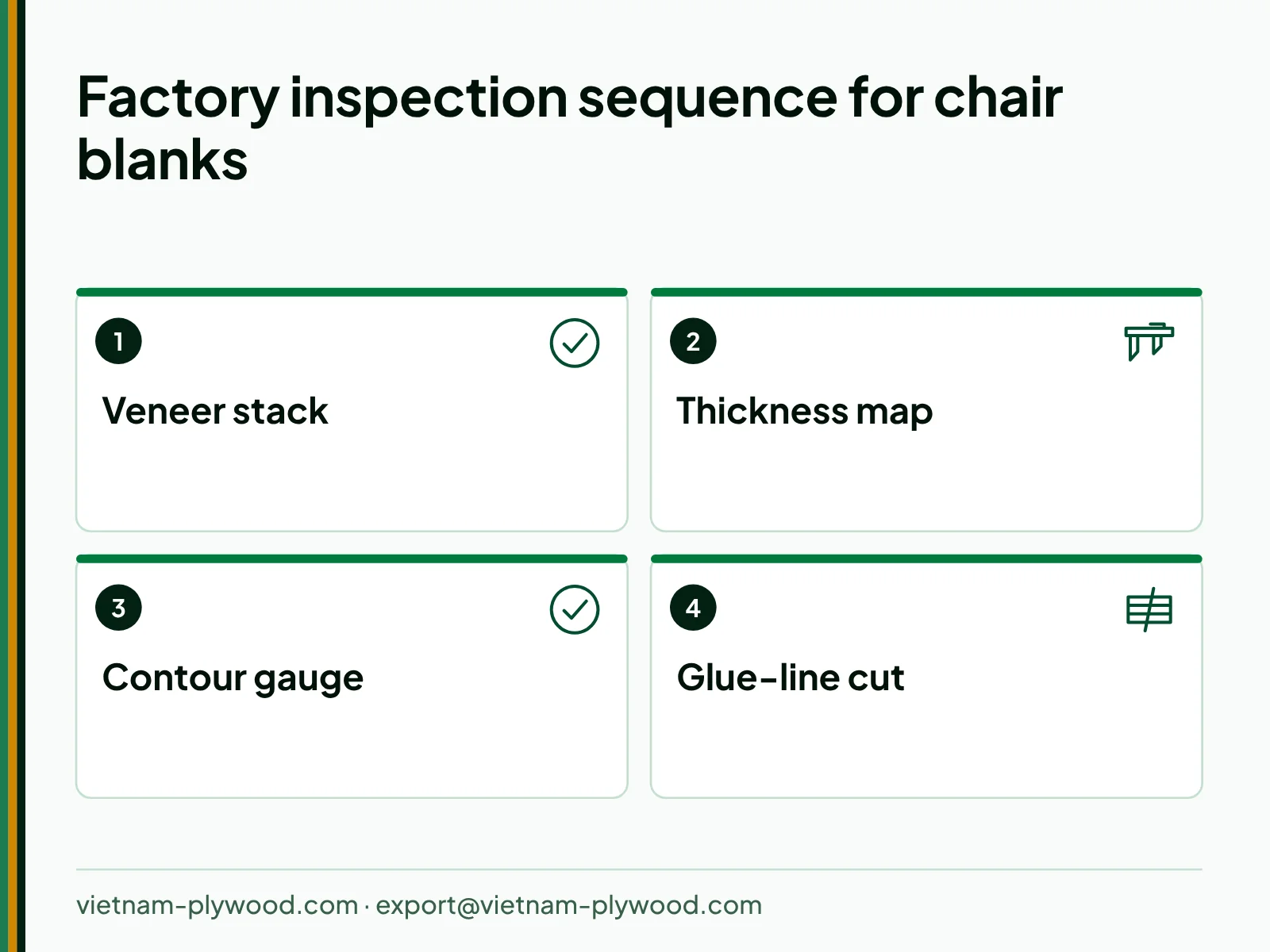
For flat seat blanks, inspect face grade, core continuity, panel dimensions and sanded thickness at mapped locations. The furniture-line tolerance is ±0.2 or ±0.3 mm as ordered, and length and width tolerance is ±2 mm. For a shaped trial, add a radius gauge, contour template, springback observations and a section cut that exposes glue lines.
Inspect attachment-hole edges and section cuts for voids. Test the complete chair assembly for its intended duty.
How do weight and container mixing affect a chair order?
Container planning should use the chosen core density and finished thickness, rather than the decorative face name. For 18 mm, 1220 × 2440 mm flat sheets, the calculated sheet weights are 26.79 kg with styrax, 31.08 kg with acacia and 34.83 kg with eucalyptus.
A full 40HC reference load at that size and thickness is 990 styrax sheets (26.52 t), 880 acacia sheets (27.35 t), or 795 eucalyptus sheets (27.69 t). The container payload limit is 28.5 t. These figures apply to flat sheets; shaped shells need a separate packing design and count.
The minimum order is one 40HC, and one container can carry several specifications as long as the payload limit holds. A furniture blank order can therefore be planned alongside another agreed plywood specification, with the packing plan checked against both volume and weight. For the detailed load-count method, use container packing.
Which glue, emissions and surface details belong in the drawing?
The drawing should specify adhesive and emissions as separate fields, together with the face grade and intended finish. Melamine MR glue is associated with a 12-hour boil description; phenolic weather-and-boil-proof (WBP) glue with a 72-hour boil description. Those glue descriptions do not establish a chair-shell bending radius.
The furniture line’s emission choices are E0 and E1. For US-bound components, the applicable product definition matters before requesting a compliance document. The US Environmental Protection Agency’s stakeholder guidance explains that curved plywood is excluded from the hardwood-plywood definition under Toxic Substances Control Act (TSCA) Title VI, while regulated composite-wood panels used in fabricated products can still trigger requirements. EPA’s official guidance distinguishes these constructions; a flat panel later shaped by a fabricator should be evaluated against its actual production route.
A buyer can request the producing member factory’s relevant FSC, CARB P2, ISO 9001 or CE documents, shown with factory details masked, on request. Do not substitute an emission class for a test report or a third-party certification where one is legally required.
How should edges, joints and finish be specified?
Chair-seat specifications should show every exposed edge, fastener zone and finishing surface on the component drawing. An edge that remains visible after assembly needs a consistent ply appearance and a trimming allowance that preserves the finished outline.
For veneered seats, define the face species, A/B grade where applicable, grain direction and coating system. Birch face is graded D/E/F in this range; it is a face option rather than a birch-core construction. Our furniture line does not press birch-core plywood, and a birch-faced panel must be described accordingly.
Specify hardware and hole placement around sound glue lines; finish trials should check edge absorption and veneer sanding.
What happens from approved sample to export?
After a sample and written specification are approved, the order moves through production, factory inspection, packing and shipment. HCPLY manages the export process, including documents and loading, and each order ships directly from the factory matched to its specification.
Factory lead time runs 15–45 days from receipt of the 30% deposit; the exact figure depends on order size, line loading and what the contract fixes. The balance is 70% against the scanned bill of lading (B/L), by telegraphic transfer (T/T) or irrevocable letter of credit (L/C) at sight. We ship FOB Hai Phong, or CFR (CNF) or CIF to your port.
The shipment file includes the commercial invoice, packing list, B/L, certificate of origin, phytosanitary and fumigation papers, plus agreed certificate and test documents. EU lots include EUR.1 and the EUTR/EUDR file set; CIF shipments include insurance. After loading, the draft shipping documents come to you for approval. For handling at arrival, use the receiving and storage guide.
What should a chair maker send for a sample set?
A chair maker should send a dimensioned component drawing and a written flat-blank or moulded-shell requirement before requesting a sample set. Specify the tightest bend, grain direction, attachment method and inspection acceptance criteria, so a trial answers a production question rather than merely demonstrating appearance.
For flat furniture plywood: from US$350/m³ FOB Hai Phong (October 2026). The finished quotation follows the selected core, veneer face, thickness tolerance, surface grade, cutting and order mix. A purpose-built curved shell requires separate tooling and process evaluation, so a flat-sheet starting price is not a moulded-shell quote.
Send the following to Lucy at export@vietnam-plywood.com through contact:
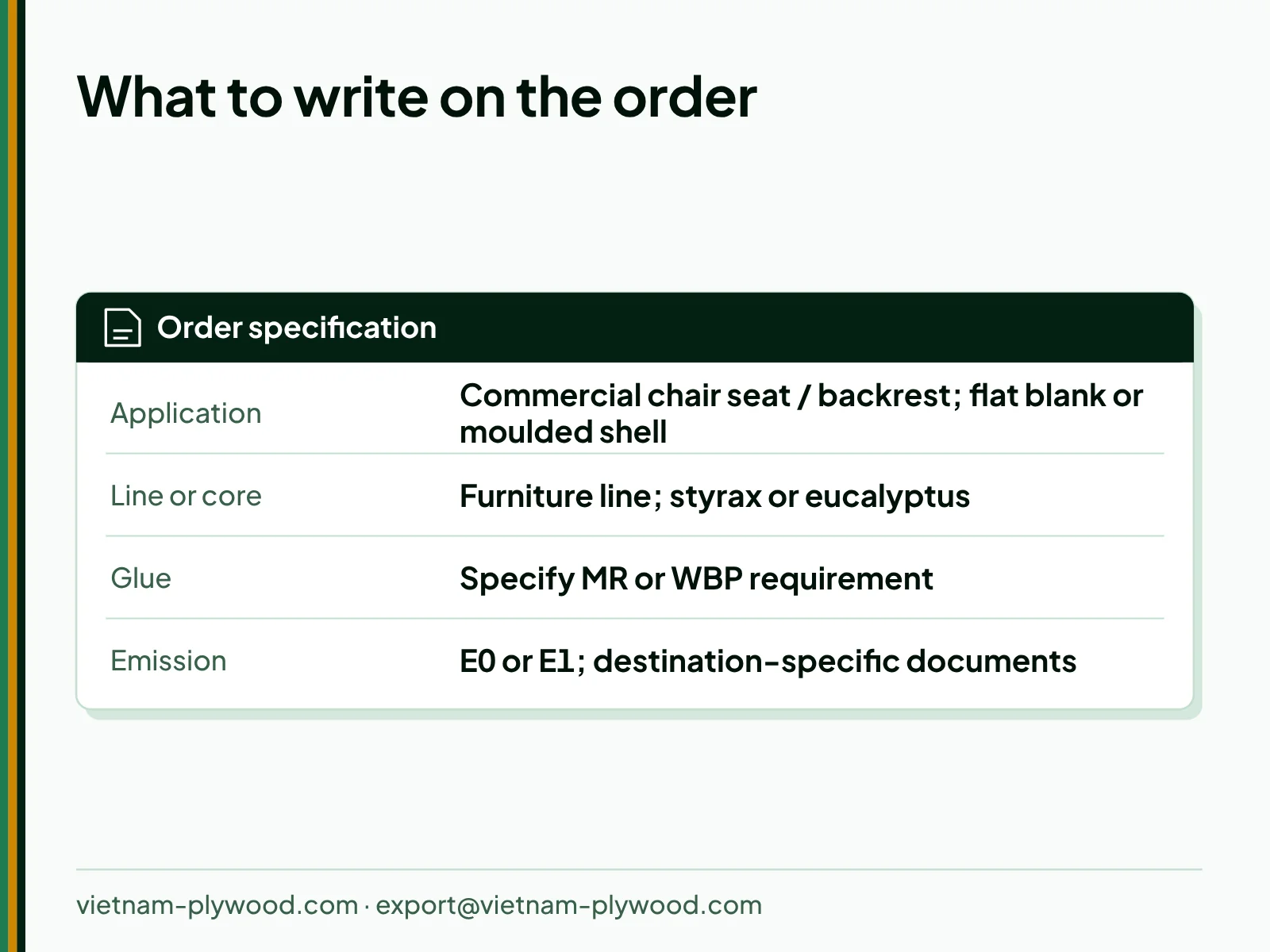
Application: commercial chair seat / backrest; flat blank or moulded shell
Line or core: furniture line; styrax or eucalyptus
Glue: specify MR or WBP requirement
Emission: E0 or E1; destination-specific documents
Face and grade: species, face grade, grain direction
Thickness and tolerance: finished mm; tolerance; proposed veneer stack
Size: flat sheet or dimensioned shell drawing and minimum inside radius
Quantity: sheets / components; container mix
Destination port: port and country
Ask for a sample set against the drawing before releasing the production order.