





An LVL inspection before loading should compare the finished members, their condition and their bundle identity with an agreed purchase specification. Missing a twisted member or an open glue line can mean rejected bundles, interrupted cutting schedules and replacement freight. At HCPLY, the buyer or appointed inspector can witness checks at the producing factory before the loading decision.
What should an LVL inspection cover before loading?
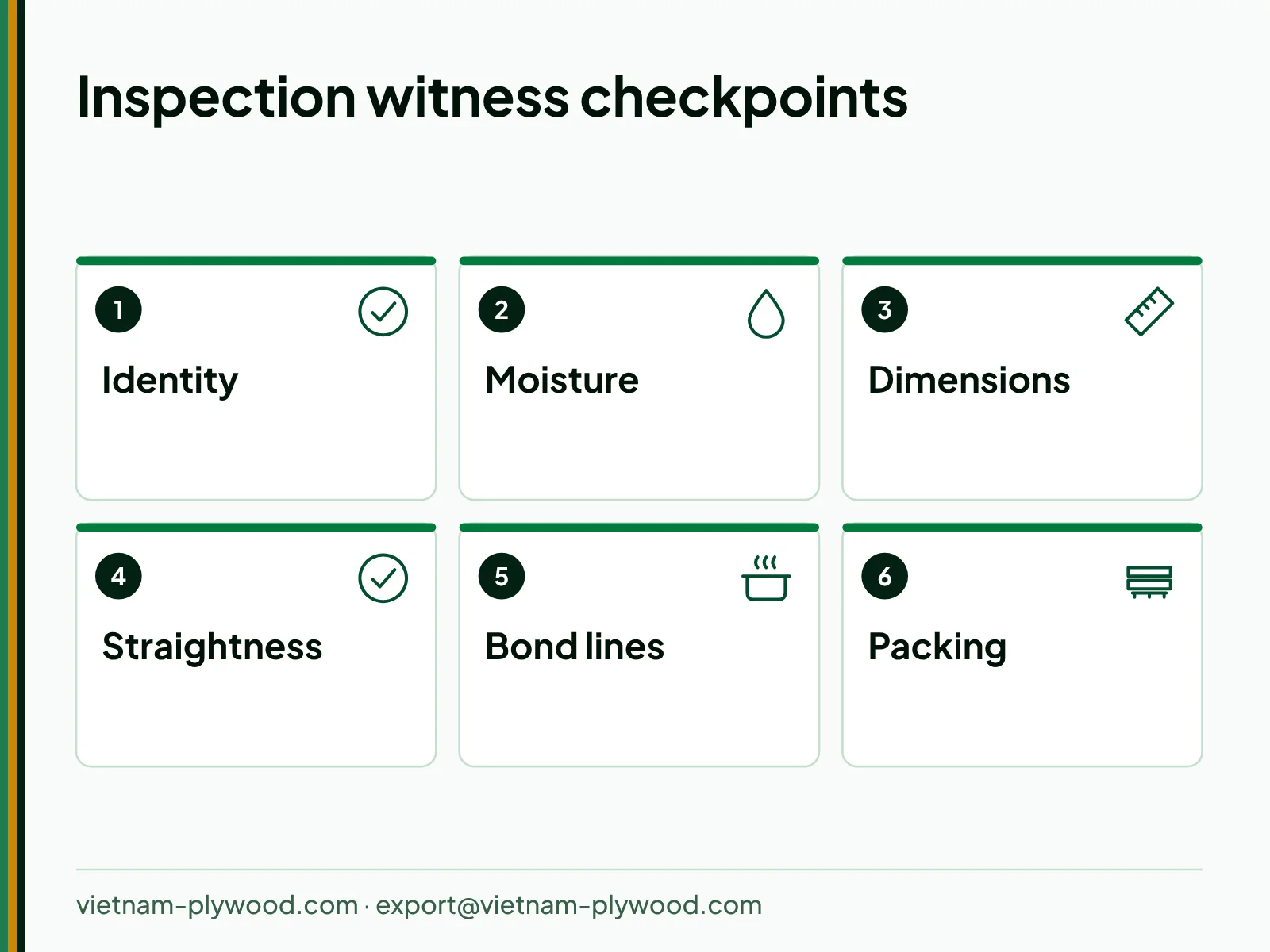
An LVL inspection should establish the ordered product identity, measured section size, length, moisture condition, straightness, visible bonding condition, surface defects and packed quantity. The inspector should record actual measurements and the agreed acceptance limit beside each finding. Any unresolved departure should be isolated before the container is closed. A visual pass alone cannot establish structural design values.
Start with the purchase order and approved drawing rather than a generic grade description. Laminated veneer lumber (LVL) is built from bonded veneers with grain primarily along the member’s length; it is distinct from ordinary cross-laminated plywood. Record whether the order calls for industrial packing members, precision-cut components or a structural application, because their acceptance evidence differs.
Use the broader pre-shipment inspection service checklist to coordinate the inspection hold point with packing and loading. For each sampled bundle, connect measurements to a bundle reference and the inspector’s dated record.
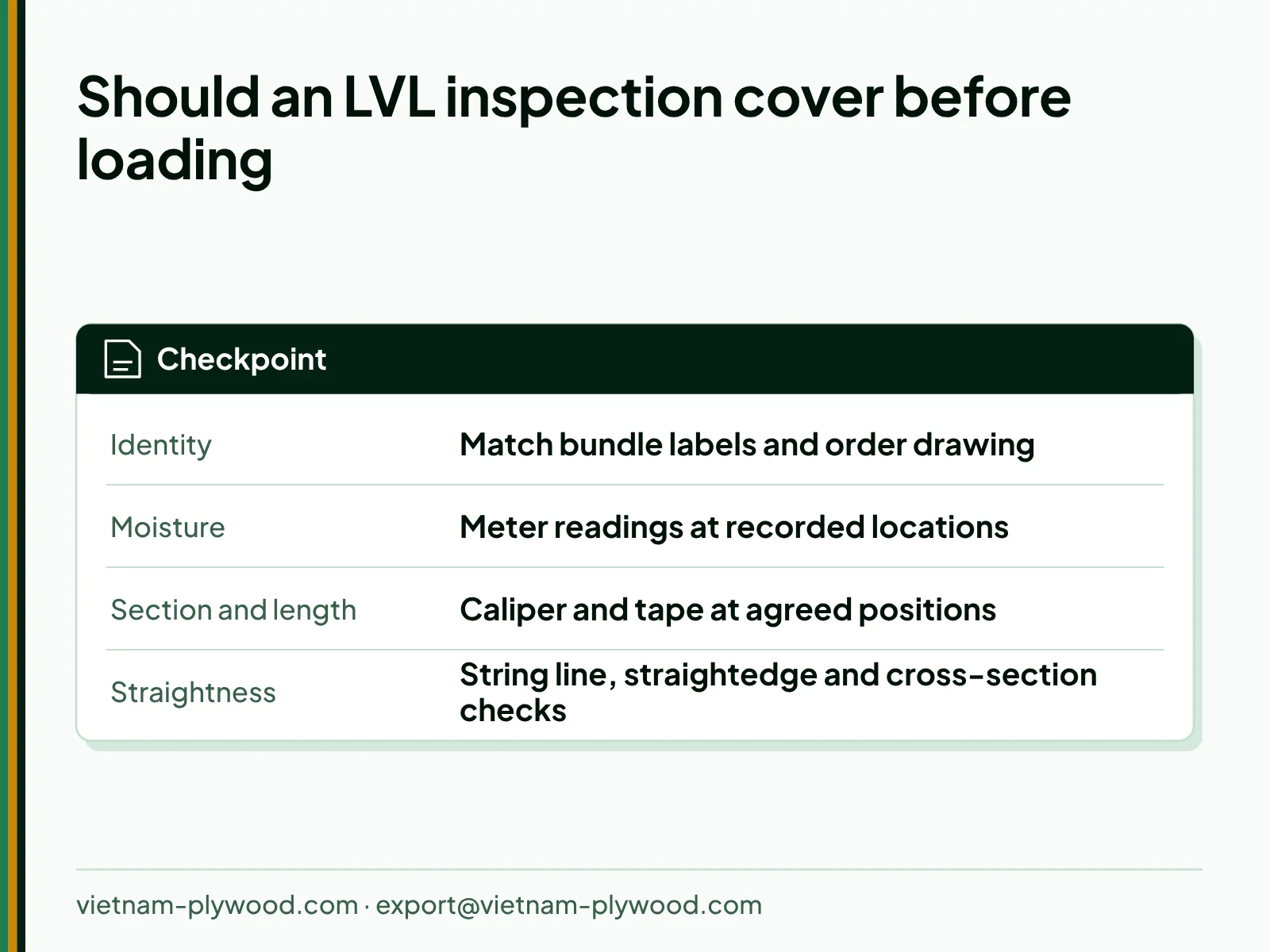
| Checkpoint | Witness method | Decision basis |
|---|---|---|
| Identity | Match bundle labels and order drawing | Agreed product and lot reference |
| Moisture | Meter readings at recorded locations | Written moisture range and reference method |
| Section and length | Caliper and tape at agreed positions | Drawing and tolerances |
| Straightness | String line, straightedge and cross-section checks | Specified bow, spring and twist limits |
| Bond lines | Inspect ends and exposed edges | Agreed defect criteria and bond-test evidence |
| Packing | Count bundles and inspect protection | Approved packing list and loading plan |
What LVL defects should an inspector flag?
Open glue lines, separated veneers, splits, pronounced bow, spring, twist, crushed corners and wet staining deserve recorded findings. A visible veneer joint is not automatically a failed bond; the distinction rests on whether the joint meets the agreed construction and defect criteria. Photograph both the defect and a scale, then identify the member and bundle.
Exposed ends reveal separation hidden by broad faces. Mark defects intersecting the proposed machining path.
Do not substitute a surface photograph for bond testing. If adhesive durability or strength is a purchase condition, identify the sampling plan, laboratory method and acceptance report before production release. An inspector can witness sampling without claiming that a visual examination measures internal bond strength.
How is LVL moisture content checked?
A useful LVL moisture content check records the meter type, setting, measurement position and reading for multiple accessible members. Measure at sound locations away from obvious wet patches or damaged edges, and compare the spread of readings across bundles. The agreed purchase specification must define the moisture acceptance range; HCPLY does not apply an unstated universal LVL target.
The APA – The Engineered Wood Association explained in its 2022 technical topic TT-131 that moisture changes affect LVL dimensions. Its published description states: “Laminated Veneer Lumber (LVL), like other wood products, experiences dimensional changes due to moisture content variations.” See APA’s LVL dimensional-adjustment topic.
Adhesive layers can influence electrical readings. Resolve disputed readings through the agreed reference moisture test and record storage conditions separately.
How are straightness and glue lines checked?
Straightness is checked by measuring bow along the broad face, spring along the narrow edge and twist across the section. Place the member on suitable supports, use a reference line and note the largest measured departure with its location. Compare each result with the buyer’s stated tolerance and intended fixture or assembly.
For glue lines, examine the exposed end grain and both long edges under consistent light. Identify any line that appears open, stepped or locally separated, and record whether it continues along the member. A dark adhesive line alone is not proof of delamination; a specified bond test is the route for assessing adhesive performance.
The 2003 Bureau of Indian Standards scheme for IS 14616 describes separate controls for visual defects, dimensions, moisture and adhesion testing. That document is useful as an example of distinct inspection categories, not as a certification or marking claim for HCPLY products. Buyers should select their applicable acceptance method before ordering.
What should be checked before CNC cutting LVL?
Before computer numerical control (CNC) cutting, measure the real section, length, squareness and straightness against the programmed stock allowance. Check the cut list’s grain direction, clamping faces and minimum clearances, then inspect representative members from more than one bundle. A member can look acceptable in storage yet bind in a tight fixture.
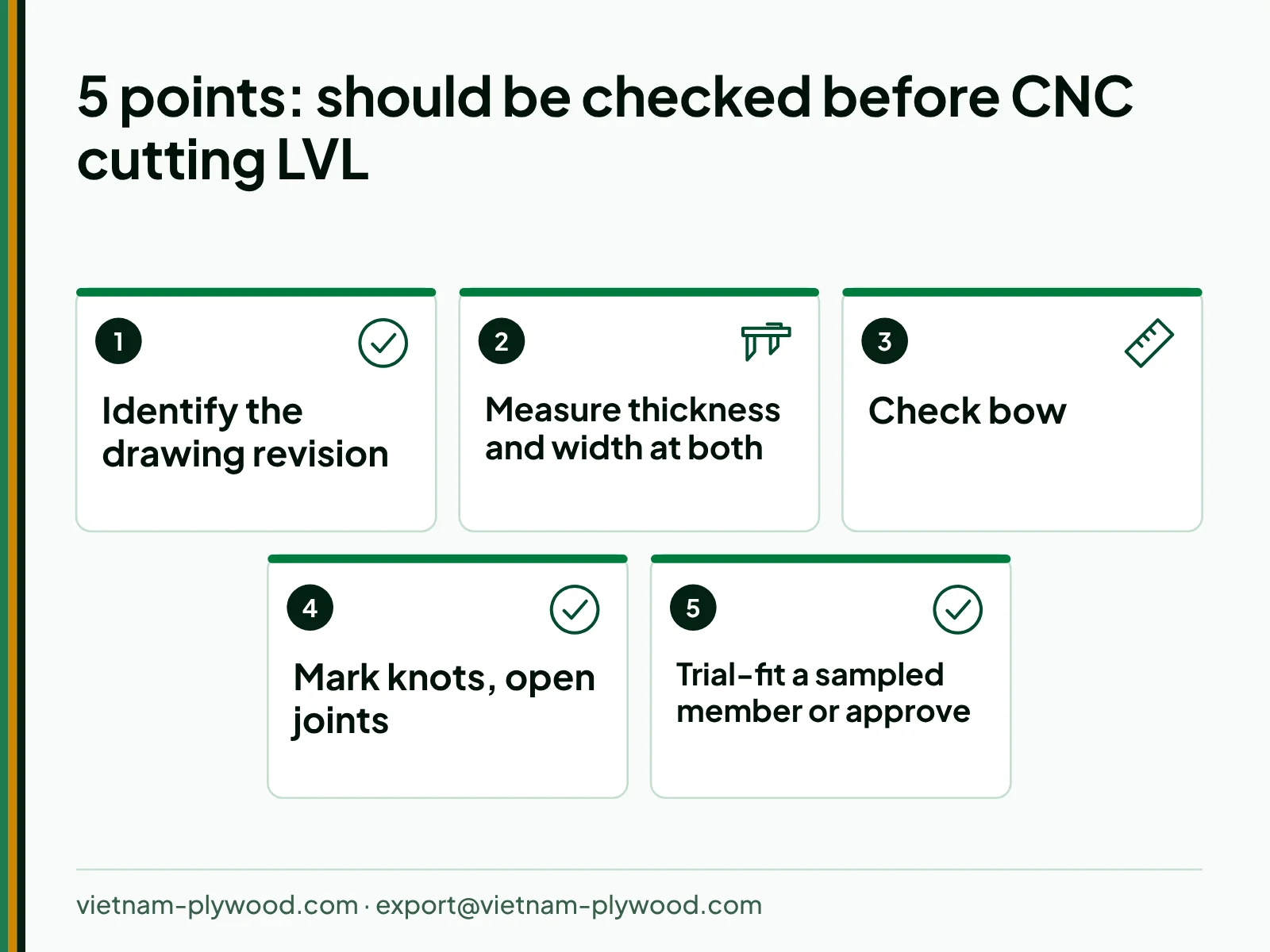
- Identify the drawing revision, finished part and raw-stock dimensions.
- Measure thickness and width at both ends and near the middle; record the extremes.
- Check bow, spring and twist against the machine’s fixture clearance.
- Mark knots, open joints, splits or edge damage intersecting the planned cut path.
- Trial-fit a sampled member or approve a controlled cutting trial before releasing the lot.
Do not apply the sheet-plywood tolerance to an LVL member without a written LVL agreement. Where components are routed from flat packaging plywood instead, the cutting drawing and sheet inspection plan should be written for that different product.
What can a buyer witness at the producing factory?
A buyer or third-party inspector can witness identification, sampling, measurements, defect marking, segregation decisions and the packing count at the producing factory. Agree on the sampling basis and stop-work conditions before arrival, and reserve access to representative bundles rather than only the easiest pieces. HCPLY handles specification, on-site quality control, export documents and loading for its orders.
Record instrument identification, observed values, photos and rejected-bundle disposition.
The construction-project supply process also requires matching the application to the correct product and evidence. Structural use calls for its own accepted engineering and testing documentation; an industrial packing inspection cannot establish a structural grade by appearance.
How do the three production lines change the inspection?
Our commercial and packing line makes acacia-core MR-glue plywood, while our furniture line makes sanded, full-stitched styrax- or eucalyptus-core plywood. Our construction line presses film-faced or anti-slip plywood using acacia or eucalyptus cores. These are distinct plywood builds; LVL manufacturing capability and LVL-specific tolerances require a separate written specification.
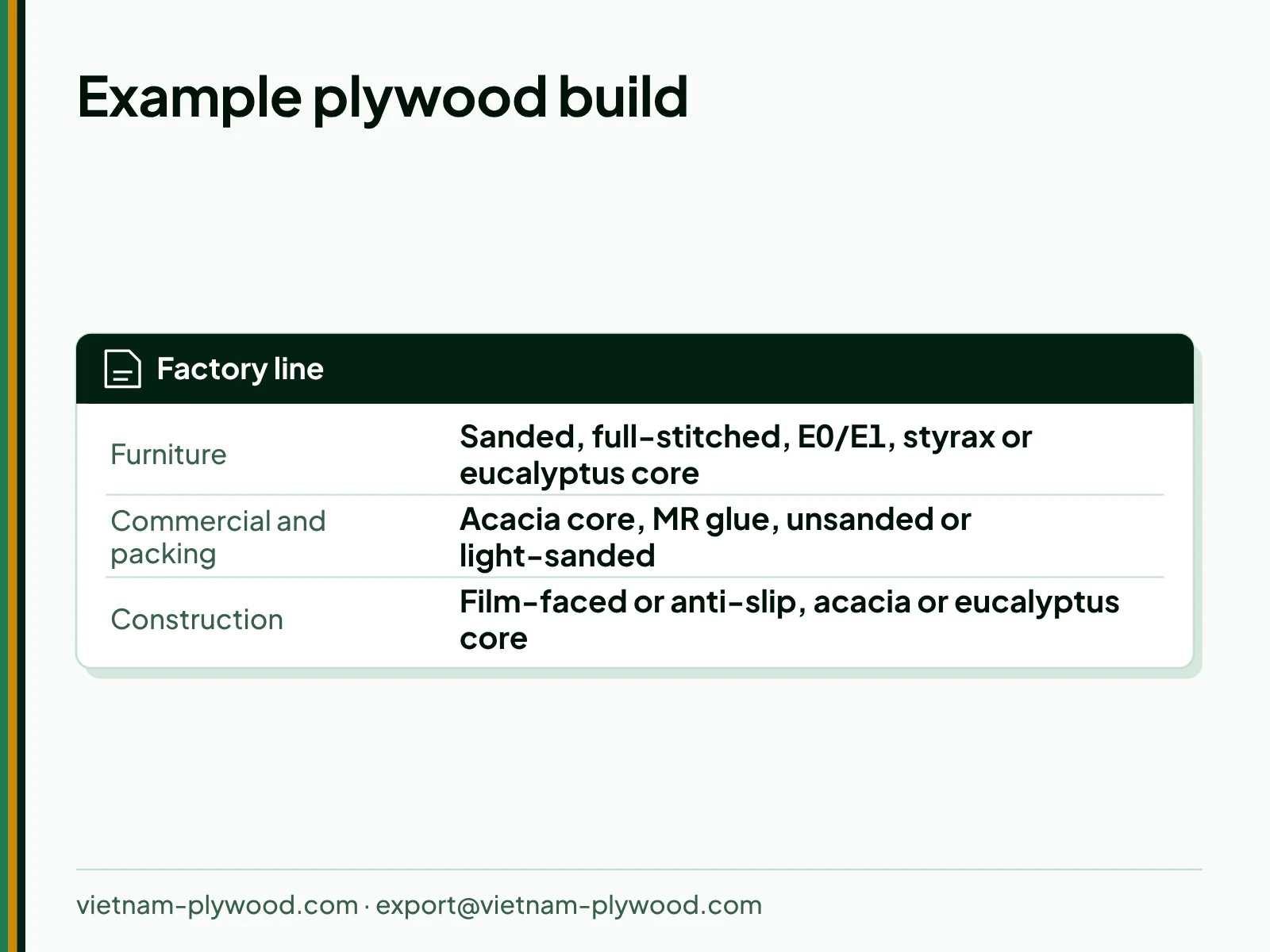
| Factory line | Example plywood build | What the inspector would emphasize |
|---|---|---|
| Furniture | Sanded, full-stitched, E0/E1, styrax or eucalyptus core | Surface, sanding and ordered thickness |
| Commercial and packing | Acacia core, MR glue, unsanded or light-sanded | Core gaps, edge condition and packing dimensions |
| Construction | Film-faced or anti-slip, acacia or eucalyptus core | Film integrity, edges and agreed glue construction |
For LVL orders, agree on the manufacturing line and acceptance specification in writing before inspection. For buyers comparing plywood alternatives across applications, see one supplier, several plywood types. Product identification must be settled before any inspector chooses the measurement protocol.
How should bundles and container loading be witnessed?
Loading inspection should reconcile accepted bundle references, quantity, protective packing and container condition with the approved loading plan. Check for dry floors, exposed fasteners, damaged packaging and unsupported edges before placement. Photograph representative bundle labels, the loading arrangement and the closed doors as a shipment record.
For a 1220 × 2440 mm, 18 mm plywood comparison, the calculated full 40HC loads are 990 styrax-core sheets at 26.52 t, 880 acacia-core sheets at 27.35 t, or 795 eucalyptus-core sheets at 27.69 t. These are plywood lookup figures, not LVL loading quantities; film weight is excluded. The 40HC payload limit is 28.5 t, and mixed specifications must remain within that limit. See container loading calculations for the sheet-based packing topic.
LVL beams require their own piece dimensions, bundle weights, support positions and loading calculation. Do not transpose a sheet count into an LVL beam count. A packing plan should also keep the inspector’s accepted and held bundles distinguishable throughout loading.
Which records connect inspection to the shipment?
The packing list connects the accepted bundle count and identification to the goods loaded; the commercial invoice and bill of lading connect the shipment to the sales and transport record. The shipment’s certificate of origin, phytosanitary and fumigation papers, insurance under CIF and agreed product documents are included as applicable. For EU lots, the document set includes EUR.1 and the EUTR/EUDR file set.
Factory certificates such as FSC, CARB P2, ISO 9001 and CE are shown with factory details masked, on request, when applicable to the producing member factory and ordered product. Glue type and emission class are separate specification fields; neither a surface inspection nor a packing list replaces an agreed test report. After loading, the draft shipping documents come to you for approval.
What is the release decision after an LVL quality check?
Release should follow a recorded comparison of the sampled goods with the purchase specification, with every nonconformity assigned a disposition. Accept conforming bundles, isolate failed ones and document any agreed rework and reinspection. Do not blend held bundles into the accepted loading count.
Record the drawing revision, sample identifiers, measurements, photographs, test references and final disposition. Structural claims require accepted test evidence.
What specification should the buyer send before inspection?
Send the intended application, product construction and measurable acceptance criteria before reserving an inspection date. For LVL, specify grain lay-up, dimensions, moisture test method, allowable defects and any structural documentation alongside the standard commercial fields. Agree on the producing line and inspection scope before scheduling the visit.
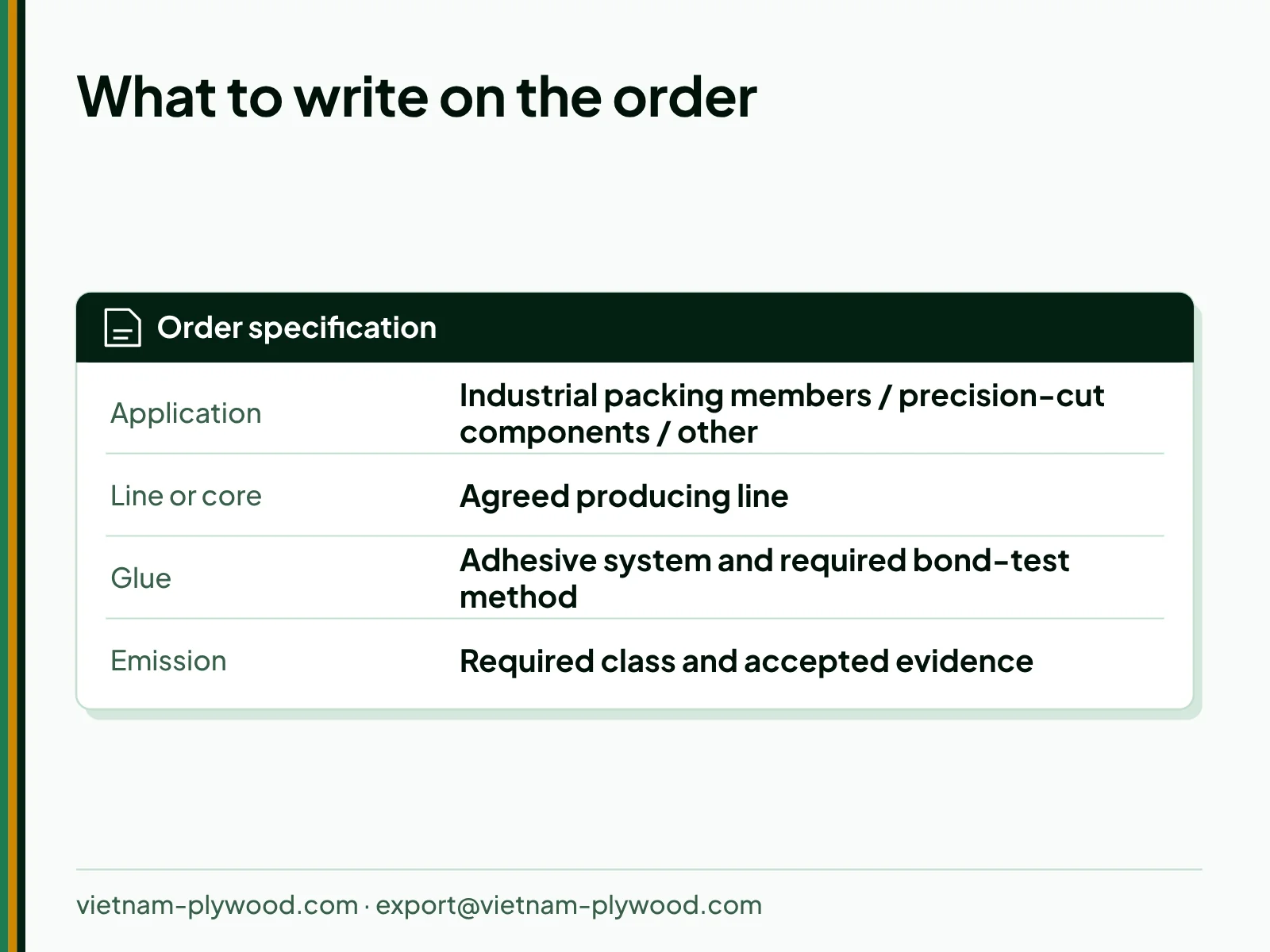
Application: industrial packing members / precision-cut components / other
Line or core: agreed producing line; proposed veneer species and lay-up
Glue: adhesive system and required bond-test method
Emission: required class and accepted evidence
Face and grade: appearance requirements and defect limits
Thickness and tolerance: nominal section, measurement points, acceptance band
Size: width x length; straightness, squareness and twist limits
Quantity: pieces, bundles and inspection sampling plan
Destination port: named discharge port and required shipping documents
Request the LVL inspection specification sheet from Lucy at export@vietnam-plywood.com before the production and loading checkpoints are agreed.