





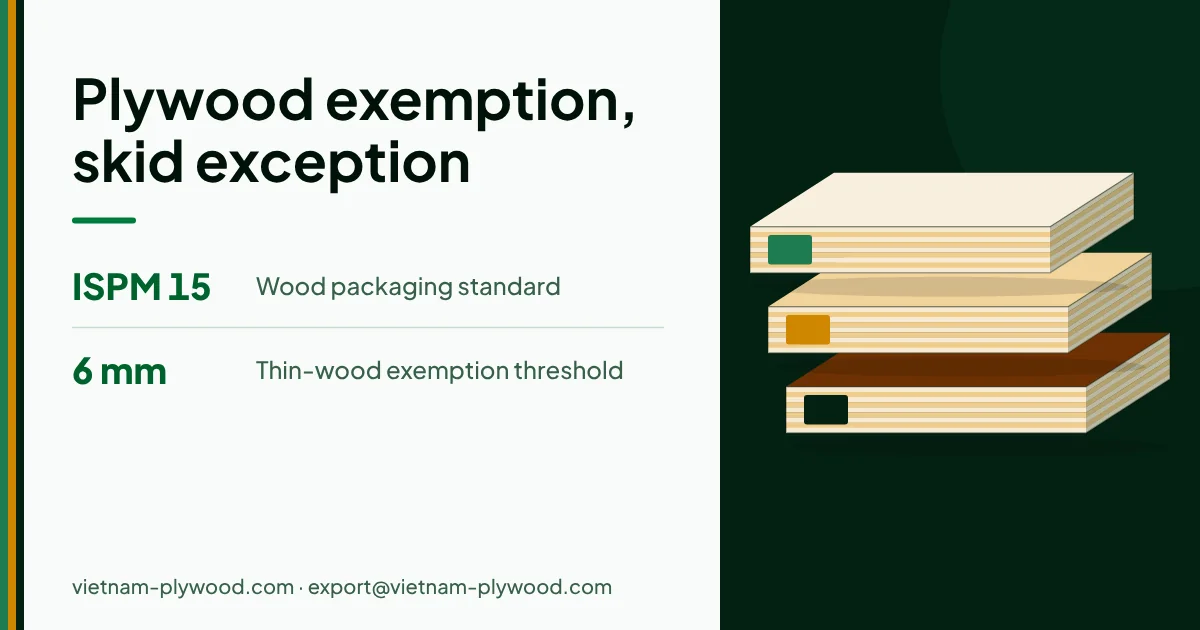
Plywood is exempt from ISPM 15 when packaging is made wholly from processed wood. Misreading that exemption can leave an importer paying for treatment or facing a rejected load. At HCPLY, we distinguish the plywood sheets from solid-wood skids, crate frames and other packing supports before export.
Is plywood exempt from ISPM 15?
Yes. Plywood is processed wood, and packaging made wholly from it is exempt from International Standard for Phytosanitary Measures No. 15 (ISPM 15). The exemption covers the plywood material rather than every component attached to it. A plywood crate with untreated solid-wood runners can still create an entry problem. Identify each packaging component before approving the packing drawing.
The International Plant Protection Convention (IPPC), in its 2019 publication of ISPM 15, exempts packaging made wholly of processed wood produced using glue, heat or pressure. The European Commission likewise identifies wholly processed-wood packaging as exempt in its wood packaging requirements, which describe the EU’s 2016 plant-health framework. That is why the question is about the assembled package, not just the plywood sheet.
Does plywood need to be heat treated for export?
Plywood does not need a separate ISPM 15 heat treatment merely because it will become packaging. Its manufactured structure places wholly processed-wood packaging within the exemption. A crate maker can cut our packing panels to form sides, lids or dividers without treating those plywood pieces as raw-wood packaging.
Heat treatment under ISPM 15 concerns regulated raw-wood packaging components. The IPPC’s 2019 ISPM 15 standard specifies conventional heat treatment reaching 56°C throughout the wood profile for 30 continuous minutes. That treatment criterion must not be confused with plywood’s hot-press settings. Our commercial and packing line presses MR-glue panels at 110–120°C, but that production temperature is not an ISPM 15 stamp or a treatment record for attached solid wood.
The United States’ 2026 Code of Federal Regulations, 7 CFR 319.40-1, excludes manufactured wood materials from the definition of regulated wood packaging material. Import rules for the plywood commodity itself remain a separate customs and plant-health question.
Which wood packaging still needs treatment?
Raw solid-wood pallets, skids, blocks, cleats, dunnage and crate frames remain in the regulated category when used in international trade to destinations applying ISPM 15. Thin wood of 6 mm or less and packaging made wholly of processed wood are listed exemptions. Do not apply the thin-wood exception to a thick runner simply because it supports a plywood panel.
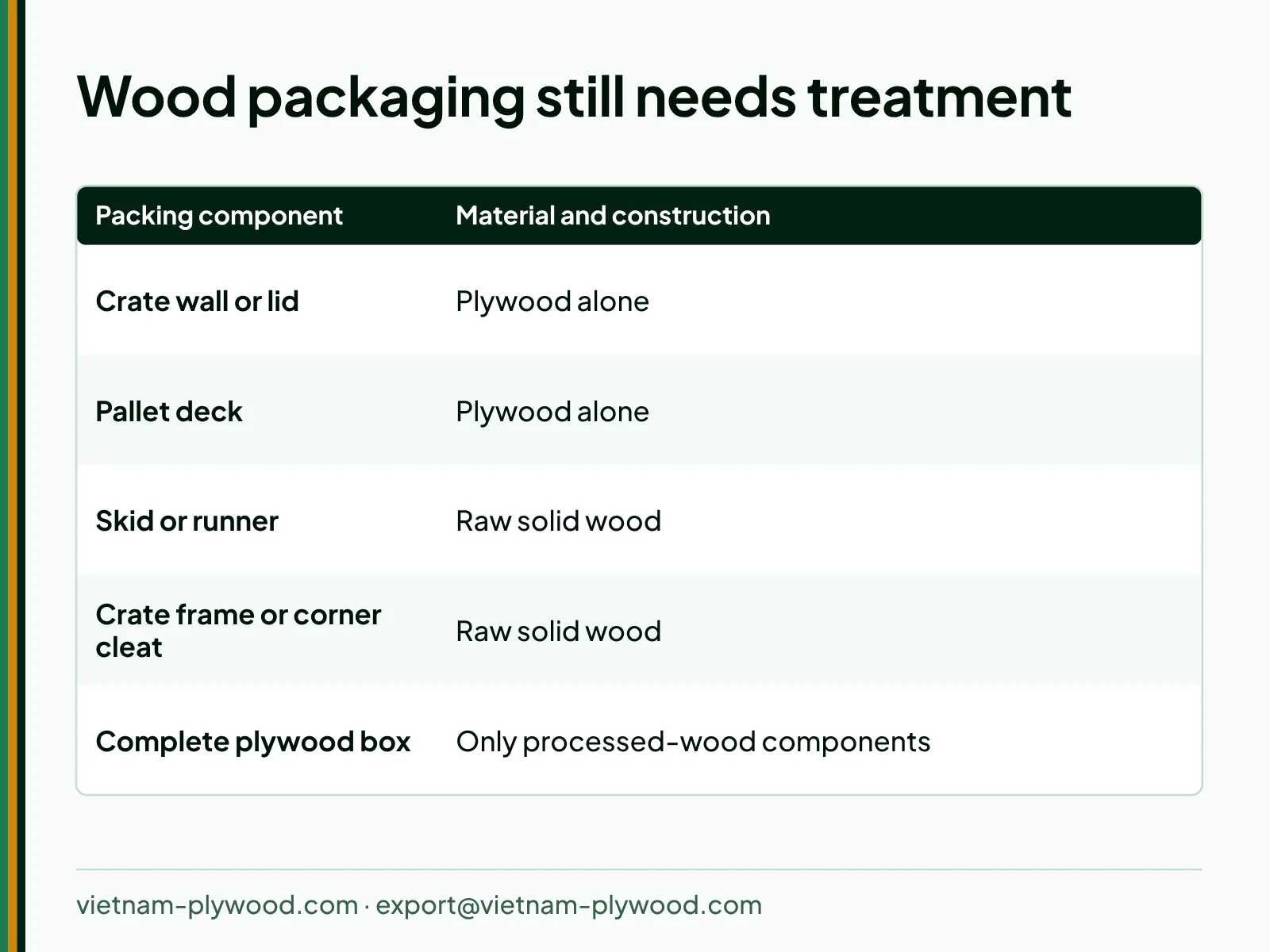
| Packing component | Material and construction | ISPM 15 decision |
|---|---|---|
| Crate wall or lid | Plywood alone | Exempt processed wood |
| Pallet deck | Plywood alone | Exempt component; inspect supports |
| Skid or runner | Raw solid wood | Regulated; approved treatment and mark needed |
| Crate frame or corner cleat | Raw solid wood | Regulated; approved treatment and mark needed |
| Complete plywood box | Only processed-wood components | Exempt under the wholly processed-wood rule |
| Mixed plywood-and-timber crate | Plywood plus solid-wood frame | Treat and mark the regulated packaging assembly |
The European Commission’s requirements describe the marking and debarking rules for non-exempt packaging arriving from outside the EU.
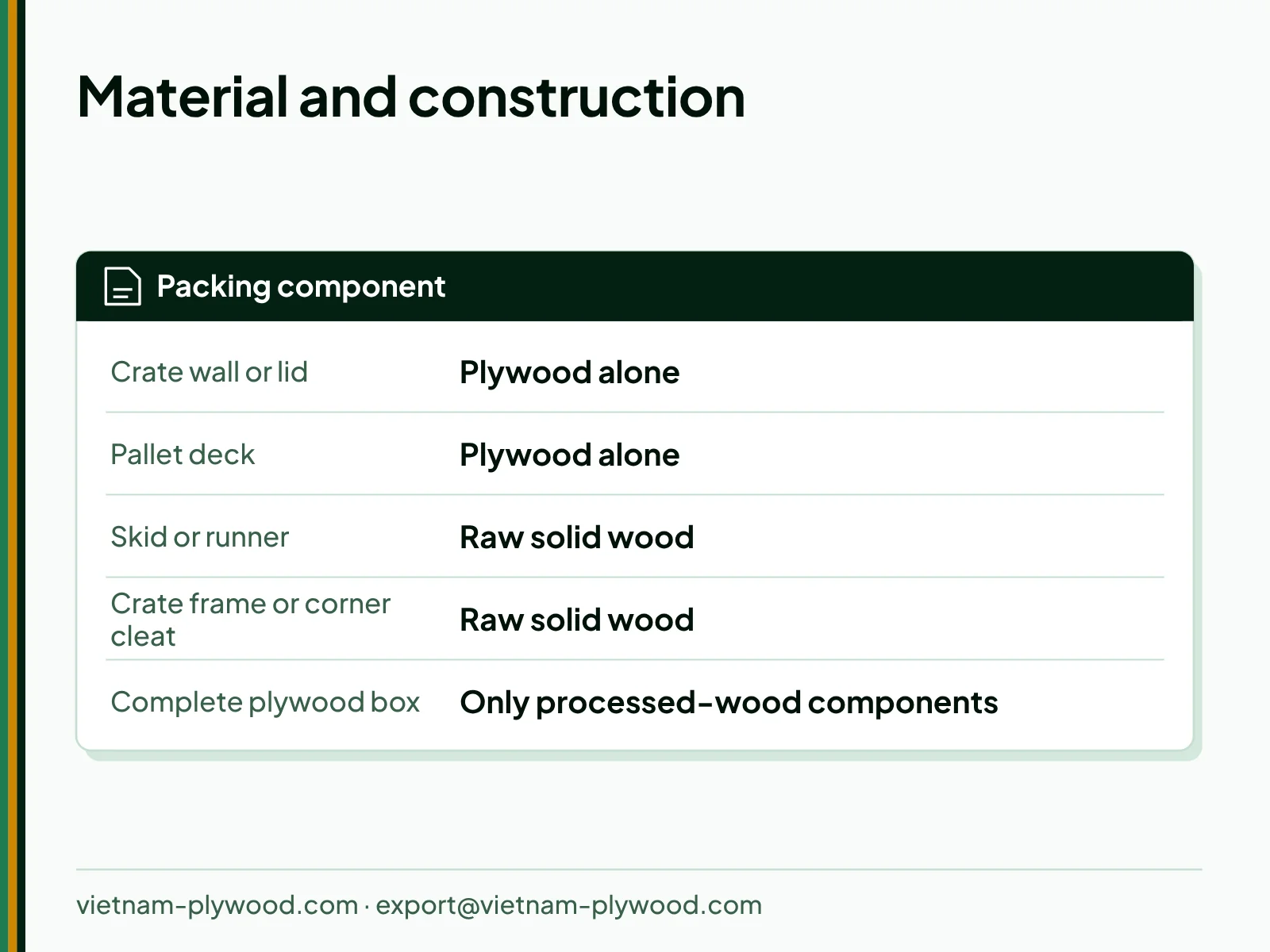
Do solid-wood skids under a plywood bundle need ISPM 15 treatment?
Yes. Solid-wood skids beneath a plywood bundle are packaging supports, so the plywood exemption does not exempt those skids. They must meet the destination’s applicable treatment and marking rules.
Ask for the skid material, the location of the treatment mark and a loading photograph showing the runners. If a pallet has a plywood deck and solid-wood blocks, inspect the blocks as regulated wood. For a shipment using wholly processed-wood supports, document that construction clearly in the packing specification.
The IPPC’s 2019 ISPM 15 standard describes disposal, treatment and other measures for non-compliant packaging at entry. A cargo of acceptable plywood can therefore still face disruption because of its raw-wood supports.
What does the ISPM 15 stamp show?
The official ISPM 15 mark identifies a regulated packaging treatment program. It shows the International Plant Protection Convention (IPPC) symbol, a two-letter country code, a producer or treatment-provider identifier, and a treatment code. The mark belongs on regulated wood packaging, not on exempt plywood sheets as a product certification.
The IPPC’s 2019 ISPM 15 standard lists HT for conventional heat treatment, MB for methyl bromide fumigation, DH for dielectric heating and SF for sulphuryl fluoride. A stamp with an unreadable facility code or no recognizable IPPC symbol is a reason to stop the packing inspection.
Inspect the mark alongside exit holes, frass and other visible pest evidence. A mark is evidence of an approved treatment process, not permanent protection against infestation after treatment. Reused packaging should be checked again for repairs, altered components and visible pest activity.
What does the plywood exemption mean for a crate or pallet maker?
A crate maker can specify plywood panels for walls, lids and dividers while treating the supporting structure as a separate design decision. Our commercial and packing line makes acacia-core, MR-glue, unsanded or light-sanded panels. For crate cutting, agree the face, thickness, sheet size and tolerance before the cutting plan is approved.
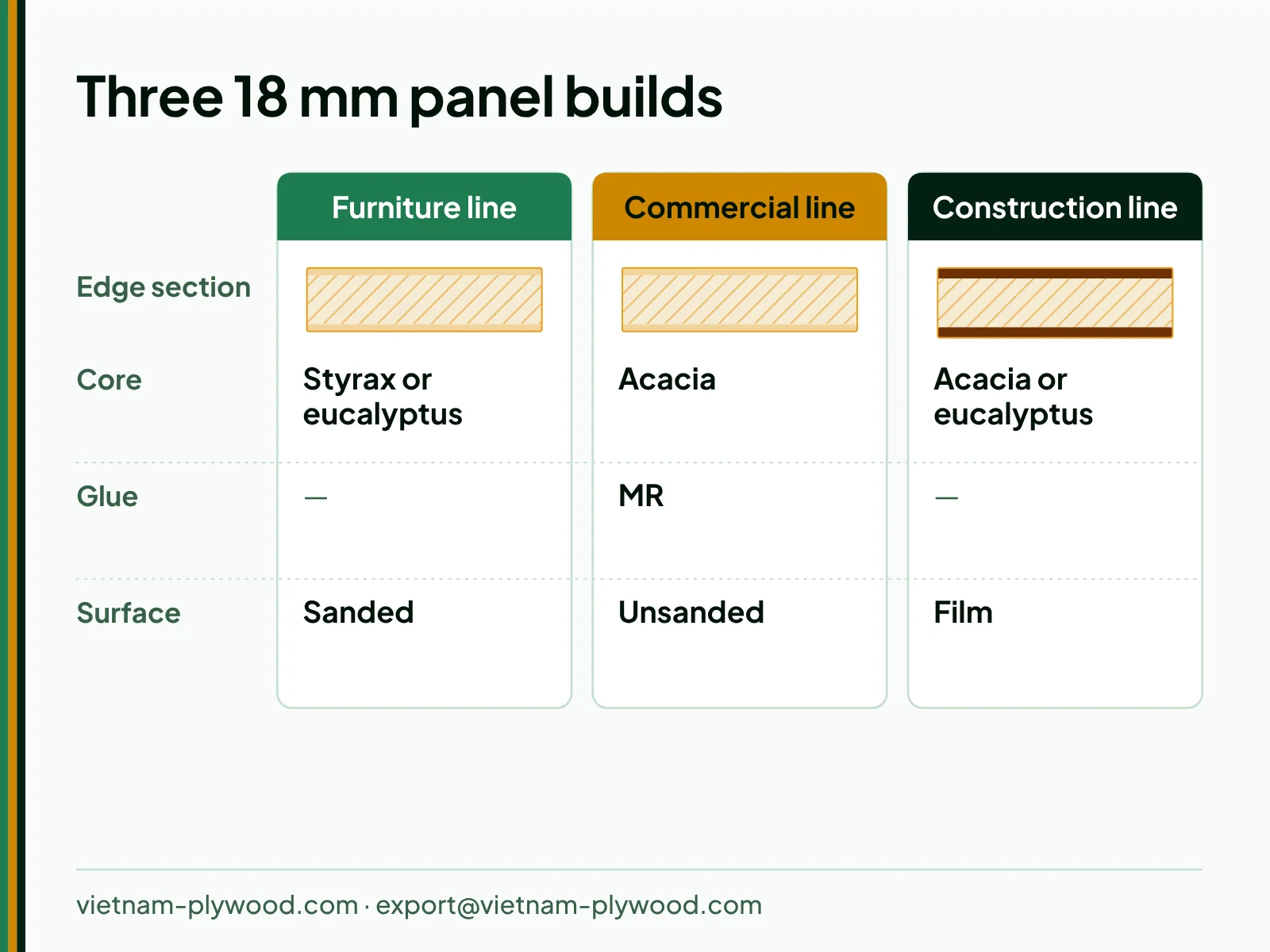
We produce orders in the factory matched to the specification. The comparison below shows how the same 18 mm requirement changes across our three factories; it does not make the different panels interchangeable.
| Line | 18 mm build | Surface and tolerance | Typical purchasing decision |
|---|---|---|---|
| Our furniture line | Styrax or eucalyptus core; full stitched | Sanded; ±0.2 or ±0.3 mm as ordered | Cabinet or visible fit-out component |
| Our commercial and packing line | Acacia core; MR glue | Unsanded or light-sanded; packing ±0.5–1.0 mm | Crate panels and packing partitions |
| Our construction line | Acacia or eucalyptus core; phenolic or melamine film | Unsanded; ±0.5 mm | Formwork rather than a basic crate wall |
The exemption comes from processed-wood construction, not the commercial grade name. See packing plywood from Vietnam for the panel application.
Can packing panels and other plywood share a container?
Yes. Specifications can be mixed within one 40HC when the combined load stays within the 28.5 t payload limit. For 18 mm, 1220 × 2440 mm panels, the computed full-load figures are 880 acacia sheets at 27.35 t and 990 styrax sheets at 26.52 t. These are separate full-load cases, not quantities to add together.
For a mixed order, request a pallet-by-pallet loading plan listing the sheet count, core, actual gross pallet mass and total payload. Check the combined mass, including supports and wrapping, against the 28.5 t ceiling.
The container-loading reference covers sheet counts by core and thickness.
What can a buyer inspect at the producing factory?
A buyer can witness the panel specification check and the packaging-material check before loading. We coordinate on-site quality control and loading at the producing factory. The factory office is the visit point, and the goods are inspected where they are made.
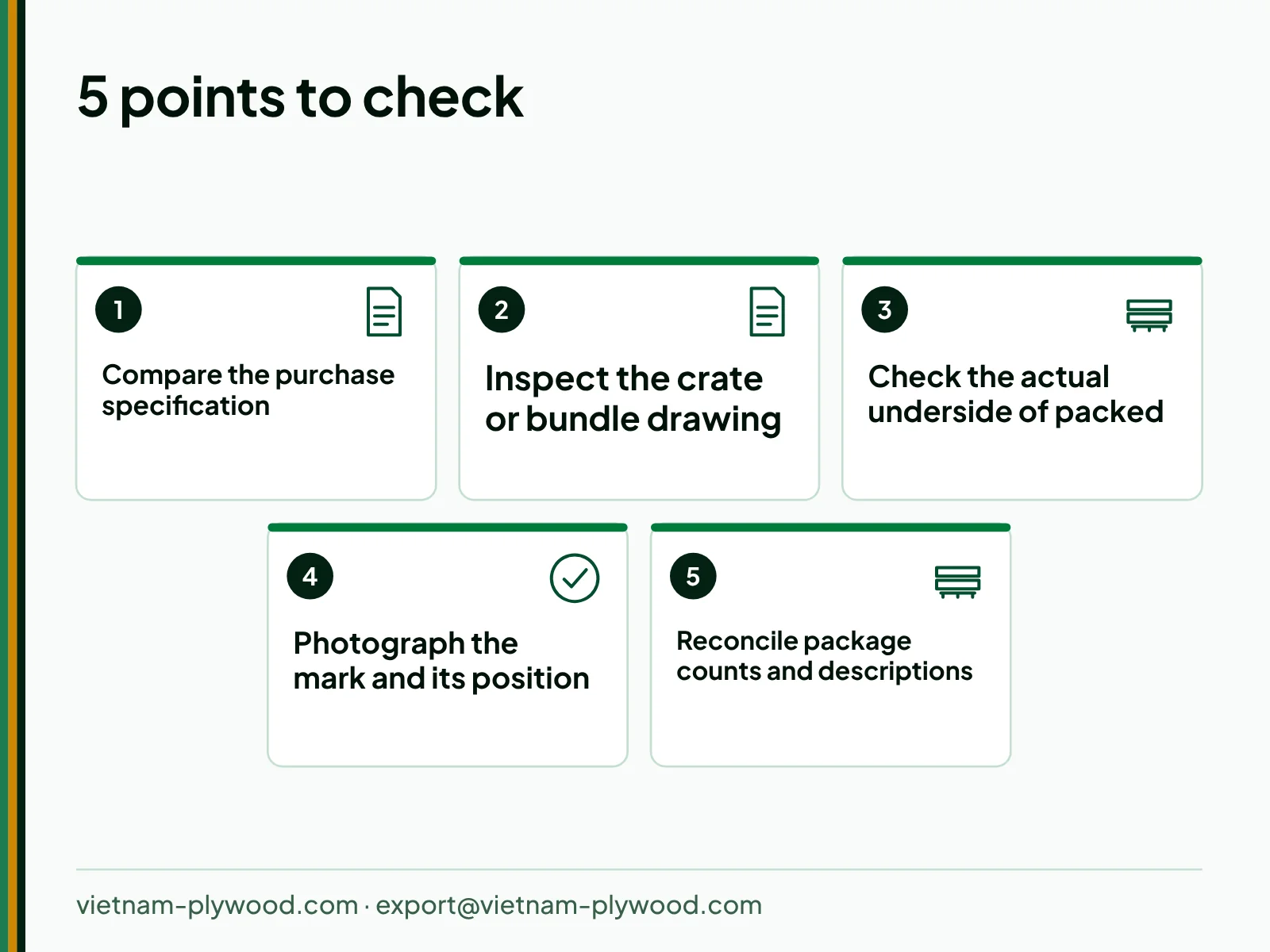
- Compare the purchase specification with the produced plywood: core, glue, surface, size and tolerance.
- Inspect the crate or bundle drawing for runners, cleats, blocks and other raw-wood components.
- Check the actual underside of packed bundles for solid-wood supports and legible marks where required.
- Photograph the mark and its position on the regulated packaging, along with the complete packed unit.
- Reconcile package counts and descriptions with the draft packing list before approving shipping documents.
For an EU consignment, the EU import-duty overview provides wider import context, while EVFTA plywood duty guidance addresses a separate tariff question. Neither tariff treatment nor an origin document replaces an ISPM 15 mark on regulated packaging.
Which stamp or paper comes with a plywood load?
Exempt plywood sheets do not require an ISPM 15 stamp. If a shipment uses regulated solid-wood packaging, the treatment mark must be present on that packaging under the applicable approved program. Ask for packing photographs and the packaging description so the importer can identify which material carries the mark.
Our export team prepares one set of export documents: commercial invoice, packing list, bill of lading (B/L), certificate of origin, phytosanitary and fumigation papers, and the order’s agreed certificate or test-report documents. Insurance is included under CIF; EU lots include EUR.1 and the EUTR/EUDR file set. After loading, the draft shipping documents come to you for approval.
These documents serve different purposes. The packing list identifies the packed cargo; a phytosanitary or fumigation paper is not automatically a substitute for the official ISPM 15 mark on a regulated skid. Certificates belonging to member factories, including FSC, CARB P2, ISO 9001 and CE, are shown with factory details masked, on request. None is an ISPM 15 certification for an individual plywood sheet.
What should importers specify before ordering?
Specify the panel build and the entire export packaging arrangement in writing.
For US shipments, the 2026 Code of Federal Regulations requires regulated wood packaging to carry an approved treatment mark. For the EU, the European Commission identifies the wholly processed-wood exemption and requires marks on non-exempt wood packaging from non-EU countries. For other destinations, check the importing authority’s current wood-packaging conditions before loading.
We ship FOB Hai Phong, with CFR (CNF) or CIF also available. Buyers planning mixed construction supplies can review plywood supply for construction projects separately. A crate maker should specify whether its order is for bare plywood sheets, completed plywood-only packaging or plywood combined with treated solid-wood supports.
What specification should the export team receive?
Send a complete build request and state the packaging material beneath each bundle. The following fields let our team identify the production line and the packaging inspection point before confirming the order.
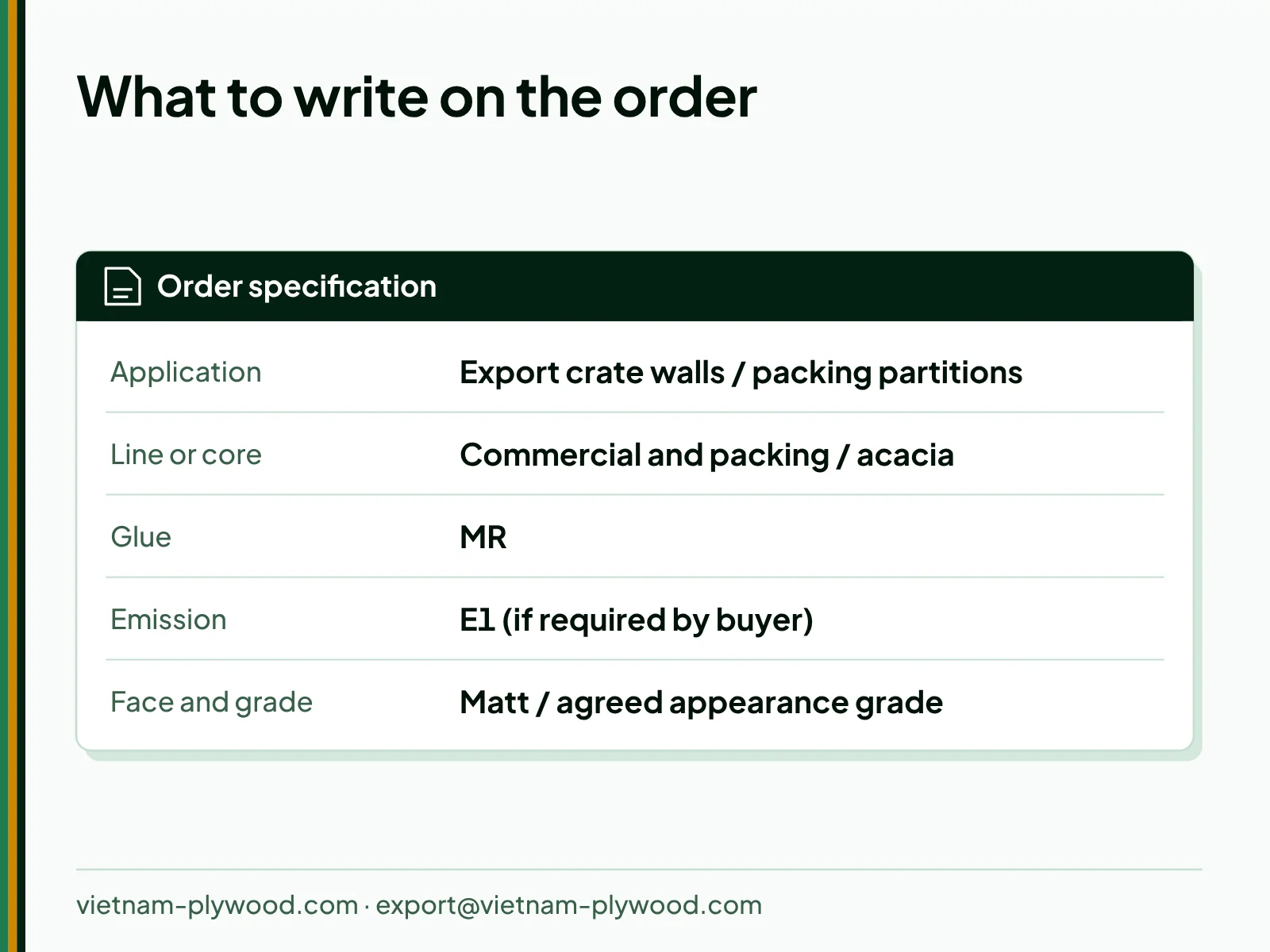
Application: export crate walls / packing partitions
Line or core: commercial and packing / acacia
Glue: MR
Emission: E1 (if required by buyer)
Face and grade: matt / agreed appearance grade
Thickness and tolerance: 18 mm / packing ±0.5–1.0 mm
Size: 1220 × 2440 mm
Quantity: [sheets and 40HC allocation]
Destination port: [port, country]
Packaging supports: [processed wood only / treated marked solid wood]
Book a factory visit with Lucy at export@vietnam-plywood.com through the contact page to inspect the panels and packing arrangement at the producing factory.