





Importing plywood from Vietnam to Canada starts with a precise panel specification and a Canadian customs classification. The wrong grade or tariff description can add inspection costs, delays or a rejected load. HCPLY prepares furniture, packing and film-faced orders at the producing factory; Canadian importers handle entry, local grade acceptance and landed costs. How do I import plywood from Vietnam to Canada without mixing these requirements?
How do I import plywood from Vietnam to Canada?
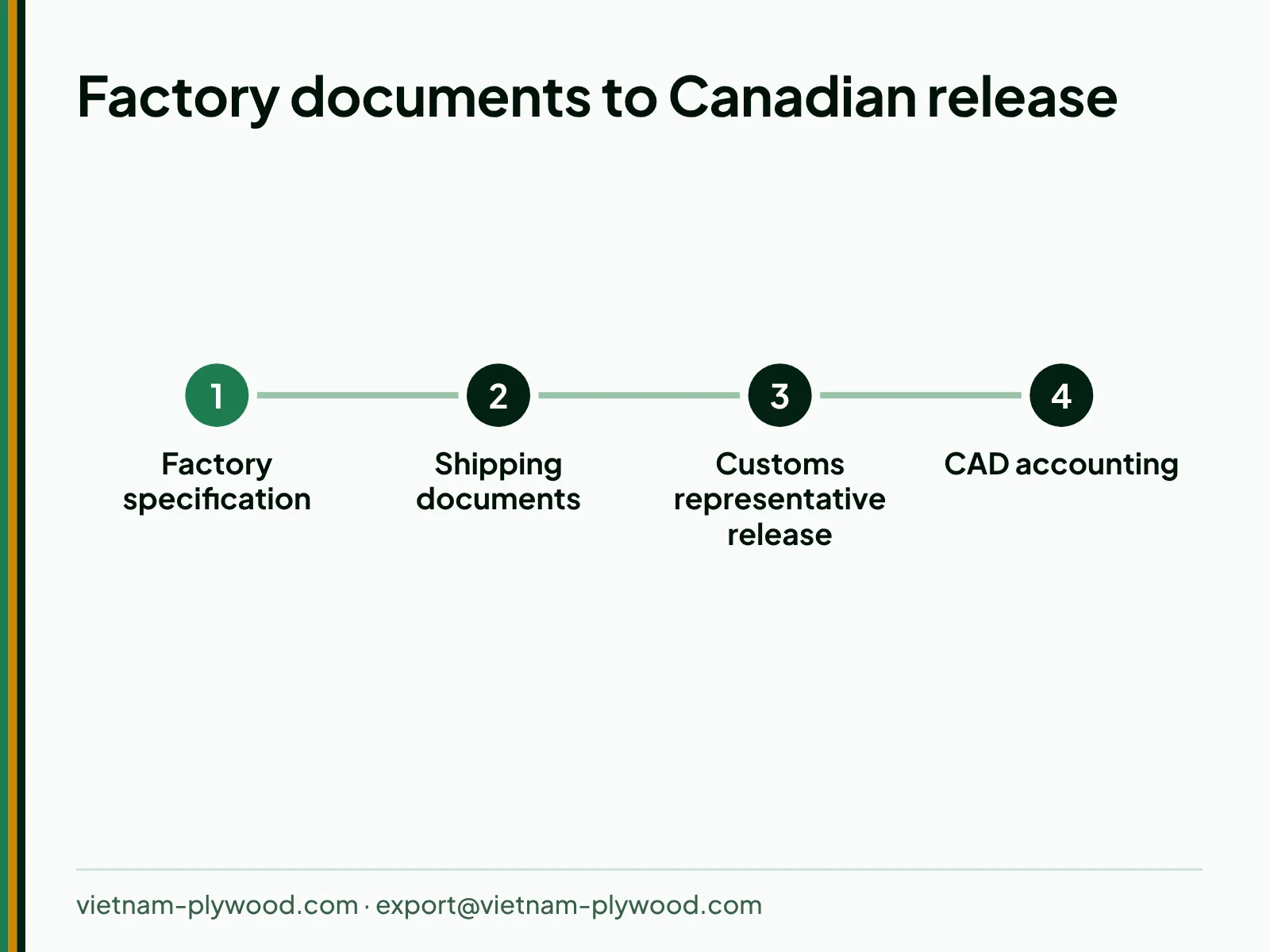
Import commercial plywood by fixing the panel specification, classifying it under Canada’s tariff, arranging importer registration, verifying origin and plant-health requirements, then lodging release and accounting records. The sequence matters: a Canadian customs entry cannot repair an inaccurate product description, and a factory quotation cannot substitute for a Canadian structural grade approval.
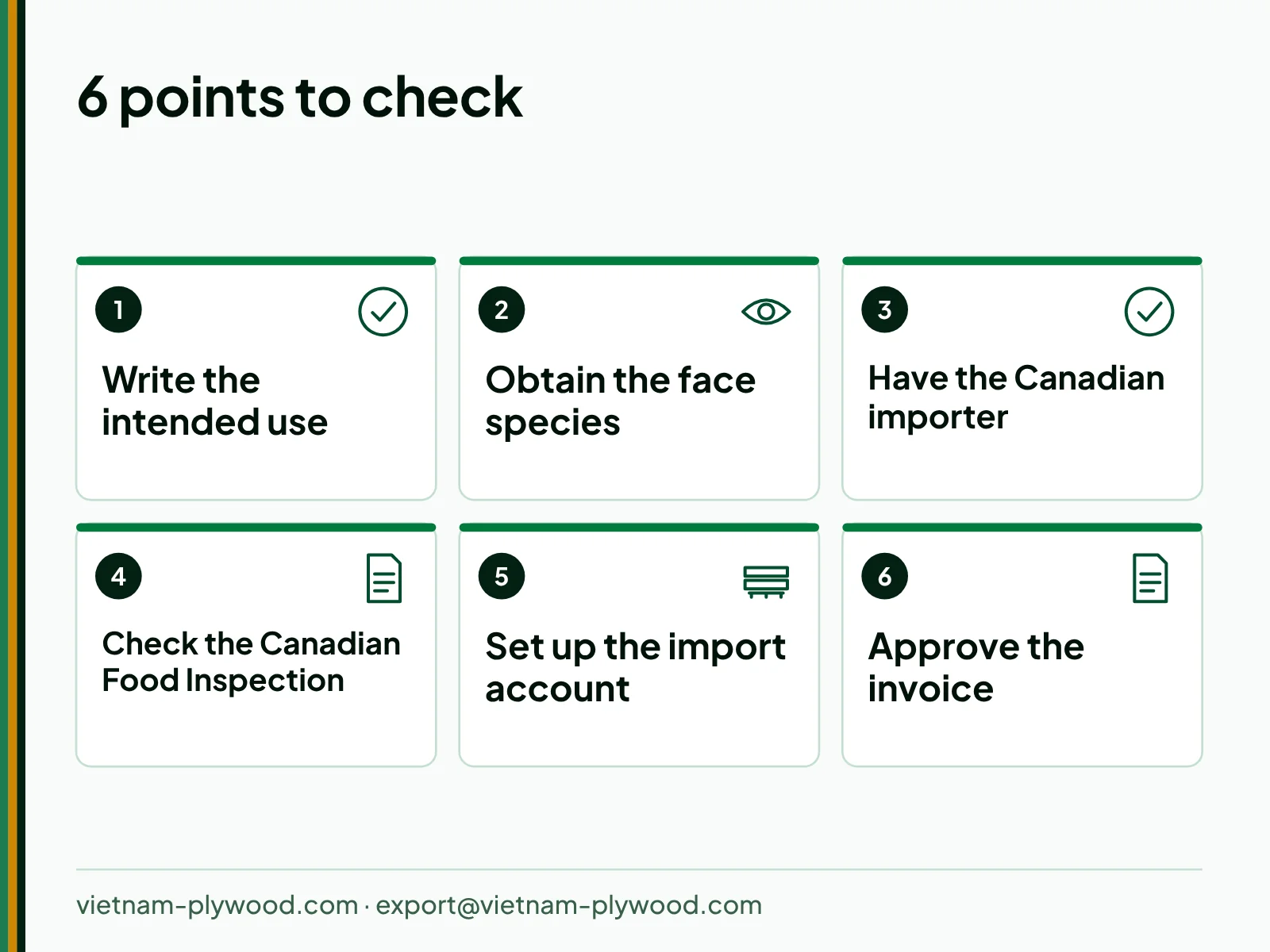
- Write the intended use: cabinet component, protective packing, or removable concrete form.
- Obtain the face species, core, glue, thickness, size, finish and manufacturing details before choosing a tariff line.
- Have the Canadian importer or customs representative review the 2026 Customs Tariff and preferential origin evidence.
- Check the Canadian Food Inspection Agency (CFIA) import conditions for the actual goods and wooden pallets.
- Set up the import account and customs release route before the container sails.
- Approve the invoice, packing list and bill of lading details, then account for the shipment in Canada.
The Canada Border Services Agency (CBSA) 2025 release memorandum D17-1-4 describes release requests and supporting records. For the broader purchase sequence, see how to import plywood from Vietnam.
What duty applies to furniture, packing and film-faced plywood?
For ordinary plywood correctly classified in heading 4412, Canada’s September 2026 tariff shows Free under the Most-Favoured-Nation column for the relevant plywood subheadings. This is a classification finding, not a blanket ruling that every wood panel or worked article enters free. The 2026 CBSA Chapter 44 tariff distinguishes face species and construction.
| Proposed shipment | Classification question for the customs representative | 2026 ordinary heading 4412 duty indication | Factory build and practical verdict |
|---|---|---|---|
| Furniture-faced plywood | Is the outer veneer tropical, a listed non-coniferous species, or another wood? | Free for applicable 4412.31, 4412.33 or 4412.34 entries | Our furniture line: sanded styrax or eucalyptus core; choose for cabinet-facing surfaces |
| Raw packing plywood | Which species form the outer plies, and is this still plywood rather than a finished packing article? | Free for applicable heading 4412 entries | Our commercial and packing line: acacia core, MR glue; choose for protective industrial packing |
| Film-faced formwork | Does the coated product retain classification as plywood, and what are the outer-ply details? | Free for applicable heading 4412 entries | Our construction line: filmed acacia or eucalyptus core; choose for removable concrete forms |
A customs representative must classify the actual goods, including any machining that changes the tariff heading.
Vietnam and Canada participate in the Comprehensive and Progressive Agreement for Trans-Pacific Partnership (CPTPP). The CBSA’s origin guidance says its certification uses minimum data elements, and origin eligibility needs evidence. Since the listed ordinary heading 4412 tariff rates are already Free, a preferential claim should be evaluated for the actual line rather than treated as an automatic additional saving.
A 2026 Canada Gazette notice describes a decorative plywood trade-remedy investigation originating in or exported from China. That notice does not establish an extra Vietnam plywood duty. Origin, product scope and current trade-remedy measures still deserve a shipment-specific check.
Which CBSA entry papers does a container need?
The Canadian importer needs a commercial description and value that agree across the release and accounting records. HCPLY prepares the shipment’s commercial invoice, packing list, bill of lading (B/L), certificate of origin, phytosanitary and fumigation papers, plus certificate documents agreed for the build. Insurance paperwork is included under CIF; after loading, the draft shipping documents come to you for approval.
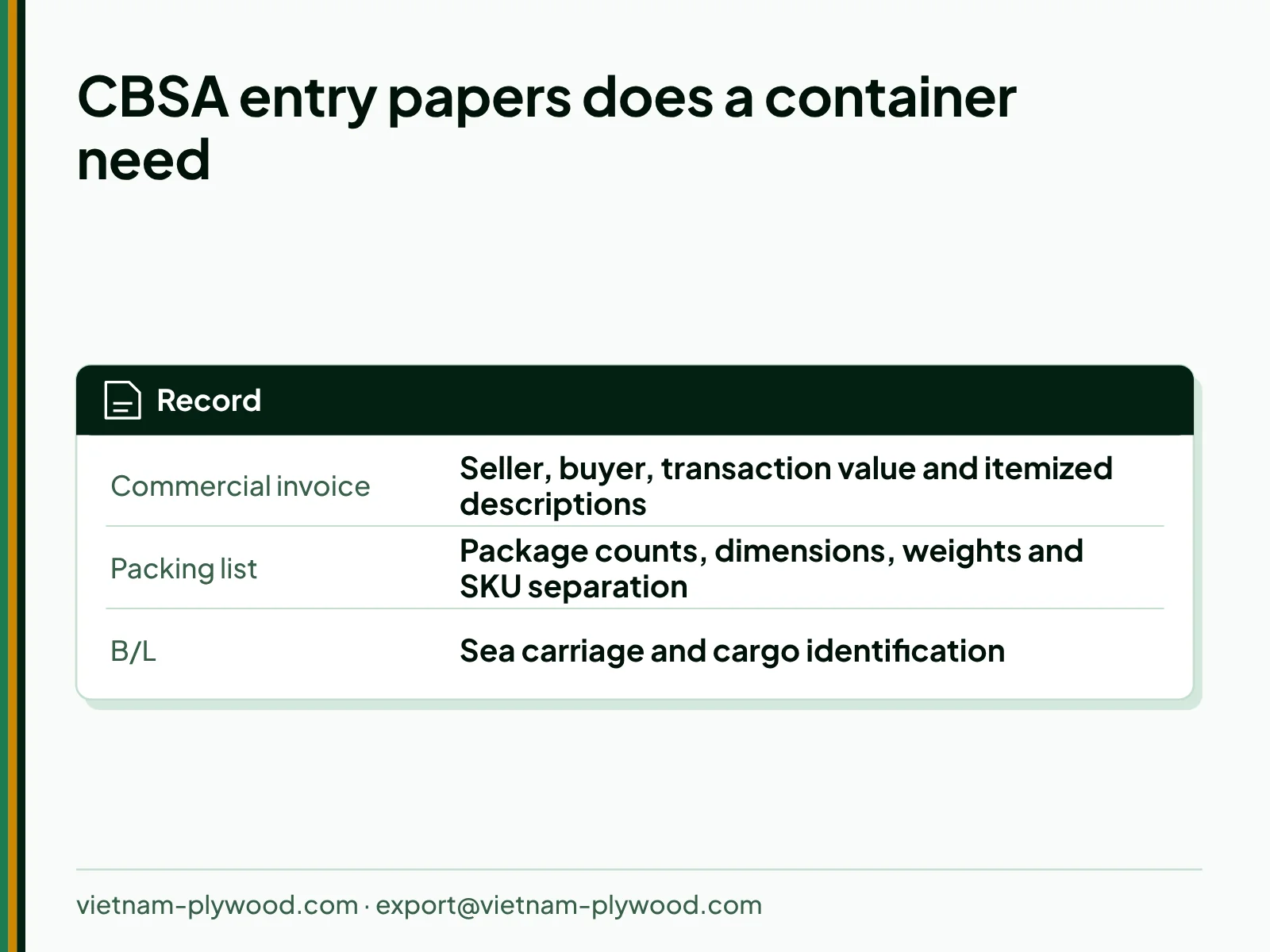
| Record | What it establishes | Who uses it |
|---|---|---|
| Commercial invoice | Seller, buyer, transaction value and itemized descriptions | Canadian importer and customs representative |
| Packing list | Package counts, dimensions, weights and SKU separation | Carrier, inspection and receiving teams |
| B/L | Sea carriage and cargo identification | Carrier and release parties |
| Origin evidence | Country of production and, when claimed, CPTPP origin criteria | Importer making a tariff claim |
| Phytosanitary/fumigation records | Treatment or plant-health evidence where required | CFIA and importer |
| Order-specific test or emission documents | Evidence for the agreed panel build | Buyer and technical reviewer |
These export papers are inputs to Canadian entry, not substitutes for a Canadian customs declaration. The CBSA’s 2025 release memorandum sets out electronic release options and the Commercial Accounting Declaration (CAD). The importer handles its business number, CBSA Assessment and Revenue Management (CARM) account, release method, duty and tax accounting; a customs representative can act on its behalf.
For CPTPP treatment, the CBSA’s 2022 certification memorandum permits importer, exporter or producer certification with prescribed data elements. A generic certificate of origin should never be presented as proof that the CPTPP origin rule was satisfied. Check who signs, the rule of origin, the HS description and supporting production evidence.
Which Canadian grade names must the quotation translate?
Translate the intended Canadian use into measurable panel attributes before matching any grade name. A Vietnamese A/B face description, an E1 emission class and a phenolic bond do not by themselves create a Canadian structural grade.
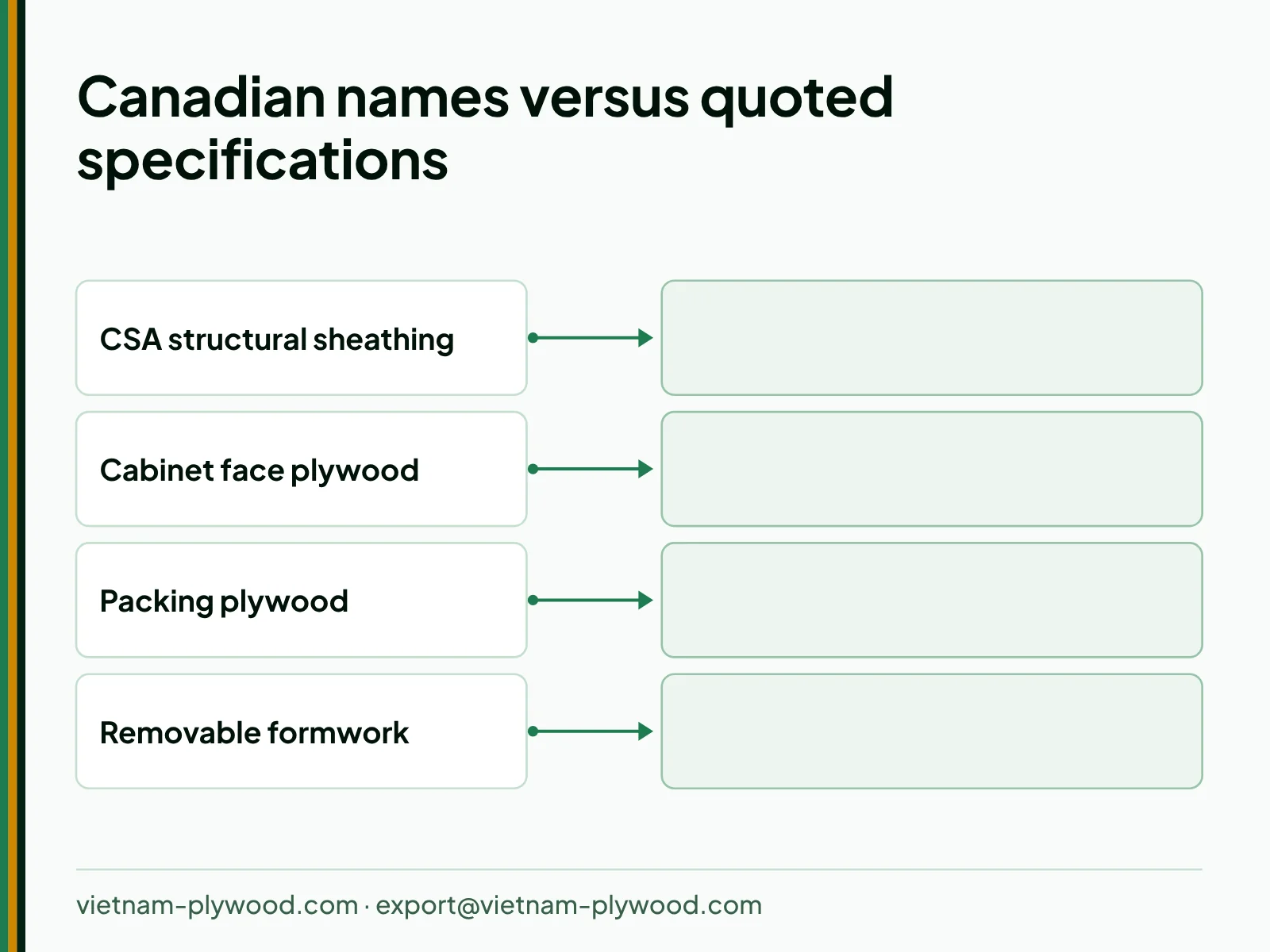
| Canadian buying language | What to specify on the Vietnam quotation | Acceptance decision |
|---|---|---|
| CSA O121 Douglas-fir plywood | Species and structural certification demanded by the project | Not an HCPLY claim; seek a compliant alternative source if mandatory |
| CSA O151 Canadian softwood plywood | Required structural stamp and sheathing application | Do not substitute an unstamped imported panel |
| CSA O153 poplar plywood | Exact standard edition, use and required evidence | Discuss the standard; do not claim certification without accepted testing |
| Cabinet or furniture plywood | Face species, A/B appearance, sanded tolerance, core and emission class | Quote our furniture line against written acceptance criteria |
| Packing-grade plywood | Acacia core, MR bond, finish and permitted dimensional deviation | Quote our commercial and packing line |
| Film-faced formwork | Film weight, glue, core, edge sealing and release practice | Quote our construction line for removable forms |
The CSA names identify different specifications and are not interchangeable commercial labels. Where structural engineering approval, a recognized stamp or code compliance is required, the buyer must obtain that evidence independently. We do not supply OSB, MDF, chipboard, blockboard, MDO, HDO, birch-core plywood or 3-ply spruce panels.
For a furniture-facing order, our furniture plywood discussion helps identify the appearance fields. For permanent building sheathing, do not use a film-faced formwork quotation as a substitute for the specified structural product.
How do the three producing lines change the same 18 mm order?
An 18 mm panel can be a cabinet blank, an industrial packing sheet or a removable formwork face, even though its nominal thickness matches. The producing factory changes the core preparation, face treatment and inspection checkpoints.
| Metric | Furniture | Commercial and packing | Construction |
|---|---|---|---|
| Typical 18 mm build | Styrax/eucalyptus, full stitched, sanded | Acacia, MR, unsanded or light-sanded | Acacia/eucalyptus, film-faced, unsanded core |
| Thickness tolerance | ±0.2 or ±0.3 mm as ordered | Commercial ±0.5 mm; packing ±0.5–1.0 mm | ±0.5 mm |
| Surface specification | A/B veneer appearance | Matt/raw or specified face | 120 g/m² standard film; 135 g/m² premium; 220 g/m² anti-slip |
| Primary receiving check | Sanded thickness and face quality | Pack count and edge/core condition | Film, sealed edges and bond specification |
We use our three factories in Phu Tho and Hai Phong according to the order’s specification. The buyer can visit the factory office and inspect panels at the producing factory. HCPLY manages on-site quality control, documentation and loading; each order ships directly from the appropriate factory.
For film-faced panels, the inspector can witness film appearance, edge sealing, thickness measurements and pallet labeling. A visual inspection cannot replace a laboratory bond report. Certificates held by member factories, including FSC, CARB P2, ISO 9001 and CE, are shown with factory details masked, on request; none should be read as blanket approval for a Canadian structural application.
What specification prevents a rejected Canadian load?
The purchase specification must make the inspection result decidable before loading. Name the application first, then separate core, face, adhesive, emissions, dimensions and acceptable evidence.
For cabinet production, request full-stitched core and sanded panels with the ordered ±0.2 or ±0.3 mm tolerance. For commercial packing, use the acacia MR build and record whether ±0.5 mm or the packing tolerance of ±0.5–1.0 mm applies. For formwork, identify the 120, 135 or anti-slip 220 g/m² film rather than using the word waterproof as a test method.
Glue and emissions belong on separate lines. Melamine glue is MR with a 12-hour boil description; phenolic glue is WBP with a 72-hour boil description. E0, E1 and E2 are emission classes, while CARB P2 / TSCA Title VI is a US limit involving third-party certification. None of these fields alone demonstrates Canadian building-code compliance.
Face veneer commonly measures 0.2–0.4 mm. Our listed panel sizes include 1220 × 2440 and 1250 × 2500 mm, with length and width tolerance ±2 mm. Custom cutting is available. Ask the inspector to record the actual dimensions, faces, edge condition and pallet counts against the purchase order.
Can furniture and packing panels share a Canadian container?
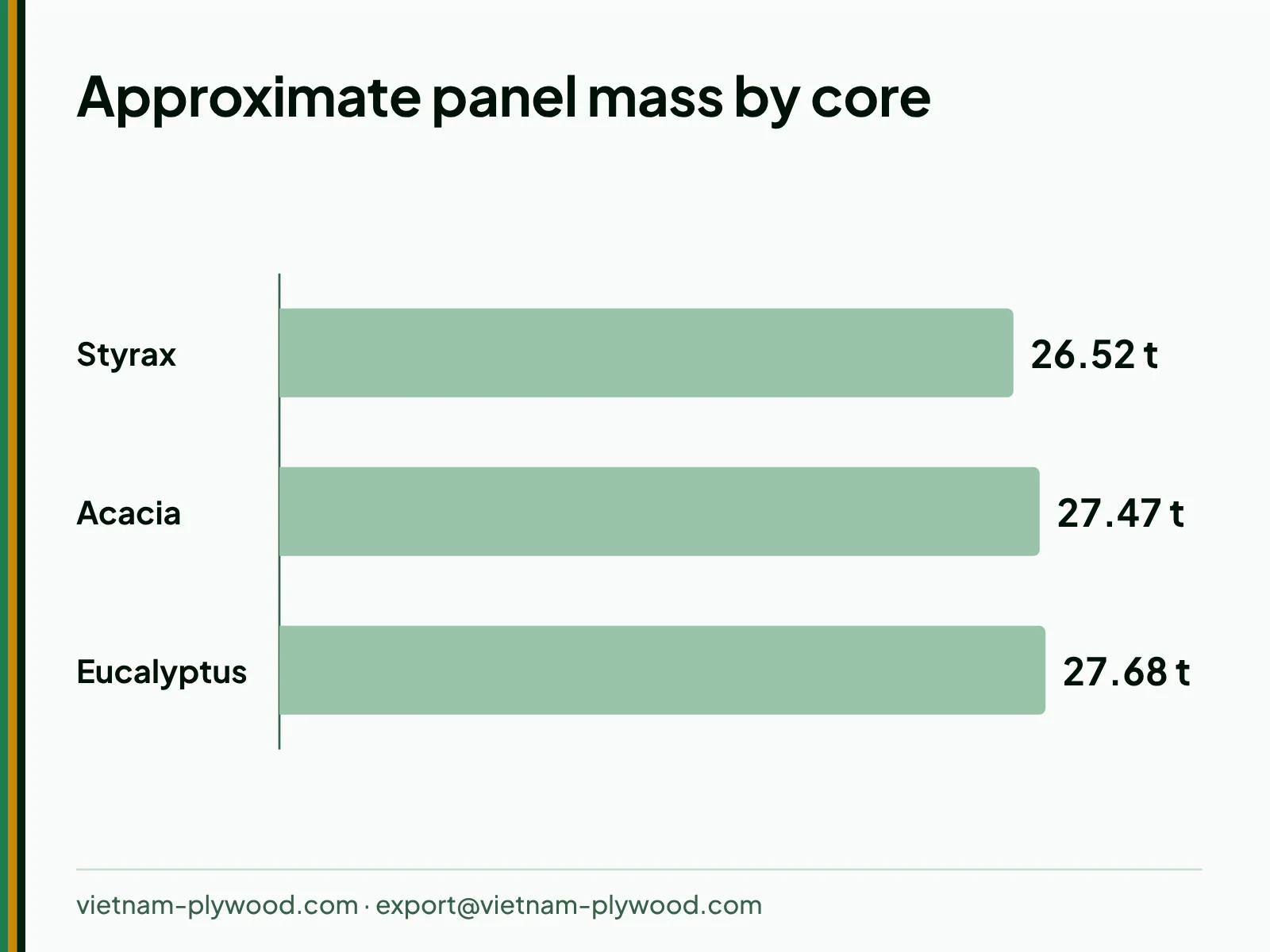
Mixed specifications can share one 40HC within the 28.5 t payload limit, but the packing calculation must use the density of each core. At 18 mm and 1220 × 2440 mm, the reference full-container counts are 990 styrax, 880 acacia and 795 eucalyptus sheets.
| Core | Density | Pallets | Sheets per pallet | Full-load sheets | Approximate panel mass |
|---|---|---|---|---|---|
| Styrax | 500 kg/m³ | 18 | 55 | 990 | 26.52 t |
| Acacia | 580 kg/m³ | 16 | 55 | 880 | 27.47 t |
| Eucalyptus | 650 kg/m³ | 15 | 53 | 795 | 27.68 t |
The calculation is sheets × 1.22 m × 2.44 m × 0.018 m × density ÷ 1000. For example, 440 acacia sheets contribute about 13.73 t; 495 styrax sheets contribute about 13.26 t. Together they contribute about 26.99 t of panels before pallet and packing allowances. Check pallet geometry and gross shipping weights before loading.
A furniture and packing combination can be practical when the importer has two receiving programmes. Keep each specification and pallet group separate on the packing list. The container packing calculation covers full-container loading details; one supplier for several plywood types covers specification coordination.
What costs belong above the factory price?
A Canadian landed-cost budget adds ocean freight, insurance where applicable, terminal handling, customs representativeage, applicable tax, inspection and inland delivery to the agreed factory price. Rank the main factory price drivers by core construction and finish first, then face grade, adhesive, thickness and order mix.
For commercial plywood, the indicative starting price is from US$250/m³ FOB Hai Phong (October 2026). Furniture plywood requires a written specification and quotation. A full-stitched, sanded furniture build costs more than a simpler unsanded commercial build because its core preparation and finishing work are greater. Film-faced pricing requires a written specification and quotation; no fixed figure is supplied.
Under FOB Hai Phong, the Canadian buyer budgets ocean freight and subsequent import charges. CFR (CNF) and CIF are also available, but the named destination port and the insurance allocation must be recorded. Goods and services tax or harmonized sales tax, any recoverable input tax credits, port storage, demurrage and local delivery should be reviewed with the importer’s accountant and forwarder; they are not included in the stated commercial plywood starting price.
Use a worksheet with separate lines for panel cubic metres, purchase value, freight, insurance, customs charges, tax, terminal costs, inland haulage and contingencies. Do not apply an assumed freight rate or tax recovery percentage without a dated carrier quote and the importer’s actual tax status. For a comparable destination-market discussion, see Vietnam-to-US importing, but Canadian tariff treatment must be checked separately.
What should the importer arrange before sailing?
The importer should complete registration, customs representative instructions and product admissibility checks before booking a sailing. A late release filing can add storage and terminal charges even when the tariff rate is Free.
- Identify the Canadian importer of record and the business number used for customs purposes.
- Arrange CARM access and the release arrangement with the customs representative, including any financial security needed for release before payment.
- Match each SKU to its Canadian tariff description and verify any CPTPP claim.
- Review the CFIA Automated Import Reference System requirements for the precise product and packaging.
- Approve commercial descriptions, pallet markings and transport instructions before loading.
- Receive and review draft shipping documents after loading; resolve discrepancies before Canadian entry.
The CFIA’s 2017 D-02-12 directive distinguishes non-processed wood products and their phytosanitary conditions. Its separate wood-packaging rules can apply to pallets. A fumigation paper from an exporter does not, by itself, settle Canadian admissibility for every commodity and packaging combination.
Our production period is 15–45 days from the 30% deposit, set by order size, line loading and the contract. The balance is 70% on the scanned bill of lading, by T/T or irrevocable sight L/C. Minimum order is one 40HC; specifications can be mixed within the payload limit. These terms should be written into the purchase agreement before production.
Does a China plywood trade case change Vietnam duty?
The April 2026 Canada Gazette notice concerns decorative and other non-structural plywood originating in or exported from China, not a general surcharge on all Asian plywood. The CBSA’s September 2026 preliminary determination also identifies China as the subject origin.
A Canadian importer should still check the product definition, origin and current measures before entry. Routing goods through another country does not change their origin automatically. Keep factory production records and transport records aligned with any origin claim.
Classify every panel by its actual construction rather than its sales name.
How should a Canadian buyer inspect the producing factory?
The buyer or appointed inspector should check the agreed panel specification at the producing factory before the container is sealed. Start with a traceable sample, then inspect production panels and compare the packing list with the loaded pallets.
- Check the purchase order against the face, core, glue and emission fields on the production instruction.
- Measure thickness at multiple locations and inspect length and width against the agreed tolerances.
- Review core gaps, sanding or film appearance and any cut-edge sealing required for the application.
- Match pallet labels, counts and weights to the packing list and photograph the loading sequence.
- Review available factory-specific certificates and order-specific test reports, without treating them as approvals for an untested build.
For removable formwork, our construction line can discuss film weight and bond type. With proper handling, a release agent on every pour and sealed edges (cut edges included), melamine-glue film-faced plywood yields about 12–15 pours and phenolic-glue film-faced plywood up to about 25 pours. These are conditional use figures, not a Canadian structural grade or a performance warranty. See plywood supply for construction projects.
What belongs in the trial-container request?
A trial container request should identify one receiving port, each intended application and a measurable acceptance checklist. Send the complete specification to Lucy at export@vietnam-plywood.com so the producing line and documentary requirements can be matched before quoting.
Free samples are available; a first-time buyer pays the courier, and that charge comes off the first confirmed order. Compare each sample with the proposed production build.
Application: Canadian cabinet parts / protective packing / removable formwork
Line or core: furniture styrax/eucalyptus / packing acacia / construction acacia/eucalyptus
Glue: melamine MR or phenolic WBP, as specified
Emission: E0 / E1 / E2, as specified
Face and grade: species, A/B or film weight; specify both sides
Thickness and tolerance: ___ mm; ___ mm tolerance
Size: ___ × ___ mm
Quantity: ___ sheets / ___ m³, grouped by SKU; one 40HC minimum
Destination port: ___, Canada
Next step: plan a trial container with Lucy using the approved specification and Canadian entry checklist.