





What is mesh plywood?
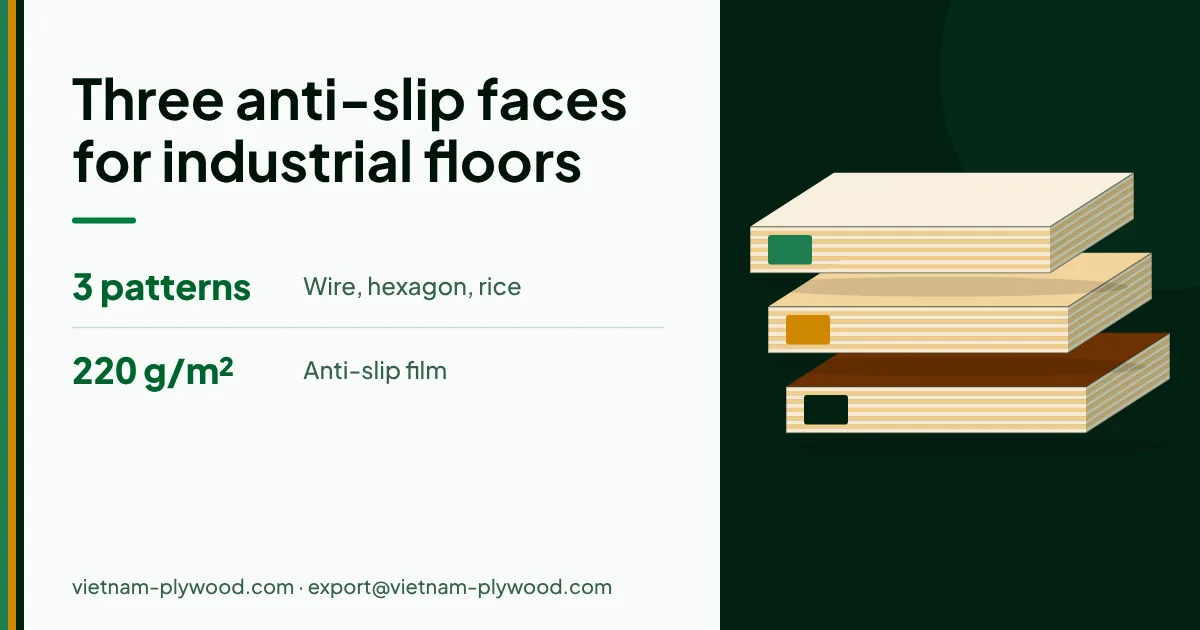
Mesh plywood is film-faced plywood with an embossed grid that provides surface texture for industrial walking and loading areas. HCPLY presses wire mesh, hexagon and rice-grain anti-slip faces on its construction line. The choice is governed by contamination, footwear, cleaning and wear, rather than the pattern name alone. A wrong face can mean extra cleaning shifts, premature replacement or a rejected flooring specification.
The film carries the embossed texture; the veneer core carries the panel’s structural demands. Wire mesh plywood is also called mesh faced plywood or wire mesh film faced plywood in procurement schedules. A square pattern anti slip plywood request usually describes a grid-like face, but drawings or physical samples settle the geometry. For the wider range, see anti-slip plywood from Vietnam.
How do wire mesh, hexagon and rice grain differ?
The three faces can be pressed over the same acacia or eucalyptus core, so the surface comparison need not change the core at the same time. The table gives selection hypotheses for trial, rather than laboratory rankings.
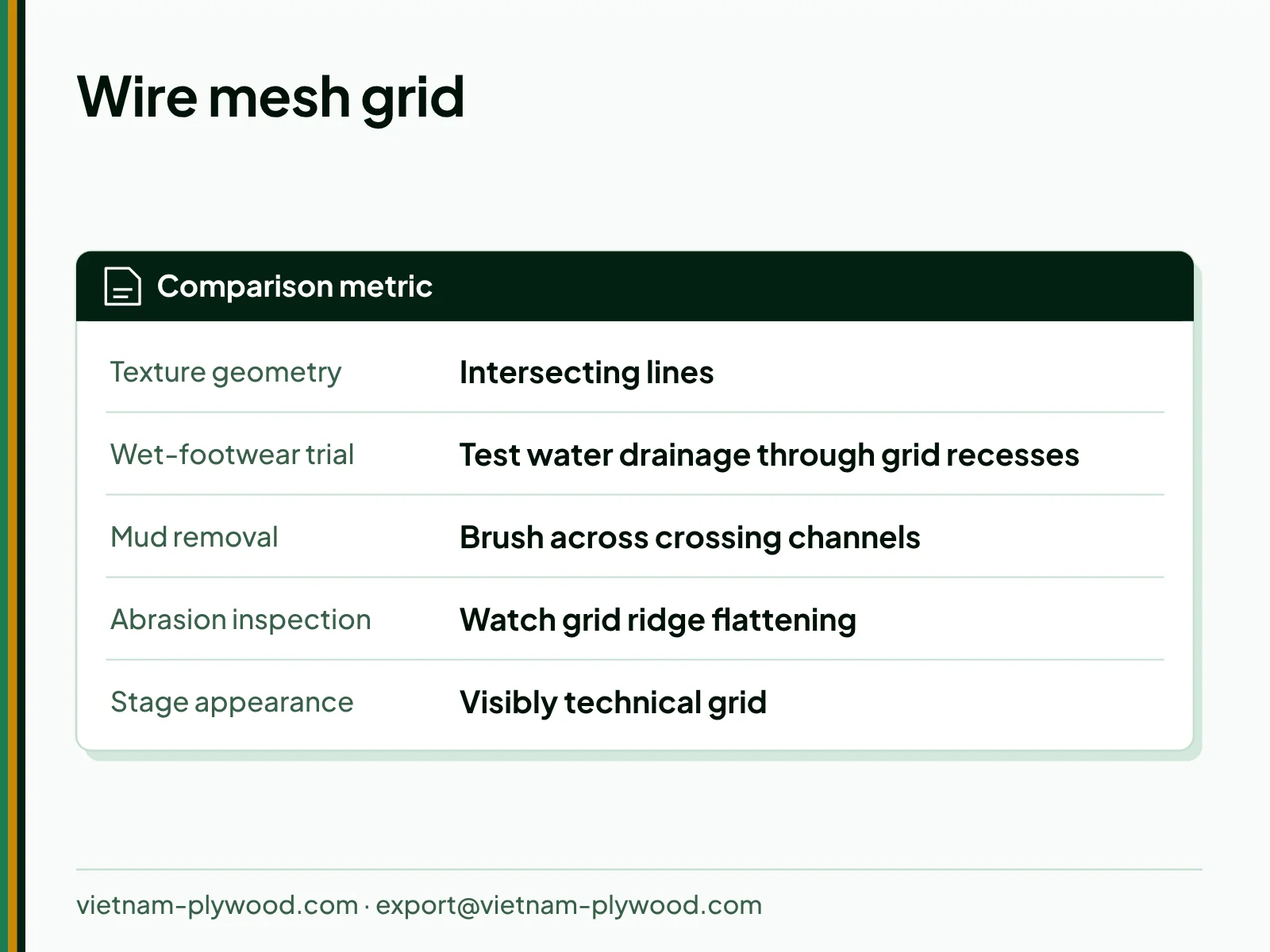
| Comparison metric | Wire mesh grid | Hexagon cells | Rice-grain emboss | Verdict by use |
|---|---|---|---|---|
| Texture geometry | Intersecting lines | Repeating six-sided cells | Separate grain-shaped marks | Match the buyer’s reference sample |
| Wet-footwear trial | Test water drainage through grid recesses | Test retained water in cells | Test water between raised grains | No winner without matching wet tests |
| Mud removal | Brush across crossing channels | Check residue at cell corners | Check gaps between grains | Trial rice first for frequent wash-down |
| Abrasion inspection | Watch grid ridge flattening | Watch cell-edge rounding | Watch grain-tip wear | Trailer trials: mesh or hex |
| Stage appearance | Visibly technical grid | Distinct geometric pattern | Finer distributed marks | Stage trials: rice |
| Scaffold deck use | Candidate with wet-grip evidence | Candidate with wet-grip evidence | Candidate with wet-grip evidence | Specify load and slip criteria separately |
Flooring applications explain the installation contexts; hexagrip specification covers the hexagon face in more detail.
Which pattern grips best when wet?
No pattern can be ranked first for wet grip without equivalent tests on the actual finished faces. Ask for the same test method, surface condition, footwear or slider, contamination and reporting units. A dry result cannot stand in for a wet ramp result.
The UK Health and Safety Executive’s contamination guidance explains that rainwater, oil and dust contribute to slips. This guidance concerns floor conditions rather than a slip rating for any plywood pattern.
A heavily textured face can still become slippery when its recesses fill with contamination. Request the test method and acceptance threshold in the purchase specification; see anti-slip plywood slip-resistance testing.
Which anti-slip face is easier to clean?
Rice-grain emboss is a useful first sample for frequent cleaning because its separated marks may allow brushes to reach between raised areas. That is a cleaning hypothesis to verify with the actual dirt, detergent and equipment. Hexagon cells can retain material at corners; wire mesh has intersecting grooves that deserve the same inspection.
The UK Health and Safety Executive explains on its contamination guidance that water, oil and dust contribute to slips and that cleaning itself can introduce hazards. Plan cleaning and drainage alongside the panel face.
Compare equal-size samples after the same mud, fine dust and oily-residue exposure. Record how much material remains in the texture, how the face looks after brushing, and whether water is left on the floor.
Which face suits trailers, ramps, stages and scaffold decks?
Trailer floors are sensible candidates for mesh or hexagon trials because they combine foot traffic with rolling cargo and abrasion. A ramp needs measured wet traction under its actual slope and contamination; geometry alone cannot authorize use. Stage decks may favor rice grain when frequent cleaning and a less pronounced visual pattern matter.
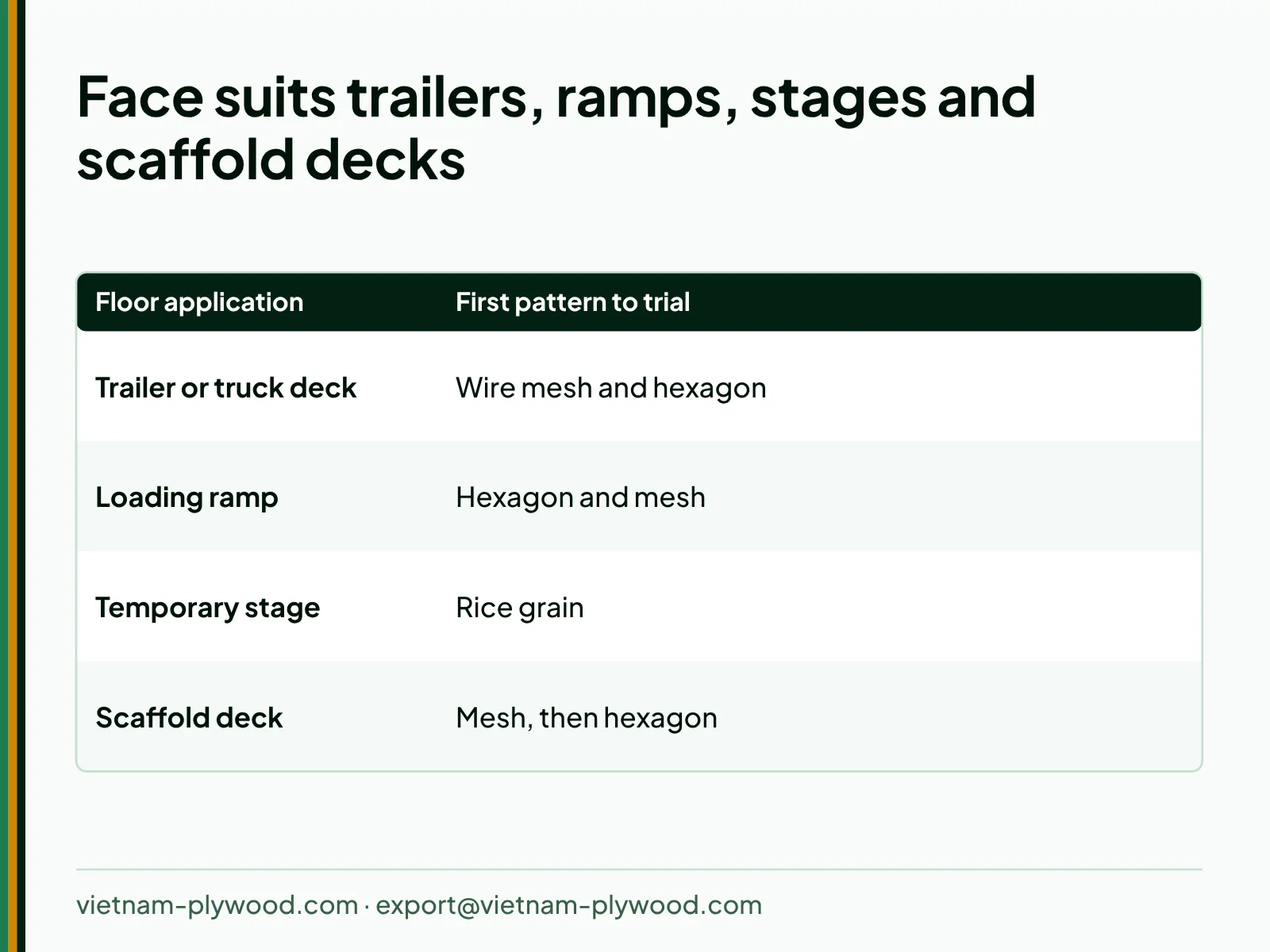
| Floor application | First pattern to trial | Acceptance evidence | Main maintenance watchpoint |
|---|---|---|---|
| Trailer or truck deck | Wire mesh and hexagon | Abrasion, wet grip, load design | Flattened texture and edge damage |
| Loading ramp | Hexagon and mesh | Wet-condition slip test at intended use | Water, oil and mud accumulation |
| Temporary stage | Rice grain | Footwear-specific grip and panel support | Residue and visible wear |
| Scaffold deck | Mesh, then hexagon | Platform-system load approval and wet grip | Fasteners, cut edges and loose panels |
Scaffolding systems need their own competent design and approval. For broader procurement, see plywood supply for construction projects.
Which HCPLY line presses these faces?
Our construction line presses the embossed film on an unsanded acacia or eucalyptus core. Our furniture line makes sanded, full-stitched styrax- or eucalyptus-core panels for interior work; our commercial and packing line makes acacia-core panels with moisture-resistant glue.
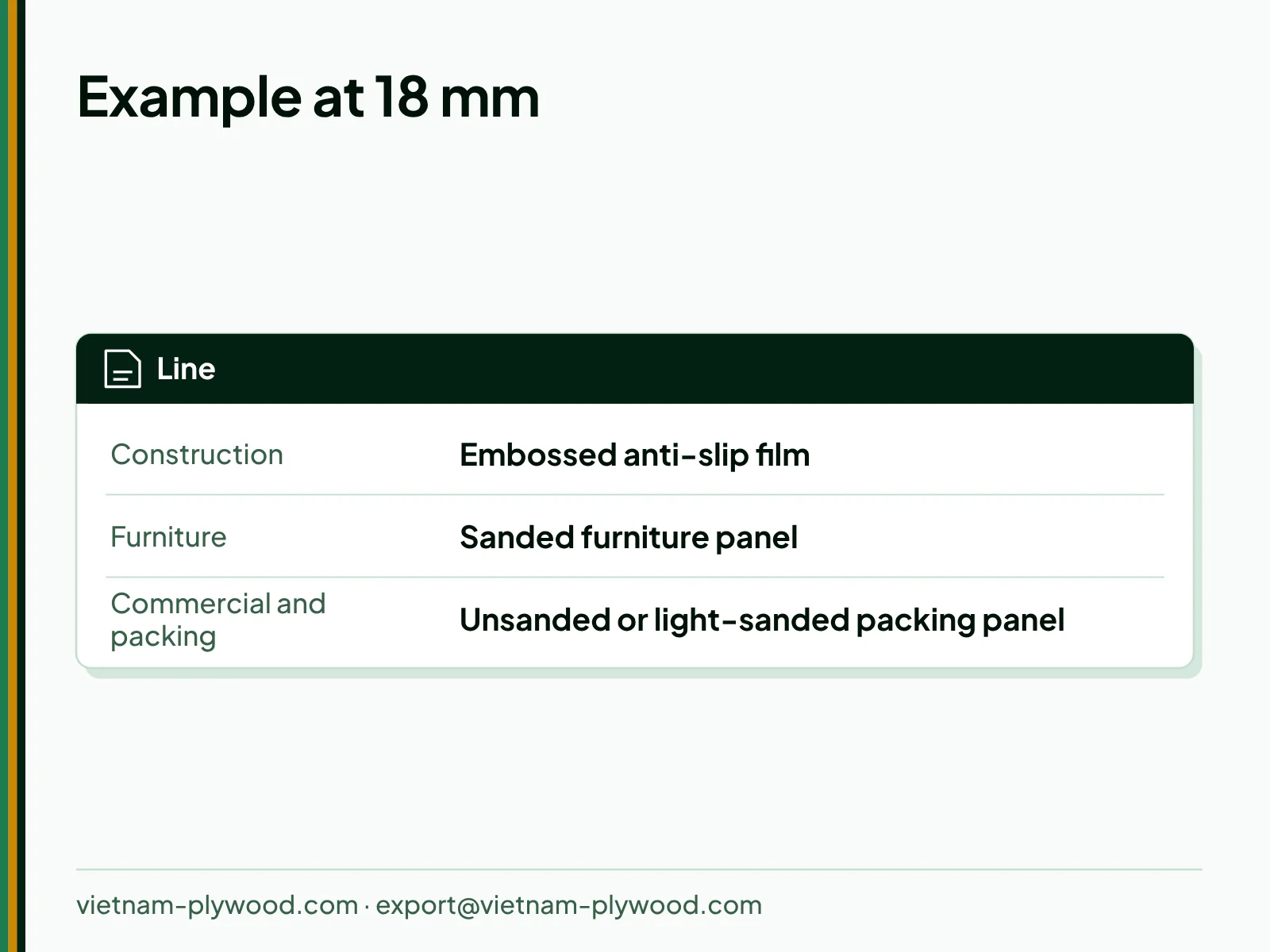
| Line | Example at 18 mm | Core and face | Appropriate decision |
|---|---|---|---|
| Construction | Embossed anti-slip film | Acacia or eucalyptus; wire, hex or rice | Specify traction and exposure |
| Furniture | Sanded furniture panel | Styrax or eucalyptus; veneer face | Choose for cabinet or furniture production |
| Commercial and packing | Unsanded or light-sanded packing panel | Acacia; raw or commercial face | Choose for protective packaging |
Our construction line uses 220 g/m² film for anti-slip faces. For the glue, specify melamine moisture-resistant (MR, 12-hour boil) or phenolic weather and boil proof (WBP, 72-hour boil). Glue and formaldehyde-emission class are separate fields. Film-faced thickness tolerance is ±0.5 mm, with length and width ±2 mm.
What should a floor-panel specification contain?
A usable specification fixes the pattern, core, bond, geometry and performance acceptance conditions before pressing. HCPLY can quote thicknesses from 3–40 mm and sizes including 1220 × 2440 mm and 1250 × 2500 mm, with custom cutting available. Select thickness from the floor’s supported span and loads.
For 18 mm construction panels, 11–13 plies is the core-veneer range. Core density follows the wood: acacia 580 kg/m³ and eucalyptus 650 kg/m³. The patterned film is a separate face characteristic; calling a panel phenolic mesh plywood describes a face-and-bond combination only when both are actually specified.
Do not substitute anti slip mesh phenolic birch plywood sheets for the construction build described here: we do not press birch-core plywood.
How do buyers inspect embossing and wear?
At the producing factory, an inspector can compare the pressed face with an approved reference sample and inspect texture continuity across each sheet. Check corners, edges, visible film defects and any flattened areas before packing.
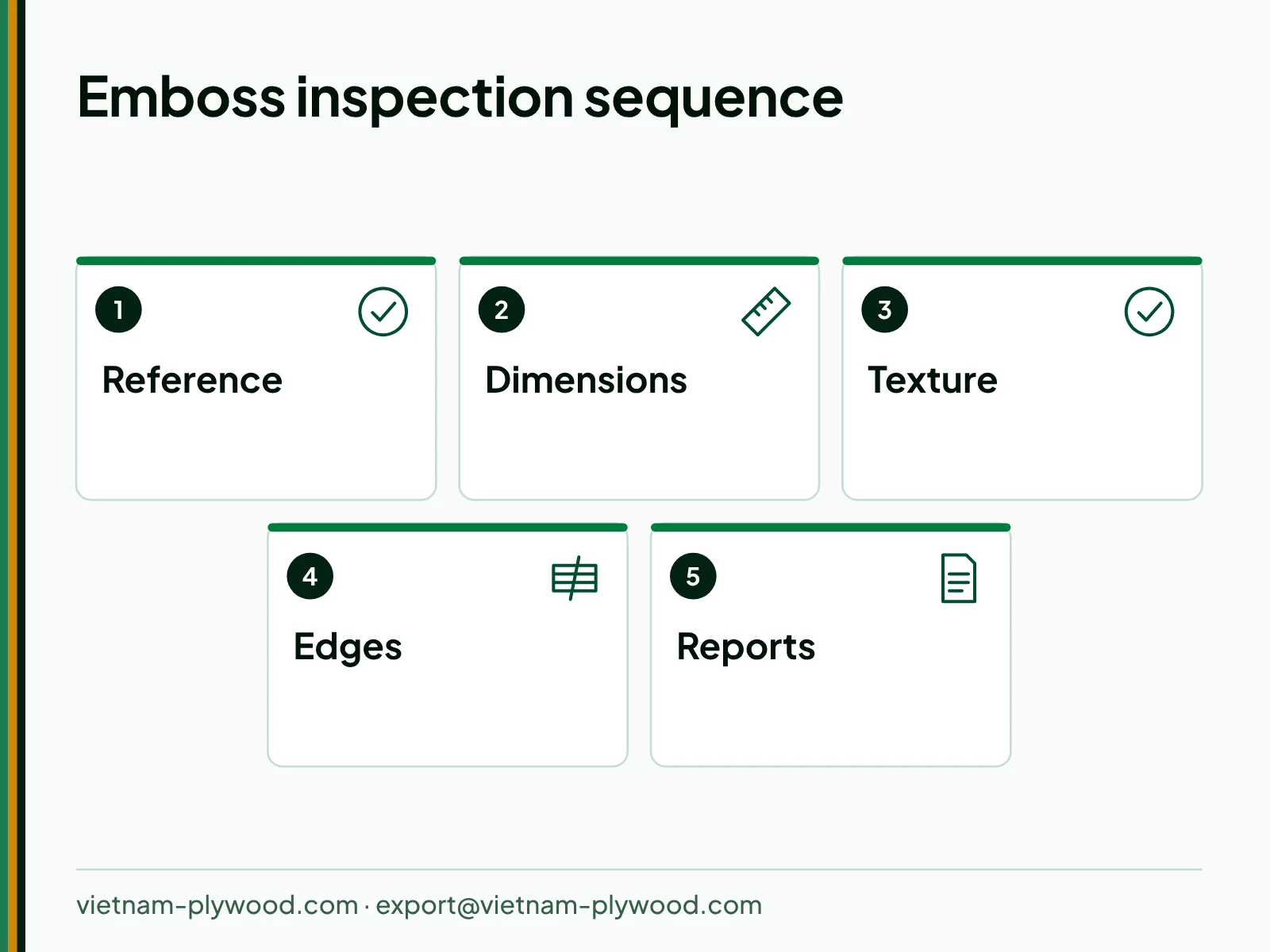
- Label approved wire, hexagon and rice reference pieces by pattern and batch.
- Measure thickness and dimensions against the written tolerances.
- Examine embossed ridges under side lighting and record photographs at consistent positions.
- Check sealed factory edges and specify resealing after field cutting.
- Match sample identifiers to any agreed slip, abrasion and bond test reports.
Ask for a laboratory report on the agreed build when the project calls for a numeric acceptance criterion. Factory-member certificates and relevant reports can be shown with factory details masked, on request.
Is anti-slip coating as good as embossed plywood?
A field-applied anti-slip coating and factory-embossed film are different flooring systems with different wear and repair schedules. Coating quality depends on substrate preparation, application and curing; embossed film arrives with its surface texture pressed into the panel. Neither should receive an automatic wet-grip ranking.
For a coating comparison, test the finished coated panel and the embossed panel under the same wet contamination. Include abrasion after traffic and how the maintenance crew repairs worn areas.
Ask the installer to document edge treatment, fasteners and any coating touch-up method. If a face is worn smooth, replace or repair it according to the approved floor-system procedure.
Can different patterns share one 40HC container?
Yes. Wire mesh, hexagon and rice-grain specifications can share a 40HC within the 28.5 t payload limit. The loading plan must distinguish core species, thickness, size and pallet count; a pattern change alone does not change the core-density arithmetic.
For 18 mm, 1220 × 2440 mm acacia-core panels, the lookup is 31.08 kg per sheet, 55 sheets per pallet and 880 sheets across 16 pallets, totaling 47.15 m³ and 27.35 t before film weight. For eucalyptus at the same size and thickness, the corresponding figures are 34.83 kg, 53 sheets per pallet and 795 sheets across 15 pallets, totaling 42.60 m³ and 27.69 t before film weight.
For a mixed-pattern acacia load, dividing those 16 pallets among the three face designs retains the 880-sheet core-only planning total when every pallet uses the same size and thickness. Actual film, packaging and loading details still need to fit the payload. See the container-loading calculation for other sizes and builds, and several plywood types in one order for mixed specifications.
What documents accompany the shipment?
The packing list identifies quantities, patterns and pallet marks against the approved order. The shipment also uses a commercial invoice, bill of lading, certificate of origin, phytosanitary and fumigation papers, and agreed test or emission documents. European Union lots include the applicable EUR.1 and EUTR/EUDR file set; insurance is included under cost, insurance and freight (CIF).
After loading, the draft shipping documents come to you for approval. HCPLY handles specifications, on-site quality control, documents and loading, with goods shipped directly from the producing factory. Available delivery terms are free on board (FOB) Hai Phong, cost and freight (CFR/CNF), or CIF.
The minimum order is one 40HC, with mixed specifications within the payload limit. Factory lead time runs 15–45 days from receipt of the 30% deposit; the exact figure depends on order size, line loading and what the contract fixes. The 70% balance is against the scanned bill of lading, by telegraphic transfer or irrevocable letter of credit at sight.
What should the buyer send for a pattern-specific quote?
Send a written floor duty and acceptance criterion before asking for a pattern price. Core species, glue, film pattern, thickness, size, order mix and test requirements drive the quotation; no universal price applies to these anti-slip builds. The buyer can request free samples, book the courier as a new buyer and have that courier cost credited against a real order.
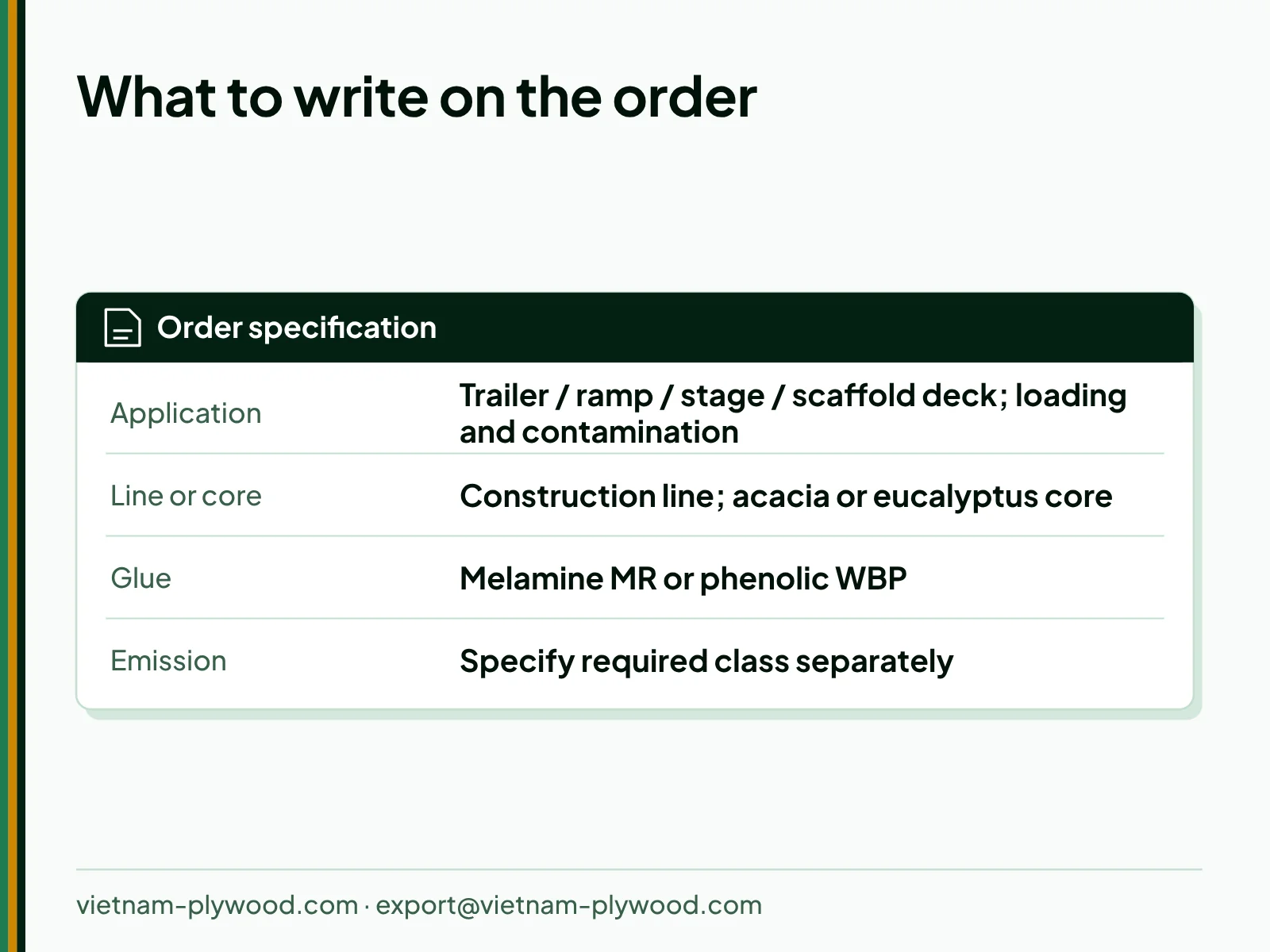
Use the following specification as an editable purchasing request.
Application: trailer / ramp / stage / scaffold deck; loading and contamination
Line or core: construction line; acacia or eucalyptus core
Glue: melamine MR or phenolic WBP
Emission: specify required class separately
Face and grade: 220 g/m² anti-slip film; wire mesh / hexagon / rice grain; approved reference
Thickness and tolerance: ___ mm; ±0.5 mm
Size: ___ × ___ mm; length/width ±2 mm
Quantity: ___ sheets by pattern and core; one 40HC minimum
Destination port: ___
Slip/abrasion acceptance: method, wet condition, threshold and report required
Request the pattern-specific specification sheet from Lucy at export@vietnam-plywood.com.