





HDHMR board vs plywood comes down to routed finish, fixing loads and moisture exposure: HDHMR can stay on decorative fronts, while HCPLY plywood builds suit selected cabinet structures. Choosing the wrong board can mean swollen edges, failed hinges and rejected cabinet parts. Indian importers should compare actual builds rather than treating HDHMR, MR plywood and BWP plywood as interchangeable labels.
What is HDHMR board?
HDHMR is high-density, high-moisture-resistance fibreboard: a refined wood-fibre panel engineered for humid interior applications. Its consistent fibre structure makes routing and painted profiles attractive to cabinet makers. Moisture resistance describes a tested property of a particular board; it does not mean that an exposed cut edge can remain wet indefinitely. HDHMR is a fibreboard category, whereas plywood uses bonded veneer layers. We do not press HDHMR or conventional MDF. For the broader material family, see wood board types for importers.
HDHMR board vs plywood: which is better?
HDHMR board vs plywood is a part-by-part decision. Keep HDHMR where a smooth routed face and consistent machining dominate; choose properly specified plywood where hinge fixing, repeated fastening, load-bearing cabinet construction, or wet-edge exposure matters. Compare actual board samples under the same hardware and moisture conditions before changing an established bill of materials. Neither name alone predicts the finished cabinet’s service life.
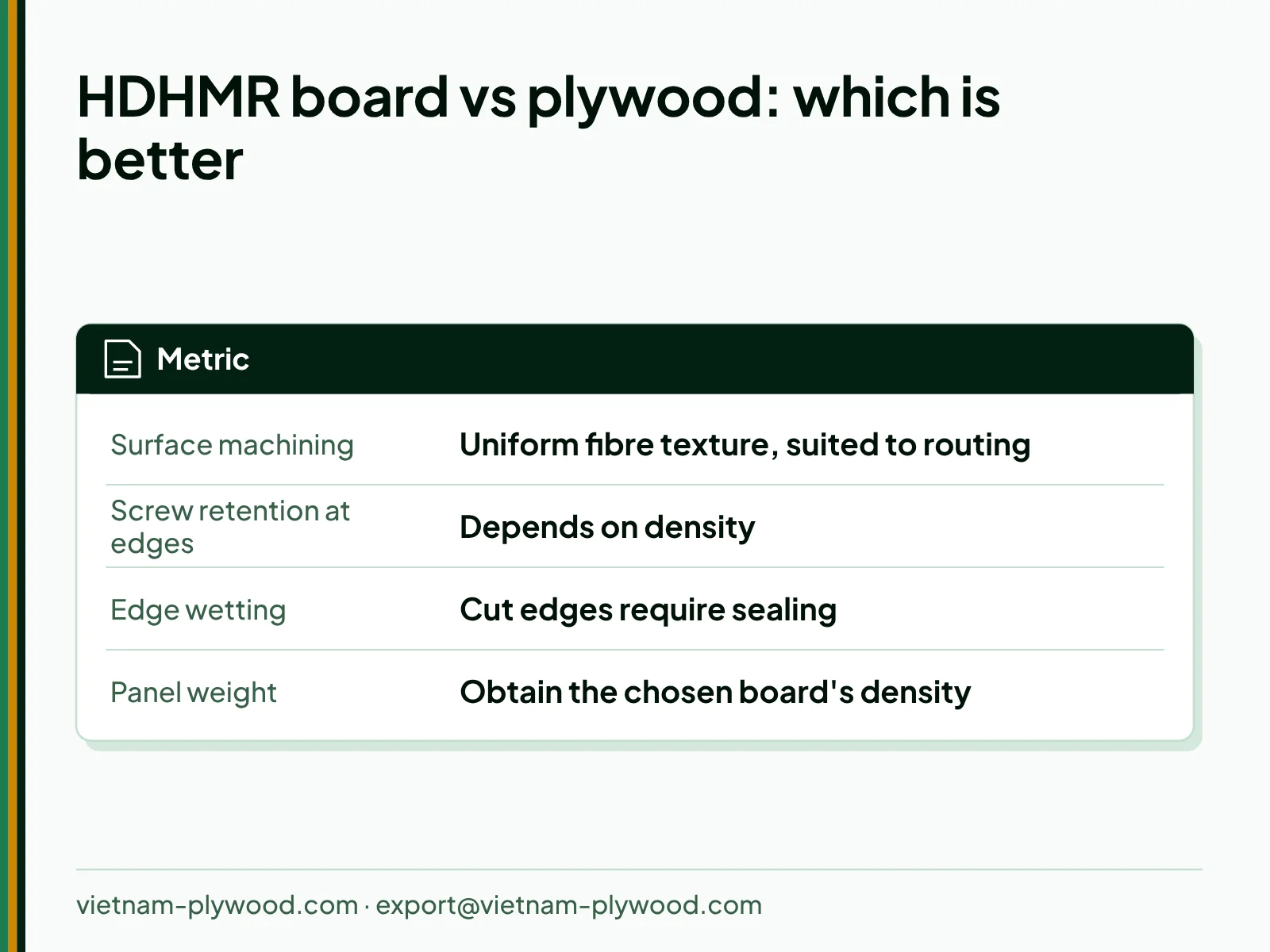
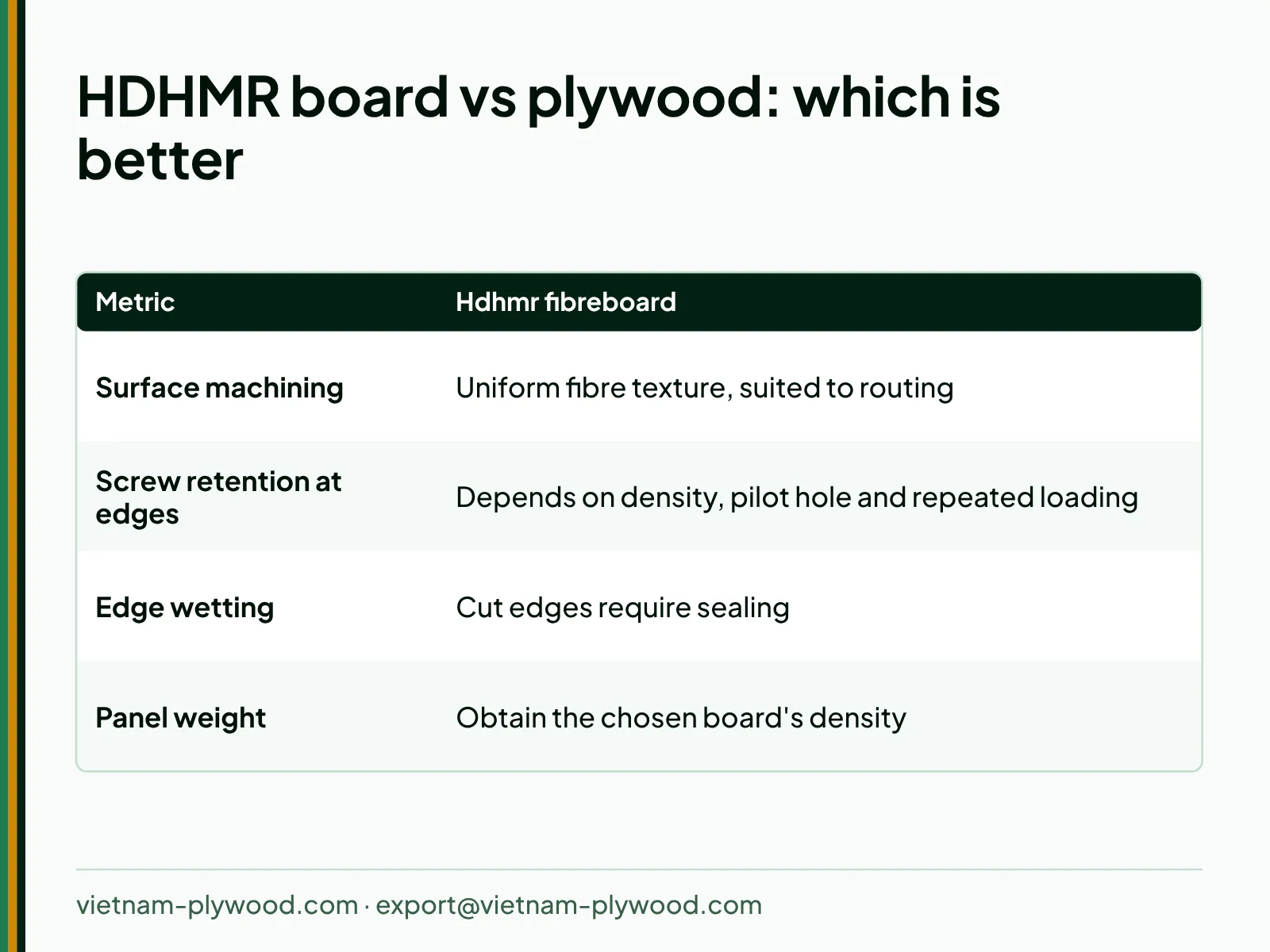
| Metric | HDHMR fibreboard | MR commercial plywood | Phenolic-bonded plywood | Verdict by use |
|---|---|---|---|---|
| Surface machining | Uniform fibre texture, suited to routing | Veneer grain and possible core variation | Veneer grain and possible core variation | HDHMR for intricate routed fronts |
| Screw retention at edges | Depends on density, pilot hole and repeated loading | Depends on veneer quality and edge construction | Depends on veneer quality and edge construction | Test plywood for hinge-heavy carcasses |
| Edge wetting | Cut edges require sealing | Cut edges require sealing | Bond withstands tougher wet exposure; wood still absorbs water | Phenolic build for splash-prone carcasses |
| Panel weight | Obtain the chosen board’s density | Acacia core 580 kg/m³ | Eucalyptus core 650 kg/m³ if selected | Compare shipping mass by actual build |
| Face finish | Smooth for paint and routed detail | Sanded furniture veneer or raw commercial face | Veneer face selected to finish plan | HDHMR for routed paint; plywood for veneer finishes |
| Bond specification | Ask for the board’s test report | Melamine MR, 12-hour boil specification available | Phenolic WBP, 72-hour boil specification available | Phenolic for more demanding moisture exposure |
| Purchase basis | Local board quote with grade and thickness | Export specification and volume | Export specification and volume | Compare landed cost per usable component |
Which holds screws better and swells less at the edges?
A well-built plywood edge often tolerates hinge and connector loads better than fibreboard, especially when fasteners are removed and reinstalled. That is a design tendency, not a numerical screw-withdrawal claim. Veneer gaps, loose core assembly, screw diameter, pilot-hole position and hardware pattern can reverse a simple material ranking.
Edge swelling is a separate test. Seal exposed edges and drill holes on both materials; compare thickness change after a defined wetting and drying cycle. Inspect for veneer delamination on plywood and fibre bulging on HDHMR. Record the test method and exposure duration alongside the result.
How does HDHMR compare with BWP plywood?
Boiling-water-proof (BWP) is a bond-performance term used in Indian panel purchasing. HDHMR describes a fibreboard construction and moisture-resistance positioning, so the two labels are not equivalent specifications. Our phenolic weather-and-boil-proof (WBP) adhesive has a 72-hour boil specification; buyers requesting an Indian BWP classification should specify an accepted independent test report against the required standard.
The Bureau of Indian Standards’ 2021 Indian Standards for Public Works Departments lists IS 303 for general-purpose plywood and IS 12406 and IS 14587 for medium-density fibreboards. These are distinct product-standard families. For sink-base structures, assess edge protection, fastening and exposure together.
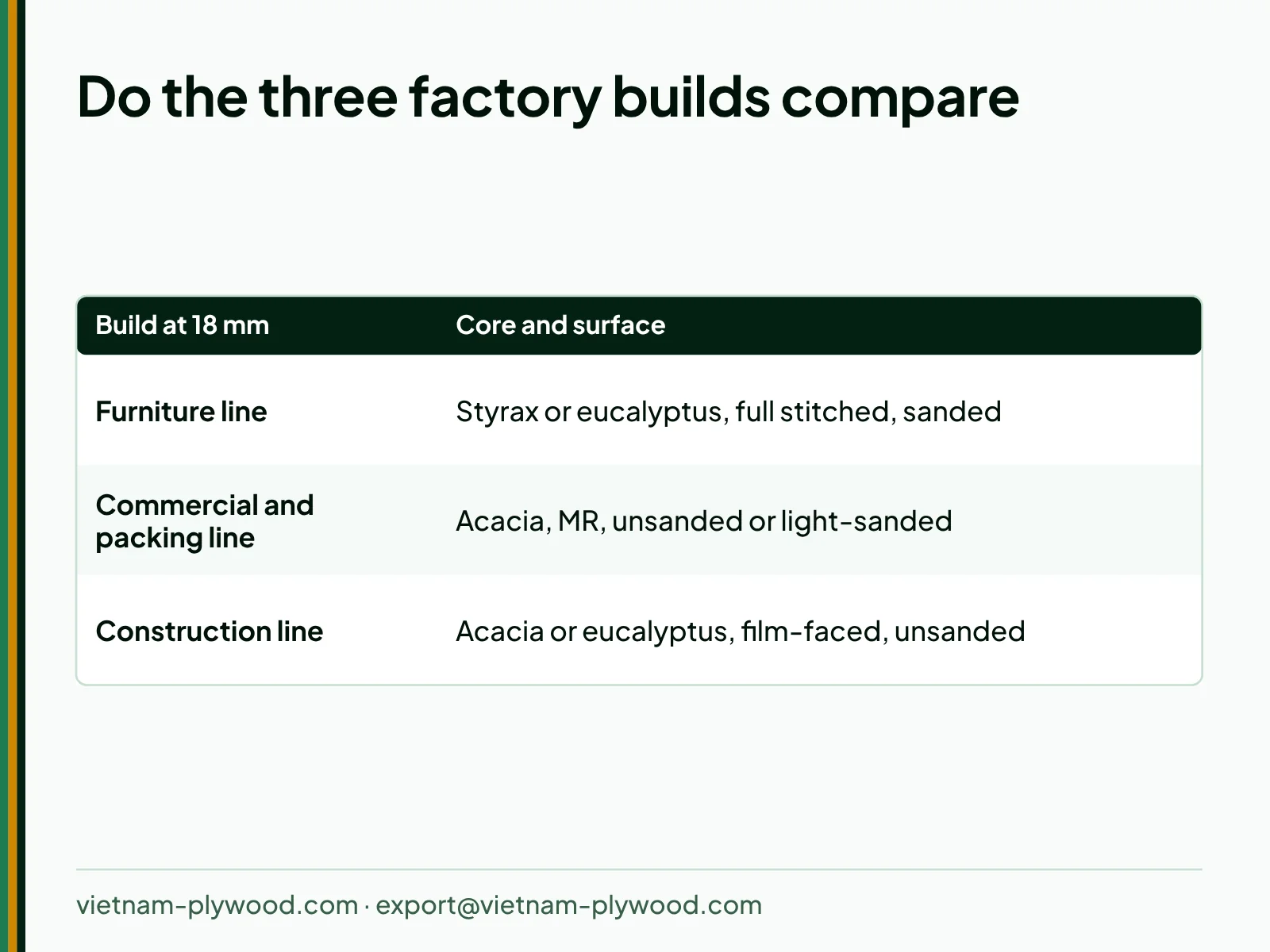
How do the three factory builds compare?
For a cabinet maker replacing selected HDHMR parts, our furniture line is the natural choice for full-stitched, sanded styrax or eucalyptus-core panels with E0 or E1 emission classes. Our commercial and packing line presses acacia-core MR plywood with an unsanded or light-sanded face. Our construction line makes phenolic- or melamine-film panels for formwork, rather than decorative cabinet fronts.
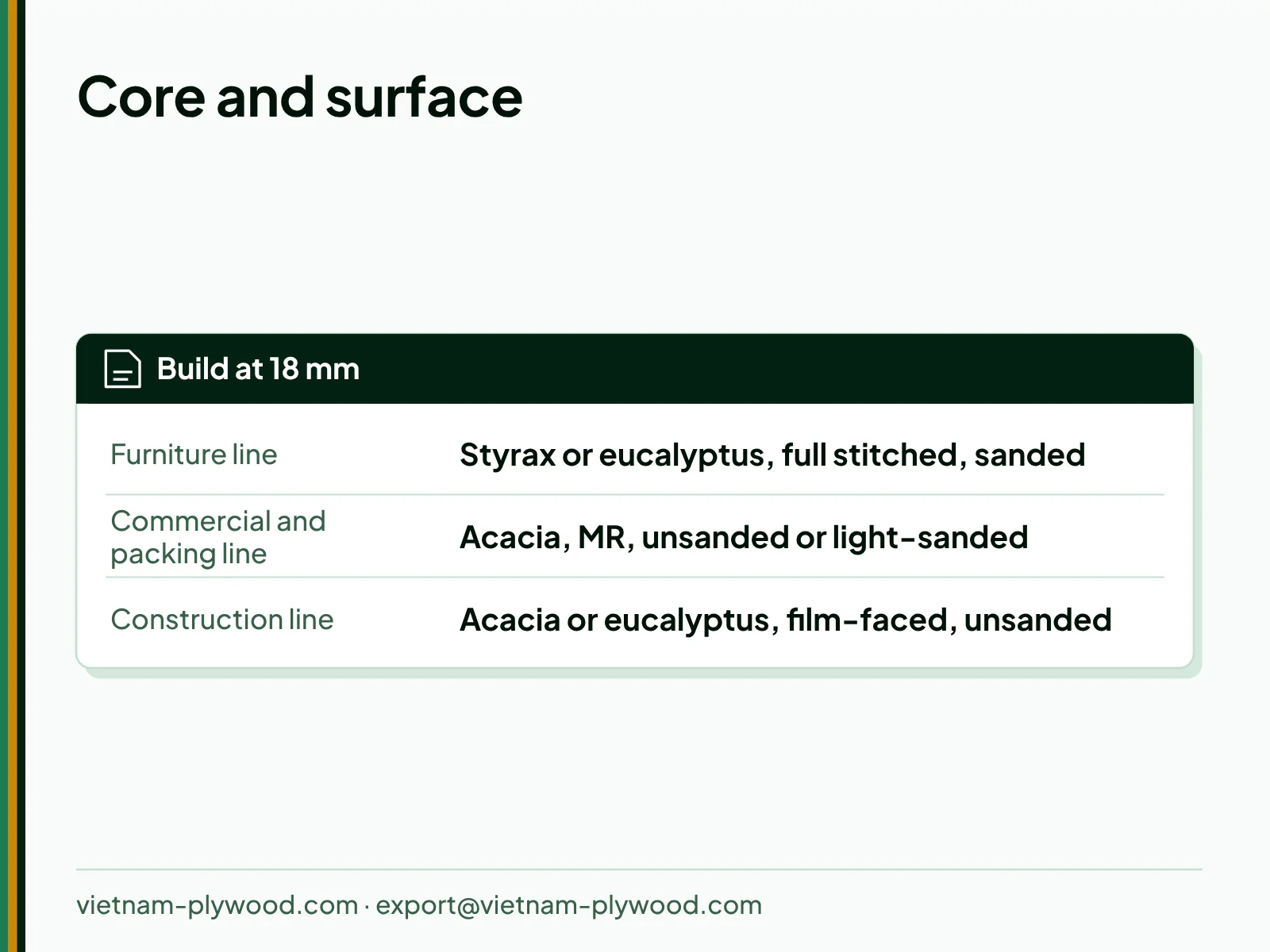
| Build at 18 mm | Core and surface | Thickness tolerance | Cabinet decision |
|---|---|---|---|
| Furniture line | Styrax or eucalyptus, full stitched, sanded | ±0.2 or ±0.3 mm as ordered | Visible cabinetry and accurate machining |
| Commercial and packing line | Acacia, MR, unsanded or light-sanded | ±0.5 mm | Concealed dry-area utility components after finishing review |
| Construction line | Acacia or eucalyptus, film-faced, unsanded | ±0.5 mm | Formwork, not the default cabinet replacement |
Specify core construction and surface finish rather than ordering an ambiguous “HDHMR plywood.” See furniture plywood and packing or commercial plywood for the respective constructions.
What does panel weight change in a container?
At 18 mm and 1220 × 2440 mm, a styrax-core sheet weighs 26.79 kg, acacia 31.08 kg and eucalyptus 34.83 kg. Full single-core 40HC loads are respectively 990 sheets at 26.52 t, 880 at 27.35 t and 795 at 27.69 t. These figures exclude film weight and use a 28.5 t payload limit.
Specifications can be mixed in a container within that payload limit. For a mixed load, request a pallet-by-pallet loading plan that accounts for packaging and the actual payload. Compare the HDHMR supplier’s declared density before assuming that a board of the same thickness has the same freight cost. The full loading method belongs to container packing.
How does commercial plywood compare with HDHMR?
Commercial plywood uses layered veneers and a specified adhesive, while HDHMR is a dense fibre panel. Acacia-core MR plywood from our commercial and packing line has a 580 kg/m³ core density and an unsanded or light-sanded finish. It can suit concealed, dry-use cabinet parts where surface appearance is secondary and edge construction passes inspection.
For a visible painted door with deep routing, retain HDHMR or evaluate a separate face-finishing process. For carcass sides, back rails and shelf supports, compare screw performance and panel flatness using the actual fastening schedule. See chipboard comparisons.
How do HDHMR and plywood compare on price?
Core construction, adhesive system, face grade and machining tolerance are the main plywood price drivers; full-stitched sanded furniture builds typically cost more to produce than basic unsanded MR commercial builds because of core preparation and finishing. Phenolic bonding adds a different performance requirement and cost input. HDHMR prices need a comparable local quote at the same thickness, dimensions, finish and quantity.
HCPLY’s commercial plywood starts from US$250/m³ FOB Hai Phong (October 2026), while furniture plywood starts from US$350/m³ FOB Hai Phong (October 2026). Those export starting points are not comparable to a domestic per-sheet retail ticket without freight, duties, taxes, cutting waste and rejected-part allowances. Ask for written quotations against the same finished-part schedule rather than treating the lowest board price as the lowest cabinet cost.
Which kitchen and wardrobe parts should keep HDHMR?
Keep HDHMR on routed, painted wardrobe doors and decorative profiles when the current board’s finish and machining performance meet the job. Consider full-stitched furniture plywood for hinge-heavy door frames, carcass sides, load-bearing shelves and fixing rails. For sink-adjacent cabinet parts, compare a phenolic-bonded plywood sample with sealed edges against the incumbent HDHMR board after defined moisture exposure.
Specify exposure, fastening frequency, span and finish for each part. A melamine or high-pressure-laminate surface is a separate facing decision, a separate facing category; see melamine-faced board comparisons.
How do MDF, HDHMR and plywood differ?
Conventional medium-density fibreboard (MDF) is made from bonded fibres; HDHMR is a higher-density, moisture-resistant fibreboard proposition within the broader fibre-panel family. Plywood is built from veneers with alternating grain directions. A fibreboard’s homogeneous face helps routed details, while veneer construction offers a different edge-fixing and bending response.
Compare material-specific test reports rather than assuming all MDF is unsuitable or all plywood is waterproof. For a related comparison, read HDF plywood versus MDF panels.
What can an importer inspect at the producing factory?
A buyer can witness thickness measurement across the panel, examine cut edges for core gaps, check sanding and face grade, and observe screw installation in sample components. For wet-area decisions, agree a test method and have the relevant samples identified before testing.
HCPLY handles specifications, on-site quality control, documents and loading. Buyers visit the factory office and inspect goods at the producing factory. Certificate material from member factories, including FSC, CARB P2, ISO 9001 and CE where relevant, is shown with factory details masked, on request. Emission class and adhesive specification should appear as separate fields in the order.
How should an importer specify the replacement order?
Start with a component schedule identifying each cabinet part and its service exposure. Request the exact core, bond, emission class, face and grade, nominal thickness, tolerance and sheet dimensions. For a 1220 × 2440 mm furniture panel, the sanded thickness tolerance can be ±0.2 or ±0.3 mm as ordered; length and width tolerance is ±2 mm.
Minimum order is one 40HC. Factory lead time runs 15–45 days from receipt of the 30% deposit; the exact figure depends on order size, line loading and what the contract fixes. The remaining 70% is paid on the scan of the bill of lading, by T/T, or by irrevocable sight L/C. We ship FOB Hai Phong, or CFR (CNF) or CIF to your port. The commercial invoice and packing list identify the shipped specification, and after loading, the draft shipping documents come to you for approval. Read one supplier, several plywood types for coordinating mixed builds.
What specification should the buyer send?
Send a part-level request that separates routed decorative faces from structural cabinet components. Lucy at export@vietnam-plywood.com can review the build and provide a spec sheet for the proposed replacement.
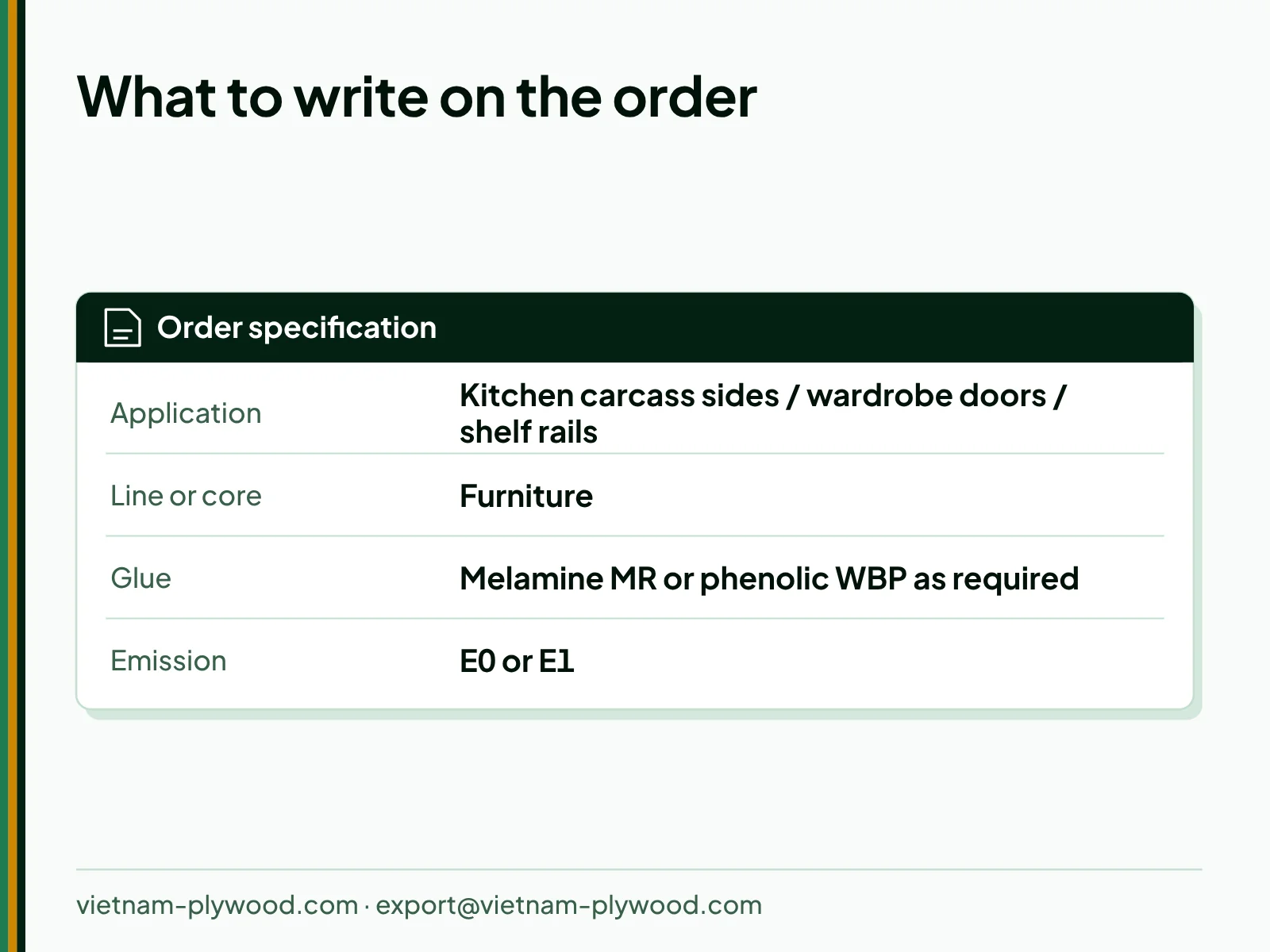
Application: kitchen carcass sides / wardrobe doors / shelf rails
Line or core: furniture; full-stitched styrax or eucalyptus
Glue: melamine MR or phenolic WBP as required
Emission: E0 or E1, stated separately from glue
Face and grade: selected veneer; A/B as agreed
Thickness and tolerance: 18 mm; ±0.2 or ±0.3 mm sanded
Size: 1220 × 2440 mm
Quantity: sheets and mixed-load allocation within one 40HC
Destination port: [Indian discharge port]