





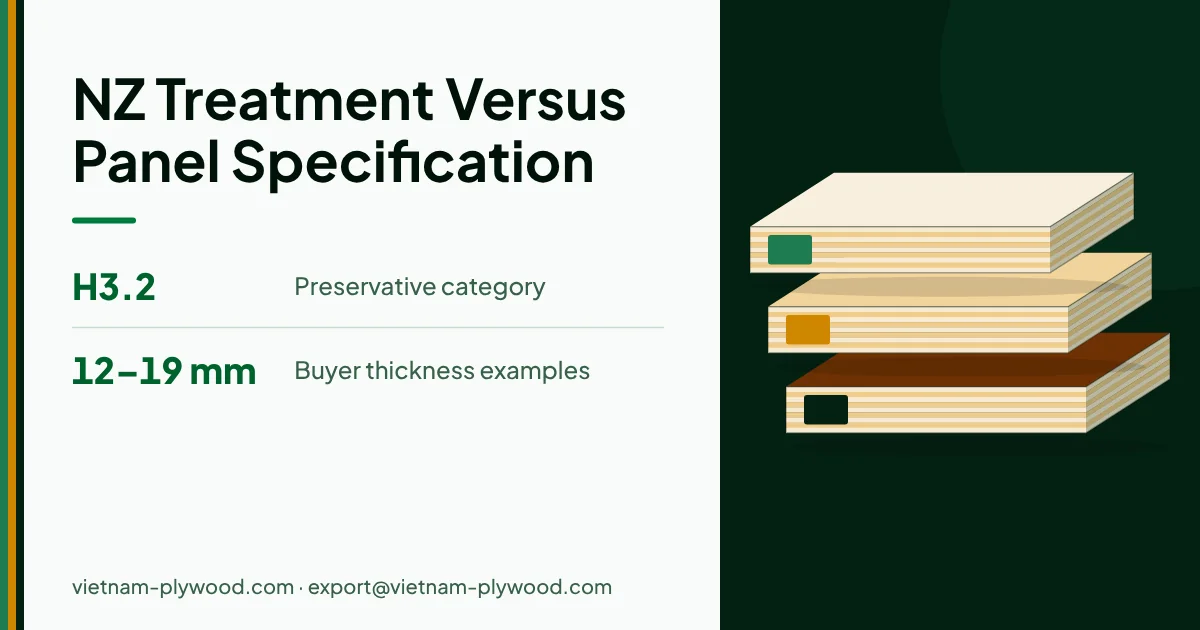
H3 and H3.2 treated panels for New Zealand and Australia must be specified by exposure, treatment evidence and structural use. A mistaken substitution can cost an importer a rejected shipment and weeks of replacement work. HCPLY manufactures exterior-glue and film-faced plywood, while a local H3.2 structural designation requires a separate accepted evidence package.
What does h3.2 plywood mean in New Zealand?
H3.2 plywood refers to plywood specified for a New Zealand above-ground exposure category where decay risk is higher, including weather exposure or trapped moisture. It is a preservative-treatment requirement, separate from structural grading, glue selection and sheet thickness. An importer needs evidence for each field before describing an imported sheet as H3.2 structural plywood.
New Zealand’s Ministry of Business, Innovation and Employment explained the H3.2 exposure category in its 2015 determination on treated engineered timber: above-ground timber exposed to weather or moisture entrapment, including critical structural uses. That determination distinguishes this hazard class from a strength grade. For plywood specifically, Standards New Zealand and Standards Australia describe treatment penetration and retention requirements in AS/NZS 1604.3:2012.
HCPLY makes plywood through its own production lines, but its ordinary exterior-glue construction sheet must not be ordered as an H3.2-treated or locally structural-graded product without a separately accepted treatment and structural evidence package. Begin with the exterior plywood specification and define the end use.
Which applications actually require treated structural sheets?
The building application determines the treatment class and structural evidence, rather than the word “exterior” on an invoice. Exposed decking substrates, weather-facing cladding, bracing and membrane substrates raise different questions about design, fixings, moisture and treatment.
A New Zealand specification should identify the relevant building consent pathway, design documents and accepted product evidence. An H3.2 designation alone cannot establish bending strength, stiffness, bracing capacity or fastening performance. Australian project requirements and accepted standards need a separate check.
For a temporary formwork application, our construction line can press a film-faced panel to a defined glue and core build. For permanent regulated structural work, obtain a project-accepted structural report and preservative-treatment evidence before proposing a substitute.
How do H3.2, exterior glue and structural grade differ?
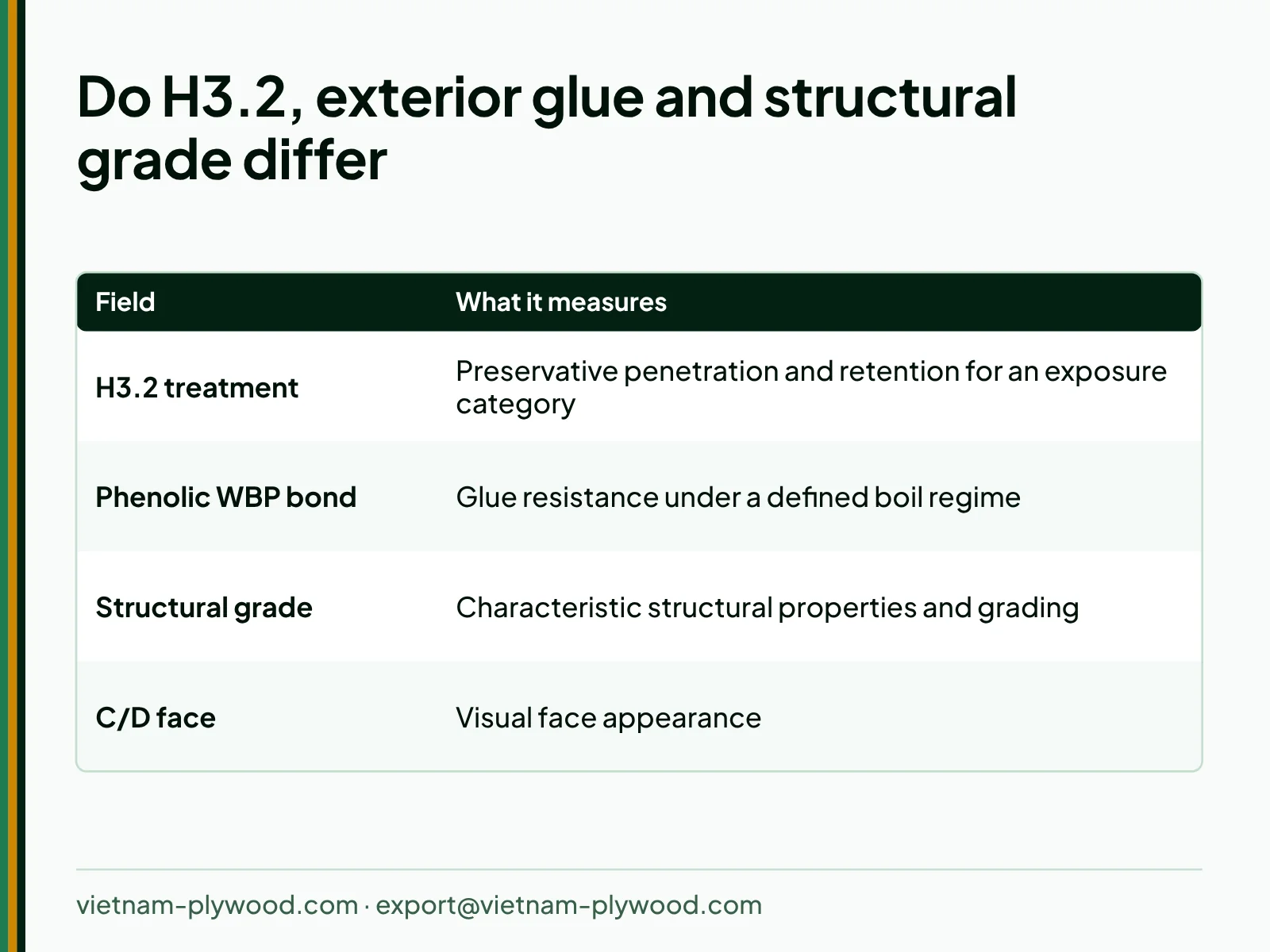
These three descriptions answer different procurement questions. Keep them as separate fields on the purchase order and inspection sheet.
| Field | What it measures | Evidence to request | Buying verdict |
|---|---|---|---|
| H3.2 treatment | Preservative penetration and retention for an exposure category | Treatment record and relevant testing | Required where the design specifies H3.2 |
| Phenolic WBP bond | Glue resistance under a defined boil regime | Agreed bond test report | Useful for wet service, but not a treatment certificate |
| Structural grade | Characteristic structural properties and grading | Accepted structural test and grading documents | Required for load-bearing design |
| C/D face | Visual face appearance | Face grading inspection | Does not replace structural or treatment evidence |
| Thickness | Nominal panel section and tolerance | Caliper readings against the order | Does not establish load capacity |
For deeper treatment terminology, read the pressure-treated plywood guide. A “marine” label is another separate specification; see how to buy marine plywood.
Can buyers order 12 mm, 18 mm or 19 mm panels?
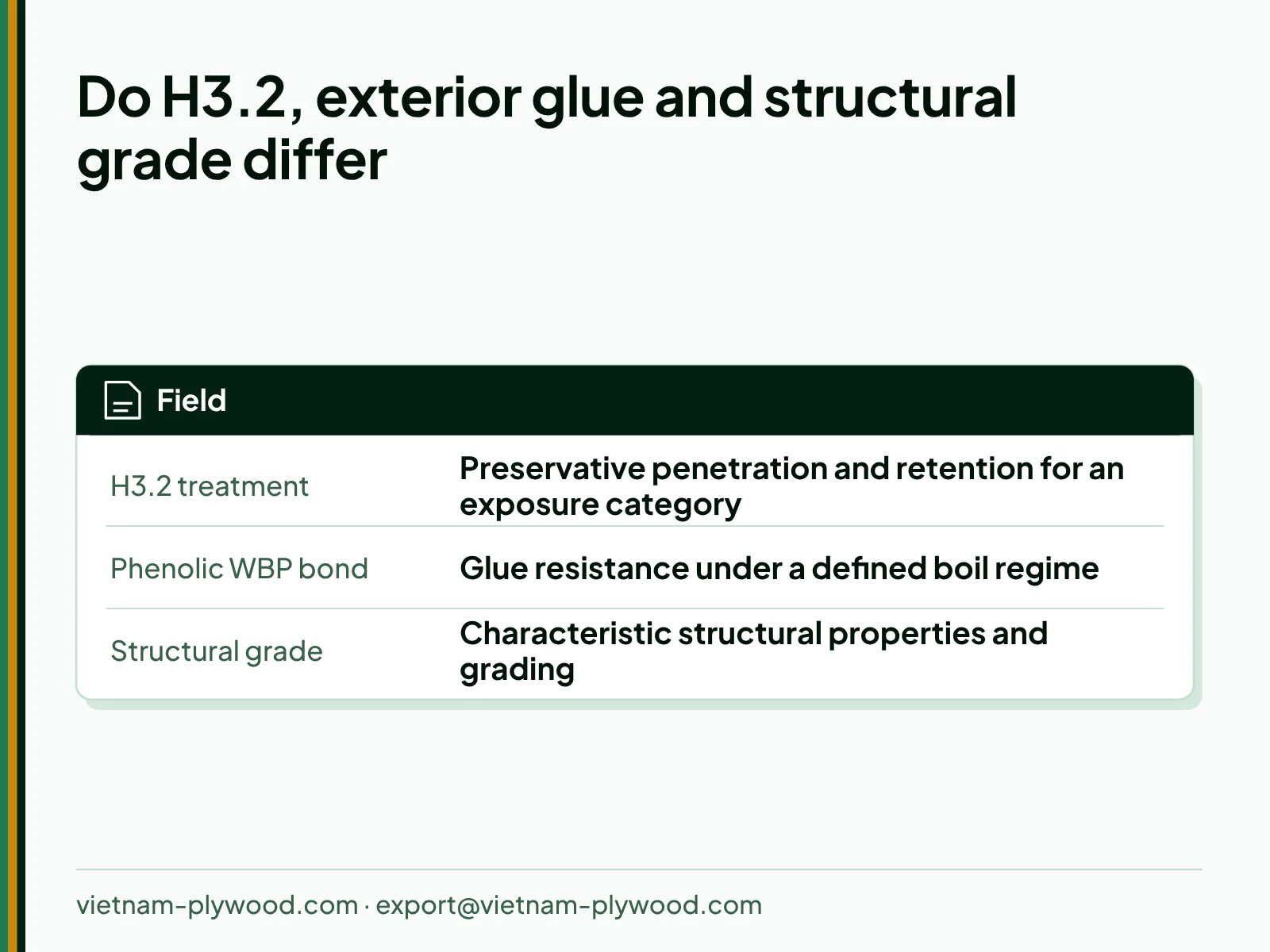
HCPLY’s listed common thicknesses include 12 mm and 18 mm, while 19 mm can be specified within its 3–40 mm thickness range. None of these dimensions by itself creates an H3.2 or structural-grade designation.
At 12 mm, 1220 × 2440 mm acacia-core commercial plywood has a calculated sheet weight of 20.72 kg. At 18 mm, the same acacia core weighs 31.08 kg per sheet. These are core-based planning weights; preservative loading and film are outside that calculation.
Local stockists advertise different sheet formats. Our standard list includes 1220 × 2440 mm and 1250 × 2500 mm, with custom cutting available. Buyers seeking exact local replacement dimensions should put finished length, width and tolerance in writing, rather than converting a nominal imperial or metric label.
Which HCPLY line fits the intended exposure?
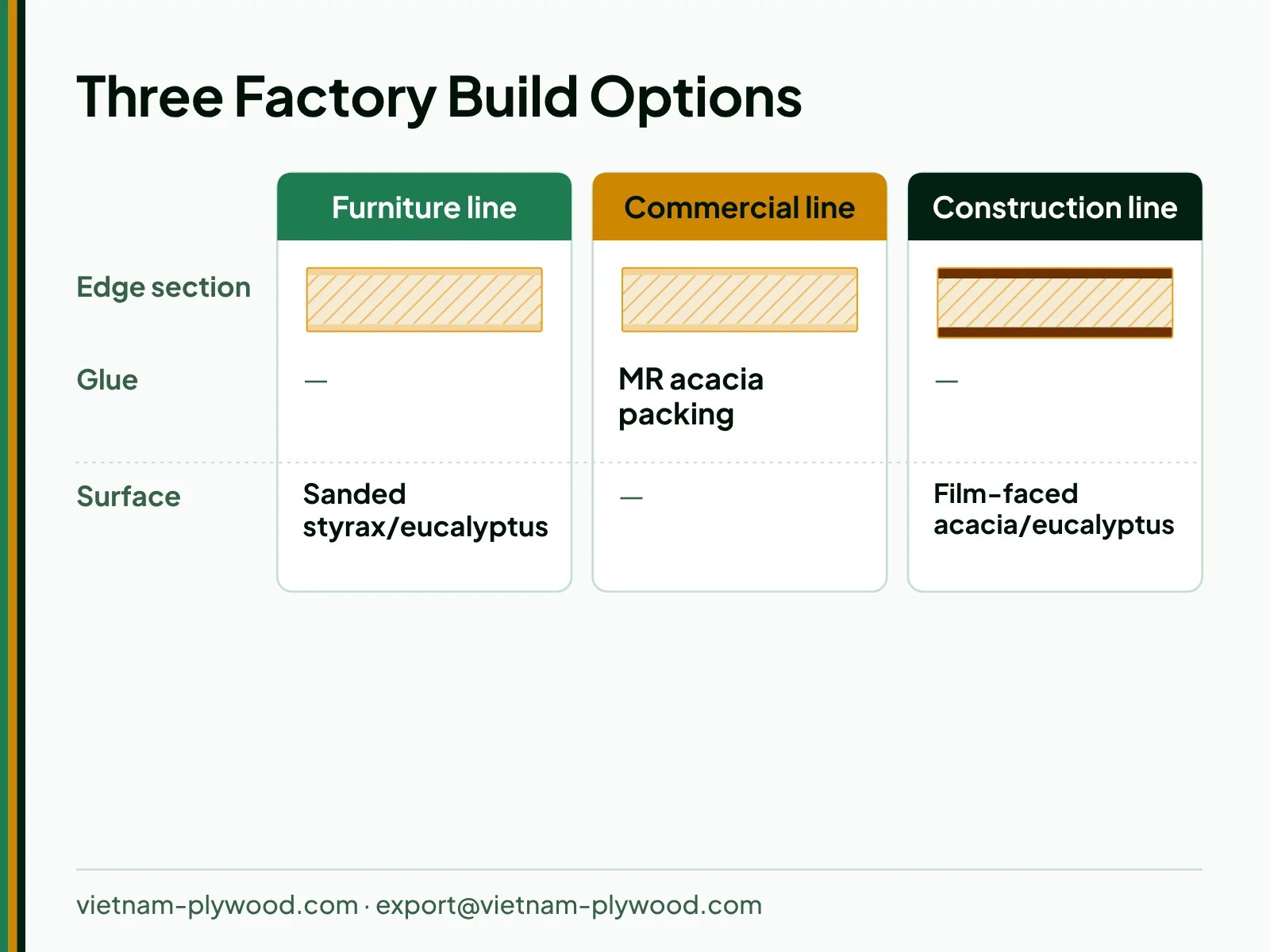
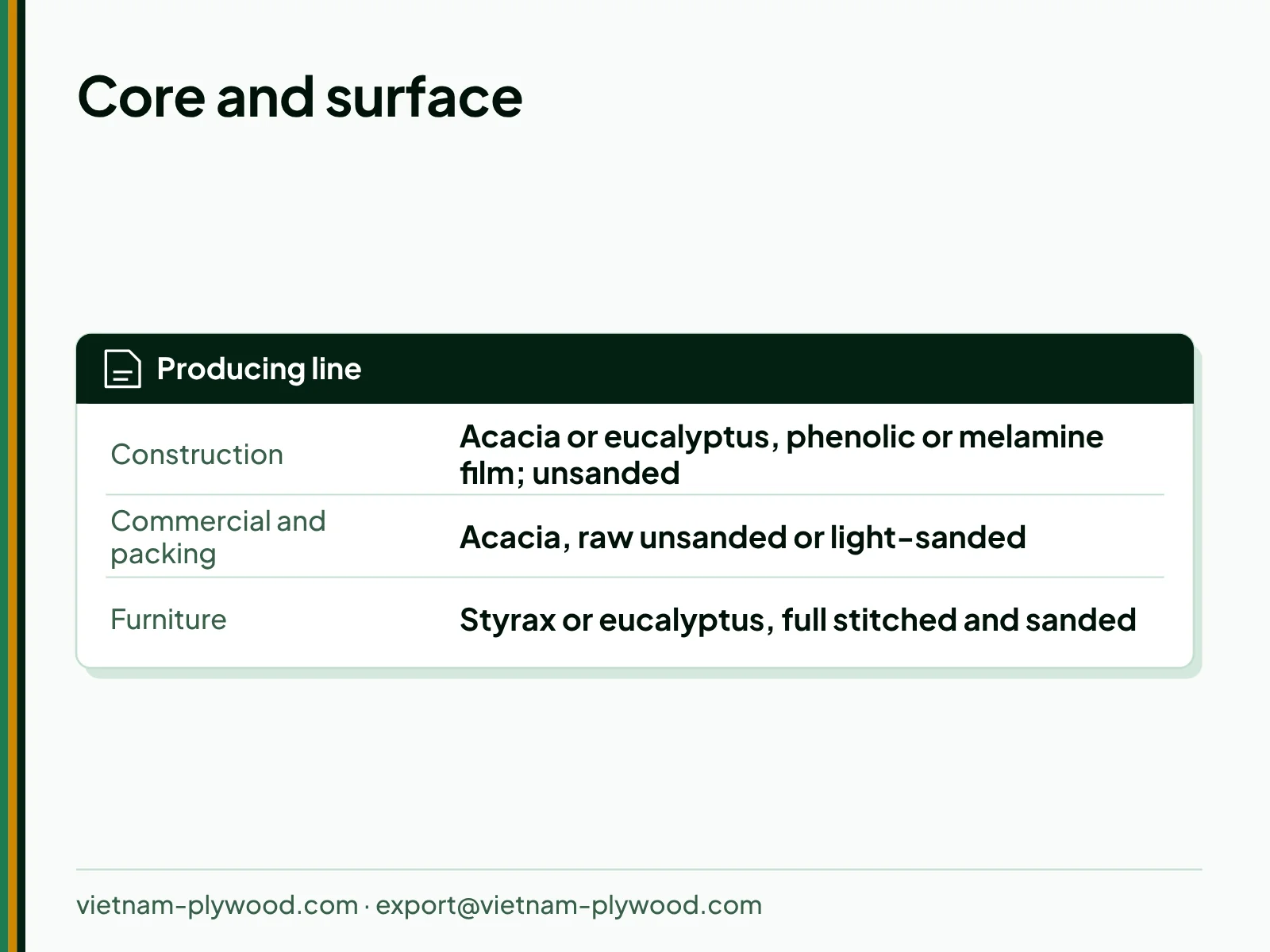
Our construction line is the starting point for a weather-exposed temporary formwork specification; our commercial and packing line is appropriate for non-structural packing where moisture exposure is controlled. Our furniture line instead builds a sanded interior-oriented face and core specification.
| Producing line | Core and surface | Glue or finish choice | Appropriate procurement discussion |
|---|---|---|---|
| Construction | Acacia or eucalyptus, phenolic or melamine film; unsanded | Phenolic WBP or melamine MR as ordered | Temporary formwork, release surface and edge protection |
| Commercial and packing | Acacia, raw unsanded or light-sanded | MR | Packaging, crating and non-structural panels |
| Furniture | Styrax or eucalyptus, full stitched and sanded | Ordered glue; E0/E1 emission field | Cabinet and fit-out components away from direct wet exposure |
HCPLY does not press pine-core structural sheets or assign an AS/NZS stress grade. A local H3.2 C/D pine structural product and a Vietnamese acacia-core film-faced panel should therefore be treated as different purchase specifications.
What must a pressure-treatment supplier prove?
A pressure-treatment supplier should document the preservative system, treated product identity, penetration, retention, sampling and test method. A statement that a panel has phenolic glue cannot stand in for those records.
The 2012 AS/NZS 1604.3 plywood treatment standard, listed by New Zealand’s Building CodeHub, covers preservative penetration and retention as well as bond type. Its published scope explicitly says that it does not cover grade or seasoning condition. For a New Zealand project, ask the design professional or approving party which edition and evidence route they accept.
Request traceability from the actual treatment batch to the bundles delivered. If an importer intends post-manufacture treatment, agree who is responsible for process validation, compatibility, re-testing and the final product description before purchase.
How should a buyer compare New Zealand supplier listings?
Compare the application and evidence package before comparing advertised sheet prices. Local listings can bundle treatment, structural grading, face grade and ready-stock dimensions that an export factory quote does not automatically include.
A New Zealand retail listing examined for this comparison offers C/D H3.2 treated pine structural plywood in several nominal thicknesses, including 12 mm and 18 mm. Another established local product listing separates structural compliance, H3.2 CCA treatment and C/D surface grades. These categories are useful purchasing checks.
For 19 mm H3.2 requests, ask whether the requirement is truly 19 mm finished thickness, a nominal local trade size or an engineered design calling for a particular stiffness. The answer changes the required checks.
What tolerances and face details belong on the order?
State the finished thickness, face appearance, core, glue, emission class and intended treatment independently. For commercial and film-faced panels, HCPLY’s thickness tolerance is ±0.5 mm; packing panels are ±0.5–1.0 mm. Length and width tolerance is ±2 mm.
Construction film choices are 120 g/m² standard, 135 g/m² premium or 220 g/m² anti-slip. These weights describe the film facing and do not quantify preservative treatment. A raw commercial face is different from a C/D structural face classification used in local trade listings.
At the producing factory, a buyer can witness caliper readings, size checks, core-edge inspection and bundle identification. For an H3.2 claim, those physical checks must be supplemented by the agreed independent treatment evidence.
What can fit in one 40HC container?
An 18 mm, 1220 × 2440 mm acacia-core shipment has a planning capacity of 880 sheets, 47.15 m³ and 27.35 tonnes. The corresponding eucalyptus-core construction option is 795 sheets, 42.60 m³ and 27.69 tonnes. These figures exclude film weight and use a 28.5-tonne payload limit.
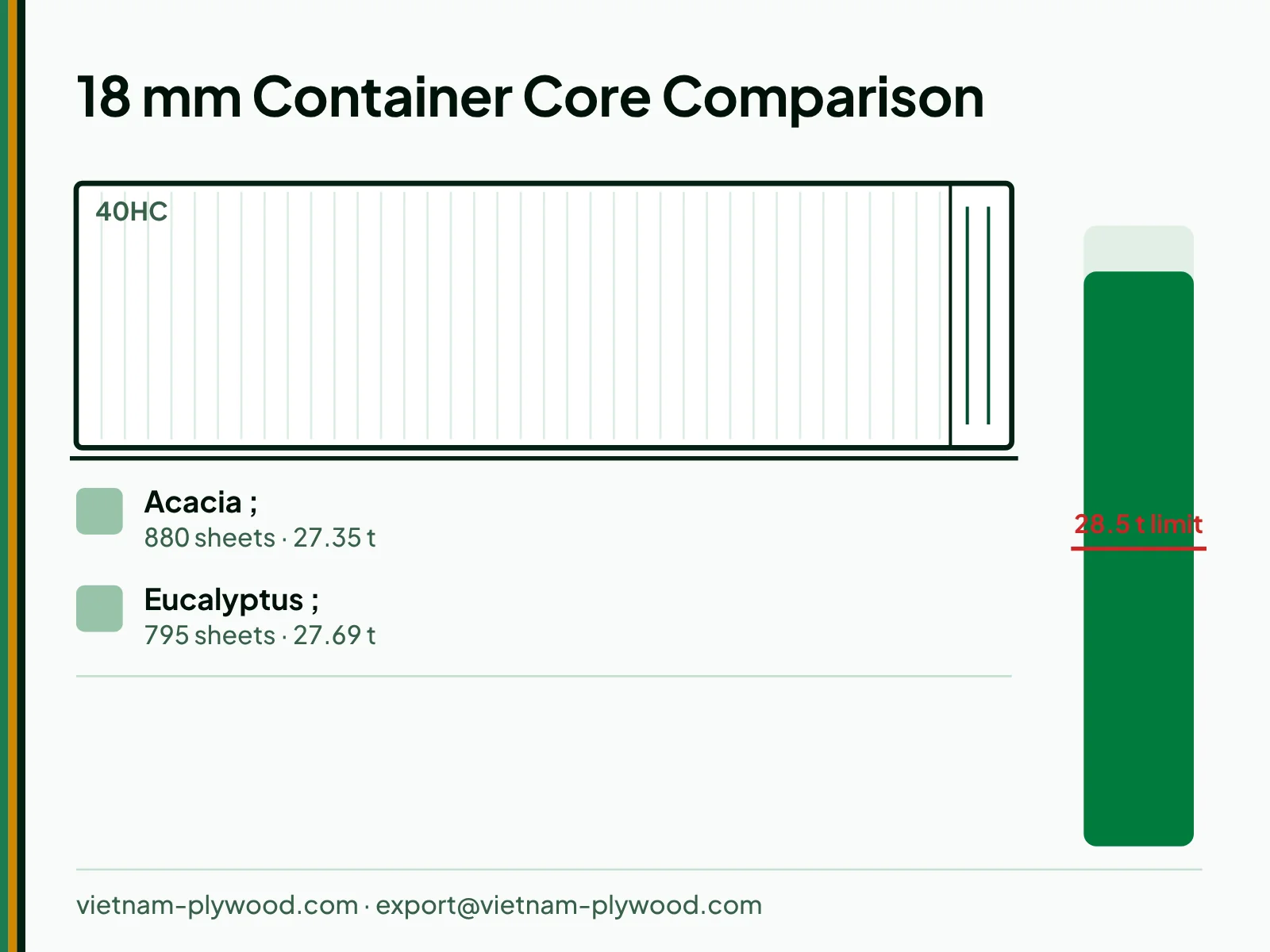
Different specifications can share a 40HC if the combined load stays within the payload limit and the packing plan works. For example, two acacia pallets at 55 sheets each account for 110 sheets and approximately 3.42 tonnes using 31.08 kg per sheet; the balance must be planned against the remaining weight and floor space.
For the full pallet calculation and other thicknesses, see container loading calculations. HCPLY ships FOB Hai Phong, with CFR (CNF) or CIF also available.
Which factory and shipping checks matter?
The inspection should match the approved order to actual bundles and to the export paperwork. Our on-site QC covers the build, loading and document preparation at the producing factory.
Inspectors can witness thickness measurements, face condition, edge construction, pack marks and container loading. Ask for test reports covering the agreed build when the application calls for bond or structural testing; treatment and local structural acceptance require their own evidence route.
The shipment documents include an invoice, packing list, bill of lading, origin certificate, phytosanitary and fumigation papers, and order-specific evidence. Insurance is included under CIF. After loading, the draft shipping documents come to you for approval.
How should importers request quotations and samples?
A useful request identifies the exact end use before naming a treated grade. Where a New Zealand H3.2 structural specification is mandatory, request the acceptance evidence first; where the application is non-structural or temporary, specify the relevant HCPLY build directly.
The minimum order is one 40HC, with mixed specifications permitted within its payload limit. Production takes 15–45 days after a 30% deposit, depending on quantity, production conditions and agreement; the 70% balance is against the scanned B/L by T/T or irrevocable L/C at sight. Samples are free; new buyers book their courier, and that courier cost can be credited against a real order.
Treatment, grade evidence, thickness, core and shipment mix drive a tailored quotation. The production lead-time explanation helps buyers coordinate approval and loading.
What should the first trial order say?
The first trial order should describe a single application and the documents needed to release that application in the destination market. For H3.2 structural work, hold the specification at the evidence-review stage until treatment and structural acceptance are established.
Send Lucy the intended use, drawing references, thickness, face, core, glue, treatment requirement and destination. HCPLY can then discuss a suitable manufacturing line and inspection scope without substituting an exterior-glue panel for a certified treated structural product.
Application: [temporary formwork / non-structural packing / NZ structural use requiring H3.2]
Line or core: [construction—acacia/eucalyptus / commercial—acacia / furniture—styrax/eucalyptus]
Glue: [phenolic WBP / melamine MR, as specified]
Emission: [E0 / E1 / E2, as specified]
Face and grade: [film weight or veneer species and face grade]
Thickness and tolerance: [12 / 18 / 19 mm; stated finished tolerance]
Size: [length × width in mm]
Quantity: [sheets and container mix]
Destination port: [New Zealand or Australian port]
Treatment/structural evidence: [project-accepted requirements, where applicable]
Plan a trial container with Lucy at export@vietnam-plywood.com through the contact page.