





What plywood is used for flight cases?
Flight case panels are usually plywood skins captured by aluminium extrusions, with hardware loads transferred through reinforced fixing points. A wrong substrate can tear at a rivet, waste finished skins and delay an accepted shipment. HCPLY presses sanded, full-stitched styrax- or eucalyptus-core panels on our furniture line; builders apply their own skins and hardware.
Road case plywood must work as a complete assembly. Panel bending, the extrusion channel, corner fittings, rivet spacing and handle backing all affect service performance. Ask for a core-construction description and inspect the edge before committing to a batch.
For related industrial sheet applications, see industrial plywood uses. The choice here concerns an unlaminated plywood substrate for professional case production, rather than a finished case panel with factory-applied plastic or decorative skins.
Which light panels suit road-case builders?
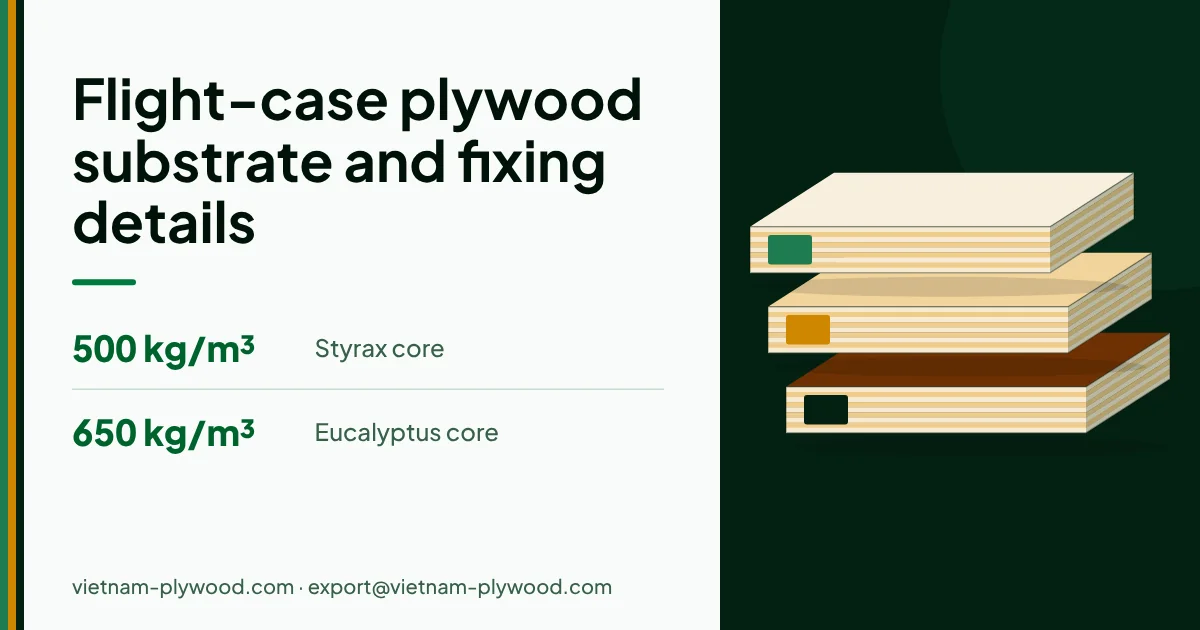
Our furniture line offers full-stitched, sanded styrax or eucalyptus cores. Styrax has a stated core density of 500 kg/m³; eucalyptus is 650 kg/m³. At identical dimensions, styrax reduces the weight carried by the case shell, while eucalyptus provides a denser substrate to evaluate where fixings concentrate loads. Density alone cannot establish rivet pull-through resistance.
A 9 mm, 1220 × 2440 mm styrax-core sheet weighs 13.40 kg; the corresponding eucalyptus-core sheet weighs 17.41 kg. The 4.01 kg difference is relevant before adding laminate, edging, extrusions and fittings. These are core-based sheet figures, without a separately specified surface laminate.
Bintangor, okoume and engineered-veneer faces are among the veneer choices to discuss for an even lamination substrate. Face species names describe the visible veneer, while core species controls the stated density. A birch face does not mean a birch core: we do not press birch-core plywood. The buyer should specify the face and core separately.
What thickness holds rivets and extrusions?
Start a flight-case design with the extrusion manufacturer’s channel dimension and the case builder’s tested joint detail. A 9 mm substrate is a practical comparison point for lighter shells; 12 mm and 18 mm provide thicker sections for larger assemblies. None of those thicknesses alone proves a rivet’s pull-out strength or a loaded case’s drop performance.
The panel range is 3–40 mm, with common options including 9, 12, 15 and 18 mm. For furniture-line sanded plywood, specify ±0.2 mm or ±0.3 mm thickness tolerance as ordered; length and width tolerance is ±2 mm. A nominal board that falls outside an extrusion channel’s working fit can slow case assembly even when its face is attractive.
For through-riveted handles and castors, use backing plates or battens and assess the entire joint under the intended load. Place test holes near production-cut edges, because an isolated rivet in a small coupon can behave differently from hardware installed across a case corner. Specify hole spacing and edge distance in the buyer’s assembly drawing rather than assuming a universal value.
Which glue should flight case plywood have?
Choose the glue line for the exposure and cleaning conditions the case will meet. Our melamine MR glue is described as a 12-hour boil build; phenolic WBP, meaning weather and boil proof, is described as a 72-hour boil build. Those descriptions identify glue systems and do not turn an unsealed case edge into a waterproof assembly.
Glue selection and formaldehyde emission classification are separate specification fields. Furniture-line panels can be ordered in E0 or E1 classes. Specify emission class alongside glue, face and core.
A laminate applied by the case builder changes the finished surface, while exposed drilled holes and cut edges still require appropriate sealing. Test a representative laminated coupon after the actual adhesive and finishing process, including a section through a drilled fixing.
How do the three factory lines differ for the same thickness?
For a 9 mm requirement, the furniture line is the route for a sanded case substrate. The other lines serve different use conditions and should be specified for their own applications.
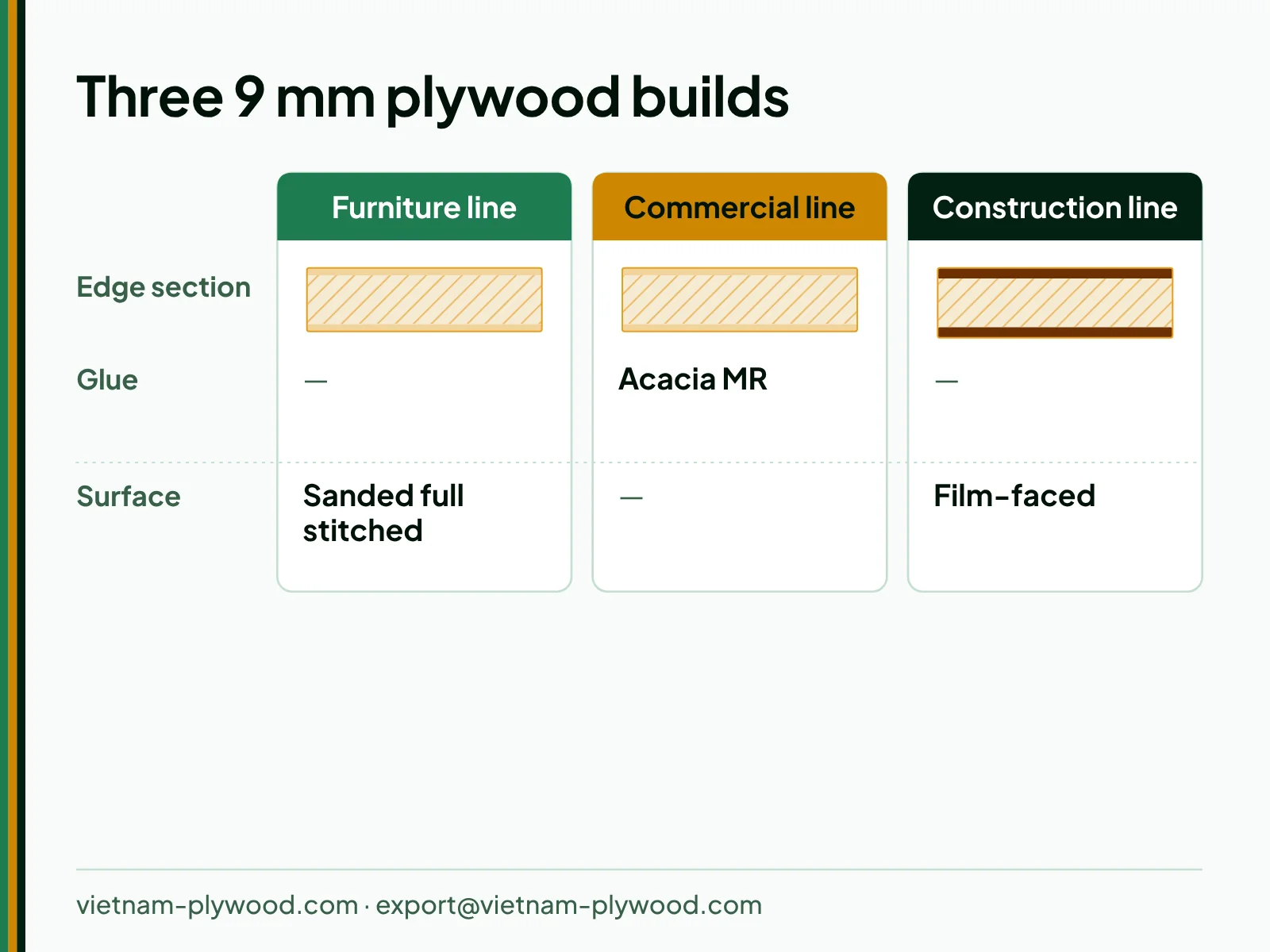
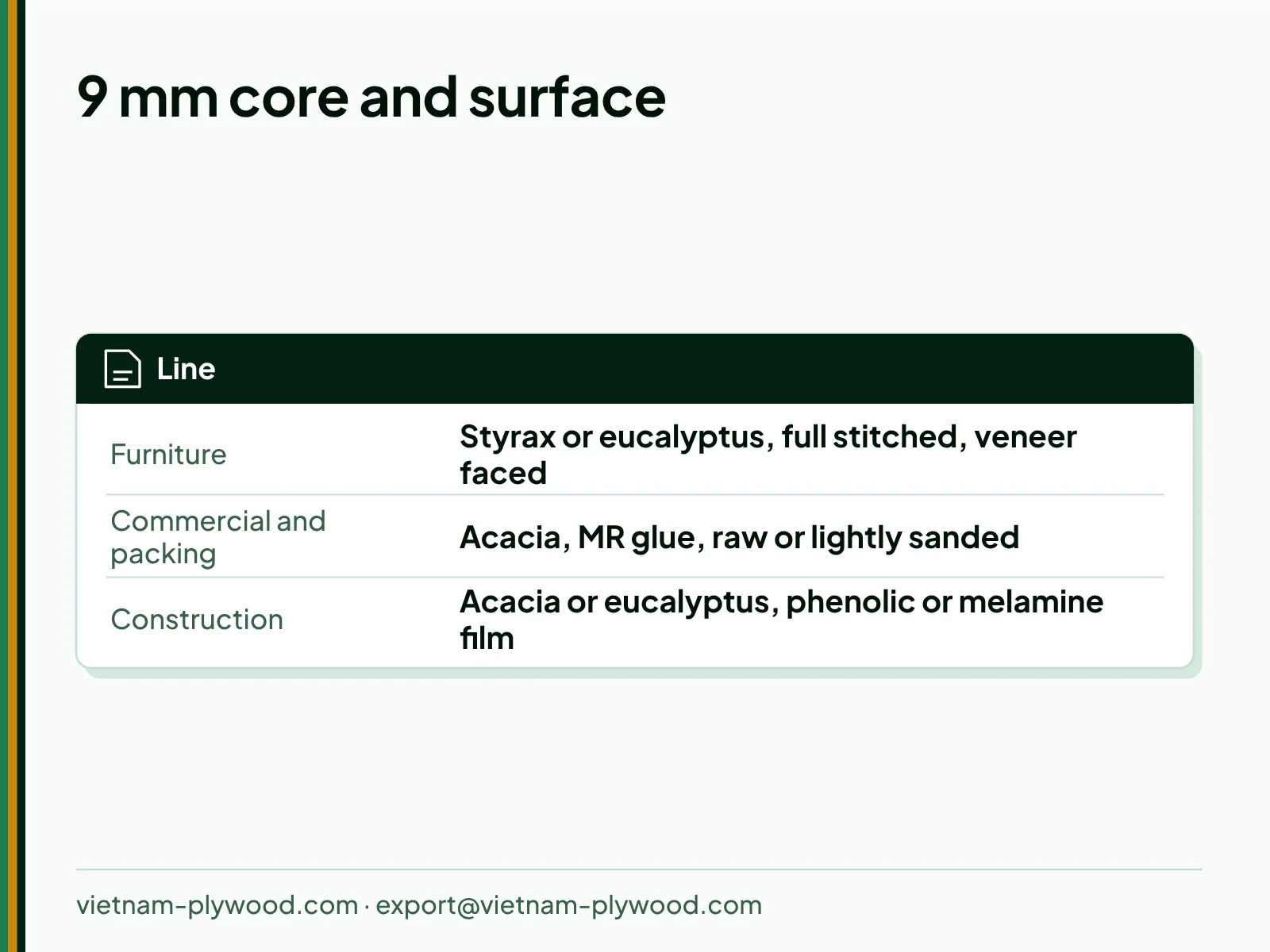
| Line | 9 mm core and surface | Finish and tolerance | Buyer use |
|---|---|---|---|
| Furniture | Styrax or eucalyptus, full stitched, veneer faced | Sanded; ±0.2 or ±0.3 mm as ordered | Case skins to be laminated by the builder |
| Commercial and packing | Acacia, MR glue, raw or lightly sanded | ±0.5 mm commercial; packing ±0.5–1.0 mm | Packing crates and protective transport sheets |
| Construction | Acacia or eucalyptus, phenolic or melamine film | Unsanded; ±0.5 mm | Formwork or film-surfaced work panels |
For shipping protection rather than a laminated case shell, examine packing plywood from Vietnam and the packing versus commercial plywood distinction. Film and anti-slip constructions belong to our construction line, rather than the furniture substrate discussed here.
How should case builders test a riveted joint?
Test the exact panel, laminate, extrusion and fastener combination intended for production. A useful acceptance sample includes a straight edge joint, a corner joint and a reinforced handle attachment. Record the failure mode as well as the applied load in the buyer’s test procedure.
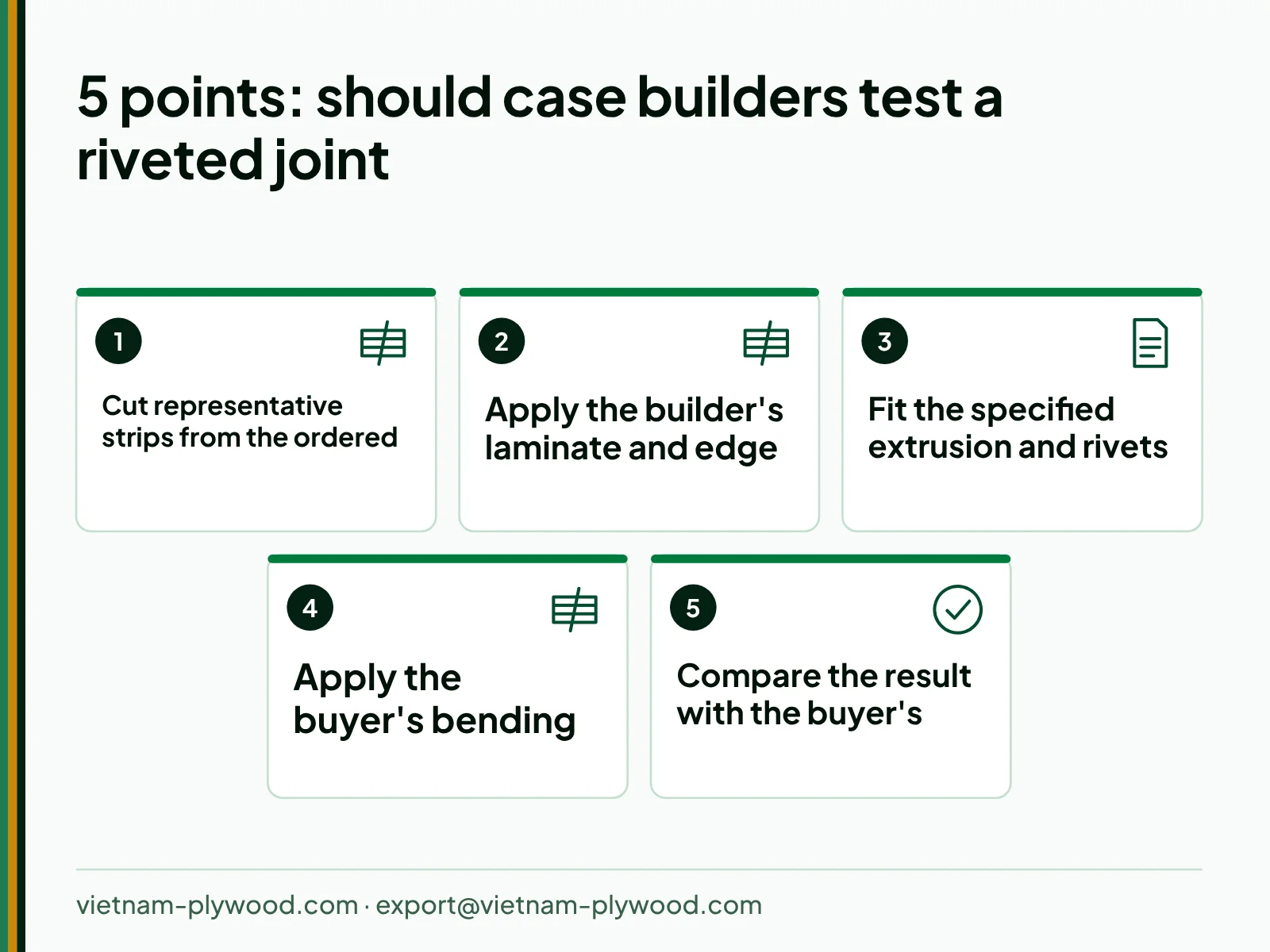
- Cut representative strips from the ordered face, core and thickness; identify the sheet batch.
- Apply the builder’s laminate and edge treatment, then allow the assembly process to finish.
- Fit the specified extrusion and rivets using the production hole pattern and backing arrangement.
- Apply the buyer’s bending, pull-through and handling tests, documenting movement, splitting and fastener deformation.
- Compare the result with the buyer’s written acceptance criteria before approving volume cutting.
A complete loaded-case trial also captures corners, hinges and handles working together.
What can an inspector witness at the producing factory?
At the producing factory, a buyer can witness the ordered thickness, face condition, core construction and packing identification before dispatch. HCPLY coordinates the specification, on-site quality control and loading. Factory-office visits and goods inspection take place at the factory making the order.
For a sanded substrate, measure thickness at multiple locations, inspect the surface under raking light and examine cut edges for gaps that would intersect a fastener path. Check whether the veneer face suits the builder’s intended laminate adhesive and whether the requested tolerance appears on the inspection sheet.
The producing factory can present member-factory FSC, CARB P2, ISO 9001 or CE certificates, and EUTR/EUDR documents, with factory details masked, on request. Certificate relevance must be matched to the actual order and destination. The inspector should distinguish documentary scope from the case builder’s separate mechanical test results.
Can flight case panels ship with other furniture-line plywood?
Yes. Specifications can be mixed in one 40HC container within its 28.5 t payload limit, including case substrates and other furniture-line panels. The calculation must account for each core and thickness separately before loading.
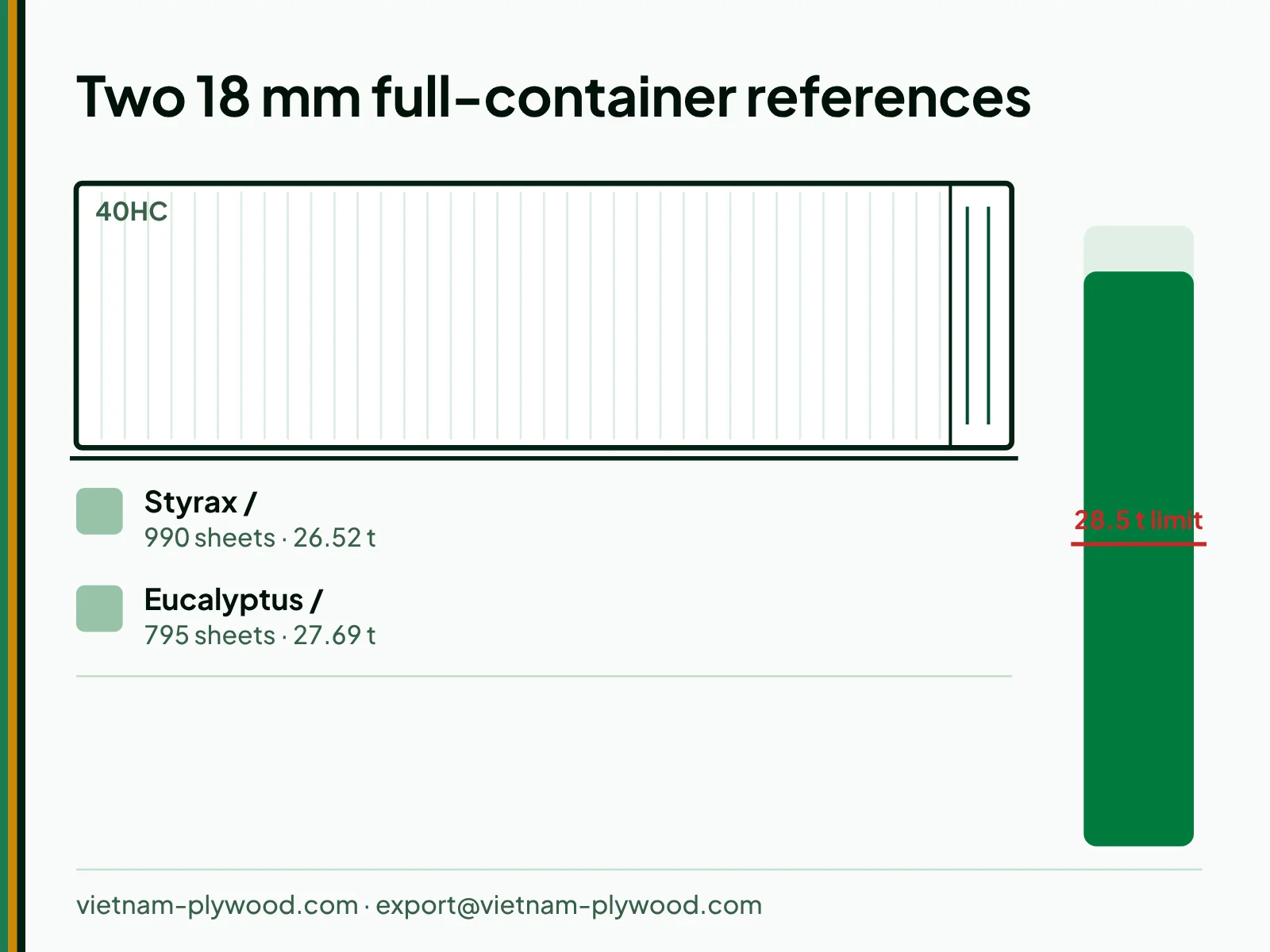
For 18 mm sheets measuring 1220 × 2440 mm, the full-container lookup gives 990 styrax-core sheets at 26.52 t or 795 eucalyptus-core sheets at 27.69 t. The former uses 18 pallets and the latter 15 pallets. A mixed order needs its own pallet and mass schedule; neither full-load figure should be copied as a mixed-load total.
For a mixed order, list each panel specification, its lookup sheet weight and its quantity on the loading worksheet; then check the packed shipment against the payload limit, including pallets and packaging. See mixed plywood container loads and the container packing reference for load planning.
Which dimensions and faces belong on the purchase specification?
Write the core, veneer face, thickness tolerance and sheet size as independent fields. Common sheet sizes include 1220 × 2440 mm and 1250 × 2500 mm; custom cutting is available.
Face veneer commonly measures 0.2–0.4 mm. Available face grades include A/B for relevant veneers, while birch face grades are D/E/F. A smooth face matters for the builder’s laminate bonding process, but the finish supplier should approve adhesive compatibility with the selected surface preparation.
For a furniture-line 18 mm build, the stated ply-count range is 11–13, since individual core veneers differ in thickness. Specify full-stitched core construction rather than relying on ply count alone. For a separate surface comparison, plastic-coated plywood options explains the coated-panel category without implying that we apply the builder’s decorative laminate.
What export documents accompany the panels?
The shipment’s packing list identifies the packed sheet quantities and descriptions, while the commercial invoice records the contracted goods. The bill of lading, certificate of origin and applicable phytosanitary and fumigation papers accompany the export process; EUR.1 is used for EU lots, and CIF shipments include insurance.
The order’s certificate documents can include an FSC claim on sales documents, an emission certificate and test reports for the agreed build. EU lots also have an EUTR/EUDR file set. After loading, the draft shipping documents come to you for approval.
For EU import planning, the European Commission’s 2025 guidance on Regulation (EU) 2023/1115 explains that Article 9 requires common and full scientific names for wood species in relevant products. This is why the case substrate’s face and core identification should remain traceable through purchase and shipment records. See the European Commission guidance.
How should a buyer request a case-panel quotation?
Send a written build specification that names the case application and the substrate to be laminated. For furniture plywood, the indicative starting price is from US$350/m³ FOB Hai Phong (October 2026). The quoted case-panel build is then priced against core, face, thickness, glue, finishing and order mix.
The minimum order is one 40HC, and mixed specifications are possible within the payload limit. Factory lead time runs 15–45 days from receipt of the 30% deposit; the exact figure depends on order size, line loading and what the contract fixes. The remaining 70% is paid on the scan of the bill of lading, by T/T, or by irrevocable sight L/C. We ship FOB Hai Phong, or CFR (CNF) or CIF to your port.
Samples cost nothing: a first-time buyer pays the courier, and that charge comes off the first confirmed order. Send the drawing and requested tests to Lucy at export@vietnam-plywood.com, or use the contact page.
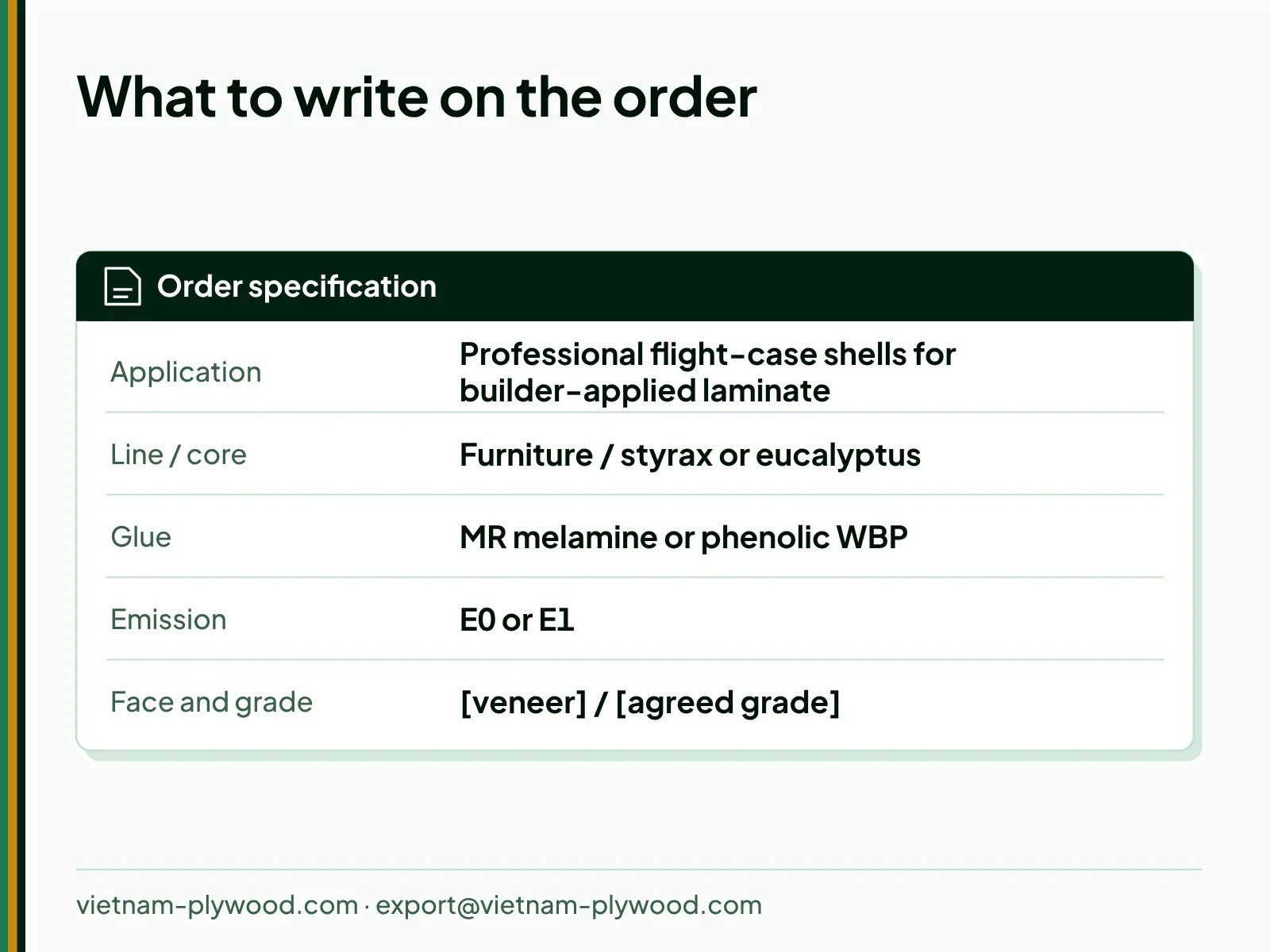
Application: professional flight-case shells for builder-applied laminate
Line / core: furniture / styrax or eucalyptus, full stitched
Glue: MR melamine or phenolic WBP
Emission: E0 or E1
Face and grade: [veneer] / [agreed grade]
Thickness and tolerance: [mm] / ±0.2 or ±0.3 mm as ordered
Size: [mm × mm]
Quantity: [sheets and pallet mix]
Destination port: [port]
Book a factory visit with Lucy to inspect the substrate at the producing factory.