





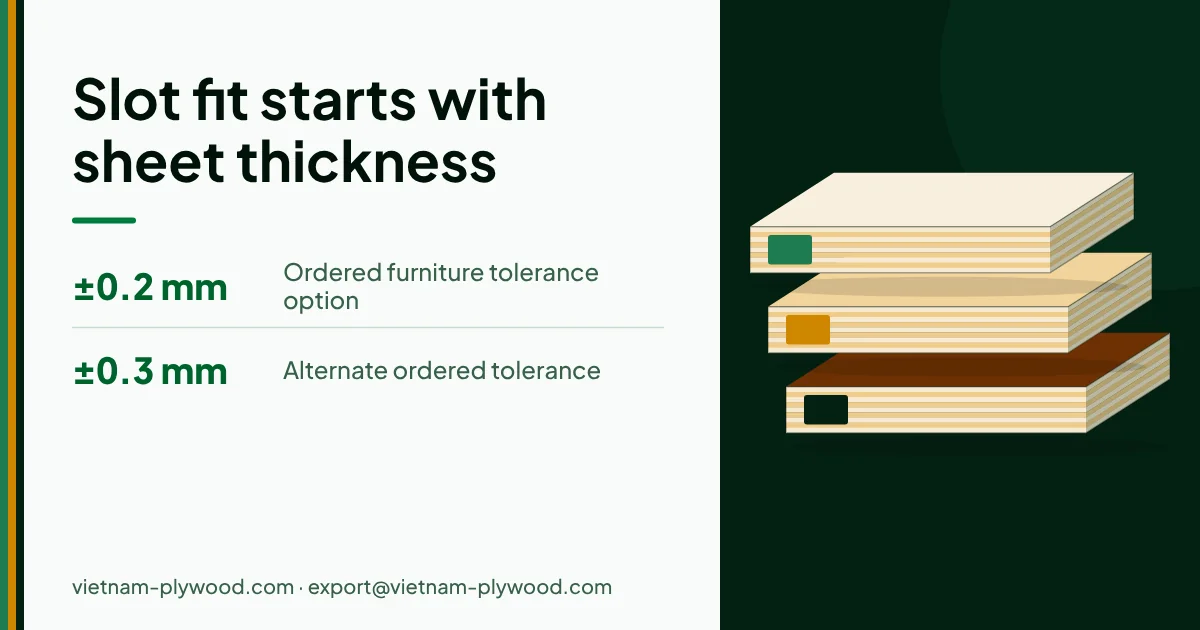
CNC plywood furniture slots fit reliably when sheet thickness stays inside the ordered tolerance and the cutter follows an approved joint clearance. A wrong thickness choice can scrap cut parts, delay assembly and turn a shipment into a rejected load. HCPLY sands furniture plywood to ±0.2 mm or ±0.3 mm as ordered, then supports lot-based checks for matching flat-pack components. See the applications library for related industrial builds.
What thickness tolerance does CNC plywood furniture need?
CNC plywood furniture with interlocking slots needs a thickness range narrower than the joint’s usable clearance. HCPLY’s sanded furniture line offers ±0.2 mm or ±0.3 mm thickness tolerance as ordered. Specify which band applies, measure actual sheets, and trial-cut the mating parts before releasing the full cutting programme. A nominal 18 mm drawing alone cannot establish a reliable fit.
For a nominal 18 mm panel ordered at ±0.2 mm, the permitted sheet thickness runs from 17.8 to 18.2 mm. At ±0.3 mm, it runs from 17.7 to 18.3 mm. Those are dimensional ranges derived from the ordered tolerance, not measured production results. A slot drawn for one thickness can grip another sheet too tightly or leave visible play. The buyer must establish an acceptable assembly clearance through a physical trial.
Which plywood is suitable for CNC furniture?
Our furniture line is the starting point for CNC plywood for furniture that needs accurately fitting slots: full-stitched, sanded styrax- or eucalyptus-core plywood, with the specified face and emission class. The face names the product; the core determines its reference density. Furniture plywood has an indicative starting price of from US$350/m³ FOB Hai Phong (October 2026).
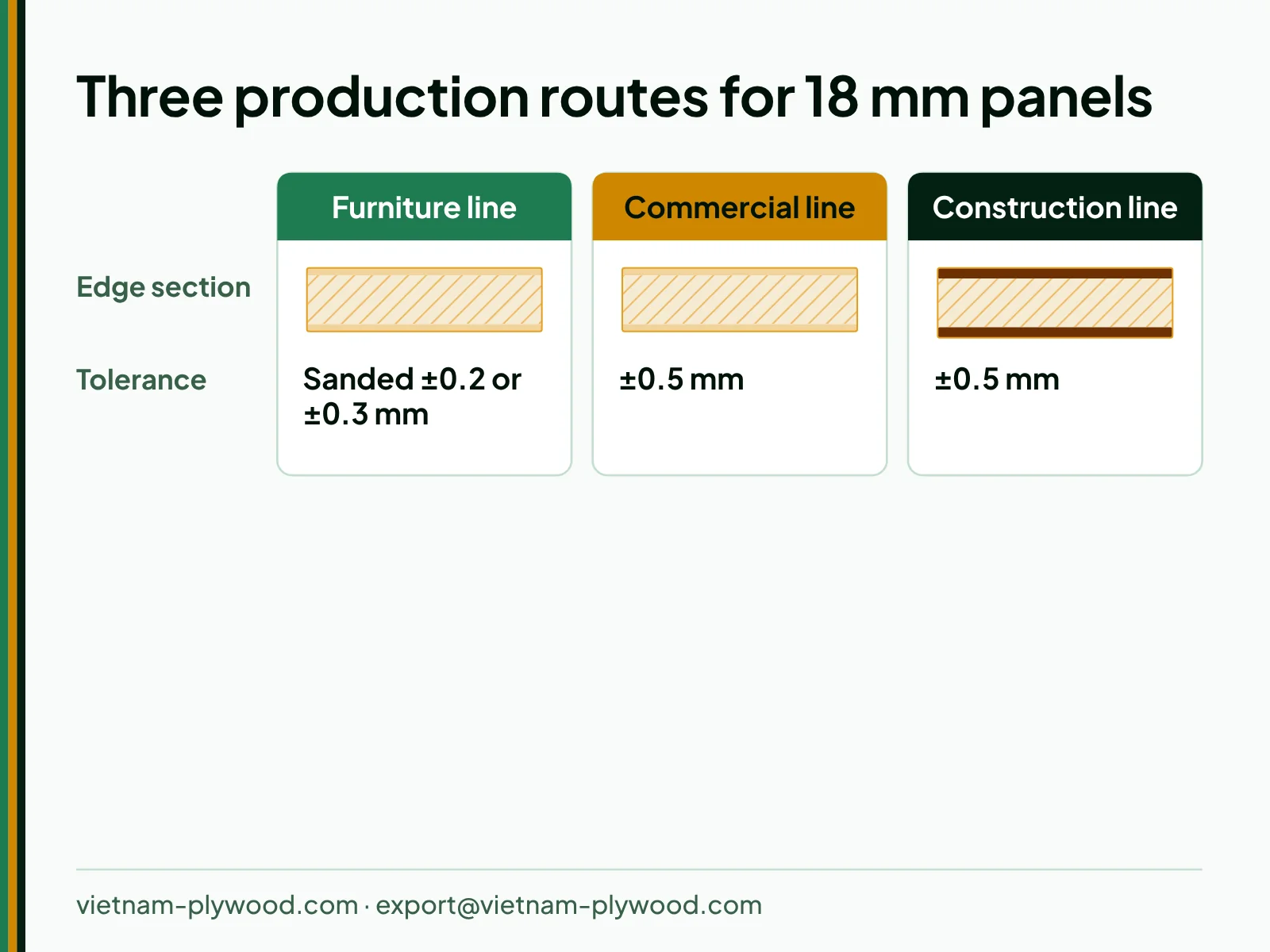
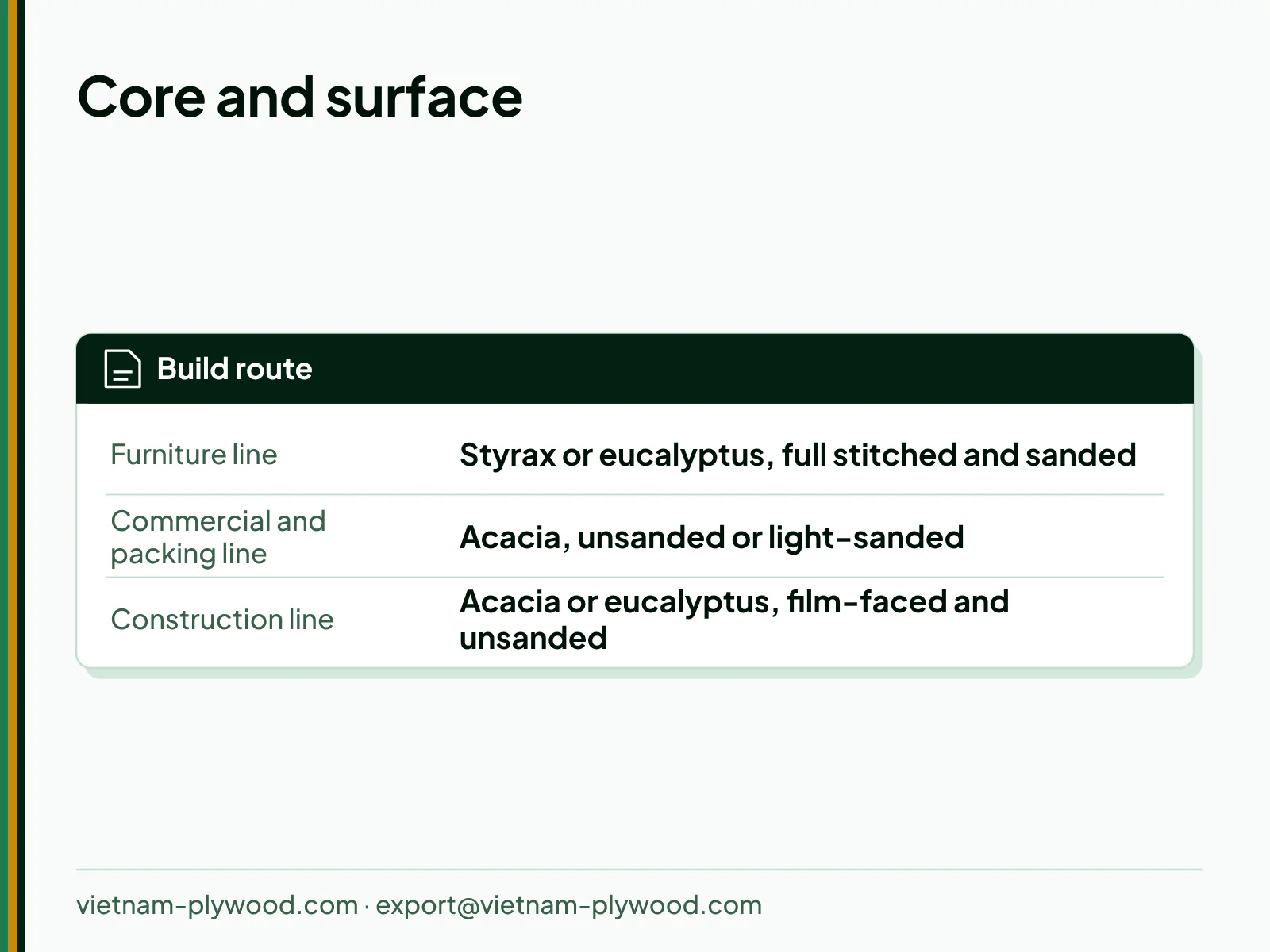
| Build route | Core and surface | Thickness tolerance | Suitable buying decision |
|---|---|---|---|
| Furniture line | Styrax or eucalyptus, full stitched and sanded | ±0.2 or ±0.3 mm as ordered | Slot-together flat-pack ranges with calibrated fit |
| Commercial and packing line | Acacia, unsanded or light-sanded | ±0.5 mm | Packing or non-interlocking industrial panels where wider tolerance is accepted |
| Construction line | Acacia or eucalyptus, film-faced and unsanded | ±0.5 mm | Concrete formwork rather than visible flat-pack furniture |
HCPLY does not press birch-core plywood, medium-density fibreboard (MDF), oriented strand board (OSB), chipboard or blockboard. Birch-faced plywood is distinct from birch-core plywood. The furniture components specification is the relevant product starting point.
How should CNC plywood joints use measured thickness?
Design CNC plywood joints with measured stock thickness as a named computer-aided design (CAD) parameter, then adjust the slot geometry to the agreed fit. This keeps a change in the sheet specification from silently changing the assembly outcome.
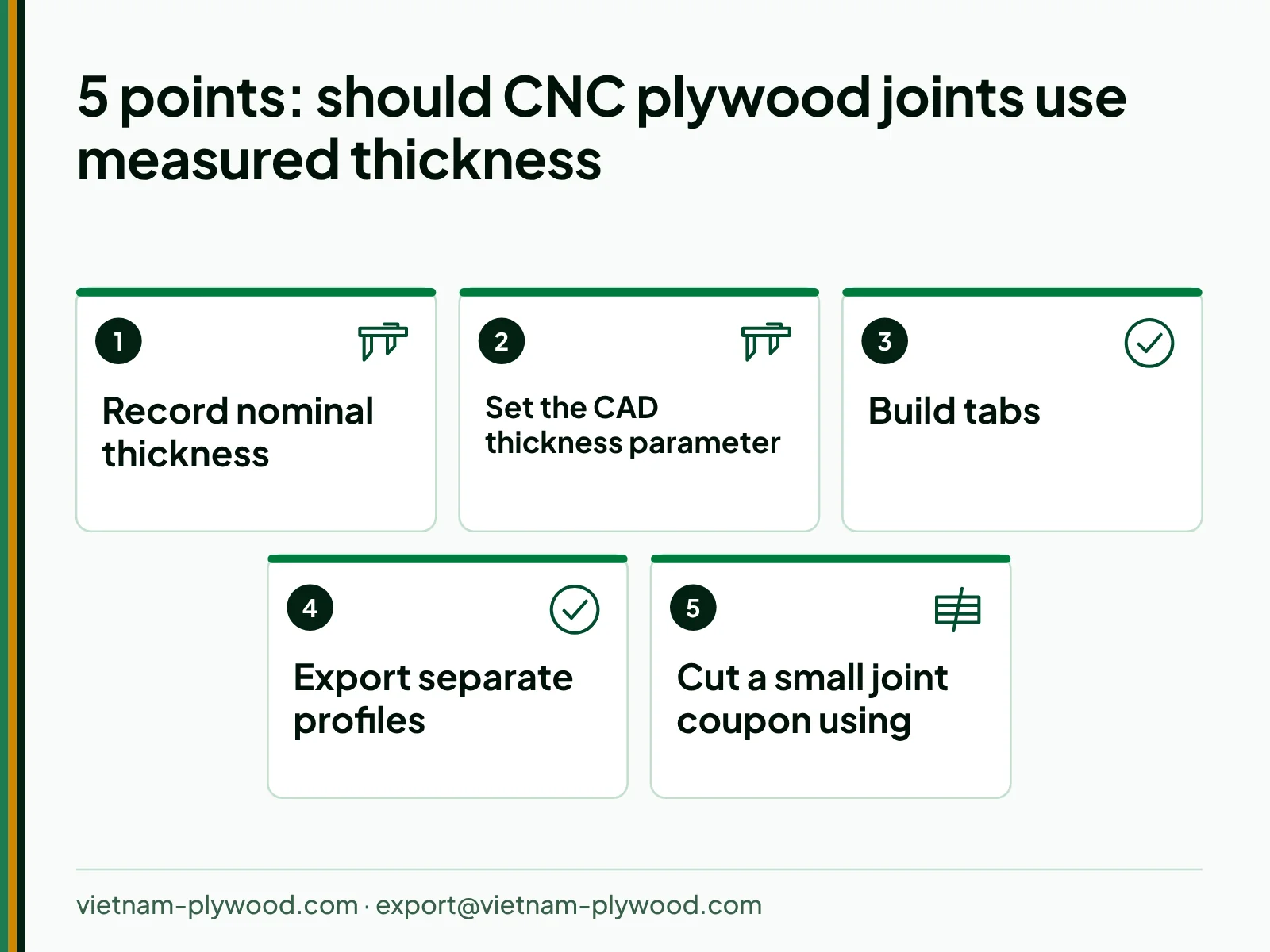
- Record nominal thickness, ordered tolerance, and the actual thickness distribution from representative sheets.
- Set the CAD thickness parameter to the production reference established from those measurements; define the intended clearance separately.
- Build tabs, through-slots and half-lap depths from the parameter rather than entering repeated fixed dimensions.
- Export separate profiles, pockets and drill operations for computer numerical control (CNC) machining, with the cutter and compensation settings identified.
- Cut a small joint coupon using the production cutter, assemble it, inspect face alignment and insertion force, then approve or adjust the programme.
Which joint details change the machining outcome?
Router-cut internal corners have a radius, so square tabs can bottom out before the joint seats. Provide an approved corner-relief geometry, such as a dogbone relief, or redesign the tab end to clear the cutter radius. Keep relief placement consistent across the range.
The CNC Panel Joinery Notebook published by Make in 2012 explains the rotary cutter’s inside-corner problem and alternative joint families. Its joint catalogue is useful for concept selection; the purchasing specification still needs panel tolerance, lot identity and a factory inspection method.
How can one plywood lot cover a furniture range?
Reserve one identified production lot for the parts that must interlock across a complete furniture range, and carry that identity into cutting and packing records. Ask for a written lot-allocation plan before production rather than mixing sheets from different thickness settings.
A practical release sequence is to approve the face, core, glue, emission class and thickness band first. Next, identify the sheets intended for shared mating components and take thickness readings at agreed positions. Then cut and assemble representative parts from that identified group. Mark the accepted lot on bundle labels and the packing specification so replacements and matching components can be traced.
What can the inspector witness at the producing factory?
The buyer or inspector can witness thickness measurements, review bundle identification, and assemble a trial pair from the lot at the producing factory. Our furniture line presses and sands the furniture panels; HCPLY manages on-site quality control and export documentation.
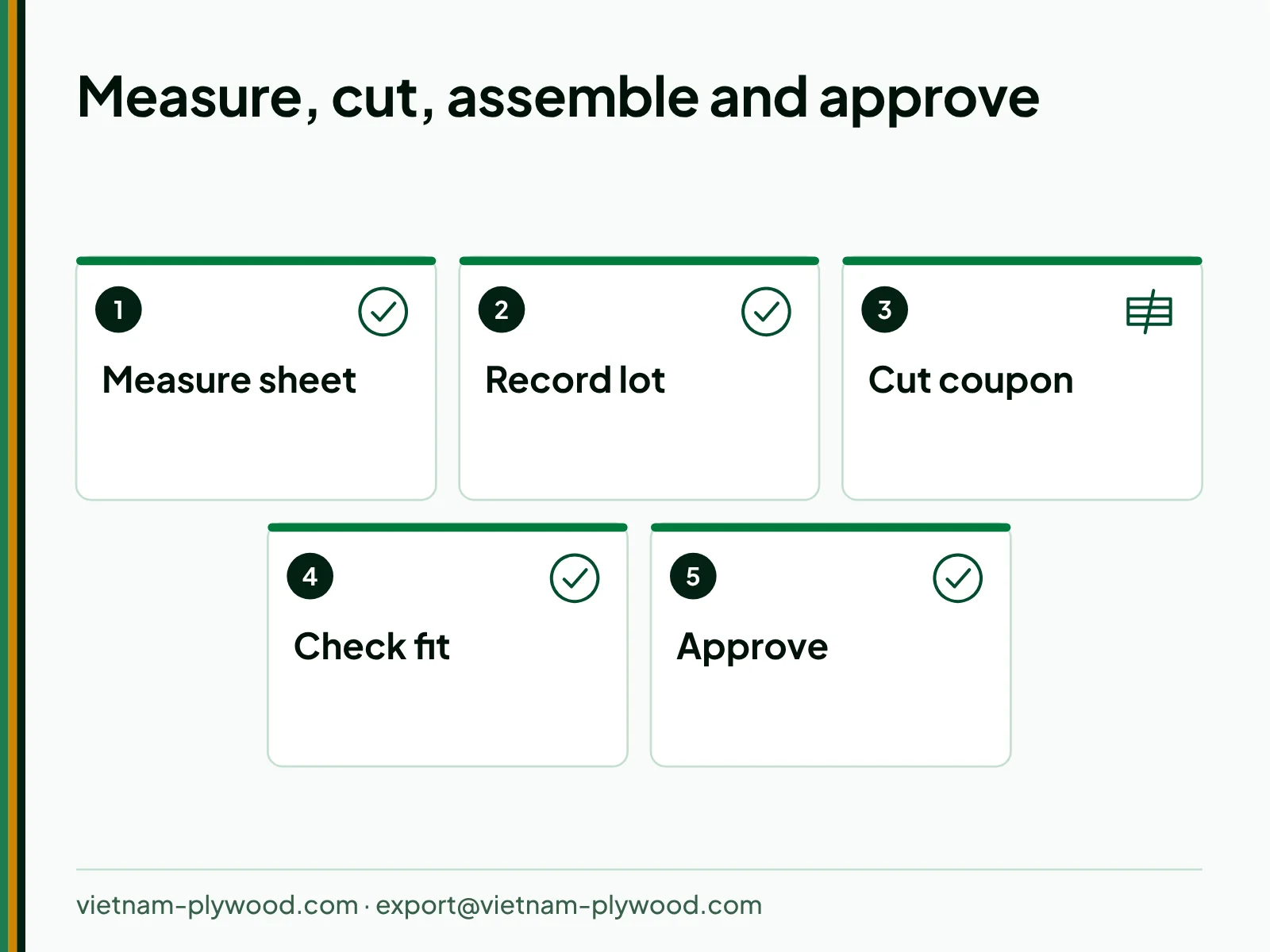
Specify the measurement tool, measurement locations, number of sheets to sample and rejection rule in the purchase specification. Record each reading against the ordered ±0.2 mm or ±0.3 mm band. A second check should compare cut slot width, corner relief and actual insertion behaviour with the approved coupon. A photograph of a single well-fitting joint is weaker evidence than recorded readings across the agreed sample.
Can parts be ordered already cut to drawing?
For related applications, see industrial plywood uses. Custom cutting is available, so buyers can request a quotation for CNC furniture parts already cut to their drawings. The drawing package should state whether the requested service is rectangular cutting, profiled parts or a complete machined joint set; the agreed operation belongs in the written quotation.
Send dimensioned drawings and a machine-readable file, plus a drawing revision, part number, grain or face direction, nesting preference, edge quality requirement and quantity per part. Specify whether the finished parts require identification marks and matched packing sets. Define tolerances for finished part dimensions separately from raw sheet thickness.
How does core choice affect shipping weight?
At 18 mm and 1220 × 2440 mm, a styrax-core sheet weighs 26.79 kg, while a eucalyptus-core sheet weighs 34.83 kg, excluding any film. Those figures help importers assess handling and payload before combining furniture panels with other specifications.
The full 40HC lookup for this size and thickness is 990 styrax sheets at 26.52 tonnes, compared with 795 eucalyptus sheets at 27.69 tonnes. A mixed order must stay within the 28.5-tonne payload limit, and specifications can share a container. The container loading reference explains full-container counts; these figures are reference loads.
Which glue and emission documents belong in the order?
Specify glue and formaldehyde emission class as separate fields. The furniture line uses E0 or E1 emission classes; melamine moisture-resistant (MR) glue and phenolic weather-and-boil-proof (WBP) glue describe bonding systems, not emission classifications.
For US-bound regulated hardwood plywood, the US Environmental Protection Agency’s 2016 final rule under Toxic Substances Control Act (TSCA) Title VI established third-party certification and related labeling requirements. The EPA’s official rule summary states that the rule covers hardwood plywood and finished goods containing regulated composite wood products. Specify the accepted certification evidence for the exact producing factory and ordered build: EPA formaldehyde rule summary.
Member-factory certificates such as FSC, CARB P2, ISO 9001 and CE, plus EUDR/EUTR documents, are shown with factory details masked, on request. A certificate’s applicability must match the ordered product and destination. The order’s agreed emission certificate or test report belongs with its shipment documents.
How should the order and shipping records identify the parts?
The purchase order should identify the approved drawing revision, sheet build, thickness band, cut-part schedule, lot marking and acceptance coupon. These fields connect the factory inspection to the received cartons.
HCPLY coordinates the commercial invoice, packing list, bill of lading (B/L), certificate of origin and applicable shipment papers. For EU lots, the certificate of origin can be EUR.1 and the EUTR/EUDR file set accompanies the shipment. Insurance is included under cost, insurance and freight (CIF) terms. After loading, the draft shipping documents come to you for approval.
Delivery terms can be free on board (FOB) Hai Phong, cost and freight (CFR/CNF), or CIF. For recurring programmes, plywood supply programmes for distributors provide the broader ordering context.
What should be approved before production?
Approve the written sheet specification and a real cut-and-fit sample before authorising production of the full range. The sample should cover the tightest mating slot, the most visible joint and any pocket or relief detail that could affect assembly.
HCPLY’s minimum order is one 40HC, with mixed specifications permitted within the payload limit. Factory lead time runs 15–45 days from receipt of the 30% deposit; the exact figure depends on order size, line loading and what the contract fixes. The 70% balance is against the scanned B/L, by telegraphic transfer (T/T) or irrevocable letter of credit at sight. Free samples are available; new buyers book their courier, and its cost can be credited against a real order.
What specification should the buyer send?
Send a single specification with the joint acceptance method and the complete part schedule. For CNC plywood furniture, include the measured-thickness reference and a sample-assembly requirement alongside the sheet dimensions.
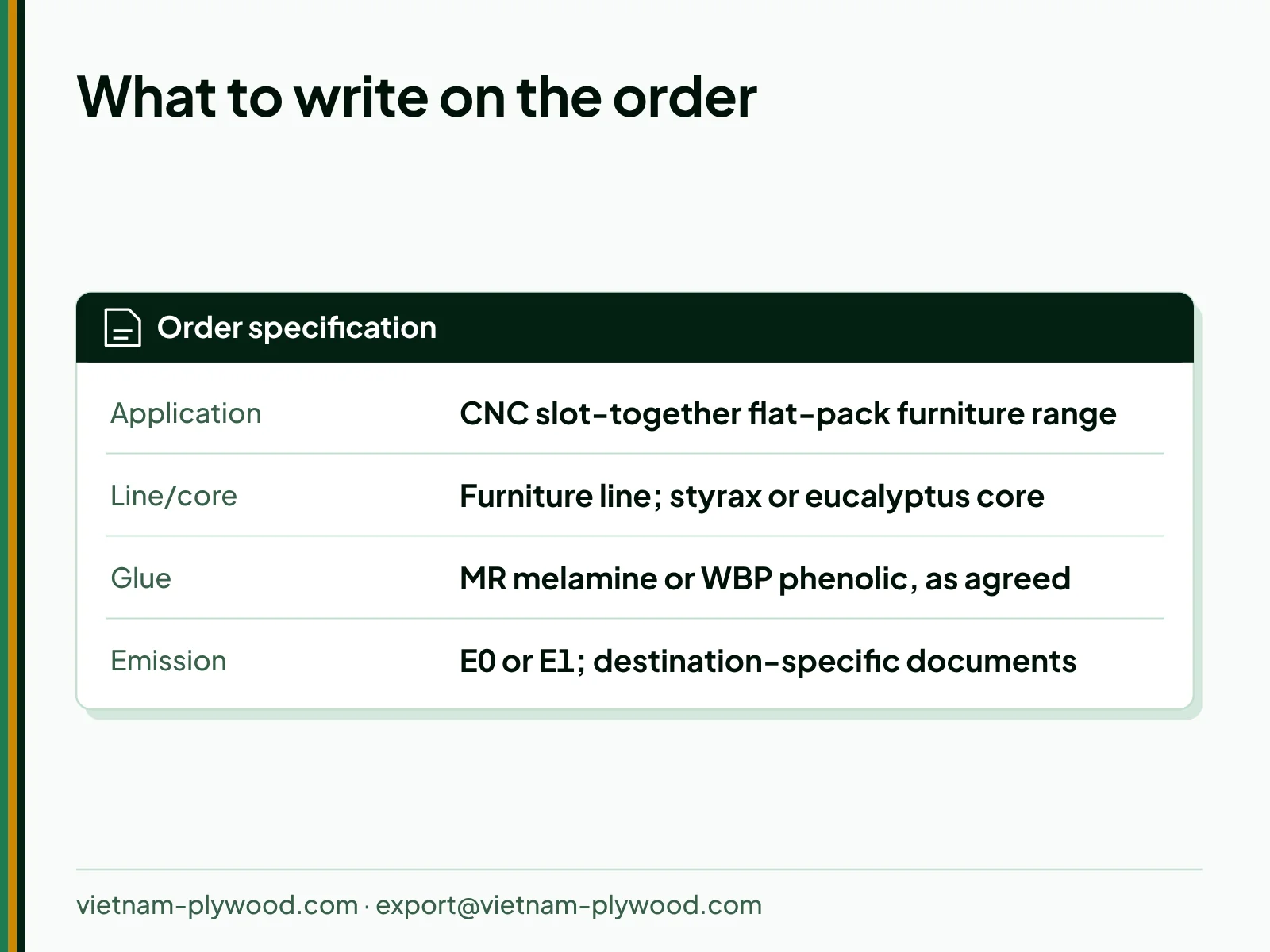
Application: CNC slot-together flat-pack furniture range
Line/core: Furniture line; styrax or eucalyptus core
Glue: MR melamine or WBP phenolic, as agreed
Emission: E0 or E1; destination-specific documents
Face and grade: [face species], [A/B or birch D/E/F]
Thickness and tolerance: [nominal mm], ±0.2 mm or ±0.3 mm
Size: [sheet mm]; cut parts to drawing revision [ID]
Quantity: [sheets / part sets], one identified production lot
Destination port: [port, country]
Joint acceptance: measured sheet reference, slot coupon, fit sign-off
Request the spec sheet from Lucy at export@vietnam-plywood.com with the drawing revision and the mating-joint acceptance criteria.