





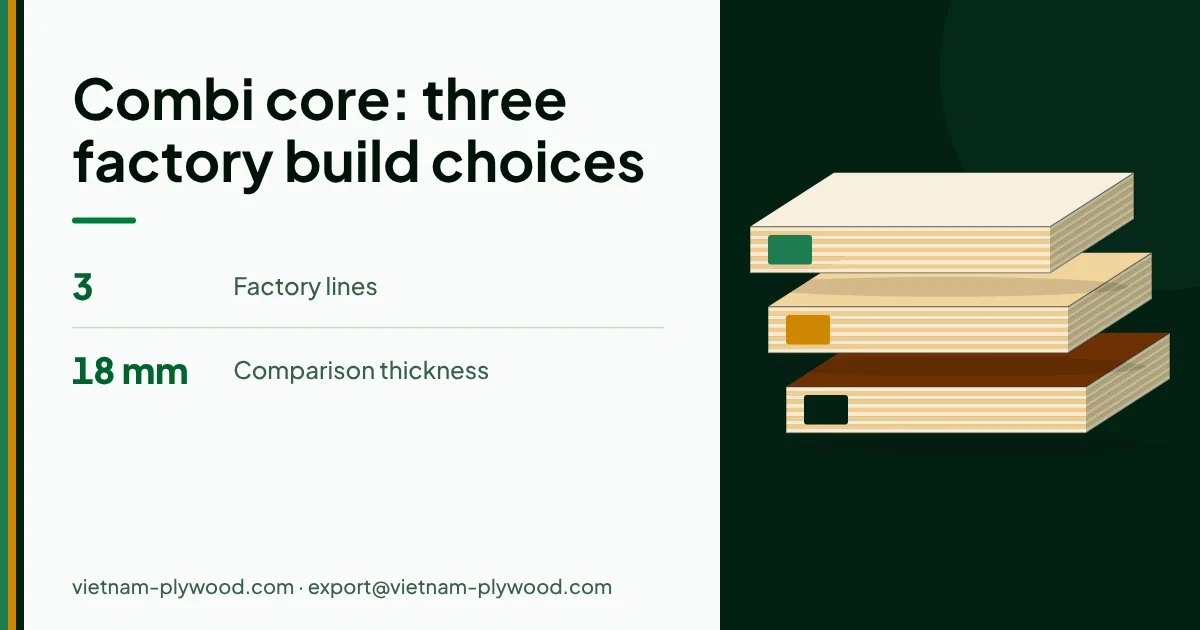
Combi core plywood needs a written species and layer schedule before a factory can press the quoted build. Choosing the wrong mix can waste machining time, increase freight weight or cause a rejected load. HCPLY works from the application and the actual core construction rather than treating “combi” as a fixed grade.
What is combi core plywood?
Combi core plywood is veneer plywood built with more than one core wood species, rather than a single species throughout. The phrase does not specify which species, their placement, the joint method or the adhesive. A quoted combi panel can therefore behave differently from another panel carrying the same name. HCPLY specifies the actual core build before production.
Some catalogues describe birch-faced panels with mixed inner veneers. That description does not automatically describe our production. Our Vietnam core choices are acacia, eucalyptus and styrax. A birch face is available, but birch-core plywood is not a product we press.
For a broader taxonomy, see plywood core types in Vietnam and the manufacturer core comparison. The term combined core plywood, combination core plywood or combicore still needs the same written layer schedule.
What are the advantages and disadvantages of a mixed core?
The advantage is the ability to place different veneers where their density and processing characteristics serve the finished panel. The disadvantage is that a generic mix description conceals variation in weight, void risk and machining response. Species placement matters more than a marketing label.
Our reference core densities are styrax 500 kg/m³, acacia 580 kg/m³ and eucalyptus 650 kg/m³.
A lighter inner build can suit furniture carcasses, while denser outer core layers can provide a different edge for fastening. But a core assembled from loose-laid veneers can expose gaps after cutting, regardless of its species mix. We rank core construction from full stitched, through stitched outer layers with edge-trimmed inner veneers, to finger-jointed and then loose-laid. See finger-joint core risks for the joint-related trade-off.
How does combi core compare with birch core plywood?
Combi core offers more flexibility in species placement; full birch core offers a more uniform species specification. A birch face on a mixed core is a decorative description, not evidence of birch veneers inside.
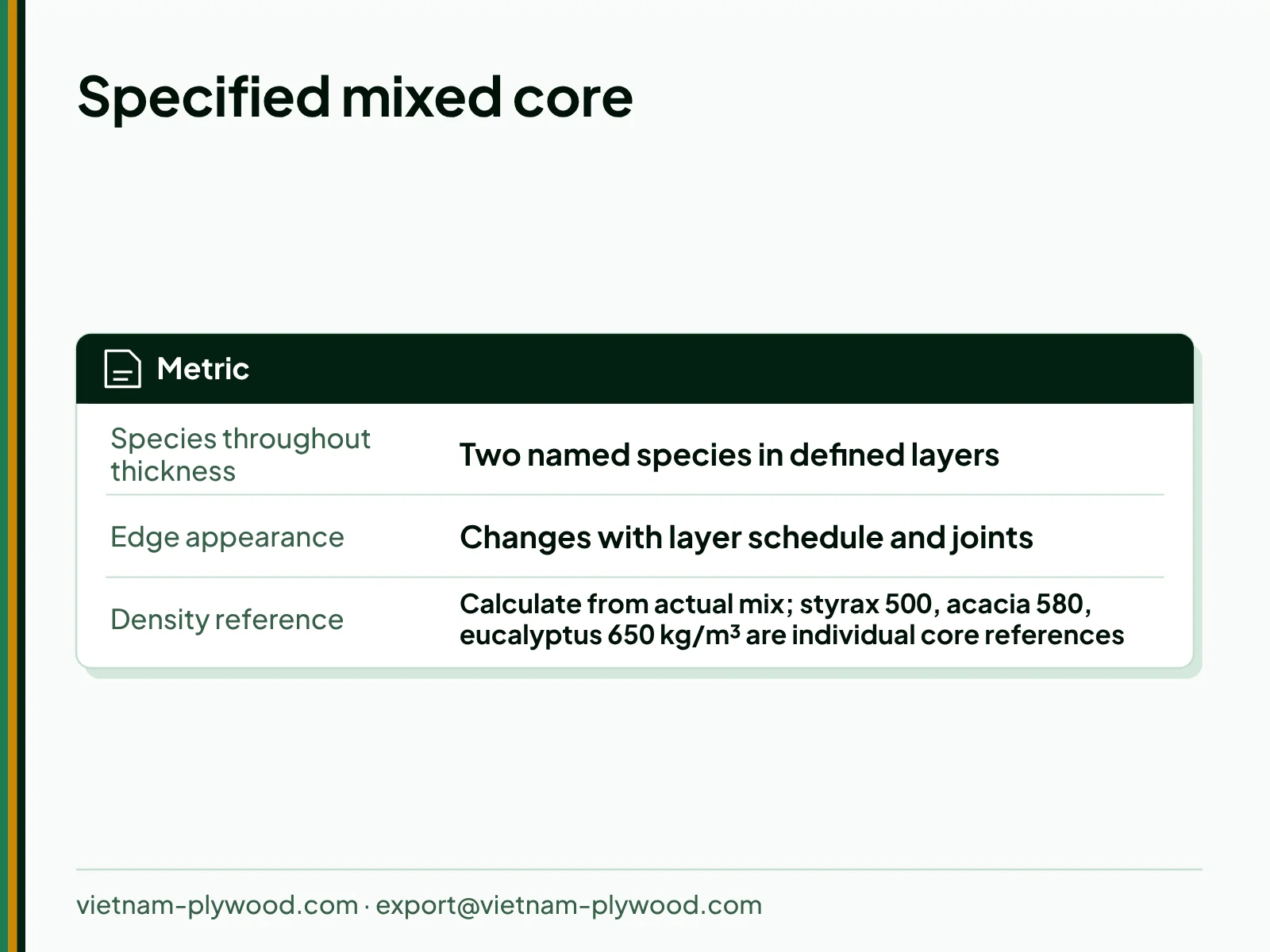
| Metric | Specified mixed core | Full birch core | Verdict by use |
|---|---|---|---|
| Species throughout thickness | Two named species in defined layers | Birch throughout | Mixed core can suit concealed cabinet parts; full birch suits exposed edges |
| Edge appearance | Changes with layer schedule and joints | More uniform species appearance | Full birch preferred for visible laminated edges |
| Density reference | Calculate from actual mix; styrax 500, acacia 580, eucalyptus 650 kg/m³ are individual core references | Requires the supplier’s actual birch specification | Compare measured panel mass for freight and handling |
| Machining and screw retention | Verify against the proposed edge build | Verify against the offered birch panel | Trial the actual hardware and CNC toolpath |
| Adhesive and emissions | Separate written fields | Separate written fields | Neither core name establishes moisture or emissions compliance |
Full birch-core plywood is outside our production range. For a different furniture-oriented option, read about styrax-core plywood as a birch alternative.
Which factory line builds the specified panel?
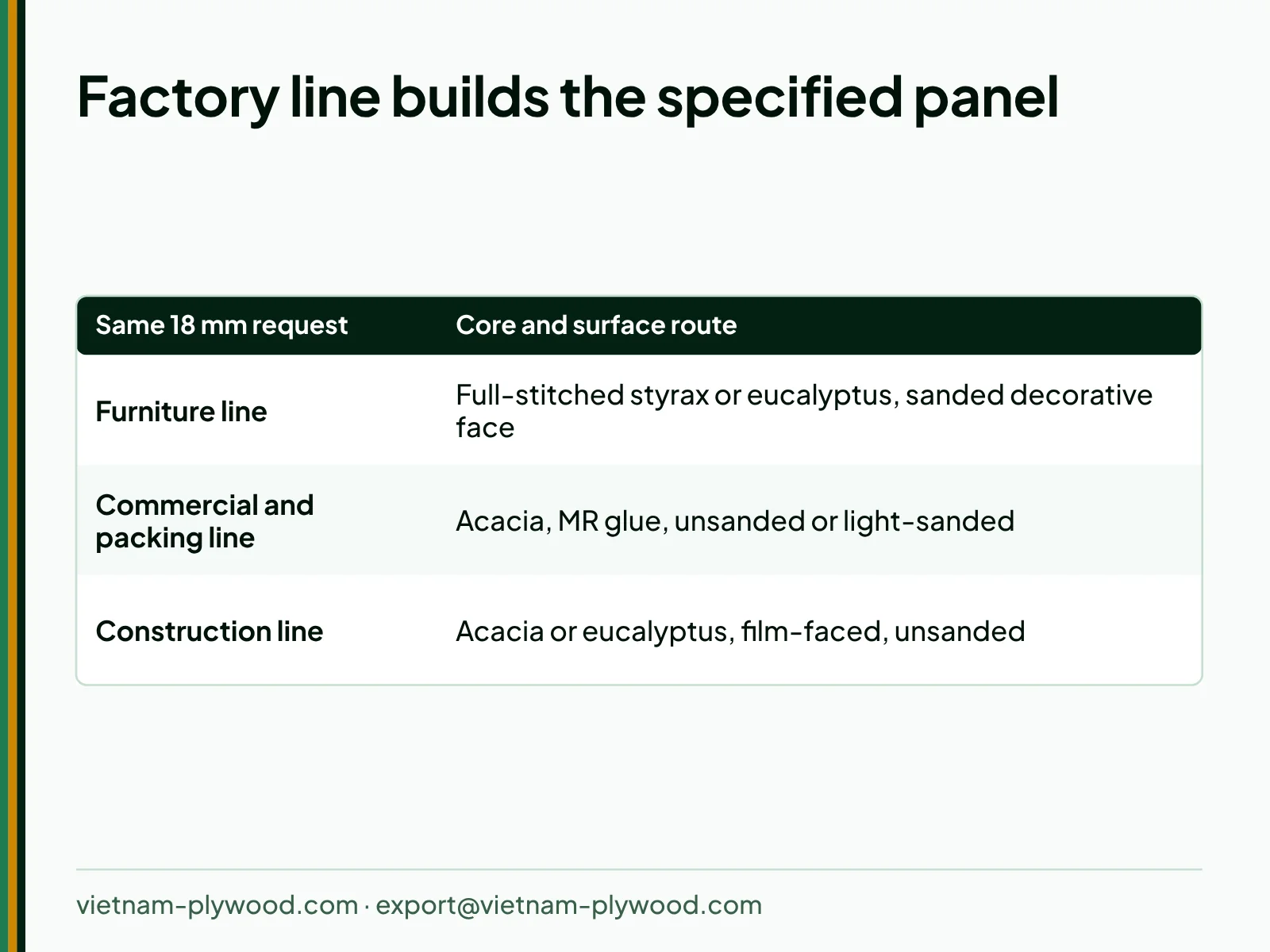
Our furniture line is the first discussion for sanded, full-stitched styrax or eucalyptus core panels with E0 or E1 emission class. Our commercial and packing line builds acacia-core MR panels, unsanded or light-sanded. Our construction line presses acacia or eucalyptus core with phenolic or melamine film and an unsanded build.
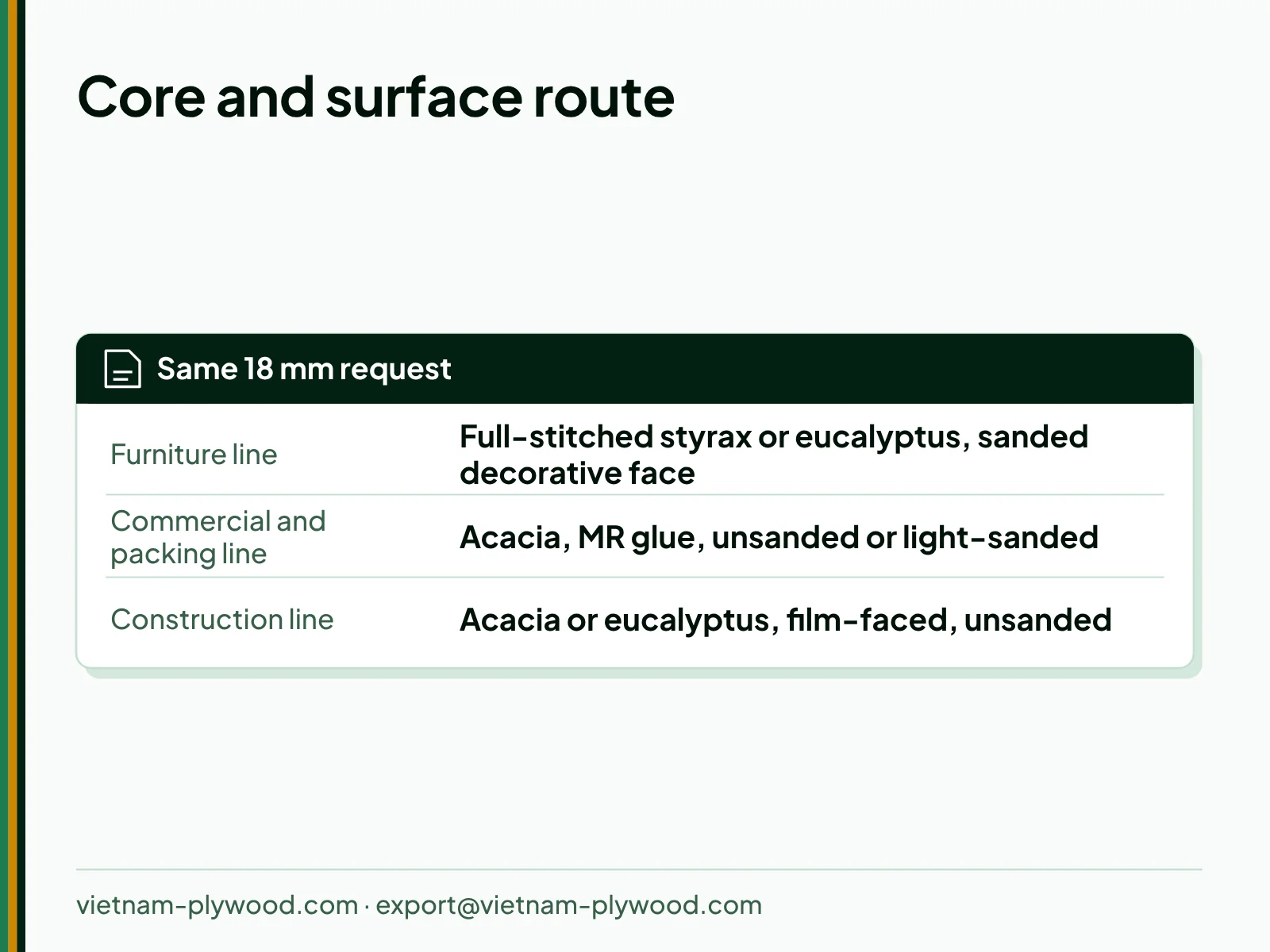
| Same 18 mm request | Core and surface route | Thickness tolerance | Appropriate use |
|---|---|---|---|
| Furniture line | Full-stitched styrax or eucalyptus, sanded decorative face | ±0.2 or ±0.3 mm as ordered | Cabinet and fit-out carcasses |
| Commercial and packing line | Acacia, MR glue, unsanded or light-sanded | ±0.5 mm commercial; ±0.5–1.0 mm packing | Cases and packing components |
| Construction line | Acacia or eucalyptus, film-faced, unsanded | ±0.5 mm | Concrete formwork |
This comparison describes our line-specific builds rather than promising an arbitrary mixed-species layup on every press. If a buyer requests an acacia–eucalyptus combination, we must agree the exact layer schedule and producing line before quoting it. HCPLY does not replace that agreement with the word combi.
Is combi core plywood suitable for cabinets and furniture carcasses?
Yes, a specified mixed veneer core can suit concealed cabinet and furniture carcasses when its edge integrity, thickness and machining tests meet the furniture maker’s acceptance criteria. For our furniture route, the standard reference is full-stitched styrax or eucalyptus core, sanded to the ordered tolerance.
Cabinet buyers should test hinge screws at the actual edge distance, cut samples using their computer numerical control (CNC) programme and inspect both faces after finishing. A clean decorative face can conceal a void near a shelf-pin hole. Specify whether the edges will remain visible, receive edging or carry repeated fasteners.
Face choices include bintangor, okoume, engineered veneer, gurjan, pine, poplar, eucalyptus, birch and sapele. Face grade A/B applies to the listed non-birch faces; birch face grades are D/E/F. Match the face grade to the visible surface, then assess the core separately. For comparison of homogeneous and mixed approaches, see full poplar core versus mixed core; full poplar core is not among our pressed core products.
Is a mixed core suitable for packing?
A mixed core can be suitable for non-decorative packing when the finished crate or case is designed around actual panel weight, fastening and handling conditions. Our commercial and packing line uses acacia core, MR glue and an unsanded or light-sanded surface.
Packing buyers often value predictable edge nailing, stack stability and consistent cutting more than a decorative face. Specify whether the panels form a reusable case, internal partition or single-shipment enclosure. Request a cut-edge sample and test the intended nails or screws in the proposed build.
Is combi core plywood suitable for formwork or exterior use?
The combi label alone is insufficient for formwork or exterior exposure. Water resistance comes from the specified adhesive system, surface protection, sealed edges and the use conditions; core joints and voids also affect service life.
Our construction line uses acacia or eucalyptus core with phenolic or melamine film. Standard film weight is 120 g/m², premium is 135 g/m², and anti-slip film is 220 g/m² only. The construction build is unsanded beneath the film. Melamine glue is MR with a 12-hour boil reference; phenolic glue is WBP with a 72-hour boil reference. These are glue-system descriptions, not a structural performance grade.
For film-faced panels, with proper handling, a release agent on every pour and sealed edges (cut edges included), melamine-glue film-faced about 12–15 pours, phenolic-glue up to about 25 pours. Loose core joints, unsealed saw cuts and inappropriate handling can shorten service life. For exposed building use, obtain the applicable performance evidence against the project specification; no generic combi name establishes a structural rating.
How should the core composition appear on the order?
The order should name each core species, its placement and the joint construction, alongside separate glue and emission fields. A single word such as combi leaves too much room for a different layup at pressing.
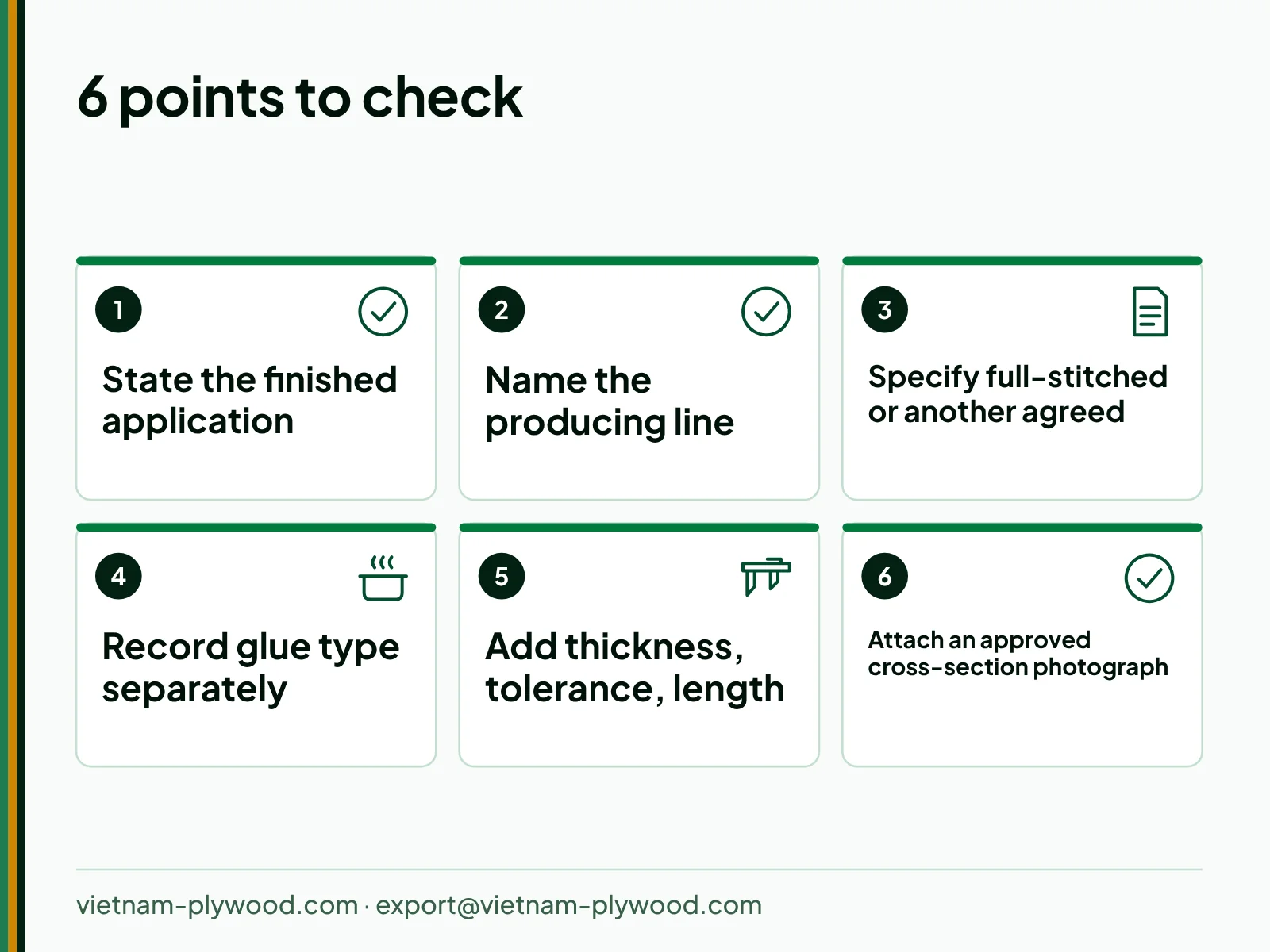
- State the finished application and whether the edges will be exposed or machined.
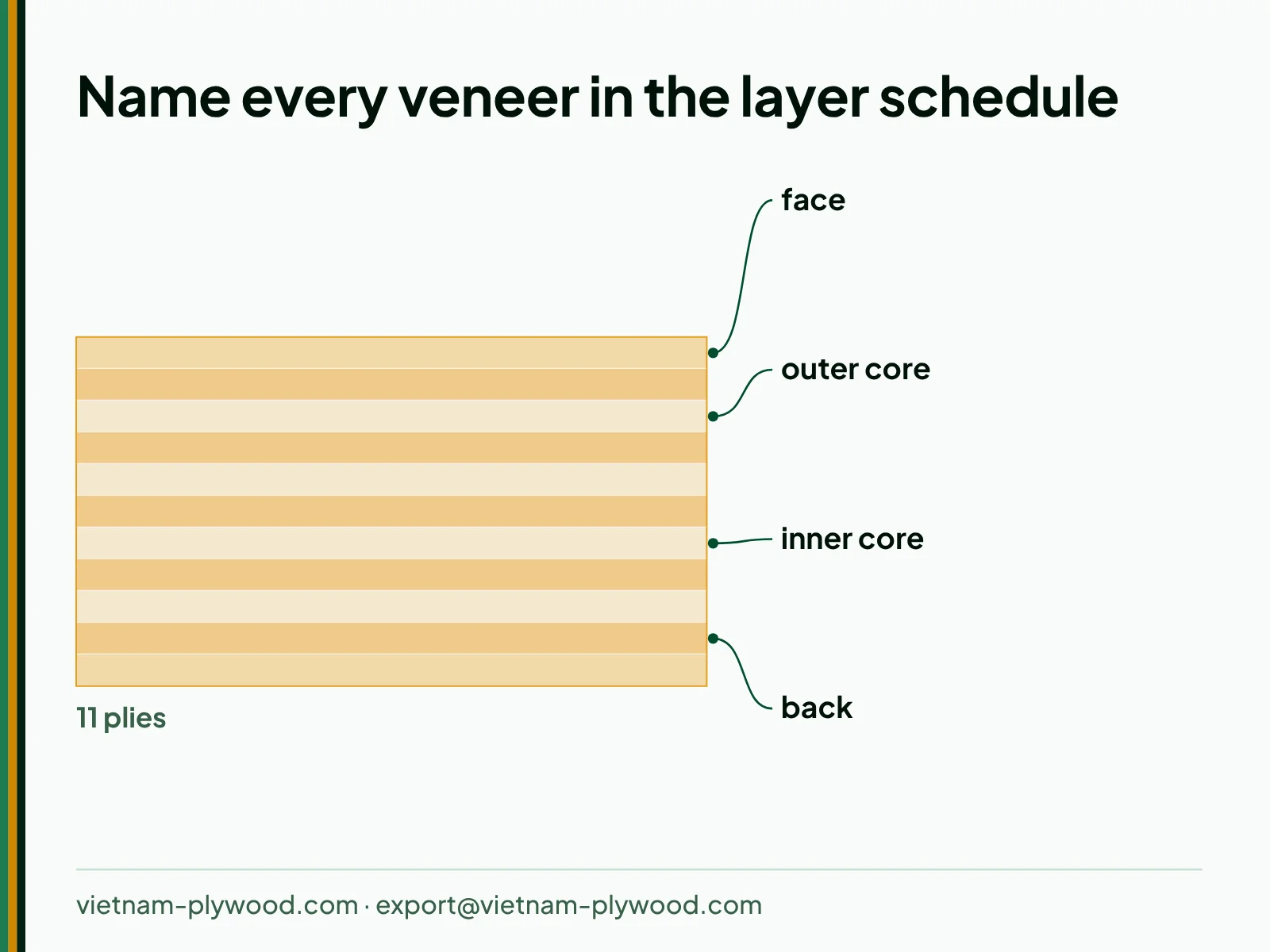
- Name the producing line and list core species in a layer-by-layer schedule, including outer and inner core veneers.
- Specify full-stitched or another agreed joint construction, plus permitted gaps and repair criteria in an approved sample.
- Record glue type separately from emission class, and specify the face species and grade.
- Add thickness, tolerance, length, width, quantity, inspection method and destination port.
- Attach an approved cross-section photograph or retained sample as the visual acceptance reference.
Our available thickness range is 3–40 mm; common orders include 3, 5, 9, 12, 15, 18, 21 and 25 mm. An 18 mm panel commonly has 11–13 plies because core veneer thickness ranges from 1.4–2.0 mm. Length and width tolerance is ±2 mm.
What can an inspector verify at the producing factory?
An inspector can witness a cross-cut panel check against the approved core schedule before loading. The most useful inspection is a labelled sample from the actual production lot, opened at several edges to expose the veneer sequence.
At the producing factory, compare the layer sequence with the order drawing, count plies, identify visible joints and check for open gaps. Measure finished thickness at agreed points and verify the specified face, sanding and surface condition. For furniture builds, compare the measured tolerance with ±0.2 or ±0.3 mm as ordered; commercial and film-faced panels use ±0.5 mm, while packing uses ±0.5–1.0 mm.
Visual inspection cannot independently establish an E0, E1 or E2 class. Factory-member FSC, CARB P2, ISO 9001 and CE certificates, and EUDR/EUTR documents, are shown with factory details masked, on request. Certificate scope must match the relevant producing factory and ordered product.
How do weight and container planning affect the choice?
Weight is a commercial consequence of the specified core, especially when a container combines furniture and packing products. The 40HC payload limit is 28.5 t, and specifications can be mixed within that limit.
For 18 mm, 1220 × 2440 mm reference panels, styrax weighs 26.79 kg per sheet, acacia 31.08 kg and eucalyptus 34.83 kg. A full reference load is 990 styrax sheets at 26.52 t, 880 acacia sheets at 27.35 t or 795 eucalyptus sheets at 27.69 t. These are single-species core reference figures; do not assign them to an unmeasured mixed layup.
For a mixed load, request a packing plan listing the sheet count, measured cargo weight and pallet weight for each specification. Check the combined payload and weight distribution against the container and carrier limits. Read the mixed-container loading options and the container packing reference for load planning.
What determines the quotation and shipment documents?
The largest price driver is the core construction and species schedule, followed by face selection, surface preparation, adhesive and required testing. Full-stitched furniture construction requires more veneer preparation than loose-laid construction; decorative sanding and tighter tolerance add processing work. A specified eucalyptus-rich build also carries different material and weight implications from styrax-rich construction.
Commercial plywood starts from US$250/m³ FOB Hai Phong (October 2026); furniture plywood starts from US$350/m³ FOB Hai Phong (October 2026). These are category starting prices, not a price for a custom combi layup. Request a quotation against the written schedule and acceptance sample.
Minimum order: one 40HC; one container can carry several specifications as long as the payload limit holds. Production: 15–45 days from the 30% deposit, set by order size, line loading and the contract. The remaining 70% is paid on the scan of the bill of lading, by T/T, or by irrevocable sight L/C. Shipping: FOB Hai Phong, or CFR (CNF) or CIF to your port.
The shipment packing list records panel descriptions, quantities and packages; the agreed build’s test reports and certificate documents provide the corresponding technical evidence. After loading, the draft shipping documents come to you for approval. HCPLY manages specification, on-site quality control, export documents and loading for shipment directly from the producing factory.
What should buyers ask before approving a combi sample?
Ask for a core cross-section, a written species schedule and a sample cut under the same conditions as the planned factory run. Approval should address the intended use rather than the appearance of a single face.
For cabinet production, check CNC edge breakout and fastener retention. For packing, check nailing and cut-edge voids. For formwork, inspect the film and edge sealing, then match the adhesive system to the planned pour conditions.
For US-bound regulated hardwood plywood, the US Environmental Protection Agency’s 2025 Code of Federal Regulations, 40 CFR §770.10, sets a formaldehyde limit of 0.05 parts per million for hardwood plywood made with veneer or composite core (official regulation). This is a regulated emission requirement, separate from the glue designation and core species. The US EPA also describes third-party certification for covered products (EPA rule summary).
What specification should be sent for sampling?
Send the intended application and a proposed layer schedule, then ask Lucy for the closest line-specific sample set. Where a combination is requested beyond the standard line builds, identify it as a proposed construction for technical review before quotation.
Application: Cabinet carcasses; concealed edges; CNC cut and screw fixed
Line or core: Furniture line; proposed styrax/eucalyptus layer schedule attached; full stitched
Glue: Melamine (MR, 12-hour boil)
Emission: E1; supporting document requested for agreed build
Face and grade: Bintangor, A/B
Thickness and tolerance: 18 mm; ±0.3 mm
Size: 1220 × 2440 mm; length/width ±2 mm
Quantity: One 40HC; final mix to be agreed within payload limit
Destination port: [buyer to insert port]
Ask Lucy at export@vietnam-plywood.com for a sample set through contact. Samples: free; a first-time buyer pays the courier, and that charge comes off the first confirmed order.