





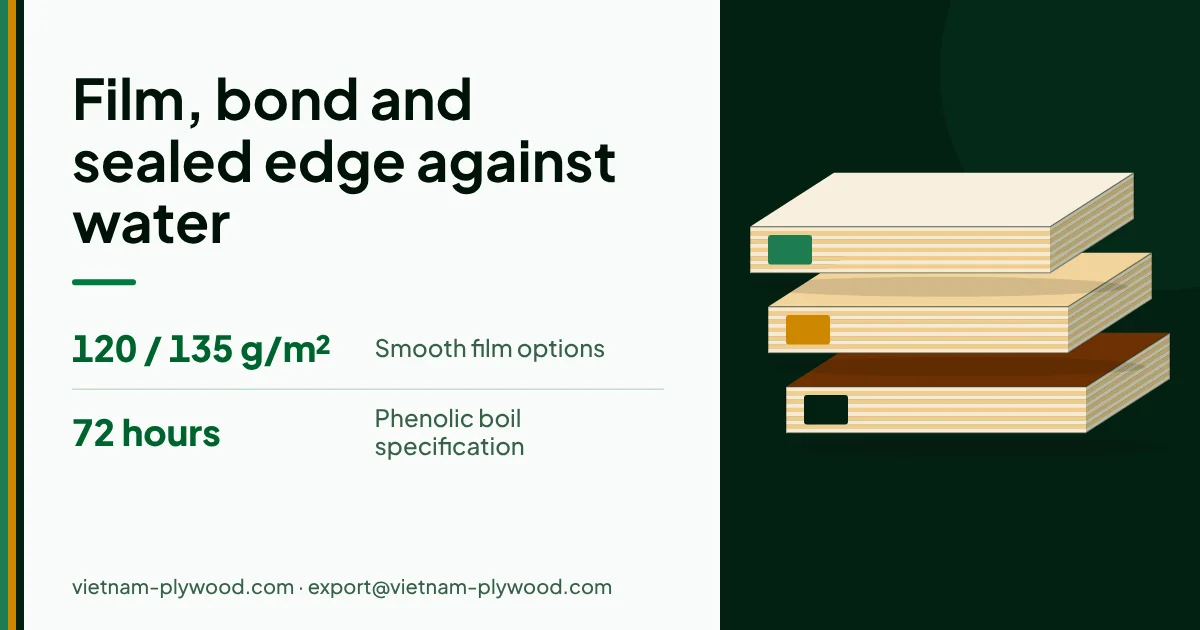
Film-faced plywood resists water during concrete pours when its film, glue bond and edge seals match the exposure. Choosing the wrong build can cost stripping cycles, replacement sheets and delayed pours. For contractors asking is film faced plywood waterproof, HCPLY specifies the wet-cycle conditions before choosing a construction-line panel.
Is film faced plywood waterproof?
Film-faced plywood is water-resistant across an intact coated face, but the complete sheet is not impermeable. Its film slows water reaching the veneer, its adhesive holds the plies together, and sealed edges limit entry through exposed wood. Cut edges, tie holes, scratches and standing water can defeat those protections. For repeated concrete pours, specify the whole build and its care rather than relying on the word “waterproof.”
HCPLY’s construction line presses film-faced panels for wet concrete contact. A buyer comparing plywood moisture performance more broadly can read how plywood responds to water.
Is shuttering plywood waterproof?
Shuttering plywood used as concrete formwork is water-resistant when its face, bond and edges suit the wet cycle. Shuttering describes the job; it does not identify the glue chemistry or the quality of the protective surface. A panel can resist fresh concrete during a pour yet absorb water at an unsealed cut after stripping.
The 2017 moisture-exposure guidance from APA — The Engineered Wood Association distinguishes Exposure 1 from Exterior bond classifications according to service moisture conditions. That is useful specification logic, rather than an HCPLY grade or stamp. A formwork order still needs its own agreed bond test and panel details.
How do film weight and sealed edges keep water out?
The film protects the broad face; edge sealing protects the exposed veneer ends where water can travel into the core. Our construction line uses 120 g/m² standard film or 135 g/m² premium film for smooth-faced construction panels. The 220 g/m² film is reserved for anti-slip surfaces. Film weight identifies the facing specification; it cannot by itself establish a waterproof rating.
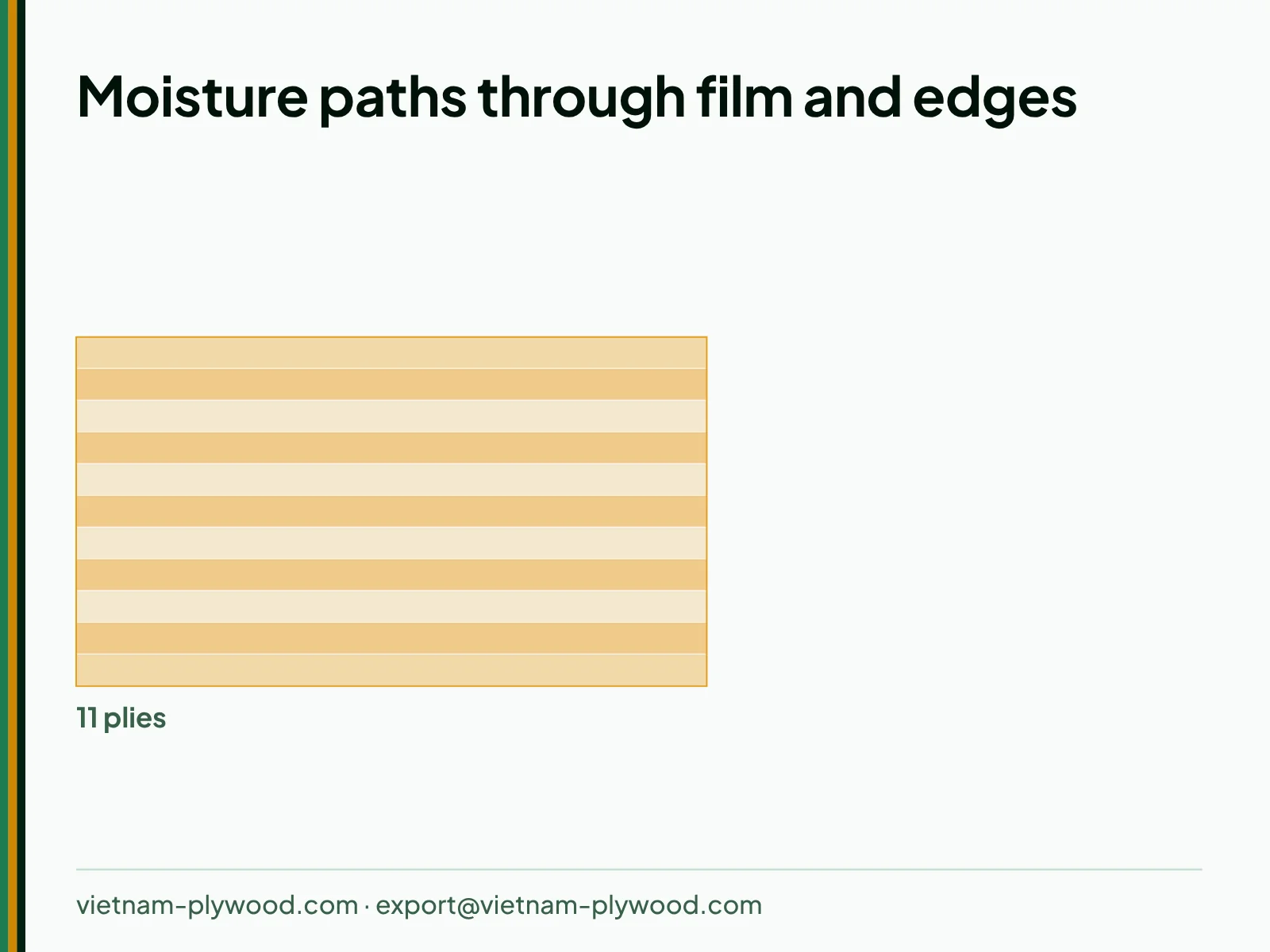
The most vulnerable locations are newly sawn edges, tie holes, corner impacts and scratches that reach the veneer. Seal factory edges and every new cut edge; inspect penetrations and repair damage before the next pour. A heavier film cannot compensate for a missing edge seal or a failed glue bond.
When the surface is stripped, remove cement residue without gouging the overlay. Keep the panels flat and protected from standing water between cycles. These measures preserve the film and make the ordered bond specification useful on site.
Does phenolic or melamine glue cope better with water?
Phenolic glue is the stronger choice for extended wet pour cycles in our available construction builds. HCPLY describes phenolic glue as weather and boil proof (WBP), with a 72-hour boil specification; its melamine moisture-resistant (MR) glue has a 12-hour boil specification. These are glue descriptions, rather than proof that every exposed part of the sheet repels water.
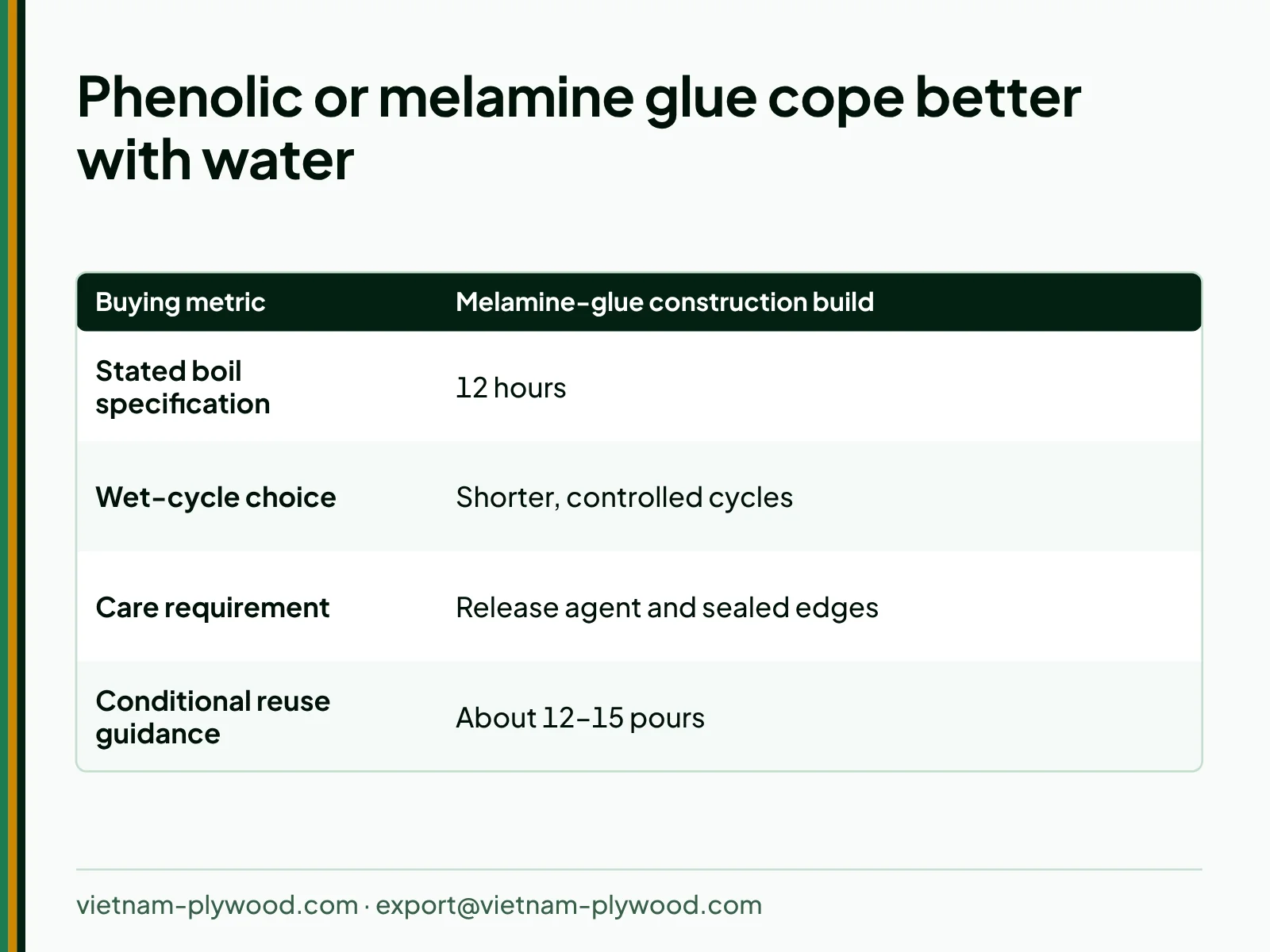
| Buying metric | Melamine-glue construction build | Phenolic-glue construction build |
|---|---|---|
| Stated boil specification | 12 hours | 72 hours |
| Wet-cycle choice | Shorter, controlled cycles | Longer or repeatedly wet cycles |
| Care requirement | Release agent and sealed edges | Release agent and sealed edges |
| Conditional reuse guidance | About 12–15 pours | Up to about 25 pours |
Both reuse ranges assume proper handling, a release agent on every pour and sealed edges, including all cut edges. Site stripping practice, moisture exposure and surface damage remain decisive. Do not translate the boil durations into an automatic number of safe site days.
Which build should I order for long wet pour cycles?
Order phenolic-glue film-faced plywood with a written film, core, thickness, edge-seal and inspection specification for long wet cycles. Start with the anticipated duration of contact with fresh concrete and the number of planned stripping cycles. Then specify where panels will be cut, drilled, stacked and exposed to rain.
For smooth concrete faces, choose the standard or premium smooth film according to the surface and handling demands. Anti-slip film belongs to walking or grip applications; its textured face is not a substitute for a smooth concrete-contact surface. Specify acacia or eucalyptus core according to the project’s weight and handling needs, then assess the panel against the agreed formwork design.
Our film-faced plywood product overview covers the construction range. The producing factory can present samples from the ordered build before shipment, including the face, edge coating and visible core at an agreed cut.
How do our three production lines differ?
Our construction line makes the film-faced panel; the other lines make products for different exposure and finish requirements. Equal nominal thickness does not make those panels interchangeable during a wet pour.
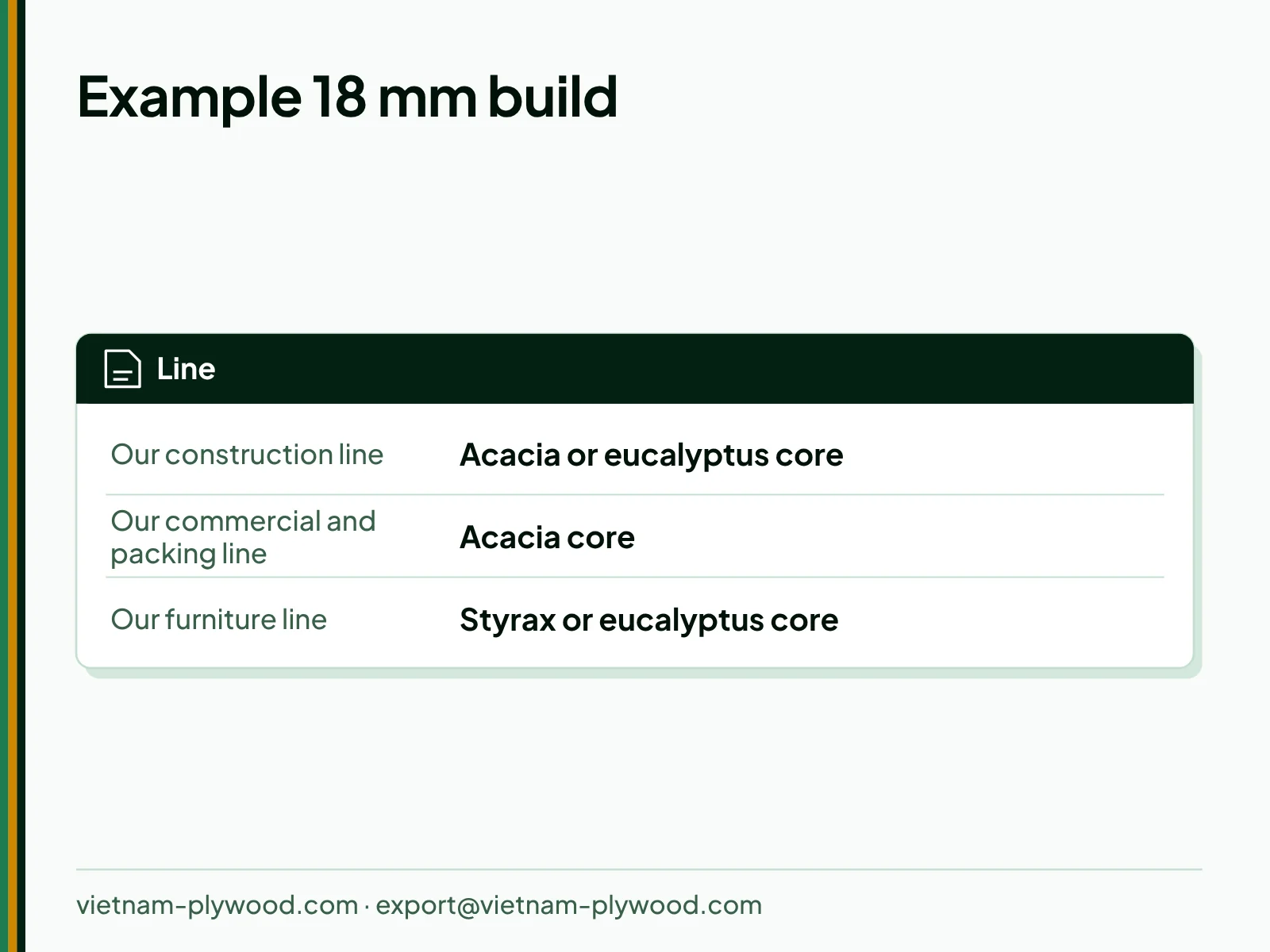
| Line | Example 18 mm build | Surface and bond | Suitable buying use |
|---|---|---|---|
| Our construction line | Acacia or eucalyptus core | Film-faced, unsanded core; phenolic WBP or melamine MR | Concrete formwork |
| Our commercial and packing line | Acacia core | Raw unsanded or light-sanded, MR glue | Packing and commercial panels |
| Our furniture line | Styrax or eucalyptus core | Full stitched, sanded, E0/E1 emission class | Furniture and cabinet components |
The construction line uses a ±0.5 mm thickness tolerance and a ±2 mm length-and-width tolerance. An 18 mm panel commonly has 11–13 plies; veneer thickness determines the actual count. For formwork, the inspector should evaluate the ordered panel rather than assuming that a furniture-grade surface indicates a better wet-cycle build.
Which bond test can a buyer witness at the factory?
Ask to witness the agreed boil-and-bond procedure on a sample of the actual construction build at the producing factory. Record the panel identification, glue specification, sample preparation, exposure duration, conditioning and post-test bond observations. Compare the result with the buyer-accepted test method and acceptance criteria written into the purchase specification.
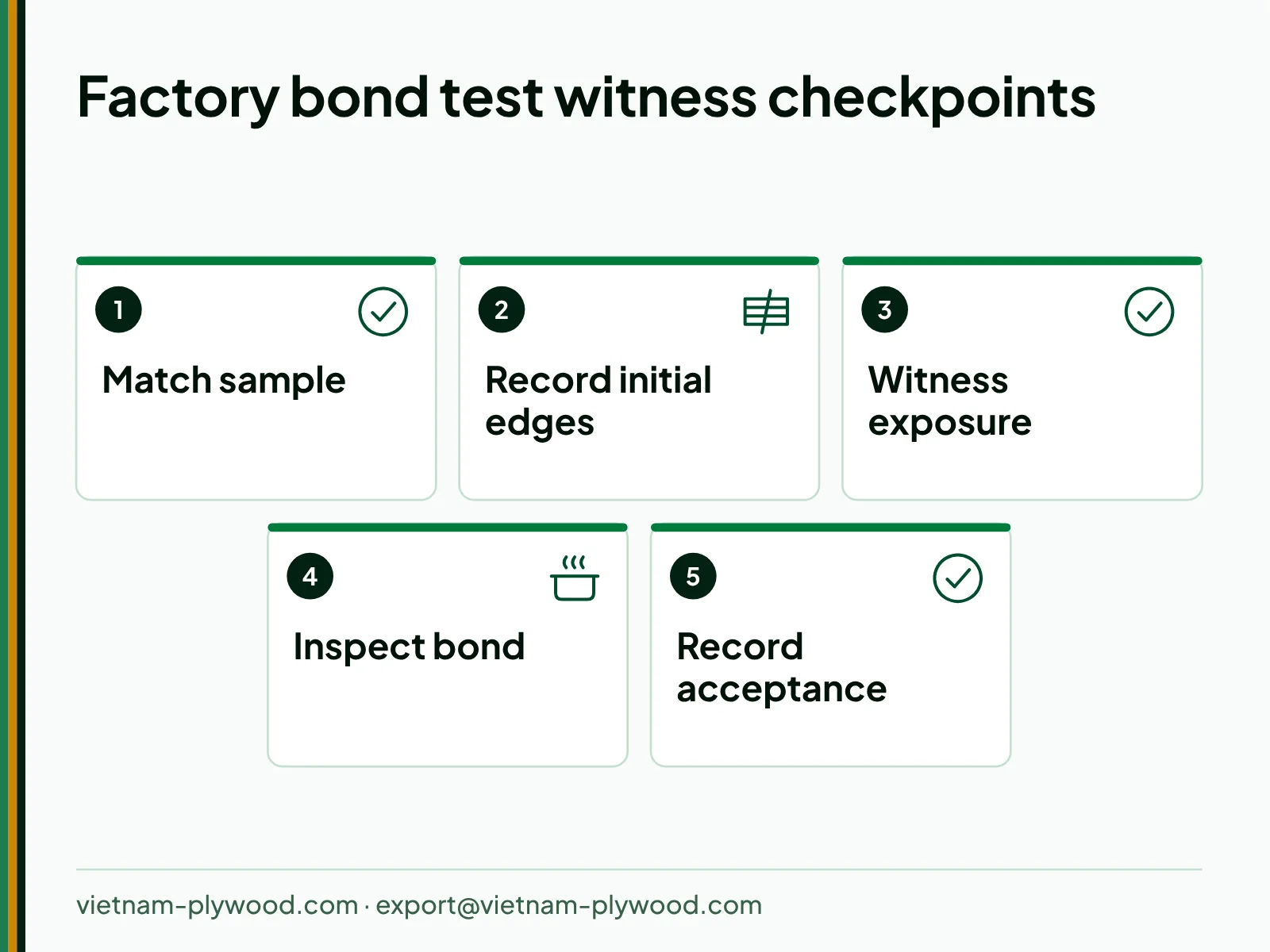
A practical inspection sequence is:
- Match the sampled panel to the order’s core, glue, film and thickness.
- Photograph the sample edges and note any existing separation.
- Witness the agreed exposure procedure and record its duration.
- Inspect the glue lines after the specified conditioning and record the observations.
- Compare the evidence with the agreed acceptance criteria and retain the report with the order records.
A witnessed boil procedure examines the adhesive bond; it does not test every edge penetration or guarantee a particular reuse count. Also inspect film continuity, edge coating, corners and cut samples. HCPLY coordinates on-site quality control with the producing factory.
What damage should stop a panel returning to a pour?
Remove a panel from the next pour when delamination, major edge swelling, broken corners or film loss makes the forming surface or safe support uncertain. A surface scratch that has not reached veneer requires different attention from an open glue line. Examine the defect’s depth, location and spread before deciding whether repair is appropriate.
Check the face for blistering, exposed veneer and concrete residue. Check the edge for openings and the back for moisture-related distortion. A wet sheet should be assessed after appropriate drying rather than immediately treated as equivalent to a dry sheet. Formwork load capacity and support spacing belong to the project’s engineering assessment.
What can share a container with film-faced plywood?
Different specifications can share one 40HC within its 28.5 t payload limit. For 18 mm sheets measuring 1220 × 2440 mm, the core-only lookup gives 880 acacia sheets at 27.35 t or 795 eucalyptus sheets at 27.69 t in the respective full-load arrangements. The film weight is excluded from these figures.
A mixed order needs a revised pallet and weight plan rather than adding two full-load quantities together. For example, acacia and eucalyptus panels can share space only when their combined actual shipment weight remains within the payload limit. The container-load planning page owns detailed sheet-count calculations.
Shipment paperwork includes the commercial invoice, packing list and bill of lading, along with applicable origin, phytosanitary, fumigation and order-specific test documents. The packing list identifies the shipped quantities; the agreed test report addresses the bond specification. After loading, the draft shipping documents come to you for approval.
How should panels be handled between pours?
Protect the film and seal every exposed edge between pours to retain water resistance. Apply release agent on each pour, strip without prying through the overlay and clean promptly after the concrete releases. Avoid dragging sheets across abrasive ground or leaving stacks in pooled water.
Store panels flat with support under the stack and cover them against direct rain while allowing sensible drying. Recoat cuts and inspect drilled holes before reuse. These habits affect the number of serviceable pours as much as the initial film specification. A damaged panel should not be put back into the formwork simply to reach a target cycle count.
What should the purchase specification state?
State the wet exposure, glue, film, core, dimensions, inspection procedure and acceptance criteria together. Separate glue chemistry from emission class: E0, E1 and E2 describe emissions, whereas MR and WBP describe the adhesive system. A buyer requiring an emission certificate should name the applicable limit and accepted report.
Write the required film surface and weight, edge coating, treatment of field cuts, permitted defects and sampling approach. Ask for the relevant producing-factory documents with factory details masked, on request, where certificates apply. For planning the order window, see plywood production lead time.
HCPLY runs specification, factory quality control, shipping documents and loading for export from Vietnam. Give the destination port and intended pour conditions in the enquiry so the quote matches the actual build.
What should a formwork buyer send next?
Send a single written build specification and request a sample set before placing the bulk order. The sample should let the buyer inspect the film, core cross-section, sealed edge and agreed bond-test approach. The purchase specification should distinguish smooth concrete-contact panels from anti-slip surfaces.
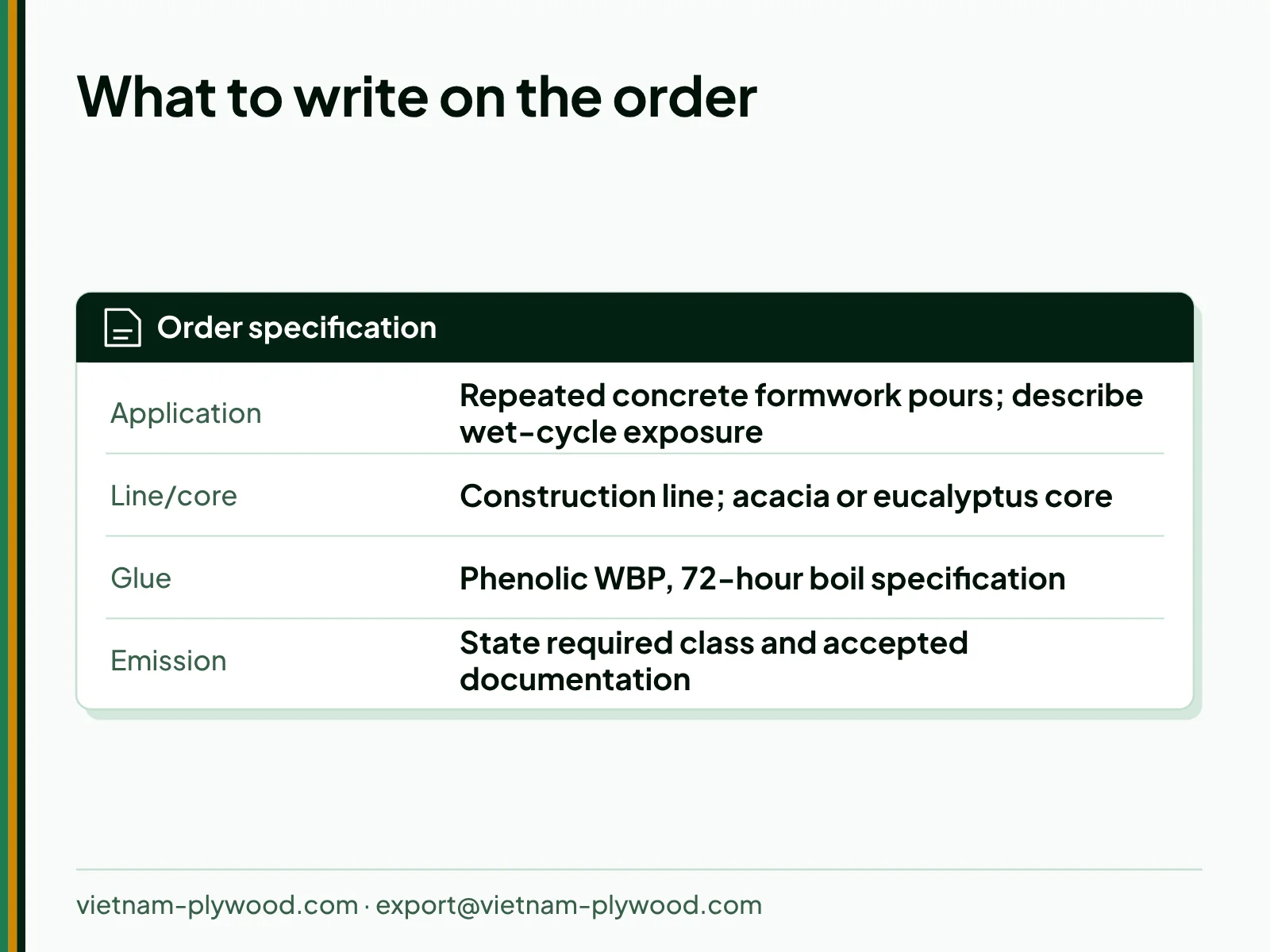
Application: repeated concrete formwork pours; describe wet-cycle exposure
Line/core: construction line; acacia or eucalyptus core
Glue: phenolic WBP, 72-hour boil specification
Emission: state required class and accepted documentation
Face and grade: smooth film-faced, 120 or 135 g/m²; agreed appearance criteria
Thickness and tolerance: 18 mm, ±0.5 mm
Size: 1220 × 2440 mm; length/width ±2 mm
Quantity: state sheets and pallet mix within 40HC payload
Destination port: state port and requested delivery term
Ask Lucy at contact or export@vietnam-plywood.com for a sample set against that specification.