





What is a project panel in plywood?
At HCPLY, a project panel is plywood sold for a defined fabrication or fit-out task, rather than a fixed technical grade. The phrase project panel tells a purchasing team little about the veneers, bonding system or acceptable defects. Two panels described this way can behave differently at a saw, edge-bander or assembly bench. The specification, rather than the trade label, determines what arrives.
Our quotation starts with the actual build. The same nominal thickness can come from a sanded furniture panel, an unsanded commercial sheet or a film-faced construction panel. Substituting one for another can mean wasted machining time, rejected visible surfaces or a load that fails incoming inspection.
For the baseline product family, see commercial plywood. A project-panel order for concealed cabinet components needs a different finish decision from a packing panel, even where both use the same dimensions.
What is utility plywood?
Utility plywood is a broad buying term for sheets selected mainly for function rather than decorative appearance. Utility plywood panels can be appropriate for backing, partitions, jigs and concealed fit-out components when the specified bond and core suit the job. The word utility does not establish a face grade, load rating or moisture performance.
Buyers should separate the intended application from the panel’s appearance. A rough face may be acceptable behind a finished lining, while an open core gap can cause trouble at a routed edge. Describe whether edges are exposed or machined.
Our multi-purpose commercial plywood overview explains the practical uses of this family without treating the label as a standard.
What do ordinary and general purpose plywood mean?
Ordinary plywood and general purpose plywood are quotation descriptions, not complete manufacturing instructions. They usually signal a broad-use panel, but neither phrase tells the inspector which veneer joints or glue were ordered. Far Eastern plywood likewise describes a trading category or regional association rather than a reproducible grade.
An ordinary-plywood listing can give thickness and sheet size while leaving density and hardness unspecified. That is useful for selecting a format, yet insufficient for comparing core quality. The same issue applies to plywood project panels listed by the sheet: a unit price alone does not reveal the quantity of usable machined parts.
The U.S. International Trade Commission’s 2010 tariff discussion places plywood and related laminated wood within heading 4412 and distinguishes subheadings by construction and veneer composition (USITC, 2010). Tariff classification does not establish a project-panel quality grade. Request a written construction schedule.
Which grade, core and glue sit behind the name?
The answer is the face grade, core species and core assembly actually written into the order. On our commercial and packing line, the core is acacia, the glue is melamine moisture-resistant (MR), and the surface is unsanded or light-sanded. For a visible cabinet face, the furniture line uses a different preparation standard.
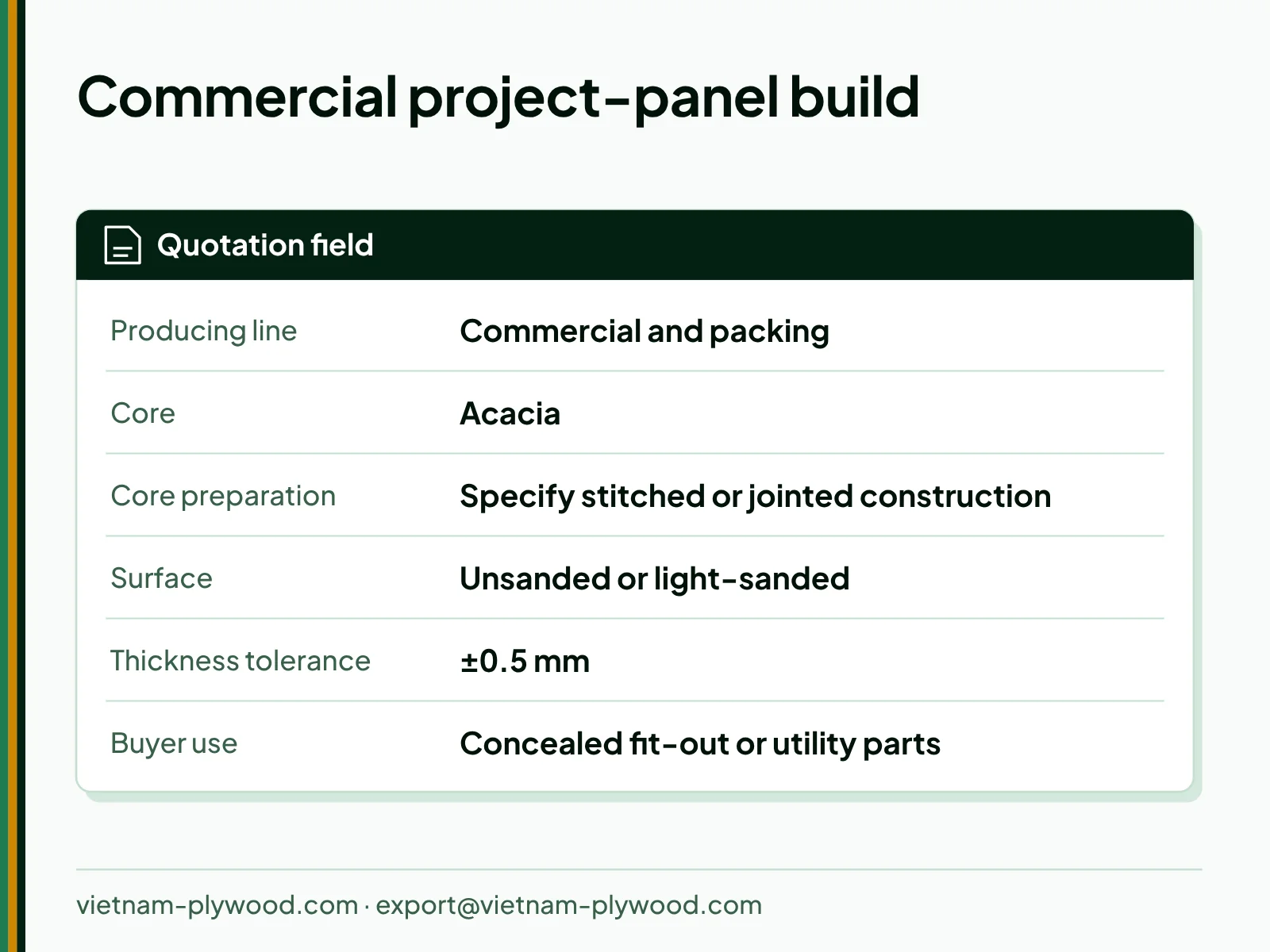
| Quotation field | Commercial project-panel build | Packing-oriented build | Furniture-oriented build |
|---|---|---|---|
| Producing line | Commercial and packing | Commercial and packing | Furniture |
| Core | Acacia | Acacia | Styrax or eucalyptus |
| Core preparation | Specify stitched or jointed construction | Specify acceptable lower-finish construction | Full stitched |
| Surface | Unsanded or light-sanded | Unsanded or light-sanded | Sanded |
| Thickness tolerance | ±0.5 mm | ±0.5–1.0 mm | ±0.2 or ±0.3 mm as ordered |
| Buyer use | Concealed fit-out or utility parts | Protective and packing components | Cabinet parts needing controlled surfaces |
A face name is not a core name. A bintangor-faced sheet can still have an acacia core; its density follows that core. Ask for face species and A/B face grade separately. Read about bintangor-faced plywood and core veneer construction before accepting a short-form quote.
Does a project panel sometimes hide a packing-grade core?
Yes. A project-panel label can cover a core assembled to a packing-oriented specification, especially when the quote lists only size and face. That difference matters when a cabinet maker needs clean cutouts or stable screw positions. Check the exposed edge against the agreed core.
Core construction choices run from full stitched, through stitched outer layers with edge-trimmed inner veneers, to finger-jointed and loose-laid assembly. These are distinct constructions, even when the face looks similar. A buyer should name the accepted construction rather than relying on an attractive face photograph.
A packing-oriented panel can be a sound purchase for a packing job. It becomes a costly substitution when used for a machined furniture component whose order required tighter core continuity. Compare the intended packing application in export-grade packing plywood.
How can buyers compare project panel quotes like for like?
Compare quotations by freezing the technical fields before comparing the commercial offer. A price per sheet is meaningful only after the dimensions, usable face and defect allowance match. An apparent saving can disappear through edge repairs, rejected parts or additional sanding.
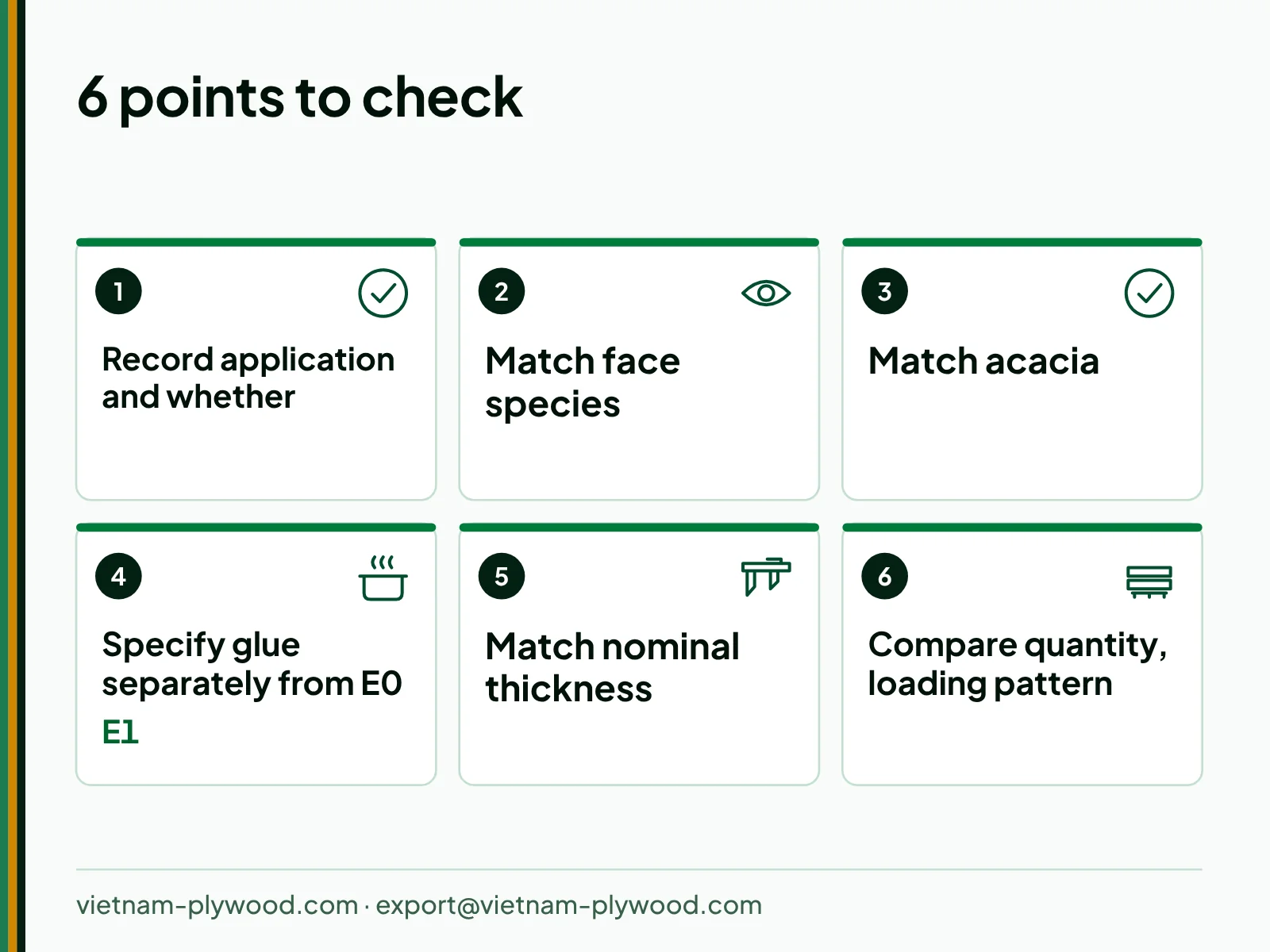
- Record application and whether the panel face or edge remains visible.
- Match face species, A/B grade and any required veneer appearance.
- Match acacia, styrax or eucalyptus core and the core joint construction.
- Specify glue separately from E0, E1 or E2 emission class; request the relevant emission evidence where required.
- Match nominal thickness, thickness tolerance, length, width and permitted dimensional deviation.
- Compare quantity, loading pattern, destination port and delivery term on the same basis.
For HCPLY, thicknesses span 3–40 mm and available formats include 1220×2440 and 1250×2500 mm. Length and width tolerance is ±2 mm. These measurements belong in the order, not in an informal description such as standard sheet.
What can an inspector check at the producing factory?
An inspector can compare the approved sample and order specification against faces, exposed edges, measured thickness and pallet identification. At the producing factory, we can present the actual order for inspection before loading. The check should target the feature most likely to cause rejection in the buyer’s process.
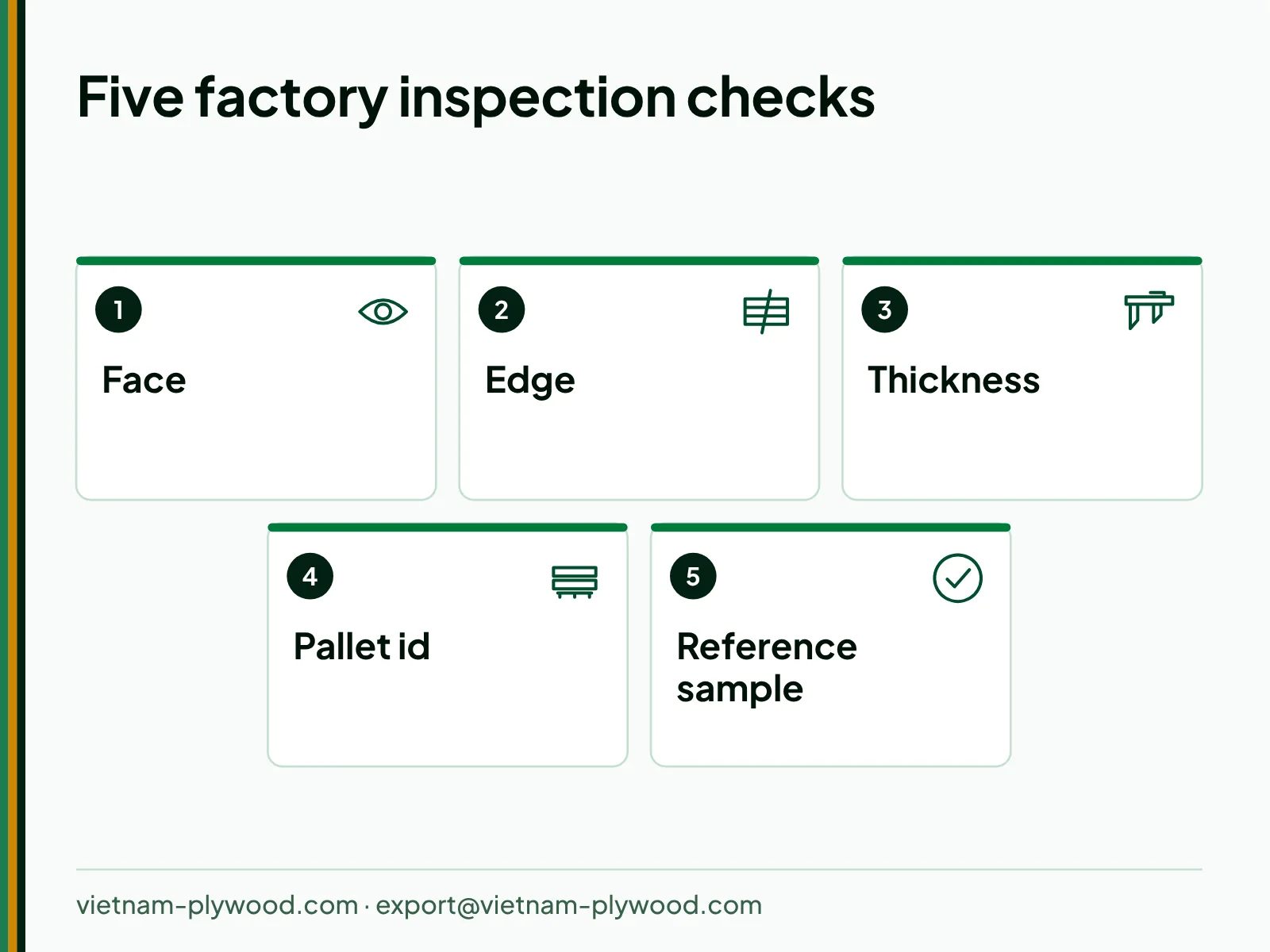
For a concealed cabinet component, inspect the cut edge for gaps and the face for patches or splits. For a packing application, inspect the agreed surface condition and core assembly instead of applying decorative-face expectations. Use thickness readings across several locations and compare each against the tolerance written on the order.
HCPLY runs specification, on-site quality control, export documents and loading. Buyers can visit the factory office and inspect the goods at the factory pressing their order. Ask that the approved reference sample and inspection checklist travel with the purchase specification.
How do the three production lines differ?
Our furniture line prepares full-stitched, sanded styrax or eucalyptus-core panels for furniture applications. Our commercial and packing line presses acacia-core MR panels for utility and packing work. Our construction line makes unsanded acacia- or eucalyptus-core film-faced panels for formwork-related use.
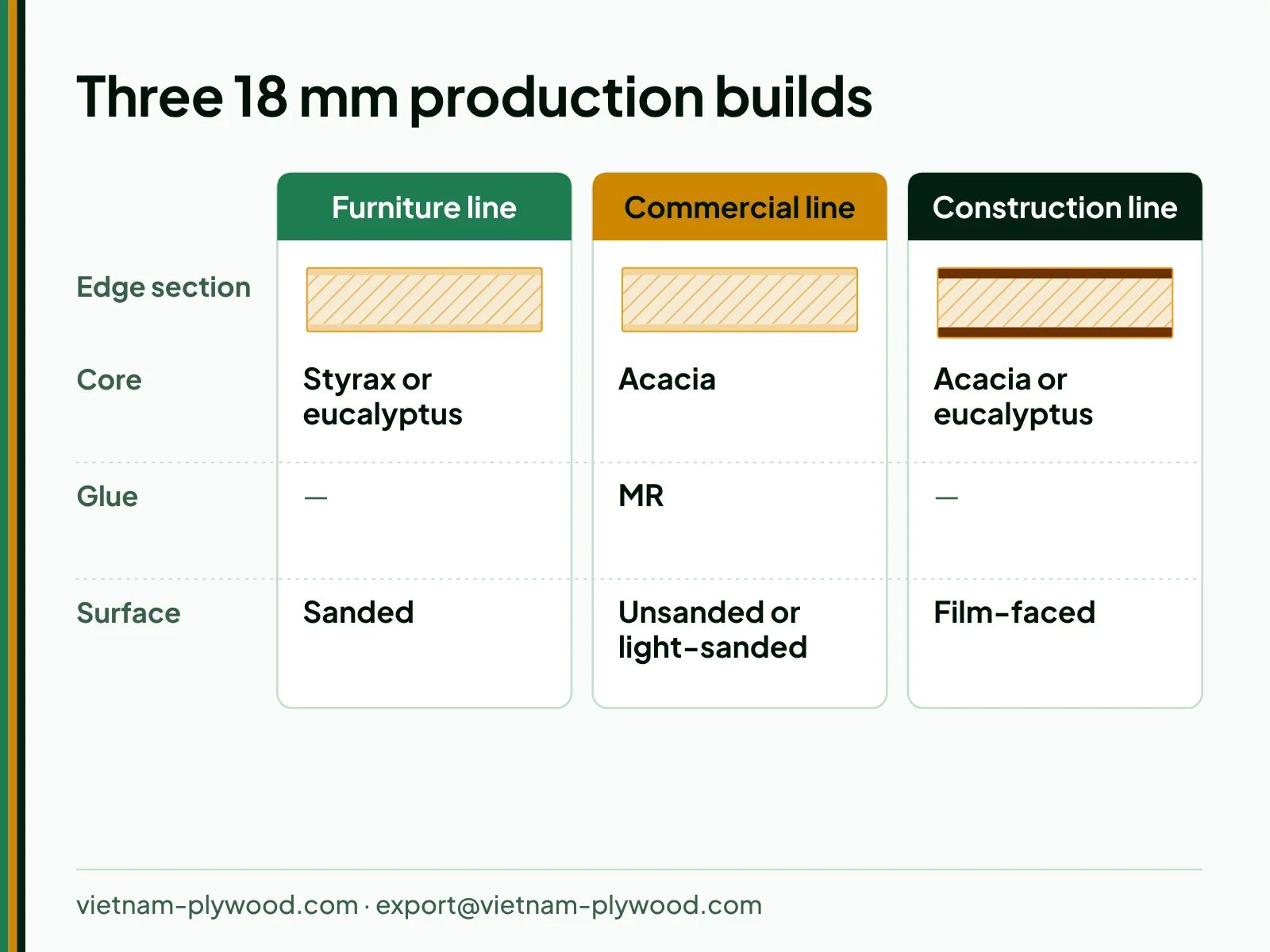
The three builds can share a nominal 18 mm thickness while differing in core, surface and tolerance. An order for a concealed fit-out component should state which result is wanted, rather than assuming the construction line produces a more suitable cabinet panel. For formwork applications, consult plywood supply for construction projects.
HCPLY coordinates the order across the appropriate producing factory and ships directly from that factory. The buyer’s specification decides the line; the marketing name does not.
Can mixed project-panel specifications share a container?
Mixed specifications can share a 40HC container within its 28.5 t payload limit. For 18 mm, 1220×2440 mm panels, a full styrax-core loading reference is 990 sheets at 26.52 t; acacia is 880 sheets at 27.35 t; eucalyptus is 795 sheets at 27.69 t. These are separate full-load references, not quantities to add together.
A mixed order must be recalculated from each specification’s sheet count and weight. For example, the acacia-core 18 mm reference weight is 31.08 kg per sheet, while the styrax-core equivalent is 26.79 kg. The mix changes the load even if every sheet has the same outer dimensions.
Use the mixed-container loading service to plan combinations and the container packing reference for the full-sheet calculation. Do not choose a core solely because it increases the count of sheets on a pallet.
What actually drives the quoted price?
Core preparation and surface requirements drive much of the difference between a basic packing-oriented build and a cabinet-ready project panel. Full-stitched, sanded construction costs more to prepare than a lower-finish loose-laid build. Face species and grade, thickness tolerance, order mix and shipping term further affect the quotation.
For a commercial plywood starting reference, the indicative figure is from US$250/m³ FOB Hai Phong (October 2026). It is a starting point for commercial plywood, not a universal price for every project-panel grade. A tighter furniture specification uses a different production route, with an indicative starting reference of from US$350/m³ FOB Hai Phong (October 2026).
Send the actual build and destination for a quotation. Comparing the two starting figures without matching the production fields would conceal the cost of the requested finish.
Which paperwork identifies the ordered build?
The agreed specification and its associated test or emission documents identify the ordered build more precisely than the name printed on a sales quote. The shipment file includes the commercial invoice, packing list, bill of lading, certificate of origin, phytosanitary and fumigation papers, plus order-specific certificate and test documents. Insurance applies under CIF; European Union lots also carry their relevant origin and timber due-diligence file.
The producing member factories’ FSC, CARB P2, ISO 9001 and CE documents can be shown with factory details masked, on request. Such documents should be matched to the actual producing factory and ordered build. After loading, the draft shipping documents come to you for approval.
We ship FOB Hai Phong, or CFR (CNF) or CIF to your port. This makes the written specification and inspection record useful when comparing quotes delivered under different trade terms.
What should go on the sample request?
The sample request should describe the actual manufacturing result required for the buyer’s application. The sample must represent the specified face, core and machining expectation. Mark inspection surfaces and edges.
For a repeatable evaluation, compare the sample against a short written specification and keep that version attached to the order. Ask for a sample set from the appropriate line, then use the same reference during factory inspection. Free samples are available; a first-time buyer pays the courier, and that charge comes off the first confirmed order.
Application: concealed cabinet / fit-out / packing (select one)
Line or core: commercial and packing / acacia (or specify furniture build)
Glue: MR melamine or specified phenolic WBP
Emission class: E0 / E1 / E2 as required
Face and grade: species; A/B; accepted surface condition
Thickness and tolerance: ___ mm; ___ mm
Sheet size: ___ × ___ mm
Quantity: ___ sheets / ___ m³
Destination port: ___
Ask Lucy for a project-panel sample set against this written specification.