





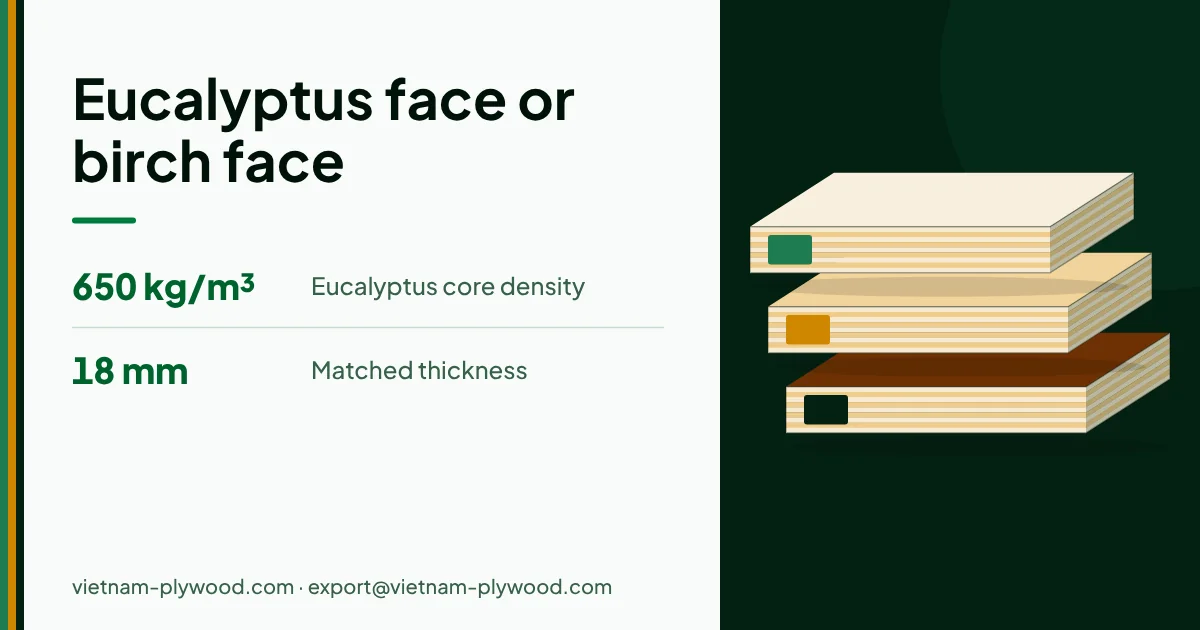
Eucalyptus face can replace birch face in selected furniture and cabinet panels when the required appearance, machining and finish pass a matched-sample trial. Choosing by species name alone can waste finishing labour or cause a rejected shipment. At HCPLY, eucalyptus plywood vs birch plywood starts with separating face veneer from the core that carries most of the panel weight.
What are the key differences in eucalyptus plywood vs birch plywood?
Eucalyptus faces usually present a warmer, more visible grain; birch faces are commonly paler and visually quieter. Neither label specifies core quality, glue, emission class or finished-panel strength. A matched comparison fixes those variables first, then checks whether the proposed face meets the buyer’s colour, coating and machining requirements.
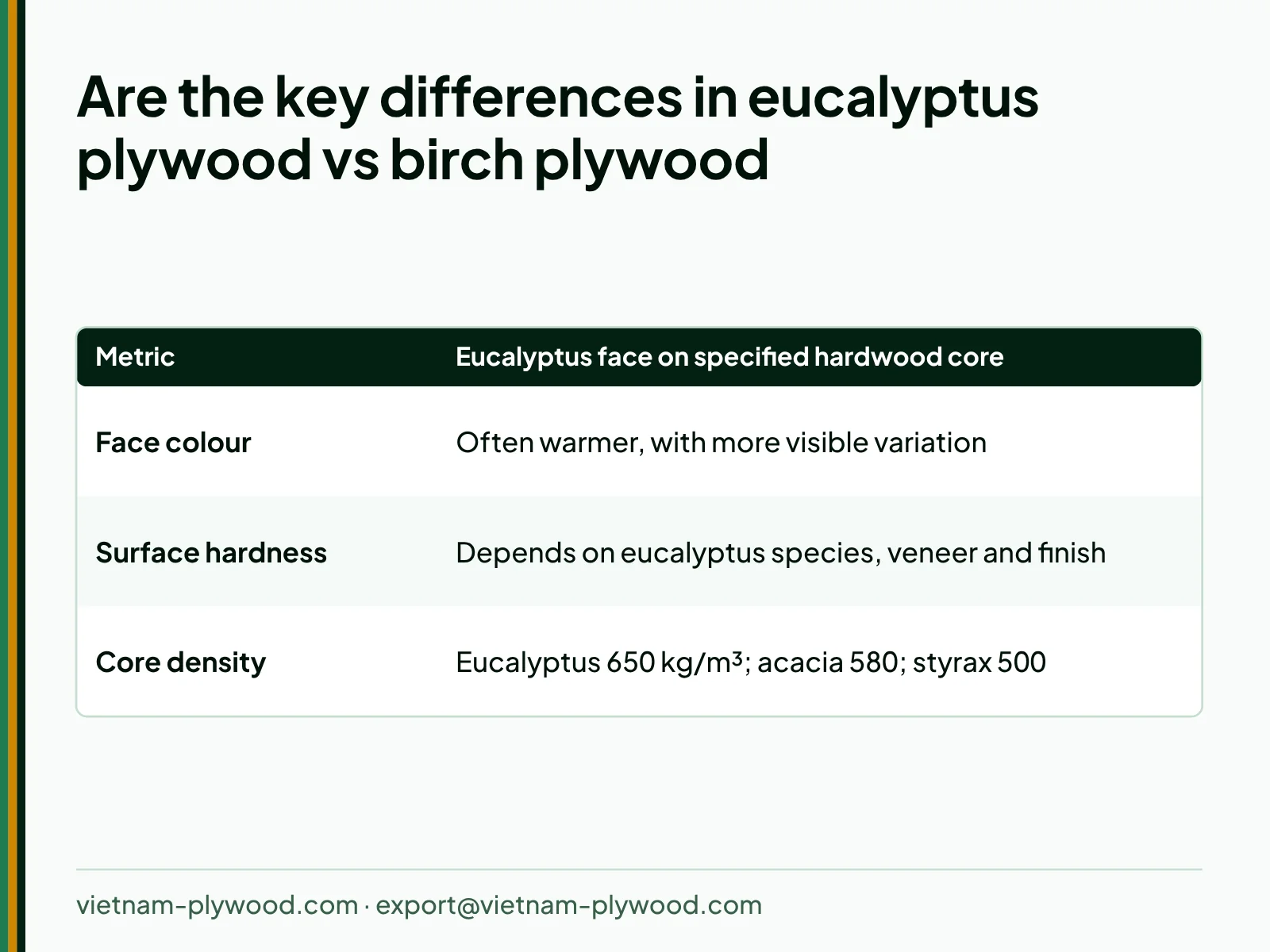
| Metric | Eucalyptus face on specified hardwood core | Birch face on specified hardwood core | Verdict by use |
|---|---|---|---|
| Face colour | Often warmer, with more visible variation | Often pale, with restrained grain | Birch for a specified pale clear finish; sample both for paint |
| Surface hardness | Depends on eucalyptus species, veneer and finish | Depends on birch species, veneer and finish | Test indentation on the actual face before substituting |
| Core density | Eucalyptus 650 kg/m³; acacia 580; styrax 500 | Same values when built on the same HCPLY core | Equal core and thickness: face choice alone is not a weight class |
| Paint coverage | Grain and colour can show through light coats | Pale face can reduce colour masking | Birch has a practical starting advantage for pale paint; trial determines acceptance |
| Stain and clear coat | Warm grain remains visible | Pale, fine appearance remains visible | Select against the approved colour board |
| CNC edges | Core gaps and layup dominate exposed cuts | Core gaps and layup dominate exposed cuts | Match core construction; all-birch edges are a separate specification |
| Bond and moisture | Determined chiefly by adhesive, exposure and edge treatment | Same requirement | Neither face species wins without a defined test |
| Veneer cost | Can offer a lower-cost face option | Birch veneer can cost more | Quote both on identical build and volume |
The eucalyptus plywood product overview gives the broader face and core specification context. For a purchase decision, the table is a screening tool; paired production samples settle the finish and processing questions.
Is eucalyptus plywood as good as birch for cabinets?
Eucalyptus-faced plywood can meet the same cabinet drawing when the drawing calls for a coated surface rather than a particular pale wood figure. Concealed carcasses, drawer components and painted partitions are sensible first trials. Exposed, clear-finished doors need a tighter colour-board comparison.
Do not substitute a eucalyptus-core panel for an all-birch panel merely because both are hardwood plywood. The latter describes its internal veneers as well as its visible face. HCPLY does not press birch-core plywood; our birch option is a birch face over a specified available core.
For cabinet machining, record screw placement, edge-banding adhesion, routing breakout and flatness on the same sample layout. Compare these findings with the factory-line grade criteria before signing off the substitution. A face that paints acceptably can still fail an exposed-edge requirement when the core construction differs.
How do hardness, colour and weight compare?
Hardness must be judged on the finished face, while weight is primarily a core-density calculation. Species-level solid-wood hardness figures cannot stand in for an indentation test on thin face veneer bonded to plywood. A 0.2–0.4 mm face veneer is common in our range; the underlying build affects dent response.
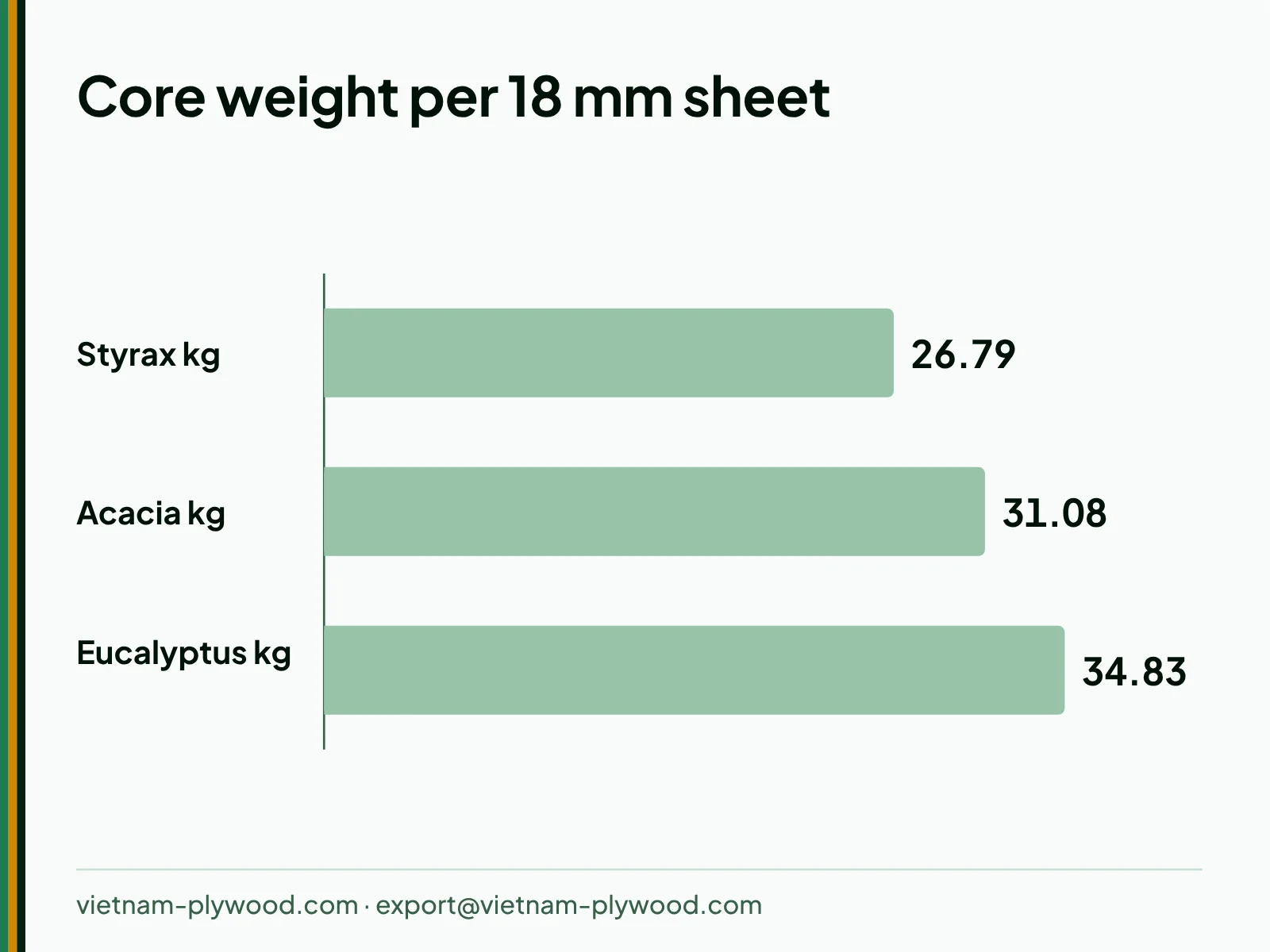
For a 1220 × 2440 × 18 mm sheet, our eucalyptus-core calculation gives 34.83 kg, compared with 31.08 kg on acacia core and 26.79 kg on styrax core. These are core-based figures without a film allowance. The birch-faced and eucalyptus-faced samples built on the same core should be compared directly rather than assigned unrelated generic species densities.
The USDA Forest Service’s Wood Handbook (2021) covers wood as an engineering material. That scope is useful here: no single wood-species label resolves all the purchasing tests. See the 2021 government publication record.
Which takes paint better: eucalyptus or birch plywood?
Birch’s lighter face is often easier to cover with a pale opaque coating, but paint acceptance belongs to the full coating system. Eucalyptus can work well for painted cabinet parts when the primer controls colour bleed and grain visibility. Neither claim replaces a sample finished on the buyer’s production line.
Prepare matched panels with the same sanding, primer, coat weight, drying schedule and topcoat. Compare colour under the intended lighting and inspect the surface after cutting and edge-banding. Record pinholes, raised fibres, visible grain, colour uniformity and coating adhesion against the buyer’s acceptance board.
For stain or clear lacquer, compare the species’ natural figure rather than assuming the warmer face is easier to stain. Test the intended stain on more than one veneer sheet because face colour can differ within a lot. A birch reference colour cannot be reproduced by changing the core alone.
Which of our factory lines makes each comparison sample?
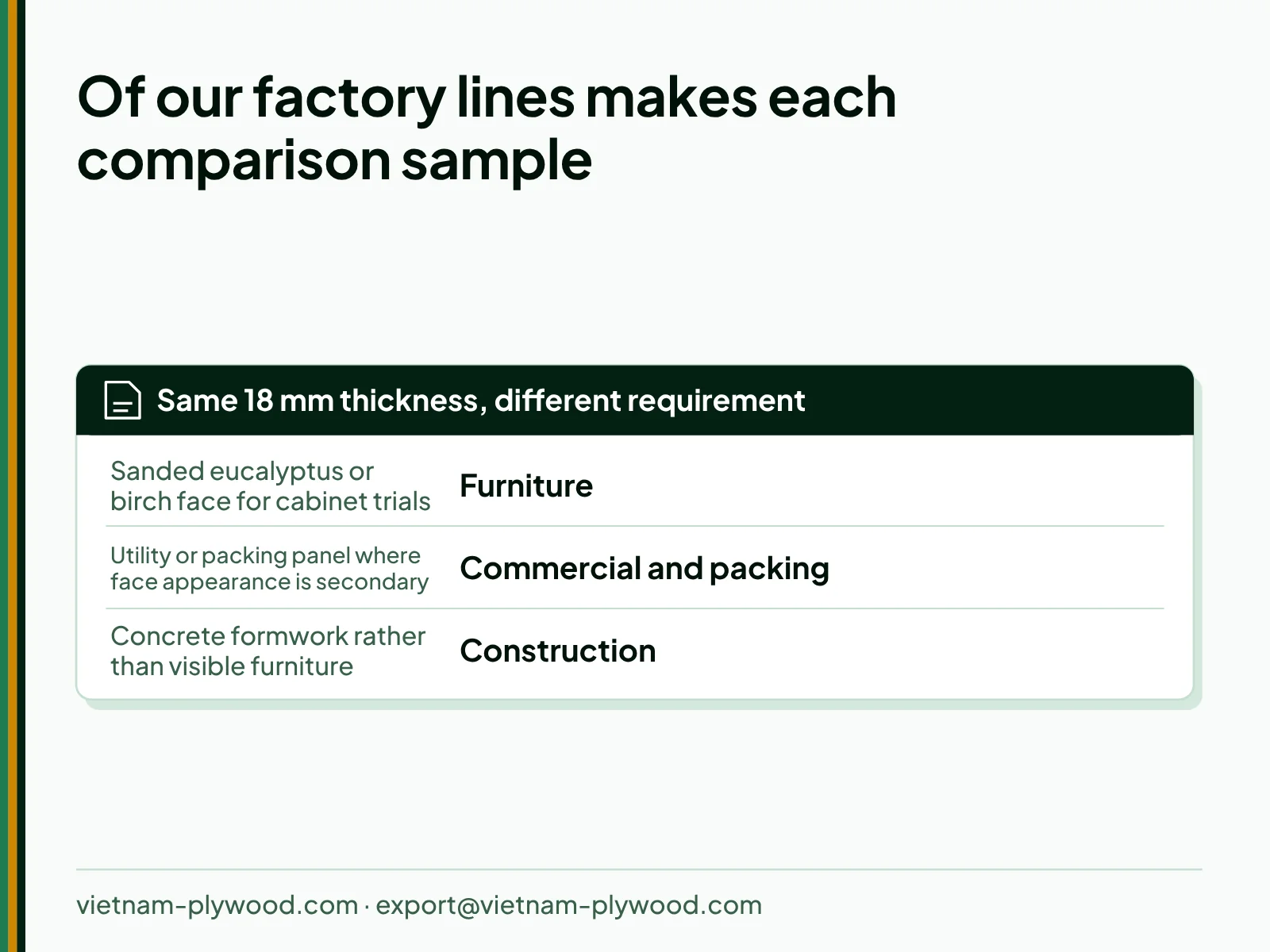
Our furniture line is the appropriate starting point for matched sanded furniture faces. It uses styrax or eucalyptus core with full stitched construction and E0 or E1 emission class. The other lines answer different applications rather than being interchangeable furniture builds.
| Same 18 mm thickness, different requirement | Producing line | Build and buyer’s use |
|---|---|---|
| Sanded eucalyptus or birch face for cabinet trials | Furniture | Full stitched styrax or eucalyptus core; finish-ready comparison samples |
| Utility or packing panel where face appearance is secondary | Commercial and packing | Acacia core, moisture-resistant (MR) glue, unsanded or light-sanded |
| Concrete formwork rather than visible furniture | Construction | Phenolic or melamine film over acacia or eucalyptus core, unsanded |
The factory-line grade comparison explains how similar nominal dimensions can hide different end uses. HCPLY’s three factories are in Phu Tho and Hai Phong, and the order is produced at the factory suited to its specification.
Does glue or core construction change the verdict?
Yes: adhesive choice and internal veneer assembly often matter more than the face species for service conditions. Melamine MR and phenolic weather-and-boil-proof (WBP) are glue descriptions; E0, E1 and E2 describe emission classes. A buyer should write glue and emission as separate fields.
Full stitched core is the highest of our listed core-construction options, followed by stitched outer layers with edge-trimmed inner veneers, finger-jointed core and loose-laid core. Select the internal build before comparing decorative faces. For a routed cabinet edge, inspect gaps and joint transitions across multiple cut positions.
Water exposure is a separate design question. Do not infer outdoor suitability or pest protection from a eucalyptus face. Match the adhesive, coating, sealed edges and exposure conditions to the end use, then specify an accepted bond test if required.
What changes in a container when the core changes?
Core density changes the payload calculation even when the face and nominal thickness stay the same. For 18 mm, 1220 × 2440 mm sheets, the 40HC lookup gives 990 styrax-core sheets at 26.52 t, 880 acacia-core sheets at 27.35 t, or 795 eucalyptus-core sheets at 27.69 t in their respective full-load arrangements. The payload limit is 28.5 t.
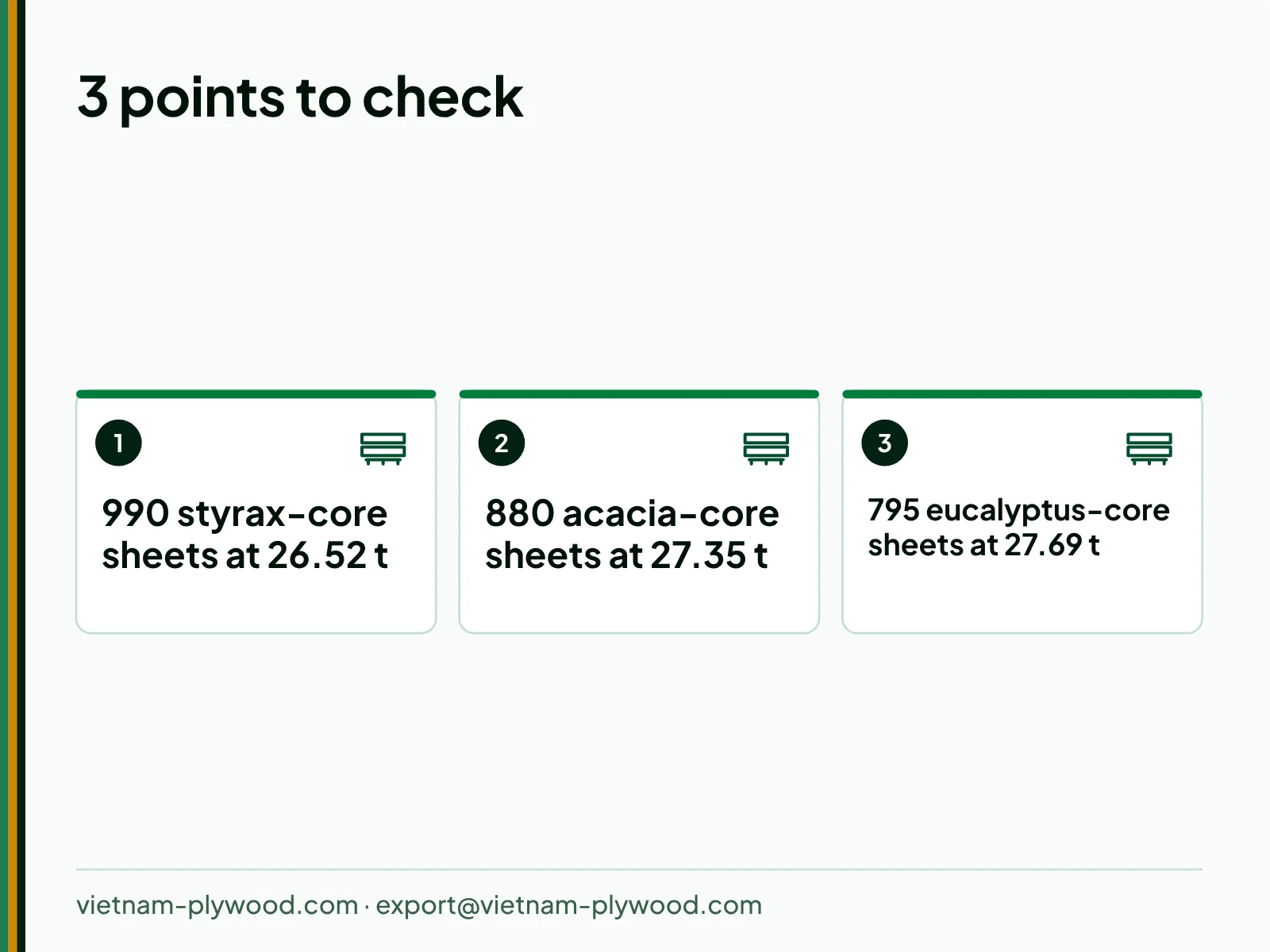
That comparison explains why a eucalyptus-core cabinet order should not inherit a styrax-core packing quantity. Specifications can be mixed within one 40HC while remaining inside the payload limit, but pallet plans must be checked against the actual mix. The container loading reference owns the complete loading method.
Is eucalyptus plywood cheaper than birch plywood?
An eucalyptus-faced alternative can cost less when the birch face veneer is the largest changed cost component. A birch face over the same eucalyptus core usually costs more in veneer procurement than an otherwise matched eucalyptus face, but a firm differential requires two quotations. No universal percentage discount is credible across species, grades and markets.
Price drivers, in practical order, are the core and internal construction, face veneer species and grade, glue and emission requirements, then thickness, surface preparation, dimensions and quantity. A full stitched, sanded furniture build costs more to make than a lower-finish utility build because it requires tighter internal assembly and surface work.
Our indicative furniture starting point is from US$350/m³ FOB Hai Phong (October 2026). That is a furniture category starting price, not a price for either face comparison. Ask Lucy for paired quotations against the same written specification and destination; that isolates the face premium without mixing unrelated product grades.
How should a buyer compare samples at the producing factory?
Approve the substitute by observing the same checks on both marked sample builds. Buyers can visit the factory office and inspect goods at the producing factory. HCPLY coordinates the specification, on-site quality control, export documents and loading.
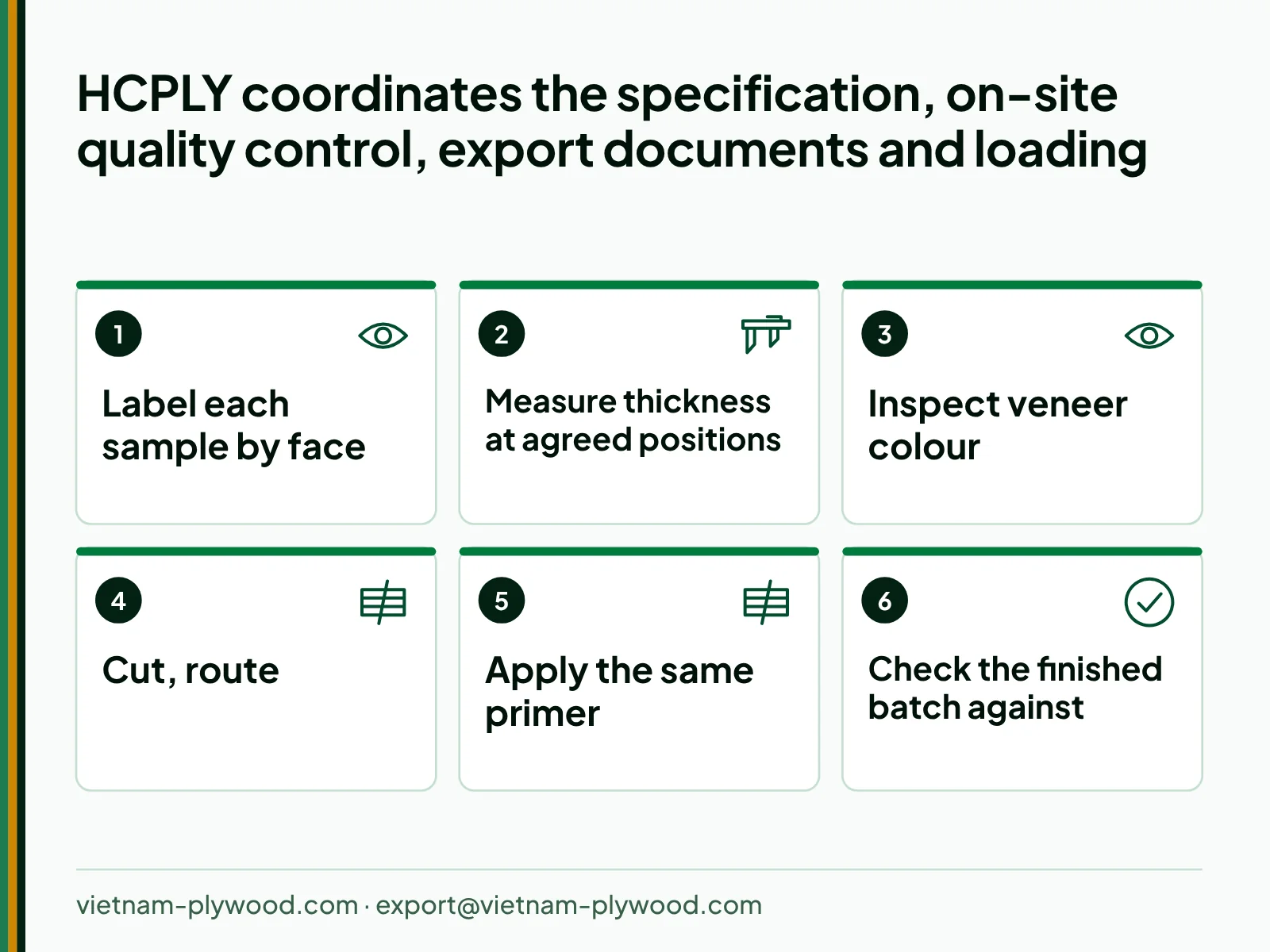
- Label each sample by face, core, core construction, glue, emission class and nominal thickness.
- Measure thickness at agreed positions; our sanded furniture tolerance is ±0.2 or ±0.3 mm as ordered.
- Inspect veneer colour, patched areas, face joints and sanding marks under consistent light.
- Cut, route, drill and edge-band matched pieces using the buyer’s normal tooling.
- Apply the same primer and topcoat, then record appearance and adhesion against the approval sample.
- Check the finished batch against the approved face board and agreed packing identification before loading.
A certificate requested for an order belongs to the producing member factory and is shown with factory details masked, on request. Where relevant, the agreed emission certificate or test report accompanies the shipment’s certificate documents; an emission class alone is not a glue specification.
Where can eucalyptus replace birch, and where should birch remain?
Eucalyptus face is a strong candidate for concealed or painted furniture panels whose drawings allow a different veneer figure. Birch remains the more direct choice for a pale clear-coated visual specification or an explicitly all-birch cross-section. The replacement decision should be made part by part, with the actual machining and finish requirements recorded.
For a distributor, retain two sample codes rather than calling both products simply hardwood plywood. One code should identify the eucalyptus face and one the birch face; both should carry the same core, glue, emission, size and acceptance criteria. This makes future repeat orders traceable to the tested construction.
For the face and core choices available to importers, see the eucalyptus plywood specification overview. If sourcing documentation matters, request the order’s applicable factory certificate documents and origin papers at quotation stage. The face species and core species should remain separately identified in the purchase specification and packing description.
What specification should the buyer send for a matched trial?
A matched sample request should hold every variable steady except the face veneer. The normal minimum order is one 40HC, while samples are free; new buyers book their courier, and its cost can be credited against a real order. Contact Lucy through the sample request page or export@vietnam-plywood.com with the two builds and the intended paint system.
Application: painted cabinet carcass / visible cabinet door (state which)
Line or core: furniture line; eucalyptus core / styrax core (choose one)
Core construction: full stitched
Glue: MR melamine / WBP phenolic (choose one)
Emission: E0 / E1 (choose one)
Face and grade: eucalyptus face A/B vs birch face D/E/F; matched sample pair
Thickness and tolerance: 18 mm; ±0.2 mm or ±0.3 mm as ordered
Size: 1220 × 2440 mm
Quantity: sample pair, then proposed 40HC mix
Destination port: [port and country]
Finish test: buyer's primer, paint, edge-banding and machining criteria
Ask for a matched eucalyptus-face and birch-face sample set before approving the substitution.