



E0 is one of the most misused terms in plywood sourcing. Buyers ask for “E0 glue”, suppliers answer with a mix of glue and emission labels, and the specification ends up meaning nothing on paper. E0 is an emission grade — and getting it right matters most for furniture sold into the EU, where indoor air quality rules and brand requirements are strict.
This guide explains what E0 covers and what to request. For the regulatory context see our EUDR-compliant plywood for the European market and the country-by-country buyer guide.
The stakes are practical. A panel quoted as E0 but supplied as something weaker can fail an emission test at the destination, hold up a container, or trigger a complaint from the end-brand that bought the furniture. Getting the term right on paper, and proving it, is cheaper than discovering the gap after the goods have shipped.
What E0 actually measures
E0 is a formaldehyde emission grade. It describes how little formaldehyde a finished panel releases into the air. The common scale runs E0, E1 and E2, from lowest emission to highest. E0 sits at the low-emission end and is broadly equivalent to the Californian CARB P2 standard used in the US. It is a property of the finished panel, not a glue.
Why E0 is not a glue type
Glue and emission are two separate fields, and mixing them is the most common specification error. The glue is the bonding chemistry — melamine (MR class) for furniture and commercial panels, phenolic (WBP class) for construction and film-faced. The emission grade — E0, E1 or E2 — describes the panel’s output. Writing “E0 glue” is meaningless. Write two fields instead: “Glue: melamine (MR) | Emission: E0”.
Where E0 fits for EU buyers
E1 is the common European baseline for general use. E0 is specified above it for furniture and indoor products, where buyers and end-brands want the lowest emission they can document. For furniture exported to the EU, requesting E0 (and accepting CARB P2 as equivalent) is the safe default. Cheaper E2 material is aimed at lower-requirement Asian markets and should not be quoted for EU furniture.
E0 and the core underneath it
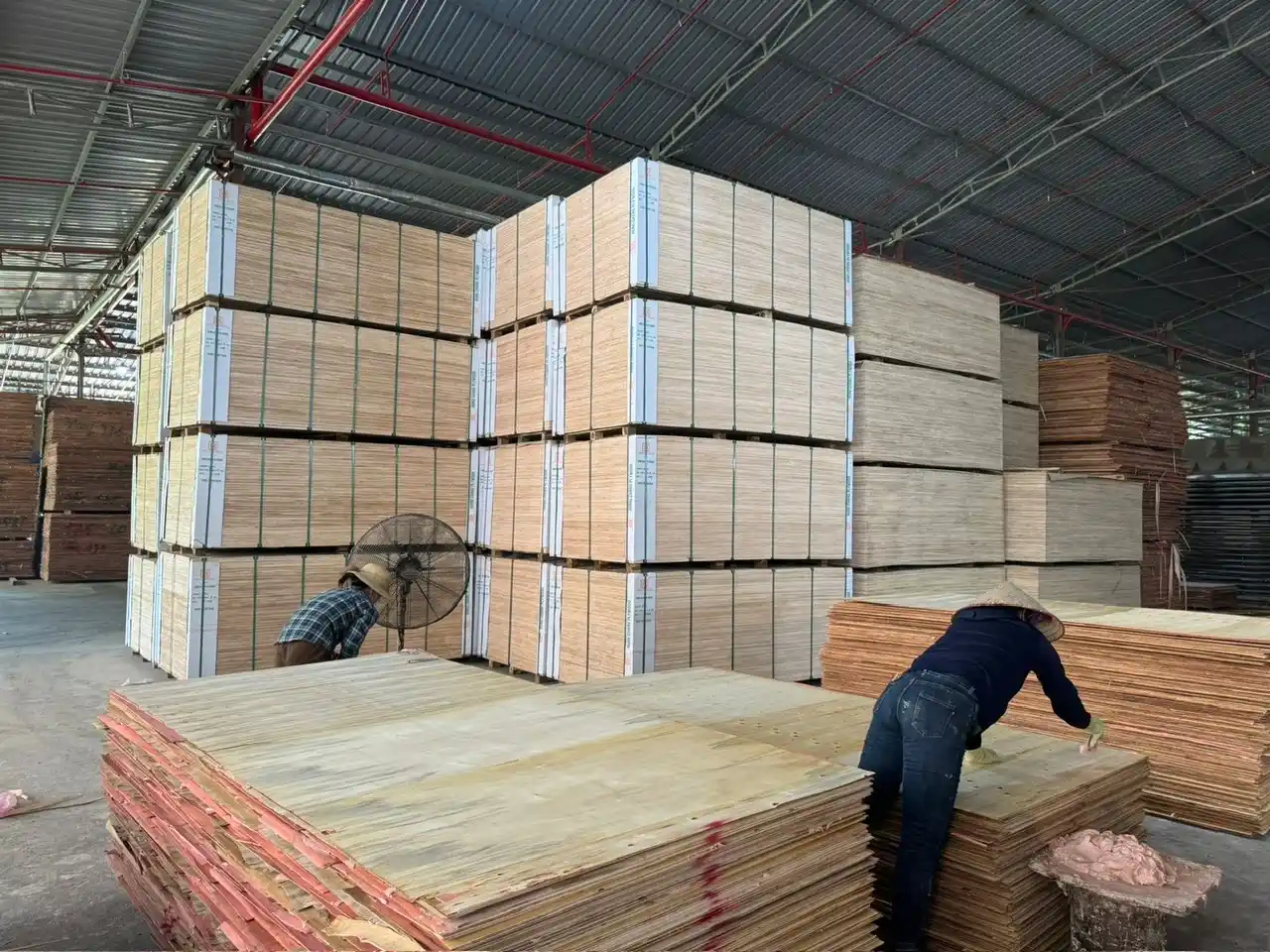
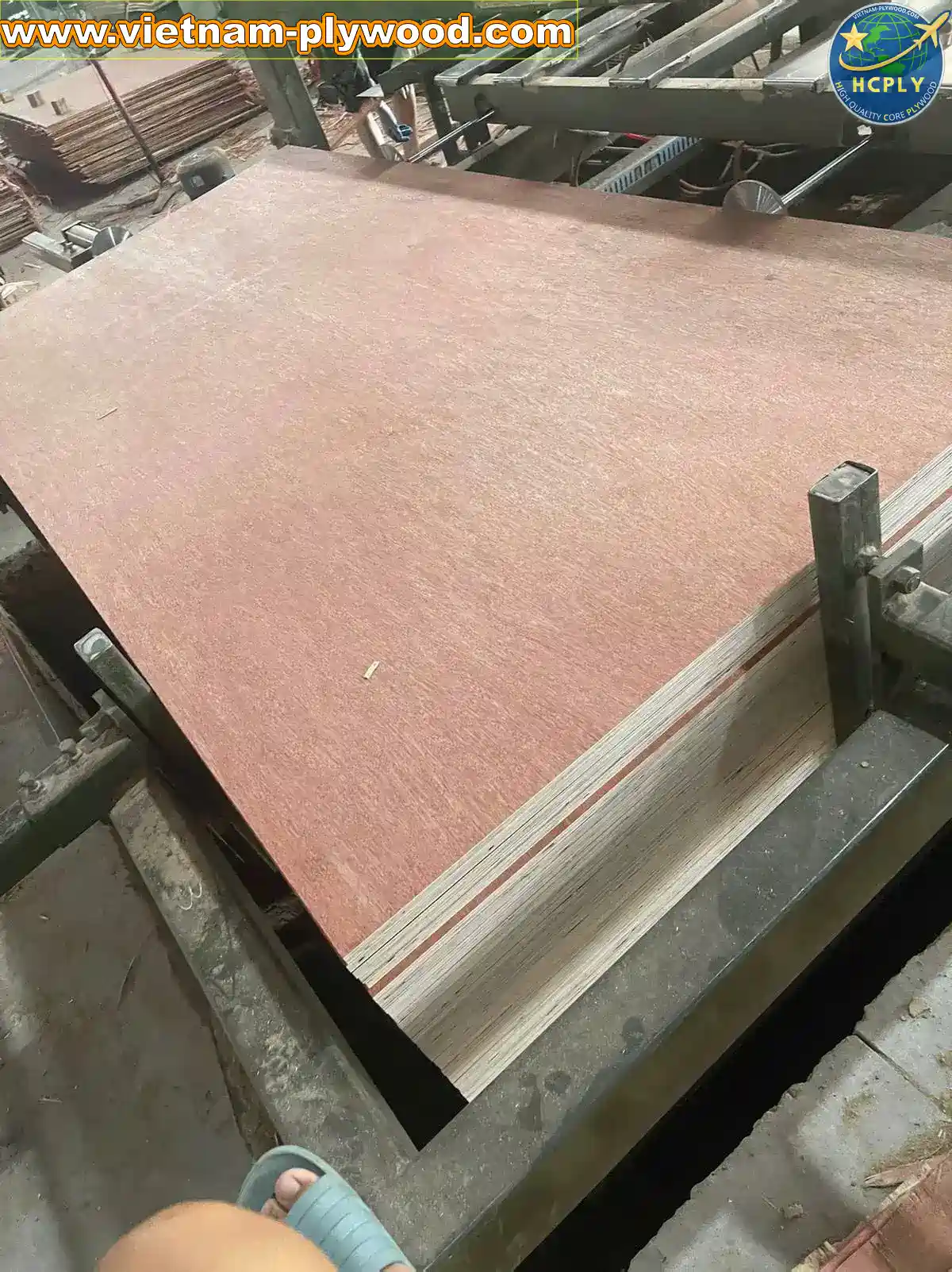
Emission grade applies to the whole panel, so the core matters too. Vietnamese cores are acacia, eucalyptus and styrax; styrax is the smooth, light choice favoured for furniture. A genuine Vietnam plywood manufacturer can state core species and emission grade together, because it controls both the veneer and the bonding line.
Why factory control makes E0 reliable
An emission grade is only as trustworthy as the production behind it. E0 depends on the glue formulation, the press temperature and the consistency of every panel in the run. Melamine (MR) bonding is hot-pressed at roughly 110 to 120°C; if a factory pushes panels through too fast or varies the press, emission can drift batch to batch even under the same label. A factory-direct manufacturer that runs its own line can hold the formulation and the press steady, which is what keeps the E0 result repeatable. A reseller buying finished panels from several sources cannot make that promise, because it does not control the press. This is the practical reason buyers who care about E0 lean toward factory-direct supply.
Common E0 mistakes that fail at customs
Three errors recur on real shipments. First, quoting “E0 glue” — a meaningless phrase that tells the factory nothing and leaves the actual emission unspecified. Second, accepting a certificate whose scope does not cover finished plywood; a report for a different product category will not satisfy a customs officer. Third, mixing E0 on the proforma with E2 material in the container to hit a price — a gap that surfaces at testing and stops the goods. Avoid all three by writing the two fields separately, checking the certificate scope, and confirming the test report matches the batch you ordered.
Documents that prove E0
A label is not proof. Request the test report behind the E0 or CARB P2 claim, issued for the relevant product category, and confirm it is current rather than expired. HCPLY supplies E0/CARB P2 documentation alongside FSC, CE and EUDR data as a standard package — see our certifications page. For European furniture, the EUDR due-diligence data became a practical requirement from 30 December 2025.
How to specify E0 cleanly
On the proforma, separate the two fields and add the evidence: glue class, emission grade (E0), the equivalent standard (CARB P2), core species, and the test report reference. A factory-direct exporter confirms all of it from its own production records. To receive E0 / CARB P2 test documentation for a specific order, send your specification through our contact page.