





Concrete form plywood price in the US is a landed-sheet calculation followed by a cost-per-pour comparison. Choosing the wrong overlay or duty assumption can add avoidable expense or delay a formwork load. HCPLY manufactures film-faced construction plywood in Vietnam for contractors, formwork yards and importers; a current specification-based quote is required for the actual dollar figure.
What is the concrete form plywood price in the US?
Concrete form plywood price in the US combines the panel purchase, transport, customs treatment and the number of usable pours. A local yard sheet and a container-imported sheet have different cost bases. We quote film-faced construction plywood against a written specification; there is no verified US retail sheet price or film-faced factory from-price in this article.
A meaningful comparison starts with a current yard quotation for the exact panel, a delivered import quotation for the same size, and an agreed finish requirement. Retail HDO plywood pricing, MDO plywood pricing and Plyform price quotes cannot be transferred to a film-faced product without checking the overlay and structural requirements. A price list cannot establish equivalent delivered cost.
The Vietnam plywood export cost breakdown explains how origin-side charges enter a shipment. For the specific film-faced build, see construction plywood.
Which drivers change a 3/4 form plywood sheet quote?
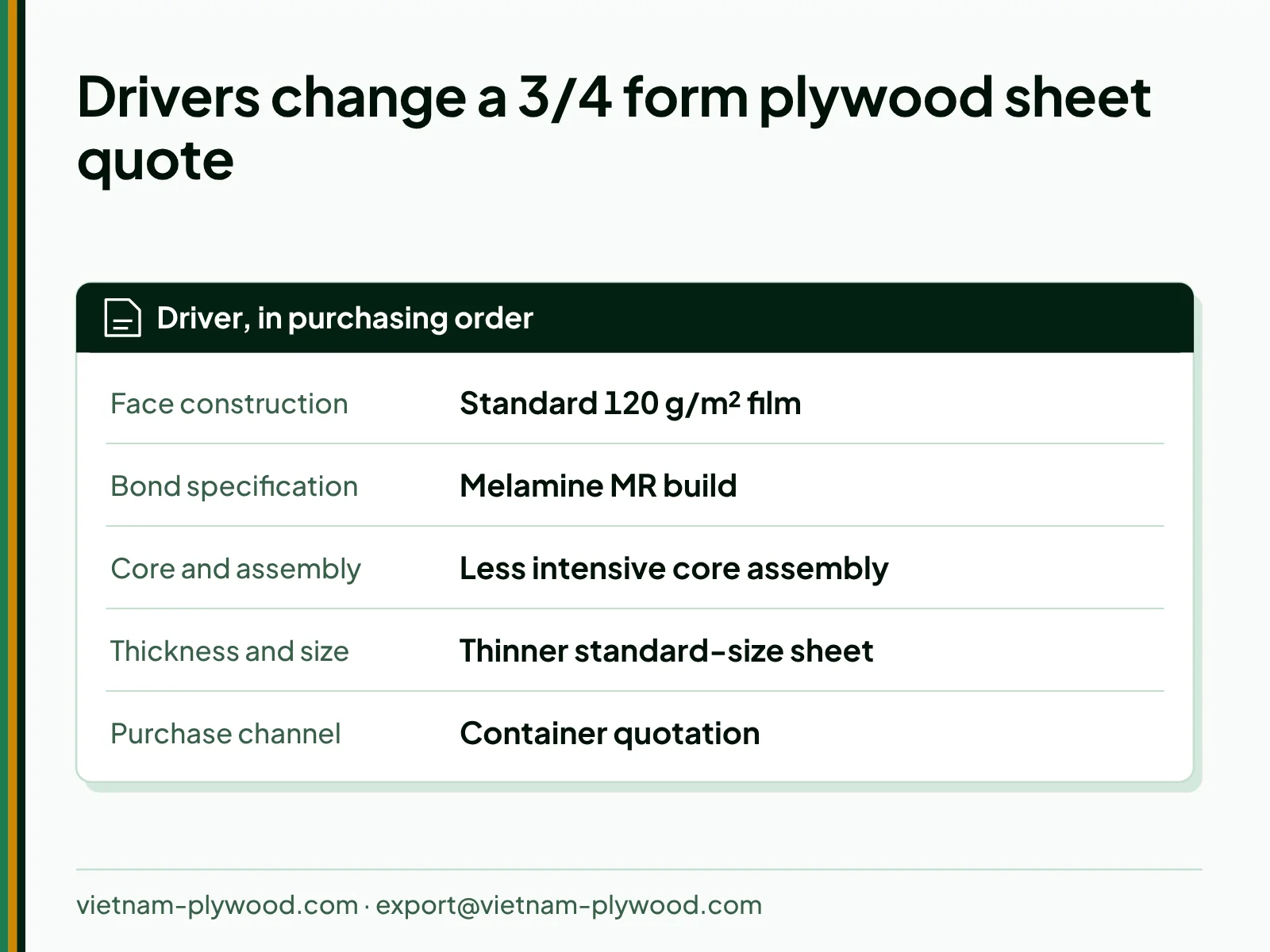
The largest differences usually start with face construction and adhesive specification, followed by core construction, thickness, order volume and delivery terms. Ask for comparable quotations before treating any driver as a quantified saving.
| Driver, in purchasing order | Lower-cost direction | Higher-cost direction | What to verify |
|---|---|---|---|
| Face construction | Standard 120 g/m² film | Premium 135 g/m² film or a separate HDO product | Film weight, face condition and intended concrete finish |
| Bond specification | Melamine MR build | Phenolic WBP build | Written glue field and agreed test method |
| Core and assembly | Less intensive core assembly | Tighter, more continuous core assembly | Edge inspection and void control |
| Thickness and size | Thinner standard-size sheet | Thicker or specially cut sheet | Actual millimetres, tolerance and cutting schedule |
| Purchase channel | Container quotation | Small-lot stocked purchase | Same specification and delivered location |
| Logistics and import status | Lower freight and applicable charges | Higher freight, handling or duty exposure | Port, entry classification and date |
Our construction line presses film-faced panels using acacia or eucalyptus cores. The standard film weight is 120 g/m²; the premium film weight is 135 g/m². The 220 g/m² film is for anti-slip construction. A thicker film alone does not establish a particular structural capacity or pour count.
Is 18 mm the same as a 3/4-inch forming panel?
An 18 mm film-faced sheet is thinner than a nominal three-quarter-inch dimension, so buyers must specify the required actual thickness. Our film-faced tolerance is ±0.5 mm. A specification written only as “3/4 form plywood” can create a mismatch at adjoining form faces or framing details.
Our available sheet dimensions include 1220 × 2440 mm and 1250 × 2500 mm, with length and width tolerance ±2 mm. The form designer sets required thickness from pressure, span, supports and allowable deflection. The plywood quotation should reproduce that requirement rather than infer a structural rating from a thickness label.
At the producing factory, the buyer can witness a thickness check across selected sheets, inspect exposed edges for core gaps and compare the face film with the order sample. Record acceptance limits before pressing.
Why does HDO cost more than film-faced plywood?
High-density overlay (HDO) uses a resin-impregnated fibre overlay with a different manufacturing and finish specification from standard film-faced plywood. Medium-density overlay (MDO) uses a different overlay construction again. Higher overlay processing and specified surface performance can increase an HDO quotation, but no universal price premium follows from the label alone.
We do not press HDO or MDO panels. Our construction line makes film-faced plywood, while HDO and MDO remain external comparison categories. Compare face configuration, bond, thickness, finish and delivered price.
Plyform can refer to forming-grade plywood sold under particular product and grading conventions. The term by itself does not establish that an imported film-faced panel carries an American structural stamp. Our panels are not offered with an APA or PS 1 stamp. Where a project specification requires those marks, source a compliant product rather than substituting by appearance.
How do film-faced, HDO, MDO and Plyform compare?
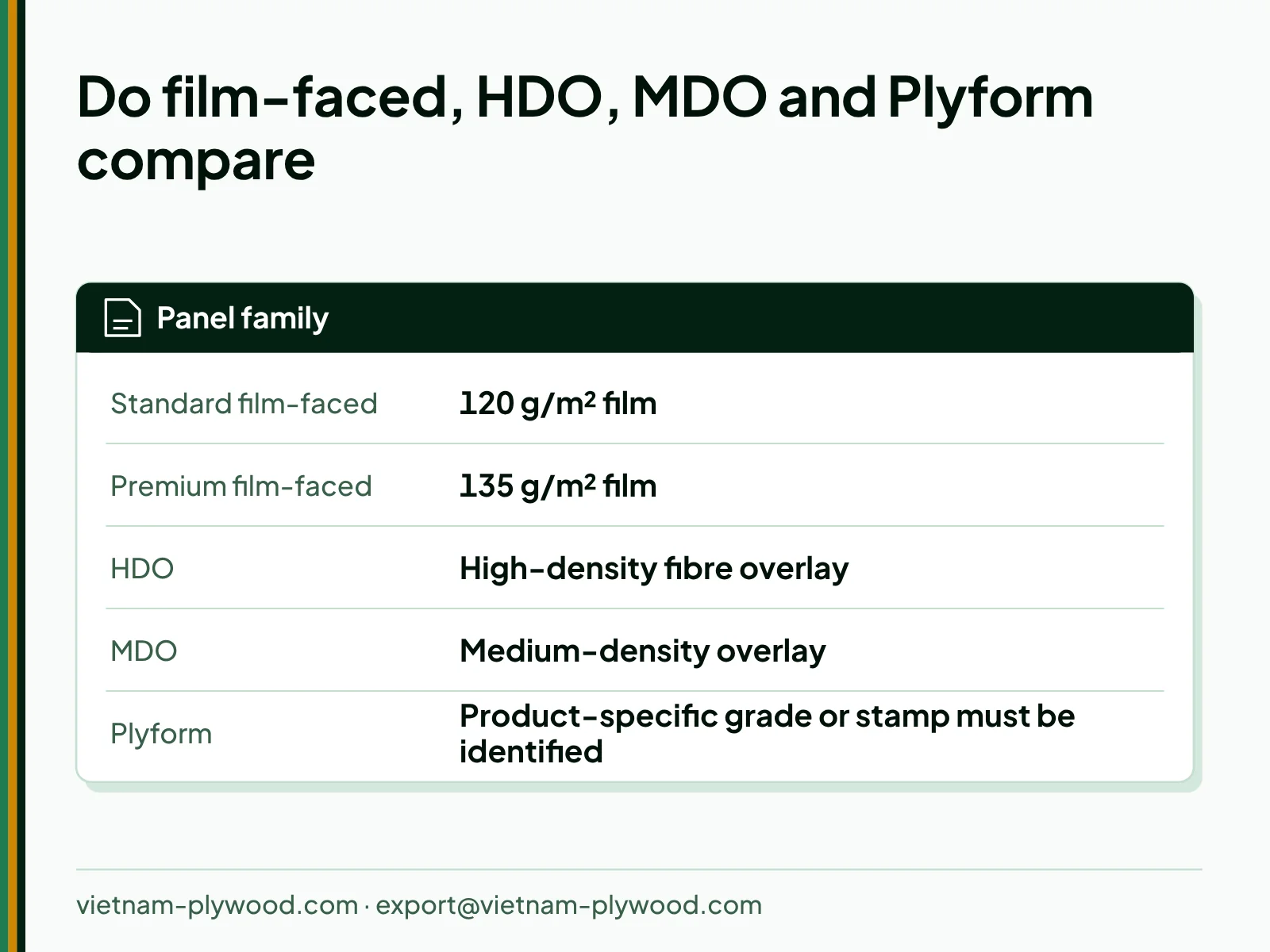
The choice follows the specified finish, documented structural requirements and actual reuse programme. This comparison separates products that are often grouped together in form plywood prices.
| Panel family | Surface metric | Quotation metric | Verdict by use |
|---|---|---|---|
| Standard film-faced | 120 g/m² film | Delivered USD/sheet and USD/usable pour | Candidate for repeat forming when its build meets the project specification |
| Premium film-faced | 135 g/m² film | Increment over standard, plus realized pours | Evaluate where a premium film is requested |
| HDO | High-density fibre overlay; face specification required | Current yard or distributor USD/sheet | Compare for a specified smooth architectural face |
| MDO | Medium-density overlay; one- or two-face specification required | Current yard or distributor USD/sheet | Compare where a matte or paint-oriented face is specified |
| Plyform | Product-specific grade or stamp must be identified | Current USD/sheet for the exact grade | Use when the project calls for that documented forming grade |
No common US dollar range is presented because no verified like-for-like quotations are available. The competitor’s published MDO price examples are dated examples, not current bids for identical specifications. Check whether yard quotations include tax and delivery.
How much do US duties add to imported form panels?
US duties add the amounts legally applicable to the entered product and origin, calculated on the relevant customs value. A film-faced description alone cannot determine the tariff classification or the applicability of an antidumping or countervailing duty order. Obtain a product-specific classification and scope review.
The U.S. Government Publishing Office’s 2024 edition of 19 U.S.C. § 1673 states that antidumping duties apply to merchandise covered by the statutory determinations and are additional to other duties. For a Vietnamese film-faced panel, ask the customs specialist for the entry classification, current trade-remedy order scope and deposit instructions in writing. The statute does not assign a product-specific rate.
For landed costing, keep ordinary customs duty, any applicable trade-remedy deposits, customs-clearance and port charges as distinct lines. Check scope and rates for the entry date. Neither a blanket zero-duty assumption nor a generic hardwood-plywood rate is suitable for a purchase approval.
How is landed cost per sheet calculated?
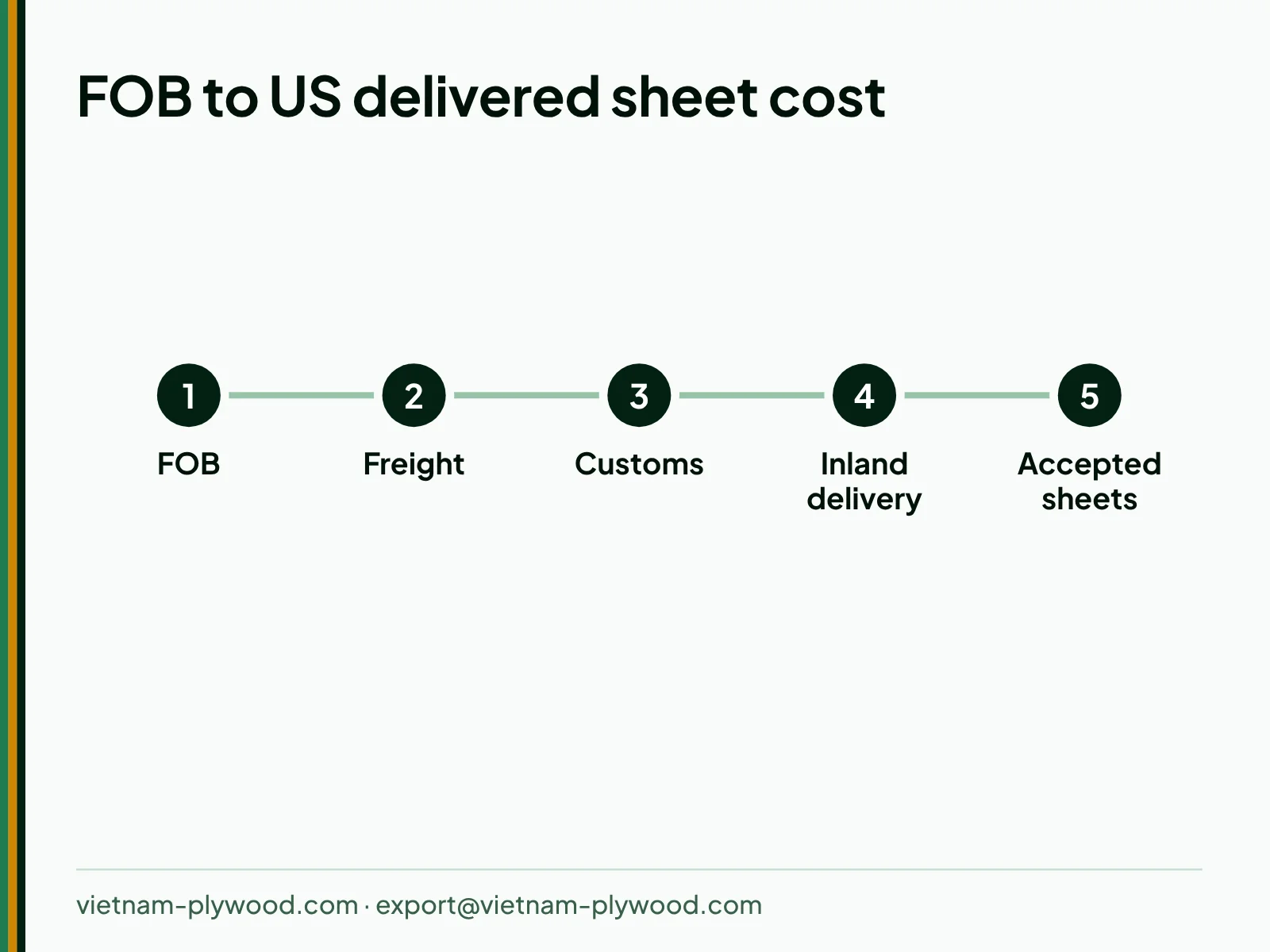
Landed cost per sheet is the complete shipment cost to the selected delivery point divided by the number of usable sheets received. Start with the written FOB Hai Phong quote, then add ocean freight, insurance where applicable, import duties, clearance, port handling and inland delivery. Allocate any damage or shortage against the accepted quantity.
- Fix the specification and destination port, then obtain a current FOB quotation.
- Obtain freight, insurance and port-handling quotations for the shipping window.
- Have the importer establish the customs classification and applicable duty treatment.
- Add customs-clearance fees and inland transport to the receiving location.
- Divide the total landed shipment cost by accepted sheets, using the packing list and receiving count.
- Divide that per-sheet cost by realized pours for the project’s panel-reuse metric.
Formula: landed USD/sheet = (FOB shipment + freight + insurance + duties + clearance + port charges + inland delivery) / accepted sheets. Keep currency consistent. For a broader film-faced plywood price discussion, compare the same bill of materials and shipment date.
What does an 18 mm container calculation contribute?
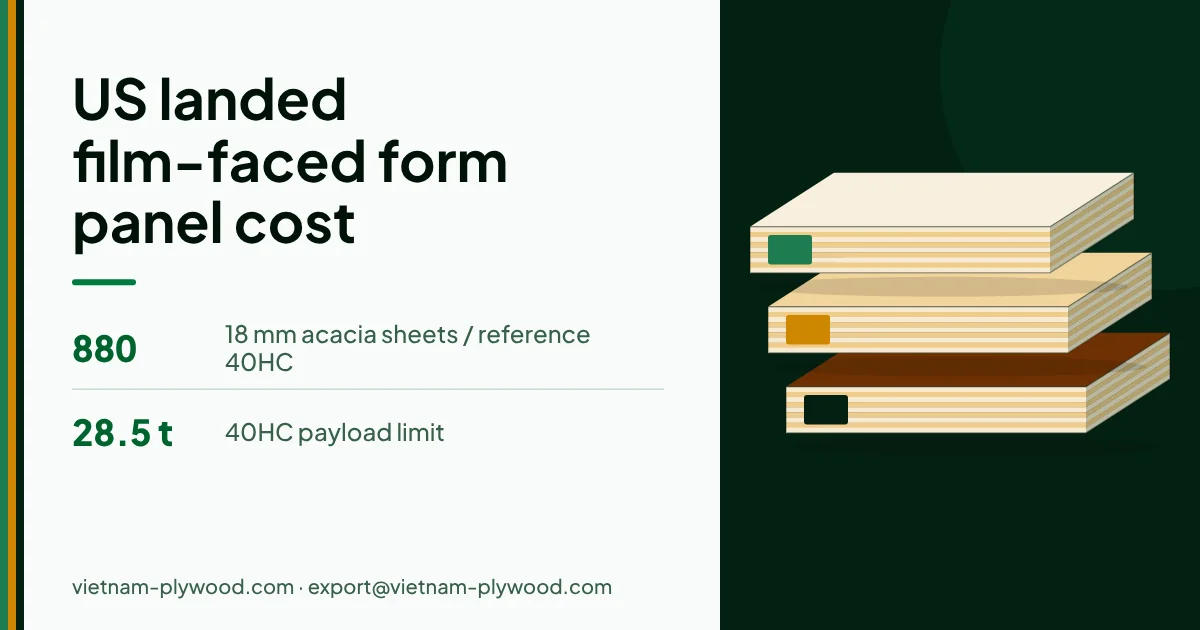
An 18 mm, 1220 × 2440 mm acacia-core load provides a concrete denominator for the landed sheet calculation. Our lookup gives 55 sheets per pallet, 16 pallets and 880 sheets for a full 40HC, with 47.15 m³ and 27.35 t of core-based weight. Film weight is excluded from that lookup.
For eucalyptus core at the same dimensions, the lookup gives 53 sheets per pallet, 15 pallets and 795 sheets, with 42.60 m³ and 27.69 t. The difference comes from density and pallet stacking limits; eucalyptus is 650 kg/m³ and acacia is 580 kg/m³. The 40HC payload limit is 28.5 t, so the final load plan must account for all actual packed weight.
These are full-container reference configurations. For other sizes and thicknesses, use the container packing calculation. Specifications can be mixed in a container within the payload limit; the mixed-container process covers planning by product.
Which production line makes the quoted panel?
Our construction line makes the film-faced product in this comparison; our furniture line and our commercial and packing line build different panels. A same-thickness inquiry must identify the intended application before the factory is selected.
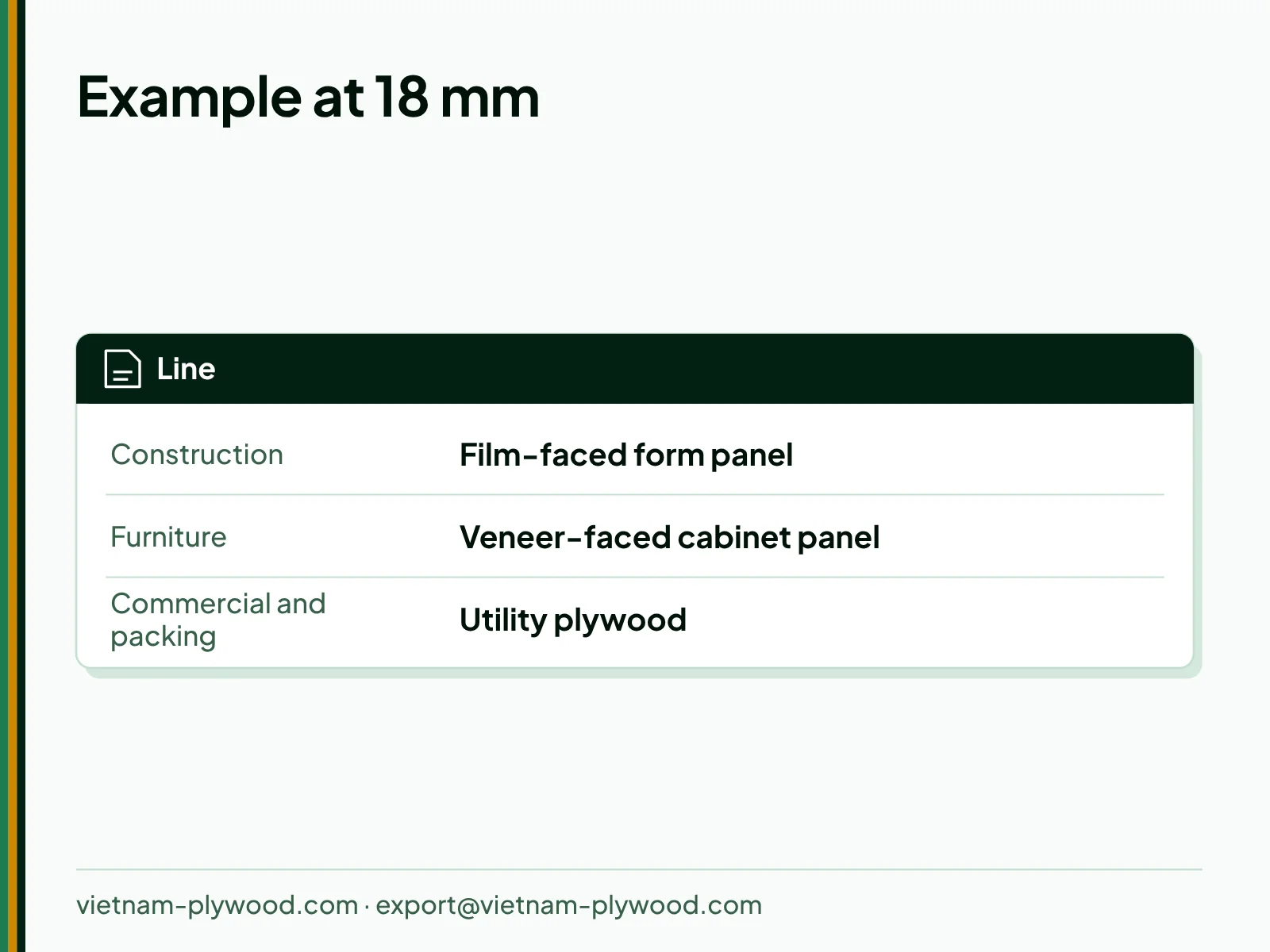
| Line | Example at 18 mm | Core and finish | Purchasing implication |
|---|---|---|---|
| Construction | Film-faced form panel | Acacia or eucalyptus, unsanded, specified film | Quote against pour programme and surface requirement |
| Furniture | Veneer-faced cabinet panel | Styrax or eucalyptus, full stitched, sanded | Quote for furniture finish and ordered thickness tolerance |
| Commercial and packing | Utility plywood | Acacia, MR glue, unsanded or light-sanded | Quote for packing or commercial use, not a formwork substitute |
HCPLY operates three member factories in Phu Tho and Hai Phong. Each order is produced and shipped directly from the factory that fits the specification. Our construction plywood capacity is up to 140 containers a month; furniture and commercial plywood is up to 100 containers a month. Buyers can visit the factory office and inspect the producing factory.
The export shipment uses a commercial invoice, packing list and bill of lading (B/L), with certificate of origin and applicable shipment papers. The packing list is the document that records the shipped sheet quantities used in the landed calculation. After loading, the draft shipping documents come to you for approval.
How should a contractor calculate cost per pour?
Cost per pour divides the cost attributable to each panel by the number of successful uses that meet the required concrete finish. Count actual usable cycles rather than assigning an HDO or MDO reuse number to film-faced plywood. Add cleaning, release-agent, edge-sealing, repair and disposal costs to the project comparison.
For our film-faced panels, with proper handling, a release agent on every pour and sealed edges (cut edges included), melamine-glue film-faced yields about 12–15 pours, while phenolic-glue film-faced yields up to about 25 pours. These figures describe the stated care conditions; job-site records determine the realized denominator.
Use landed panel cost / realized pours for the panel-only measure. For an operational measure, add the project’s cleaning, release-agent and repair costs across the cycles, then divide by the accepted pours. Keep labor assumptions identical across options. An HDO sheet with a higher initial quotation can still be economical on a demanding finish programme, but that verdict needs a project-specific quote and cycle record.
What should the importer verify before accepting the quote?
The importer should verify the complete construction specification, measurable tolerances, shipment quantities and customs assumptions before authorizing a purchase. A film colour or a product-family name is insufficient evidence of an agreed build.
Request a sample and a written sheet specification identifying film weight, glue, core, size and thickness tolerance. At the producing factory, the inspector can compare film appearance, measure thickness, inspect cut edges and check the packing marks against the order. Agree the sampling and rejection procedure in writing.
For US entry, the importer also needs a customs classification and order-scope determination. We provide export documents and agreed test reports for the ordered build; certificates belonging to member factories, including FSC, CARB P2, ISO 9001 and CE, are shown with factory details masked, on request. Specify the documents required by the end use.
What is the practical purchase decision?
Choose a film-faced import when its documented build meets the form design and the landed cost per successful pour beats the comparable stocked alternative. Choose HDO, MDO or a specified Plyform grade where the finish, marking or performance requirement calls for that distinct product. Use the same delivery point and actual working cycles.
Our minimum order is one 40HC. Factory lead time runs 15–45 days from receipt of the 30% deposit; the exact figure depends on order size, line loading and what the contract fixes. The remaining 70% is paid on the scan of the bill of lading, by T/T, or by irrevocable sight L/C. We ship FOB Hai Phong, or CFR (CNF) or CIF to your port. Samples cost nothing: a first-time buyer pays the courier, and that charge comes off the first confirmed order.
Send the application and destination details to Lucy at export@vietnam-plywood.com. A current film-faced quotation will identify the actual product and shipment terms, rather than reuse an unrelated furniture or commercial starting price. For a formal request, use contact.
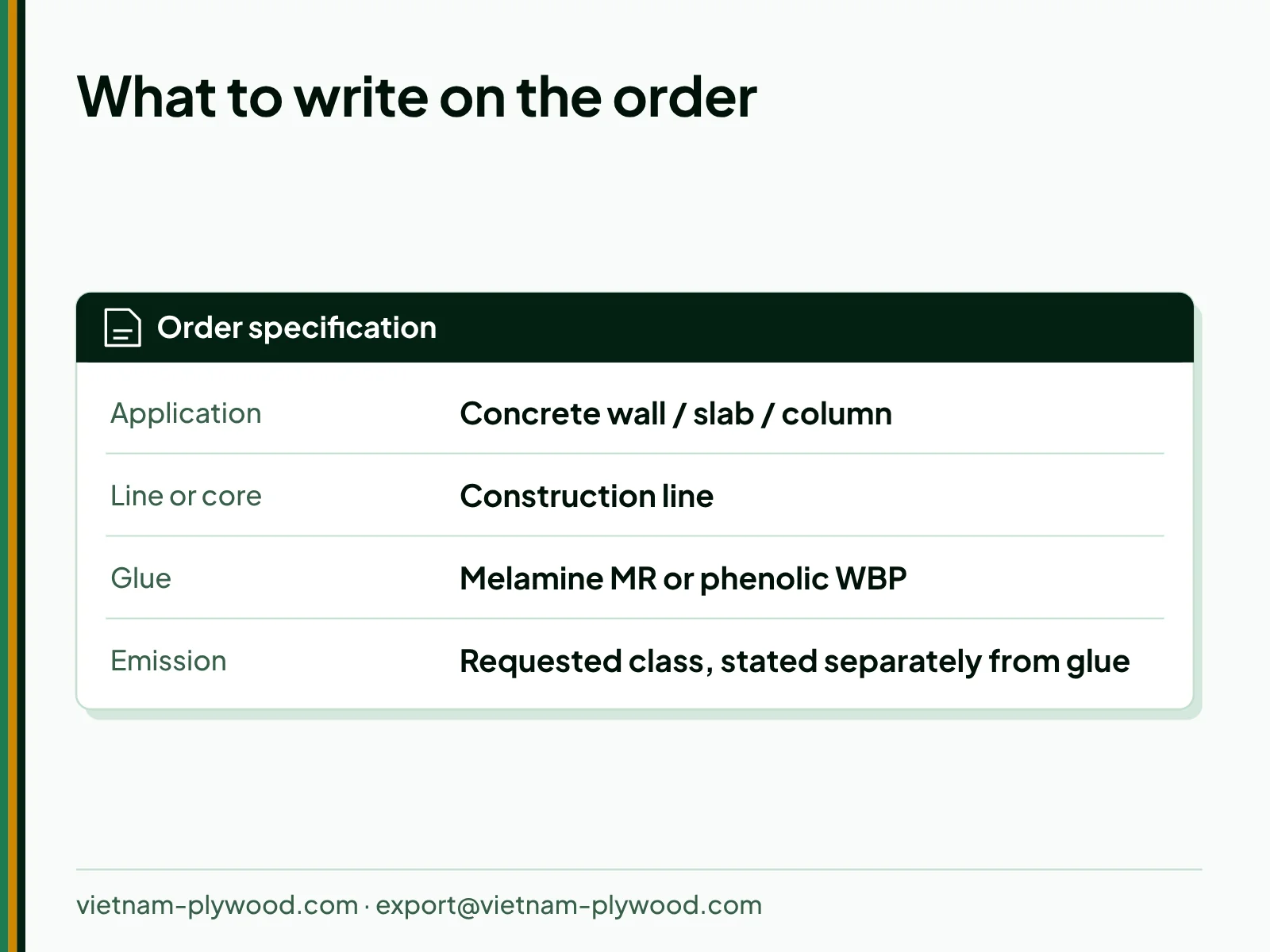
Application: concrete wall / slab / column; required finish and pour programme
Line or core: construction line; acacia or eucalyptus
Glue: melamine MR or phenolic WBP
Emission: requested class, stated separately from glue
Face and grade: film-faced, 120 or 135 g/m²; agreed face acceptance
Thickness and tolerance: 18 mm, ±0.5 mm (or specified alternative)
Size: 1220 × 2440 mm (or specified alternative)
Quantity: full 40HC or agreed mixed specification within payload
Destination port: [US port] and final delivery point
Request the spec sheet for the selected film-faced build.