





CE2+ ply orders for British structural work must match the producing factory’s CE documents for the exact panel build. A mistaken structural designation can cost an importer a rejected load, replacement material and lost site days. HCPLY quotes a structural application only after checking the intended use against the member factory’s documents, shown with factory details masked, on request.
The term combines CE marking with assessment and verification of constancy of performance (AVCP) system 2+. It does not name a timber species, strength class or universal plywood grade. Start with the structural use and declared performance before choosing a face or thickness.
What is CE2+ ply?
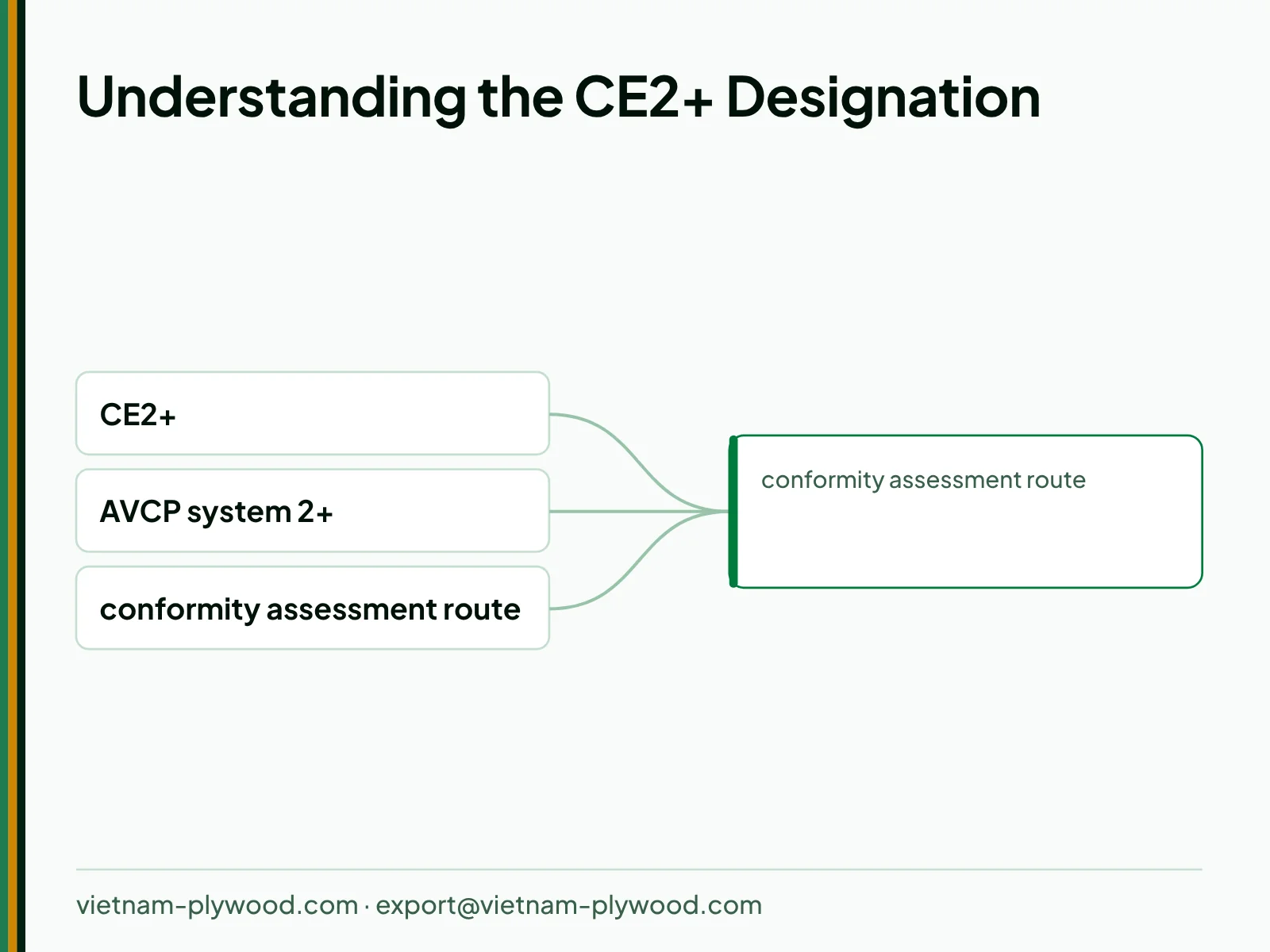
CE2+ ply is plywood offered for a structural construction use under a CE-marking route with AVCP system 2+ factory production control certification. The designation describes a conformity assessment route, rather than a promise that every panel bearing similar marketing words suits every load-bearing design. The declared intended use and performance values still govern selection.
For wood-based panels in construction, EN 13986 is the product-standard reference commonly used to organise declared characteristics. A buyer should match the precise standard edition and scope on the declaration, not assume the shorthand CE2+ establishes structural adequacy. Structural suitability is determined by the project’s designer using the relevant declared properties and design requirements.
The UK Ministry of Housing, Communities and Local Government’s 2025 construction-products guidance says CE marking remains available for construction products in Great Britain. Its guidance distinguishes Great Britain from Northern Ireland, where different arrangements apply. See our quality and certification documentation for the order-level review route.
What does CE2+ mean on a plywood sheet?
CE2+ means the supplier is referring to CE marking and system 2+ assessment for the declared construction product. The plus sign belongs to the assessment system; it is not a higher strength grade than an imaginary CE2 panel. Read the complete marking and declaration together.
Check the manufacturer’s identity, product-type identifier, declared intended use, applicable standard, declaration of performance reference and notified-body information where required. The declared performance might address mechanical characteristics, reaction to fire or other characteristics relevant to the product’s intended use. A mark alone does not tell a structural engineer which loads a panel can carry.
The UK government’s 2026 construction-products reform white paper explains that conformity marking and suitability for a particular application are separate decisions. For procurement, record the actual designation and declaration reference in the purchase specification. Avoid treating a catalogue label as a substitute for traceable product documents.
When does a UK job need CE2+ structural plywood?
A British construction project needs an appropriate structural plywood specification when panels contribute to permanent structural work and the relevant product rules and project design require declared structural performance. Roof decking, wall sheathing and structural flooring are examples of applications to investigate. A temporary formwork panel has a different role from permanently incorporated structural sheathing.
For Great Britain, the UK government’s 2026 product-sector marking table lists UKCA or CE for construction products. Northern Ireland follows a different marking route. A request for CE2+ should therefore identify the destination jurisdiction, permanent application, design specification and accepted conformity route.
The designer must identify the structural performance needed; a purchasing team should not derive it from thickness alone. For example, 18 mm identifies a dimension, while structural design also needs declared strength and stiffness values, support spacing, load duration and service conditions. Ask for the relevant declaration before assigning the board to the design.
A site buying panel for concrete formwork should start with the exterior plywood application and the film-faced test-report discussion. Film-faced shuttering use does not automatically turn a panel into a CE2+ structural product for permanent works.
Which of our factory lines fits the application?
Our construction line is the starting point for a construction enquiry, but structural status is established only by the member factory’s CE documents for the requested build. Our furniture line and our commercial and packing line serve different specifications. The same nominal thickness can therefore produce three different procurement decisions.
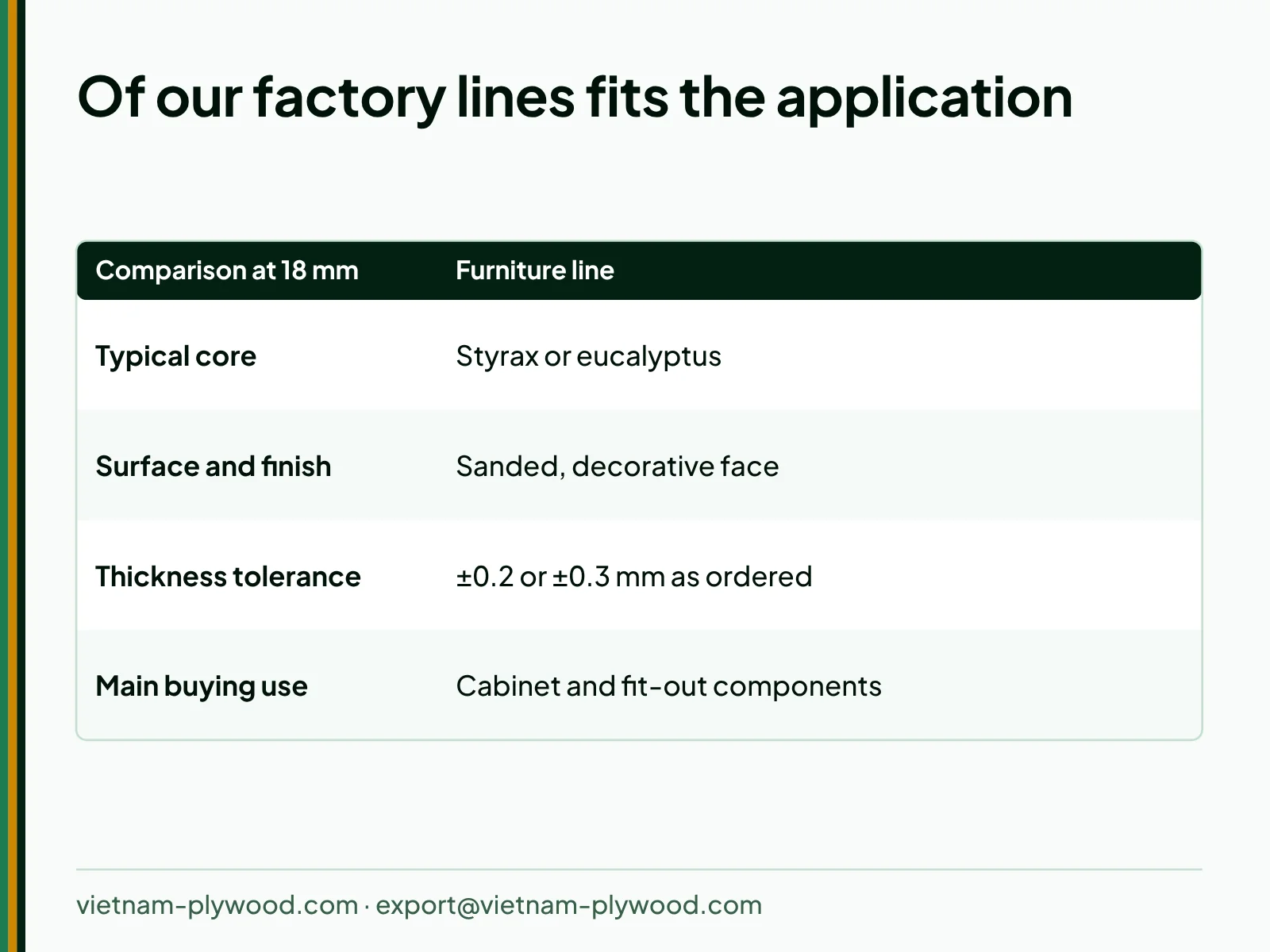
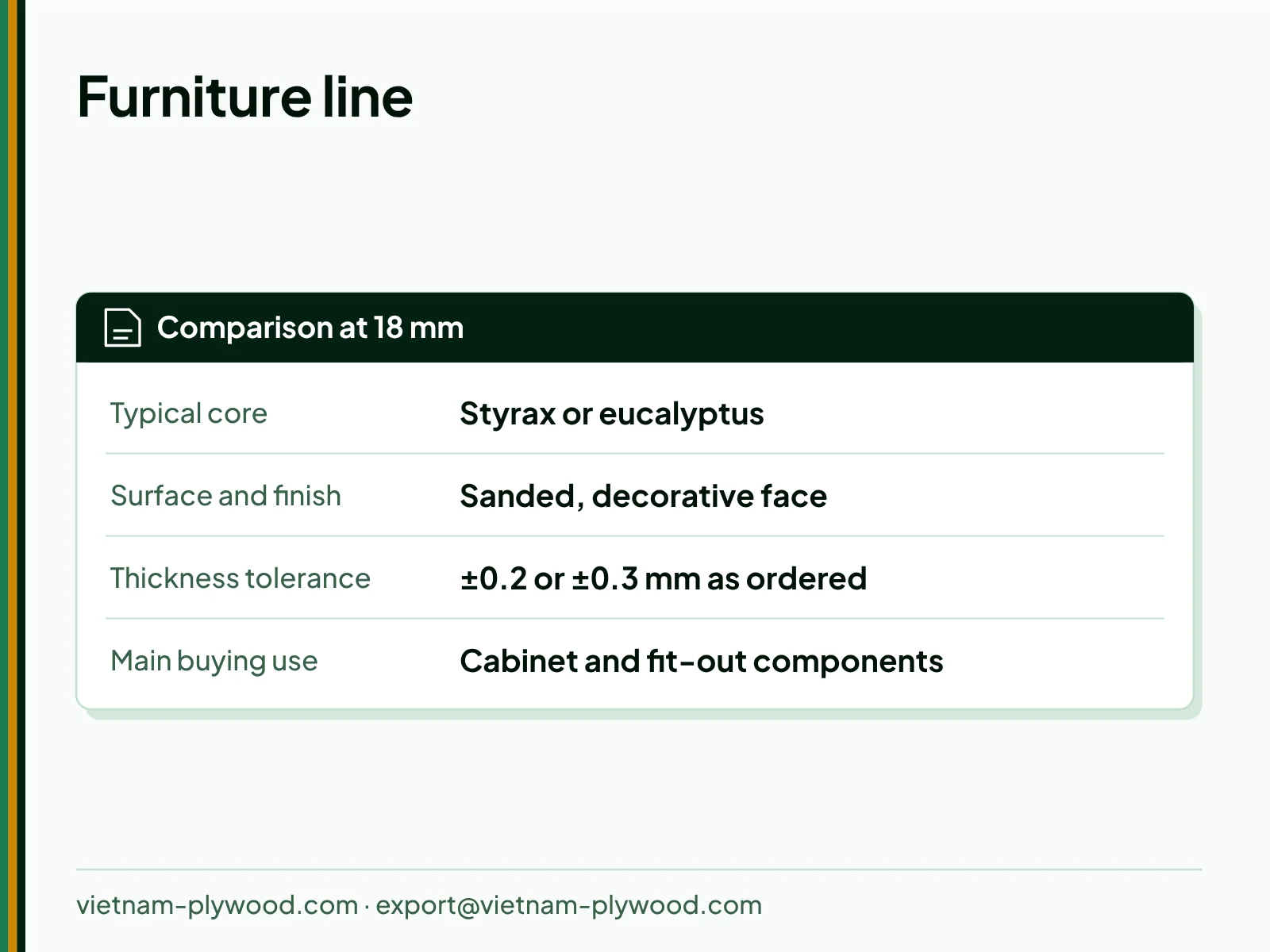
| Comparison at 18 mm | Furniture line | Commercial and packing line | Construction line |
|---|---|---|---|
| Typical core | Styrax or eucalyptus | Acacia | Acacia or eucalyptus |
| Surface and finish | Sanded, decorative face | Unsanded or light-sanded | Phenolic, melamine or anti-slip film |
| Thickness tolerance | ±0.2 or ±0.3 mm as ordered | Commercial ±0.5 mm; packing ±0.5–1.0 mm | ±0.5 mm |
| Main buying use | Cabinet and fit-out components | Cases, crates and packing | Formwork and construction enquiries |
| CE2+ structural decision | Outside this line’s stated furniture specification | Outside this line’s stated packing specification | Review exact factory CE documents before quoting a structural build |
Our construction line presses the film-faced build when the order calls for it. Our furniture line instead makes full-stitched, sanded panels with E0 or E1 emission classes; the commercial and packing line uses an acacia core and MR glue. We do not manufacture 3-ply spruce panels or birch-core plywood. If a specification calls for structural softwood plywood, its timber construction and certified performance must be checked against an actual producer’s documents rather than relabelled as one of these builds.
What is the Q-Mark on plywood?
Q-Mark is a third-party product certification scheme associated with BM TRADA; it is distinct from statutory CE or UKCA marking. A Q-Mark claim needs its own current scheme certificate, product scope and identifiable certificate holder. It cannot be inferred from a CE mark or from a seller’s use of the words structural plywood.
UK stock listings sometimes combine Q-Mark, CE2+ and external-grade terminology in a single product title. Those labels address different questions: independent scheme certification, regulatory conformity route and service exposure. A buyer should request the certificate schedule for the specific product before treating Q-Mark as a contractual requirement.
HCPLY’s member-factory CE documentation can be shown with factory details masked, on request. We do not offer a Q-Mark claim for our panels. If a tender expressly requires Q-Mark, the buyer needs a supplier whose certificate covers the exact specified product; substituting an unrelated CE document would leave a gap in the tender evidence.
How does EN 314-2 relate to CE2+ plywood?
EN 314-2 addresses plywood bonding quality and bond classes; CE2+ concerns a conformity assessment route for a construction product. A bond-class result is useful evidence about glue-line performance, but it does not establish bending strength, stiffness or complete structural conformity. Check the standard and the test scope on the report.
In our production terminology, melamine MR glue is associated with a 12-hour boil and phenolic WBP glue with a 72-hour boil. Those production descriptors must not be substituted for an EN 314-2 class or a certified structural declaration. Glue and formaldehyde emission are separate specification fields; E0, E1 and E2 describe emission classes, not adhesive types.
A buyer can compare the intended exposure with the reported bond performance, then examine the structural properties under the applicable product declaration. For cabinet panels, formaldehyde emission ratings answer a different question. For construction orders, the technical datasheet and standards checklist helps keep these evidence categories separate.
Which documents back a CE2+ plywood order?
A CE2+ structural order needs the declaration and supporting conformity evidence for the precise build, alongside the normal commercial shipment papers. Before pricing, compare the intended use, panel identity and performance declaration with the member factory’s available CE documentation. The document scope must cover the specification being ordered.
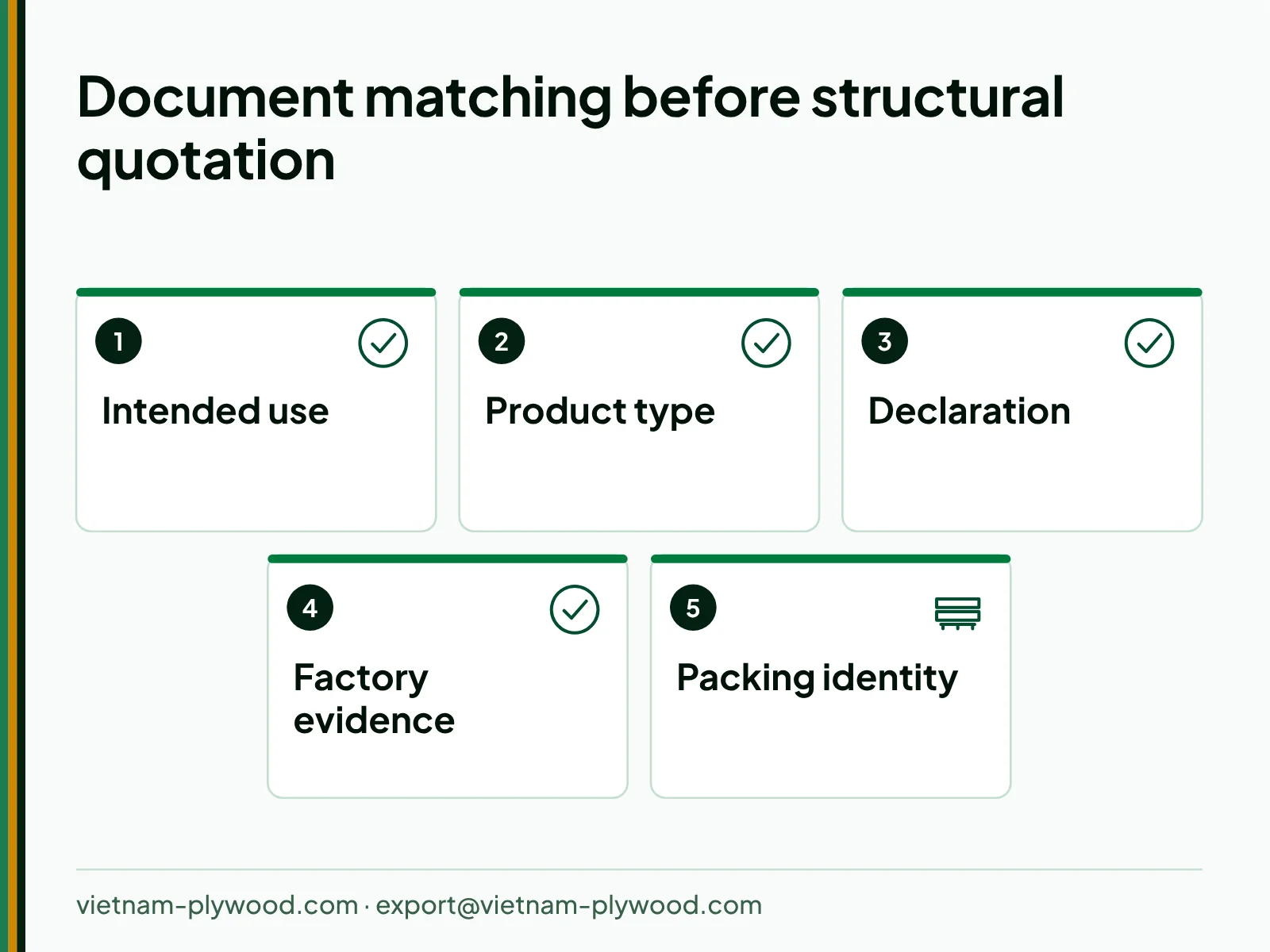
- Record the application, destination jurisdiction and designer’s required declared characteristics.
- Identify the producing factory’s applicable CE documents, declaration of performance and relevant factory production control evidence.
- Match the product type, construction, thickness, intended use and test-report references against the proposed order.
- Agree the physical inspection points, product identification and shipment paperwork before loading.
- Review the draft shipping documents after loading, before final approval.
Our shipment documents include the commercial invoice, packing list, bill of lading, certificate of origin, phytosanitary and fumigation papers, and the order’s agreed certificate documents and test reports. Insurance is included under CIF. For EU lots, the file also covers EUR.1 where applicable and the EUTR/EUDR documents; the EU due-diligence discussion addresses that separate obligation.
The certificate review and the commercial paperwork answer different questions. The former supports the specified product’s declared conformity; the latter records what was sold, loaded and shipped. Keep the agreed product identifier consistent across both.
What can an inspector witness at the producing factory?
An inspector can compare the physical panels and packing marks with the agreed specification and available build records. This is a practical identity and workmanship check; structural performance remains anchored to the accepted declaration and relevant reports.
At the producing factory, the buyer can inspect veneer assembly, surface finish, edges, measured thickness and length or width. Our construction panels use acacia or eucalyptus cores, and their standard film weights are 120 g/m² or 135 g/m²; 220 g/m² is the anti-slip option. The buyer can witness a thickness check against the construction tolerance of ±0.5 mm and dimensions against ±2 mm.
The check should also trace the inspected batch to the agreed product description and packing list. For a structural specification, request the corresponding documents before treating the batch as eligible. HCPLY handles specification, on-site quality control, documents and loading, while buyers can visit the factory office and inspect at the producing factory.
Can structural and nonstructural orders share a shipment?
Different specifications can share a 40HC container within its 28.5 t payload limit, provided their identification and paperwork remain distinct. A mixed shipment does not transfer any structural designation from one pallet to another. Label each specification and retain its corresponding documentation.
For an 18 mm, 1220 × 2440 mm illustration, the full-container figures are 880 acacia-core sheets at 27.35 t and 795 eucalyptus-core sheets at 27.69 t. A styrax-core furniture load is 990 sheets at 26.52 t. These are alternative full-load examples, not quantities to add together; film weight is excluded from the lookup.
If a structural enquiry is accepted against the factory’s CE documents, its pallets must be identified separately from furniture or packing pallets. Discuss the mixed-order plan through our mixed-container loading process and several plywood types from our factories. The container packing reference covers detailed sheet counts.
How should an importer request a comparable quotation?
A comparable quotation starts with the structural duty and required documentation, followed by construction, dimensions and shipment terms. Two 18 mm boards with different cores, face treatments or declarations cannot be compared solely by price per cubic metre.
For a CE2+ enquiry, document scope and structural performance come first. Next come core construction and veneer quality, glue specification, film or face treatment, thickness tolerance and order quantity. A more demanding documented structural build costs more to substantiate and control than a basic packing build; premium film and tighter workmanship add further cost drivers. We quote this product against a written specification, without a published starting price.
Our minimum order is one 40HC, and specifications can be mixed within the payload limit. Factory lead time runs 15–45 days from receipt of the 30% deposit; the exact figure depends on order size, line loading and what the contract fixes. The remaining 70% is paid on the scan of the bill of lading, by T/T, or by irrevocable sight L/C. We ship FOB Hai Phong, or CFR (CNF) or CIF to your port.
Free samples are available; a first-time buyer pays the courier, and that charge comes off the first confirmed order. For a first structural enquiry, sample identity should match the document-backed build being evaluated.
What should a buyer decide before approving the order?
Approve the order only when the application, declaration and physical build describe the same product. A procurement team should obtain the designer’s requirements before selecting a panel based on a stock title. The terms CE2+, Q-Mark and exterior glue must each be checked for their separate meaning.
For a British project, distinguish Great Britain from Northern Ireland at the start. Ask whether the plywood is permanently incorporated in structural work, used as temporary formwork or specified for nonstructural fit-out. Then check whether the actual product documentation supports the requested use and marking route.
The British government’s 2026 market guidance identifies importer duties including checking conformity processes, documentation and marking. That makes document matching a purchase-stage task rather than an issue to resolve after arrival. Send Lucy the completed specification through contact for review against the member factory’s CE documents.
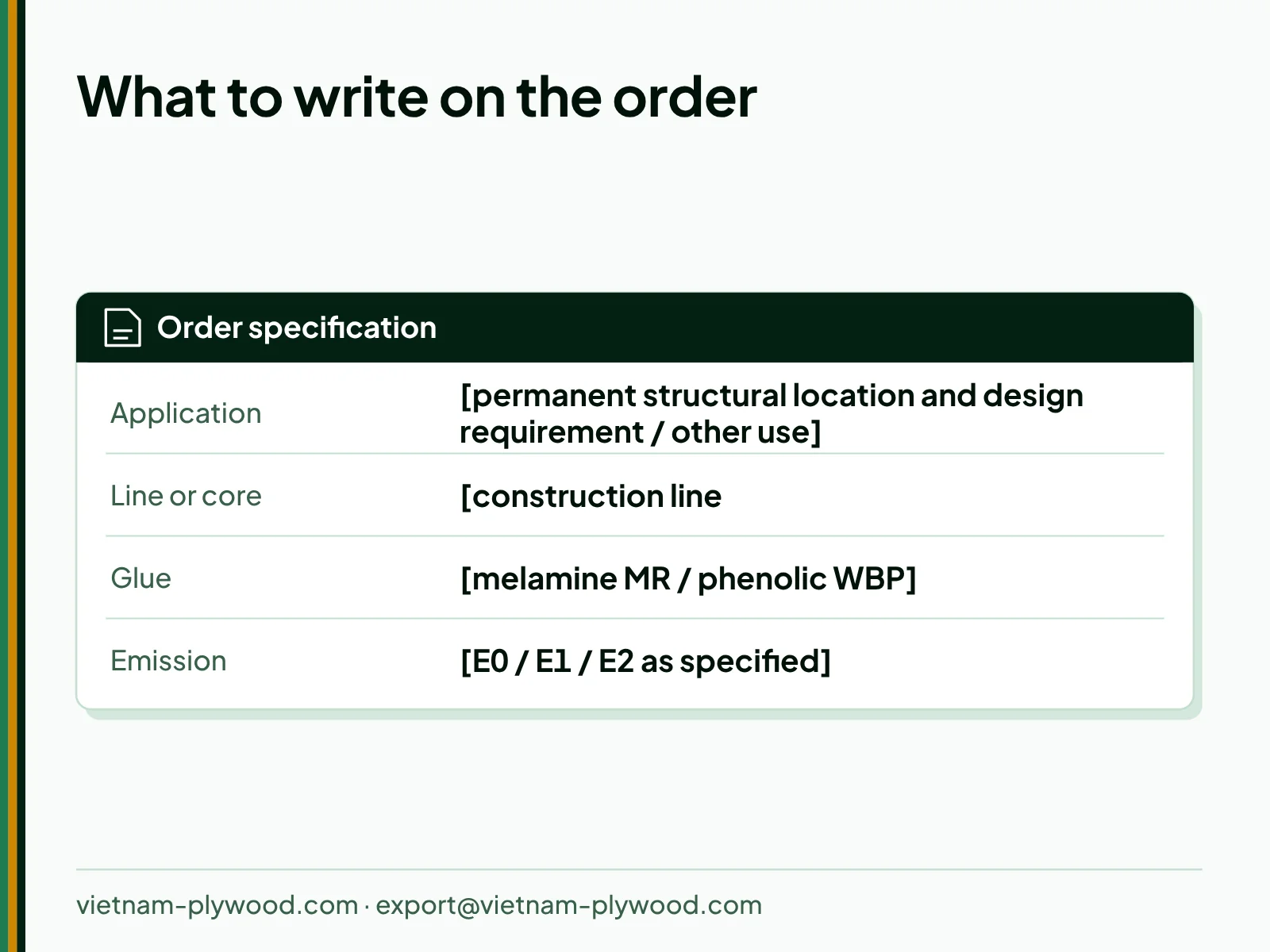
Application: [permanent structural location and design requirement / other use]
Line or core: [construction line; acacia or eucalyptus core]
Glue: [melamine MR / phenolic WBP]
Emission: [E0 / E1 / E2 as specified]
Face and grade: [film weight and finish / specified face and grade]
Thickness and tolerance: [mm; ±0.5 mm for construction]
Size: [length × width in mm]
Quantity: [sheets and 40HC allocation]
Destination port: [port and GB/NI jurisdiction]
Required CE documents: [standard, intended use, declared characteristics, accepted evidence]
Plan a trial container with Lucy at export@vietnam-plywood.com after the build and CE documents have been matched to the intended use.