





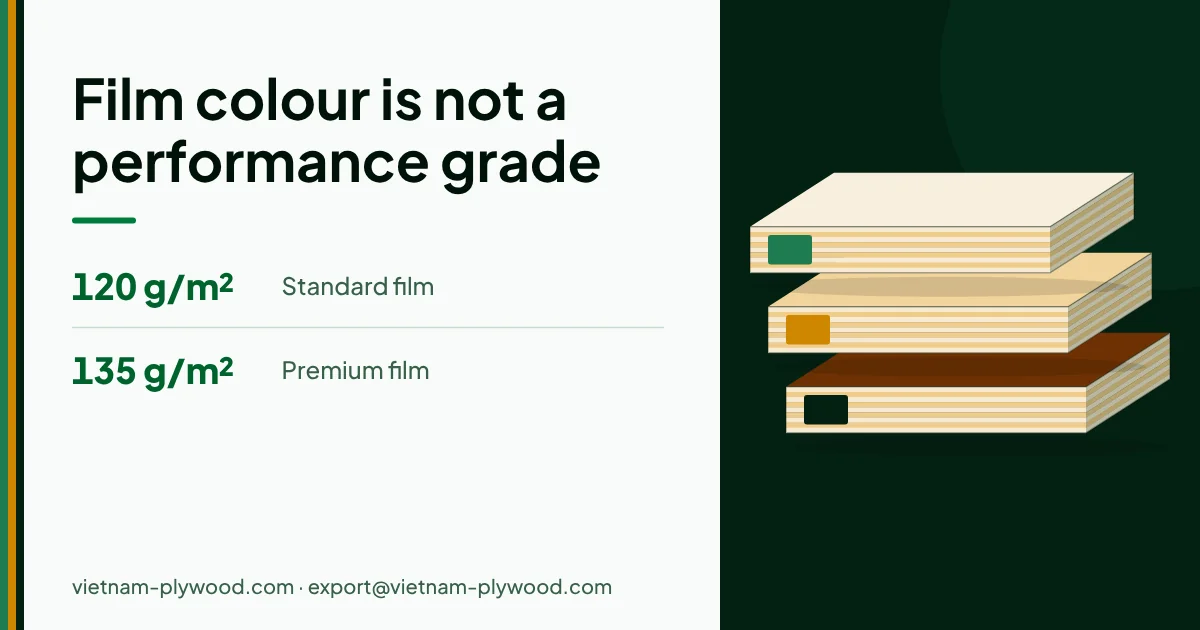
Black, brown, red, green and white formwork films identify surface appearance, while the panel build determines performance. Choosing by colour alone can waste a formwork budget or cause a rejected load. HCPLY makes black film faced plywood decisions around film mass, glue, core and inspection criteria rather than an assumed colour grade.
What does black film faced plywood actually tell a buyer?
Black film faced plywood identifies the visible overlay colour, but colour alone cannot establish glue performance, core construction or formwork life. Brown, red, green and white films likewise identify an appearance choice rather than a common technical grade. For a comparable purchase, specify film weight, adhesive, core, panel dimensions and edge treatment alongside colour. A black sample and a brown sample can be built to the same technical specification.
Colour is useful for sorting, but acceptance must follow the agreed build. See the broader plywood types category for how surface names differ from construction grades.
Black versus brown: which performs better?
Neither colour wins by itself. Compare matched panels with the same core, adhesive, film mass and thickness before assigning a performance advantage. A heavier overlay can be specified in either appearance where the approved film material permits it; the actual film specification controls the comparison.
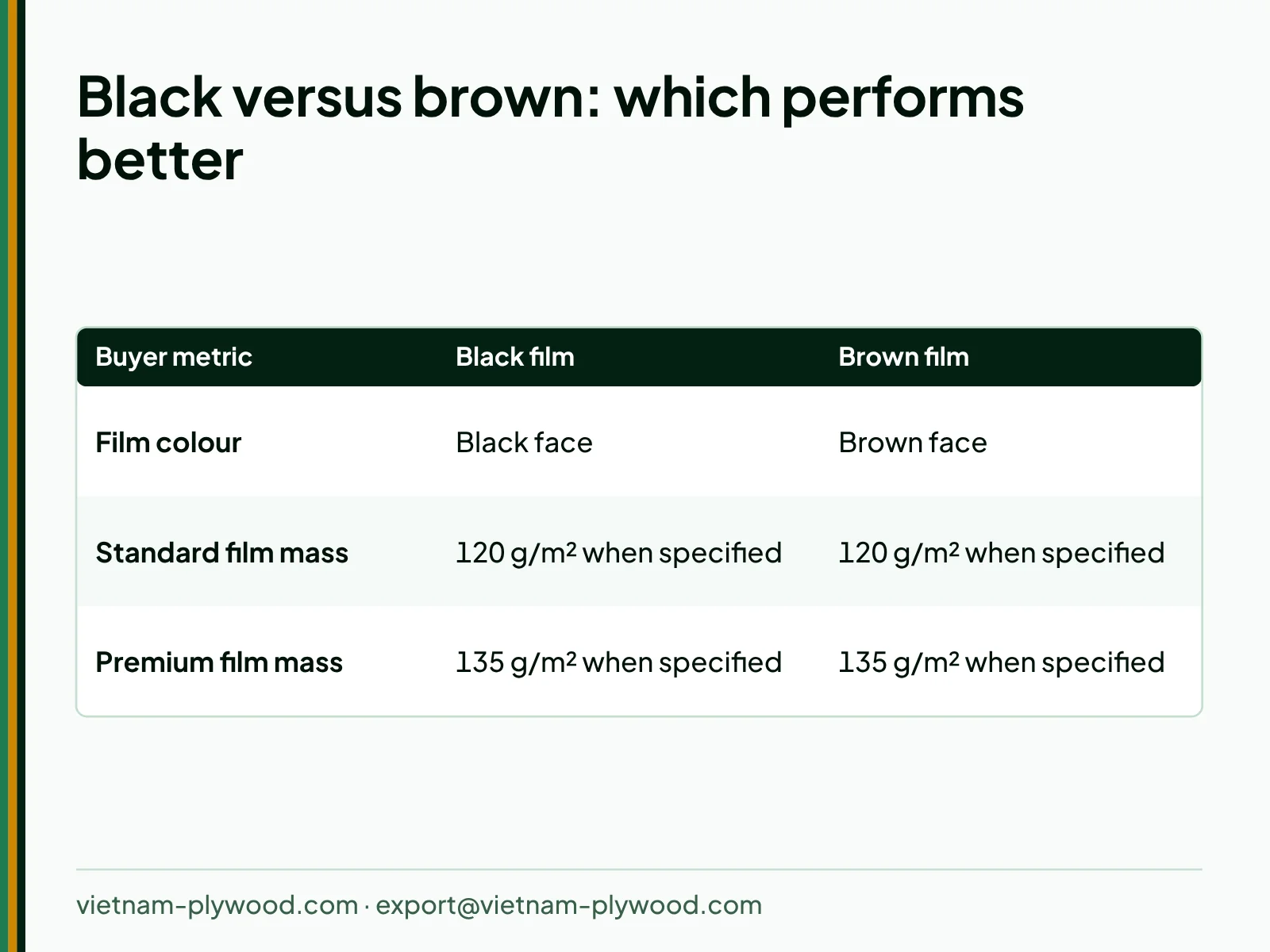
| Buyer metric | Black film | Brown film | Verdict by use |
|---|---|---|---|
| Film colour | Black face | Brown face | Choose either for batch identification |
| Standard film mass | 120 g/m² when specified | 120 g/m² when specified | Equal on the stated mass |
| Premium film mass | 135 g/m² when specified | 135 g/m² when specified | Compare film construction and sample |
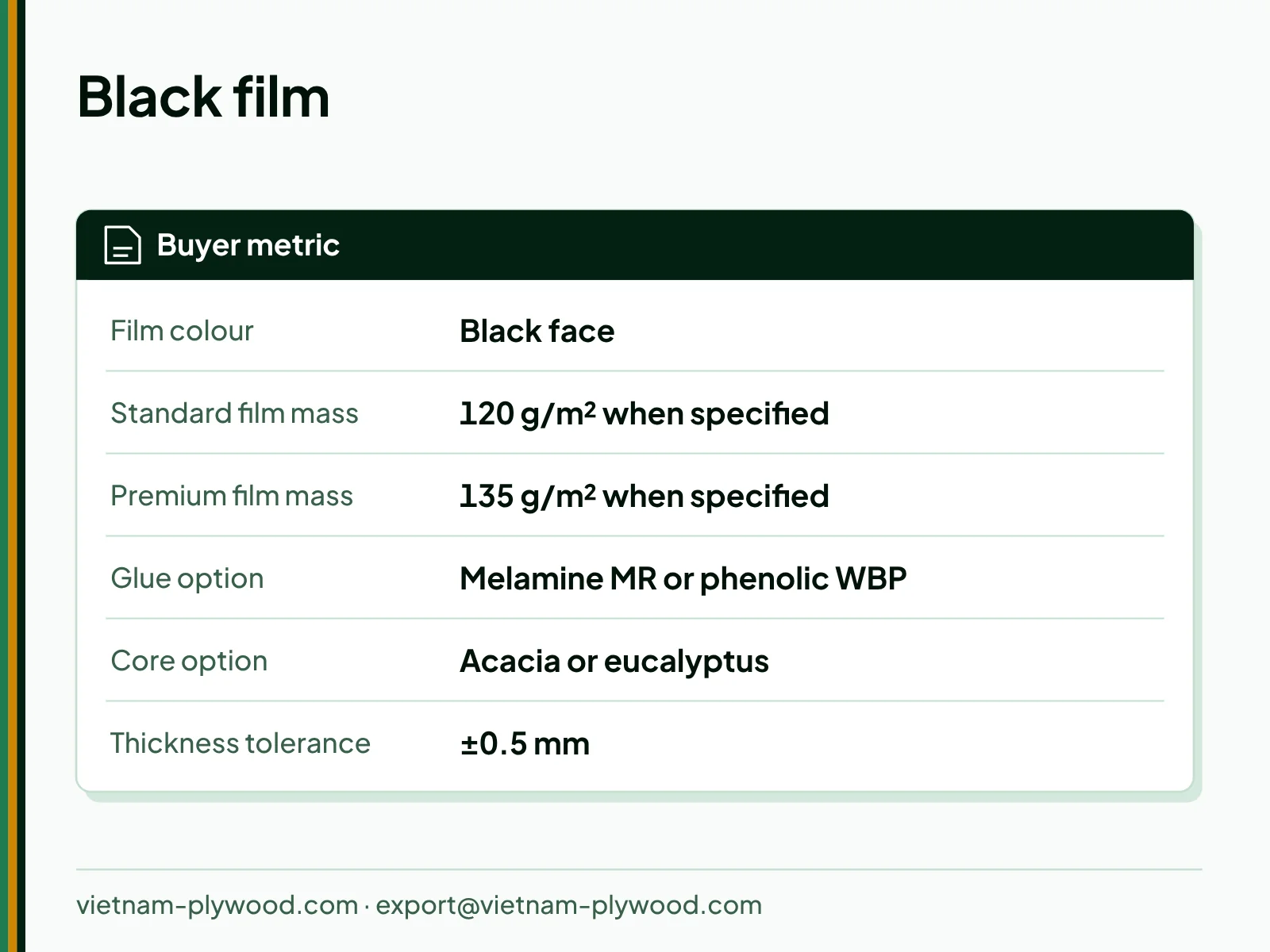
| Glue option | Melamine MR or phenolic WBP | Melamine MR or phenolic WBP | Select for exposure and reuse plan |
| Core option | Acacia or eucalyptus | Acacia or eucalyptus | Match core to handling and weight |
| Thickness tolerance | ±0.5 mm | ±0.5 mm | Same acceptance check |
| Formwork finish | Inspect sample after release | Inspect sample after release | Select by required concrete surface |
Request the two samples with identical build details and check the face after a controlled pour. The film-faced plywood product overview explains the construction range.
What do red, green and white films mean?
Red, green and white are possible film appearances in the wider formwork market, but there is no universal performance code linking these colours to a particular bond or service life. A buyer should treat each coloured film as a separately identified surface material and request its technical description. Do not assume green means a particular environmental attribute or white means a different glue.
Check that any requested colour is available for the agreed film build before fixing it in the contract. HCPLY’s construction line is described by phenolic or melamine film and anti-slip film; this page does not assign separate production specifications to red, green or white.
Does film colour identify the resin or waterproof bond?
Film colour does not identify the panel’s glue. The surface film and the adhesive joining the wood veneers are separate specifications, and neither can be read reliably from the shade of the face. Ask for the film type and the internal glue type as distinct fields.
For HCPLY construction plywood, melamine glue is the moisture-resistant (MR) option associated with a 12-hour boil, while phenolic glue is the weather-and-boil-proof (WBP) option associated with a 72-hour boil. Those descriptions refer to glue systems, not a test result for an individual shipment. Likewise, emission classes E0, E1 and E2 are separate from adhesive naming; do not write an emission class as though it were a glue formulation.
Which film weight, core and thickness should be specified?
Start with film mass and core before debating colour. HCPLY’s construction line uses 120 g/m² standard film or 135 g/m² premium film; 220 g/m² is reserved for anti-slip film. The cores are acacia at 580 kg/m³ and eucalyptus at 650 kg/m³. Density follows the core rather than the face colour.
Available panel thickness spans 3–40 mm, with 12, 15, 18 and 21 mm among common sizes. For a formwork order, state the designed thickness and the construction tolerance of ±0.5 mm, plus the length and width tolerance of ±2 mm. Standard formats include 1220 × 2440 mm and 1250 × 2500 mm; custom cutting is available. Specify the supporting formwork design separately, since colour and nominal thickness alone cannot establish load capacity.
An inspection sample should expose the edge so the buyer can compare gaps, overlaps and veneer arrangement. The construction project supply page covers broader project coordination.
Which factory line builds a coloured formwork panel?
Our construction line presses film-faced formwork plywood with acacia or eucalyptus core and an unsanded base. The other lines serve different specifications rather than changing a film colour into a performance grade. HCPLY allocates each order to the producing factory that matches the approved build.
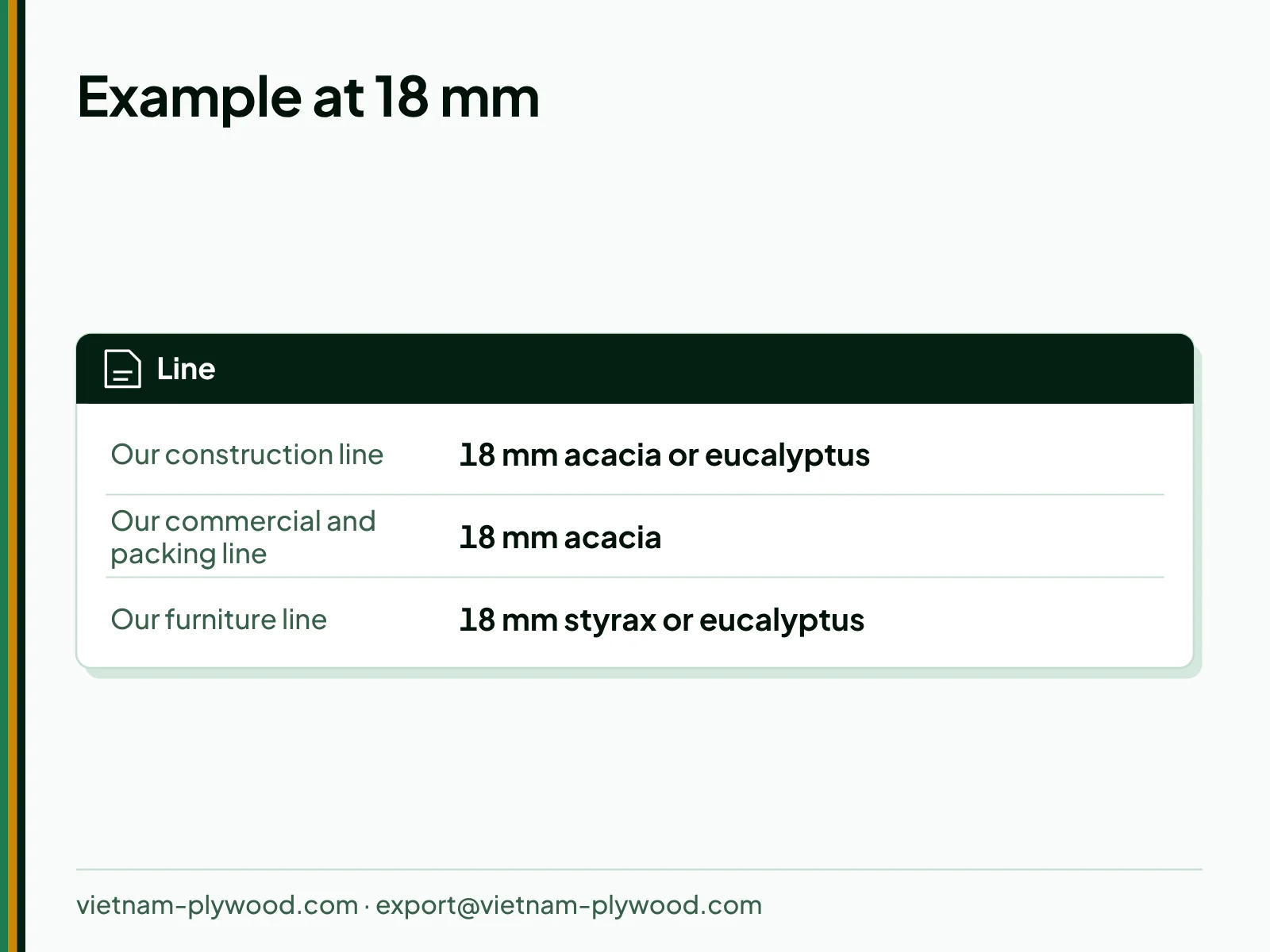
| Line | Example at 18 mm | Face and construction | Appropriate purchase |
|---|---|---|---|
| Our construction line | 18 mm acacia or eucalyptus | Film face, unsanded core | Reusable formwork |
| Our commercial and packing line | 18 mm acacia | Raw, unsanded or light-sanded, MR glue | Packing and commercial applications |
| Our furniture line | 18 mm styrax or eucalyptus | Sanded, full-stitched, veneer face | Furniture and cabinets |
Our three factories are in Phu Tho and Hai Phong. Buyers can visit the factory office and inspect the goods at the producing factory. The commercial plywood export guide describes why a raw commercial panel follows a different specification.
What should the inspector check before loading?
The inspector should compare the approved colour sample against production sheets under consistent lighting, then verify the written film and core specification. Visual shade alone cannot substitute for the agreed material checks. At the producing factory, the buyer can witness the following sequence:
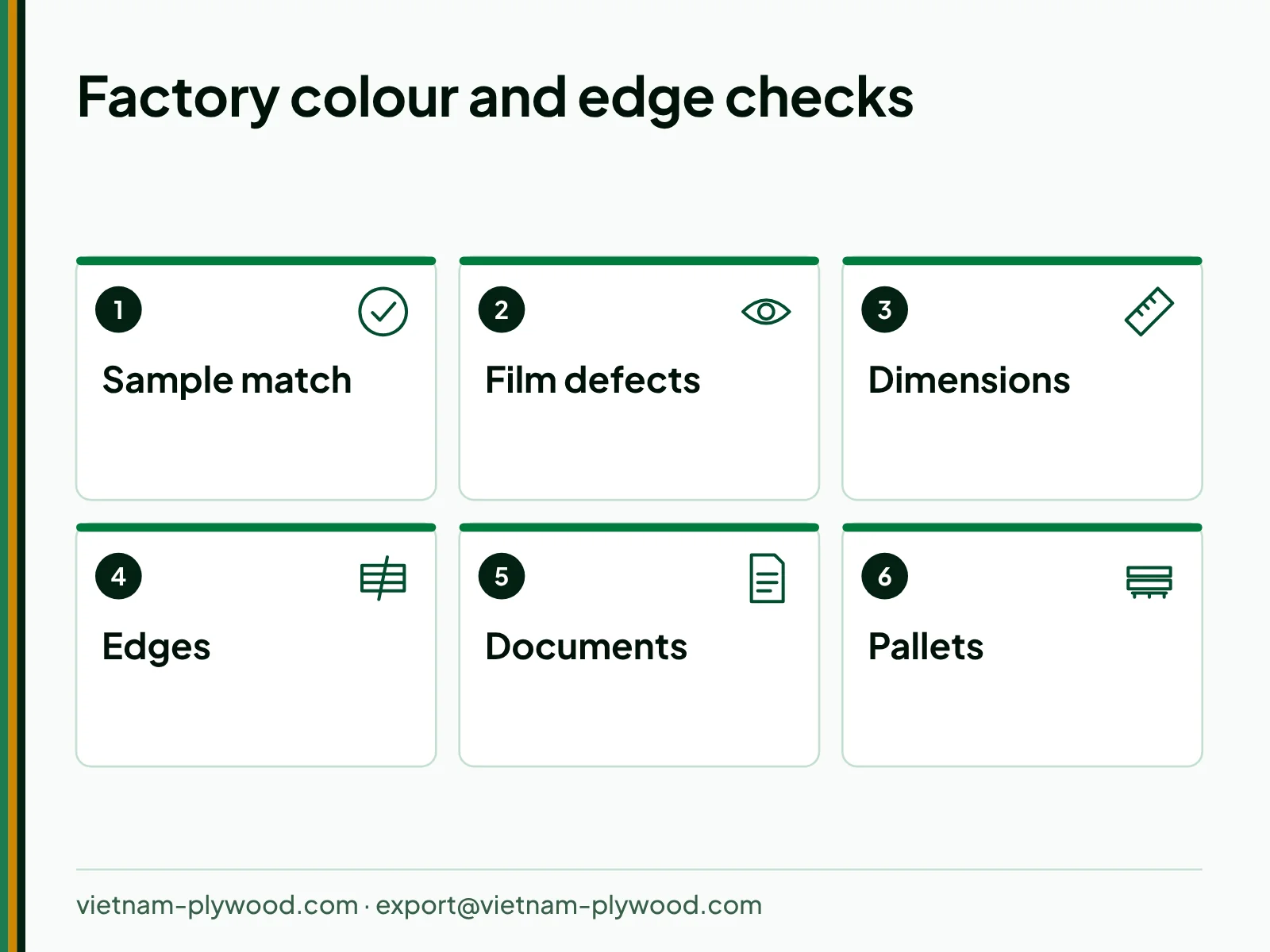
- Match pallet identification and the approved colour sample to the order line.
- Check the film surface for visible defects, scratches, folds and local lifting.
- Measure thickness and dimensions against the stated tolerances.
- Inspect cut edges for core gaps, overlaps and the specified edge sealing.
- Review the agreed glue and film documentation and identify any required test report.
- Check pallet count and loading against the packing list before container sealing.
For a demanding concrete finish, agree on a sample-pour assessment and record the acceptance criteria before production.
How many pours should buyers budget for?
With proper handling, a release agent on every pour and sealed edges, including cut edges, HCPLY melamine-glue film-faced plywood is described at about 12–15 pours. Under those same conditions, phenolic-glue film-faced plywood reaches up to about 25 pours. These figures distinguish the glue build and care conditions, not black from brown.
APA – The Engineered Wood Association explains in its Concrete Forming Design/Construction Guide (2012) that form maintenance includes stripping, cleaning, release-agent application and handling. Its concrete-forming guidance also describes edge sealing and release agents as specification considerations.
Track replacement caused by chipped edges and damaged faces separately from normal wear. A colour-based reuse claim cannot replace a project trial.
Can black and brown sheets share a container?
Black and brown film-faced specifications can share a 40HC load when the total payload stays within 28.5 t and the packing plan separates the order lines. At 18 mm and 1220 × 2440 mm, an acacia-core sheet weighs 31.08 kg before film weight; the full acacia lookup is 880 sheets, 47.15 m³ and 27.35 t. An eucalyptus-core sheet at the same dimensions weighs 34.83 kg before film weight, with a full lookup of 795 sheets, 42.60 m³ and 27.69 t.
Those are separate full-container reference loads, not quantities to add together. Film weight is excluded from the lookup, so the final load plan must account for the finished shipment. See container packing and mixed container loads for the dedicated loading topics.
What makes black film more expensive than brown?
A black face has no fixed price premium over brown. The largest meaningful quote differences come from the core and its construction, glue specification, film mass and finish requirements; thickness, cutting and order mix then change material consumption and production work. At the same colour, a higher film-mass build costs more in overlay material than a lower film-mass build, and a phenolic-glue specification changes the bond-system cost against a melamine-glue specification.
A 135 g/m² film uses more overlay material per square metre than a 120 g/m² film. Request a quotation for each complete specification rather than a price per colour. For a comparable decision, ask for the same dimensions, core, glue, film mass, quantity and destination term on both quote lines.
Which export documents identify the selected build?
The packing list identifies the shipped quantities and helps the buyer reconcile colour-coded pallet lines against the purchase order. The commercial invoice, bill of lading and certificate of origin accompany the shipment, together with phytosanitary and fumigation papers. EU lots include EUR.1 where applicable and the EUTR/EUDR file set; CIF shipments include insurance.
Order-specific certificate documents can include an FSC claim on sales documents, an emission certificate or test reports for the agreed build. Member-factory FSC, CARB P2, ISO 9001 and CE documents, and EUDR/EUTR documents, are shown with factory details masked, on request. After loading, the draft shipping documents come to you for approval. A certificate should be checked for its actual scope rather than inferred from the film colour.
How should a formwork yard order a trial?
Order a trial around the formwork application and an agreed sample, with black and brown identified as separate colour lines only when a direct comparison is needed. HCPLY’s minimum order is one 40HC, with specifications mixed within the payload limit. Factory lead time runs 15–45 days from receipt of the 30% deposit; the exact figure depends on order size, line loading and what the contract fixes; the 70% balance is against the scanned bill of lading, by T/T or irrevocable letter of credit at sight.
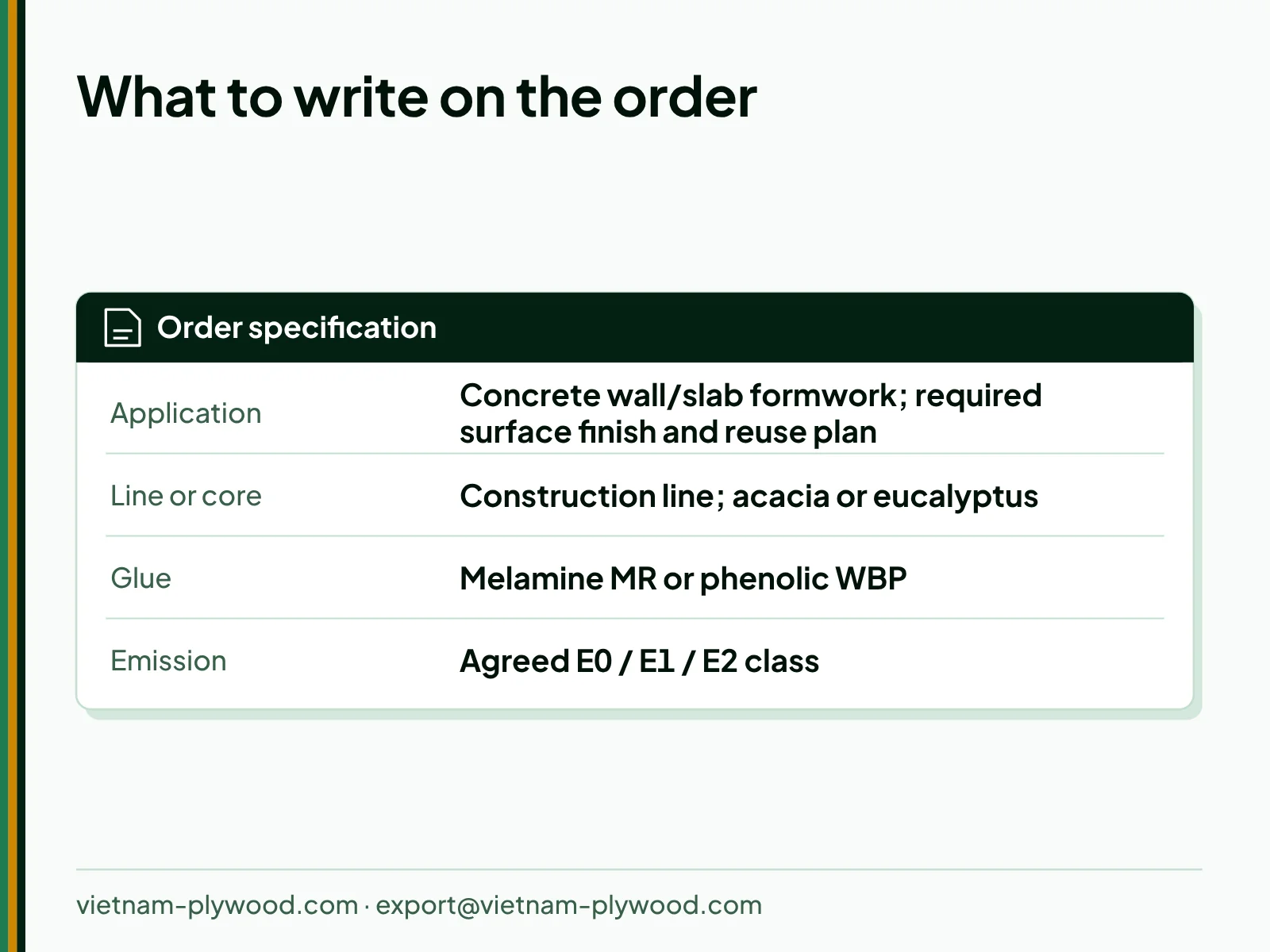
We ship FOB Hai Phong, or CFR (CNF) or CIF to your port. Samples cost nothing: a first-time buyer pays the courier, and that charge comes off the first confirmed order. Lucy at export@vietnam-plywood.com can discuss a written colour and build comparison through contact. Use the specification below to request matching panels for the same intended pour conditions.
Application: concrete wall/slab formwork; required surface finish and reuse plan
Line or core: construction line; acacia or eucalyptus
Glue: melamine MR or phenolic WBP
Emission: agreed E0 / E1 / E2 class
Face and grade: black or brown film; film mass 120 or 135 g/m²; approved sample
Thickness and tolerance: 18 mm; ±0.5 mm
Size: 1220 × 2440 mm; length/width ±2 mm
Quantity: one 40HC; quantities by colour and core
Destination port: [port]; delivery term FOB Hai Phong / CFR / CIF
Next step: plan a trial container with the agreed colour samples and inspection points.