

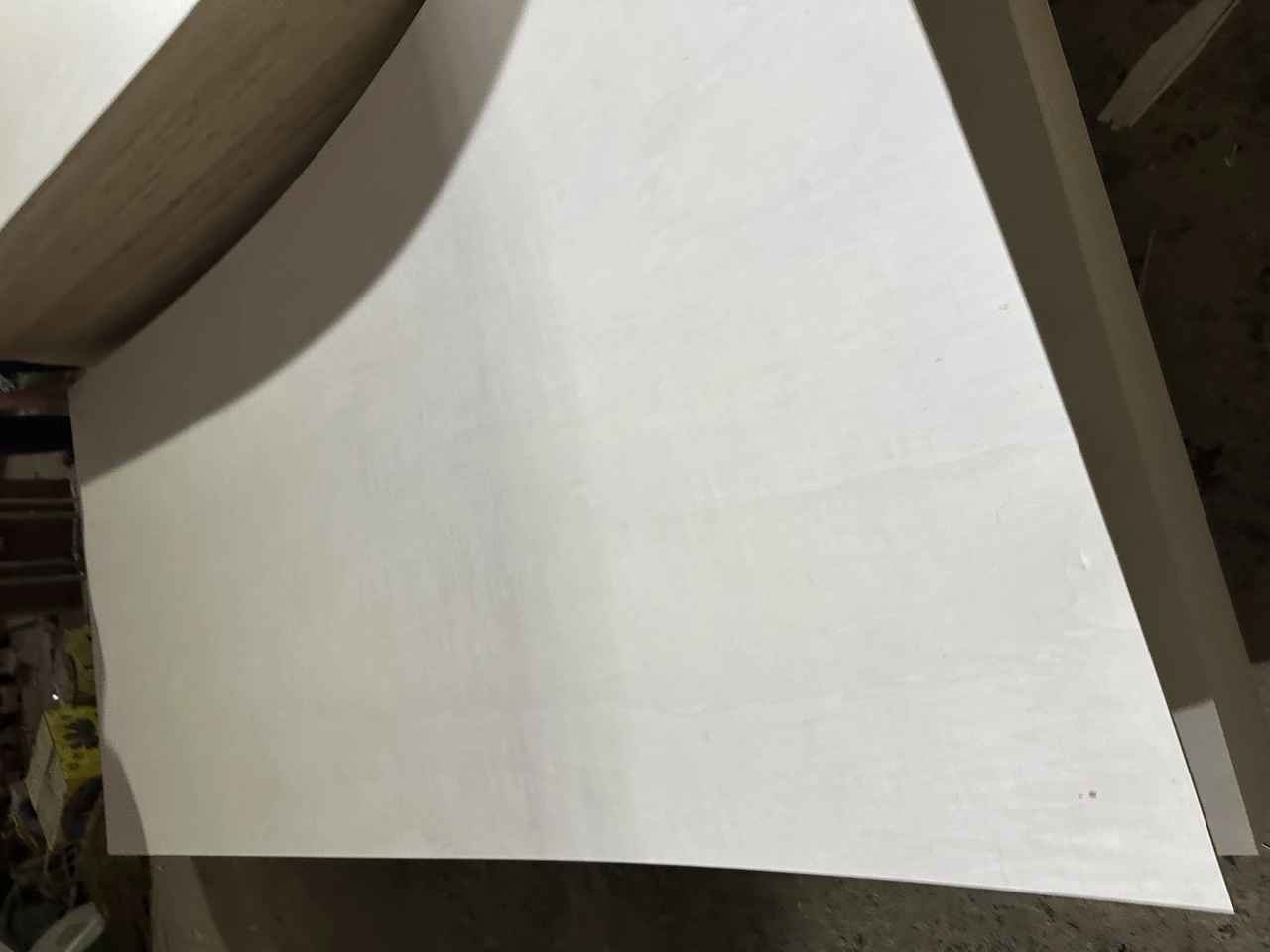
📋 Why White Core Matters for Furniture Manufacturers
Walk into any furniture panel warehouse in Korea, Japan, or Germany and ask which plywood buyers specifically request by core color. The answer is consistent: white core. That distinction is not aesthetic — it is functional.
Vietnam poplar plywood with white styrax core has become the standard substrate for laminated furniture panels in Northeast Asia and Europe precisely because of three properties that matter at the production line. First, the pale styrax core does not bleed color through thin laminates. Second, styrax density (480–500 kg/m³) is consistent batch to batch, unlike mixed-origin cores where density variation causes press gap problems. Third, the low resin content in styrax reduces the adhesive interference that darker acacia cores can introduce when bonding high-gloss or thin paper laminates.
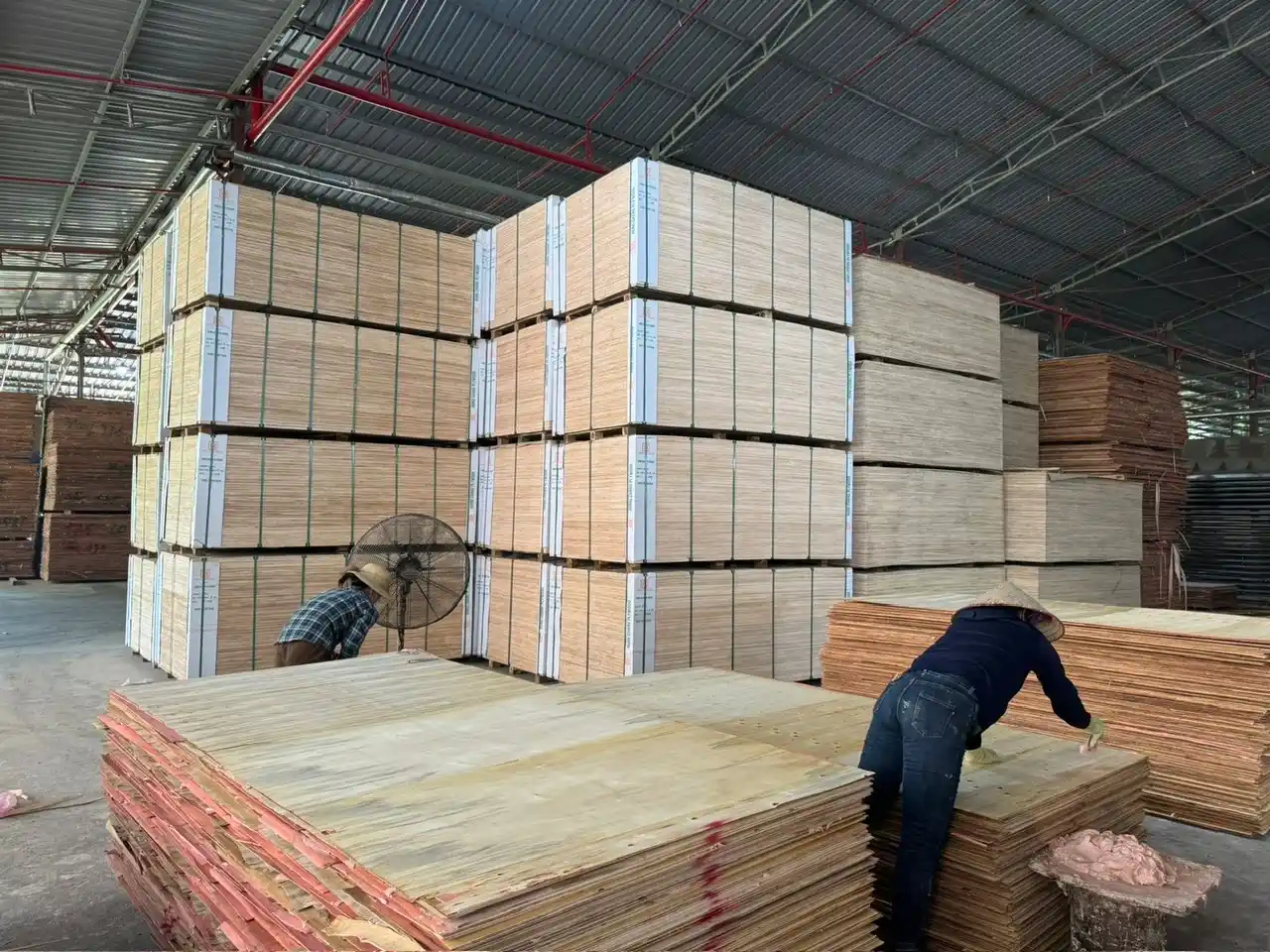
As of 2026, HCPLY ships white-core poplar plywood to furniture factories across Europe, South Korea, Japan, and re-export processing hubs in Malaysia and Thailand. The panels serve as lamination substrates, furniture carcasses, drawer components, and wall panel bases — all applications where the white core characteristic directly determines production line performance.
💡 Key Insight: The term “white core” in the poplar plywood trade is not a marketing label — it is a technical specification. Buyers who specify “white core” are requesting styrax (or hopea) inner plies with visible pale coloring on panel edges. This distinguishes the product from dark-core acacia variants and signals specific density, bonding, and lamination requirements.
📐 Vietnam Poplar Plywood — Full Specifications
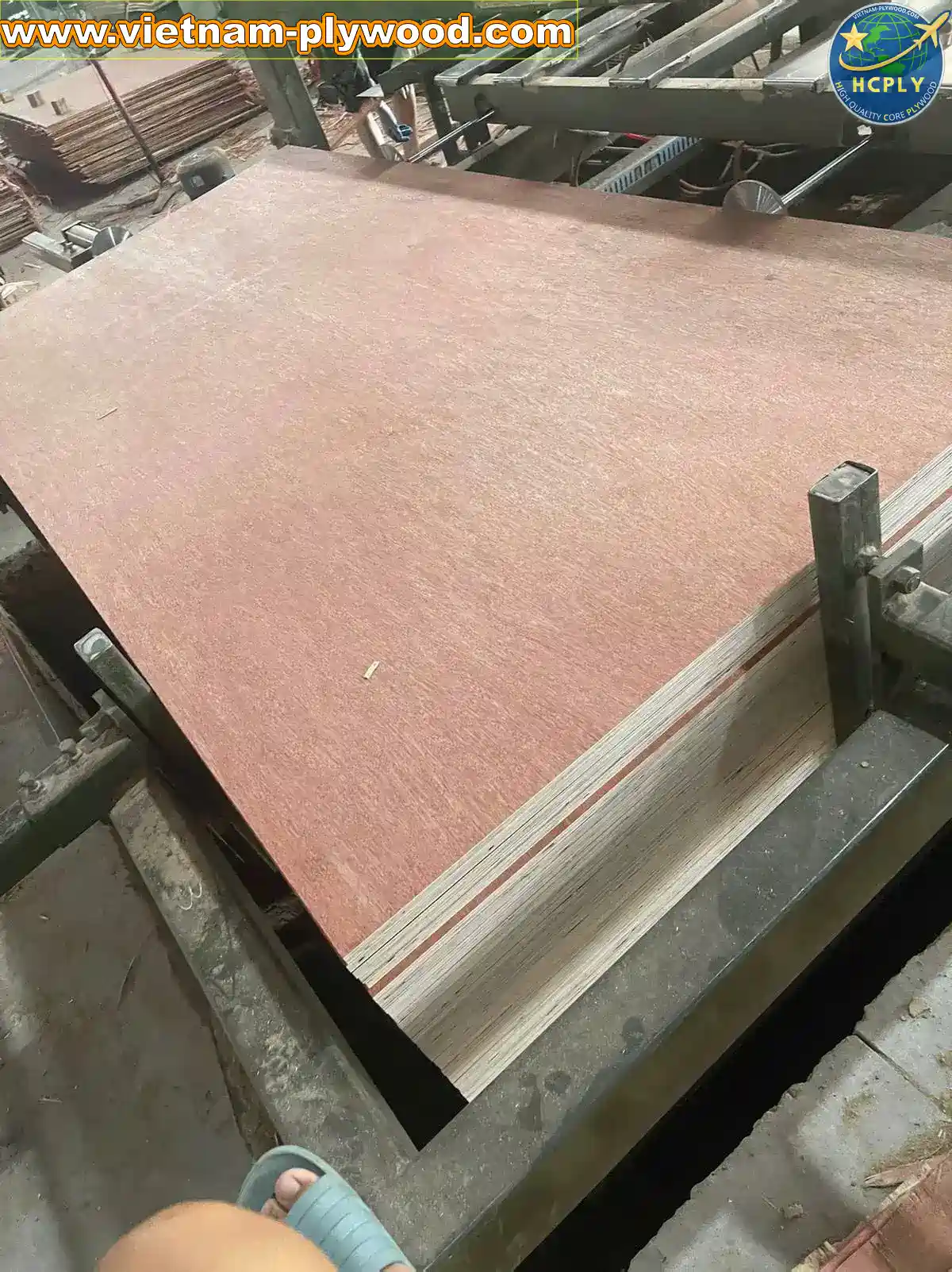
Understanding poplar plywood from Vietnam requires separating the face veneer from the core. The poplar face is 0.2–0.4mm thick — it determines surface appearance and initial bonding performance. The core determines density, weight, mechanical properties, and container economics.
“We always ask buyers about their end application before quoting. A furniture manufacturer and a construction contractor need completely different specs even when they both request 18mm plywood. Getting the application right prevents 90% of post-delivery complaints.” — Lucy, International Sales Manager, HCPLY
| Parameter | Styrax Core (White Core) | Acacia Core |
|---|---|---|
| Face veneer | Poplar A/B (pale cream) | Poplar A/B (pale cream) |
| Core species | Styrax (white, 480–500 kg/m³) | Acacia (~580 kg/m³) |
| Panel density | 480–500 kg/m³ | ~580 kg/m³ |
| Glue type | Melamine (MR) | Melamine (MR) |
| Emission class | E0 / E1 / CARB P2 | E0 / E1 |
| Thickness range | 3–30mm | 3–30mm |
| Common furniture sizes | 9, 12, 15, 18, 25mm | 9, 12, 15, 18, 25mm |
| Sheet size | 1220×2440mm, 1250×2500mm | 1220×2440mm, 1250×2500mm |
| Thickness tolerance | ±0.3mm | ±0.3mm |
| Moisture content | ≤12% (kiln-dried) | ≤12% (kiln-dried) |
| Sanding | Both faces, calibrated | Both faces, calibrated |
| Container load (40HC) | ~53 CBM — 18 pallets | ~47.5 CBM — 16 pallets |
⚠️ Important: Glue type and emission class are two separate parameters. Melamine (MR) is the glue system. E0 is the formaldehyde emission standard. Always specify both when ordering. “MR glue with E0 emission” is correct. For a full breakdown, see the guide to plywood glue types and emission standards.
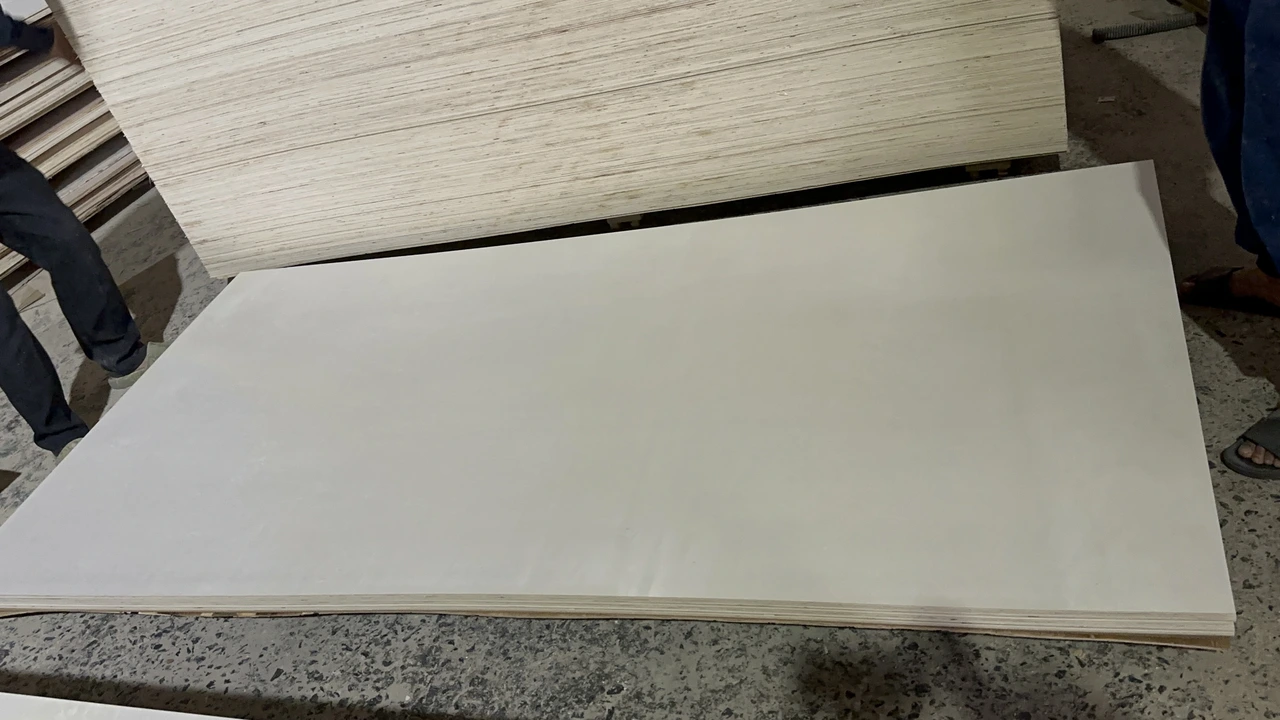
🔧 Styrax Core: The Science Behind the White Panel
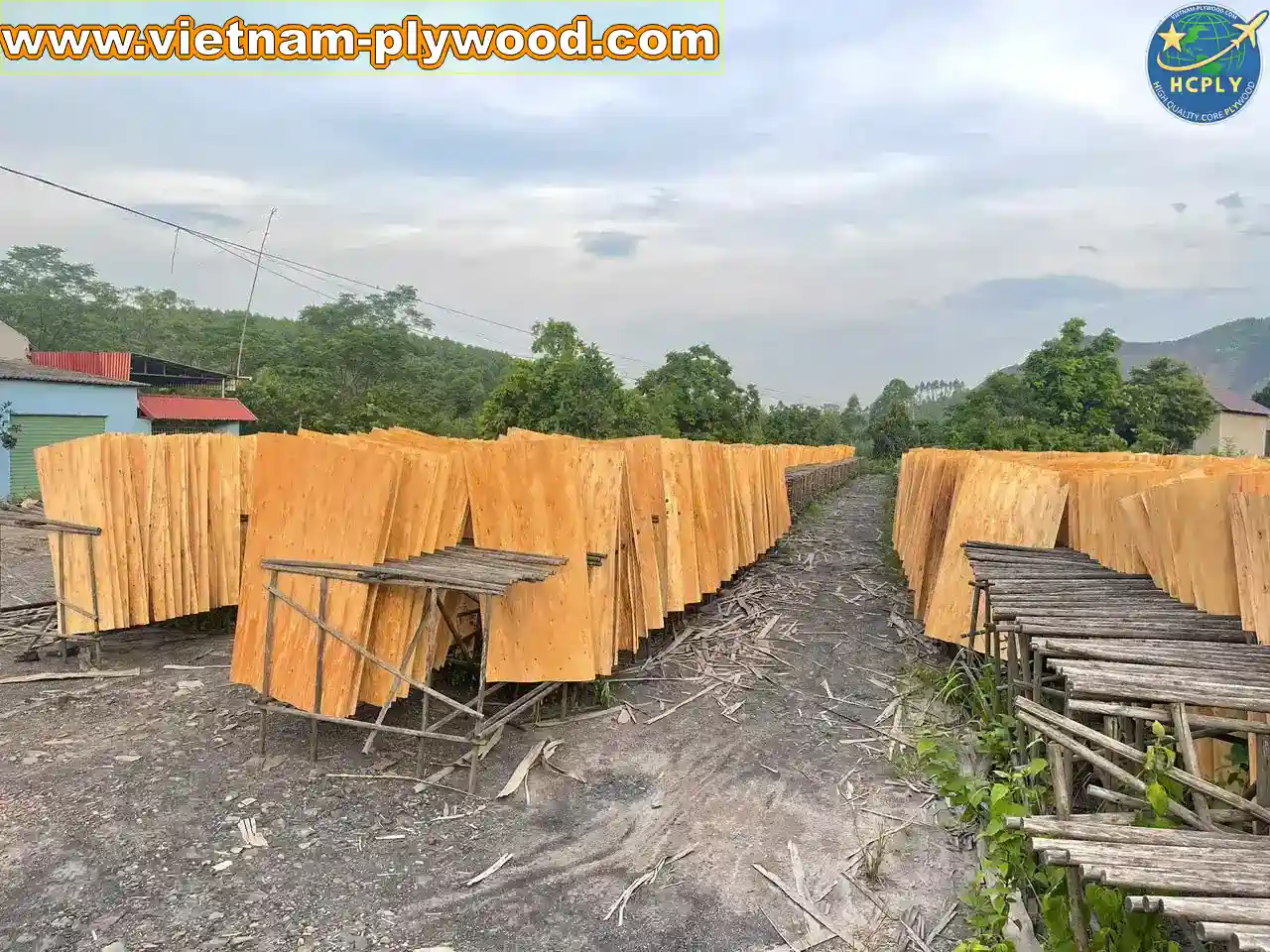
Styrax (Styrax tonkinensis) is a fast-growing plantation species native to Northern Vietnam, concentrated in Phu Tho, Yen Bai, and Tuyen Quang provinces. It is not imported — HCPLY sources styrax directly from nearby plantations, giving the supply chain a structure that supports FSC chain-of-custody documentation and EUDR traceability requirements.
Three technical properties make styrax the preferred core for furniture-grade poplar plywood.
Low density without softness. At 480–500 kg/m³, styrax is the lightest commercially available core in Vietnam — lighter than acacia (~580 kg/m³) and significantly lighter than eucalyptus (650–750 kg/m³). Yet styrax has sufficient density to hold press adhesion, accept edge-banding, and carry shelf loads typical of interior furniture. The lightweight characteristic reduces finished furniture weight, which matters for flat-pack systems where product weight directly affects packaging and shipping costs.
Uniform fiber structure. Styrax grows in a controlled plantation environment. This controlled origin produces veneer with consistent density across a sheet and batch to batch — a property that directly affects CNC machining performance. Furniture factories running calibrated CNC equipment need thickness variation below ±0.3mm. Styrax core delivers this consistently, while mixed-origin cores sometimes exceed tolerance over the panel surface area (HCPLY production data, 2026).
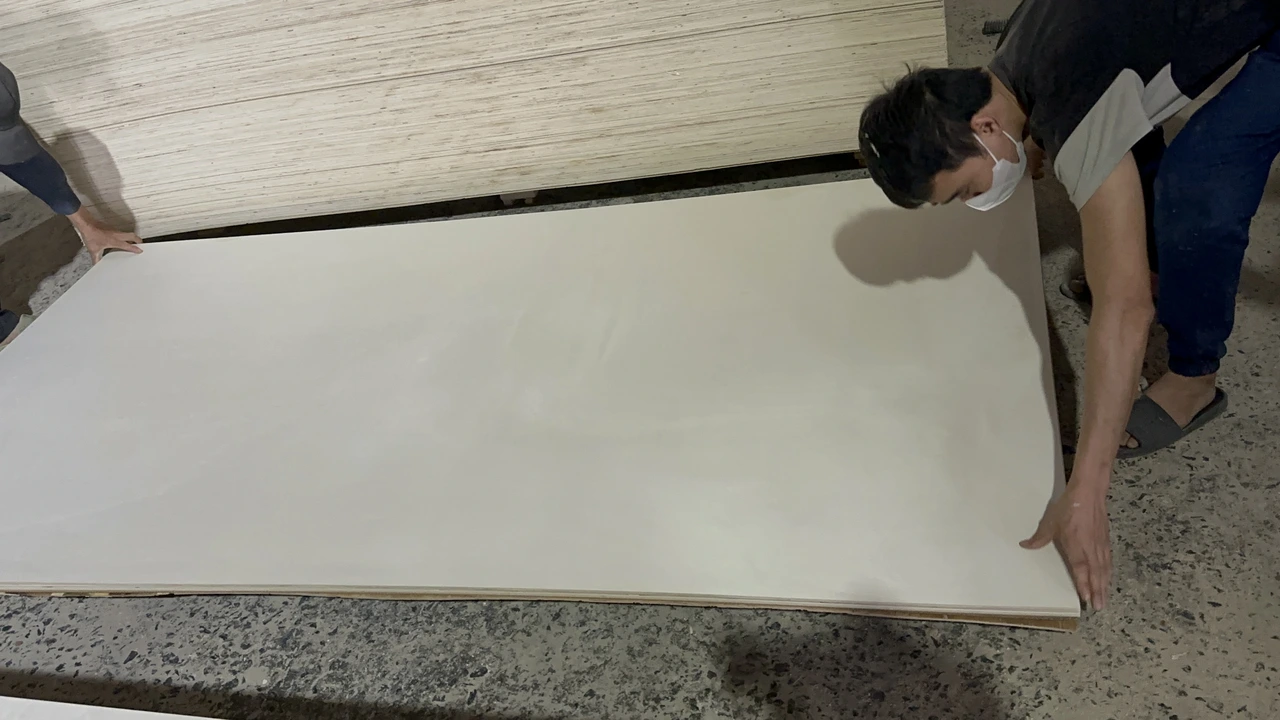
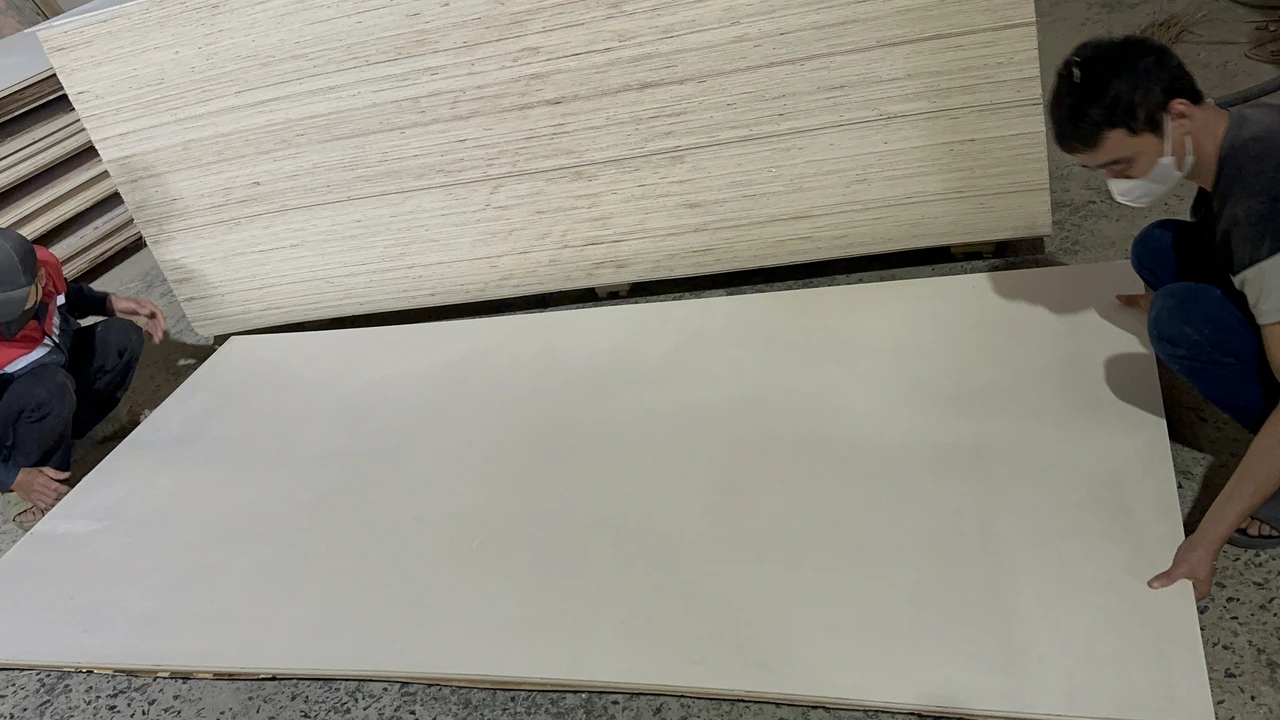
Non-resinous, clean bonding surface. Styrax has minimal resin content. When core veneers are bonded with poplar face veneers using melamine adhesive systems, there is no resin bleed to contaminate the adhesive film. The result is a flat, clean bond line visible on panel edges — the defining characteristic of quality white-core poplar plywood.
“The white core is not just appearance — it tells you the panel is made from styrax, not a mixed or substituted core,” says Lucy, International Sales Manager at HCPLY. “Buyers who have received dark-core panels labeled as ‘white core’ from other suppliers immediately understand why the specification matters.”
🪑 Furniture Applications: Where Vietnam Poplar Plywood Is Used
Vietnam poplar plywood with white styrax core is not a universal material — it has a defined application range where it performs optimally and adjacent applications where other species outperform it.
Cabinet and wardrobe carcasses — including kitchen cabinet plywood — are the primary volume application. The structural box of a wardrobe, kitchen cabinet, or shelving unit takes 18mm poplar plywood on sides, top, and base — sometimes 25mm for heavy-duty shelving. Styrax-core panels deliver adequate bending stiffness for typical furniture span lengths (up to 800mm unsupported shelf) while minimizing the finished furniture weight that affects shipping and end-user handling.
Drawer boxes and cabinet backs use thinner gauges. Drawer bottoms run at 4–6mm. Drawer sides and backs: 12–15mm. Cabinet backing panels: 6–9mm. In all these applications, the flat, consistent surface of sanded poplar plywood accepts cabinet assembly adhesives and cam-lock fastener inserts without surface preparation. For buyers manufacturing flat-pack furniture at volume, surface consistency across batches eliminates variance-related rework on assembly lines.
Laminated furniture panels are the second major application category. Furniture factories in Korea, Japan, and parts of Europe press melamine paper, HPL, or PVC film directly onto poplar plywood panels to produce finished shelf boards, side panels, and worktops. The white styrax core and pale poplar face minimize color telegraphing through thin laminates — a practical problem with darker cores and more resinous face species.
Door cores and panel substrates use poplar plywood as internal substrate material. Flush interior doors, decorative panels, and display cabinet sides all use white-core poplar as the structural base onto which decorative finishes are applied. The light weight reduces door weight for hardware (hinges, closers) sizing decisions.
Request samples for your specific furniture application →
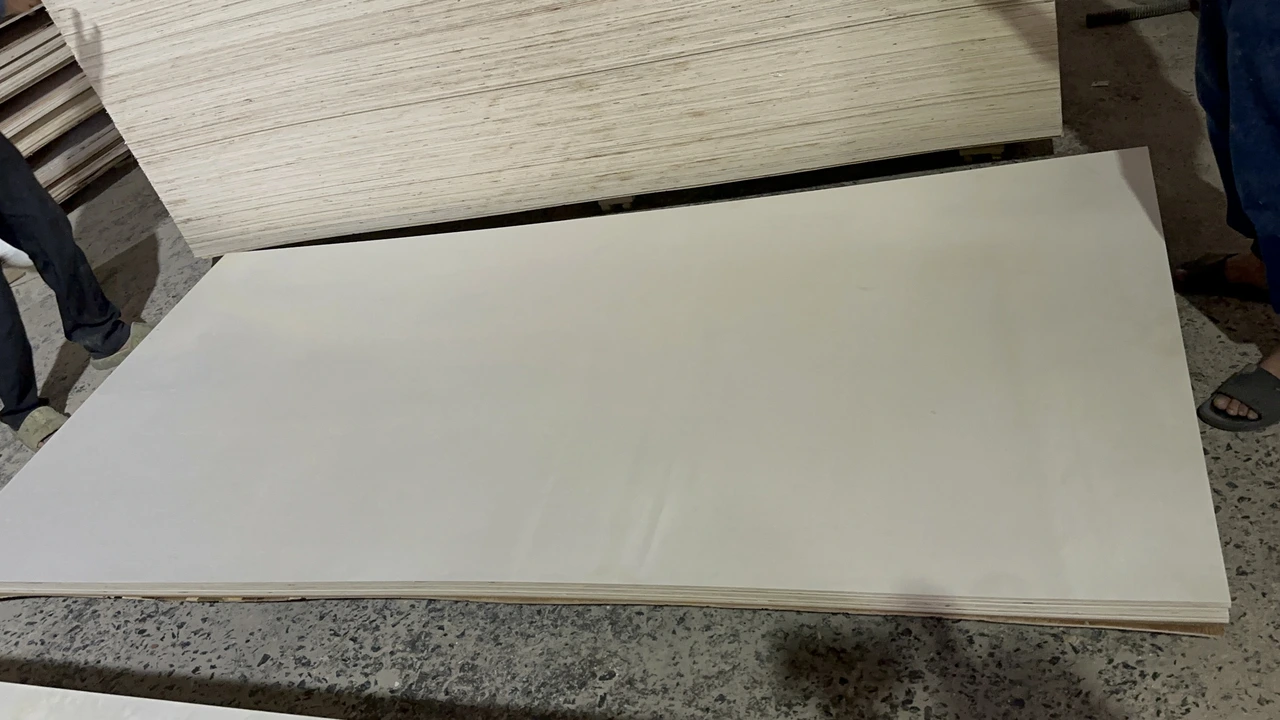
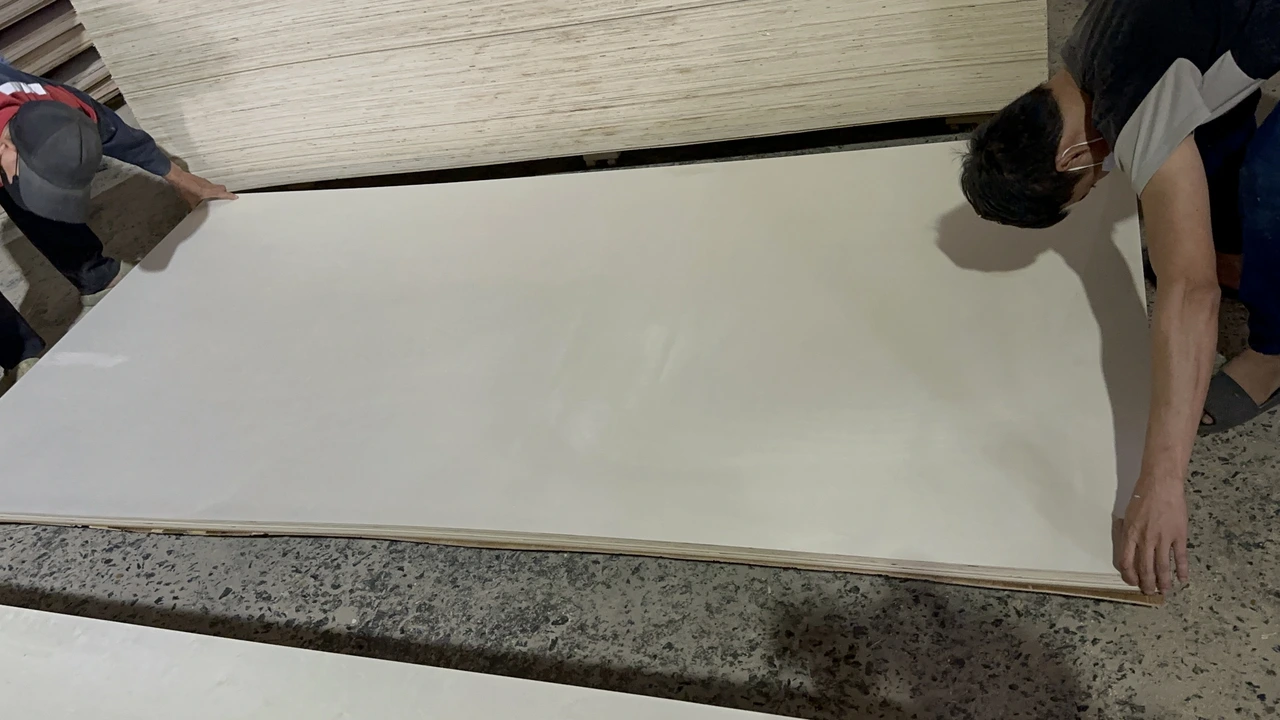
⚙️ Core Construction for Furniture Grade
Not all poplar plywood uses the same internal construction. For furniture applications, core construction quality directly affects the panel’s long-term performance.
HCPLY offers three core construction grades for poplar plywood.
Full stitched core is the premium option. All veneer pieces — both outer and inner layers — are sewn together with continuous threads before layup. This eliminates gaps, overlaps, and loose sections in the core, producing a structurally solid panel that machines cleanly and does not produce hollow-sound areas when assembled into furniture. For E0-grade furniture destined for EU or Korean markets, full stitched core is the standard specification.
Stitched outer + edge-trimmed inner is the mid-grade option. The outer core plies (adjacent to face veneers) are stitched for surface flatness. Inner plies are precision edge-trimmed and fitted without stitching. This construction meets most furniture requirements at a lower cost than full stitched — appropriate for domestic market furniture and price-sensitive export applications.
Loose-laid is the commercial/packing grade construction. Veneer pieces are positioned without stitching, relying on glue pressure to hold alignment. This construction is not recommended for furniture applications where surface quality, screw retention, or long-term dimensional stability matter. It is appropriate for packing grade poplar where cost is the only driver.
For buyers ordering furniture-grade poplar plywood from Vietnam, the default specification at HCPLY is full stitched core on all E0 orders. Specifying construction type in the purchase order prevents material substitution during production. See the guide to plywood core types from Vietnam for a full breakdown of stitched vs loose-lay construction differences.
📊 Poplar vs Birch vs Pine: Furniture Panel Comparison
Buyers frequently evaluate poplar plywood against birch and pine for the same furniture applications. The correct choice depends on application requirements, not general quality rankings.
| Property | Poplar (Styrax Core) | Birch (Styrax Core) | Pine (Styrax Core) |
|---|---|---|---|
| Panel density | 480–500 kg/m³ | ~510–540 kg/m³ | 480–500 kg/m³ |
| Face hardness | Moderate — soft fibers | Higher — harder surface | Moderate — knot variations |
| Face appearance | Pale cream, consistent | Pale yellow, fine grain | Warm golden, knotty |
| Bonding surface for lamination | Excellent — minimal telegraphing | Excellent | Good — knots may telegraph |
| E0 availability | Yes (standard) | Yes (standard) | Yes (available) |
| Screw holding | Adequate for cam-lock | Strong — preferred for screws | Adequate |
| CNC routability | Good — clean cuts | Excellent | Good |
| EUDR compliance ease | High (Vietnam plantation) | Moderate (imported birch veneer) | High |
| Price level | Mid (from $260/CBM) | Higher (imported face) | Mid (from $280/CBM) |
| Primary furniture market | Korea, Japan, EU lamination | EU, US premium furniture | Australia, EU decorative |
For furniture carcasses and laminated panels where the face will be covered, poplar is the cost-optimal choice. Where exposed hardwood surface or maximum screw-holding performance is required — high-end cabinet carcase joints, hardware-heavy modular systems — birch plywood from Vietnam is the correct specification. Where warm-grain decorative appearance matters, pine plywood from Vietnam is appropriate.
The practical guide: specify poplar for everything that will be laminated or painted. Specify birch for exposed surfaces and mechanical assembly. Specify pine for decorative exposed panel applications.
🏆 EU & International Market Compliance
Three compliance requirements directly affect furniture-grade poplar plywood imports into regulated markets.
EUDR documentation is now required for timber product imports entering the EU. Vietnam’s plantation-grown styrax and poplar species produce documentation-friendly supply chains: plantation GPS coordinates, harvest records, and species declarations are straightforward compared to mixed tropical hardwood origins. HCPLY maintains EUDR-compliant supply chain records and prepares ready-to-submit documentation packages for EU importers, updated for current 2026 enforcement requirements (International Tropical Timber Organization, 2025).
E0 emission compliance is standard for furniture destined for the EU, Korea, Japan, and the US. E0 (≤0.5 mg/L formaldehyde) is HCPLY’s default for furniture-grade poplar orders. For Japanese buyers, this is equivalent to the F★★★★ standard required for Japanese customs clearance. For Korean buyers, the Korean KC certification equivalent is met by E0 test documentation. For US buyers, CARB P2 (equivalent strictness to E0) certification is available.
FSC Chain of Custody is required by many EU importers, green building specifications (LEED, BREEAM), and government procurement programs. FSC-certified poplar plywood from HCPLY verifies the chain of custody from plantation origin to export — a key differentiator from Chinese-origin panels where FSC documentation integrity has been questioned by Forest Stewardship Council (FSC, 2024) audit findings.
For buyers working through the full compliance matrix, the plywood certifications and export documentation guide covers FSC, CARB, CE, and EUDR in detail.
📦 Container Economics: Why White Core Pays Off
Furniture importers run on landed cost per sheet — not FOB price per CBM in isolation. Poplar plywood with styrax core has a structural freight advantage that compounds on every container.
Styrax-core poplar plywood (480–500 kg/m³) loads at 18 pallets per 40HC container with a pallet stack height of 1000mm, yielding approximately 53 CBM total. Container weight at 53 CBM of styrax-core panels is approximately 26.5 MT — comfortably below the 28.5 MT payload limit. This means the container is volume-limited, not weight-limited, on every shipment.
For comparison, eucalyptus-core plywood (650–750 kg/m³) loads at only 15 pallets per 40HC — approximately 44.5 CBM — because the weight limit constrains loading before the volume limit is reached.
The difference: styrax-core poplar delivers approximately 19% more CBM per container than eucalyptus-core alternatives. On a freight cost of $3,000 per container, the per-CBM freight cost for styrax-core poplar is approximately $56/CBM versus $67/CBM for eucalyptus-core. At scale — 20 containers per year — this differential is significant. See the detailed calculation in the plywood container packing calculation guide.
Acacia-core poplar plywood loads at 16 pallets per 40HC (~47.5 CBM, ~27.5 MT). Still weight-efficient compared to eucalyptus, but 10% less volume per container than styrax. For buyers whose furniture applications require the denser acacia core for screw holding, the trade-off is clear.
!Vietnam poplar plywood white core export packing bundles container ready hcply factory
Request a container loading plan and FOB quote →
🔗 Ordering: What to Specify for Furniture Grade
A complete order specification prevents quality disputes and production delays. Based on HCPLY export documentation across 600+ containers shipped annually (HCPLY production data, 2026), here are the parameters every furniture buyer must confirm.
Required fields:
- Face grade — A/B for furniture (clean white face, minimal repairs); B/C for commercial
- Core species — Styrax (white core, lighter) or Acacia (denser, better fastener retention)
- Core construction — Full stitched (premium, E0 orders) or edge-trimmed (mid-grade)
- Glue type — Melamine (MR) for standard interior; specify WBP only if moisture exposure applies
- Emission class — E0 for EU/Korea/Japan/US; E1 for other markets
- Thickness — Nominal thickness + confirm ±0.3mm tolerance is acceptable
- Sheet size — 1220×2440mm (standard) or 1250×2500mm (EU metric)
- Certifications — FSC, CARB P2, EUDR documentation if required by your market
- Sanding specification — Both faces calibrated (standard furniture spec)
- MOQ — Minimum 1×40HC container; mixed thicknesses within one container accepted
Poplar face on styrax core is available as described. If your application requires a more durable face surface — for furniture that will not be laminated and needs paint hold or abrasion resistance — consider EV plywood from Vietnam (engineered veneer) on styrax core as an alternative with better face consistency.
Lead time from order confirmation to FOB Hai Phong: 15–20 working days. Air freight samples available before container order commitment.
✅ Conclusion: Is Vietnam Poplar Plywood Right for Your Furniture Line?
Vietnam poplar plywood with white styrax core is the standard substrate choice for furniture factories that laminate, paint, or apply film finishes to their panels. The supply case is straightforward: plantation-grown, EUDR-compliant, and free from the trade restrictions and price volatility affecting Russian birch and Chinese plywood alternatives.
The technical case is equally direct. Styrax core at 480–500 kg/m³ delivers the weight profile furniture manufacturers need for flat-pack systems and modular furniture, the container volume efficiency that reduces landed cost per sheet, and the consistent density that CNC-driven furniture production requires. The white core appearance is the visible marker of this core specification — and the reason experienced buyers call it out explicitly in their orders.
For a deeper understanding of the plywood raw materials used in Vietnamese production — veneer species, core types, and plantation sourcing — see our raw materials guide. White-core poplar plywood from Vietnam is not the right choice when maximum screw-holding performance is the primary requirement (use acacia or eucalyptus core), when exposed hardwood surface aesthetics drive specification (use birch), or when high-moisture environments require WBP bonding (use pine or film-faced alternatives). For the majority of laminated interior furniture — carcasses, drawer boxes, wall panels, flat-pack components — it is a proven production fit at a predictable landed cost.
Disclosure: This article is published by HCPLY, a Vietnam-based plywood manufacturer and export operator. While we aim to provide objective industry guidance, readers should consider our perspective as a market participant when evaluating recommendations.
Get a Free Quote for Poplar Plywood Vietnam →
No commitment required. Container loading plan and FOB pricing within 12 hours.