


Moisture content is the single most underestimated specification in a plywood purchase order. Buyers check thickness, grade, and glue type — but overlook moisture. Yet panels with incorrect moisture content can warp in transit, delaminate on-site, or be rejected at port before a single sheet is installed.
Vietnam plywood exports follow defined moisture standards that align with EN 636, JAS, and ASTM D4442. Understanding those standards — and how factories control and verify them — gives buyers a meaningful quality checkpoint before shipment.
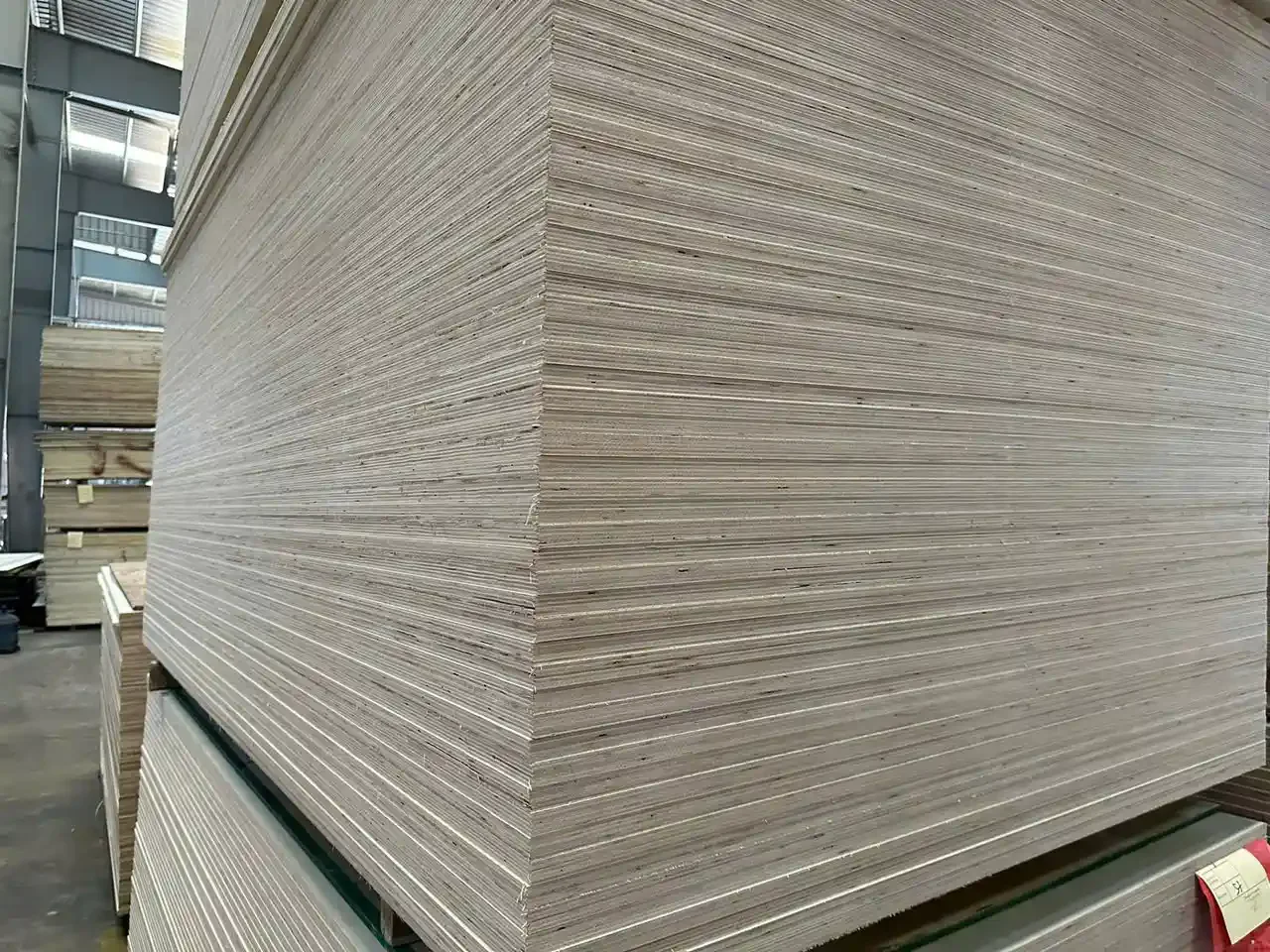
📊 Standard Moisture Ranges for Vietnam Export Plywood
Plywood moisture content is expressed as a percentage of the wood’s oven-dry weight. A panel reading 8% moisture contains 80g of water per 1,000g of dry wood fiber.
Vietnam plywood factories targeting premium markets maintain the following ranges as of 2026:
| Plywood Grade | Target Moisture Range | Key Markets |
|---|---|---|
| Interior furniture (E0/E1) | 6–10% | EU, US, Japan, Korea |
| Commercial / general interior | 8–12% | India, Middle East, ASEAN |
| Exterior / WBP construction | 8–12% | Australia, UAE, Korea |
| Marine-grade (phenolic WBP) | 8–14% | Marine applications globally |
| Packing / crating grade | ≤15% | All markets |
These ranges reflect the equilibrium moisture content of wood in typical air-conditioned interiors (EU: 8–12% relative humidity environment, Japan: tighter). Panels shipped outside this window arrive and then rebalance — warping as they absorb or release moisture.
⚠️ Important: Moisture content is measured on final panels ready to ship, not on raw veneer. Veneer at the pressing stage must be kept lower (6–8% for melamine, up to 10% for phenolic) for proper glue cure. These are two different measurements with different target ranges.
🔧 How Vietnam Factories Control Moisture Content
Maintaining correct vietnam plywood moisture levels requires control at five points in the production chain. The Vietnam plywood manufacturing process covers the full sequence — moisture management threads through every stage.
📌 Stage 1: Veneer Drying (Kiln)
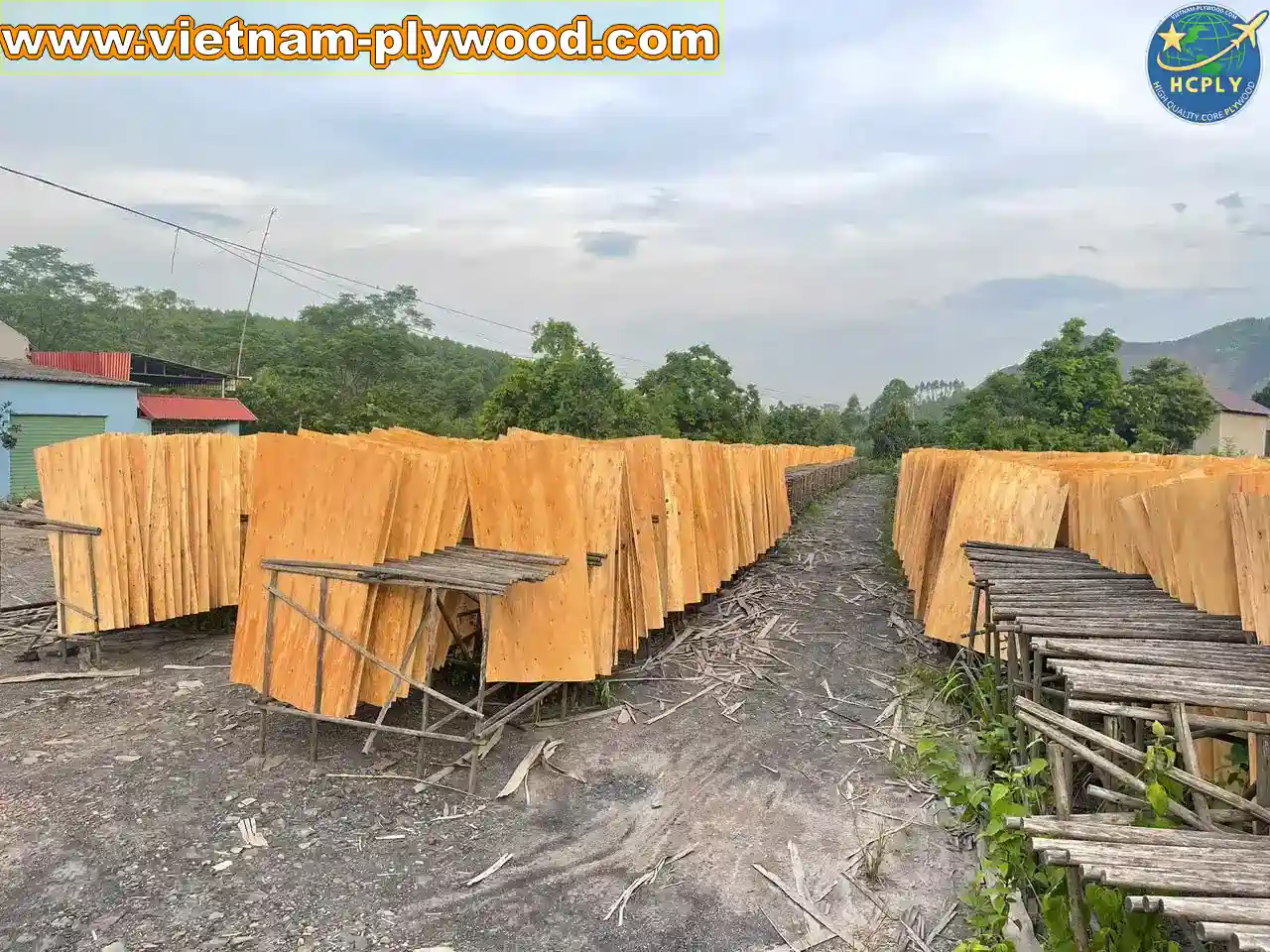
Freshly peeled veneer carries 60–120% moisture (green wood basis). Industrial roller kilns reduce this to 6–8% for core veneer and 5–7% for face veneer before lay-up. Kiln temperature is typically 120–160°C; dwell time varies by veneer thickness (0.2–2.0mm).
Over-drying — below 4% — makes veneer brittle and prone to cracking during lay-up and pressing. Under-drying — above 10% — causes steam expansion during hot pressing, creating internal voids and surface blisters.
📌 Stage 2: Conditioning Before Lay-Up
After kiln drying, veneer stacks are conditioned in a controlled room for 12–24 hours. This equalizes moisture gradients across the stack — edges dry faster than centers in kilns, and conditioning reduces that variance before glue application.
Premium furniture-grade factories (HCPLY’s furniture facility runs this step for all E0 orders) document target vs. actual moisture at conditioning sign-off.
📌 Stage 3: Glue Application and Hot Pressing
Glue type determines acceptable veneer moisture at pressing:
- Melamine (MR glue): Veneer moisture 6–8% at pressing. Melamine resin requires controlled moisture for full cross-linking. (See plywood glue types & emission standards for the full chemistry comparison.)
- Phenolic (WBP glue): Veneer moisture up to 10% tolerated. Phenolic resins are more moisture-tolerant during pressing, which is why film-faced formwork boards can use slightly higher-moisture eucalyptus core.
Hot pressing removes residual press moisture — panels typically exit at 6–9% from the press.
📌 Stage 4: Post-Press Acclimatization
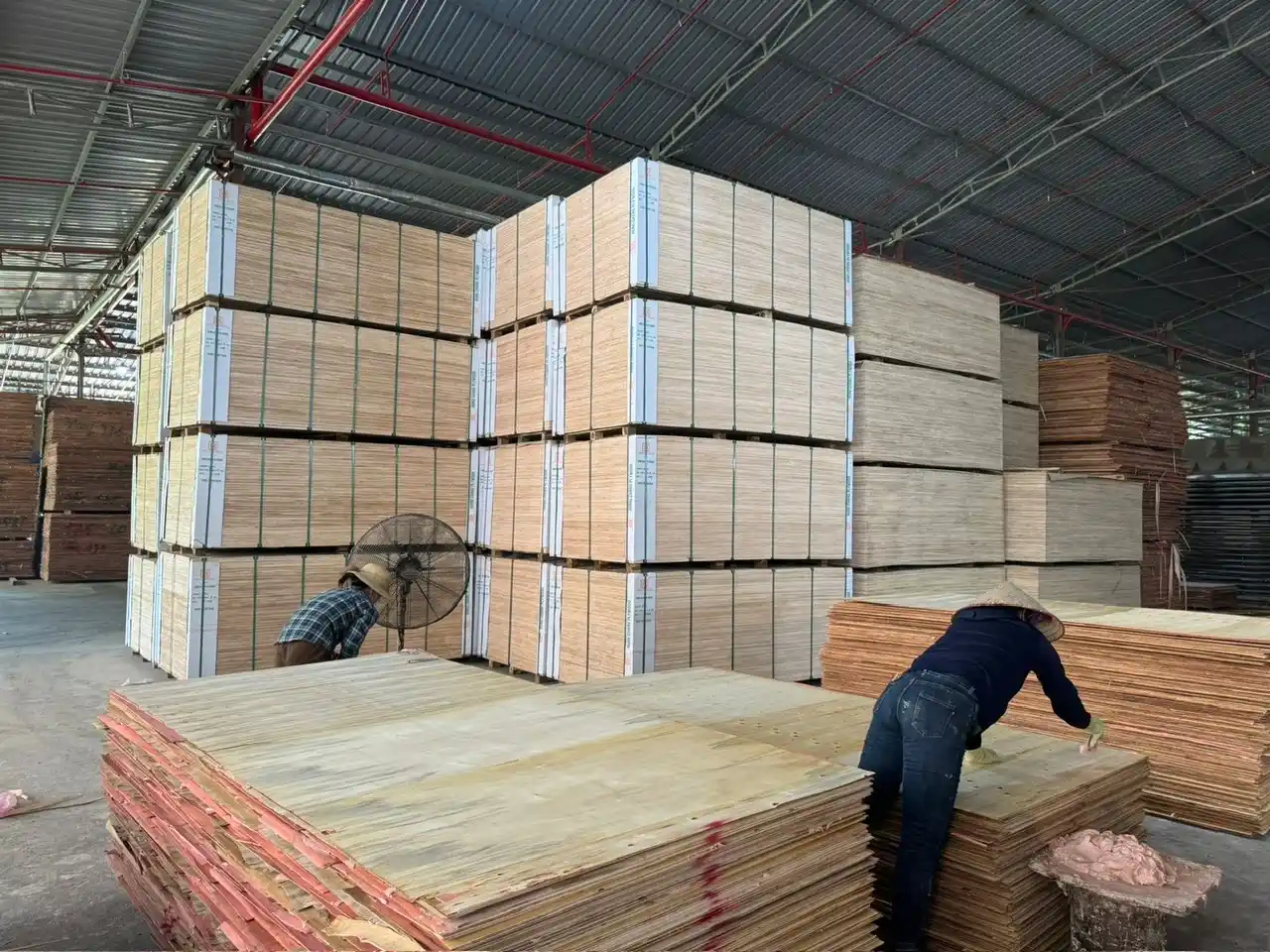
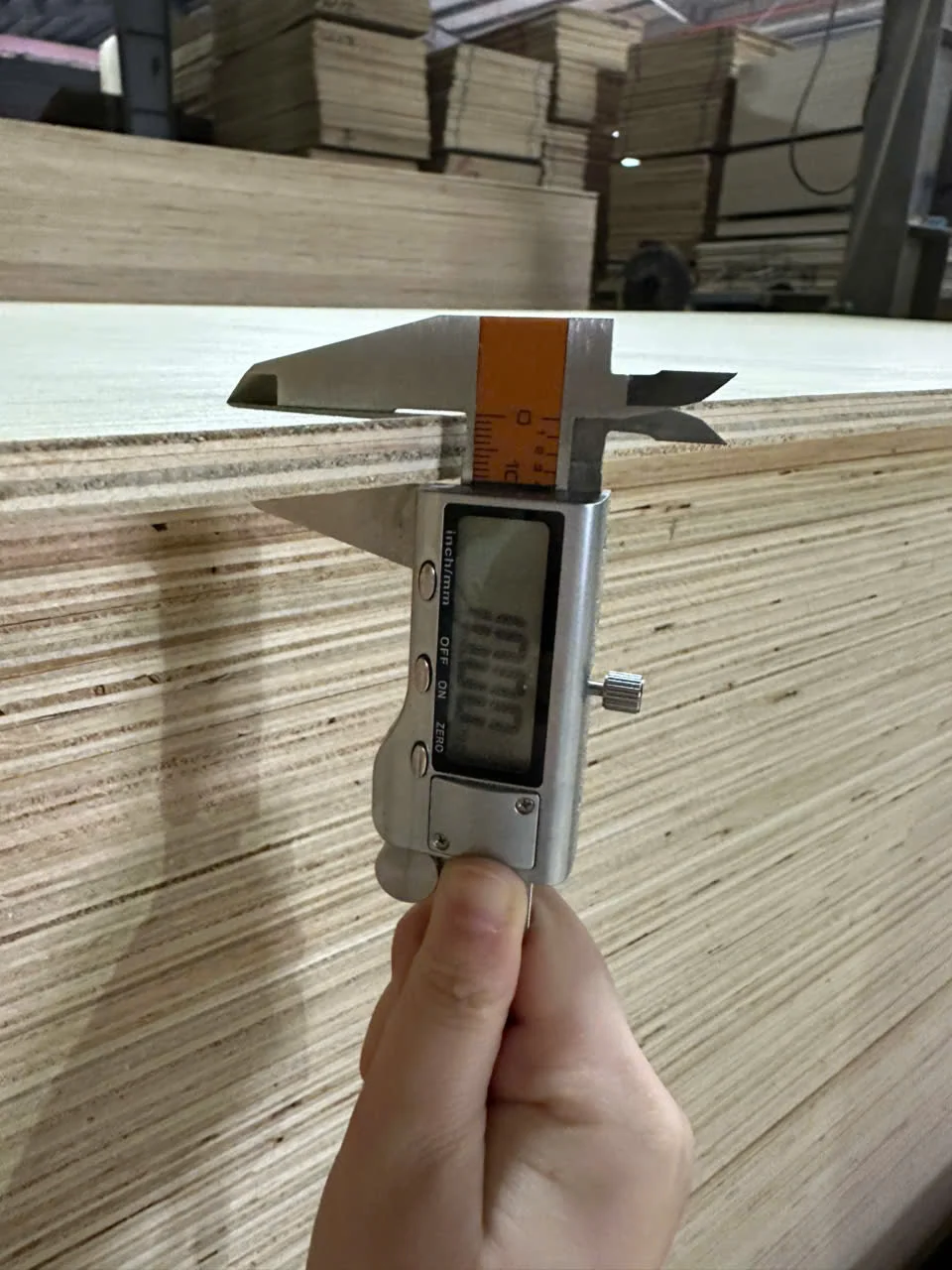
Panels are stacked in the factory warehouse for 24–72 hours post-pressing before sanding and cutting. This step allows residual press heat and steam to dissipate, stabilizing the panel. Stacking too soon after pressing is a common shortcut that causes bow and twist that doesn’t appear until the container is opened.
📌 Stage 5: Humidity-Controlled Packaging
Final pallets are wrapped with stretch film and edge-sealed before container loading. High-volume export orders to Japan and Korea often include desiccant packets inside pallet wrapping to absorb any transit moisture absorption. This is especially relevant for 20–35-day ocean voyages through humid tropical routes.
Get a Free Quote with Moisture Documentation
📋 Moisture Testing Methods in Vietnam Plywood Production
Three testing methods are used in sequence across the production process. Each serves a different purpose.
⚙️ Method 1: Electrical Resistance Meter (Spot Check)
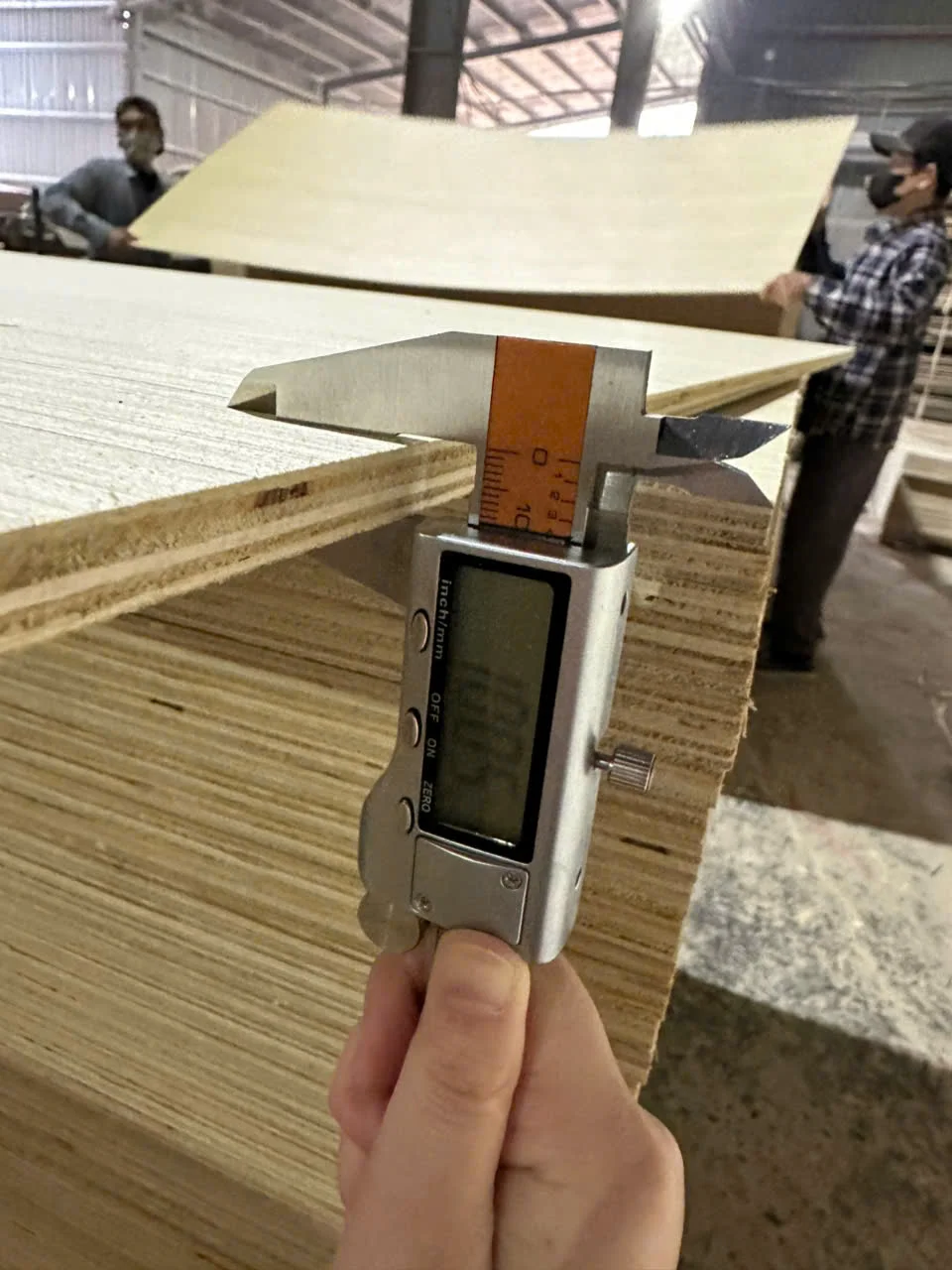
A handheld resistance meter drives two pins into the panel surface and measures electrical resistance — which correlates to moisture content. Fast and non-destructive, this method is used for:
- Random spot checks across every production lot (10–15 panels per 200-sheet lot)
- Incoming veneer QC at kiln exit
- Pre-loading verification on finished pallets
Accuracy: ±1–2% across the 6–20% range. Pins read surface moisture — results must be adjusted if checking through film-faced or lacquered panels.
⚙️ Method 2: Capacitive (Dielectric) Meter
Capacitive meters use electromagnetic fields rather than pin penetration — measuring without surface damage. Used for high-volume batch screening where resistance pin marks would affect surface grade. Common on Japanese and Korean buyer inspection lines.
Accuracy: ±1–1.5% in the 5–20% range. Less affected by surface coatings than resistance meters.
Method 3: Oven-Dry Method (ASTM D4442)
The primary standard test per ASTM D4442 (Standard Test Methods for Direct Moisture Content Measurement of Wood and Wood-Based Materials, Intertek/ASTM). Procedure:
- Cut specimen to known dimensions (~100×100mm)
- Weigh to record initial mass (M₁)
- Place in oven at 103°C (±2°C)
- Weigh every 3 hours until mass change is ≤0.1% over a 3-hour interval (M₂)
- Moisture Content (%) = ((M₁ − M₂) ÷ M₂) × 100
This method defines the reference standard. Resistance and capacitive meters are calibrated against oven-dry results for each species. HCPLY’s QC lab runs oven-dry tests on every production batch — results are attached to the shipping documentation.
💡 Tip: When requesting QC documentation from any Vietnam plywood supplier, specify “oven-dry moisture test certificate per ASTM D4442 or EN 322.” This eliminates ambiguity between methods and confirms you receive an actionable, comparable reading.
📦 What Happens When Moisture Content Is Wrong
Incorrect plywood moisture content creates problems that typically appear 2–12 weeks after delivery — long after the payment is settled and the dispute window has narrowed.
High Moisture (Above 14%)
Transit warping: Panels stored in a 40HC container crossing the Indian Ocean can experience 70–90% relative humidity for 20–30 days. Panels already at 13–14% absorb additional moisture and bow — especially 3–6mm furniture panels where the face-to-core moisture gradient is uneven.
Delamination: Excess moisture during pressing prevents complete melamine cure. The glue line looks intact at pressing — it fails in service when the panel is loaded or exposed to humidity cycling. This is the most common insurance claim category for Vietnam plywood shipments to humid destinations.
Mold growth: Panels above 18% moisture in tropical-climate storage (India, Philippines, West Africa) can develop surface mold within 2–3 weeks. Mold does not indicate structural failure, but it triggers buyer rejection and customs hold.
Port rejection: Several import markets — Japan most strictly — test moisture on arrival. Panels above 14% may be refused entry, requiring re-conditioning in a bonded warehouse at buyer’s cost.
Low Moisture (Below 5%)
Over-dried panels occur when kilns run too aggressively (common shortcut to increase throughput). Effects:
- Edge cracking: Face veneer splits at edges and corners during transport vibration
- Post-installation gap opening: Panels absorb ambient moisture after installation, expanding and separating joints that were measured to zero tolerance
- Brittle surface failure: Sanded surfaces crack or splinter when cut or nailed
A 2022 analysis of Vietnam plywood buyer complaints reviewed by third-party inspection firm SGS (SGS Plywood Inspection Reports, 2022) identified moisture-related defects as responsible for 34% of all quality claims — ranking above surface grade defects (28%) and thickness tolerance failures (19%).
🔍 How Buyers Can Verify Moisture Compliance
Buyers importing from Vietnam have four practical verification options. The level of verification should match the order value and destination market sensitivity.
-
Request factory moisture log with shipment documentation. Premium suppliers attach batch moisture records — oven-dry test certificates from QC lab — to the commercial invoice pack. If a supplier cannot produce these records, that is a direct indicator of QC system maturity.
-
Third-party pre-shipment inspection. Hire SGS, Bureau Veritas, or a local Vietnam inspection agency. Inspectors bring calibrated meters, conduct random sampling per AQL standards, and cross-reference resistance readings with reference oven-dry tests. HCPLY welcomes third-party inspection — inspectors have full factory access. The plywood quality control page explains the on-site QC process in detail.
-
On-arrival spot check. A calibrated resistance meter costs $150–$400. For orders above 2 containers, the tool pays for itself on the first disputed shipment. Check 20+ panels per container at multiple locations — center, edge, and corner.
-
Specify moisture tolerance in the purchase contract. Write explicitly: “Final panel moisture content: 6–10% measured per ASTM D4442 or EN 322. Non-conforming panels: buyer reserves right to reject.” This creates an enforceable baseline and signals to the supplier that you will check.
“Moisture control is invisible to the eye but visible in performance. Always request and verify moisture test reports.” — David, Export Project Leader, HCPLY
💹 Moisture Control Costs and Market Implications
Proper moisture control adds cost — primarily from kiln time, conditioning space, and QC labor. The realistic premium for documented moisture-controlled panels over commodity-grade product is 2–5% FOB price increase.
That cost needs to be weighed against:
- Rejection costs: demurrage at destination port runs $150–$400/day. A 7-day hold = $1,000–$2,800 per container before re-inspection fees.
- Insurance claims: most marine cargo policies cover goods “in good order” — moisture-damaged panels from documented improper packing may not be covered.
- Buyer confidence: Japanese and Korean buyers in particular pay a 5–8% price premium to suppliers with documented QC systems. The plywood certifications guide covers the full documentation scope including ISO 9001, FSC, and CE certification.
For furniture-grade orders to EU, Japan, and Korea, moisture documentation is not optional — it is a prerequisite for repeat business. For commercial orders to price-sensitive markets like India and Southeast Asia, buyers routinely accept ≤12% with basic resistance meter documentation.
The plywood quotation guide explains how moisture specification (along with glue type, core species, and sanding) affects FOB pricing from Vietnam factories.
✅ Summary: What to Specify and What to Check
Vietnam plywood moisture content management is a supply chain discipline, not a one-time test. Understanding vietnam plywood moisture specifications before you write your purchase order prevents the costly disputes that arrive with your shipment. The core principles:
Specify clearly: Write 6–10% (furniture) or 8–12% (construction/commercial) into your purchase order. Reference ASTM D4442 or EN 322 as the test method. Ambiguous specs invite ambiguous compliance.
Match grade to destination climate: Interior furniture for Japan or Korea requires tighter control (6–9%) than packing plywood for industrial use in tropical markets (≤15%). Your spec should reflect your destination, not a generic number.
Verify before loading, not after arrival: Pre-shipment inspection costs $300–$600 per container inspection. Port rejection costs $5,000–$20,000+ in demurrage, re-inspection, and potential disposal. The math favors verification.
Choose suppliers with documented QC systems: ISO 9001 certification (held by HCPLY) requires documented control of production parameters — moisture records are part of that system. Factories without ISO 9001 may control moisture adequately, but cannot produce auditable records.
Request Moisture-Certified Plywood from HCPLY — HCPLY provides oven-dry moisture certificates with every commercial shipment. Specifications, documentation, and sample availability on request.
Disclosure: This article is published by HCPLY, a Vietnam-based plywood manufacturer and export operator. While we aim to provide objective industry guidance, readers should consider our perspective as a market participant when evaluating recommendations.