


The plywood manufacturing process is a 10-stage transformation of raw logs into precision-engineered panels — and every stage either adds quality or introduces defects that no downstream fix can remove. Most buyers never see beyond the finished panel. They evaluate thickness, surface appearance, and price. But the manufacturing process that produced that panel — from the moment a log enters the factory yard to the moment a container door closes at port — determines everything: bonding strength, dimensional stability, moisture behavior, formaldehyde emission, and service life in the final application.
This is a factory-level guide to the plywood manufacturing process as executed in Vietnamese plywood production facilities. All technical parameters — temperatures, pressures, moisture targets, tolerances — come from direct production data at facilities managed by HCPLY in Phu Tho Province, Northern Vietnam. This is not theory. This is how plywood is made in a real factory producing 200+ export containers per month.
⚠️ Important: All specifications in this article are sourced from factory production data and verified reference documentation. We do not fabricate technical parameters. Where process parameters vary by glue type, core species, or factory segment, those variations are stated explicitly.
🪵 Stage 1 — Log Sorting and Species Selection
The plywood manufacturing process begins in the log yard — not at the lathe. Every panel starts as a round log, and the species, diameter, and condition of that log determines what the factory can produce from it.
📌 Species Selection: Core vs Face
Vietnamese plywood factories work with two categories of logs:
Core logs — the structural interior of the panel:
- Acacia — ~580 kg/m³ density, darkest color, lowest cost, most widely available plantation species in Vietnam
- Eucalyptus — 650-750 kg/m³, heaviest and strongest, pale yellowish color, premium applications
- Styrax — 480-500 kg/m³, lightest, white color, premium furniture grade, available only in Northern Vietnam
These are the only three core species produced in Vietnam. Claims of gurjan core, birch core, or hopea core from Vietnamese factories are technically incorrect — these species are face veneers, not core materials in Vietnam’s production system.
Face veneer logs are either peeled from the same species (eucalyptus face from eucalyptus logs) or sourced as imported sliced/peeled veneer (birch, okoume, gurjan). Face veneer thickness in Vietnam ranges from 0.2-0.4mm for standard production, with a full production range of 0.16-1.0mm.
Diameter Grading
Log diameter directly determines veneer quality. Larger-diameter logs produce wider, cleaner veneer sheets with fewer joints required during lay-up. The factory sorts incoming logs by:
- Diameter — minimum 15-20cm for core veneer, larger preferred
- Straightness — curved logs waste material and produce uneven veneer
- Defects — knots, rot, insect damage, bark inclusions
- Moisture condition — freshly harvested logs peel better than air-dried logs
Logs that fail diameter or defect standards are diverted to lower grades or rejected entirely. This first sorting step is where factory discipline separates premium and commercial operations.
Debarking and Preparation
After sorting, logs pass through a debarking machine that removes bark, dirt, and surface irregularities. Clean debarked logs reduce lathe blade wear and prevent bark contamination in veneer sheets.
♨️ Stage 2 — Log Steaming and Soaking
Raw logs are too rigid to peel cleanly. The wood fibers must be softened before the rotary lathe can produce smooth, consistent veneer. Vietnamese factories use two softening methods:
Steam vats — logs are loaded into enclosed chambers and steamed at 60-80°C for 12-48 hours depending on species and diameter. Steaming softens the wood fibers, reduces peeling resistance, and produces smoother veneer surfaces.
Soaking ponds — logs are submerged in hot water (50-70°C) for 24-72 hours. This method is simpler and more common in smaller factories, but requires more yard space.
| Species | Softening Method | Duration | Notes |
|---|---|---|---|
| Acacia | Steam or soak | 12-24h | Softens readily, faster than eucalyptus |
| Eucalyptus | Steam preferred | 24-48h | Dense wood requires longer softening |
| Styrax | Soak or steam | 12-24h | Lightweight, softens quickly |
The softening time is critical. Under-softened logs tear during peeling, producing rough veneer with surface checks (tiny cracks running along the grain). Over-softened logs become too flexible, producing wavy, dimensionally unstable veneer. Factory operators adjust softening duration based on ambient temperature, log diameter, and species — this is experience-based knowledge that cannot be standardized into a single formula.
🔄 Stage 3 — Rotary Veneer Peeling
This is the core of the plywood manufacturing process. A softened log is mounted on a rotary lathe and spun against a fixed blade that peels a continuous sheet of veneer — like unrolling a roll of paper towel.
How Rotary Peeling Works
The log is centered on the lathe spindle (which grips both ends) and rotated at controlled speed. A pressure bar compresses the wood fibers just ahead of the cutting blade, preventing the veneer from splitting as it separates from the log. The blade angle, pressure bar gap, and rotation speed are the three parameters that determine veneer quality.
Veneer Thickness Control
The blade-to-spindle distance determines veneer thickness:
| Veneer Type | Thickness Range | Purpose |
|---|---|---|
| Face veneer | 0.2-0.4mm (standard VN) | Panel surface — appearance grade |
| Core veneer | 1.2-2.0mm | Structural interior plies |
| Thick core | 2.0-3.0mm | Specialty or lower-ply-count panels |
Thinner face veneer requires more precise lathe settings, sharper blades, and better-softened logs. This is why premium factories producing birch plywood or gurjan plywood invest in high-precision lathes — the face veneer determines the product’s market value.
Lathe Settings by Species
Each wood species responds differently to the peeling blade:
- Acacia — medium hardness, peels cleanly at moderate speed, most forgiving species for lathe operators
- Eucalyptus — harder, denser wood requires slower rotation speed and sharper blade angles to avoid tearing. Produces the strongest core veneer
- Styrax — softest of the three, peels at fastest speed, produces the lightest and whitest veneer sheets. Preferred by premium furniture factories for its birch-like appearance
After peeling, the continuous veneer ribbon is clipped into standard widths (typically matching the target panel width of 1220mm or 1250mm) and stacked for drying.
Peeler Core Waste
The lathe cannot peel a log down to zero diameter. A cylindrical peeler core remains — typically 8-12cm diameter — which is diverted to wood chip processing, biomass energy, or low-grade pallet production. Larger log diameters produce proportionally less waste relative to usable veneer output.
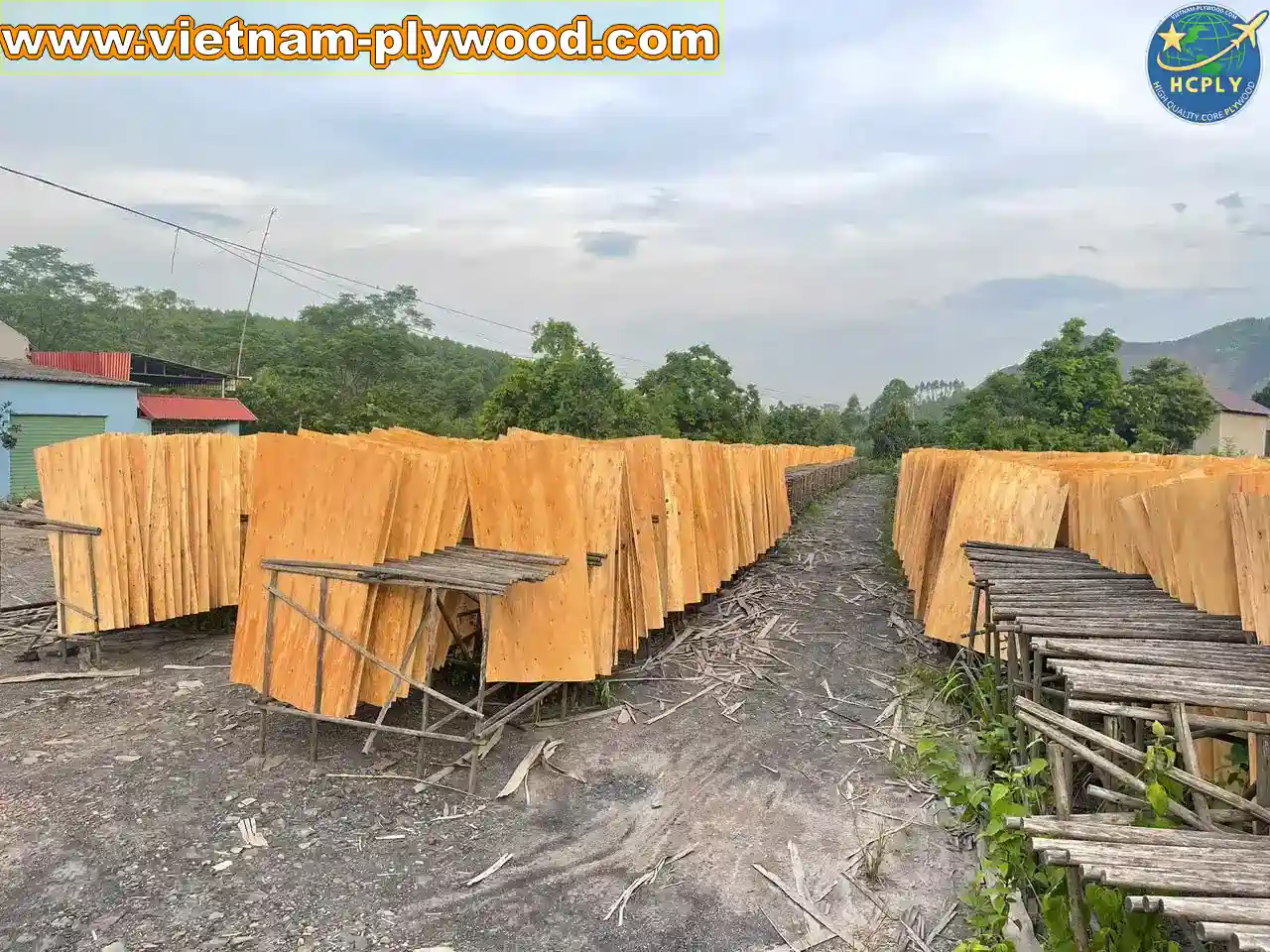
🌡️ Stage 4 — Veneer Drying
Freshly peeled veneer contains 40-80% moisture content — far too wet for gluing. The drying stage reduces moisture to a target range that allows proper glue adhesion without causing defects during hot pressing.
Target Moisture Content
| Veneer Type | Target MC | Reason |
|---|---|---|
| Core veneer | 8-12% | Allows proper glue penetration without excess moisture |
| Face veneer | 6-10% | Thinner sheets need slightly lower MC for smooth pressing |
Drying Equipment
Vietnamese plywood factories use roller dryers (also called continuous-feed dryers) for core veneer — veneer sheets travel on a conveyor through a heated chamber at controlled speed. Larger factories use multi-deck roller dryers that process multiple veneer layers simultaneously.
Drying parameters:
- Temperature: 120-180°C (air temperature inside the dryer)
- Feed speed: adjusted by operator based on veneer thickness and initial moisture
- Passes: 1-3 passes through the dryer depending on species and starting MC
Why Drying Matters
Veneer that is too wet (above 14% MC) causes steam blisters during hot pressing. Trapped water converts to steam under press temperature and pressure, creating visible bubbles between plies that weaken the bond and are impossible to repair.
Veneer that is too dry (below 5% MC) absorbs excessive glue, increasing adhesive consumption cost by 15-25% and creating brittle bond lines that crack under stress.
The drying stage is where factory operating cost directly translates to panel quality. Running the dryer faster saves energy and increases throughput — but produces unevenly dried veneer with hot and cold moisture spots that cause pressing defects downstream. Premium factories that produce furniture-grade eucalyptus plywood run dryers slower with tighter moisture control.
After drying, veneer is sorted by moisture content using handheld moisture meters. Sheets that fall outside the target range are either re-dried or set aside for less critical applications.
🧪 Stage 5 — Glue Spreading
Dried veneer is coated with adhesive before assembly. The glue type, formulation, and application rate directly determine the panel’s water resistance and formaldehyde emission class. For a detailed explanation of glue types vs emission standards, see our plywood glue types and emission standards guide.
Two Glue Systems
| Property | Melamine (MR) | Phenolic (WBP) |
|---|---|---|
| Water resistance | 12-hour boiling test | 72-hour boiling test |
| Press temperature | 110-135°C | 135-145°C |
| Color | White/clear (does not stain wood) | Dark brown (visible glue line) |
| Application | Furniture, interior, cabinet | Construction, marine, film-faced formwork |
| Emission options | E0, E1, E2 available | E1, E2 typical (E0 available at premium) |
⚠️ Note: Glue type (MR vs WBP) and emission class (E0/E1/E2) are two separate specifications. MR is not “E0 glue.” WBP is not automatically “E1.” These are independent variables. The same MR glue can produce E0, E1, or E2 panels depending on the resin formulation.
Application Rate
Glue is applied using a roller spreader machine — veneer passes between two rollers coated with adhesive. The application rate is measured in grams per square meter (gsm):
| Method | Application Rate | Usage |
|---|---|---|
| Single spread | 150-200 gsm on one face | Thinner panels, cost-sensitive production |
| Double spread | 120-160 gsm per face | Standard production — both faces of core veneer coated |
The roller gap determines coating thickness. Too much glue wastes adhesive, increases emission levels, and creates squeeze-out that stains panel edges. Too little glue produces starved bond lines — areas where insufficient adhesive coverage leads to delamination.
Premium factories calibrate glue spreaders daily and verify application weight by weighing sample veneer sheets before and after coating. This level of process control is the difference between a factory that consistently produces E0-grade plywood and one that occasionally fails emission testing.
📐 Stage 6 — Assembly and Lay-Up
This is where individual veneer sheets become a plywood panel. The assembly stage (called “lay-up” in factory terminology) arranges dried, glue-coated veneer into a stack following two non-negotiable rules.
Rule 1: Odd Number of Plies
Plywood panels always have an odd number of plies — 3, 5, 7, 9, 11, or 13 plies depending on thickness. This creates a symmetrical panel with a center ply flanked by equal numbers of plies on each side.
| Panel Thickness | Typical Ply Count | Core Veneer Thickness |
|---|---|---|
| 3-5mm | 3 plies | 1.2-1.5mm |
| 6-9mm | 5 plies | 1.2-1.5mm |
| 12-15mm | 7-9 plies | 1.5-1.8mm |
| 18-21mm | 9-11 plies | 1.5-2.0mm |
| 25-30mm | 11-13 plies | 1.5-2.0mm |
Rule 2: Cross-Grain Orientation
Every adjacent ply has its grain direction perpendicular to the ply below it. This cross-grain construction is what distinguishes plywood from solid wood or laminated veneer lumber (LVL). It provides:
- Equal strength in both length and width directions
- Resistance to splitting along the grain
- Dimensional stability (expansion/contraction balanced in all directions)
- Resistance to warping and cupping
Core Construction Methods
The method used to form each core ply from individual veneer strips has a major impact on panel quality:
| Method | Quality Level | Description | Typical Segment |
|---|---|---|---|
| Full stitched | Highest | Veneer strips sewn together with thread — zero gap, zero overlap | Premium furniture (Segment A factories) |
| Stitched outer + edge-trimmed inner | High | Outer plies stitched, inner plies edge-jointed | Mid-premium |
| Edge-jointed | Medium | Strips butted edge-to-edge and trimmed | Commercial |
| Loose-laid | Lowest | Strips placed side by side with small gaps | Packing, budget |
Full-stitched construction produces panels with consistent thickness across the entire sheet face. Loose-laid construction allows gaps between veneer strips that create localized thickness variations and weak bonding zones. This is not a cosmetic difference — it directly affects screw-holding strength, surface flatness after sanding, and lamination bond quality.
Balanced Construction
The lay-up must be balanced — the veneer species, thickness, and grain direction should be symmetrical from center outward. An unbalanced panel (different species on front and back, for example) will warp as the two faces respond differently to humidity changes. Professional factories use identical veneer thickness and species for corresponding plies on each side of the center ply.
🔥 Stage 7 — Cold Pre-Press and Hot Pressing
Cold Pre-Press
Before entering the hot press, assembled panel stacks go through a cold pre-press — a room-temperature press that applies moderate pressure (3-5 kg/cm²) for 10-20 minutes. The purpose is not to cure the glue, but to:
- Eliminate air pockets trapped between plies
- Ensure full veneer-to-veneer contact across the panel face
- Compress the lay-up to a uniform preliminary thickness
- Allow the glue to begin tack-bonding so plies do not shift during transfer to the hot press
Factories that skip cold pre-pressing have higher rates of edge delamination and air bubble defects.
Hot Pressing: Where Bonding Happens
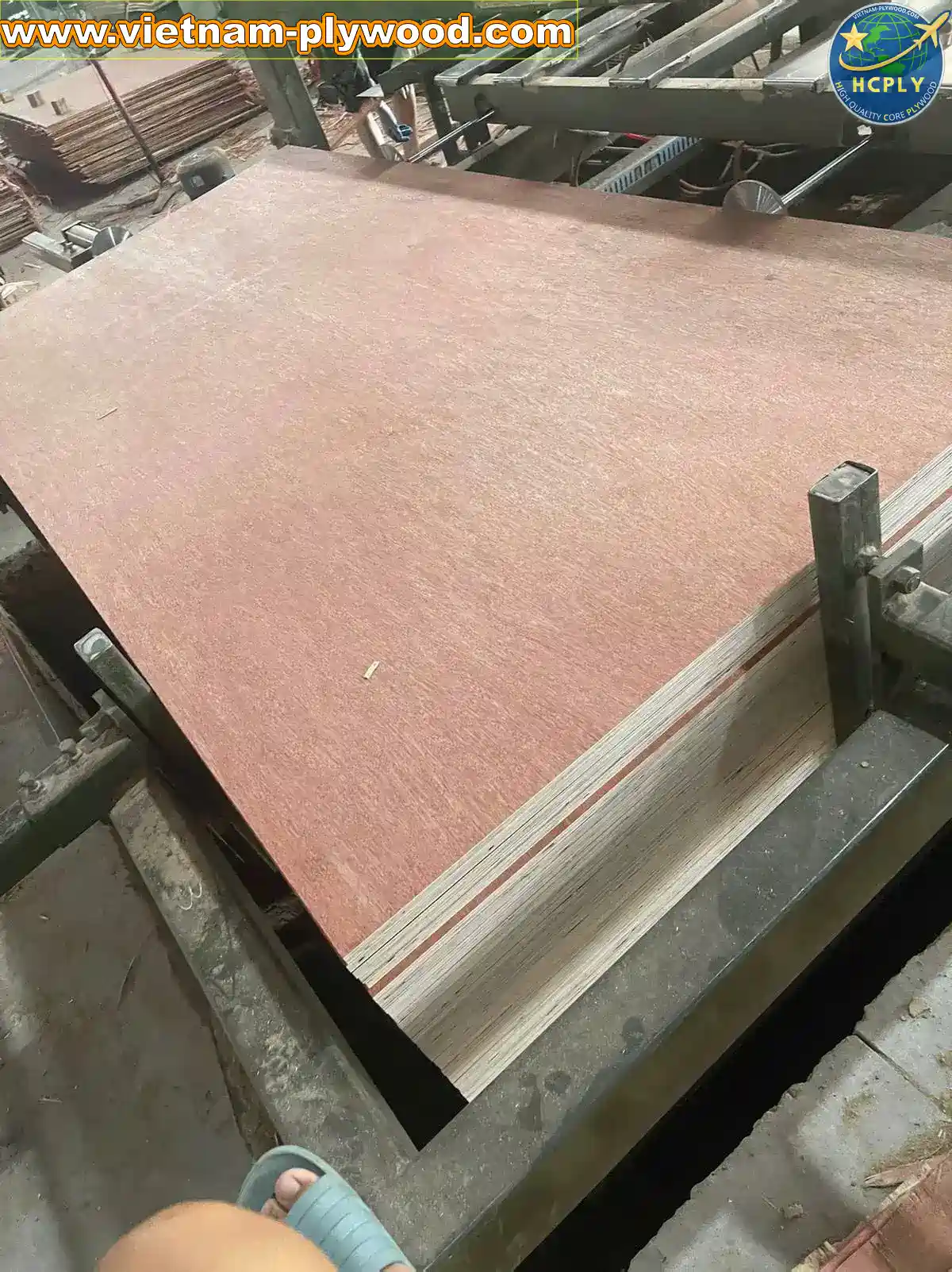
The hot press is the single most critical machine in a plywood factory. Multi-daylight hot presses (10-20 openings) allow pressing 10-20 panels simultaneously, with each panel between two heated steel platens.
Press Parameters by Glue Type
| Parameter | Melamine (MR) | Phenolic (WBP) |
|---|---|---|
| Temperature | 110-135°C | 135-145°C |
| Pressure | 8-12 kg/cm² | 8-12 kg/cm² |
| Time (rule of thumb) | ~1 min per mm thickness | ~1.2-1.5 min per mm thickness |
| Example: 18mm panel | 15-20 minutes | 20-28 minutes |
Temperature must match the glue chemistry exactly. MR glue pressed at phenolic temperatures degrades — the melamine resin over-cures and becomes brittle. WBP glue pressed at melamine temperatures does not fully cure — the phenolic resin remains soft and the bond fails under the boiling water test.
Pressure ensures full veneer-to-veneer contact. Too low pressure leaves unbonded areas (visible as voids or bubbles in the finished panel). Too high pressure crushes the veneer fibers, reducing panel thickness below target and damaging face veneer surface quality.
Time allows heat to penetrate from the platen surface through outer plies to the center of the panel. Thicker panels require proportionally longer press times because heat must travel further to cure the center bond lines. Under-pressed panels may appear normal on the surface but have uncured center plies that separate under load or moisture exposure.
Why Press Parameters Vary by Factory Segment
This is the operational reality that separates Vietnam plywood factory types. A premium furniture factory running MR glue at E0 emission uses a specific resin formulation that cures optimally at 115-120°C for a precisely calculated duration. A premium film-faced factory running WBP phenolic at 140°C uses completely different resin chemistry, press timing, and cooling cycles. The equipment may look similar, but the process parameters — and the operator experience to manage them — are entirely different.
✂️ Stage 8 — Trimming and Sanding
After hot pressing, raw panels exit the press with rough edges and slight thickness variations. The trimming and sanding stage transforms pressed panels into dimensionally precise products.
Edge Trimming
A double-end trim saw cuts all four edges of the panel to the target size:
| Target Size | Trim Amount | Notes |
|---|---|---|
| 1220 x 2440mm | 5-10mm per edge | Standard 4x8 ft panel |
| 1250 x 2500mm | 5-10mm per edge | Metric European standard |
Trimming removes the outer 5-10mm where glue squeeze-out, edge gaps in core veneer, and press marks are concentrated. The factory produces oversized panels specifically so trimming removes all edge defects.
Edge trimming also produces trim waste — narrow strips of plywood scrap that are either chipped for biomass fuel or recycled into packing material.
Calibration Sanding
Wide-belt sanding machines pass the trimmed panel between precision abrasive belts that remove material from both faces simultaneously. The purpose is twofold:
Thickness calibration — achieving the target thickness within tolerance:
| Specification | Value |
|---|---|
| Standard tolerance | ±0.3mm |
| Premium furniture tolerance | ±0.2mm |
| Dimension tolerance (L/W) | ±2mm |
Surface preparation — producing a smooth, consistent surface suitable for the panel’s intended application.
Sanding by Product Type
Not all plywood is sanded. The decision depends entirely on the end application:
| Product | Sanding | Reason |
|---|---|---|
| Furniture plywood (birch, okoume, EV) | Double-side sanded | Surface quality critical for visible applications |
| Cabinet plywood | Double-side sanded | Must accept laminate, paint, or finish |
| Commercial plywood | Light single-side or unsanded | Cost optimization |
| Packing plywood | Unsanded | No surface quality requirement |
| Film-faced plywood | Unsanded | Film overlay applied directly to pressed core |
| Anti-slip plywood | Unsanded | Anti-slip film applied directly |
Wide-belt sanders use progressively finer grit — typically starting at 60-80 grit for calibration (thickness removal) and finishing at 120-180 grit for surface smoothness. Premium furniture panels may receive a final 220-grit pass for ultra-smooth face veneer.
🔍 Stage 9 — Quality Control
Quality control in the plywood manufacturing process is not a single inspection point — it is a multi-stage verification system embedded throughout the production line. At HCPLY’s production facilities, QC occurs at five distinct stages.
5-Stage QC System
Stage 1: After peeling — veneer is visually graded into face, core, and reject categories. Face-grade veneer must meet species-specific appearance standards (knot count, color uniformity, surface smoothness). Core veneer is graded for structural integrity (no splits, no excessive grain deviation).
Stage 2: After drying — moisture content is checked with pin-type and pinless moisture meters across multiple points on each veneer sheet. Sheets outside the 8-12% MC target range are flagged for re-drying or re-grading.
Stage 3: After pressing — random panels from each press load are tested for:
- Bonding test (boiling test): Panel samples are submerged in boiling water for the duration specified by the glue type (12h for MR, 72h for WBP). Any delamination = press load failure
- Thickness spot-check: Digital caliper measurement at 5 points (4 corners + center)
- Visual inspection: Surface defects, bubbles, press marks, edge delamination
Stage 4: After sanding — sanded panels are checked for:
- Thickness tolerance: ±0.3mm standard, ±0.2mm for premium furniture
- Surface quality: Sanding marks, uneven material removal, face veneer damage
- Flatness: Panel must lie flat without warping or bowing
Stage 5: Before loading — final inspection of finished panels before packing:
- Moisture content: Re-verified to ensure panels have not absorbed moisture during storage
- Visual grading: Final surface inspection under production lighting
- Thickness re-check: Random sampling from packed bundles
- Edge quality: No splits, no visible core gaps, clean trim edges
For a detailed look at HCPLY’s QC systems, visit our quality control page or browse real factory inspection photos.
Boiling Test: The Bond Line Verification
The boiling water test deserves special attention because it is the definitive test of the plywood manufacturing process. A panel that fails boiling test indicates a fundamental process failure — not just a material issue.
Common failure causes identified during boiling test:
| Failure Mode | Root Cause | Process Stage |
|---|---|---|
| Delamination at face | Insufficient glue on face veneer | Stage 5 (glue spreading) |
| Center ply separation | Under-pressed — heat did not reach center | Stage 7 (hot pressing) |
| Edge delamination | Veneer moisture too high at pressing | Stage 4 (drying) |
| Partial bond failure | Glue pot life exceeded — resin partially cured before pressing | Stage 5 (glue mixing) |
HCPLY’s QC team performs boiling tests on every press batch — not just random sampling. This 100% batch testing protocol is standard at premium factories and is one of the measurable differences between factory segments.
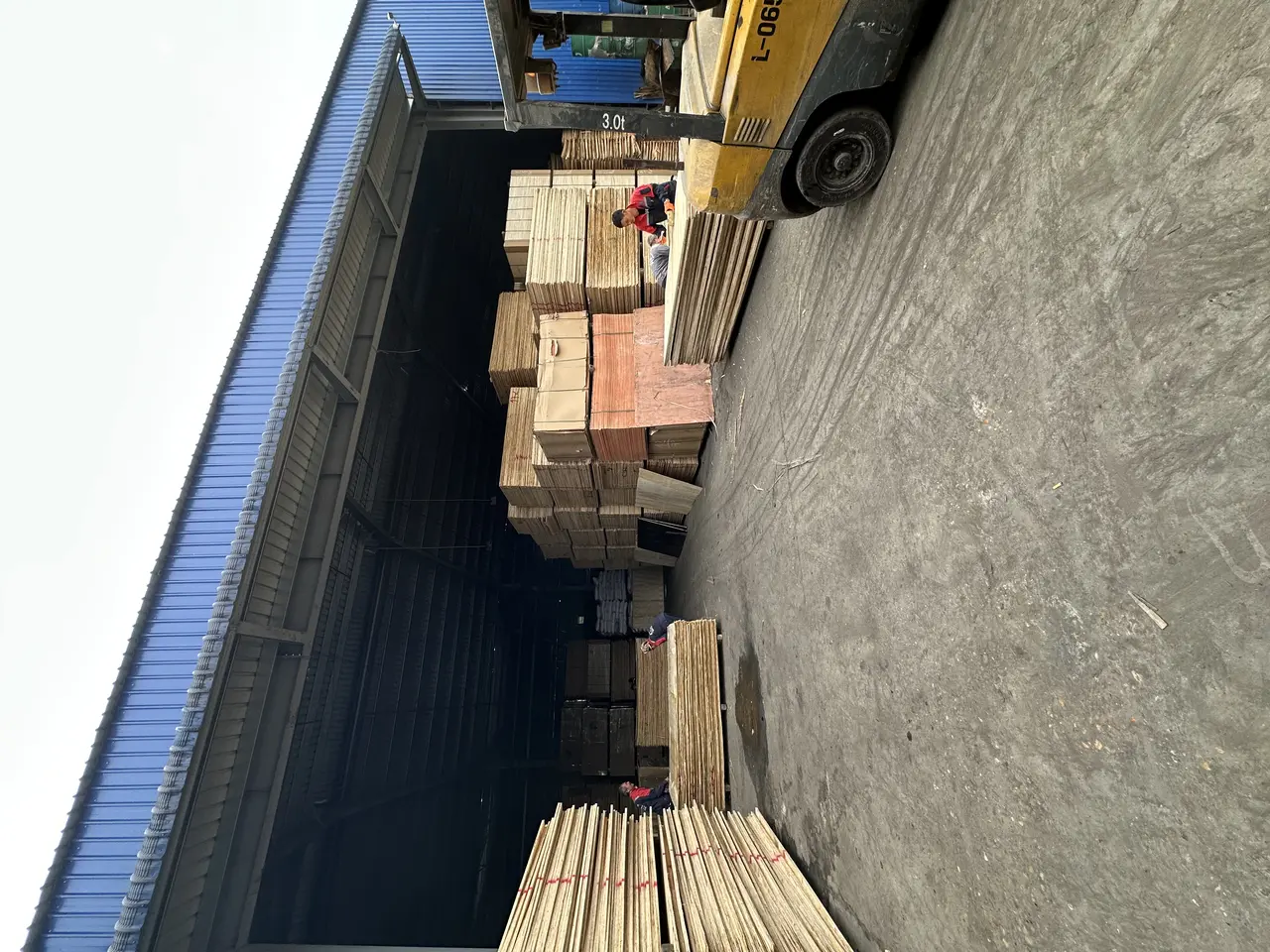
📦 Stage 10 — Packing and Container Loading
The final stage of the plywood manufacturing process prepares panels for international shipping. Packing quality directly affects whether panels arrive at their destination in the same condition they left the factory.
Pallet Assembly
Finished panels are stacked into pallets:
- Pallet height: 1000mm (forklift-safe, structurally stable)
- Sheet count per pallet: varies by thickness (e.g., 18mm = 55 sheets/pallet, 12mm = 83 sheets/pallet)
- Moisture barrier: polyethylene film wrap around each bundle
- Strapping: steel straps in a 4-point pattern with corner protectors to prevent edge damage during forklift handling
Each pallet is labeled with production batch code, thickness, grade, glue type, emission class, and sheet count.
Fumigation (ISPM-15)
All wood packaging materials (pallets, dunnage) must comply with ISPM-15 international phytosanitary standards — heat treatment or fumigation to prevent insect pest transmission between countries. Panels themselves are not fumigated (the hot pressing process already eliminates pests in the wood), but the pallet timber requires treatment. HCPLY provides a Phytosanitary/Fumigation Certificate with every shipment.
Container Loading
Container loading follows a packing plan specific to each order:
| Core Species | Pallets per 40HC | Approx. CBM | Approx. Weight |
|---|---|---|---|
| Styrax (480-500 kg/m³) | 18 | ~53 CBM | ~26.5 MT |
| Acacia (~580 kg/m³) | 16 | ~47.5 CBM | ~27.5 MT |
| Eucalyptus (650-750 kg/m³) | 15 | ~44.5 CBM | ~28 MT |
The 40HC container payload limit of 28.5 MT is the hard constraint. Eucalyptus core approaches this limit at 15 pallets — the heavier the core, the fewer pallets fit before weight (not volume) becomes the limiting factor. For detailed packing tables by thickness and core type, see our plywood container packing calculation guide.
Layout: Standard 4x4 pallet arrangement (16 pallets lying flat) for acacia core. Styrax core adds 2 additional pallets loaded vertically at the container door end (18 total). Eucalyptus core loads 15 pallets to stay within payload limits.
Export Documentation
Every HCPLY container ships with a complete documentation package:
- Commercial Invoice
- Packing List (bundle-level detail: sheet count, thickness, grade per bundle)
- Bill of Lading (B/L)
- Certificate of Origin (CO Form D for ASEAN tariff preference)
- Phytosanitary/Fumigation Certificate
- FSC Chain of Custody Certificate (on request)
- Emission test report (E0/E1 per specification)
- Insurance certificate
HCPLY provides a detailed container loading plan with pallet layout diagram, total CBM, and estimated gross weight — required for accurate customs declaration and letter-of-credit compliance at destination ports.
🏭 Factory Segments — Same Process, Different Execution
Understanding the plywood manufacturing process is incomplete without understanding that different factory segments execute the same 10 stages at vastly different quality levels. Vietnam’s plywood industry operates in four distinct factory segments — and the manufacturing process differences between them explain why two panels with the same product name can have 30-60% price differences.
Segment A: Premium Furniture Factories
- Core: Styrax or eucalyptus, full-stitched construction (all plies sewn, zero gaps)
- Glue: Melamine (MR), E0 emission standard
- Face: Sanded both sides, face veneer graded A/B
- Press: Precise temperature control (115-120°C for MR), longer press cycles
- QC: 100% batch boiling test, 5-point thickness check, moisture verification
- Certifications: FSC, CARB P2, CE, ISO 9001, EUDR
- Markets: EU, US, Japan, Korea, Australia
- Products: Birch plywood, okoume plywood, EV plywood, premium eucalyptus plywood
Segment B: Commercial / Packing Factories
- Core: Acacia, loose-laid or edge-jointed construction
- Glue: Melamine (MR), E2 or E1 emission
- Face: Bintangor C/D grade, unsanded or light sanding
- Press: Higher throughput, shorter press cycles
- QC: Sampling-based, less rigorous moisture control
- Certifications: Minimal — basic CO and fumigation
- Markets: Southeast Asia, Africa, price-sensitive segments
- Products: Bintangor plywood, packing plywood
Segment C: Premium Film-Faced Construction Factories
- Core: Eucalyptus or acacia, Grade A core veneer, may be stitched
- Glue: Phenolic (WBP), higher press temperatures (135-145°C)
- Face: AICA film or equivalent premium phenolic film, 135+ gsm
- Press: Phenolic-specific press parameters, longer cure times
- QC: 72-hour boiling test standard, film adhesion verification
- Products: Premium film-faced plywood with 15+ reuse cycles, anti-slip plywood
- Markets: EU, Korea, Japan, Australia
Segment D: Budget Film-Faced Factories
- Core: Acacia, unstitched
- Glue: Melamine with 5-15% phenolic blend, E2
- Film: Vietnamese or Chinese budget film
- Reuse: 4-8 times only (vs 15+ for Segment C)
- Markets: Southeast Asia, Africa, budget construction
⚠️ Key point: You cannot compare prices between factory segments. A 18mm film-faced plywood panel from a Segment C factory (WBP phenolic, AICA film, 15+ reuse) costs 30-40% more than the same-thickness panel from a Segment D factory (melamine blend, budget film, 4-8 reuse). The manufacturing process explains exactly why — every stage from core selection through pressing parameters is fundamentally different.
🔗 How HCPLY Manages the Manufacturing Process
HCPLY manages 3 specialized production facilities in Phu Tho Province, Northern Vietnam — the center of Vietnam’s plywood export industry. Each facility is purpose-built for a specific product segment:
-
Premium furniture facility — styrax and eucalyptus core, full-stitched construction, E0 emission, sanded faces. Produces birch, okoume, EV, gurjan, pine, poplar, and eucalyptus face plywood for EU, US, Japan, Korea, and Australian furniture markets.
-
Commercial and packing facility — acacia core, competitive pricing, high throughput. Produces bintangor, poplar, and packing-grade plywood for commercial and industrial applications.
-
Premium film-faced facility — AICA film, WBP phenolic bonding, reuse 15+ cycles. Produces film-faced formwork and anti-slip plywood for construction markets worldwide.
Why Specialization Matters
A single factory cannot optimally run both MR furniture production and WBP film-faced production. The glue chemistry, press temperatures, QC protocols, and operator expertise are different. Factories that attempt to produce across segments typically compromise on one — either the furniture panels are over-pressed (brittle bond lines) or the film-faced panels are under-pressed (failed boiling test).
HCPLY’s multi-facility model solves this by ensuring each facility runs the process parameters optimized for its product segment. One QC team oversees all three facilities, applying consistent standards while respecting the different process windows each segment requires.
On-Site QC Team
HCPLY stations a dedicated QC team at the production facilities — not at a separate office. This means QC inspectors are present during every stage of the plywood manufacturing process:
- Verifying veneer grade after peeling
- Checking moisture content after drying
- Monitoring press temperature and cycle time during hot pressing
- Measuring thickness tolerance after sanding
- Conducting boiling tests on every press batch
- Performing final inspection before packing
HCPLY provides real-time photos and video footage of QC checks, loading process, and container sealing for every shipment. Buyers receive visual confirmation that their specific order was manufactured and loaded to specification. Visit our gallery for examples of factory, QC, and container loading documentation.
📊 Process Summary Table
| Stage | Operation | Key Parameters | Common Defect if Failed |
|---|---|---|---|
| 1 | Log sorting | Species, diameter, defect grading | Wrong species, knots in face veneer |
| 2 | Steaming/soaking | 60-80°C, 12-48h by species | Rough veneer, surface checks |
| 3 | Rotary peeling | 0.2-2.0mm thickness control | Uneven veneer, excessive waste |
| 4 | Veneer drying | Target 8-12% MC | Steam blisters, weak bond lines |
| 5 | Glue spreading | 150-200 gsm, MR or WBP | Starved joints, excessive emission |
| 6 | Lay-up assembly | Odd plies, cross-grain, balanced | Warping, unequal strength |
| 7 | Hot pressing | 110-145°C, 8-12 kg/cm², 1-1.5 min/mm | Delamination, uncured center |
| 8 | Trimming/sanding | ±0.3mm tolerance | Out-of-spec thickness, rough surface |
| 9 | Quality control | 5-stage inspection, boiling test | Defective panels shipped |
| 10 | Packing/loading | ISPM-15, 28.5 MT payload limit | Transit damage, customs rejection |
✅ What Buyers Should Take Away
The plywood manufacturing process is sequential and cumulative — a defect introduced at Stage 3 (peeling) cannot be fixed at Stage 8 (sanding). Understanding this chain helps buyers ask the right questions when evaluating suppliers:
- Ask about core species and construction method — this reveals the factory segment immediately
- Ask for press parameters — temperature and time by glue type. Factories that cannot answer this question precisely are not controlling their process
- Ask for boiling test results — every serious factory conducts these tests. Reluctance to share results is a warning
- Ask about QC frequency — batch-level testing vs random sampling. The difference determines consistency
- Ask for drying records — moisture content data from the veneer dryer is a reliable indicator of factory discipline
HCPLY invites buyers to visit our production facilities in Phu Tho Province to observe the manufacturing process firsthand. Factory visits are coordinated through our export team — contact us to schedule a visit.
For more detailed guides on specific aspects of plywood production and sourcing from Vietnam: