
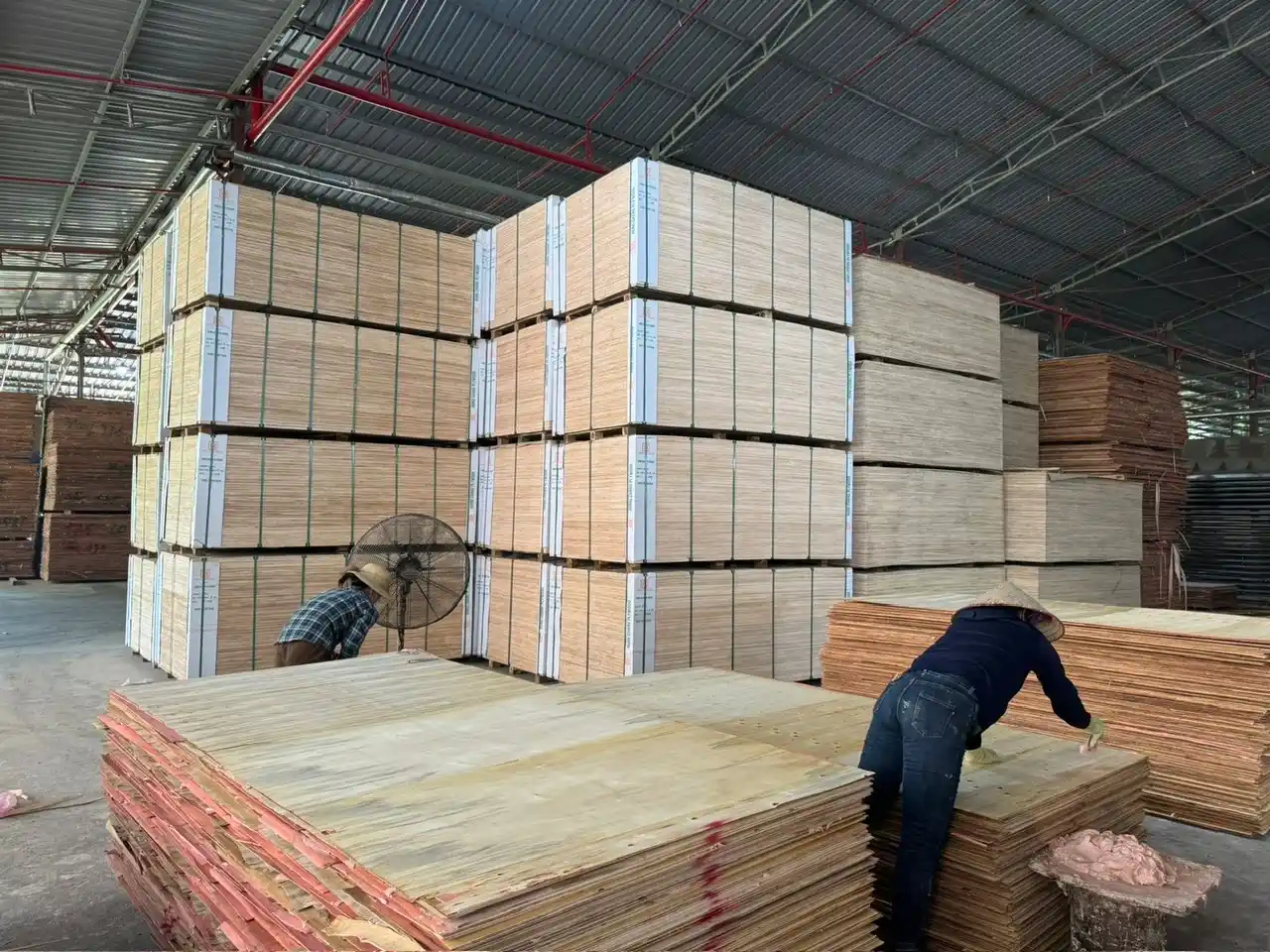
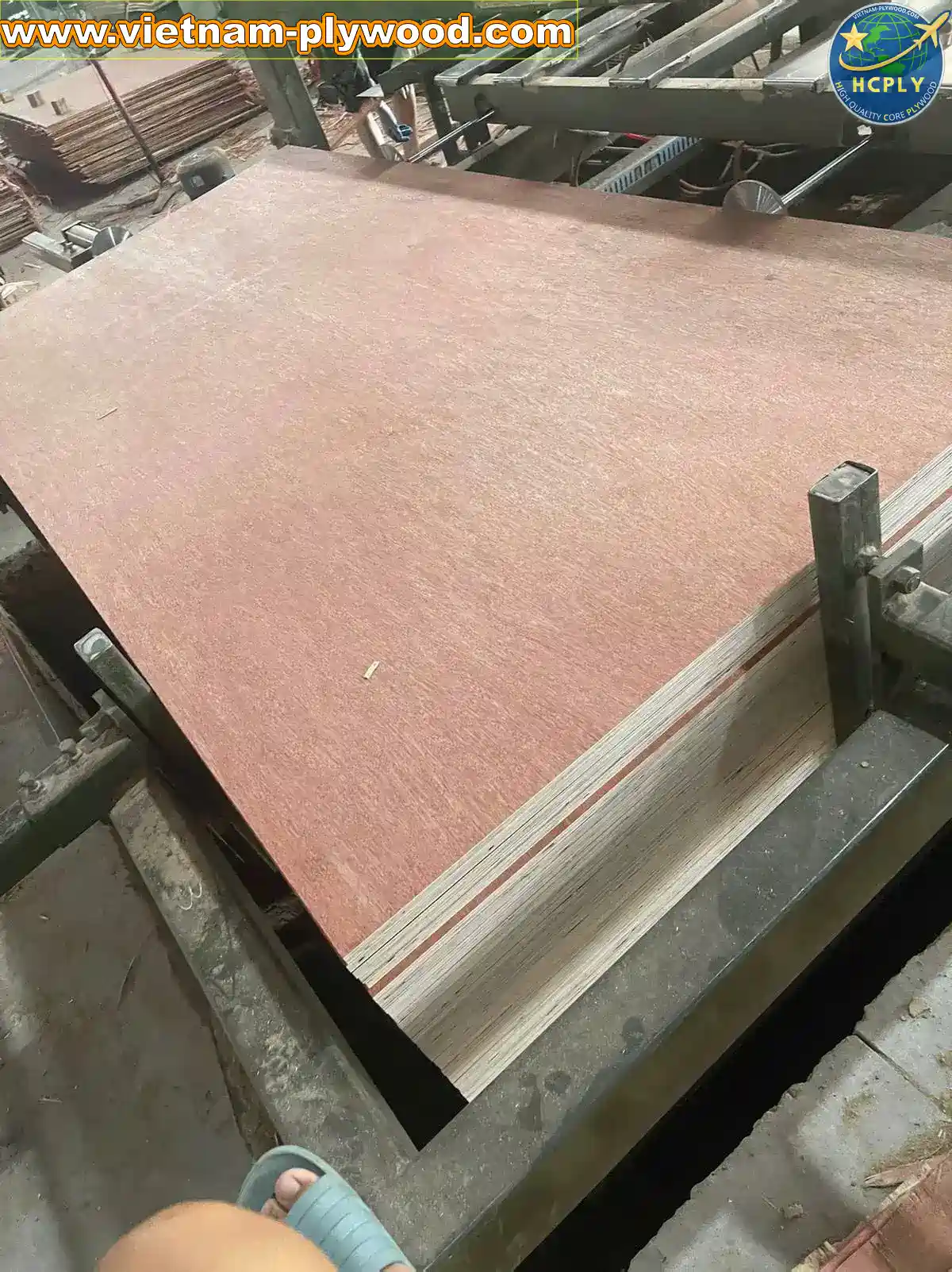
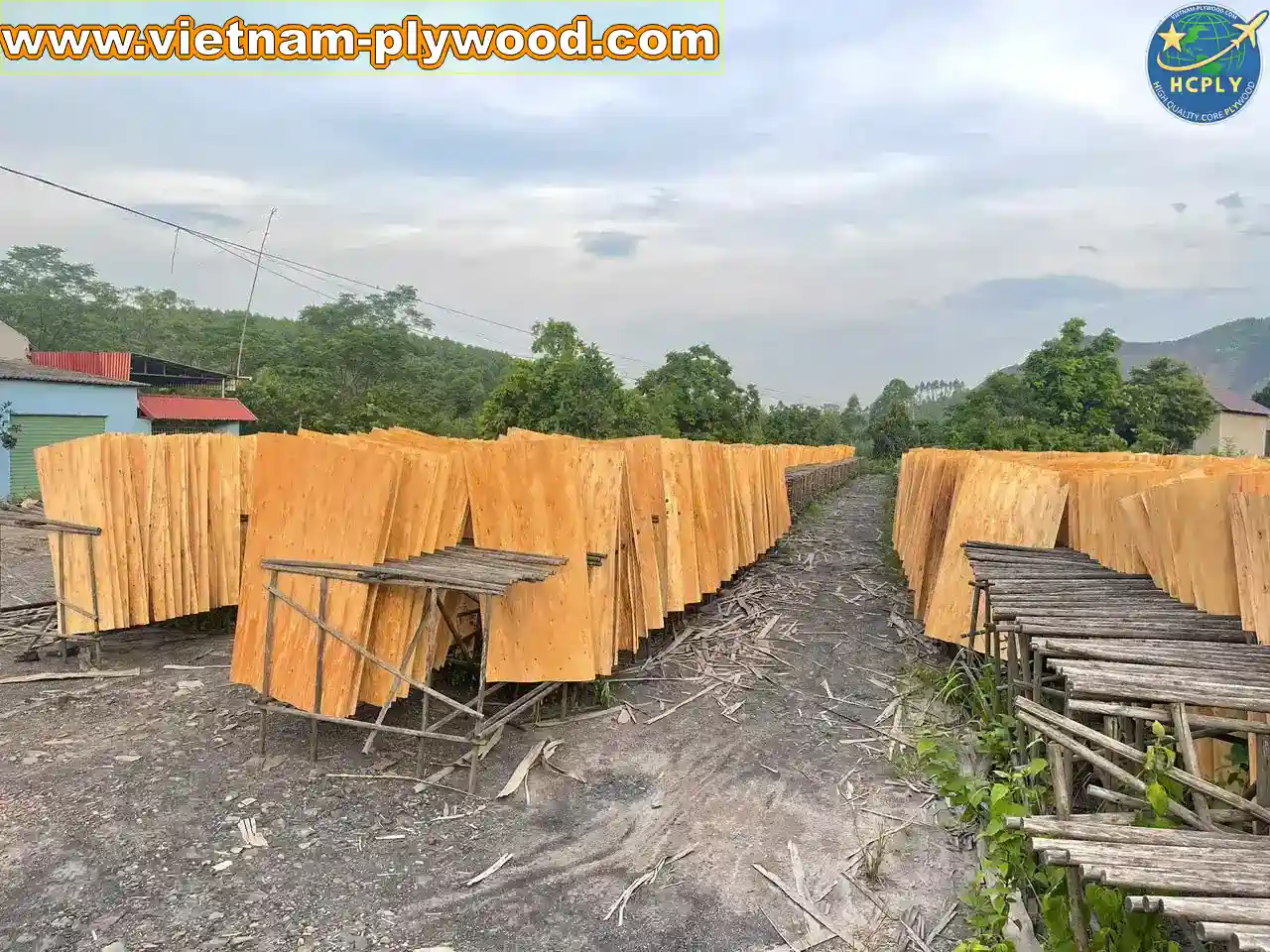

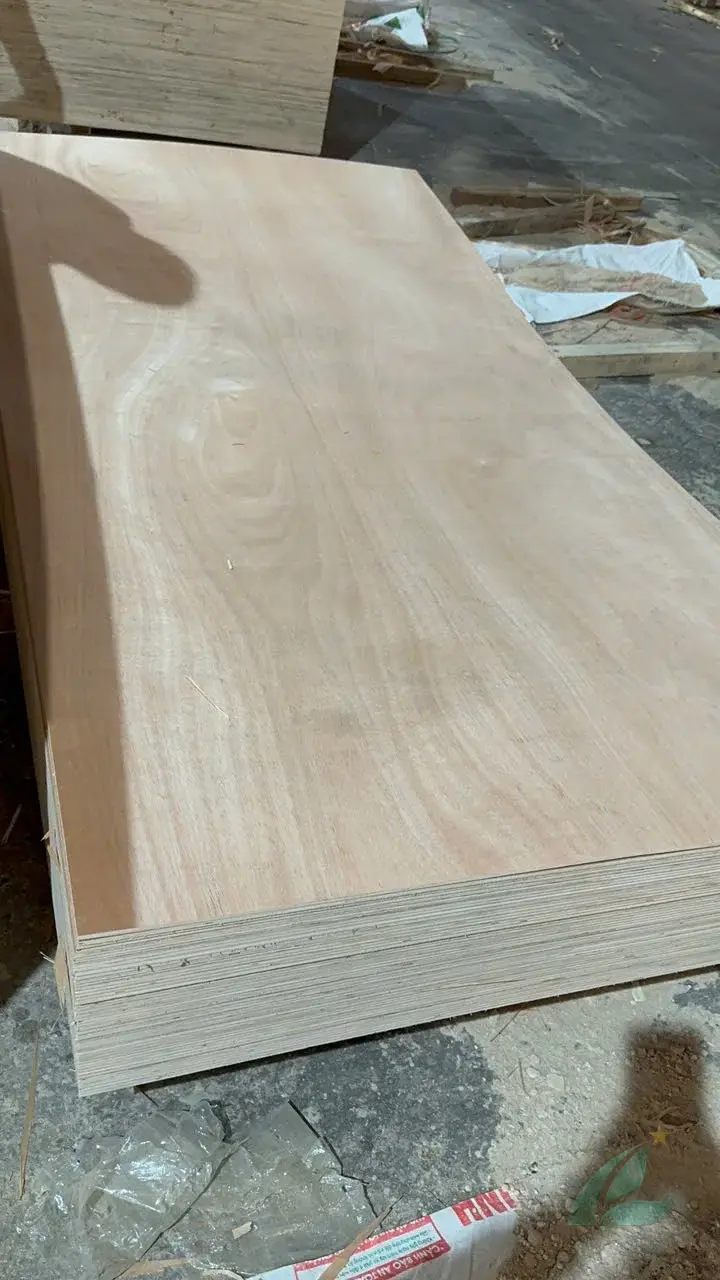
Vietnam has emerged as the primary sourcing destination for okoume face plywood used in furniture, cabinetry, and interior fitout. The country’s Northern manufacturing belt — centered in Phu Tho Province — combines African okoume face veneer with domestic plantation core species to deliver export-grade panels at factory-direct prices. As of 2026, Vietnamese okoume plywood is shipped to 20+ countries, with Europe, the Middle East, and Southeast Asia as the top three destination markets (HCPLY production data, 2026).
This guide covers what Vietnam okoume plywood manufacturers produce specifically for interior applications: material specifications, factory segmentation, certification requirements, and the evaluation criteria that separate reliable suppliers from opportunistic traders.
📋 What Is Okoume Plywood and Why Interior Use?
Okoume is a light-pink to pale-reddish tropical hardwood veneer sourced from West and Central Africa (Gabon, Cameroon, and Equatorial Guinea). When peeled into face veneer and bonded to a plantation core, it produces plywood panels with three properties ideal for interior applications:
- Smooth, consistent grain — minimal knots, repairing cleanly for paint or lacquer finishes
- Lightweight panel weight — okoume face over styrax core averages 480-500 kg/m³, reducing cabinet handling load
- Low formaldehyde compatibility — bonds well with MR melamine adhesive systems meeting E0/E1 emission standards
For interior fitout buyers, okoume represents a cost-effective middle tier. It is priced above bintangor (which shows more grain variation) and below birch (premium, graded D/E/F), making it the default choice for European and Middle Eastern furniture manufacturers who need a clean face at commercial pricing.
🏭 Vietnam Okoume Plywood Manufacturing: Factory Segments
Not all Vietnam okoume plywood manufacturers produce to the same standard. The industry divides into two segments relevant to interior buyers:
📌 Segment A: Premium Interior Furniture Manufacturers
These factories target EU, US, Korean, and Japanese markets. Their production parameters:
- Core species: Styrax (480-500 kg/m³) or eucalyptus (650-750 kg/m³) — no acacia in premium lines
- Core construction: Full stitched (both horizontal and vertical stitching across all inner layers) — no gaps, no overlaps
- Glue: Melamine (MR) standard; phenolic (WBP) available on request
- Emission: E0 standard (≤0.5 mg/L formaldehyde), CARB P2 compliant
- Sanding: Both faces, calibrated to ±0.3mm thickness tolerance
- Certifications: FSC Chain of Custody, CARB P2, CE EN13986, ISO 9001, EUDR documentation
These factories do not produce packing or commercial grade — their equipment, labor skills, and QC systems are built exclusively for furniture-grade output.
📌 Segment B: Commercial & Mixed-Grade Manufacturers
These factories serve price-sensitive markets in Southeast Asia, South Asia, and Africa. Okoume panels from this segment typically use:
- Core: Acacia (lower density, ~580 kg/m³, darker color)
- Core construction: Loose-laid or edge-jointed — acceptable for commodity uses, not furniture-grade
- Emission: E1 or E2 — not compliant for EU furniture or US market interior use
- Certifications: Minimal, often only basic export documentation
The critical point for interior-use buyers: both segments sell “okoume plywood Vietnam” on the same platforms. Price differences of 15-25% between segments reflect actual construction and emission specification differences — not margins (HCPLY production data, 2026).
⚠️ Important: Buyers sourcing for EU, US, or Korean interior markets must confirm E0/CARB P2 compliance and full stitched core construction explicitly in the purchase order. Requesting a test report from an accredited laboratory — not a factory self-declaration — is standard practice for first orders.
Understand the full Vietnam plywood supplier type overview
📊 Okoume Plywood Interior Specifications: Complete Table
| Specification | Interior Furniture Grade | Commercial Grade |
|---|---|---|
| Face veneer | Okoume A/B, 0.2-0.4mm | Okoume B/C, 0.2mm |
| Core species | Styrax or eucalyptus | Acacia |
| Core construction | Full stitched | Loose-laid / edge-jointed |
| Glue | Melamine (MR) | Melamine (MR) |
| Emission standard | E0 / CARB P2 | E1 / E2 |
| Sanding | Both faces, calibrated | Light or unsanded |
| Thickness range | 3-30mm | 4-18mm common |
| Sheet size | 1220×2440mm, 1250×2500mm | 1220×2440mm |
| Thickness tolerance | ±0.3mm | ±0.5mm |
| Certifications | FSC, CARB P2, CE, EUDR | Export docs only |
Standard interior applications: kitchen cabinets, wardrobes, bed frames, shelving, wall paneling, drawer boxes, and interior doors.
⚙️ Material Selection: Core Species for Interior Okoume Panels
The core species has more impact on panel weight and structural performance than the okoume face itself. Vietnam factories pair okoume face with:
Styrax core (480-500 kg/m³) — the preferred choice for furniture panels. Styrax is a plantation species found exclusively in Northern Vietnam. Its low density keeps finished cabinet and wardrobe panels light, reducing installation labor and hardware load. Color is white to pale — consistent with clean furniture aesthetics. An 18mm okoume/styrax panel weighs approximately 26.8 kg/sheet (1.22 × 2.44 × 0.018 × 500 = 26.8 kg for 1220×2440mm).
Eucalyptus core (650-750 kg/m³) — used when extra density and rigidity are specified. Common in heavy-duty shelving, structural interior panels, and applications where screw-holding strength matters more than weight. An 18mm okoume/eucalyptus panel weighs approximately 34.8 kg/sheet at 650 kg/m³ (1.22 × 2.44 × 0.018 × 650).
For most interior furniture applications, styrax core is the factory-recommended option. Eucalyptus core adds freight cost and is rarely necessary unless the end product requires structural load-bearing performance.
Compare all core species options from Vietnam factories
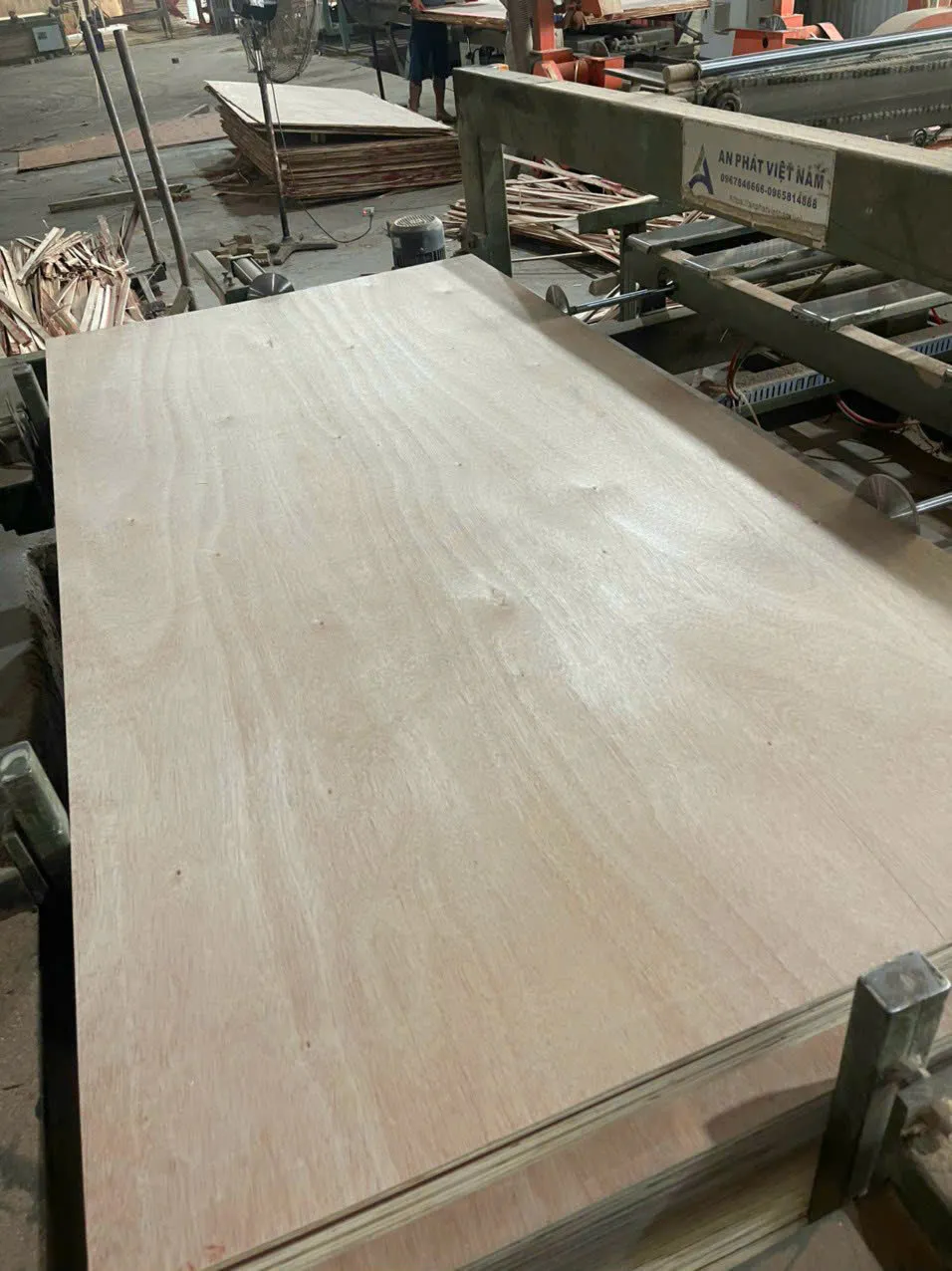
🔧 Glue & Emission: What Interior Buyers Must Specify
Glue type and emission standard are two distinct specifications — they must both appear in any purchase order for interior-use okoume plywood.
Glue type (adhesive system):
- Melamine (MR): Standard for interior use. Passes 12-hour boiling test. Adequate for indoor humidity exposure in furniture, cabinets, and fitout.
- Phenolic (WBP): For marine or exterior applications. Passes 72-hour boiling test. Not required for interior furniture.
Emission standard (formaldehyde off-gassing):
- E0 / CARB P2: ≤0.5 mg/L formaldehyde. Mandatory for US market (Lacey Act, TSCA Title VI), recommended for EU furniture, required for Japanese and Korean import.
- E1: ≤1.5 mg/L. Acceptable for most European commercial interior applications (offices, shopfitting).
- E2: ≤5.0 mg/L. Not suitable for enclosed interior spaces. Restricted in EU and US markets.
“When buyers ask for ‘E0 okoume plywood’ without specifying the adhesive, we confirm both specifications explicitly before issuing a quotation. Interior applications need MR glue with E0 emission — these are always two separate line items on our specification sheet.” — Lucy, International Sales Manager, HCPLY
Full guide to plywood glue types and emission standards
📐 Thickness Ranges and Interior Use Cases
| Thickness | Typical Interior Application |
|---|---|
| 3-5mm | Drawer bottoms, back panels, decorative wall cladding |
| 9mm | Cabinet shelf boards (light load), door panels |
| 12mm | Standard cabinet carcass, furniture back walls |
| 15mm | Cabinet doors, worktops (supported), shelving |
| 18mm | Primary carcass construction, wardrobes, bed frames |
| 25mm | Heavy-duty shelving, tabletops, structural panels |
All thickness measurements assume sanded-both-sides production with ±0.3mm tolerance. Custom thicknesses between 3mm and 30mm are available at HCPLY at MOQ of one 40HC container.
✅ Certifications for Interior-Use Okoume Plywood
Export-grade interior okoume plywood from qualified Vietnam manufacturers carries the following certifications:
FSC Chain of Custody — documents that timber (including okoume veneer sourced from Africa) passes through FSC-certified supply chains from forest to finished panel. Required by EU retailers, public procurement, and many US importers. The Forest Stewardship Council (FSC, fsc.org) maintains searchable databases of certified suppliers.
CARB P2 (California Air Resources Board Phase 2) — formaldehyde emission limit of 0.05 ppm for hardwood plywood. Mandatory for all wood composite products sold in California; effectively the national US standard under TSCA Title VI. Third-party testing by CARB-approved laboratories is required for certification.
CE EN13986 — European conformity marking for wood-based panels in construction applications. Required for panels used in commercial fit-out and structural interior applications in the European Economic Area.
EUDR (EU Deforestation Regulation) — mandatory since December 2024 for timber products entering the EU. Requires documented traceability of okoume veneer to legally harvested forest plots. Suppliers without EUDR documentation cannot legally export to EU from 2025 onward (European Commission, 2023).
ISO 9001 — factory-level quality management system certification. Indicates documented production controls, not product performance. Should be verified against the latest certification date.
💡 Tip: Request the CARB P2 test report number and verify it against the CARB database (arb.ca.gov) before placing a first order. Self-issued “CARB compliant” claims without third-party test numbers are not verifiable.
🔗 How to Evaluate Vietnam Okoume Plywood Manufacturers
A structured evaluation of okoume plywood suppliers should cover five checkpoints:
-
Factory segment confirmation — Ask which production segment (interior furniture vs commercial) the okoume line operates in. Request photos of the hot press line and sanding equipment. Premium interior factories use wide-belt sanders (1300-1600mm width) calibrated to tight tolerances.
-
Core species and construction — Request a cross-section sample or photo showing core veneer layers. Full stitched core has no visible gaps; loose-laid core shows open joints. Confirm whether styrax or eucalyptus is used — acacia in premium interior-grade panels is unusual.
-
Certification validity — Verify FSC certificate number (fsc.org search), CARB P2 test report number (arb.ca.gov), and ISO 9001 certificate expiry date. Valid certifications have current dates from accredited bodies.
-
Emission test reports — Request the most recent third-party formaldehyde emission test report. Accept only reports from accredited laboratories (listed by CARB, ILAC, or equivalent bodies). Factory self-tests are not sufficient for US or EU import.
-
Lead time and MOQ — Vietnam interior-grade factories typically quote 15-20 days production lead time for full 40HC orders. MOQ is one 40HC container for standard specifications. Mixed specs within a container are accepted but require weight recalculation.
Request a factory-direct quotation from HCPLY
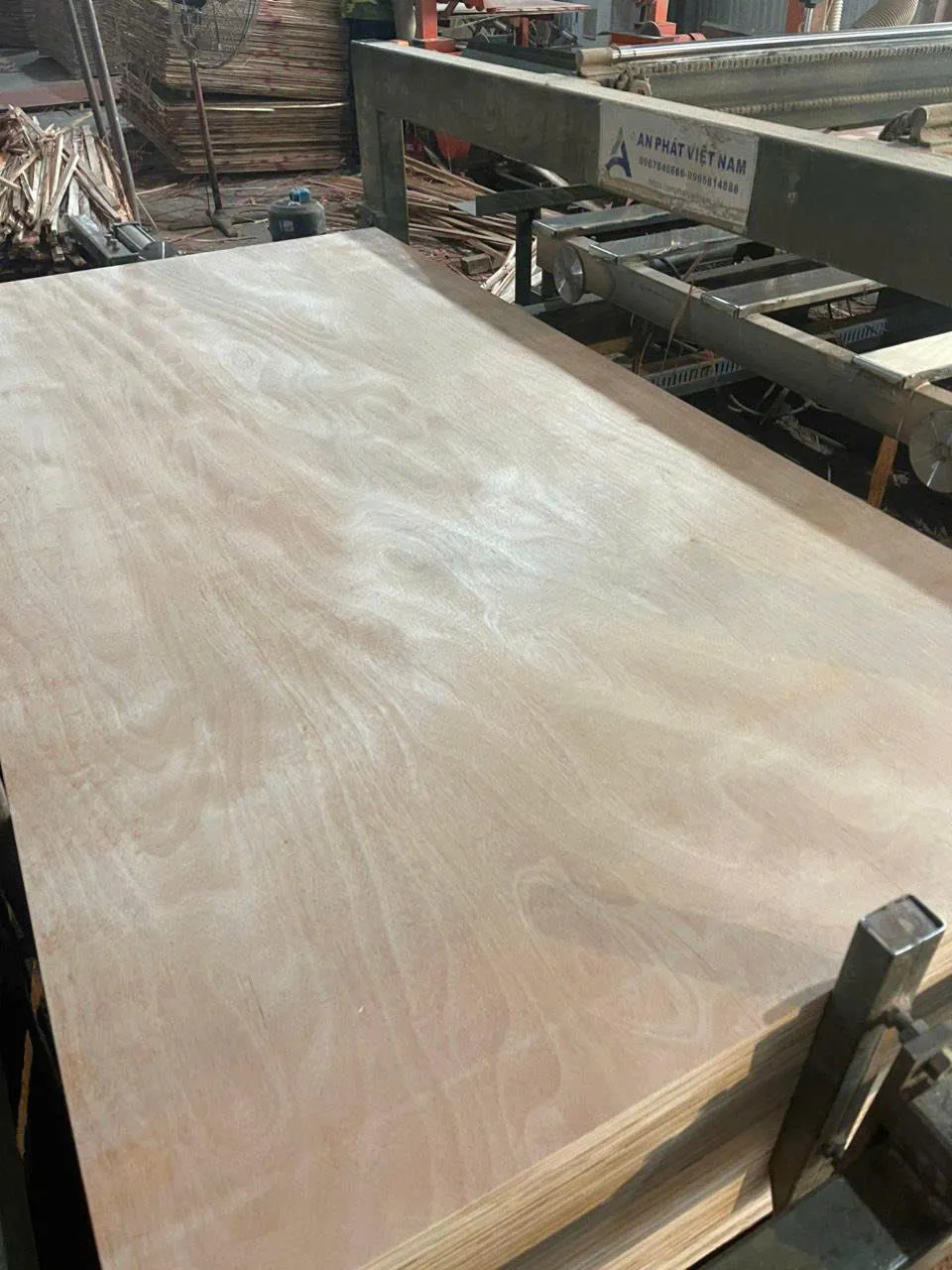
📦 Container Loading: Okoume Plywood for Interior Orders
Okoume plywood for interior use is loaded on pallets into 40HC containers at the factory. Container capacity depends on core species:
| Core Species | Pallets per 40HC | Approx. CBM | Approx. Weight |
|---|---|---|---|
| Styrax | 18 pallets | ~53 CBM | ~26.5 MT |
| Eucalyptus | 15 pallets | ~44.5 CBM | ~28 MT |
Styrax core okoume plywood allows maximum sheet count per container — 18 pallets vs 15 for eucalyptus — making it the freight-efficient choice for interior furniture buyers who prioritize cost per sheet. Eucalyptus core hits the 28.5 MT payload limit faster due to higher density.
Pallet height is maintained at 1,000mm (forklift-safe). Standard pallet arrangement is 16 flat + 2 upright at the container front. All pallets are stretch-wrapped and steel-strapped before loading (HCPLY production data, 2026).
Full container packing calculation guide for plywood
🏭 Factory-Direct Okoume Plywood from Northern Vietnam
- Full stitched styrax or eucalyptus core
- Melamine (MR) adhesive, E0 emission standard
- Sanded both faces, ±0.3mm thickness tolerance
- FSC Chain of Custody, CARB P2, CE, ISO 9001, EUDR documentation
- FOB Hai Phong port, 15-20 days production lead time
- MOQ: one 40HC container (mixed specs accepted)
As a multi-facility export operator, HCPLY ships factory-direct — no VAT overhead, no intermediate trading company markup. Each order includes full export documentation: Certificate of Origin, FSC certificate, phytosanitary, fumigation certificate, commercial invoice, and Bill of Lading.
“Interior buyers in Europe consistently ask about EUDR documentation for the okoume face veneer. We provide full traceability from the African forest source through our FSC-certified supply chain — this is documented before production begins, not assembled after the order ships.” — Lucy, International Sales Manager, HCPLY
View the complete okoume plywood product specifications
📋 Conclusion: Sourcing Okoume Plywood from Vietnam for Interior Use
Vietnam okoume plywood manufacturers supply furniture-grade panels to 50+ markets, combining African okoume face veneer with Northern Vietnam plantation cores under certified quality systems. For interior applications, the specification requirements are clear: okoume A/B face, styrax or eucalyptus full-stitched core, MR melamine glue, E0 or E1 emission, sanded both faces.
The difference between a reliable interior-grade supplier and a commodity trader is verifiable: FSC certificate numbers, CARB P2 test reports from accredited labs, ISO 9001 current certification dates, and cross-section photos confirming core construction. Request these before any first order.
HCPLY produces interior-grade okoume plywood factory-direct from Phu Tho Province, with complete certification documentation and mixed-spec container flexibility.
Disclosure: This article is published by HCPLY, a Vietnam-based plywood manufacturer and export operator. While we aim to provide objective industry guidance, readers should consider our perspective as a market participant when evaluating recommendations.