
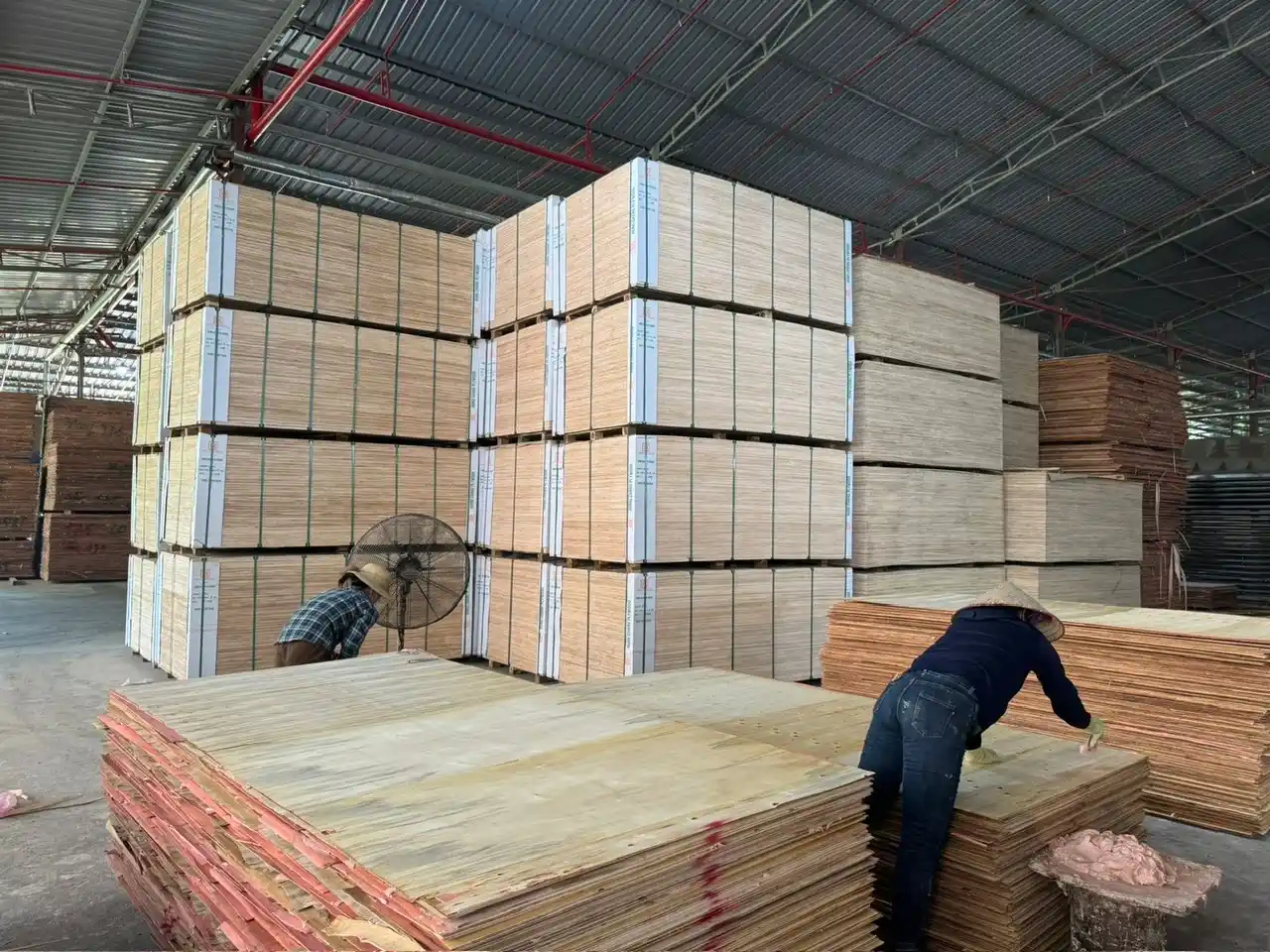
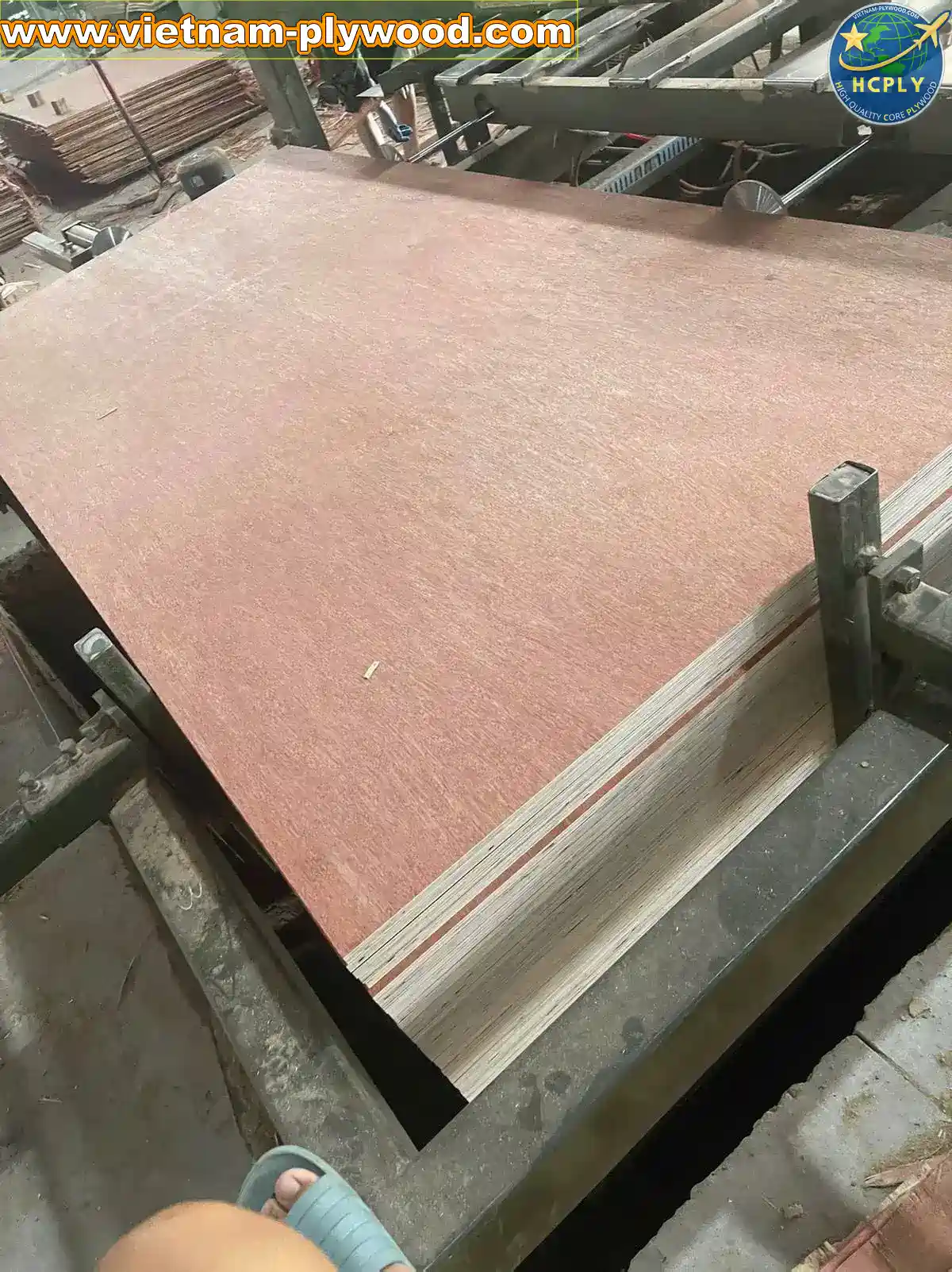
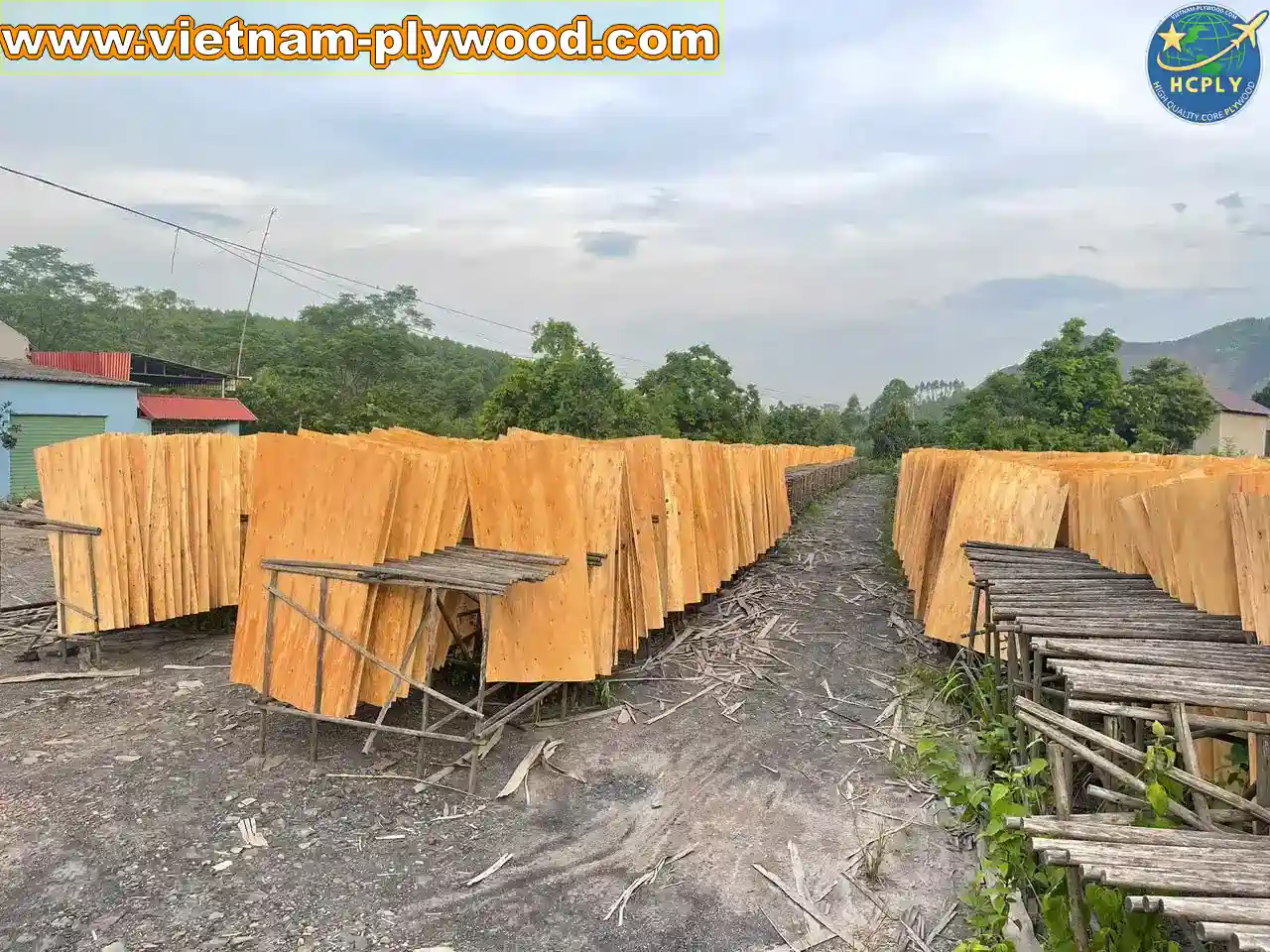

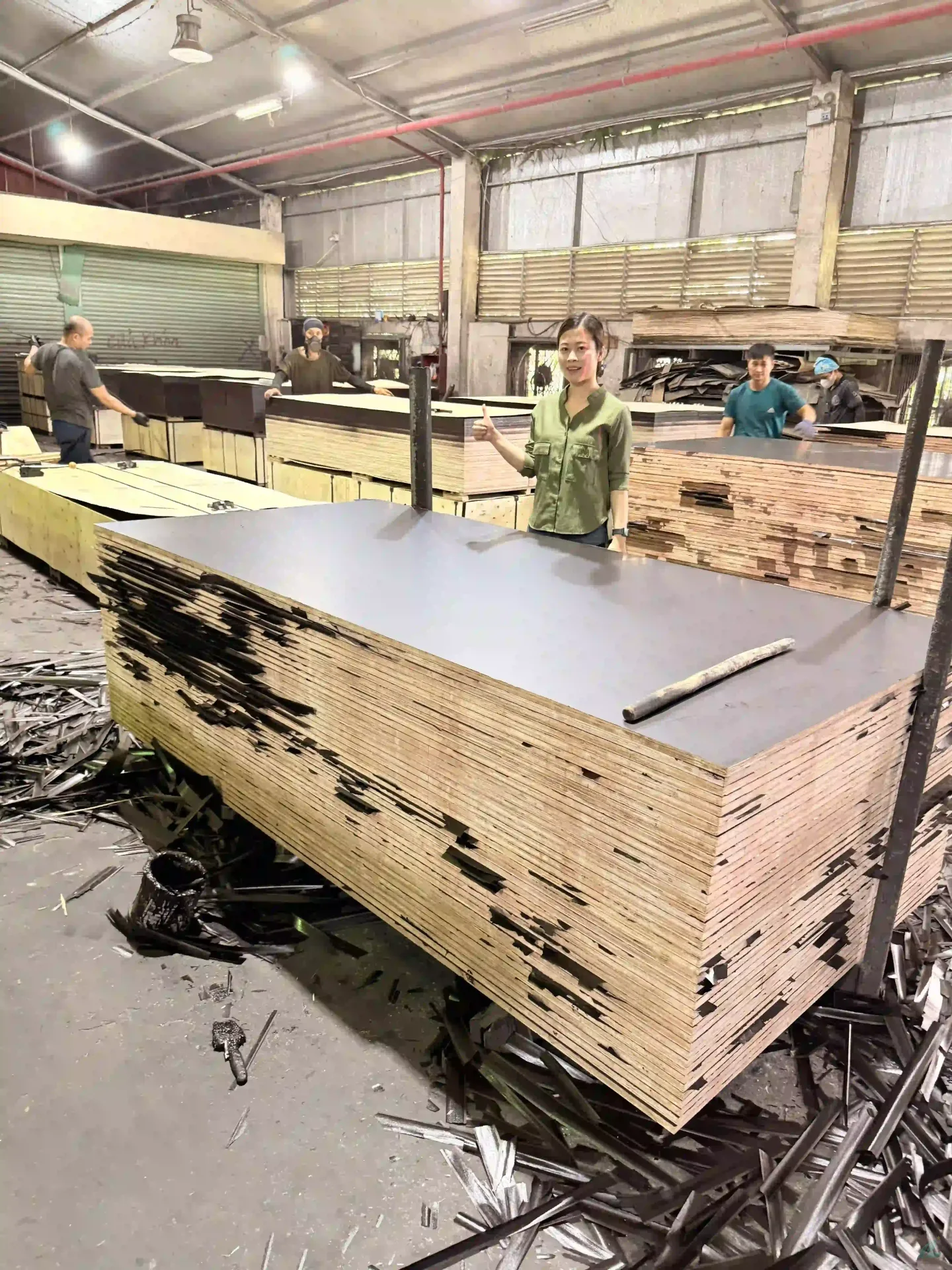
Construction grade plywood fails inspection far more often because of incorrect specification than because of poor manufacturing. Buyers who write “structural plywood, 18mm, WBP” on a purchase order without locking in core species, core construction method, and film weight often receive a panel that passes the boil test — but sags under load or delaminates after four formwork cycles.
This guide explains what “construction grade” actually means at the factory level, which specifications matter for each structural application, and how to source correctly from Vietnam in 2026.
📋 What Is Construction Grade Plywood?
Construction grade plywood is a panel engineered for structural load-bearing, not surface appearance. Three criteria distinguish it from furniture or commercial plywood:
- Glue system: WBP phenolic resin (72-hour boiling test). Not MR melamine (12-hour test). This distinction determines whether the panel survives moisture exposure in roofing, flooring, or outdoor formwork.
- Core construction: Void-free or tight-core with no internal gaps larger than 5mm. Gaps create weak points under bending stress.
- Structural certification: Compliance with EN 636 (Europe), AS/NZS 2269 (Australia), or equivalent national building codes.
⚠️ Important: Emission class (E0, E1, E2) describes formaldehyde off-gassing — it does NOT indicate moisture resistance or structural performance. WBP phenolic glue is a separate classification from E0/E1/E2. Construction panels can be both WBP-bonded and E1-compliant.
“Buyers frequently conflate E0 with waterproof,” notes Lucy, International Sales Manager at HCPLY. “An E0-certified furniture panel uses melamine glue — it will fail the 72-hour boil test that structural plywood must pass.”
🔧 Core Species for Structural Applications
The core species — one of the key plywood raw materials — determines density, bending strength, and container load efficiency. Vietnam produces three plantation hardwood cores relevant for structural plywood. (HCPLY production data, 2026)
“Film-faced plywood quality depends on the entire production process — core density, pressing parameters, and film grade — not just the percentage of melamine in the glue. Our premium line uses 8% melamine with AICA 135gsm film and achieves 12–15 reuse cycles.” — David, Export Project Leader, HCPLY
| Core | Density | Pallets/40HC | Structural Use |
|---|---|---|---|
| Eucalyptus | 650–750 kg/m³ | 15 | Heavy flooring, high-load formwork |
| Acacia | ~580 kg/m³ | 16 | General structural, wall sheathing |
| Styrax | 480–500 kg/m³ | 18 | Not recommended for structural — furniture-grade core |
For true load-bearing applications, eucalyptus core delivers the highest strength-to-panel ratio. Acacia core offers a cost-optimized alternative for wall sheathing and roof decking where payload limits matter more than maximum bending resistance.
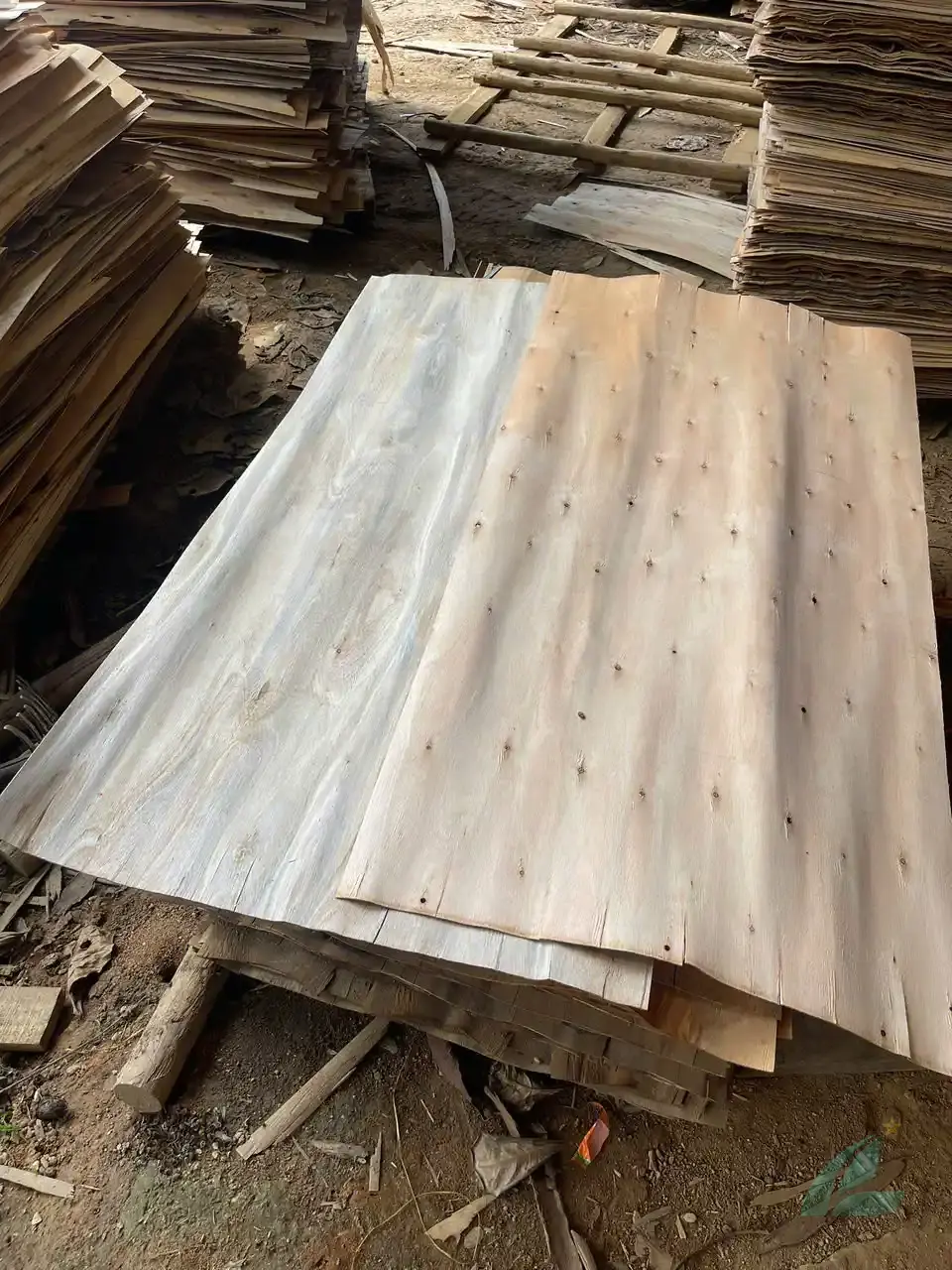
💡 Tip: Styrax (bồ đề) core is Vietnam’s birch substitute for furniture plywood — lightweight and white. It is NOT a construction core. Specifying styrax for structural use is a common sourcing error.
🏗️ Construction Grade Plywood Applications from Vietnam
📌 Concrete Formwork (Film-Faced Plywood)
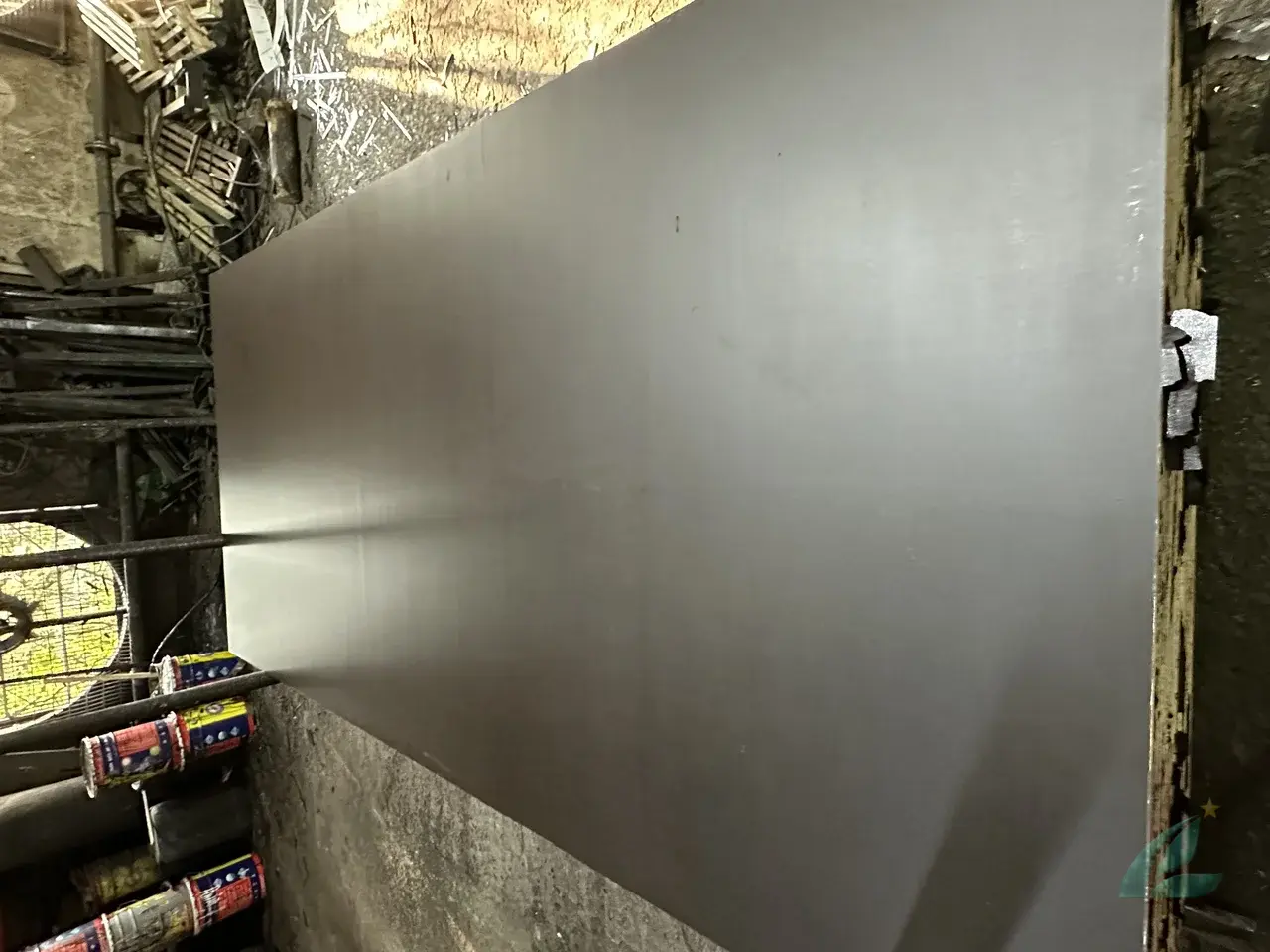
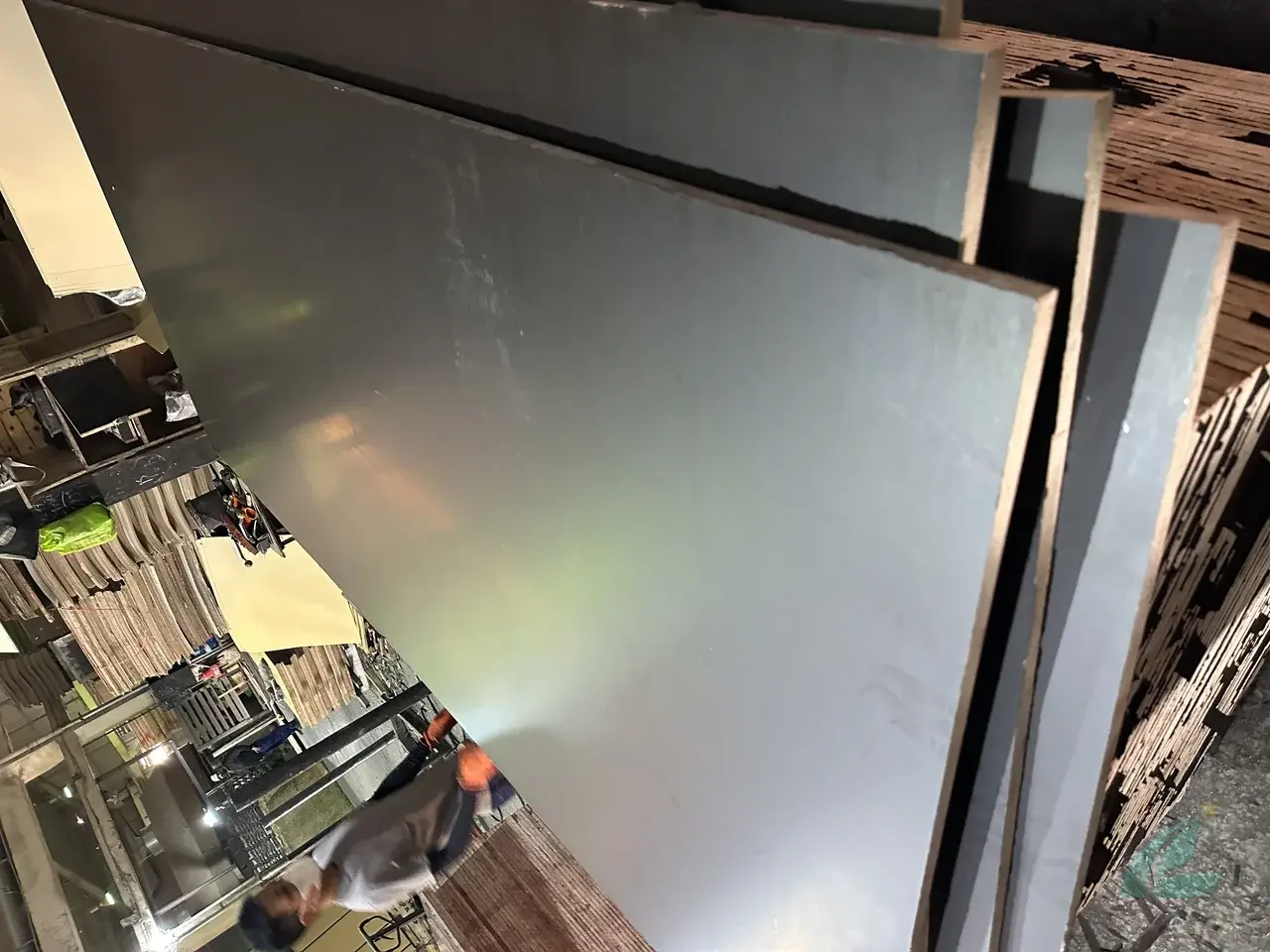
Film-faced structural plywood is the primary product for concrete forming. The phenolic film surface (minimum 120 gsm AICA film) creates a release surface that prevents concrete adhesion, while the WBP core maintains dimensional stability through repeated wetting and drying cycles.
HCPLY’s premium film-faced construction panels achieve 15+ reuse cycles with AICA phenolic film. Standard Vietnam market film-faced panels using lower-grade domestic film average 4–8 reuse cycles (HCPLY production data, 2026).
Key specs for formwork ordering:
- Film weight: 120–220 gsm (higher = more cycles)
- Core: eucalyptus preferred for high-pressure pours
- Thickness: 12mm, 15mm, 18mm (most common)
- Glue: Phenolic WBP mandatory
- Sizes: 1220×2440mm (4×8ft) or 1250×2500mm (metric EU)
View Film-Faced Plywood Vietnam specs and pricing →
📌 Structural Flooring Substrate
Construction grade plywood for subfloor systems requires high density and dimensional stability under repeated compression. Eucalyptus core at 650–750 kg/m³ distributes point loads evenly and resists deflection better than lower-density alternatives.
Standard subfloor thickness: 15mm–18mm for residential; 18mm–21mm for commercial/industrial applications. Tongue-and-groove edge profiles are available on request.
📌 Wall Sheathing and Roof Decking
Wall sheathing panels act as structural diaphragms — they resist lateral racking forces from wind and seismic loading. For this application, the panel’s shear strength matters more than surface finish. Unsanded construction panels with acacia core at 12mm–15mm are standard for sheathing.
Roof decking panels must resist uplift forces and thermal movement. WBP phenolic bonding is mandatory for any outdoor or semi-exposed application. EN 636-3 or AS/NZS 2269 F11/F14 specifies the minimum requirements for most building codes. (EN 636:2012, European Committee for Standardization)
📌 Anti-Slip Scaffold Decking
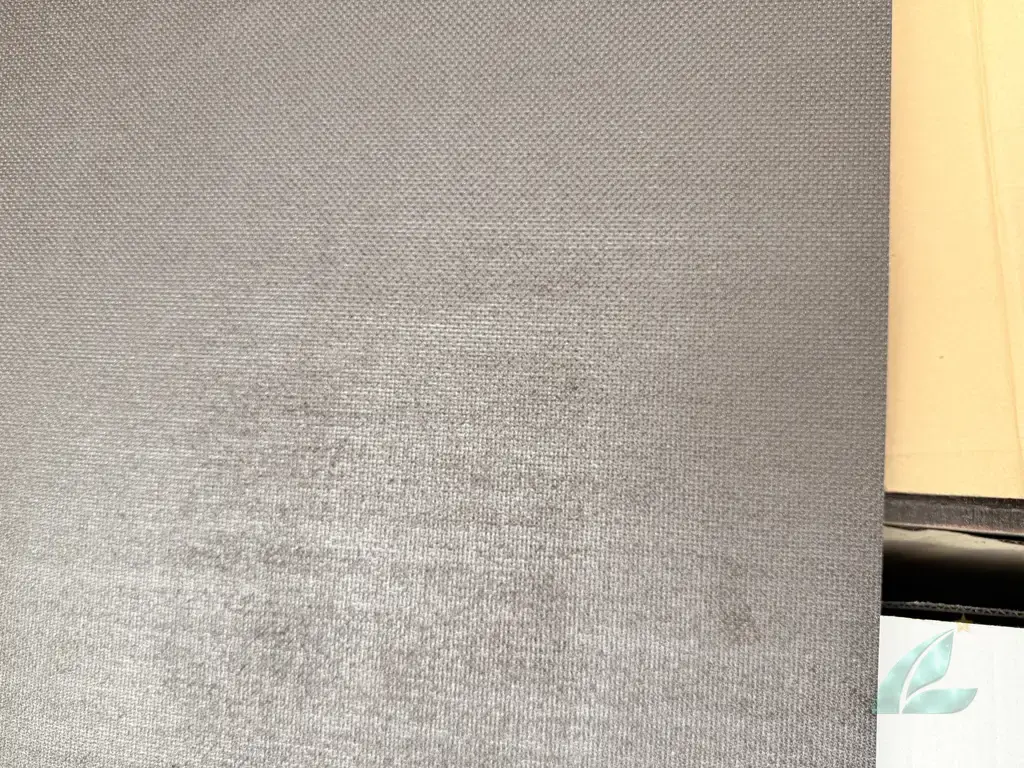
For construction scaffolding, safety requires anti-slip surface treatment. HCPLY’s anti-slip construction plywood uses 220 gsm AICA film with embedded wire mesh, providing certified non-slip surface properties even when wet.
Anti-Slip Plywood Vietnam — scaffolding and truck floor specs →
📊 Construction Grade Plywood: Vietnam Spec Sheet
Standard specifications for HCPLY construction grade panels as of 2026:
| Specification | Value |
|---|---|
| Glue system | WBP Phenolic (72h boil test) |
| Core species | Eucalyptus (650–750 kg/m³) or Acacia (~580 kg/m³) |
| Thickness range | 12mm, 15mm, 18mm, 21mm (standard) |
| Custom thickness | 3–40mm, ±0.5mm standard tolerance |
| Sheet sizes | 1220×2440mm / 1250×2500mm / custom |
| Surface | Plain, film-faced (120–220 gsm), anti-slip |
| Core construction | Full stitched or edge-jointed |
| Certifications | CE, FSC, ISO 9001, EUTR/EUDR |
| Container | 40HC, FOB Hai Phong |
| Lead time | 15–20 days |
| MOQ | 1 × 40HC |
⚙️ How Vietnam’s Factory Segment Affects Quality
Not all Vietnam factories produce the same construction grade plywood — even from the same species and glue type. Understanding factory segmentation prevents mismatched sourcing.
Premium construction factories (Segment C) use eucalyptus or acacia Grade A core, stitched construction, AICA film, and achieve 15+ formwork reuse cycles. These factories supply Australia, Korea, Germany, and UAE. Full certifications (CE, FSC, ISO) are standard.
Budget construction factories (Segment D) use acacia AB core, unstitched lay-up, domestic film, and produce panels with 4–8 reuse cycles. Certifications are absent or single-test documents. These factories supply price-sensitive markets in Southeast Asia and Africa.
Understand Vietnam plywood factory types and quality tiers →
🔗 Specifying Construction Plywood Correctly
The single most common sourcing failure: writing “18mm WBP plywood” without specifying core species or core construction method. Two panels both passing the 72-hour boil test differ significantly in bending performance if one uses eucalyptus Grade A stitched core and the other uses acacia loose-lay — the density gap alone (700 vs 580 kg/m³) signals a meaningful strength difference.
A complete construction grade specification includes:
- Thickness with tolerance (e.g., 18mm ±0.5mm)
- Sheet size (1220×2440 or 1250×2500)
- Core species (eucalyptus or acacia — specify which)
- Core construction (full stitched preferred for structural)
- Glue system: WBP Phenolic
- Surface: plain unsanded / film-faced (specify film gsm) / anti-slip
- Certification required: CE, AS/NZS 2269, EN 636, FSC if applicable
- Quantity in CBM (for container planning — see the CBM per thickness complete table)
Review plywood glue types and how WBP phenolic compares to MR melamine →
Understand core species — eucalyptus vs acacia for structural vs furniture use →
🌍 Which Markets Import Construction Grade Plywood from Vietnam?
Construction plywood from Vietnam ships to over 20 countries. Specification requirements vary by destination:
Australia and New Zealand require AS/NZS 2269 compliance. F11 and F14 stress grades are most commonly specified for residential framing. HCPLY exports film-faced and plain structural panels to Australia regularly (Australia’s Department of Agriculture, Fisheries and Forestry — import compliance, 2024).
Europe requires EN 636-2/3 compliance for structural panels. CE marking is mandatory for panels sold as construction products within the EEA. EUDR compliance (from 2025) requires full chain-of-custody documentation — FSC certification satisfies this for most species. (European Committee for Standardization EN 636:2012)
Middle East and Gulf consume high volumes of film-faced formwork panels for the ongoing construction sector expansion. UAE, Saudi Arabia, and Qatar are consistent buyers of 12mm–18mm brown film-faced panels from Vietnam.
South Korea specifies E0 emission alongside WBP bonding for construction panels destined for enclosed building applications. HCPLY supplies KS-compliant panels with dual WBP + E0 certification.
✅ Quality Verification Before Shipment
Three checks buyers should request before loading:
-
Boil test sample: Request one sheet be cut and boiled for 72 hours. If it delaminates, the glue is not WBP phenolic. This test costs nothing to perform at the factory.
-
Core cross-section photo: Request a photo of the cut edge. Gaps wider than 5mm in the core indicate loose-lay construction, not stitched. Stitched cores show tight, continuous veneer strips.
-
Third-party inspection: SGS or Bureau Veritas pre-shipment inspection confirms thickness tolerance (±0.5mm standard), moisture content (target 8–12%), and visual grading. HCPLY provides full inspection coordination — buyers can appoint their own inspector at no objection.
See HCPLY’s full quality control process and certifications →
📦 Container Loading for Construction Grade Plywood
A 40HC container holds 15–16 pallets of construction grade plywood depending on core species:
- Eucalyptus core (700 kg/m³): 15 pallets, ~44.5 CBM, ~28 MT — near payload limit
- Acacia core (580 kg/m³): 16 pallets, ~47.5 CBM, ~27.5 MT
Pallet stack height is held at 1,000mm regardless of sheet count. For mixed thickness orders within one container, HCPLY recalculates pallet height and weight before confirmation.
Film-faced panels are typically palletized film-side up with plastic wrap protection. Anti-slip panels stack face-to-face to prevent surface abrasion during ocean transit.
Full container loading calculations for all core species →
✅ Conclusion
Construction grade plywood from Vietnam delivers proven structural performance when specified correctly. The difference between a 15-cycle formwork panel and a 5-cycle panel comes down to three decisions: WBP phenolic glue (not MR), eucalyptus or acacia Grade A core (not budget acacia loose-lay), and AICA film weight (minimum 120 gsm, 220 gsm for premium).
Disclosure: This article is published by HCPLY, a Vietnam-based plywood manufacturer and export operator. While we aim to provide objective industry guidance, readers should consider our perspective as a market participant when evaluating recommendations.
Get a Free Quote for Construction Grade Plywood →
No commitment required. Lucy responds within 4 business hours. Samples available before bulk order.