



Every year, buyers reject container loads over a single measurement. Not delamination, not wrong species — thickness out of tolerance.
For plywood importers sourcing from Vietnam, plywood thickness tolerance is the difference between panels that fit your CNC router, cabinet grooves, and structural frames — and panels that don’t. A 0.5mm deviation sounds trivial. On a 12mm furniture sheet, it means your 11mm groove is either too loose or impossible to cut. On 100 pallets, it means $60,000 of lumber in a dispute.
This guide covers the international standards by market, the root causes of variation, how HCPLY produces calibrated plywood from 3 production facilities in Northern Vietnam, and the exact verification procedure buyers should run before accepting any vietnam plywood thickness shipment.
📐 What Plywood Thickness Tolerance Actually Means
Plywood thickness tolerance is the permitted deviation between the nominal (specified) thickness and the actual measured thickness of a finished panel.
When you order 18mm birch plywood, the factory’s obligation is not to deliver exactly 18.000mm — that is physically impossible at scale. The obligation is to deliver panels within an agreed band. For export-grade furniture plywood, that band is typically ±0.3mm, meaning every panel must measure between 17.7mm and 18.3mm.
Three distinct measurements matter:
| Measurement | What it checks |
|---|---|
| Nominal thickness | The specification you ordered (e.g., 18mm) |
| Actual thickness | The caliper reading at a given point on the sheet |
| Tolerance | The maximum permitted deviation from nominal |
The tolerance band applies not just to the average across a pallet, but to every individual reading. A pallet averaging 18.0mm with individual sheets ranging from 17.4mm to 18.6mm fails a ±0.3mm spec — even though the average is perfect.
⚠️ Important: Always specify measurement method in your purchase order. EN 315 requires measurements at defined points; visual “eyeball” checks are not contractually valid.
🌍 International Thickness Tolerance Standards by Market
Vietnam plywood is exported to 20+ countries. Each major market references a different standard, and these standards set the contractual baseline.
📌 EN 315 — Europe (Most Widely Referenced)
BS EN 315 is the European standard for plywood dimensional tolerances (EN 315:2000, confirmed 2010). The tolerance formula for sanded panels is:
Upper deviation = + (nominal × 0.03 + 0.2) mm
Lower deviation = − (nominal × 0.03 + 0.4) mm
Applying this to common thicknesses:
| Nominal (mm) | Upper limit (mm) | Lower limit (mm) | Band |
|---|---|---|---|
| 6 | +0.38 | −0.58 | ~1.0mm |
| 9 | +0.47 | −0.67 | ~1.1mm |
| 12 | +0.56 | −0.76 | ~1.3mm |
| 15 | +0.65 | −0.85 | ~1.5mm |
| 18 | +0.74 | −0.94 | ~1.7mm |
| 21 | +0.83 | −1.03 | ~1.9mm |
The standard is more permissive than most buyers expect. In practice, premium furniture-grade factories achieve ±0.3mm — tighter than the formula minimum. unsanded plywood carries wider tolerance of ±0.5mm across all thicknesses. Measured at: ≥50mm from each edge
European buyers (Germany, Poland, France, Spain) typically write EN 315 directly into their purchase orders. HCPLY’s furniture-grade line meets EN 315 sanded tolerances as standard (HCPLY QC data, 2026).
📌 ISO 12465 — General International Reference
ISO 12465:2007 (Plywood — Specifications) is the global baseline for markets that don’t specify a national standard. Tolerance provisions largely align with EN 315 for sanded grades.
Most Middle East, Indian, and Southeast Asian contracts reference ISO 12465 or simply specify tolerance directly (e.g., “±0.3mm”) without citing a named standard.
📌 JAS — Japan (Strictest Market)
JAS (Japanese Agricultural Standard for Plywood) requires the tightest tolerances in Asia:
- ±0.2mm for Class 1 furniture/interior panels
- Applies to both sanded and unsanded surfaces
- Measurement at 5 defined points per sheet (JAS 1453)
Japan’s tolerance requirement means only factories producing calibrated plywood — wide-belt sanded to ±0.1mm sander setting — with consistent veneer sourcing can reliably supply the Japanese market. It’s a genuine barrier to entry. HCPLY’s premium furniture line (styrax core, full stitched, sanded) is designed to meet JAS requirements, with vietnam plywood thickness documentation provided per shipment.
📌 Market Summary
| Market | Standard | Sanded tolerance | Unsanded tolerance |
|---|---|---|---|
| Europe | EN 315 | ±0.3mm (≤12mm) | ±0.5mm |
| Japan | JAS 1453 | ±0.2mm | ±0.2mm |
| South Korea | KS F 3113 | ±0.3mm | ±0.5mm |
| India, ASEAN | ISO 12465 / contract | ±0.3–0.5mm | ±0.5–0.8mm |
| Middle East | Contract specified | ±0.3–0.5mm | ±0.5mm |
| US | HPVA HP-1 | ±0.8mm (sanded) | N/A |
💡 Tip: When specifying tolerance in your purchase order, always cite both the standard AND the numeric value. “EN 315 compliant” without a number can be ambiguous across sanded vs unsanded categories.
Need tolerance-certified panels for your market? Contact HCPLY for a sample shipment with measurement data — specify your standard and we document every shipment.
🔧 Why Thickness Varies: The 5 Root Causes
Understanding what drives thickness variation helps buyers qualify factories — and helps factories prevent rejections. At HCPLY’s production facilities, the QC team tracks five primary causes (HCPLY production data, 2026):
- Veneer moisture content before pressing
Target moisture for core veneer is 6–8%. Above that range, steam released during pressing creates micro-blisters that reduce final density and panel flatness. Below 4%, veneer becomes brittle and fractures under press pressure, leaving voids that increase variation. Consistent drying is the single most controllable variable in the pressing stage. See the Vietnam plywood manufacturing process guide for how drying ovens are calibrated.
- Press plate uniformity and calibration
Hot-press plates deform marginally over time. A plate that applies 10–14 kg/cm² uniformly when new may develop hot spots or low-pressure zones after 50,000+ cycles. Factories that calibrate press plates monthly — not just annually — maintain tighter post-press thickness. This is a direct reflection of production discipline.
- Veneer peel thickness consistency
Rotary-peeled veneer thickness varies by log quality and lathe condition. Core veneers nominally cut at 1.7mm may range from 1.5mm to 1.9mm. A 5-ply panel built on 3 core layers absorbs this variation additively. The total error before sanding can reach ±1.0mm on an 18mm panel if veneer quality is not graded and sorted before assembly.
- Glue spread uniformity
Inconsistent glue application creates variable bonding layers. Phenolic (WBP) glue lines are thinner and more uniform than melamine lines; this is one reason film-faced plywood (phenolic) often has better post-press tolerance than furniture-grade MR panels at the same pressing temperature.
- Post-press conditioning time
After the press opens, panels exhibit “spring-back” — partial elastic recovery from compression. Factories that stack and condition panels for at least 24–48 hours before sanding get more stable final dimensions than those that sand immediately. Skipping this step is a cost-saving shortcut that reduces tolerance consistency.
⚙️ How Qualified Factories Control Thickness Tolerance
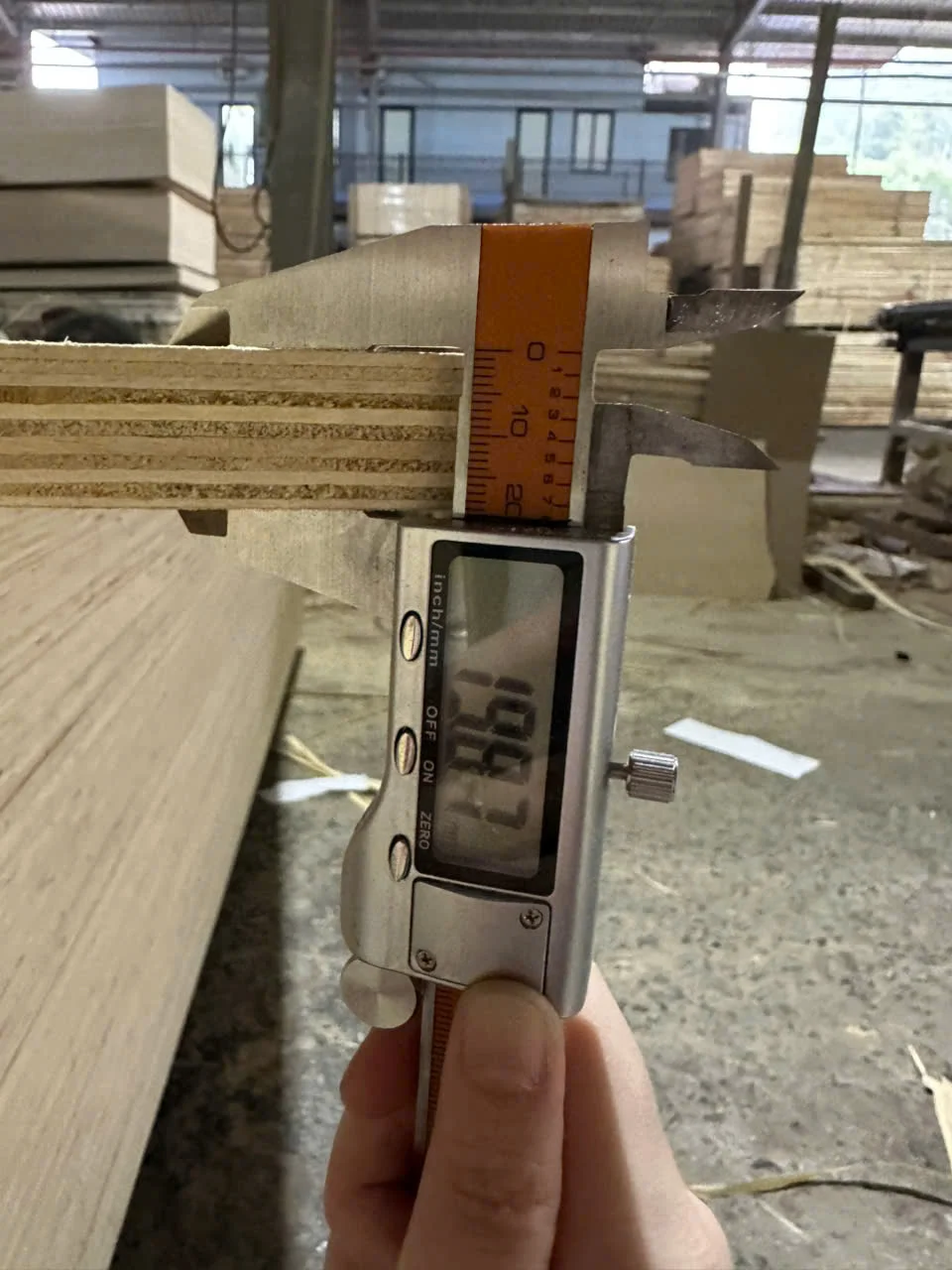
Thickness tolerance control is a multi-stage process, not a single QC check at the end of the line. HCPLY’s on-site quality team manages tolerance across five stages:
Stage 1 — Veneer incoming inspection
Before veneer enters core assembly, thickness is sampled with digital calipers. Sheets outside ±0.1mm of target peel thickness are flagged for regrading. Only consistent veneer enters the premium furniture line.
Stage 2 — Press plate calibration
HCPLY’s press plates are checked for flatness monthly using a dial gauge bridge. Plates exceeding 0.1mm of crown or sag are resurfaced before returning to production. This prevents systematic bias (panels consistently thin or thick from one area of the press).
Stage 3 — Post-press conditioning
Pressed panels condition in stacks for 24–48 hours before reaching the sander. Spring-back stabilizes. Moisture redistributes. This investment in floor time is why HCPLY’s furniture-grade sheets reach the sander at a consistent starting dimension.
Stage 4 — Wide-belt calibration sanding
This is the critical step. The sander removes material to bring panels to exact target thickness. Calibration passes remove 0.3–0.5mm across the face and back simultaneously, correcting for press-induced variation. The sander itself is set to ±0.1mm and checked every 2 hours of operation.
For sanded plywood destined for Japan or European furniture applications, two sanding passes are used: a heavy calibration pass (removing up to 0.5mm) followed by a finish pass (80-grit or 100-grit for surface quality).
Stage 5 — Final measurement and load release
Before container loading, a QC inspector measures at 10+ points per representative sheet using a digital caliper (0.01mm resolution). Readings are logged. Any sheet outside the agreed tolerance is pulled from the pallet. This is documented for every HCPLY shipment.
“Thickness tolerance is not just a technical number — it’s a reflection of manufacturing discipline and a promise kept to the customer.” — David, Export Project Leader, HCPLY (10+ years in Vietnam plywood export)
🏆 Tolerance by Product Grade
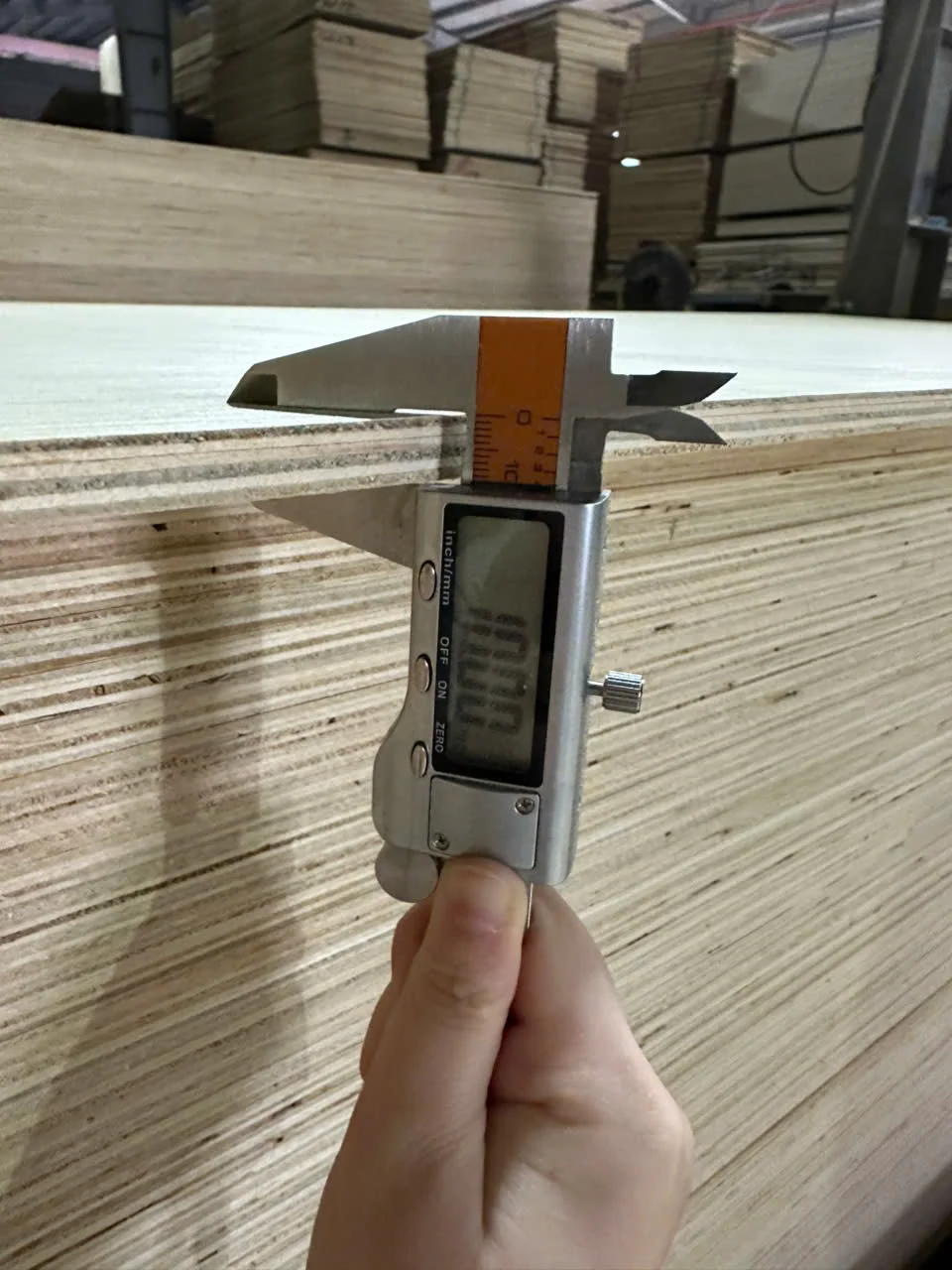
Different product grades carry different tolerance expectations — and different price points. Understanding this prevents buyers from over-specifying (paying for precision they don’t need) or under-specifying (receiving variation that causes downstream problems).
| Grade | Typical use | Face | Sanding | Tolerance |
|---|---|---|---|---|
| Premium furniture (birch, EV, okoume) | Cabinet interiors, visible furniture | D/E birch, EV | Yes — 2-pass | ±0.2mm |
| Standard furniture (bintangor A, pine) | General furniture, flat-pack | A/B | Yes — 1-pass | ±0.3mm |
| Commercial interior | Shopfitting, partition boards | B/C | Light sand | ±0.3–0.4mm |
| Film-faced construction | Concrete formwork, shuttering | Phenolic film | No | ±0.5mm |
| Anti-slip construction | Scaffold deck, truck floor | Anti-slip film | No | ±0.5mm |
| Packing / packaging | Crates, pallets | Bintangor C/D | No | ±0.5–0.8mm |
The relationship between sanding and tolerance is direct: sanded panels achieve tighter tolerances because the sander physically removes variation introduced by the press. Unsanded panels carry more variation because they rely solely on press calibration.
For the plywood glue types and emission standards used across these grades, note that glue type (MR melamine vs WBP phenolic) affects bonding line thickness and therefore influences the starting variation before sanding — but properly calibrated sanding corrects for this.
🔍 How Buyers Can Verify Thickness Tolerance
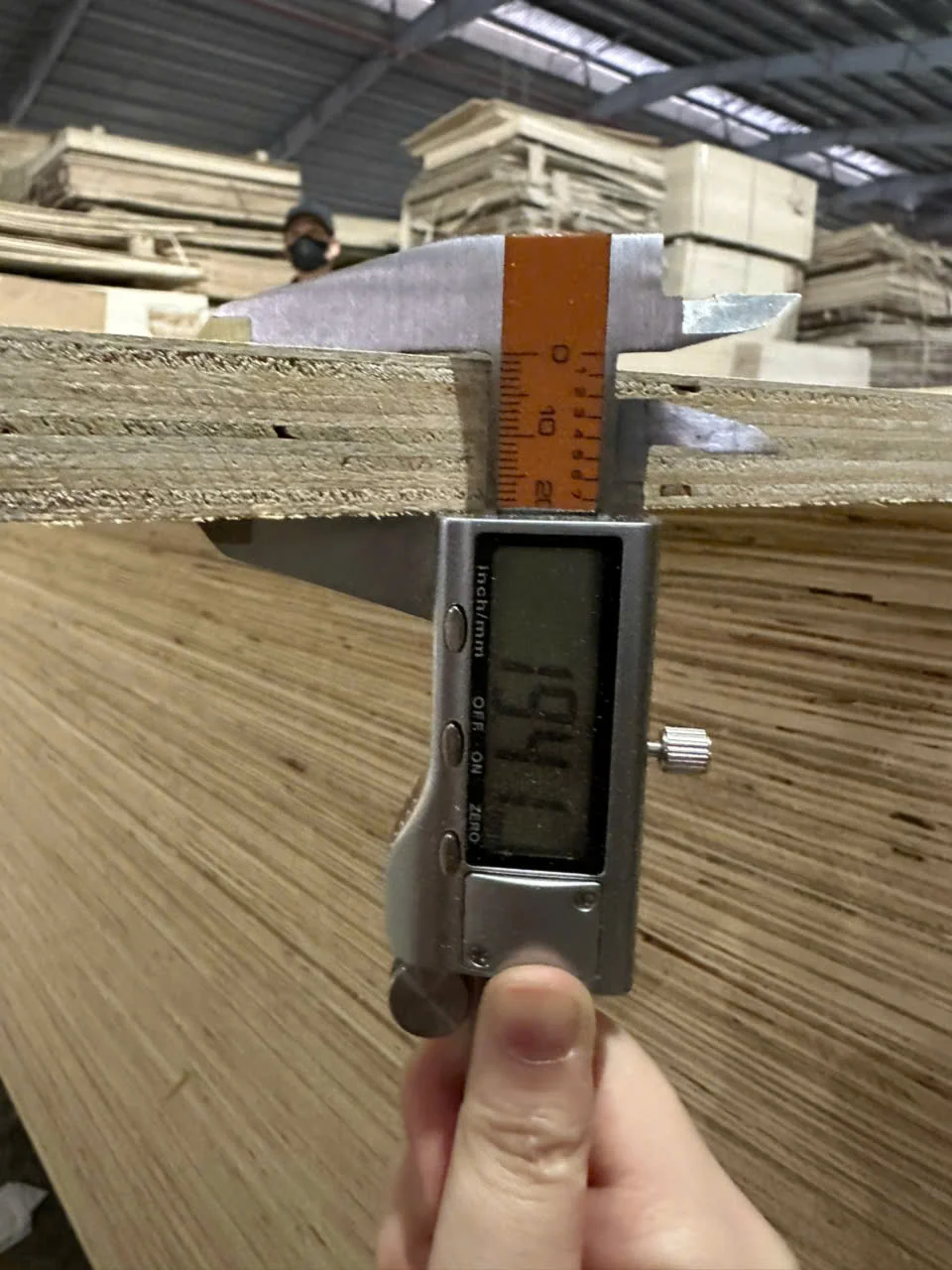
Do not rely on factory-provided thickness reports alone. Third-party verification at point of loading or upon arrival is the standard for serious B2B procurement. Here is a practical protocol:
Tools required:
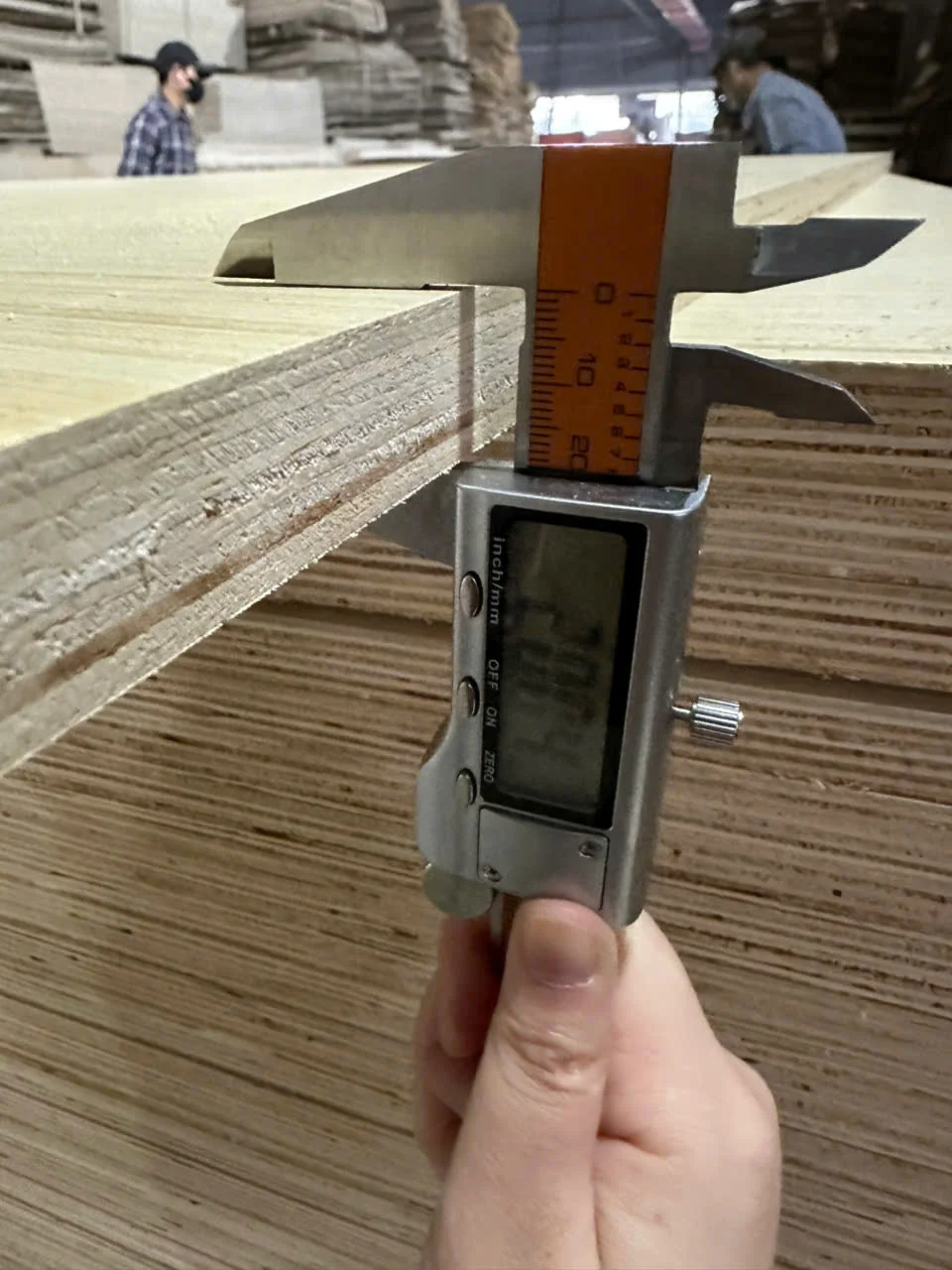
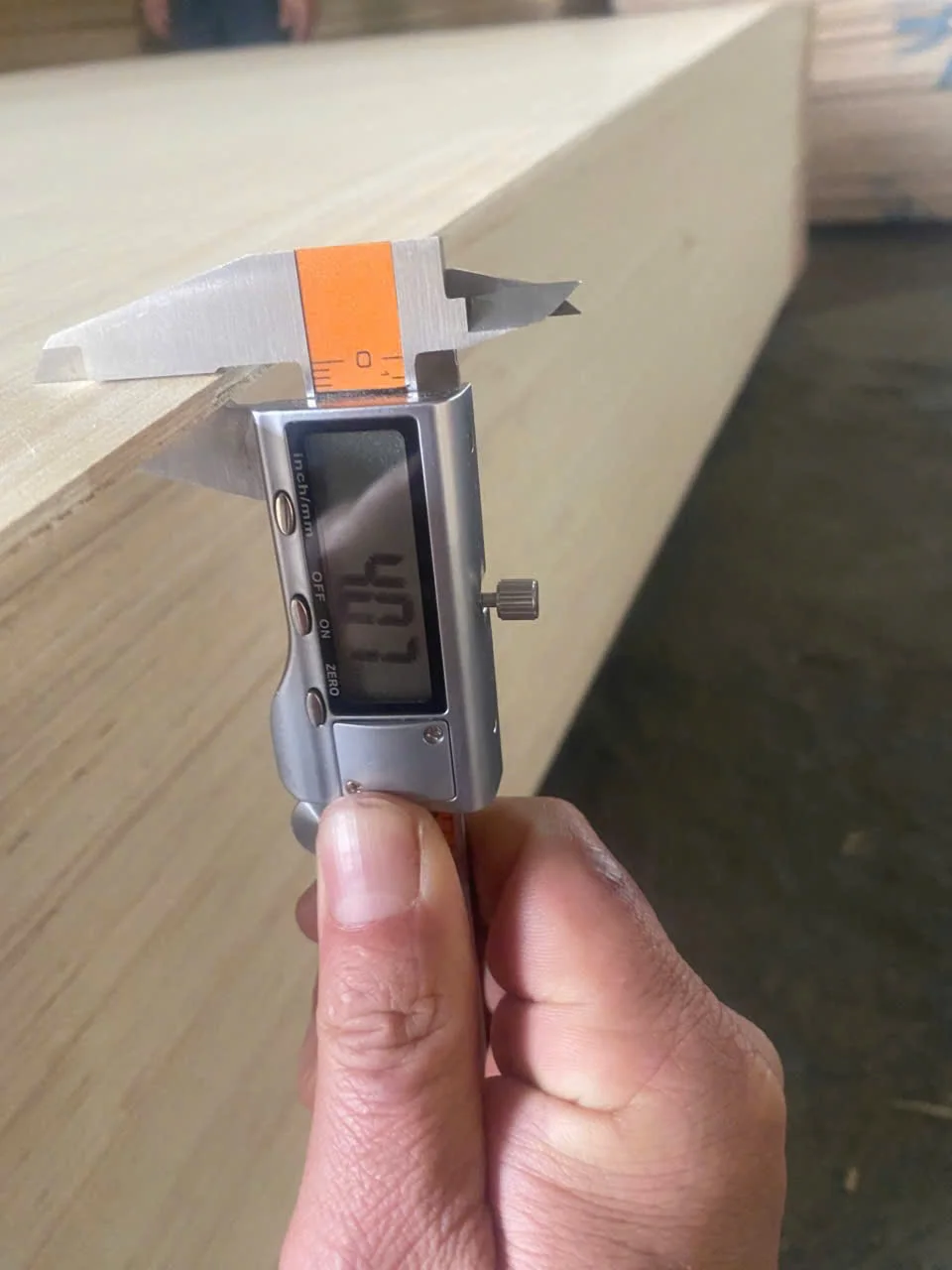
- Digital caliper (resolution 0.01mm, accuracy ±0.02mm)
- Measurement template card (marks 9 standard points per sheet)
- Photographic documentation setup
Measurement protocol:
- Sample selection: Minimum 5 sheets per pallet, selected from different positions (top, middle, bottom, front, back).
- Points per sheet: Measure at 9 points minimum — 4 corners (50mm from edge), 4 midpoints of each edge, and center.
- Record all readings: Tabulate in a spreadsheet. Calculate min, max, and range for each sheet.
- Apply tolerance check: Compare each reading against the agreed tolerance band. One reading outside the band = the sheet fails.
- Accept/reject decision: If >5% of sheets fail, trigger a formal dispute process with documentary evidence.
Acceptance criteria examples:
| Specified thickness | Tolerance | Accept range |
|---|---|---|
| 12mm | ±0.3mm | 11.7–12.3mm |
| 18mm | ±0.3mm | 17.7–18.3mm |
| 18mm | ±0.2mm | 17.8–18.2mm |
| 21mm | ±0.5mm | 20.5–21.5mm |
⚠️ Note: Always record caliper brand, model, and last calibration date in your inspection report. This documentation matters in dispute resolution.
The plywood quality control process at HCPLY includes third-party inspection access — buyers can send SGS or Bureau Veritas inspectors to measure before container sealing. This is standard for HCPLY shipments to Japan and EU.
📊 Thickness Tolerance and Price: The Real Relationship
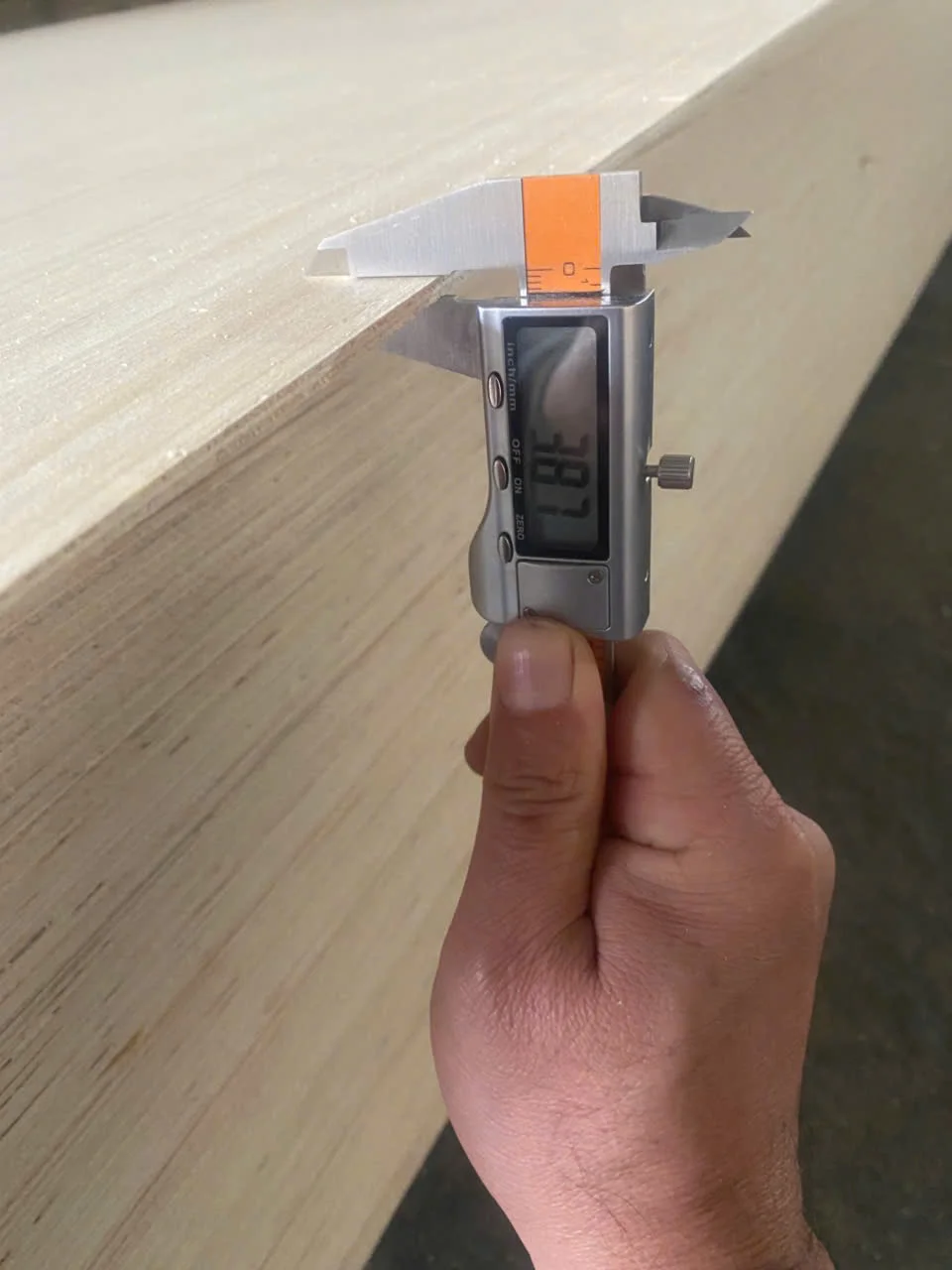
Tighter tolerance costs more. The question is: how much more, and is it worth it?
From HCPLY’s factory data, producing furniture-grade plywood to ±0.2mm (JAS/Japan spec) vs ±0.3mm (EU/standard spec) involves:
- 2-pass sanding instead of 1-pass: adds ~15–20 minutes per m³ of throughput
- Higher veneer grading rejection rate: 8–12% more core veneer discarded
- More frequent press plate calibration: +$200–400/month in maintenance
The combined effect: ±0.2mm panels cost approximately 4–7% more than ±0.3mm panels at the same nominal thickness and species combination (HCPLY production data, 2026).
For buyers, the business case calculation is straightforward:
If your downstream process involves:
- CNC routing or automated panel processing → tight tolerance reduces machine downtime and blade wear
- Cabinet carcass assembly with precise groove joints → ±0.2mm eliminates shimming and sanding at assembly
- Flooring substrate → tight tolerance prevents height variation between panels
If your application is:
- Concrete formwork (film-faced) → ±0.5mm is fine; panels get coated anyway
- Packing and crating → ±0.8mm is acceptable; dimensional precision is irrelevant
Misspecifying tolerance — requesting JAS-level precision for a packing application — inflates cost by 10–15% for no functional benefit. Conversely, accepting packing-grade tolerance for furniture work creates downstream production problems that cost far more than the price premium.
For a full view of how specifications interact with pricing, see the plywood quotation guide.
📦 Thickness Tolerance in Practice: Common Buyer Mistakes
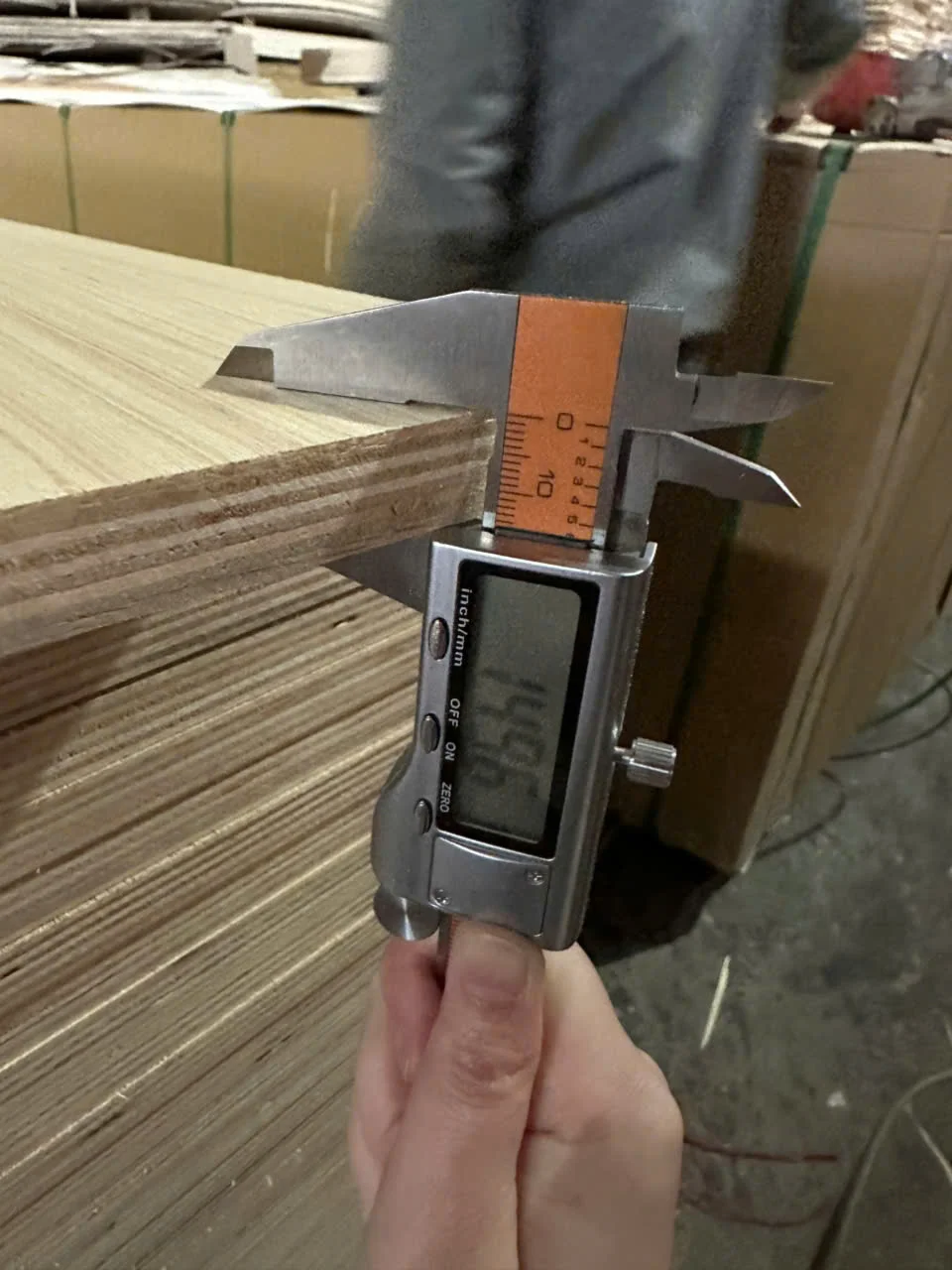
After reviewing hundreds of shipment claims, the HCPLY export team sees the same mistakes repeatedly:
Mistake 1: Not specifying tolerance in the purchase order
The single most common issue. When the PO says “18mm plywood” without a tolerance, the factory defaults to its standard (often ±0.5mm for commercial grades). If the buyer needs ±0.3mm, it must be written explicitly.
Mistake 2: Specifying one tolerance for mixed-spec orders
A container with both 12mm and 18mm panels, or sanded and unsanded sheets, needs tolerance specified per item — not a blanket statement. EN 315 sanded tolerance for 12mm is ±0.3mm; for 18mm, it’s ±0.5mm. One number doesn’t cover both.
Mistake 3: Measuring at the wrong points
Edge measurements pick up sanding edge-fall, a known artifact. EN 315 requires measurements at ≥50mm from each edge. Center measurements only miss corner-to-center variation. Use a 9-point protocol as described above.
Mistake 4: Confusing nominal and actual thickness
Plywood sold as “18mm” is press-calibrated to approximately 18mm, but the real specification is the tolerance band. A factory that consistently delivers 17.9mm ±0.2mm is technically delivering 17.7–18.1mm. If your groove spec is 17.5–18.5mm, this passes — but you should know the actual population center before designing clearances.
Mistake 5: Not accounting for moisture after shipping
Plywood absorbs moisture during ocean transit, particularly for containers stuck in humid ports. A panel that measured 18.0mm at loading in Hai Phong may arrive at 18.4mm after 6 weeks in a sealed container through the Indian Ocean. Acclimatize panels for 48–72 hours in the destination climate before final measurement and processing.
📐 What to Write in Your Purchase Order
Vague PO language is the root cause of most thickness disputes. These clauses eliminate the gap:
For furniture/cabinet/interior grade:
Thickness: 18mm ±0.3mm
Measurement: 5-point per BS EN 315 (four corners + center)
Surface: Sanded both faces (calibration grade)
Rejection criterion: Any sheet outside ±0.3mm, or >5% of batch outside ±0.3mm
For commercial/packaging grade:
Thickness: 12mm ±0.5mm
Measurement: Center point per batch sampling (10% of sheets)
Surface: Unsanded acceptable
Add this clause for any order exceeding USD 20,000:
Supplier to provide caliper reading report (min. 10 sheets) prior to container loading.
Report format: [sheet ID, 5-point measurements, average, deviation from nominal].
This pre-shipment caliper report costs the factory less than 30 minutes to produce — and it eliminates the need for a third-party inspection on routine repeat orders.
✅ Conclusion: Precision is a Specification, Not a Promise
Plywood thickness tolerance is not a background technical detail — it is a primary quality parameter that directly determines whether your production line runs smoothly or stops for rework.
Three things matter for sourcing thickness-verified plywood from Vietnam:
- Write the tolerance into your PO — specify numeric value, reference standard, and measurement method. “±0.3mm per EN 315” is contractually clear.
- Match tolerance to application — ±0.2mm for Japan/precision furniture, ±0.3mm for EU standard furniture, ±0.5mm for construction/commercial.
- Verify at loading — digital calipers, 9-point protocol, documentary record. HCPLY welcomes third-party inspection before container sealing.
Disclosure: This article is published by HCPLY, a Vietnam-based plywood manufacturer and export operator. While we aim to provide objective industry guidance, readers should consider our perspective as a market participant when evaluating recommendations.
Request thickness-verified samples from HCPLY — include your target spec and we’ll send production measurement data with the sample shipment. No commitment required.