

The global plywood market presents international buyers with hundreds of product combinations — and manufacturers do not always explain the classification system clearly. A panel labeled “commercial plywood” in one market may refer to furniture-grade in another. “Waterproof plywood” can mean WBP phenolic bonding or simply MR glue with a marketing label. Understanding how types of plywood are actually classified — by application, face veneer, core, glue, emission, and grade — is the prerequisite for writing accurate specifications and comparing quotations from different suppliers.
This guide classifies every major type of plywood manufactured in Vietnam from a factory-floor perspective. HCPLY manages 3 specialized production facilities in Northern Vietnam, covering the full spectrum from packing grade at USD 220/CBM to premium birch furniture panels at USD 580/CBM. Every technical specification below comes from actual 2026 production data — not marketing generalization.
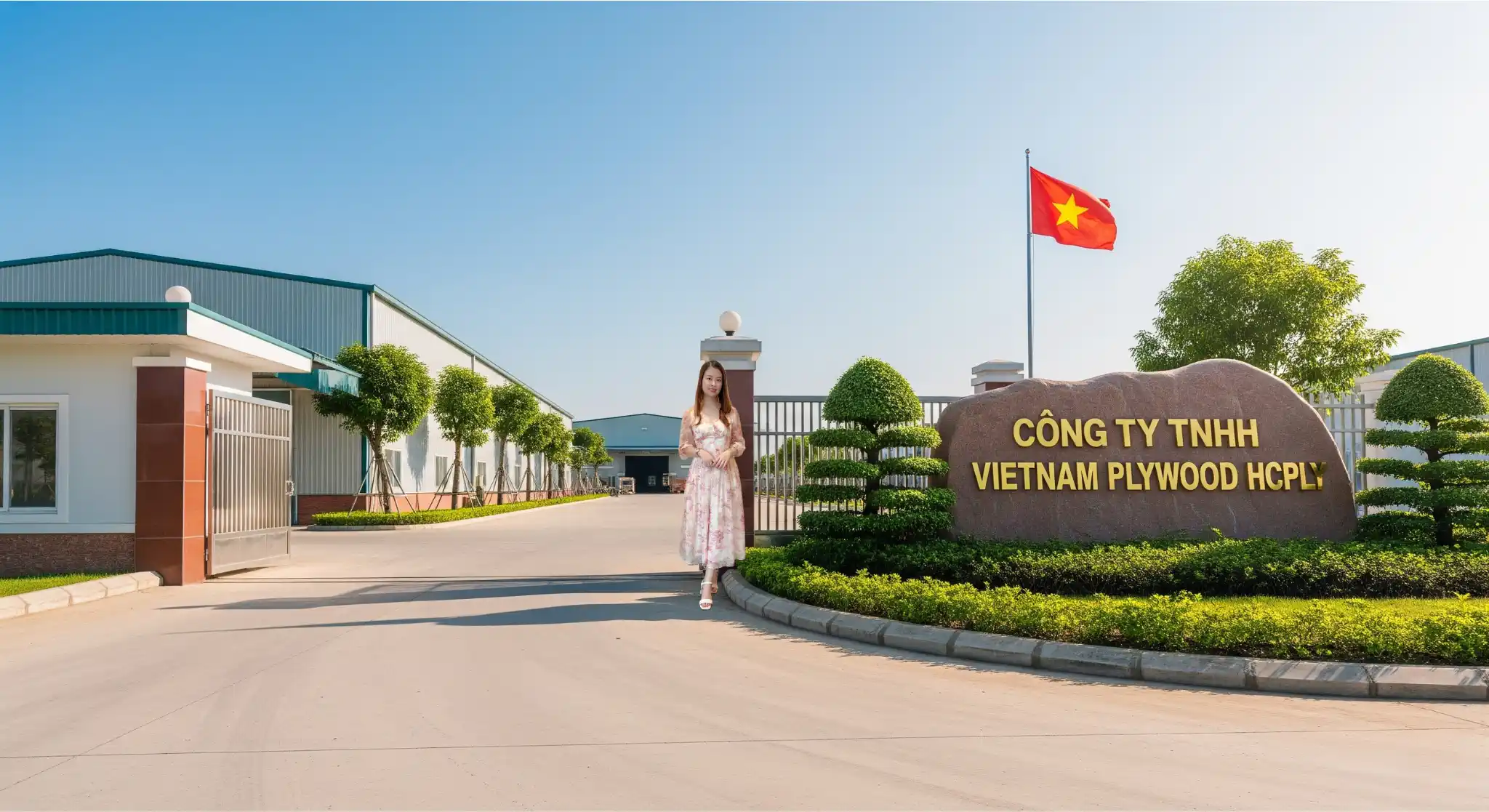
 HCPLY Northern Vietnam production facility — covering all major types of plywood from furniture-grade to construction formwork
📋 Classification by Application — The Primary Division
Application is the first and most important classification axis. It determines every downstream specification: which face veneer is appropriate, which core provides the right performance, which glue bond is required, and what emission standard applies.
Furniture-Grade Plywood
Furniture plywood is manufactured for visible interior applications — cabinets, wardrobes, drawer boxes, shelving, and decorative paneling. The defining characteristics are:
- Face veneer: A or B grade in birch plywood Vietnam, okoume plywood Vietnam, EV plywood Vietnam, gurjan plywood Vietnam, or eucalyptus plywood Vietnam
- Core: Styrax (480-500 kg/m3) or eucalyptus (650-750 kg/m3), full-stitched construction
- Glue: Melamine (MR) — 12-hour boil test
- Emission: E0 or E1 (CARB P2 for US market) — mandatory for indoor furniture
- Surface: Sanded smooth, ready for coating, lamination, or painting
- Thickness: 3-30mm, commonly 9, 12, 15, 18mm
- FOB price range: USD 300-580/CBM depending on face species
Furniture-grade production requires dedicated factory types — premium facilities with full-stitched core construction, calibrated sanding lines, and certified emission control. These factories do not produce packing or commercial-grade plywood — the production processes are fundamentally different.
Important: The distinction between furniture-grade and commercial-grade is not just about face veneer quality. Core construction, sanding precision, and emission certification add significant cost. A quotation comparing furniture-grade from one supplier against commercial-grade from another is comparing different products entirely.
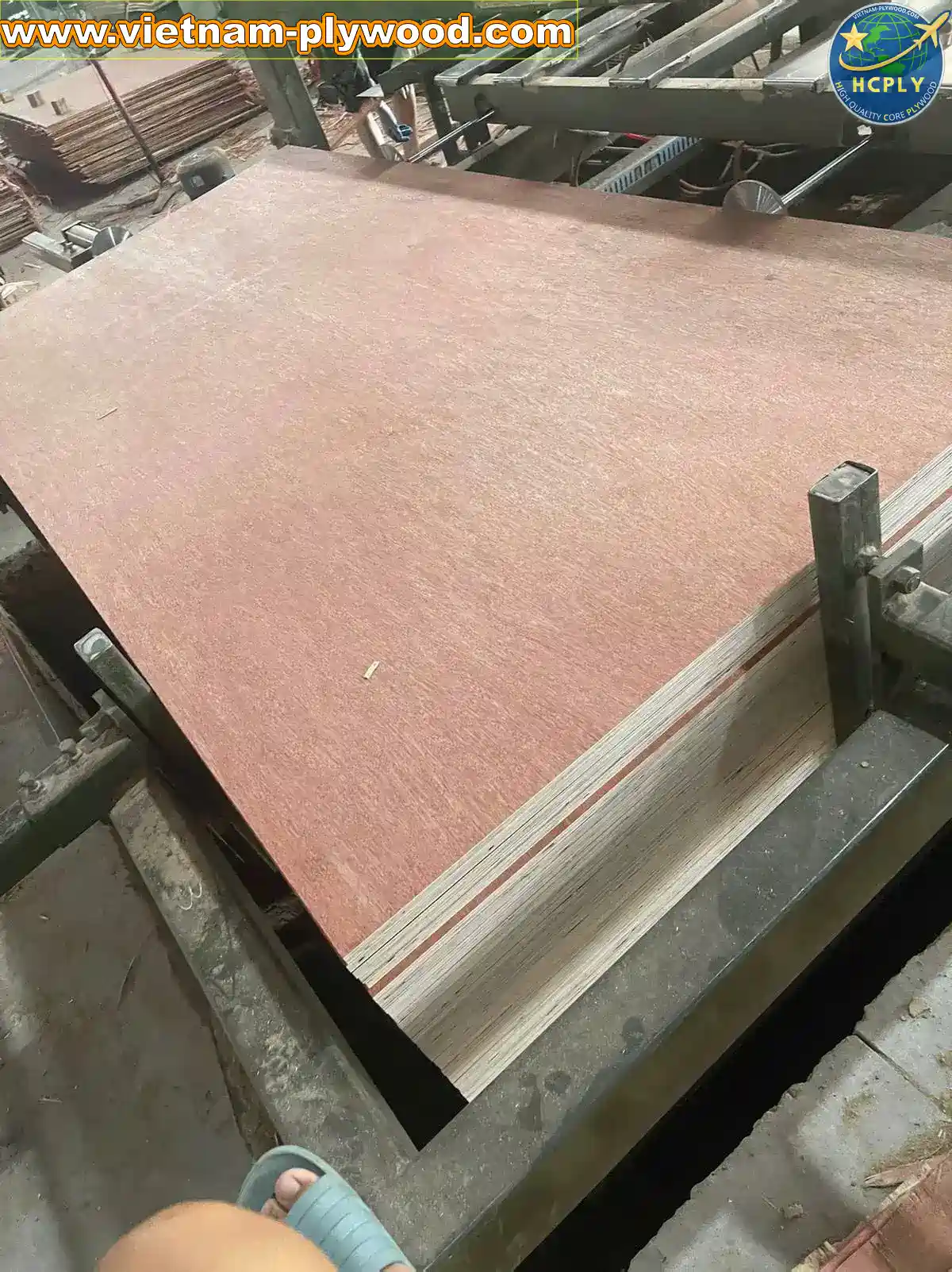
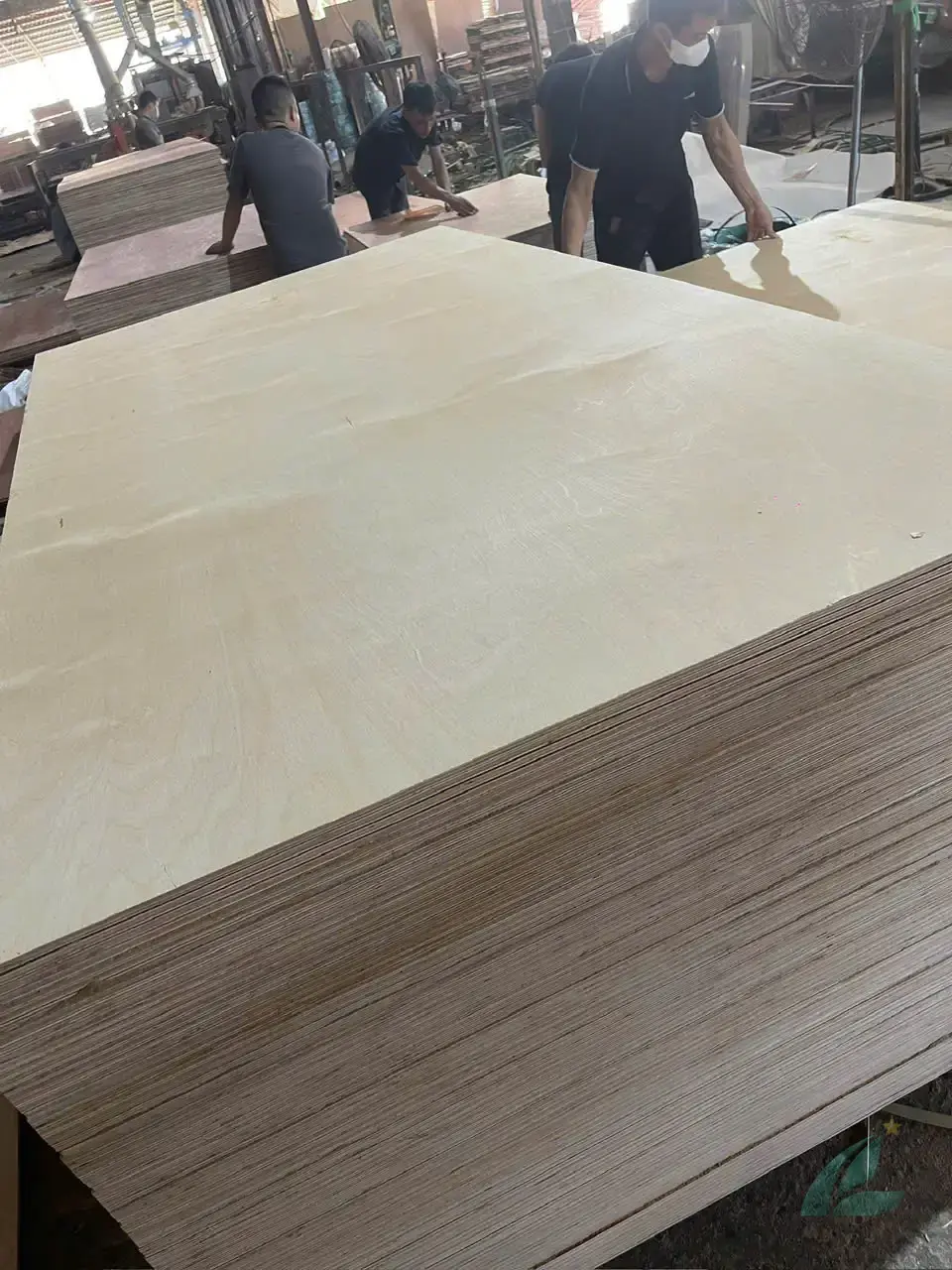 Birch furniture-grade plywood — the highest-value type of plywood in Vietnam’s export range, targeting EU and North American markets
“When buyers ask what type of plywood they need, the answer always starts with the same two questions: What is the application, and what market is it going to? In 2026, those two factors determine everything — face veneer, core species, glue system, emission standard, and which certifications need to be on the test reports.” — Ms. Lucy Pham, International Sales Manager, HCPLY
Contact HCPLY to get a specification for your application — we respond within 12 hours with the recommended type, face, core, glue, and emission combination.
Commercial-Grade Plywood
Commercial plywood serves general-purpose interior applications where appearance matters but is not the primary concern — office partitions, backing panels, secondary shelving, retail display structures, and general construction interiors.
- Face veneer: B or C grade in bintangor plywood Vietnam, poplar plywood Vietnam, or pine plywood Vietnam
- Core: Acacia (~580 kg/m3) or styrax (480-500 kg/m3), edge-jointed or finger-jointed
- Glue: Melamine (MR)
- Emission: E1 or E2
- Surface: Lightly sanded or unsanded
- FOB price range: USD 250-400/CBM
Commercial plywood is the highest-volume segment in Vietnam’s export market. Buyers in Korea, Southeast Asia, the Middle East, and Africa are the primary markets. The key differentiator from furniture-grade: lower face veneer quality, simpler core construction, wider thickness tolerance, and no mandatory E0 emission certification.
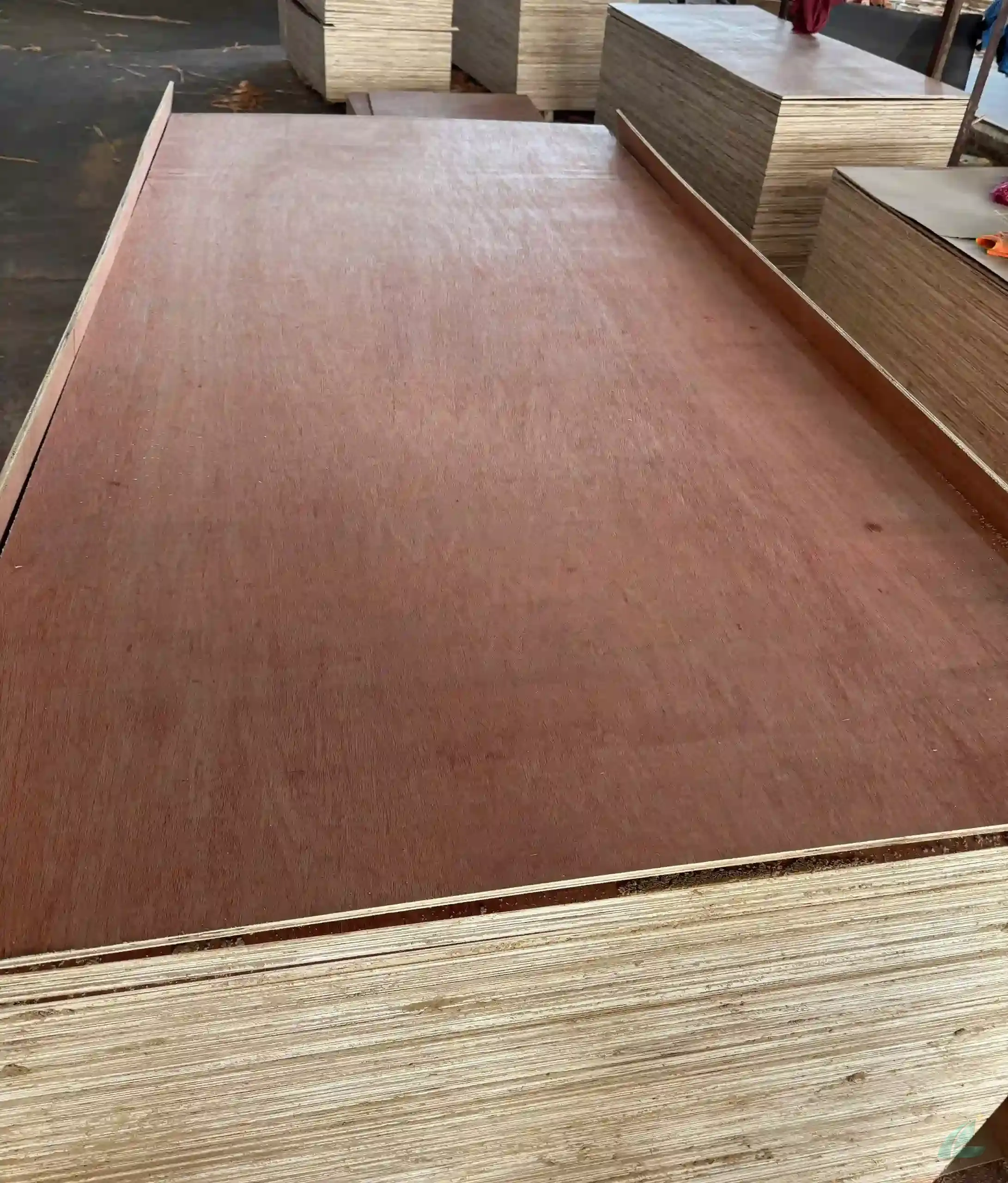 Bintangor commercial-grade plywood — the highest-volume type of plywood in Vietnam’s export market, sold across Africa, Korea, and Southeast Asia
Construction-Grade Plywood (Formwork)
Construction plywood is engineered for outdoor structural use — primarily concrete formwork, scaffolding platforms, truck flooring, and industrial decking. This segment requires waterproof bonding as a non-negotiable specification.
- Face: Phenolic or melamine film overlay (film faced plywood Vietnam), or anti-slip mesh texture (anti-slip plywood Vietnam)
- Core: Acacia (~580 kg/m3) or eucalyptus (650-750 kg/m3)
- Glue: Phenolic (WBP) — passes 72-hour boiling test
- Emission: Not applicable for exterior construction use
- Surface: Unsanded — film overlay applied directly to core
- Reusability: 6-10 times standard, 15-20+ times with premium film
- FOB price range: USD 300-520/CBM
Construction plywood uses WBP phenolic glue throughout the entire panel layup — face-to-core and core-to-core bond lines all share the same waterproof standard. MR (melamine) glue is not acceptable for formwork exposed to repeated concrete contact, rain, and pressure washing.
Marine-Grade Plywood
Marine plywood is a subset of construction-grade that meets specific standards for prolonged water immersion — boat building, yacht interiors, dock structures, and watercraft surfaces.
- Face: Okoume plywood Vietnam (traditional marine species) or birch plywood Vietnam with WBP bond
- Core: Styrax or eucalyptus, void-free construction
- Glue: Phenolic (WBP) — mandatory
- Standards: BS 1088 marine plywood specification
- Key property: Zero core voids, full cross-laminated bond integrity
Marine-grade plywood commands a premium because of stricter core quality requirements — no gaps, no overlaps, no voids anywhere in the cross-section. The face species must also accept marine-grade finishes (epoxy, marine varnish) without absorption issues.
Packing-Grade Plywood
Packing plywood Vietnam is manufactured for industrial packaging — pallets, crates, dunnage boards, and shipping containers. It is the lowest-cost plywood segment.
- Face: Bintangor C/D or poplar — character marks acceptable
- Core: Acacia (~580 kg/m3) or styrax (480-500 kg/m3), loose-laid or edge-jointed
- Glue: Melamine (MR)
- Emission: E2 — industrial use only
- Surface: Unsanded
- Lead time: 10-15 days (fastest in the range)
- FOB price range: From USD 220/CBM
Packing plywood is not a “lower quality furniture plywood” — it is a purpose-built product for structural packaging. The face veneer serves no decorative function. What matters is bond-line integrity under loading stress, ISPM 15 heat treatment compliance for international shipping, and the lowest possible cost per panel.
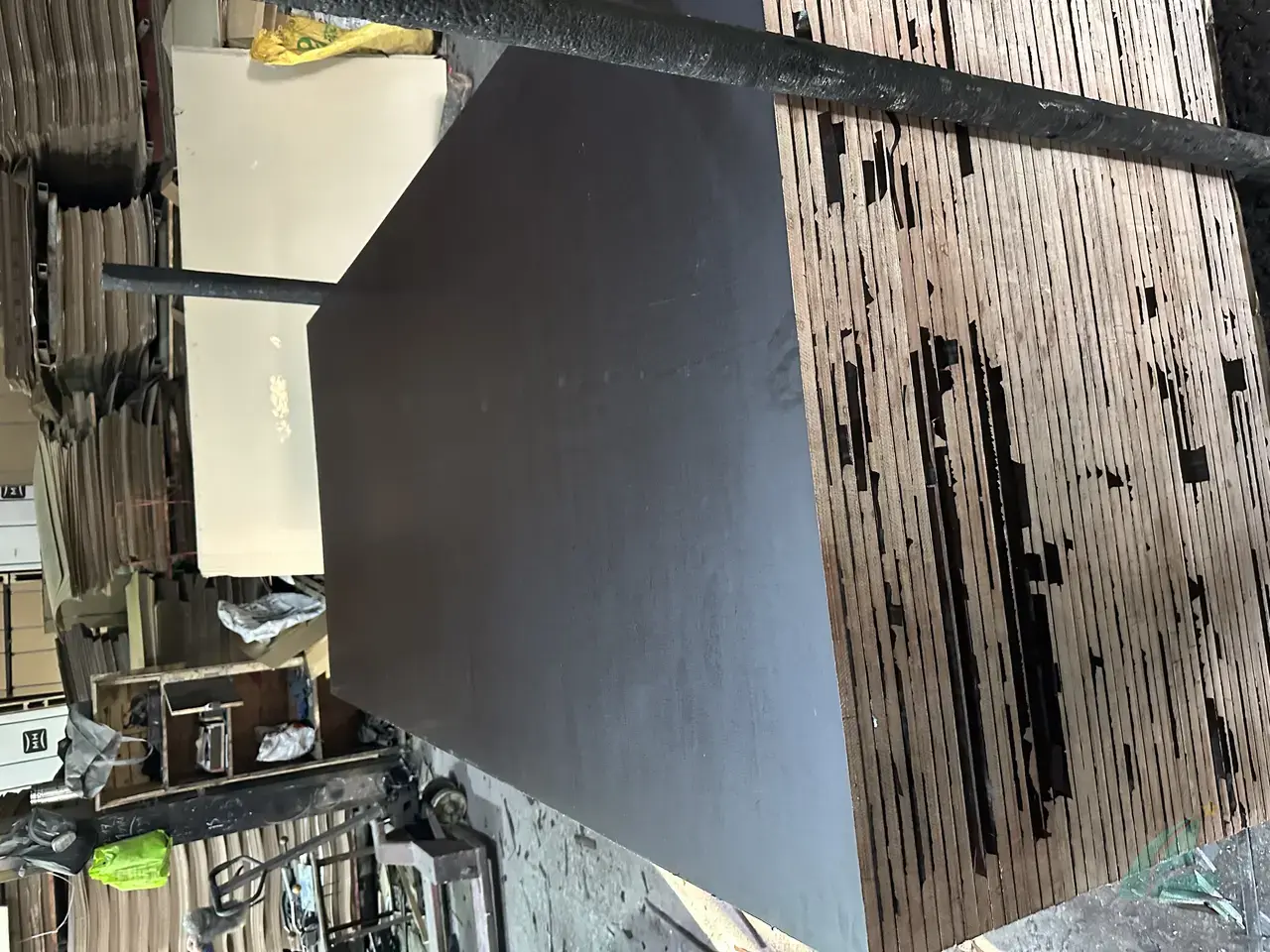 Film-faced construction plywood — phenolic WBP bonding, 8-18 reuses, the dominant construction type of plywood from Vietnam in 2026
🪵 Classification by Face Veneer — What Gives Plywood Its Name
In the global trade, plywood is named after its face veneer species. A panel with birch face veneer on acacia core is called “birch plywood” — regardless of what species the core contains. This naming convention is universal across all manufacturing countries.
Hardwood Face Veneers
| Face Species | Origin | Color/Appearance | Grade System | Price Level | Primary Market |
|---|---|---|---|---|---|
| Birch | Europe/NE Asia (imported) | Pale cream-white, very fine grain | D/E/F (D=best) | Highest | EU, Scandinavia, North America |
| Okoume | West Africa (imported) | Light pinkish-red, fine smooth grain | A/B, A/A | Medium | Europe, Australia, marine |
| Gurjan | Southeast Asia | Rich reddish-brown | A/B | Medium-high | India, UAE, South Asia |
| Bintangor | Southeast Asia | Tan-orange, open grain | A/B | Lowest | Africa, SE Asia, Korea |
| Eucalyptus | Vietnam (domestic) | Light yellow-brown | A/B | Medium | Versatile, all markets |
Softwood Face Veneers
| Face Species | Origin | Color/Appearance | Price Level | Primary Use |
|---|---|---|---|---|
| Pine | Vietnam/imported | Light yellow, visible knots | Medium | Decorative, packaging |
| Poplar | Vietnam/imported | White to pale yellow | Medium | Premium interiors, luxury packaging |
Engineered and Overlay Face Types
| Face Type | Description | Surface Finish | Primary Use |
|---|---|---|---|
| EV (Engineered Veneer) | Reconstructed wood veneer — uniform pattern, no natural defects | Sanded, consistent grain | Modern furniture, cabinets |
| Film Faced | Phenolic or melamine film overlay (120-220 g/m2) | Smooth, sealed, reusable | Concrete formwork, shuttering |
| Anti-Slip | Hexagonal wire-mesh textured film | Textured, high-grip | Truck floors, scaffolding, ramps |
| Matt | Unfaced raw core substrate — no face veneer applied | Unsanded raw surface | Lamination substrate, veneering base |
Common misconception: Matt plywood is NOT melamine with a matt finish. Matt plywood is an unfaced, unsanded raw core panel — a substrate intended for further processing (HPL lamination, veneer pressing, melamine paper bonding). It has no decorative function in its supplied state.
Face Veneer Thickness
All face veneers manufactured at HCPLY Vietnam are applied at 0.2-0.4mm thickness. This is the standard production range across Vietnamese plywood factories. The face veneer contributes appearance and surface properties — the core species determines density, weight, and structural performance.
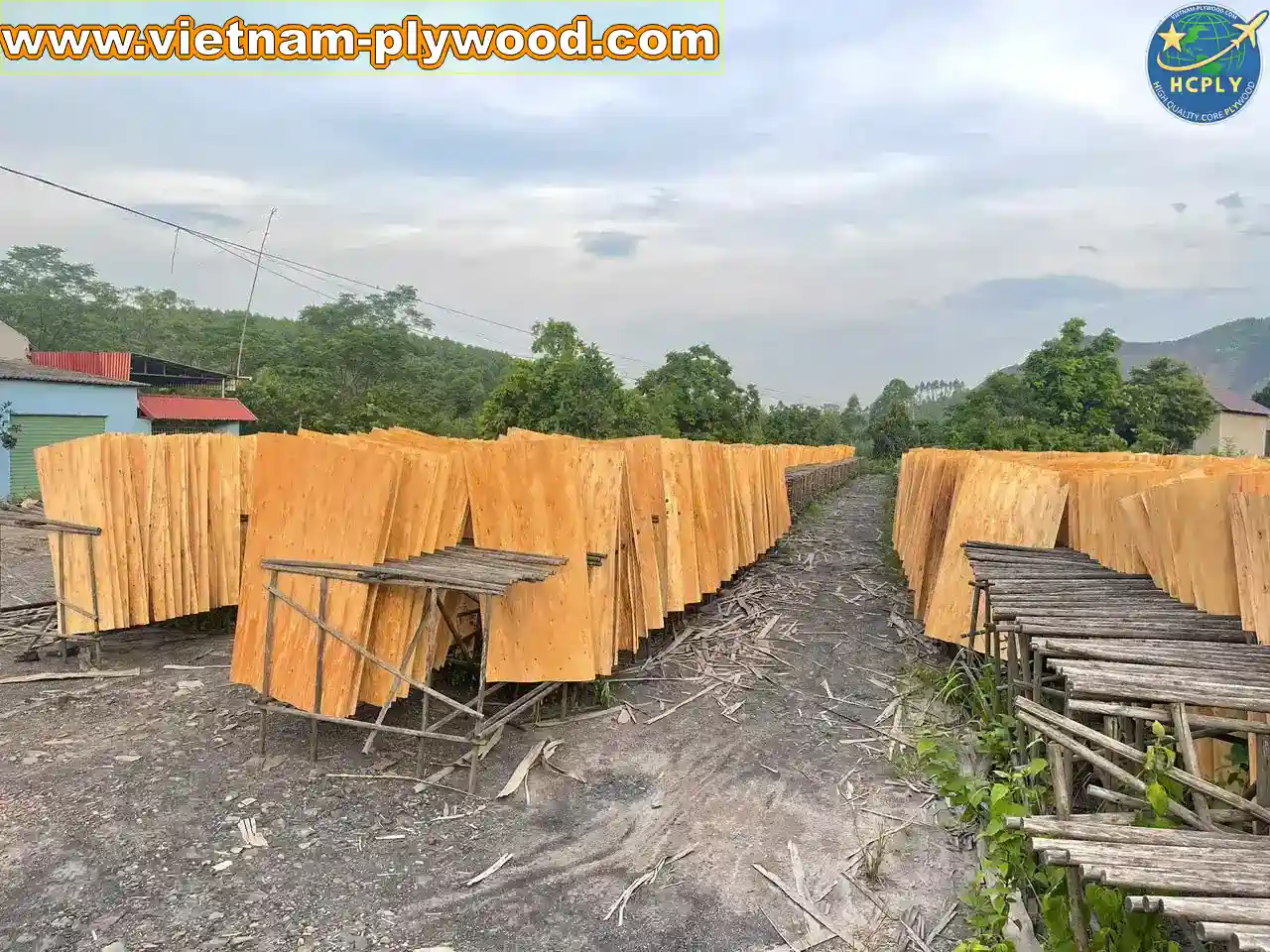
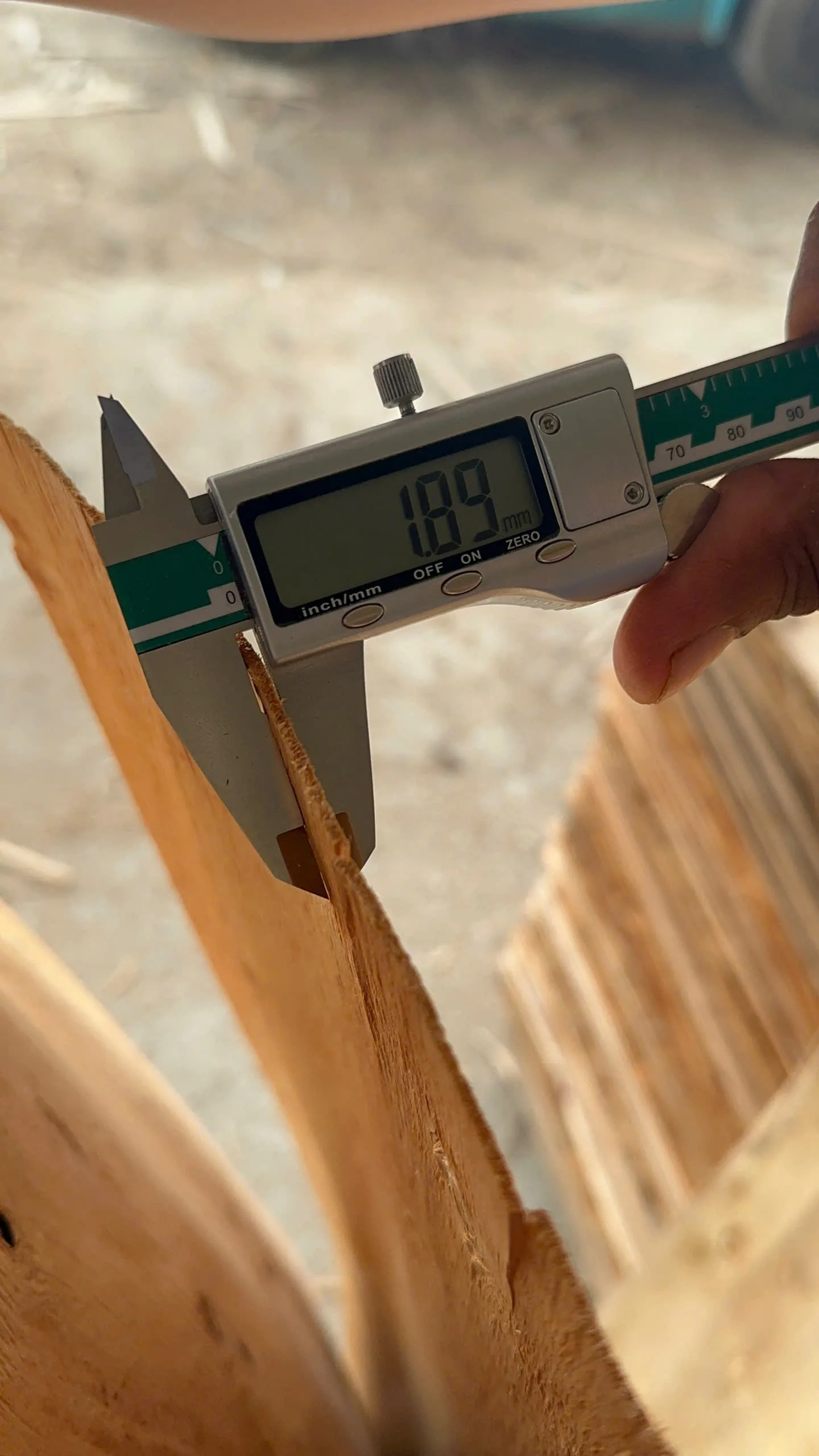 Core veneer QC inspection — species verification is mandatory for correct density specification and container loading calculations
🔩 Classification by Core Species — What Determines Density and Cost
Core species is the single most important factor determining plywood panel weight, density, container loading efficiency, and a significant portion of the panel price. Vietnam’s plywood industry uses three core species — each from domestic plantation timber.
| Core Species | Density | Weight/Sheet (18mm, 1220x2440) | Pallets/40HC | CBM/40HC | Character |
|---|---|---|---|---|---|
| Styrax (bo de) | 480-500 kg/m3 | ~26-28 kg | 18 | ~53 CBM | Lightest, white, CNC-friendly |
| Acacia (keo) | ~580 kg/m3 | ~29-33 kg | 16 | ~47.5 CBM | Mid-weight, dark tan, most common |
| Eucalyptus (bach dan) | 650-750 kg/m3 | ~38-45 kg | 15 | ~44.5 CBM | Heaviest, densest, strongest |
Core Construction Methods
The internal construction of the core — how veneer layers are assembled before pressing — is a critical quality differentiator that directly affects panel flatness, bond integrity, and price.
| Construction | Quality | Description | Typical Application |
|---|---|---|---|
| Full stitched | Highest | All veneer layers machine-stitched edge-to-edge, zero gaps | Furniture, cabinet, marine |
| Stitched outer + edge-trimmed inner | Good | Outer plies stitched, inner plies trimmed for cost optimization | Mid-range furniture |
| Finger-jointed | Medium | Core veneers joined with interlocking finger joints | Commercial grade |
| Loose-laid | Basic | Veneers laid overlapping without joining | Packing, low-cost commercial |
Factory segmentation insight: Premium furniture factories in Vietnam use full-stitched core construction across all layers. Commercial and packing factories use loose-laid or finger-jointed cores. These are different factory types with different equipment, different workforce skills, and different price structures. A single factory cannot efficiently produce both. See the full factory segmentation guide for details.
Core Selection Rules
- Vietnam core species are ONLY: acacia, eucalyptus, and styrax. There is no gurjan core, no birch core, no okoume core, and no hopea core produced in Vietnam
- Styrax is exclusive to Northern Vietnam — it is not available from factories in Southern Vietnam. See the regional map guide
- Density depends on core, not face — a birch face panel on styrax core weighs the same as an okoume face panel on styrax core (within tolerance)
- Container loading is core-dependent — styrax maximizes CBM/container (lightest), eucalyptus minimizes it (heaviest, hits payload limit first). Detailed calculations in the container packing guide
🧪 Classification by Glue Type — Water Resistance
Glue type determines water resistance performance. There are exactly two glue systems used in Vietnamese plywood production:
| Glue Type | Trade Name | Boil Test | Water Resistance | Application |
|---|---|---|---|---|
| Melamine | MR (Moisture Resistant) | 12 hours | Moisture-resistant — interior use | Furniture, cabinets, commercial, packing |
| Phenolic | WBP (Water Boiled Proof) | 72 hours | Waterproof — exterior/marine | Construction formwork, marine, anti-slip, truck floors |
Critical Rule: Glue Type Is NOT Emission Standard
This is the single most misunderstood concept in plywood trade. Glue type (MR or WBP) and emission standard (E0, E1, E2) are two completely independent classification axes.
- Correct specification: “Glue: Melamine (MR). Emission: E0.”
- Correct specification: “Glue: Phenolic (WBP). Emission: E1.”
- Incorrect: “Glue: MR, E0, E2” — this confuses two separate concepts
- Incorrect: “E0 glue” — E0 is an emission standard, not a glue type
- Incorrect: “WBP = low emission” — WBP describes water resistance, not formaldehyde output
Both MR and WBP glue can be manufactured to meet E0, E1, or E2 emission standards. The glue chemistry determines water resistance. The formaldehyde content in the glue formulation determines emission class. They are adjusted independently during manufacturing.
For a complete breakdown of this topic, see the glue types and emission standards guide.
🌿 Classification by Emission Standard — Formaldehyde Control
Emission standards regulate the amount of formaldehyde released from bonded wood products. They exist to protect indoor air quality and are enforced by import regulations in destination markets.
| Standard | Formaldehyde Limit | Market Requirement | Typical Application |
|---|---|---|---|
| E0 / CARB P2 | ≤0.5 mg/L | USA (mandatory), EU (premium), Japan, Korea, Australia | Furniture, cabinets, interior panels |
| E1 | ≤1.5 mg/L | EU (standard), general international | Furniture, commercial interiors |
| E2 | ≤5.0 mg/L | Asia (budget markets), industrial | Packing, industrial, non-residential |
Market-Specific Requirements
- United States: CARB P2 (equivalent to E0) is mandatory under the Toxic Substances Control Act (TSCA Title VI) for all hardwood plywood sold domestically
- European Union: E1 is the minimum standard for indoor use. E0 is increasingly specified by premium furniture OEMs
- Japan / Korea: JIS F**** (equivalent to E0) is required for residential and commercial interior products
- India / Southeast Asia / Africa: E2 is commonly accepted for general-purpose plywood
- Packing / Industrial: No emission requirement for packaging that does not enter enclosed living spaces
Buyer action: When requesting a quotation, always specify emission standard separately from glue type. Write: “Glue: MR. Emission: E0” — not “E0 MR glue.” This prevents specification misunderstandings that lead to incorrect production and rejected shipments.
⭐ Classification by Grade — Surface Quality Standards
Plywood grading systems classify the visual quality of face and back veneer surfaces. Different species use different grading conventions — a frequent source of confusion for international buyers.
Standard Grading (Most Species)
Used for bintangor, okoume, gurjan, pine, poplar, eucalyptus, and EV plywood:
| Grade | Face Quality | Back Quality | Typical Application |
|---|---|---|---|
| A/A | Clear face, no defects | Clear back, no defects | Premium furniture (both sides visible) |
| A/B | Clear face | Minor defects, small repairs | Standard furniture (one visible side) |
| B/B | Minor defects on both sides | Minor defects on both sides | Commercial, secondary furniture |
| B/C or BB/CC | Minor face defects | Character marks, repairs | General commercial, budget |
| C/D | Open defects permitted | Knots, splits, repairs | Packing, industrial |
Birch Grading — Different System
Birch plywood Vietnam uses a fundamentally different grading system: D/E/F where D is the best quality available in Vietnam-manufactured panels.
| Grade | Description | Application |
|---|---|---|
| D | Best available — minimal knots, tight grain, smooth sanded | Premium furniture, CNC routing, cabinets |
| E | Small knots and minor grain irregularities permitted | Standard furniture, commercial interiors |
| F | Commercial quality — visible knots, surface variation | Budget applications, backing panels |
Warning: The D/E/F system is different from the B/BB, BB/CP, CP/CP convention used by European Baltic birch manufacturers. HCPLY can provide sample panels for visual grade comparison before your first container order.
Film Faced and Anti-Slip — No Traditional Grading
Film faced plywood Vietnam and anti-slip plywood Vietnam are not graded by face veneer quality because the face is covered by a film overlay. Quality classification for these products focuses on:
- Film type and weight (phenolic 120-140 g/m2, Dynea 160-220 g/m2, melamine 80-120 g/m2)
- Core construction quality
- Glue bond integrity (WBP standard)
- Reuse cycle count (6-10 standard, 15-20+ premium)
📐 Classification by Size and Thickness
Standard Sheet Sizes
| Size (mm) | Size (ft) | Market |
|---|---|---|
| 1220 x 2440 | 4 x 8 | Most common globally |
| 1250 x 2500 | Metric | European markets |
| 1220 x 2135 | 4 x 7 | Selected markets |
| 1220 x 1830 | 4 x 6 | Packing, compact applications |
| 915 x 2440 | 3 x 8 | Selected markets |
| 915 x 1830 | 3 x 6 | Packing, small crates |
Custom cutting is available from HCPLY for all sheet sizes.
Thickness Range
- Production range: 3-40mm
- Common thicknesses: 3, 5, 9, 12, 15, 18, 21, 25mm
- Thickness tolerance: ±0.3mm
- Length/width tolerance: ±2mm
Thickness selection depends on application requirements and container loading economics. Thinner panels load more sheets per pallet (and per container), while thicker panels provide greater structural rigidity. Detailed packing calculations by thickness are available in the container packing calculation guide.
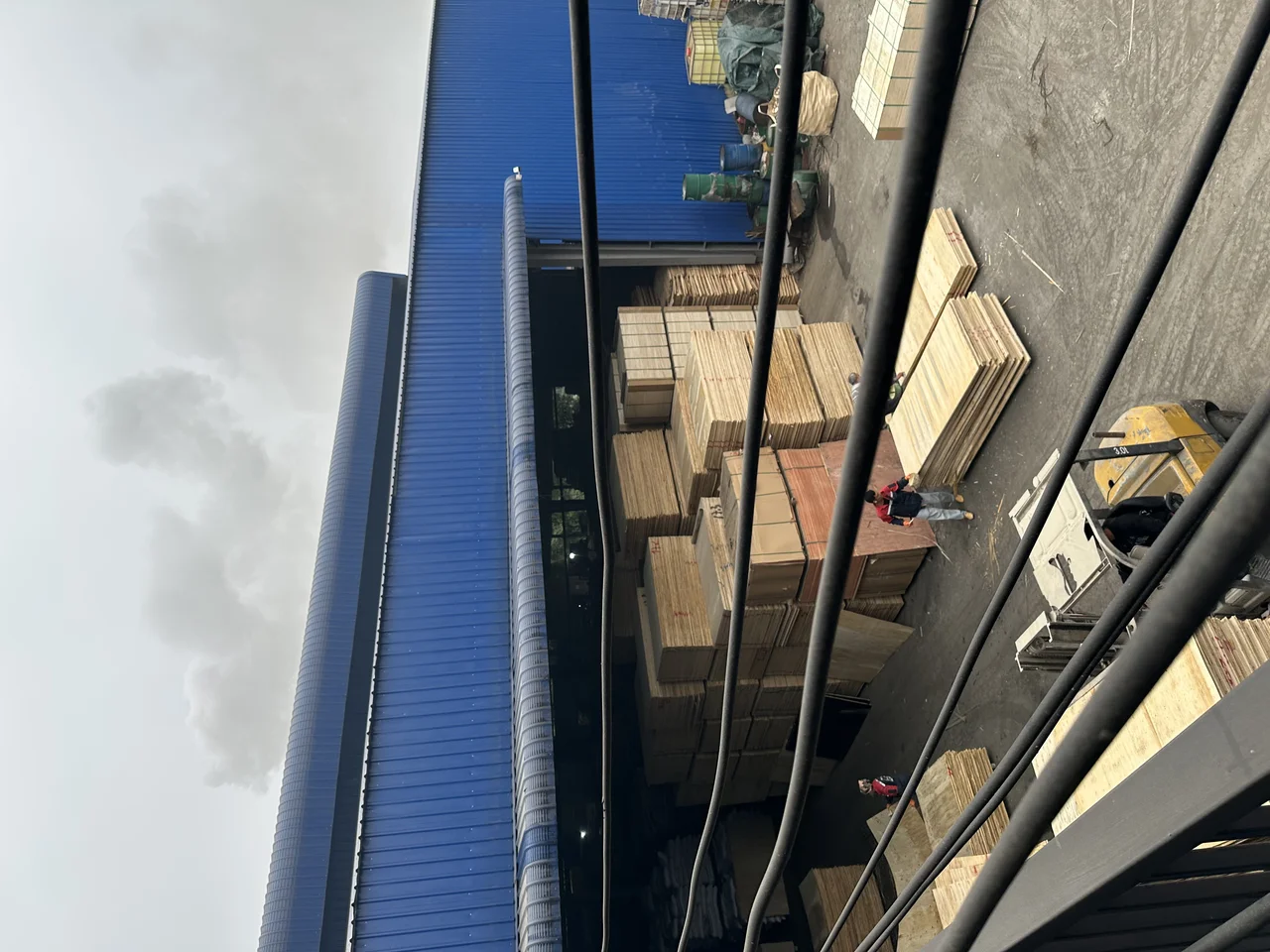
 Forklift loading pallets into 40HC container — container economics vary significantly by core species and type of plywood
Request a 2026 product catalog with all types of plywood, specifications, and FOB pricing
📊 Decision Matrix — “I Need Plywood for X”
This matrix translates application requirements into specific plywood specifications. Each row represents a real buyer scenario with the recommended specification from HCPLY Vietnam.
| Application | Recommended Face | Core | Glue | Emission | Sanding | FOB Range |
|---|---|---|---|---|---|---|
| Kitchen cabinets | Birch D, EV, okoume BB | Styrax or eucalyptus | MR | E0 | Sanded | $350-580 |
| Bedroom wardrobes | Okoume BB, EV | Styrax | MR | E0/E1 | Sanded | $300-480 |
| Drawer boxes | Birch D, poplar | Styrax | MR | E0 | Sanded | $350-520 |
| Office furniture | Bintangor A/B, EV | Acacia or styrax | MR | E1 | Sanded | $280-420 |
| Retail shopfitting | Bintangor B, okoume BB | Styrax or acacia | MR | E1 | Light sand | $260-400 |
| Concrete formwork | Film faced (phenolic) | Acacia or eucalyptus | WBP | N/A | Unsanded | $300-480 |
| Scaffolding platforms | Anti-slip film | Eucalyptus | WBP | N/A | Unsanded | $350-520 |
| Truck/trailer floors | Film faced or anti-slip | Eucalyptus | WBP | N/A | Unsanded | $350-520 |
| Boat building | Okoume A/A | Styrax or eucalyptus | WBP | E1 | Sanded | $350-480 |
| Pallets and crates | Bintangor C/D, poplar | Acacia or styrax | MR | E2 | Unsanded | $220-340 |
| Lamination substrate | Matt (unfaced) | Styrax or eucalyptus | MR | E0/E1 | Unsanded | $250-380 |
| Door skins | Okoume, bintangor | Styrax or acacia | MR | E1 | Sanded | $280-420 |
| Wall paneling | Okoume, EV, pine | Styrax | MR | E0/E1 | Sanded | $300-480 |
| Export packaging | Packing grade | Acacia | MR | E2 | Unsanded | $220-300 |
First-time buyers: If you are unsure which specification matches your application, the fastest path is to send your requirements (application, destination market, thickness, quantity) to HCPLY. The export team will recommend a specific face, core, glue, and emission combination within 12 hours. Contact at /contact/.
🔍 Price Tier Hierarchy — Understanding the Cost Ladder
The types of plywood form a clear price hierarchy driven by face veneer cost, core construction complexity, glue system, and emission certification requirements.
From lowest to highest cost (FOB Vietnam):
-
Packing grade — USD 220-340/CBM
- Bintangor C/D or poplar face, acacia core, MR glue, E2, unsanded
- Purpose: pallets, crates, industrial packaging only
-
Commercial grade — USD 250-400/CBM
- Bintangor B/C or poplar face, acacia or styrax core, MR glue, E1/E2, light sand
- Purpose: general interior, partitions, backing panels
-
Construction grade (film faced) — USD 300-480/CBM
- Phenolic film face, acacia or eucalyptus core, WBP glue, unsanded
- Purpose: concrete formwork, reusable 6-18+ times
-
Furniture grade (standard) — USD 300-480/CBM
- Okoume, bintangor A, eucalyptus, pine face, styrax or eucalyptus core, MR, E0/E1, sanded
- Purpose: furniture, cabinets, interior decorative panels
-
Furniture grade (premium) — USD 350-580/CBM
- Birch D, gurjan A, EV face, styrax or eucalyptus core, MR or WBP, E0, sanded
- Purpose: premium furniture, CNC routing, high-end cabinets
-
Marine grade — USD 350-520/CBM
- Okoume A/A or birch with WBP phenolic, void-free core
- Purpose: boat building, yacht interiors, marine structures
Why construction-grade can cost more than standard furniture: Film faced plywood requires WBP phenolic glue (more expensive than MR), specific film overlay material (imported for premium grades), and eucalyptus core (densest and most expensive). Buyers who compare film faced panels against MR-bonded furniture panels may find construction plywood priced higher — this is normal and reflects the waterproof specification.
❌ Common Misconceptions — What Is NOT Plywood
Several engineered wood products are frequently confused with plywood by international buyers. These products have fundamentally different construction, properties, and applications.
MDF Is Not Plywood
MDF (Medium Density Fiberboard) is made from wood fibers compressed under heat with synthetic resin. It has no veneer layers, no grain direction, and no cross-laminated strength. MDF is useful for painted surfaces, CNC profiles, and non-structural decorative panels. It cannot replace plywood for structural, marine, load-bearing, or screw-holding applications. MDF absorbs water rapidly and swells irreversibly — it has zero moisture resistance.
LVL Is Not Plywood
LVL (Laminated Veneer Lumber) is made from wood veneers, but all veneers run in the SAME grain direction. Plywood alternates grain direction between layers (cross-lamination). LVL is a structural beam material — strong in one direction for headers, joists, and beams. It is not used as a sheet material for panels, cabinets, or formwork.
Blockboard Is Not Plywood
Blockboard consists of a core made from solid wood strips (not veneers) sandwiched between thin face veneers. It is lighter than plywood of equal thickness but weaker in cross-grain strength. Blockboard is used for flush doors and lightweight panels — not for structural, marine, or furniture applications where plywood performance is required.
Particle Board / Chipboard Is Not Plywood
Particle board is made from compressed wood chips and resin. Like MDF, it has no veneer layers and no cross-grain strength. It is the lowest-cost engineered panel but cannot substitute for plywood in any application requiring moisture resistance, screw-holding, or structural performance.
🏭 How HCPLY Covers the Full Plywood Spectrum
HCPLY manages 3 specialized production facilities in Northern Vietnam. Each facility is purpose-built for specific types of plywood — because different plywood categories require different factory equipment, different core construction methods, different quality control processes, and different workforce skills.
Facility 1 — Premium furniture plywood:
- Styrax and eucalyptus core, full-stitched construction
- E0/E1 emission, sanded finish
- Face options: birch, okoume, EV, gurjan, pine, poplar, eucalyptus
- Markets: EU, US, Japan, Korea, Australia
- Certifications: FSC, CARB P2, CE, ISO 9001, EUDR
Facility 2 — Commercial and packing plywood:
- Acacia core, edge-jointed or loose-laid construction
- MR glue, E1/E2 emission
- Face options: bintangor, poplar, pine
- Markets: Korea, Southeast Asia, Africa, India
- Optimized for high-volume, competitive pricing
Facility 3 — Premium film faced and construction plywood:
- Eucalyptus and acacia core, stitched construction
- WBP phenolic glue, AICA film (135+ gsm)
- Reuse: 15-20+ times
- Markets: EU, Australia, Korea, Japan, Middle East
- Anti-slip plywood also produced at this facility
This multi-facility model means HCPLY can supply all types of plywood from a single export contact point — without the quality inconsistency that occurs when a single factory attempts to produce across all segments. Each facility operates within its specialization. On-site QC teams verify production at each location.
For a complete understanding of how Vietnamese plywood factories segment by product type, see the factory types guide.
📦 Summary Reference Table — All Types of Plywood at a Glance
| Type | Face | Core | Glue | Emission | Sanded | Price Tier |
|---|---|---|---|---|---|---|
| Furniture (premium) | Birch D, gurjan A, EV | Styrax, eucalyptus | MR | E0 | Yes | $$$$$ |
| Furniture (standard) | Okoume BB, eucalyptus A | Styrax, eucalyptus | MR | E0/E1 | Yes | $$$$ |
| Marine | Okoume A/A, birch | Styrax, eucalyptus | WBP | E0/E1 | Yes | $$$$ |
| Film faced | Phenolic/Dynea film | Acacia, eucalyptus | WBP | N/A | No | $$$ |
| Anti-slip | Mesh textured film | Acacia, eucalyptus | WBP | N/A | No | $$$ |
| Commercial | Bintangor B, poplar | Acacia, styrax | MR | E1/E2 | Light | $$ |
| Matt (substrate) | Unfaced raw core | Styrax, eucalyptus, acacia | MR | E0/E1 | No | $$ |
| Packing | Bintangor C/D, poplar | Acacia, styrax | MR | E2 | No | $ |
📝 How to Specify Plywood Correctly in a Quotation Request
A complete plywood specification for a purchase inquiry should include all six classification dimensions. Incomplete specifications lead to quotation misunderstandings, production errors, and shipment rejections.
Example — complete specification:
Product: Birch Plywood
Face: Birch D grade, both sides
Core: Styrax
Glue: Melamine (MR)
Emission: E0 / CARB P2
Thickness: 18mm
Size: 1220 x 2440mm
Quantity: 1 x 40HC container
Destination: Rotterdam, Netherlands
What to avoid:
- “Waterproof plywood” without specifying WBP or MR
- “E0 glue” — E0 is emission, not glue
- “Best quality” — specify grade (A/B for okoume/bintangor/gurjan; D/E for birch)
- “Standard plywood” — standard differs between markets
- “Same as last shipment” on a first order — provide full specification
For a detailed walkthrough of the quotation process, read the plywood quotation guide.
🔗 Explore Specific Types of Plywood from HCPLY Vietnam
By Product
- Birch Plywood Vietnam — D/E/F grade, CARB P2, Baltic alternative
- Okoume Plywood Vietnam — Lightweight, marine-ready, European market
- Bintangor Plywood Vietnam — Most affordable hardwood face
- Gurjan Plywood Vietnam — Premium reddish-brown, India specialist
- Pine Plywood Vietnam — Decorative softwood face
- Poplar Plywood Vietnam — White premium, luxury packaging
- Eucalyptus Plywood Vietnam — Versatile domestic face
- EV Plywood Vietnam — Engineered veneer, consistent grain
- Film Faced Plywood Vietnam — Concrete formwork, reusable
- Anti-Slip Plywood Vietnam — Truck floors, scaffolding
- Matt Plywood Vietnam — Raw substrate for lamination
- Packing Plywood Vietnam — Lowest cost, industrial packaging
- Core Veneer Vietnam — Raw veneer for plywood production
By Application Category
- Furniture Plywood — Kitchen, bedroom, office furniture panels
- Kitchen Cabinet Plywood — E0, moisture-resistant, sanded
- Commercial Plywood — General-purpose, budget interior
- Construction Plywood — Formwork, scaffolding, structural
- Packaging Plywood — Crates, pallets, export packaging
- Plywood Raw Materials — Core veneer, face veneer supply
Related Guides
- Vietnam Plywood Factory Types — Why different factories produce different types
- Vietnam Plywood Supplier Types — Trading companies, manufacturers, brokers
- Plywood Quotation Guide — Everything to know before requesting a price
- Plywood Container Packing Calculation — Factory-level 40HC loading data
- Plywood Glue Types and Emission Standards — MR vs WBP, E0/E1/E2 explained