

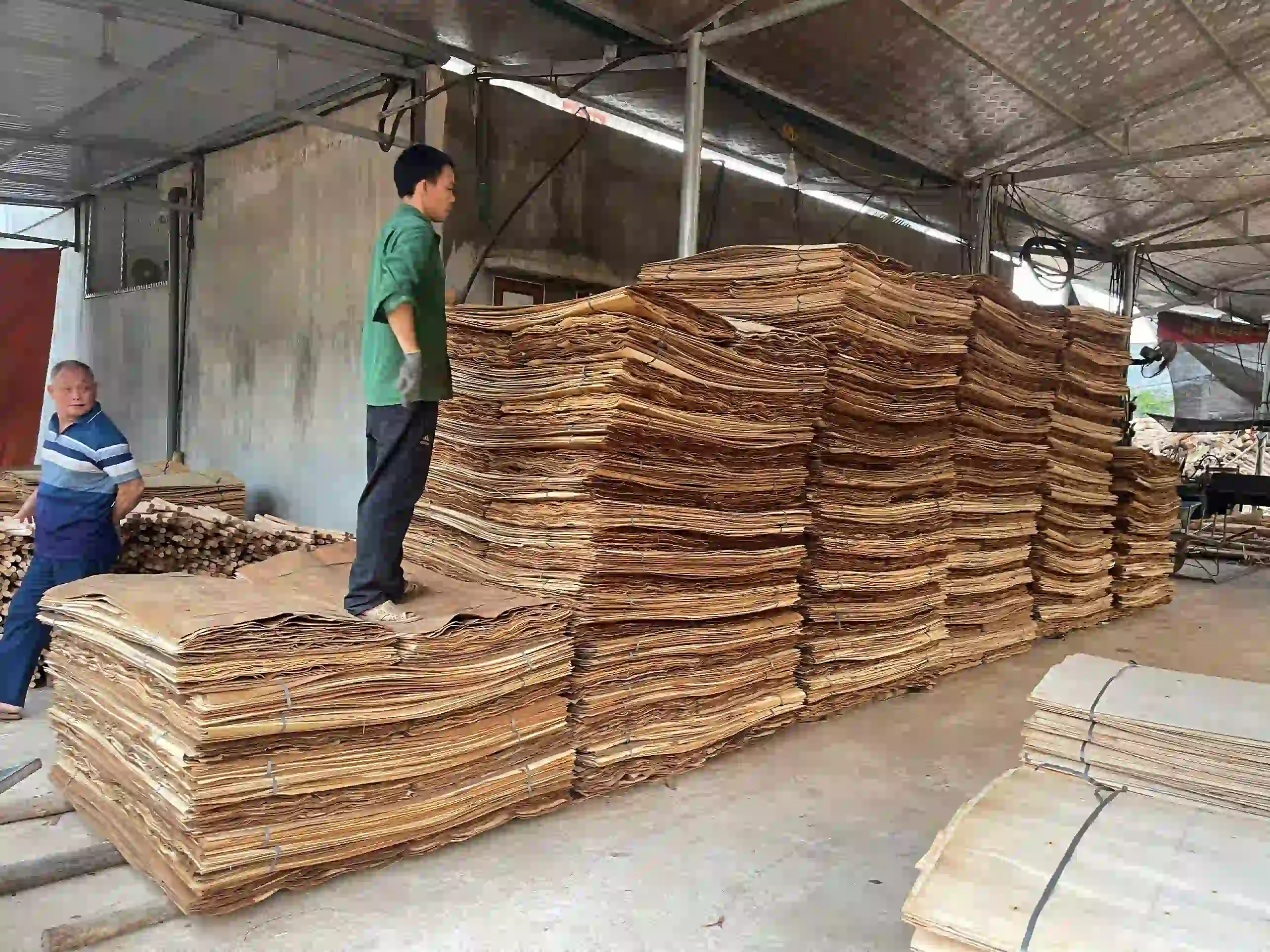
Plywood buyers frequently compare prices between suppliers and find significant differences for what looks like the same product. One 18mm birch-faced sheet from Supplier A costs 20% more than an identical-looking sheet from Supplier B — same face veneer, same species, same thickness. The difference is almost always whether the supplier used stitch core plywood construction or a cheaper alternative.
Stitch core plywood sits at the top of the four-tier quality hierarchy. Below it: edge-trimmed, finger-jointed, and loose-laid. Each method produces a visibly different cross-section and performs differently under load, moisture, and machining. Specifying the wrong tier for your application means either overpaying for quality you don’t need or receiving panels that fail in service.
This guide explains each construction method, how to identify them from a cross-section, what they cost relative to each other, and which end uses each suits. All data reflects HCPLY’s 2026 production standards across our three Northern Vietnam facilities.
📋 TL;DR: Core Construction Quality Comparison
| Method | Gap Control | Flatness | Relative Cost | Best For |
|---|---|---|---|---|
| Full Stitched | Zero gaps, all layers | Highest | +20–30% vs loose | Premium furniture, cabinets, EU/US/Japan/Korea |
| Stitched Outer + Edge-Trimmed Inner | Near zero | High | +10–15% vs loose | Commercial furniture, mid-range export |
| Finger-Jointed | Low | Medium | +5% vs loose | Budget formwork, structural panels |
| Loose-Laid | High (random) | Lowest | Baseline | Packing, pallets, non-critical structural |
⚠️ Important: Core construction is independent of core species. The same styrax core can be full stitched (premium) or loose-laid (budget). Always specify both species AND construction method when ordering.
🔧 What Is Stitch Core Plywood?
Stitch core plywood refers to panels where the core veneer strips are joined laterally — sewn side-by-side — using a stitching machine before the panel is assembled and pressed. The stitching thread holds the strips in precise alignment so there are no gaps, overlaps, or displaced edges in the finished core layer.
In Vietnamese factories, the stitching machine resembles an industrial sewing machine modified for wood veneer. Each strip passes through, and a continuous thread running perpendicular to the grain binds adjacent strips. The result is a consistent sheet that lies flat in the press and transfers load evenly across the panel’s surface.
The term “stitch core” is used loosely in some markets to mean any joined core construction. In technical factory language — and in this article — stitch core plywood refers specifically to panels with veneer-sewn core layers, as opposed to edge-trimmed, finger-jointed, or loose-laid methods.
💡 Key Insight: A stitch core layer in a 18mm panel might add USD 1.50–3.00/sheet over loose-laid construction. Over a 40HC container (approximately 1,200–1,800 sheets), that is USD 1,800–5,400. Premium buyers accept this because sanding yield, machining quality, and delamination risk all improve substantially.
⚙️ The Four Core Construction Methods
📌 Method 1 — Full Stitched Core (Highest Quality)
Full stitched core means every core layer — outer crossbands and inner plies — is machine-sewn before pressing. No gaps exist between veneer strips in any layer. After pressing, the cross-section shows clean, parallel strips with no visible voids.
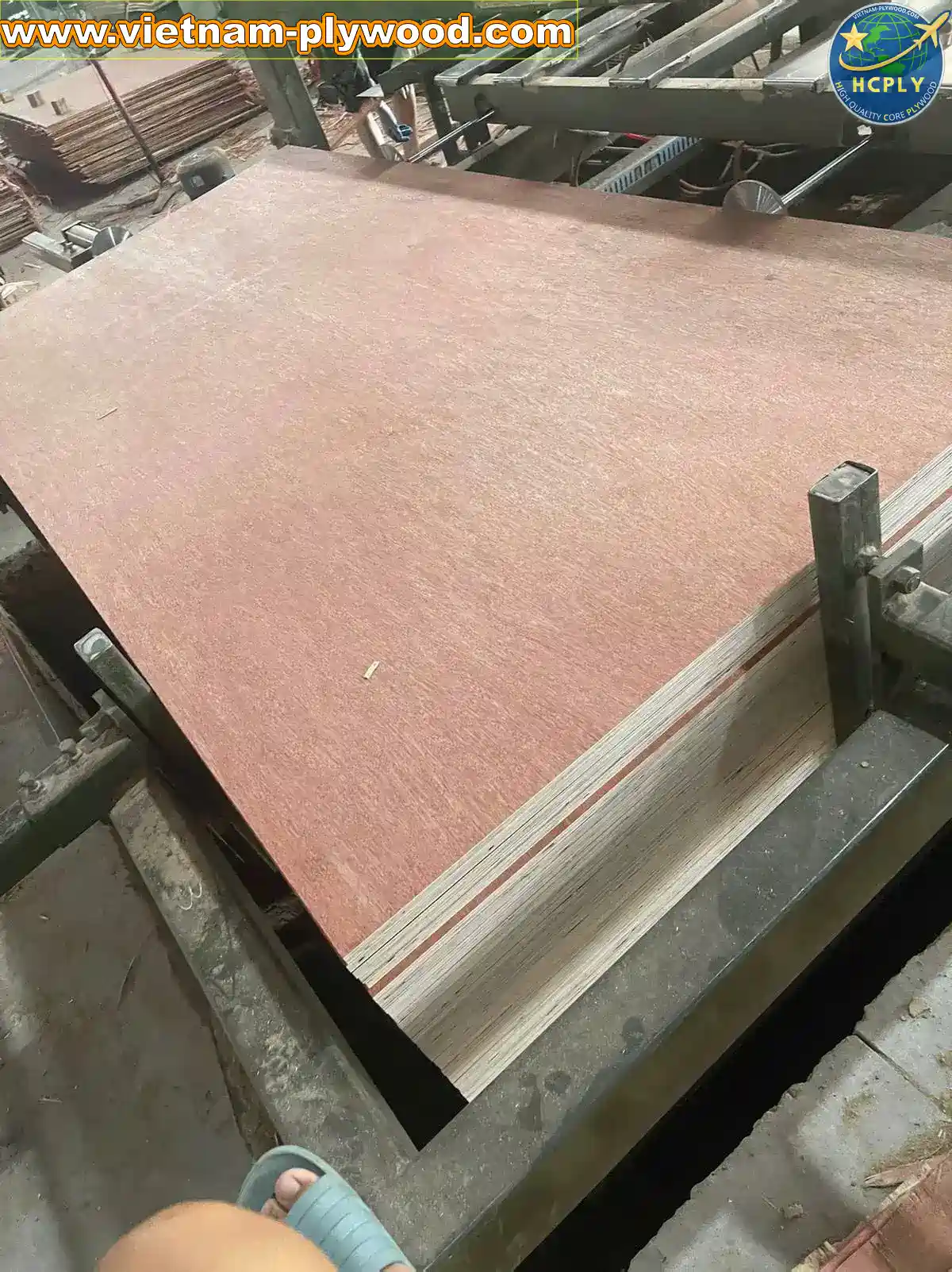
How to identify it: Cut a cross-section and examine the core layers under natural light. Full stitched panels show straight, consistent strip edges at every layer. No dark gaps, no offset strips.
Why it matters for buyers:
- Sanding is uniform — the press surface is flat because the core has no high/low spots from overlapping or gapping strips
- Thickness tolerance tightens — achievable ±0.2mm versus ±0.5mm for loose-laid
- Edge machining is clean — no voids at panel edges cause tear-out during routing or cutting
- Moisture resistance improves — gaps in core layers act as moisture channels; stitching eliminates them
HCPLY’s premium furniture production facility — dedicated to styrax and eucalyptus core panels targeting the EU, US, Korean, and Japanese markets — uses full stitched construction across all core layers as standard (HCPLY production data, 2026). This is the construction method specified when buyers order E0 sanded furniture-grade panels.
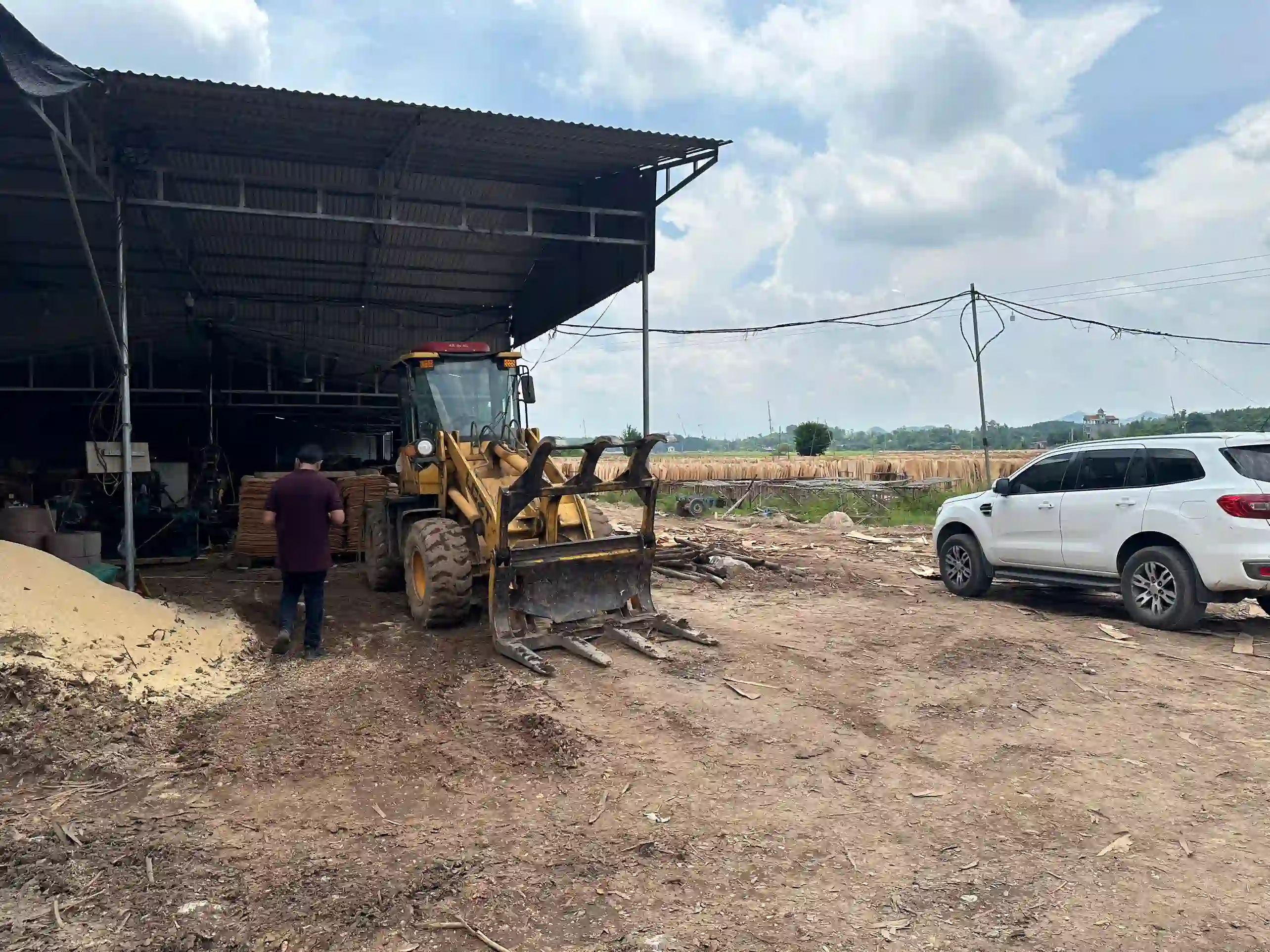
📌 Method 2 — Stitched Outer + Edge-Trimmed Inner
This construction stitches the two outer core layers (the crossbands immediately behind the face and back veneers) but uses edge-trimmed (mài mí) inner layers. Edge-trimmed means veneer strips are placed side-by-side and trimmed flush at their edges — they touch but are not sewn.
Performance: Very close to full stitched for most commercial furniture applications. The outer layers — which have the greatest influence on surface flatness — are sewn. The inner layers contribute mainly to panel stiffness rather than surface quality.
“For buyers in the commercial furniture and shop-fitting segment, stitched outer plus edge-trimmed inner is often the optimal specification — you get 90% of the performance of full stitched at roughly 85% of the price.” — Lucy, International Sales Manager, HCPLY
This is the standard construction at HCPLY’s commercial production facility, which serves mid-range furniture exporters, kitchen cabinet manufacturers, and shopfitting contractors across Southeast Asia, the Middle East, and India.
Relative cost: Approximately 10–15% premium over loose-laid baseline, compared to 20–30% for full stitched.
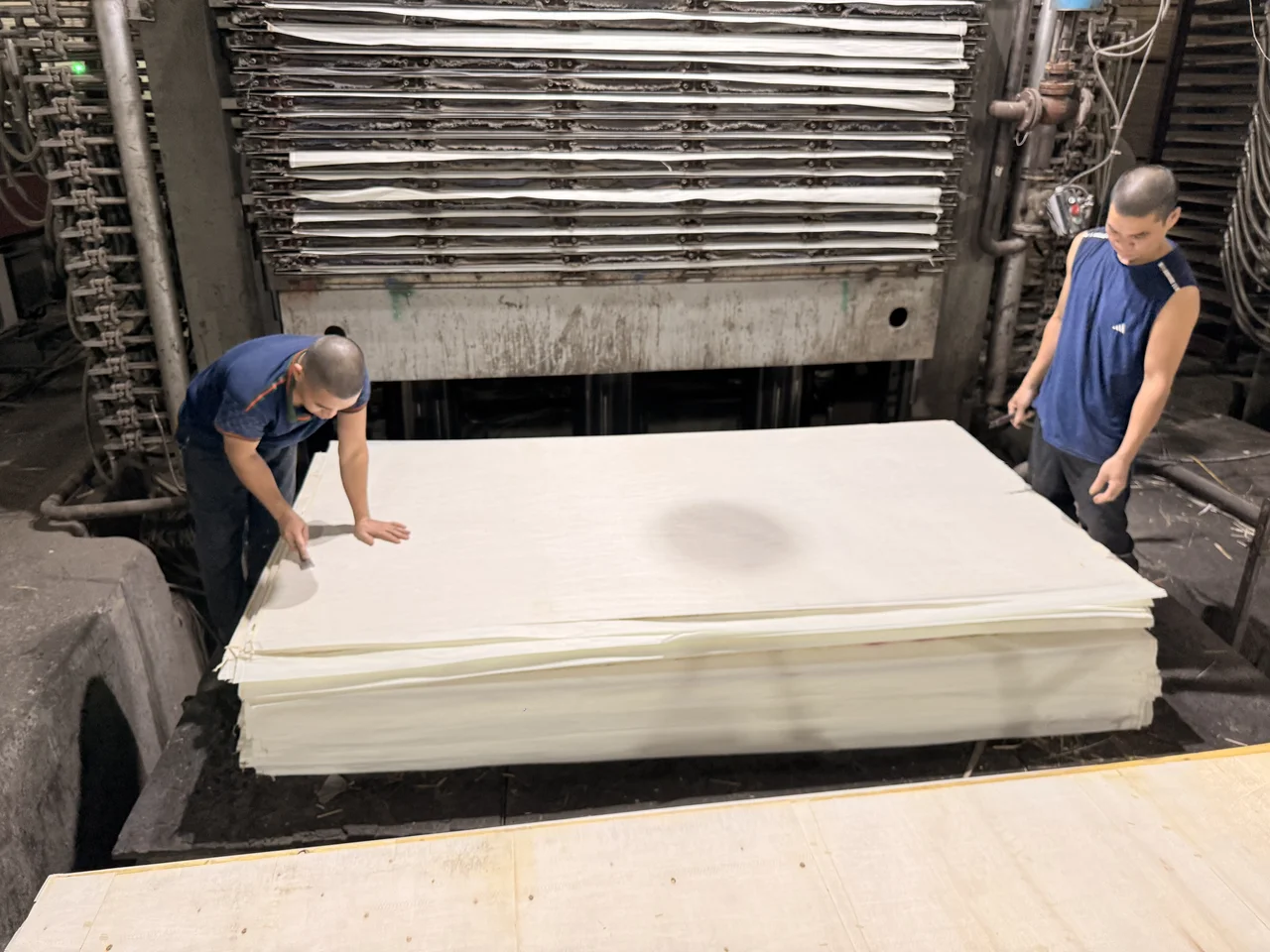
📌 Method 3 — Finger-Jointed Core
Finger-jointed core joins short veneer pieces end-to-end using interlocking triangular cuts machined into the veneer ends — similar to finger joints in timber framing. The joints allow strips of varying length to form a continuous layer. This differs fundamentally from stitch core, which joins strips side-by-side (laterally).
Finger-jointed construction is most common in film-faced plywood and concrete formwork panels where:
- Core material costs must be minimised (shorter offcuts can be used)
- Surface finish matters less than dimensional stability under repeated forming cycles
- Buyers are buying on reuse count per dollar, not surface aesthetics
Performance reality for importers: Finger-jointed core film-faced plywood typically achieves 3–6 reuses before delamination or surface failure (Shanghai Sindo Panel data, 2024). Full stitched film-faced plywood from HCPLY’s premium construction facility achieves 10–15+ reuses. If your concrete formwork project runs 10+ pours, full stitched panels have a lower total cost per pour despite the higher upfront price.
Where it falls short: Finger joints create stress concentration points under repeated bending loads. In panels used for flat furniture surfaces — particularly tabletops, cabinet shelving, or door blanks — the joint lines can telegraph through veneered faces under humidity cycling. Not recommended for sanded export furniture. Buyers who need a flat, stable surface should specify stitch core plywood rather than finger-jointed grades.
⚠️ Note: Suppliers selling “finger-jointed core furniture panels” as equivalent to stitched construction are misrepresenting quality. The joint pattern is identifiable in the cross-section — always request a cross-section photo before committing to a new supplier.
📌 Method 4 — Loose-Laid Core (Baseline Quality)
Loose-laid core (xếp chồng in Vietnamese factory terminology) places veneer strips side by side without any joining process. Strips may shift, overlap at edges, or leave gaps during assembly before the press cycle. Hot press pressure closes most gaps but cannot perfectly align displaced strips.
Result in the finished panel:
- Core gaps of 1–3mm are common, visible in cross-sections
- Thickness varies more — ±0.5mm is typical, some panels exceed ±0.8mm
- Face sanding pressure must be applied unevenly to flatten the surface, thinning face veneer over low spots
- Edge routing reveals voids — common complaint from CNC shops and cabinet makers
Where loose-laid is appropriate:
- Packing plywood and crating panels where structural load matters more than surface finish
- Pallet bases and packaging applications where the panel is cut once and not machined further
- Non-visible structural applications where thickness tolerance is secondary
Loose-laid construction is the baseline cost benchmark. All price premiums for higher construction methods are calculated relative to this baseline (HCPLY production data, 2026).
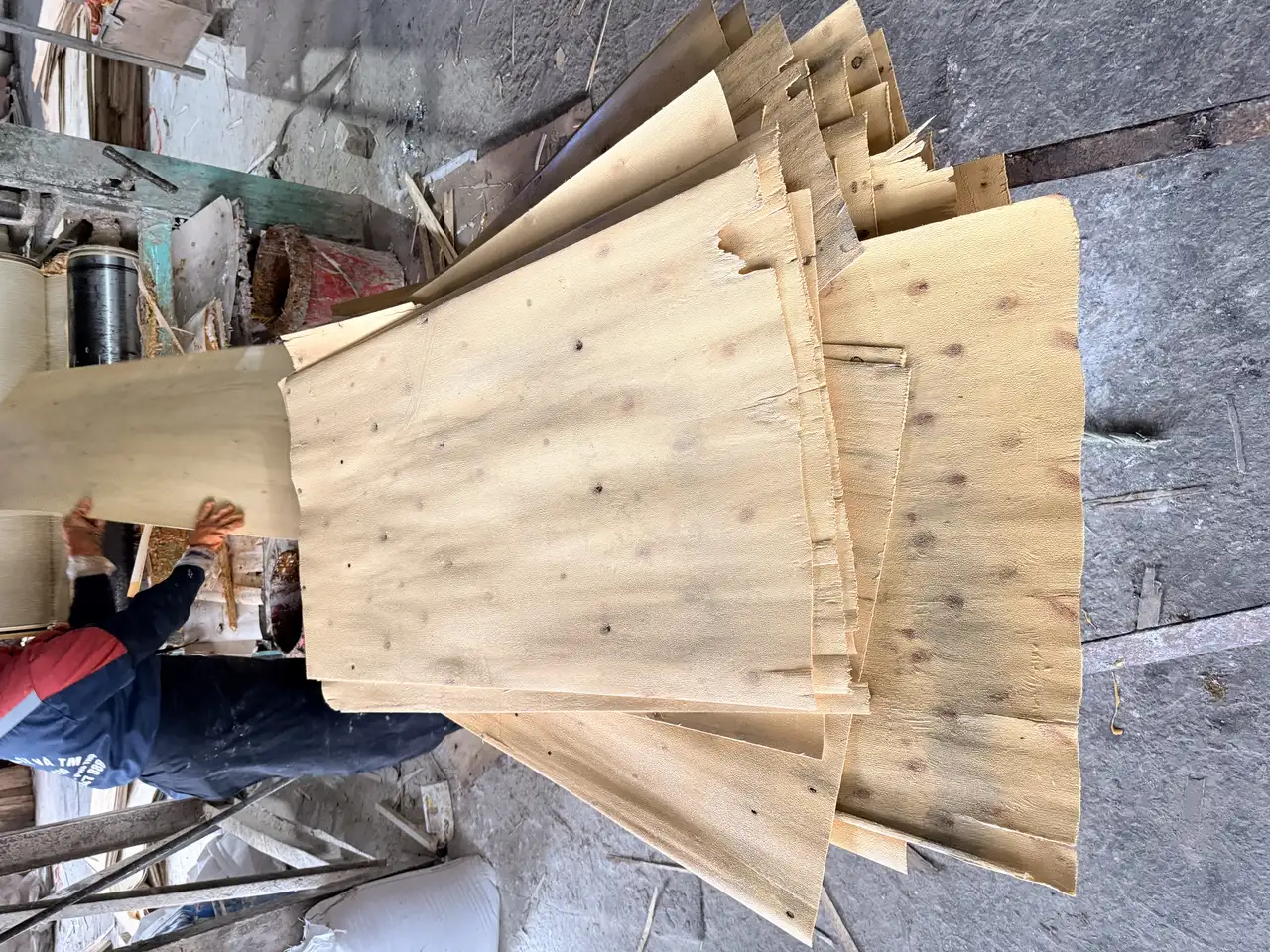
📊 How Core Construction Affects Downstream Performance
Understanding construction types in isolation is less useful than understanding their downstream effects on the applications buyers care about.
Surface Flatness and Sanding Yield
Sanding yield — the percentage of panels passing flatness inspection after wide-belt sanding — varies significantly by core construction. Full stitched core panels at HCPLY achieve a sanding pass rate of approximately 97%+ at our furniture facility. Loose-laid core panels at equivalent factories typically achieve 85–92% (HCPLY production data, 2026).
The panels that fail sanding either have visible waviness (cross-sections visible through thin face veneer under raking light) or have had face veneer thinned below 0.15mm in sanding — creating sand-through risk for the end user.
CNC routing and Edge Quality
Cabinet makers and furniture manufacturers routing dados, rabbets, and profiles rely on clean edges at panel edges. Loose-laid and finger-jointed cores produce random void patterns at edges. When a router bit hits a void, the unsupported veneer strips tear rather than cut cleanly.
Full stitched core panels machine consistently. CNC shops working with stitched core typically use the same cutting parameters across an entire batch — no mid-run adjustments for edge quality variation.
Delamination Resistance Under Moisture Cycling
Gap-free core construction reduces moisture ingress pathways. Glue penetrates into stitched joint areas during pressing, creating an additional bond along strip edges in addition to the primary face-to-core glue bond. This additional bond area contributes to delamination resistance in humid environments (European Panel Federation technical guidance, 2023).
💡 Key takeaway: For furniture shipped to humid markets — Southeast Asia, the Middle East, India’s coastal regions — specifying full stitched or stitched outer core adds meaningful protection against humidity-driven delamination during transit and in service.
🏭 How Factories Specify Core Construction by Production Line
HCPLY manages three specialised production facilities in Northern Vietnam’s Phu Tho Province, each optimised for a distinct market segment.
Facility 1 — Premium Furniture: Full stitched core standard across all layers. Styrax and eucalyptus cores. Sanded finish. E0 emission with CARB P2 and FSC certification available. Ships to EU, US, Korea, Japan, Australia.
Facility 2 — Commercial / Packing: Stitched outer + edge-trimmed inner for commercial furniture grades. Loose-laid for packing and crating panels. Acacia core primary. MR glue. competitive pricing for Middle East, India, Southeast Asia volumes.
Facility 3 — Film-Faced Construction: Full stitched core with eucalyptus/acacia Grade A. AICA film minimum 135gsm. Phenolic WBP glue. 15+ reuse rating. Ships to Korea, Japan, Europe, Australia.
Buyers placing cross-facility orders (e.g., premium furniture panels and packing plywood in the same shipment) receive factory-direct documentation from each respective facility, with no VAT overhead — pricing reflects the actual production facility’s cost structure.
Request samples with core cross-section photos from each facility
🔍 How to Verify Core Construction Before Ordering
Requesting a cross-section sample is the single most effective quality verification step when evaluating stitch core plywood or comparing construction grades from a new supplier. Ask for:
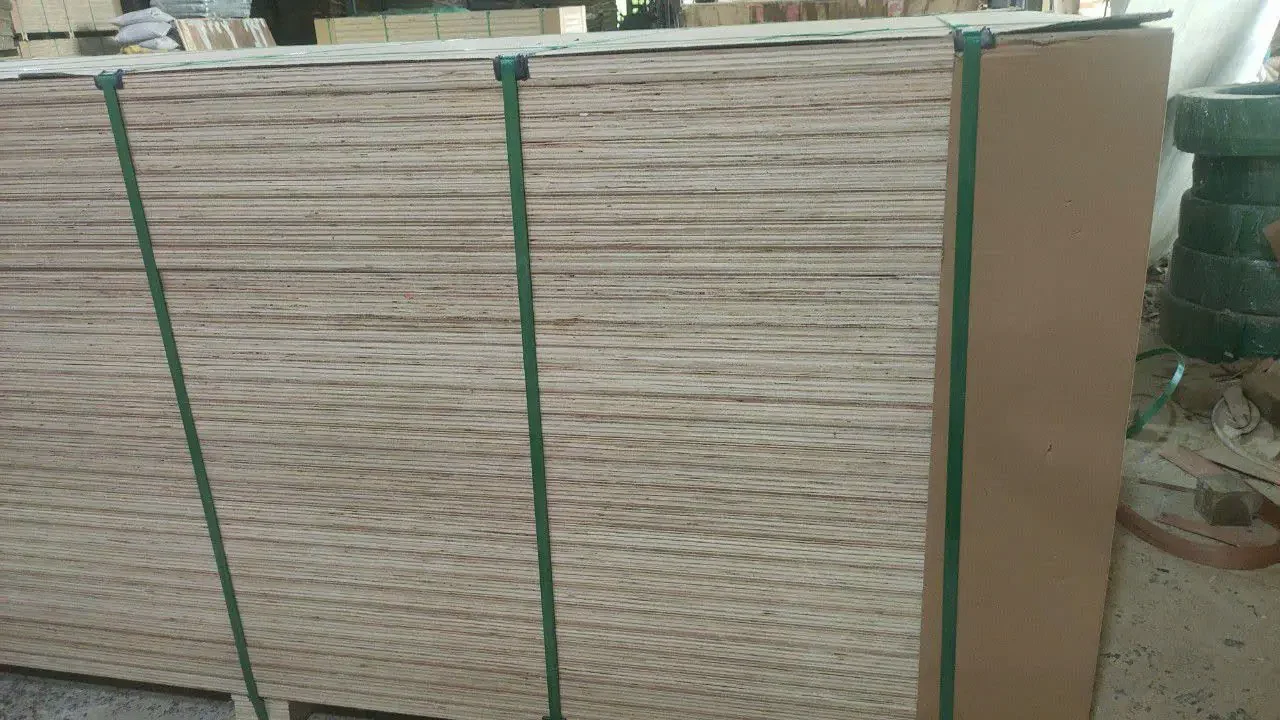
- Cross-section cut — perpendicular to face grain, through a full thickness panel. Photograph under natural light (not artificial). Gaps, overlaps, and displaced strips are clearly visible.
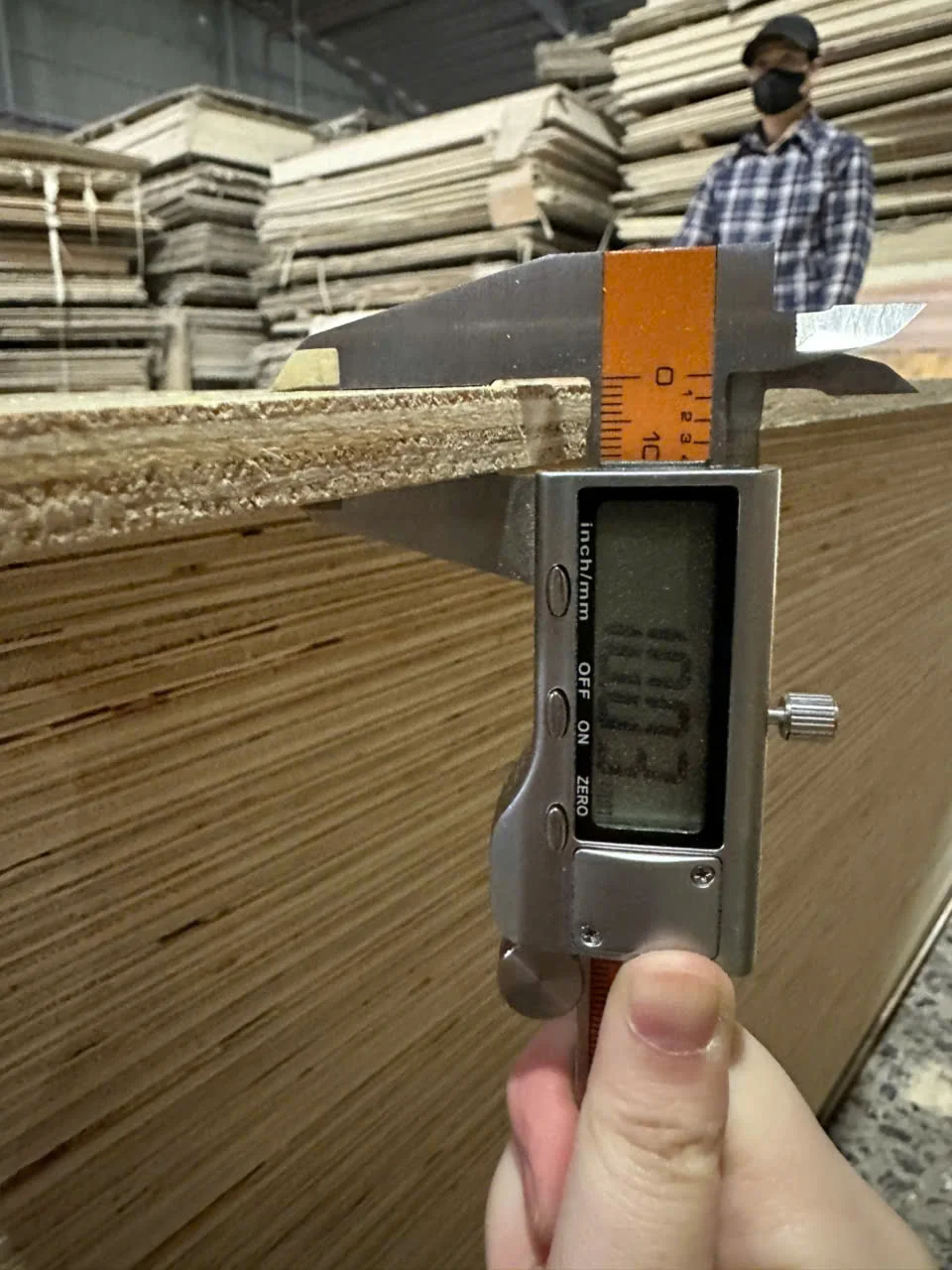
- Thickness measurement at 9 points — one measurement per quadrant plus centre. Full stitched panels typically show maximum 0.2mm spread. Loose-laid panels commonly show 0.4–0.6mm spread.
- Boiling test result — 72-hour boiling (EN 314-1 / GB/T 9846) isolates both glue bond and core construction quality. A full stitched WBP panel passes reliably; a loose-laid panel with the same glue may delaminate at gap edges.
- Sanding QC photo — a pre-shipping inspection photo showing the sanding line output. Surface waviness from poor core construction is visible under raking light.
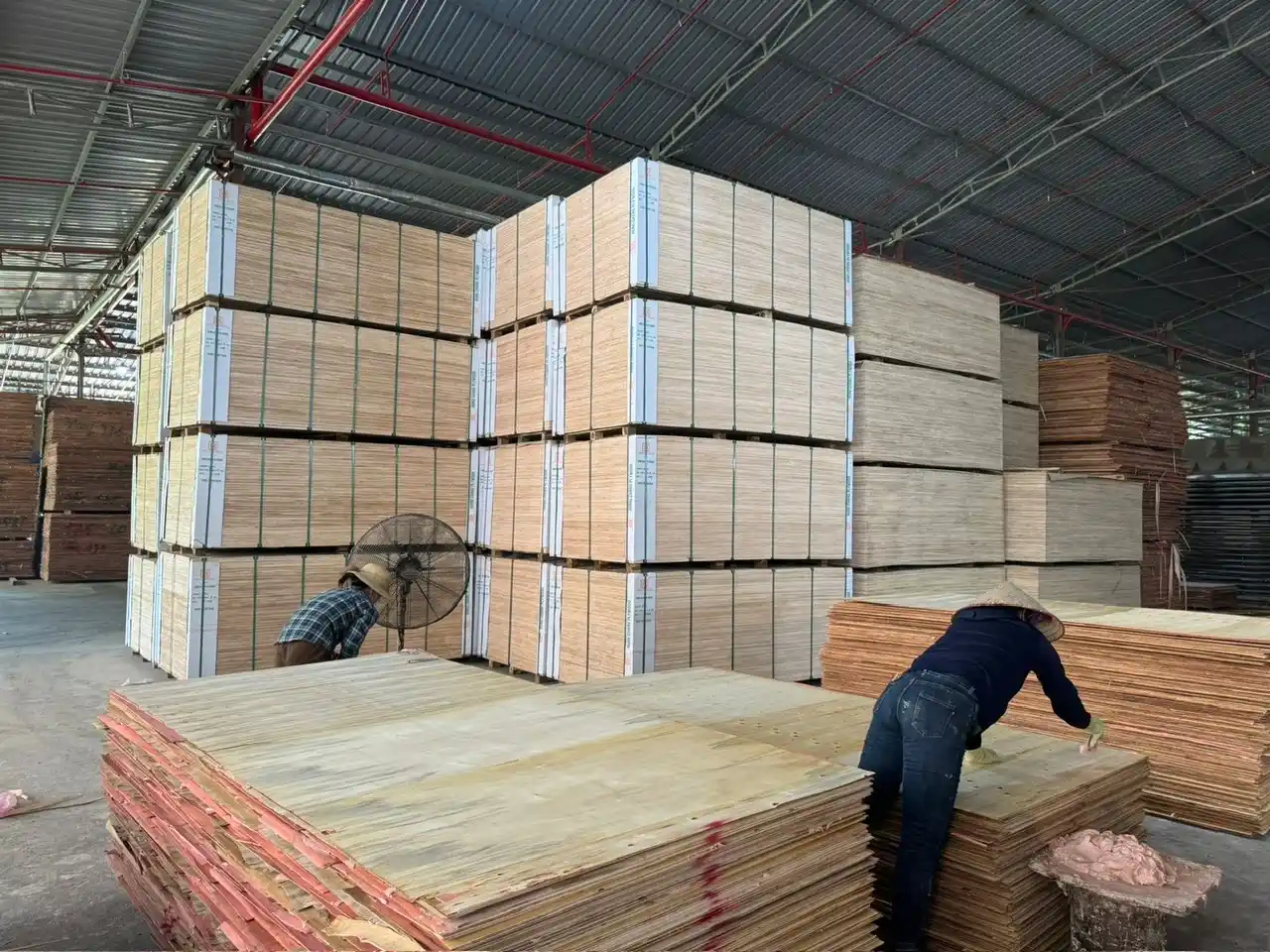
💡 Tip: When visiting a factory, ask to see the press layout before pressing, not just the finished output. The assembly table (spreading and laying up veneer) reveals construction method directly — no finished product needed.
📐 Matching Core Construction to Application
Use this quick reference to match construction type to end use:
| Application | Recommended Construction | Reasoning |
|---|---|---|
| EU/US premium furniture | Full stitched | E0 markets require tight tolerance + clean machining |
| Korean/Japanese interior panels | Full stitched | JAS F4-star + strict flatness requirements |
| Commercial furniture (ASEAN, Middle East) | Stitched outer + edge-trimmed | 90% performance at 85% cost |
| Kitchen cabinets (carcase panels) | Full stitched or stitched outer | Edge quality critical for cabinet hardware fitting |
| Film-faced formwork (10+ pours) | Full stitched | Lower cost per pour vs budget finger-jointed |
| Film-faced formwork (1–5 pours) | Finger-jointed | Adequate reuse count at minimum cost |
| Packing crates and pallets | Loose-laid | Surface quality irrelevant |
| Packing-grade carton liners | Loose-laid | Price-sensitive, no machining |
✅ Key Takeaways
Plywood core construction method — and specifically whether you order stitch core plywood or a lower-grade alternative — determines more than any other single specification the finished panel’s flatness, thickness tolerance, edge quality, and sanding behaviour. The four methods form a clear hierarchy: full stitched at the top, then stitched outer with edge-trimmed inner, finger-jointed, and loose-laid at the base.
For buyers purchasing furniture-grade panels for EU, US, Korean, or Japanese markets: specify stitch core plywood — full stitched construction — explicitly in your purchase order. Do not assume “sanded” implies stitched — these are separate specifications.
For film-faced formwork buyers: calculate cost per pour rather than cost per sheet. Full stitched panels from a premium construction facility cost more upfront but outperform finger-jointed budget panels across 10+ forming cycles.
For packing and crating applications: loose-laid core is appropriate and overpaying for stitched construction adds no practical value.
HCPLY provides cross-section photos and pre-shipment QC reports for all orders. Production data and inspection records are factory-direct — no intermediaries.
Get a free quote with core construction specification guide from HCPLY
Disclosure: This article is published by HCPLY, a Vietnam-based plywood manufacturer and export operator. While we aim to provide objective industry guidance, readers should consider our perspective as a market participant when evaluating recommendations.
🔗 Related Articles
- Plywood Core Types: Acacia, Eucalyptus, Styrax Compared — how core species selection affects density, weight, and price per container
- Plywood Core Construction: Stitched vs Loose-Laid Full Comparison — extended deep-dive with factory production photos
- Plywood quality control: Factory Inspection Process — how HCPLY’s 3-stage QC catches construction defects before shipment
- Vietnam Plywood Manufacturing Process: Factory Guide — end-to-end production from log peeling to export packing
- Core Veneer Vietnam — Eucalyptus & Acacia Sheets — raw veneer supply with stitching options
- Styrax Core Plywood: The Birch Alternative for Export Furniture — why styrax with full stitched core competes with Russian birch plywood on quality