

📋 Why Poplar Plywood from Vietnam Is Growing Fast
European buyers have a sourcing problem. Russia’s birch plywood — once the backbone of light interior panels across Germany, France, and Scandinavia — is under sanctions. Chinese plywood faces anti-dumping duties in multiple markets. Buyers need a stable, compliant, cost-effective alternative at factory scale — and this buyer’s complete guide explains why Vietnam is the answer.
Poplar plywood from Vietnam fills that gap precisely. Vietnam produces plantation-grown poplar on light-density styrax cores — a combination that delivers the weight, bonding, and lamination performance European furniture manufacturers actually need, without paying a scarcity premium.
As of 2026, HCPLY ships poplar plywood to 20+ countries, with Europe accounting for a growing share of repeat container orders. The shift is not temporary.
💡 Key Insight: Poplar plywood from Vietnam is not a downgrade from birch — it is a material match. Most furniture carcasses, laminated boards, and painted interior panels do not require birch-level hardness. They require flatness, bonding consistency, and supply stability. That is what Vietnam delivers.
📐 Poplar Plywood Vietnam — Specifications
Understanding what you are ordering starts with knowing which parameters matter for your application.
“We process quotation requests from 20+ countries monthly. Each market has different priorities — European buyers focus on EUDR compliance and E0 emission, Indian buyers prioritize BIS certification and competitive pricing, and Japanese buyers demand the tightest thickness tolerances.” — Lucy, International Sales Manager, HCPLY
| Parameter | Standard Range |
|---|---|
| Face veneer | Poplar (white, A/B grade) |
| Core species | Styrax (480–500 kg/m³) or Acacia (~580 kg/m³) |
| Glue type | Melamine (MR) |
| Emission class | E0 (≤0.5 mg/L) / E1 (≤1.5 mg/L) / CARB P2 |
| Thickness | 3–30mm (common: 5, 9, 12, 15, 18, 25mm) |
| Sheet size | 1220×2440mm (4×8 ft), 1250×2500mm |
| Tolerance | Thickness ±0.3mm, length/width ±2mm |
| Sanding | Both faces, calibrated |
| Surface grade | A/B (furniture), B/C (commercial) |
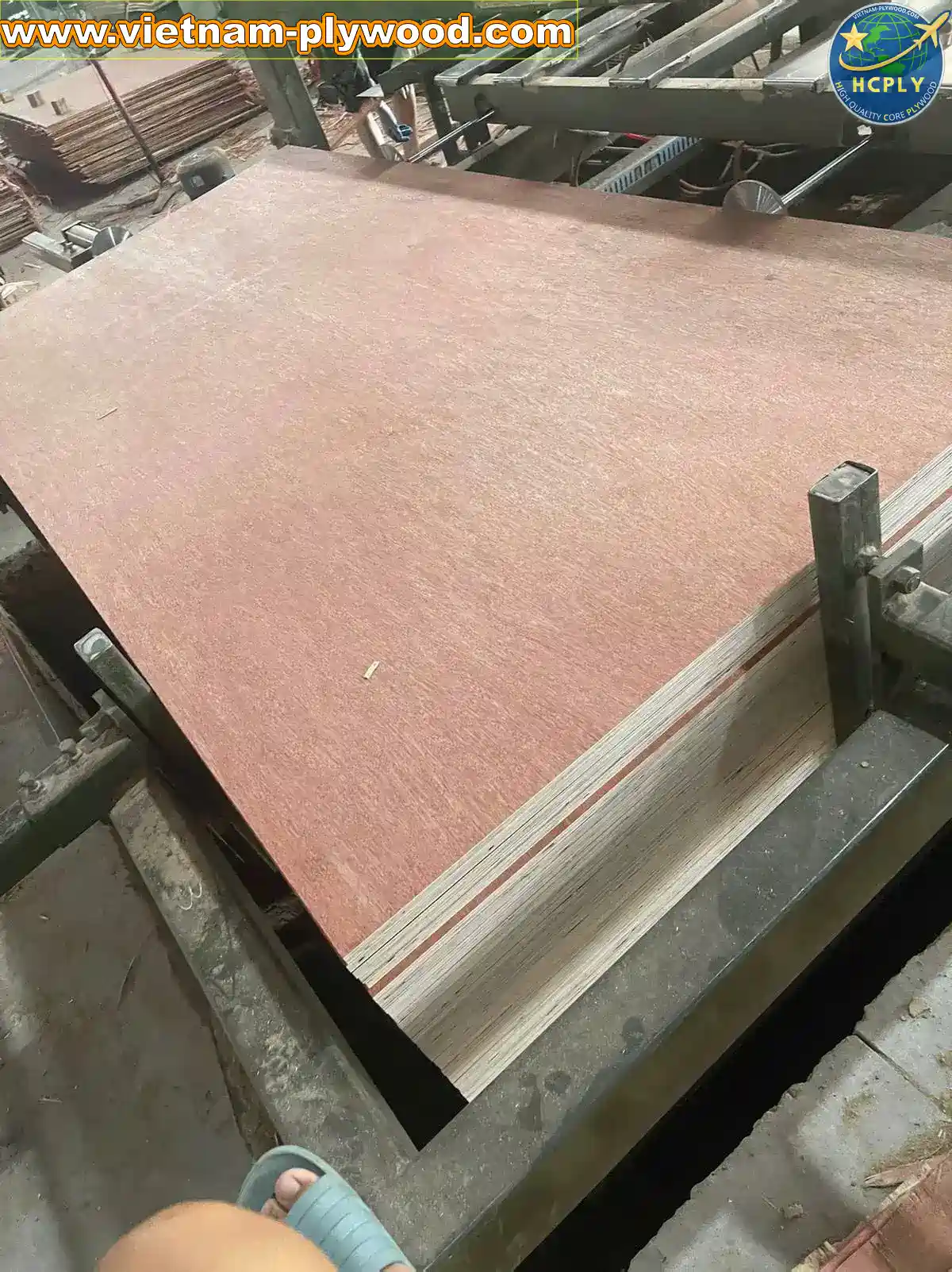
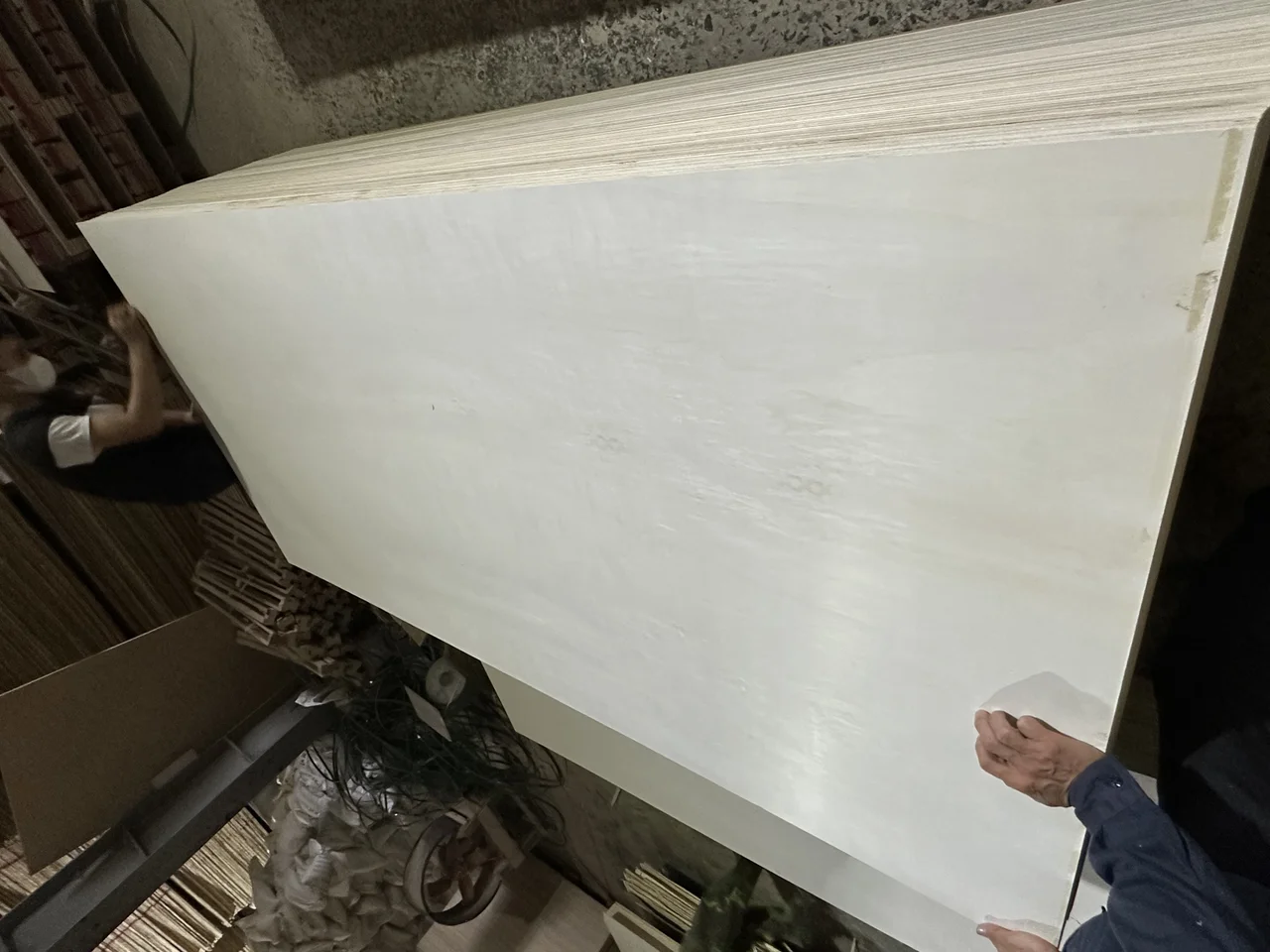
Face veneer thickness runs 0.2–0.4mm, standard for Vietnamese production. The white, even-grained poplar face accepts lamination, painting, and veneering with minimal telegraphing — critical for high-gloss furniture finishes.
⚠️ Important: Glue type and emission class are separate parameters. Melamine (MR) is the glue. E0 or E1 is the formaldehyde emission level. Always specify both. See the complete guide to plywood glue types and emission standards for a full breakdown.
🔧 The Styrax Core Advantage
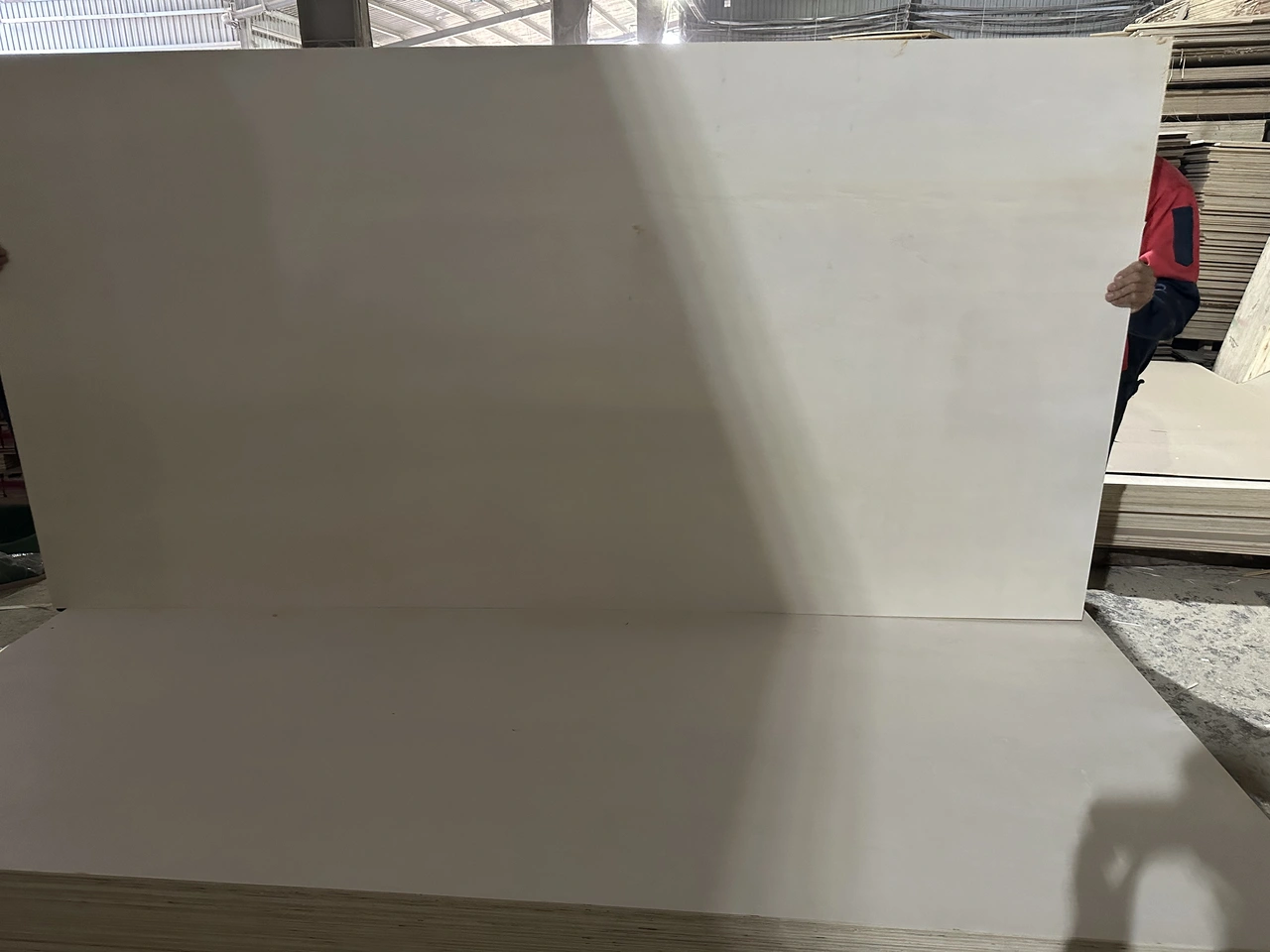
The reason poplar plywood from Vietnam works for European furniture is not the face alone — it is the styrax core structure.
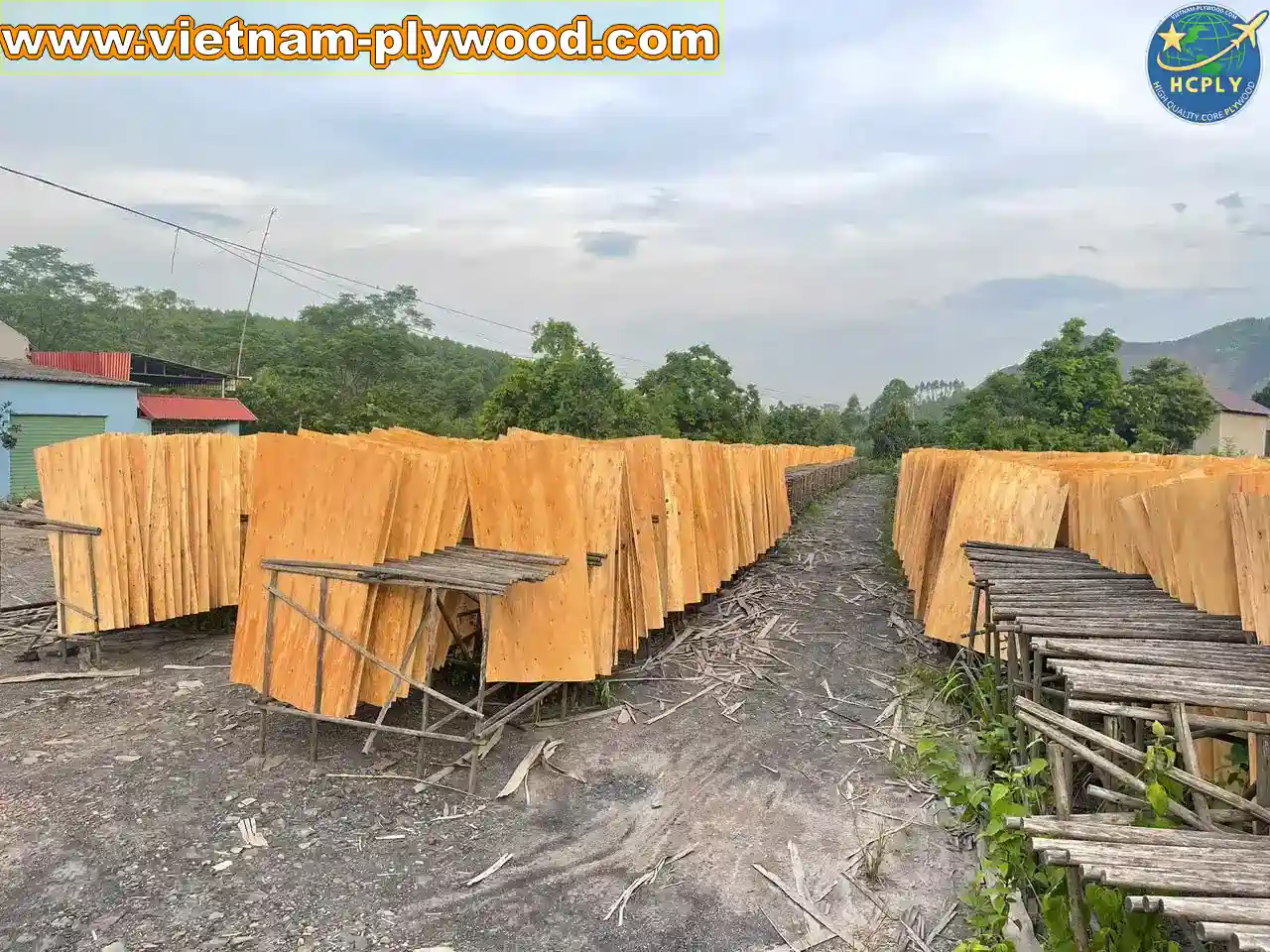
Styrax (Styrax tonkinensis) grows in Northern Vietnam, particularly in Phu Tho and surrounding provinces. It is naturally light at 480–500 kg/m³, white in color, uniform in fiber density, and low in internal stress. These properties make it the preferred core substitute for buyers who previously used full birch panels.
Three practical advantages for production buyers:
Weight reduction without structural compromise. A 15mm styrax-core poplar panel weighs significantly less than eucalyptus-core equivalents (650–750 kg/m³). On a 40HC container run from Vietnam to Rotterdam, this weight difference translates to more usable sheets per container without hitting the 28.5 MT payload limit. See the plywood container packing calculation guide for factory-level data on styrax vs eucalyptus packing efficiency.
Clean lamination surface. Styrax core is pale and non-resinous. When combined with poplar face veneer, the resulting panel bonds consistently with melamine paper, HPL, PVC, and paint systems. Surface telegraphing — a common failure mode on mixed or resinous cores — is minimized.
Dimensional stability across batches. Controlled styrax sourcing from Northern Vietnam maintains uniform density from shipment to shipment. This matters for buyers running CNC furniture lines, where thickness variation above ±0.3mm causes edge-banding and assembly failures.
“Styrax core is why Vietnam poplar works at production scale,” says Lucy, International Sales Manager at HCPLY. “European buyers who switched from China noticed the consistency immediately — same thickness, same flatness, same bonding results batch after batch.”
⚖️ Poplar Plywood vs Birch: Practical Comparison
This is not a question of quality — it is a question of application fit.
| Property | Poplar (styrax core) | Birch (styrax core) |
|---|---|---|
| Density | ~490 kg/m³ | ~510–540 kg/m³ |
| Face hardness | Moderate | Higher |
| Face color | White/pale | Pale yellow |
| Bonding surface | Excellent | Excellent |
| E0 availability | Yes | Yes |
| Container efficiency | Higher (more sheets/40HC) | Slightly lower |
| Supply stability | Stable (Vietnam plantation) | Constrained (Russia sanctions) |
| Anti-dumping risk | None (Vietnam) | Low (depends on origin) |
| EUDR compliance ease | High (plantation declared) | Moderate |
| Price trend (2026) | Stable | Volatile |
For carcass construction, painted interiors, flat-pack wardrobes, and laminated panels, poplar delivers the required mechanical performance at lower total cost. Birch retains an advantage in screw-holding-critical applications and exposed hardwood surfaces where grain aesthetics are specified.
The real shift in the European market is not substitution for substitution’s sake. It is buyers recognizing that birch is now a premium material with premium pricing and constrained availability, and that poplar from Vietnam covers the majority of interior furniture use cases at a more predictable price point.
Request poplar plywood samples and specifications →
🏆 EU Market Compliance: EUDR, E0, and FSC
Compliance is not optional for European buyers. Three regulatory areas directly affect poplar plywood imports from Vietnam.
EUDR (EU Deforestation Regulation). Vietnam’s plantation-grown poplar and styrax are among the cleaner species to declare under EUDR due diligence requirements. Plantation origin documentation — including coordinates, harvest records, and species declarations — is straightforward compared to mixed tropical hardwood origins. HCPLY prepares full EUDR-ready documentation packages for EU buyers, updated for 2026 enforcement timelines (International Tropical Timber Organization, 2025).
E0 Emission Compliance. Poplar plywood from Vietnam is available at E0 (≤0.5 mg/L formaldehyde), meeting the strictest European indoor air quality requirements. This is standard for furniture-grade production at HCPLY’s premium facility in Phu Tho. For buyers shipping to Germany, the Netherlands, or Scandinavian markets where E0 is contractually required, this is not optional.
FSC Certification. FSC chain-of-custody certification is available for poplar plywood orders requiring certified supply. As documented by the Forest Stewardship Council (FSC, 2024), demand for FSC-certified Vietnamese timber products in the EU grew sharply following restrictions on Russian supply.
For buyers handling EU compliance requirements, the plywood certifications and export documentation guide covers FSC, CARB, CE, and EUDR in detail.
🪑 Where Poplar Plywood from Vietnam Is Used
European buyers use poplar plywood from Vietnam across three main application categories.
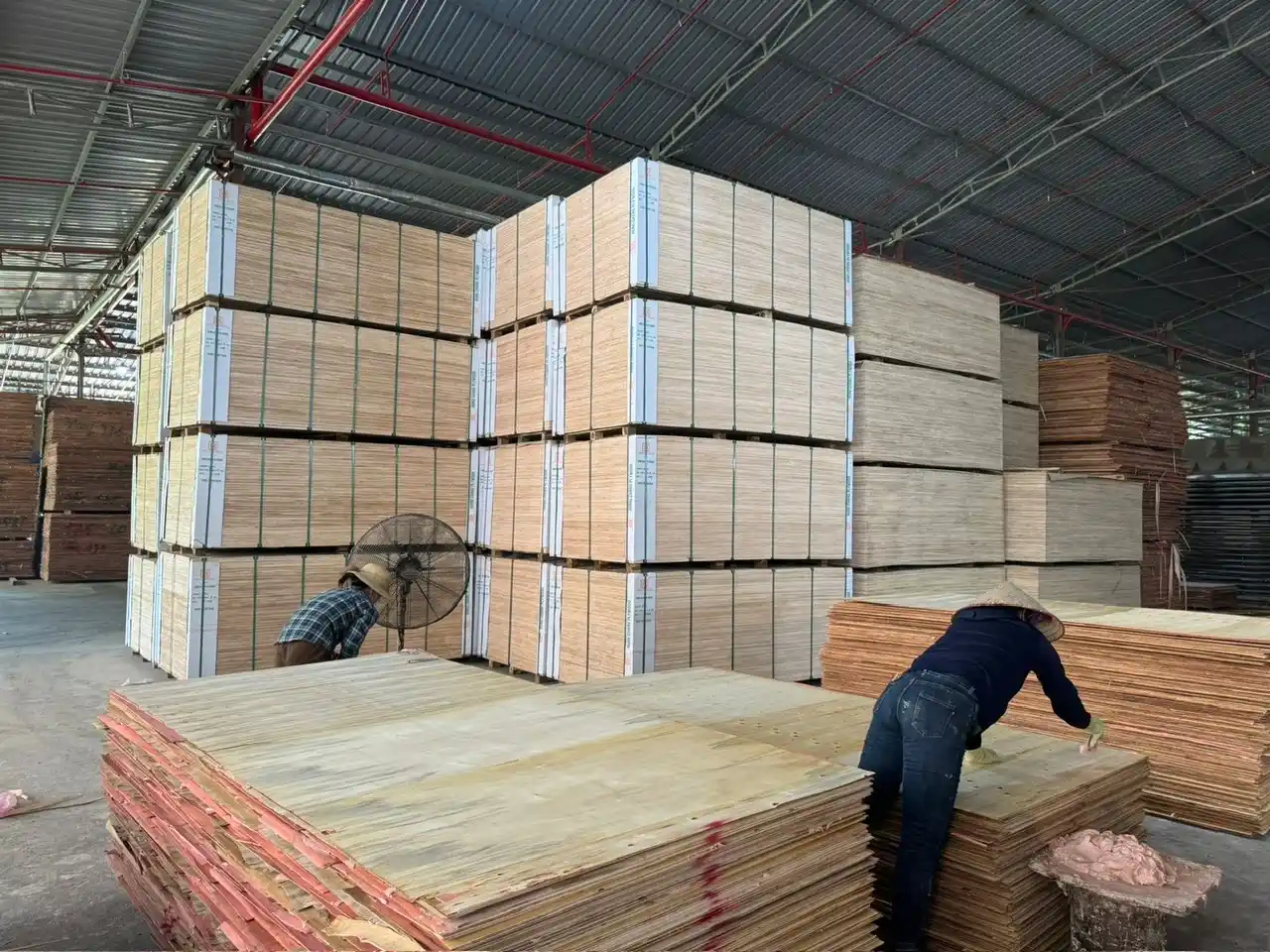
Furniture manufacturing is the primary use — see furniture plywood for application details. Furniture carcasses — the structural boxes of wardrobes, cabinets, shelving systems, and bed frames — are the largest volume application. Poplar’s light weight reduces CNC tooling wear, speeds assembly line processing, and lowers finished-product shipping weight. Sanded poplar plywood from Vietnam achieves surface smoothness suitable for direct lamination without filler.
Flat-pack and modular systems benefit directly from weight control. A wardrobe panel set in 18mm poplar-styrax weighs measurably less than the same set in eucalyptus-core alternatives. At scale — tens of thousands of units per year — this reduces packaging material consumption, transport damage, and end-user handling complaints.
Laminated and painted panels require a neutral, stable substrate. White poplar face on styrax core absorbs adhesives evenly, holds paint without bleed-through, and maintains flatness through humidity cycles common in European buildings. This makes poplar plywood from Vietnam a practical choice for interior partition systems and built-in furniture components.
For buyers building multi-product orders, poplar is frequently combined with birch plywood from Vietnam (for exposed hardwood components) and EV plywood from Vietnam (for high-consistency face requirements), all shipped in a single 40HC container.
📦 Ordering Poplar Plywood from Vietnam: What to Specify
A complete poplar plywood order specification prevents quality disputes and delays. Based on HCPLY export documentation (HCPLY production data, 2026), here are the parameters every buyer should confirm before issuing a purchase order.
Required specification fields:
- Face grade — A/B for furniture, B/C for commercial
- Core species — Styrax (lighter, furniture) or Acacia (cheaper, commercial)
- Core construction — Full stitched (premium) or edge-trimmed (standard)
- Glue type — Melamine MR (interior) or Phenolic WBP (if moisture exposure required)
- Emission class — E0 (furniture/EU export) or E1 (general commercial)
- Thickness — Specify nominal + confirm ±0.3mm tolerance is acceptable
- Sheet size — 1220×2440mm or 1250×2500mm
- Certifications required — FSC, CARB P2, CE, EUDR documentation
- MOQ — Minimum 1×40HC container
⚠️ Note: Do not combine “glue type” and “emission class” in a single field. They are separate parameters. “MR E0” means Melamine glue + E0 emission — both must be specified. Review plywood core types from Vietnam for guidance on choosing the right core for your application.
Lead time from order confirmation to FOB Hai Phong: 15–20 working days. Mixed specifications (different thicknesses or grades) within one container are possible — HCPLY recalculates packing per combined spec.
🏭 Poplar Plywood Production in Vietnam
Production parameters for furniture-grade poplar plywood:
- Core: Styrax, moisture-conditioned to 6–8% before pressing
- Glue system: Melamine MR, E0 emission calibration per batch
- Pressing: Multi-opening hydraulic press, temperature and dwell time optimized for poplar panel characteristics
- Sanding: Wide-belt sanding, both faces, calibrated to ±0.2mm tolerance
- QC stages: After pressing, after sanding, before container loading (3 checkpoints)
- Certifications: FSC, CARB P2, CE, ISO 9001, EUDR documentation
Factory-direct pricing means no VAT overhead that trading companies carry on domestic sales. For European buyers running annual volume programs, this structural cost difference is significant.
HCPLY ships poplar plywood to Europe (Germany, France, Netherlands, Spain, Poland), Korea, India, and other markets as of 2026. Repeat container programs with quarterly pricing agreements are available for importers committing to 3+ containers/month.
Contact HCPLY for factory pricing and samples →
🔗 Poplar in the Full Face Veneer Range
Poplar sits in the mid-range of the face veneer spectrum — above bintangor and packing grades, below birch and gurjan in hardness and price.
For buyers sourcing multiple face types from Vietnam, HCPLY produces the full range: bintangor, okoume, birch, gurjan, pine, poplar, eucalyptus, EV (engineered veneer), film-faced, anti-slip, matt, and packing grade. The plywood face veneer types complete guide covers appearance, application, and market positioning for each species.
Understanding where poplar fits in your product mix — and which applications justify a step up to birch or a step down to commercial bintangor — is the right starting question before requesting a quotation.
✅ Conclusion: Is Poplar Plywood from Vietnam Right for Your Business?
Poplar plywood from Vietnam is a practical, compliant, and cost-stable material for furniture manufacturers, importers, and OEM buyers who previously sourced from China or Russia.
The supply case is clear: Vietnam’s plantation-based poplar and styrax materials face no sanctions, carry minimal anti-dumping risk, and are structured for EUDR documentation. The technical case is equally straightforward: styrax-core poplar delivers the flatness, bonding, and weight profile needed for furniture carcasses, laminated panels, and painted interiors at E0 emission levels.
What poplar plywood from Vietnam is not: a replacement for high-screw-retention structural applications or exposed hardwood furniture where grain aesthetics drive specification. For those use cases, birch or gurjan from Vietnam remain the correct choice.
For the majority of volume interior furniture — wardrobes, cabinets, shelving, flat-pack systems, laminated boards — poplar plywood from Vietnam is a direct production fit at a more predictable landed cost than birch.
Disclosure: This article is published by HCPLY, a Vietnam-based plywood manufacturer and export operator. While we aim to provide objective industry guidance, readers should consider our perspective as a market participant when evaluating recommendations.
Get a Free Quote for Poplar Plywood from Vietnam →
No commitment required. Response within 24 hours. Samples available on request.