

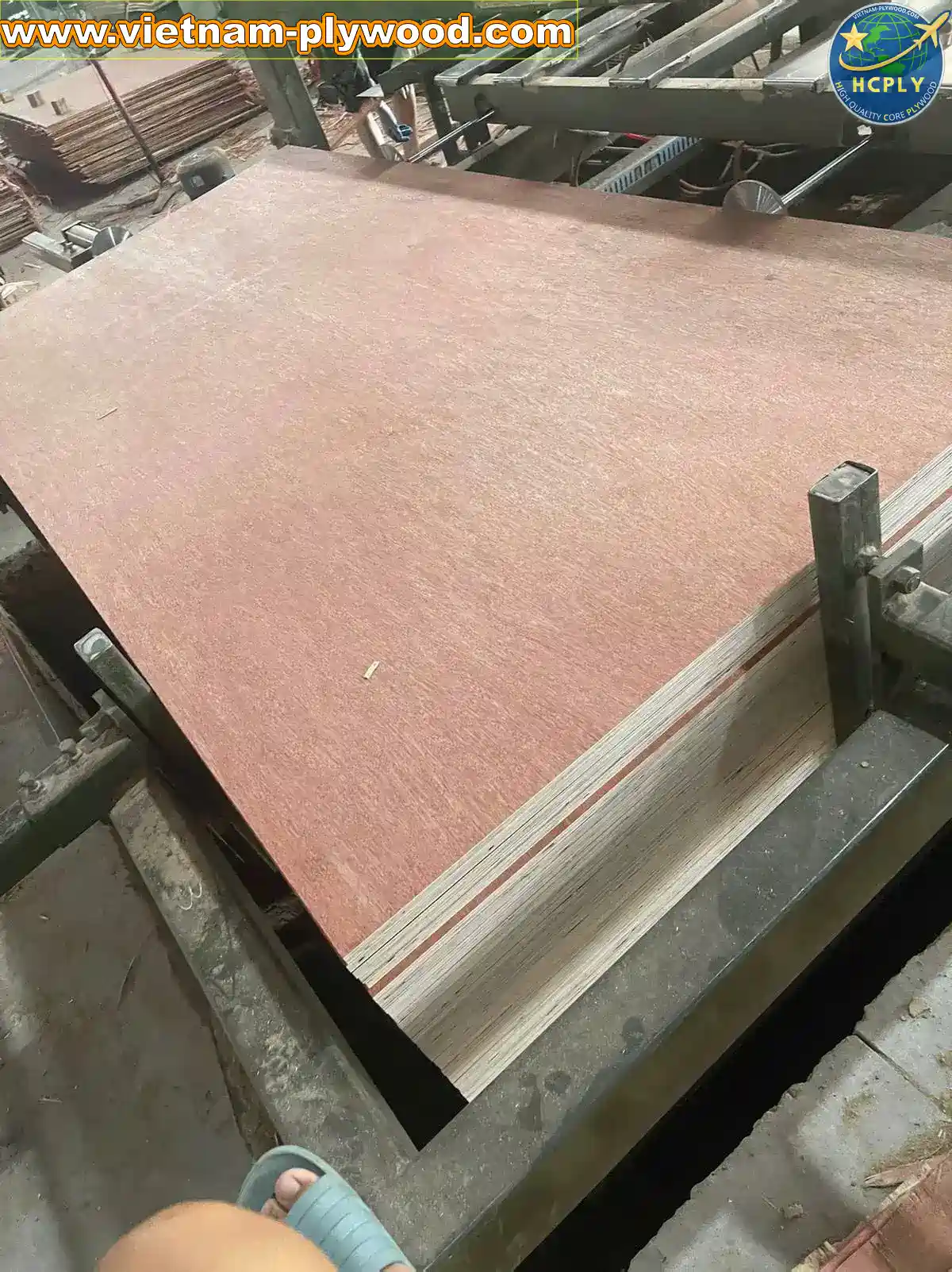
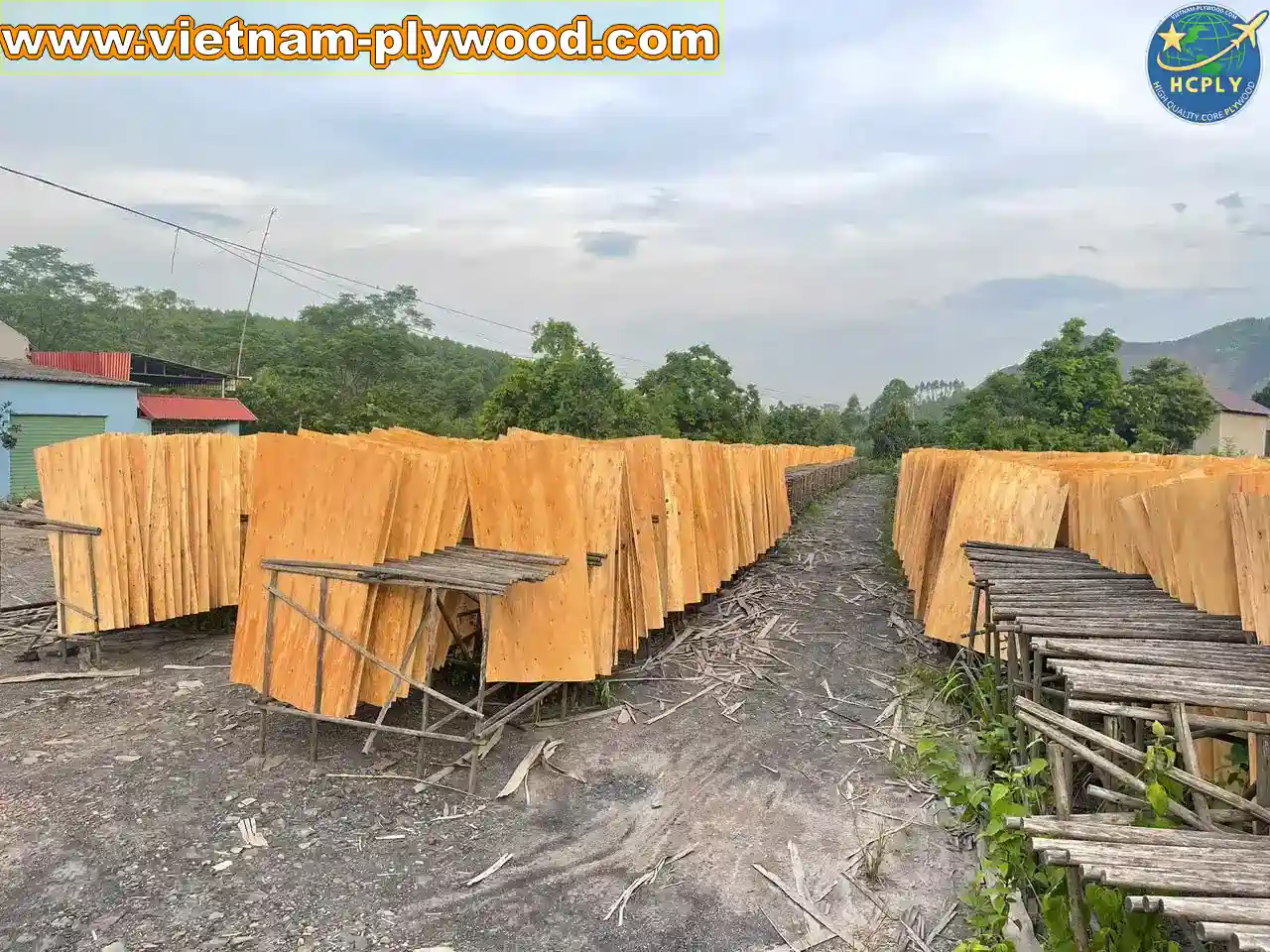

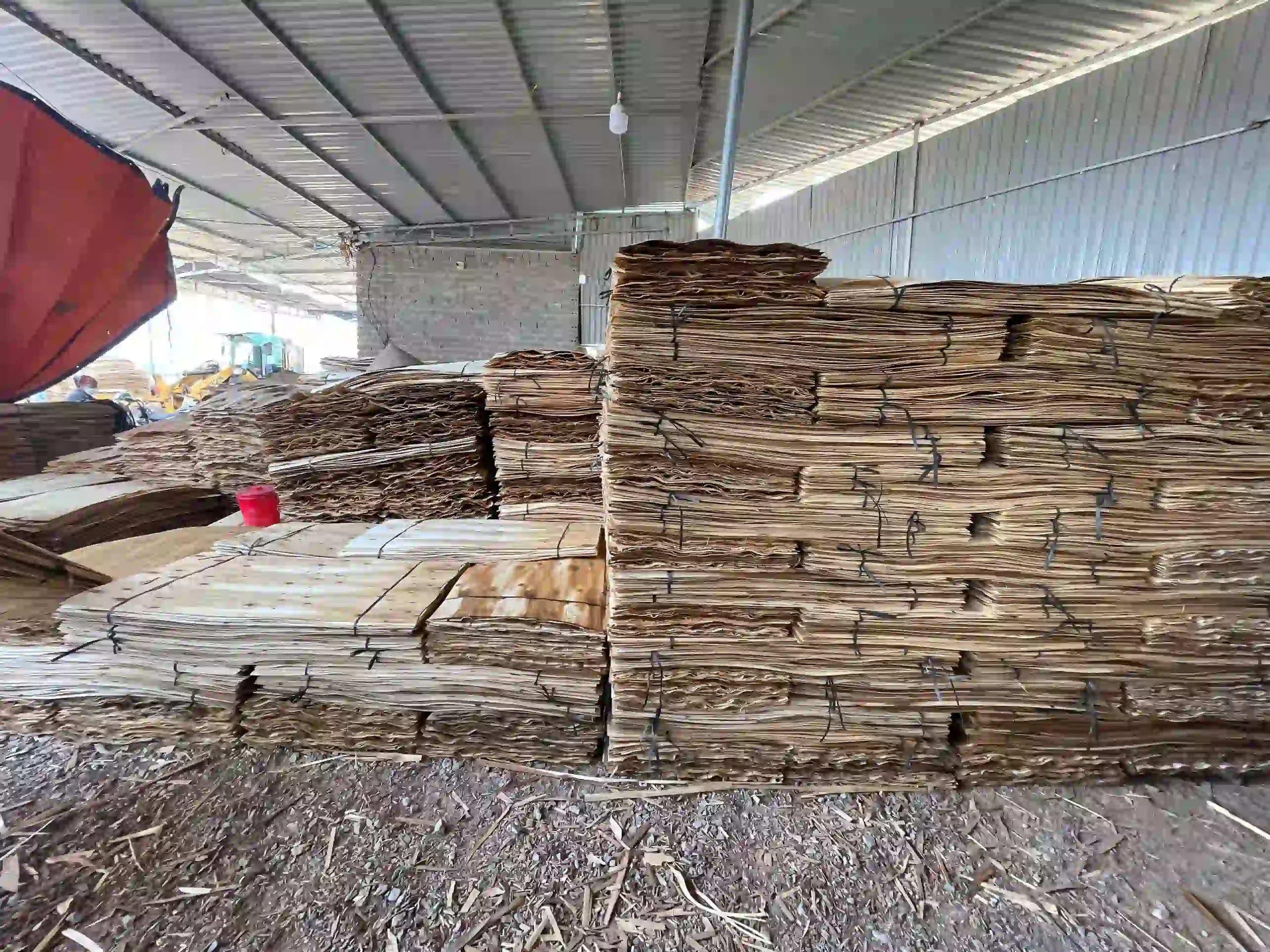
Log diameter is the single factor that affects and determines veneer quality more than any other variable in rotary peeling. A factory working with 20cm diameter logs faces an entirely different yield and quality profile than one peeling 40cm logs — even using identical machinery, species, and knife settings. International buyers who understand this principle can better evaluate supplier quotes and predict final panel quality before a container ships.
📋 What Is Rotary Veneer Peeling?
Rotary veneer peeling is the process of mounting a log on a lathe and rotating it against a fixed knife blade. The blade removes wood in a continuous spiral sheet — the same mechanical principle as peeling an apple in one unbroken strip.
The result is a long ribbon of wood at the target thickness. For core layers in Vietnamese plywood, that target is typically 1.3mm to 2.0mm per ply. Face veneers are thinner: 0.2–0.4mm is standard in Vietnamese production (HCPLY production data, 2026).
Two lathe types dominate the industry:
| Type | Log Range | Best For |
|---|---|---|
| Spindle lathe | 15–60 cm diameter | Large logs, high volume production |
| Spindleless lathe | 8–20 cm diameter | Smaller plantation logs, core bolts |
Spindleless lathes can process the core bolts left over from spindle peeling, recovering additional veneer from what would otherwise be waste. Northern Vietnam factories — where HCPLY’s production facilities are located — use both types in sequence to maximize yield from plantation-grown acacia, eucalyptus, and styrax logs.
📦 Why Log Diameter Controls Everything
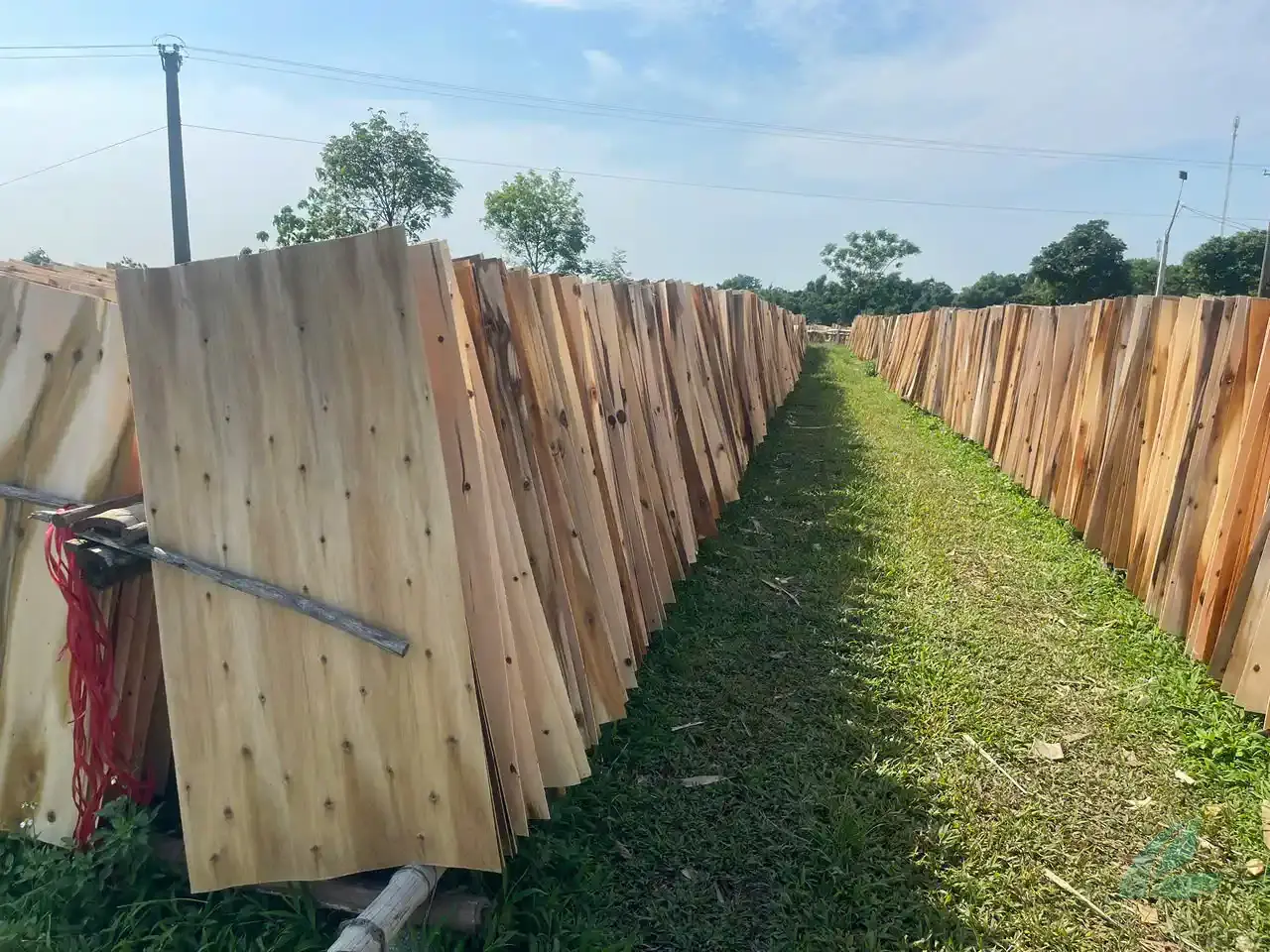
The physics of rotary peeling create a direct relationship between log diameter and veneer quality. Three mechanisms explain why:
📌 Recovery Rate vs. Core Bolt Waste
After peeling stops, a cylindrical waste piece called the core bolt remains — typically 100mm in diameter. This bolt represents wood that cannot be peeled without machine damage risk.
Recovery rate = (log volume − core bolt volume) / log volume × 100
For a 20cm diameter log, the core bolt represents roughly 25% of total volume. For a 40cm log, the same 100mm core bolt drops to under 7% waste. Research published in the Annals of Forest Science documents average veneer recovery of 54% from logs, with a clear linear trend: larger diameters consistently achieve higher recovery, up to 72.6% at the top end (Kewilaa & Loiwatu, 2020 — Effects of Wood Species and Log Diameter on Veneer Recovery).
📌 Grain Continuity and Sheet Width
A 20cm log produces veneer sheets roughly 60cm wide after flattening. A 35cm log produces sheets approaching full 1270mm panel width from fewer but wider pieces. Wider sheets mean:
- Fewer finger-joints and stitches in the assembled core
- More uniform grain direction across the panel
- Lower risk of core gaps that weaken finished plywood under load
For premium furniture-grade plywood — the type HCPLY produces for EU and Korean furniture manufacturers — fewer core joins directly translates to higher MOR (Modulus of Rupture) consistency batch to batch.
📌 Lathe Charger Accuracy at Small Diameter
As a log shrinks during peeling, centering accuracy decreases with spindle lathes. The log wobbles slightly, causing thickness variation in the final veneer sheets. Modern lathes with X-Y charger systems compensate — but only within limits. Below 15cm effective diameter, thickness variation increases sharply even on well-maintained equipment (Raute Veneer Technology, 2024).
This is why Vietnamese factories that specify tight thickness tolerances (±0.2mm veneer) source larger plantation logs and invest in spindleless secondary lathes to handle the remaining core bolt at lower tension.
🔧 The Full Rotary Peeling Sequence at Factory Level
Understanding the complete sequence helps buyers interpret quality claims from suppliers.
Step 1 — Log conditioning Logs are soaked in hot water (50–70°C) for 8–24 hours before peeling, depending on species and ambient temperature. Softening the wood reduces knife pressure and produces smoother veneer with less checking (surface cracking on the tight face).
Step 2 — Debarking and bucking Bark is removed mechanically. Logs are cut to peel lengths — 1270mm for Vietnamese standard panels (yielding 1220mm width after trim), or 1300mm for metric 1250mm panels exported to Europe.
Step 3 — Centering and chucking The log is scanned optically or manually positioned to find the true center. Poor centering wastes 8–15% of yield through off-center first cuts. This step matters most for small-diameter logs.
Step 4 — Peeling The lathe rotates at constant surface speed. The knife advances at the target veneer thickness per revolution. Modern Vietnamese factory lathes run at 80–120 m/min surface speed for core veneers.
Step 5 — Clipping and grading The continuous veneer ribbon is clipped into sheets and graded: Grade A (full sheets, no defects), Grade B (small knots, minor splits), Grade C (usable but patched). Core layers accept B and C. Face layers use A and B only.
📊 Veneer Quality Defects Caused by Peeling Problems
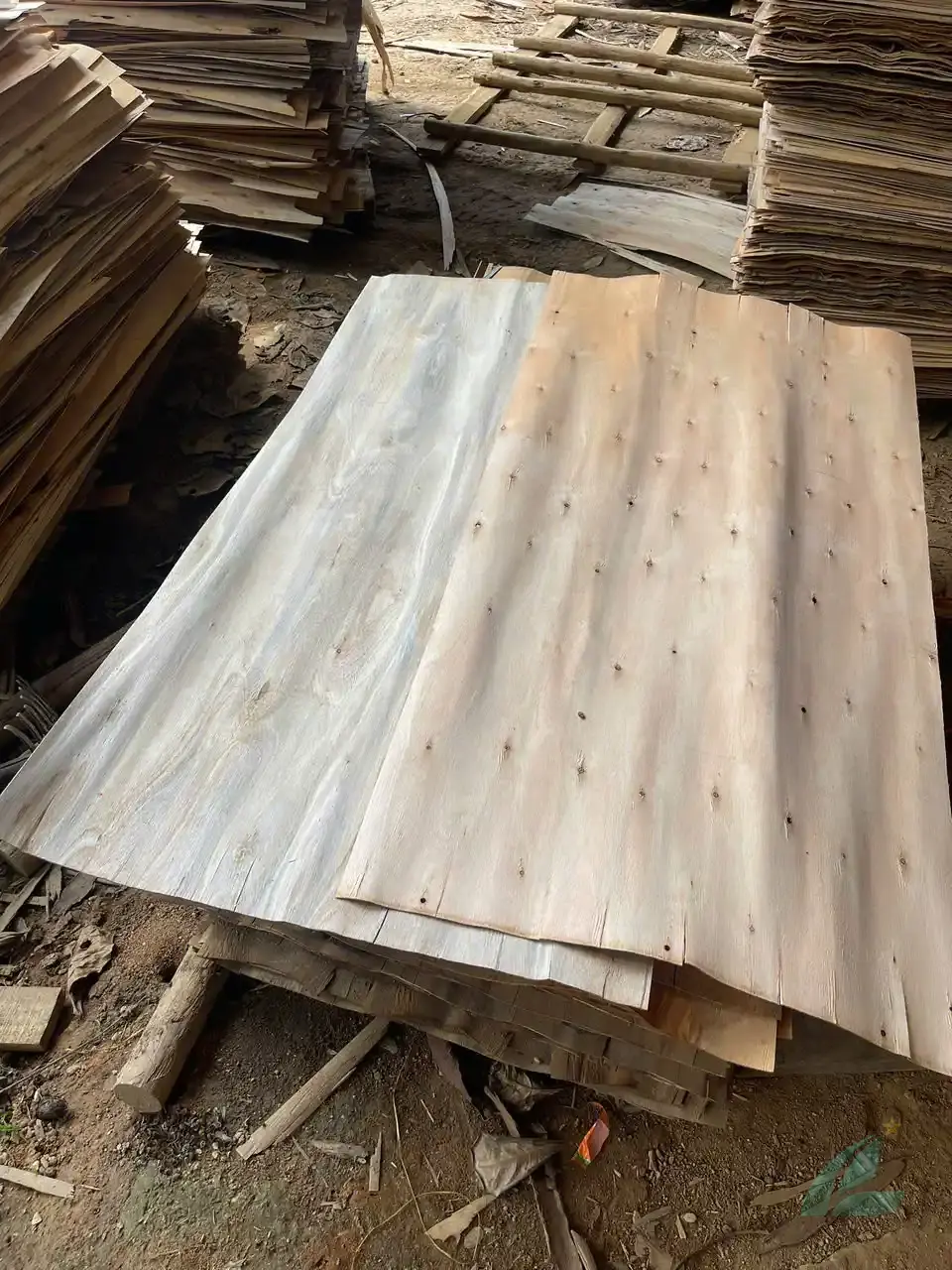
Buyers receiving plywood with internal defects often trace the problem to veneer peeling — not gluing or pressing as commonly assumed.
| Defect in Finished Panel | Root Cause in Peeling |
|---|---|
| Delamination at surface | Veneer moisture >10% at press entry |
| Core gap visible at edge | Small-log narrow sheets, poor clipping |
| Surface ripple / undulation | Blunt knife or incorrect knife bevel |
| Localized thickness variation | Off-center log chucking |
| Face veneer tear-out | Hot-pressing too quickly after peeling without drying |
⚠️ Important: Face veneer tearout and checking are not always visible on green veneer — they appear after drying and pressing. A supplier’s QC photos taken immediately after peeling cannot reveal this defect class. Request photos of the dried veneer stack, not the green ribbon.
The connection between peeling quality and finished panel performance is why HCPLY’s quality control process includes incoming veneer inspection at the dryer exit, not only final panel inspection.
⚙️ Rotary Cutting vs. Sliced Veneer — What Vietnamese Factories Use
International buyers sometimes ask whether Vietnamese plywood uses sliced or rotary-cut veneer. The answer is straightforward:
All Vietnamese plywood core layers use rotary cutting. This is not a cost compromise — it is the technically correct method for producing uniform core sheets from plantation-diameter logs.
Face veneers on standard export plywood also use rotary cutting for species like bintangor, okoume, eucalyptus, gurjan, and pine. Rotary-cut face veneers show a cathedral grain pattern — the characteristic repeating oval figure visible on most commercial plywood faces.
Sliced veneer (quarter-cut or crown-cut) appears only on decorative architectural panels, not on structural plywood or standard furniture panels. The face veneer guide covers the visual differences in detail.
“From our production facilities, rotary-cut face veneers at 0.2–0.4mm give the most consistent surface adhesion because the peeling compression tightens the loose face against the glue line during hot pressing.” — Lucy, International Sales Manager, HCPLY
🏭 How Log Diameter Choices Differ by Plywood Segment
The plywood factory segmentation guide explains four factory types in Vietnam. Log diameter purchasing directly mirrors those segments:
Premium furniture factories source eucalyptus and styrax logs at 25–40cm minimum diameter. Larger logs justify the higher procurement cost because yield losses at core bolt stage are minimal and face veneer quality is consistent.
Commercial and packing factories accept plantation logs at 15–22cm diameter. They compensate for narrower sheets by increasing the number of core layers and tolerating more stitched joints. The resulting panel meets commercial specifications at lower raw material cost.
Film-faced construction panels typically use medium-diameter eucalyptus and acacia (20–30cm). Dimensional stability matters more than appearance — the phenolic film covers the face entirely — so veneer recovery and core consistency are the priority metrics, not grain aesthetics.
Buyers comparing prices between segments should understand that log diameter procurement strategy accounts for a significant part of the cost difference. A factory claiming premium quality at commercial prices is almost certainly compromising somewhere in this chain.
Get a Free Quote — HCPLY provides factory-direct pricing with full transparency on species, core construction, and veneer grades. No commitment required.
✅ What to Ask Your Supplier About Veneer Peeling
Before placing an order, these five questions reveal a factory’s actual capability:
- What is your minimum log diameter for this species? — Under 18cm for core layers is a red flag for premium applications.
- Do you use spindleless lathes for secondary peeling? — Indicates investment in yield optimization.
- What is your target veneer thickness and tolerance? — Ask for ±mm, not just nominal thickness.
- At what moisture content do veneers enter the dryer? — Should be measured, not estimated.
- Can you share veneer grade split percentages? — Grade A/B/C ratios for the specific order species.
A supplier unable to answer questions 3–5 with specific numbers is likely buying veneer from third parties rather than peeling in-house — which changes the QC chain significantly. Core veneer from HCPLY is available as a standalone export product for plywood manufacturers who want to control their own pressing while sourcing quality peeled veneer from Vietnam.
🔗 Related Manufacturing Articles
- Plywood Manufacturing Process — From Log to Container
- Plywood Core Types — Acacia vs Eucalyptus vs Styrax
- Core Veneer Vietnam — Export Grade Peeled Veneer
- Plywood Face Veneer Types — Complete Buyer Guide
Contact HCPLY Now to request veneer thickness samples and production data sheets. Our export team responds within 24 hours. Free samples available for qualified importers.