

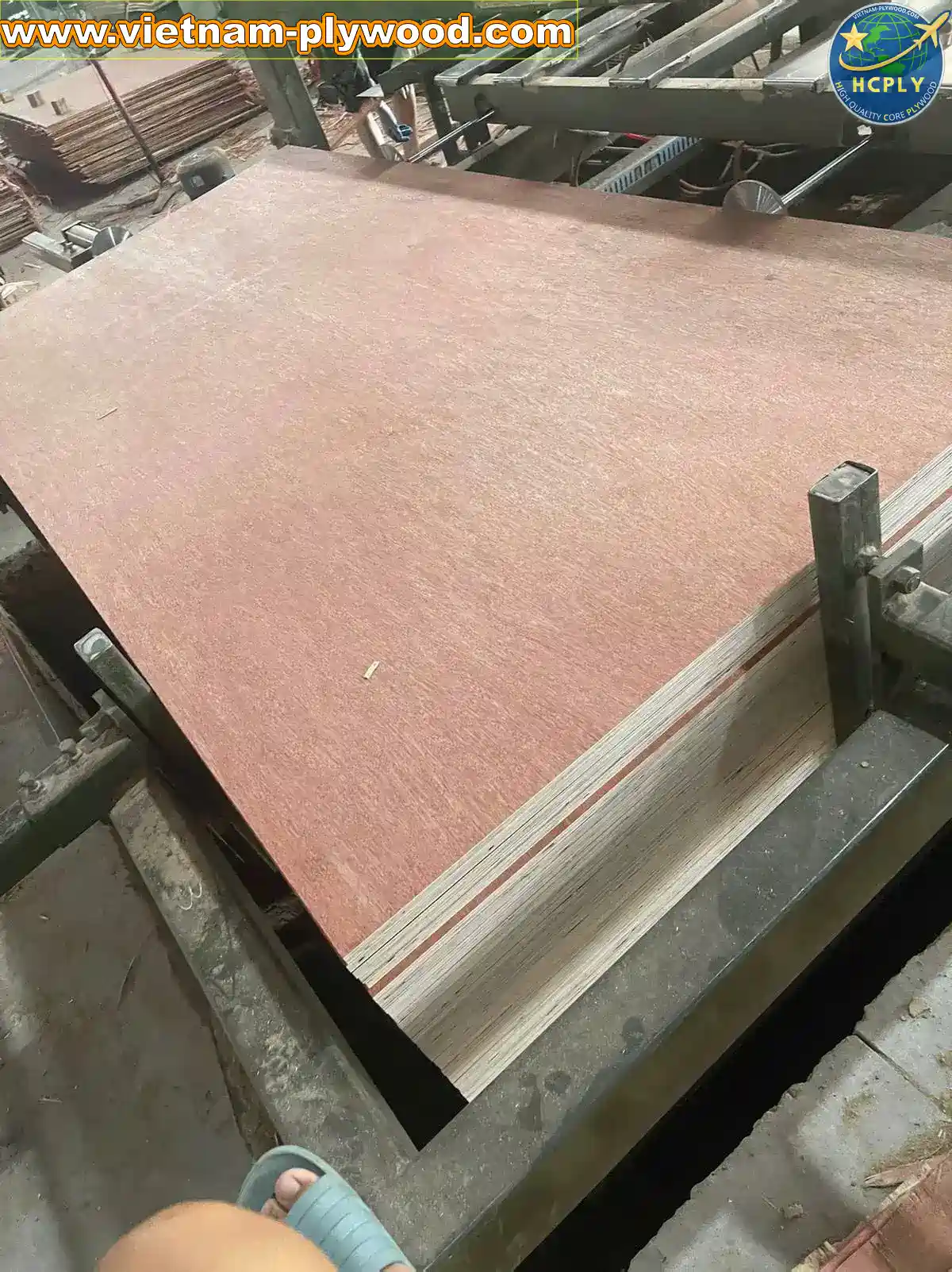
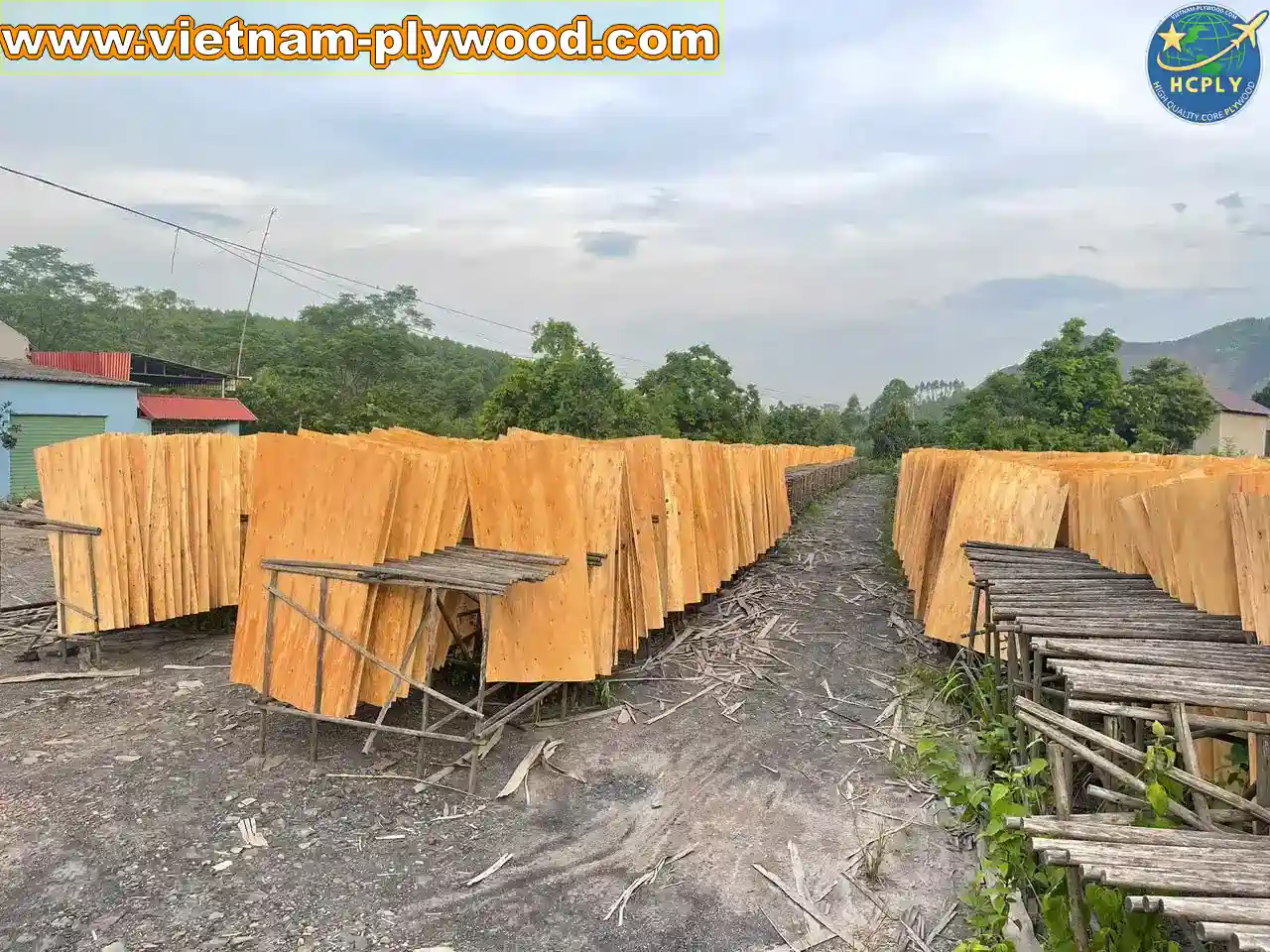

Every delaminated panel, warped sheet, or off-spec thickness that reaches a buyer’s warehouse represents a failure that should have been stopped inside the factory — not discovered after customs clearance. Vietnamese factories vary enormously in how seriously they treat quality control. Some run formal 3-stage systems. Many do only a final visual sweep before loading.
This article explains exactly how plywood quality control works at an ISO 9001-certified factory: the three distinct inspection stages, what each one measures, who performs it, and what happens when a batch fails. If you are sourcing plywood from Vietnam and want to verify whether a supplier has real QC or just claims it, this breakdown gives you the specific questions to ask.
🏭 Why 3 Stages — Not One Final Check
A single pre-shipment inspection catches only what is visible on the outside of a finished stack. It misses bonding failures hidden inside pressed panels and thickness variation corrected by over-sanding that weakens the sheet. Effective plywood quality control requires checkpoints at each production transition, because different defect types originate at different production steps.
The three transitions that matter:
- After hot pressing — bonding integrity and moisture content (internal defects, invisible externally)
- After wide-belt sanding — thickness calibration and surface grade (dimensional accuracy)
- Before container loading — final count, visual grade, packing condition (shipping-ready status)
Each stage has distinct pass/fail criteria, different instruments, and different rejection consequences.
Key Insight: ISO 9001 quality management systems (ISO, 2015) require documented inspection records at defined checkpoints. A factory without written QC records at each stage cannot demonstrate process control — regardless of what their sales team tells you.
📋 Stage 1: Post-Press QC — Bonding & Moisture
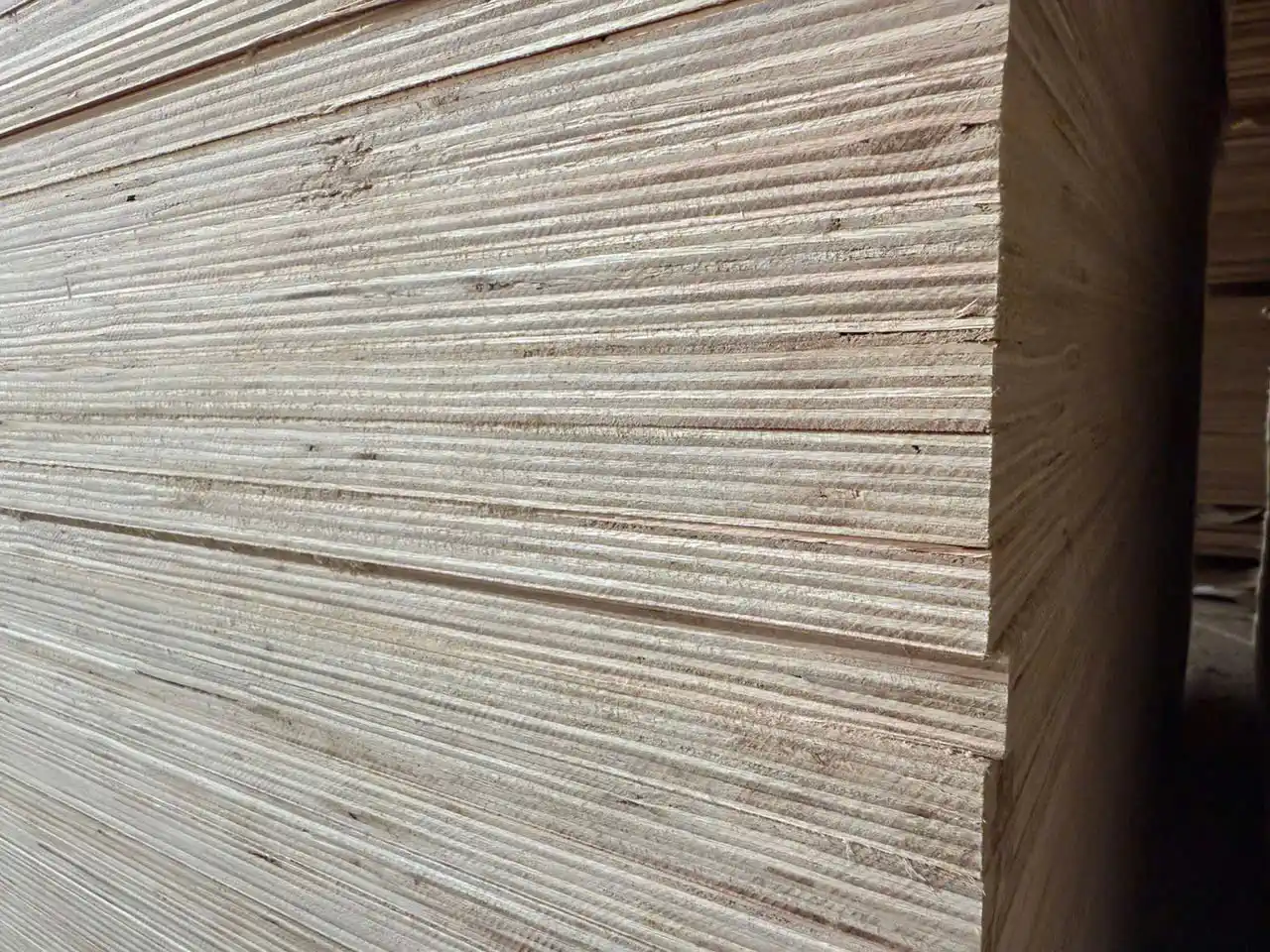
Hot pressing is the most critical step in plywood production. The press cures the glue between veneer layers under temperature and pressure. If any parameter — temperature, press time, glue spread rate — is off, the resulting panels may look correct but delaminate under moisture or mechanical load.
What Stage 1 Tests
Moisture content (MC): Panels exiting the press are still slightly elevated in moisture from the glue curing process. Factory target before moving to the sanding line: below 12%, typically 8–10%. Measurement uses a pin-type or pinless moisture meter. (HCPLY production data, 2026)
Boiling test (bonding strength): A factory sample — typically one panel per press load or per batch — is cut and subjected to a boiling test. For MR (melamine) glue: 12 hours of continuous boiling without delamination = pass. For WBP (phenolic) glue: 72 hours (IS 1734, Bureau of Indian Standards). Panels from failing press loads are quarantined immediately.
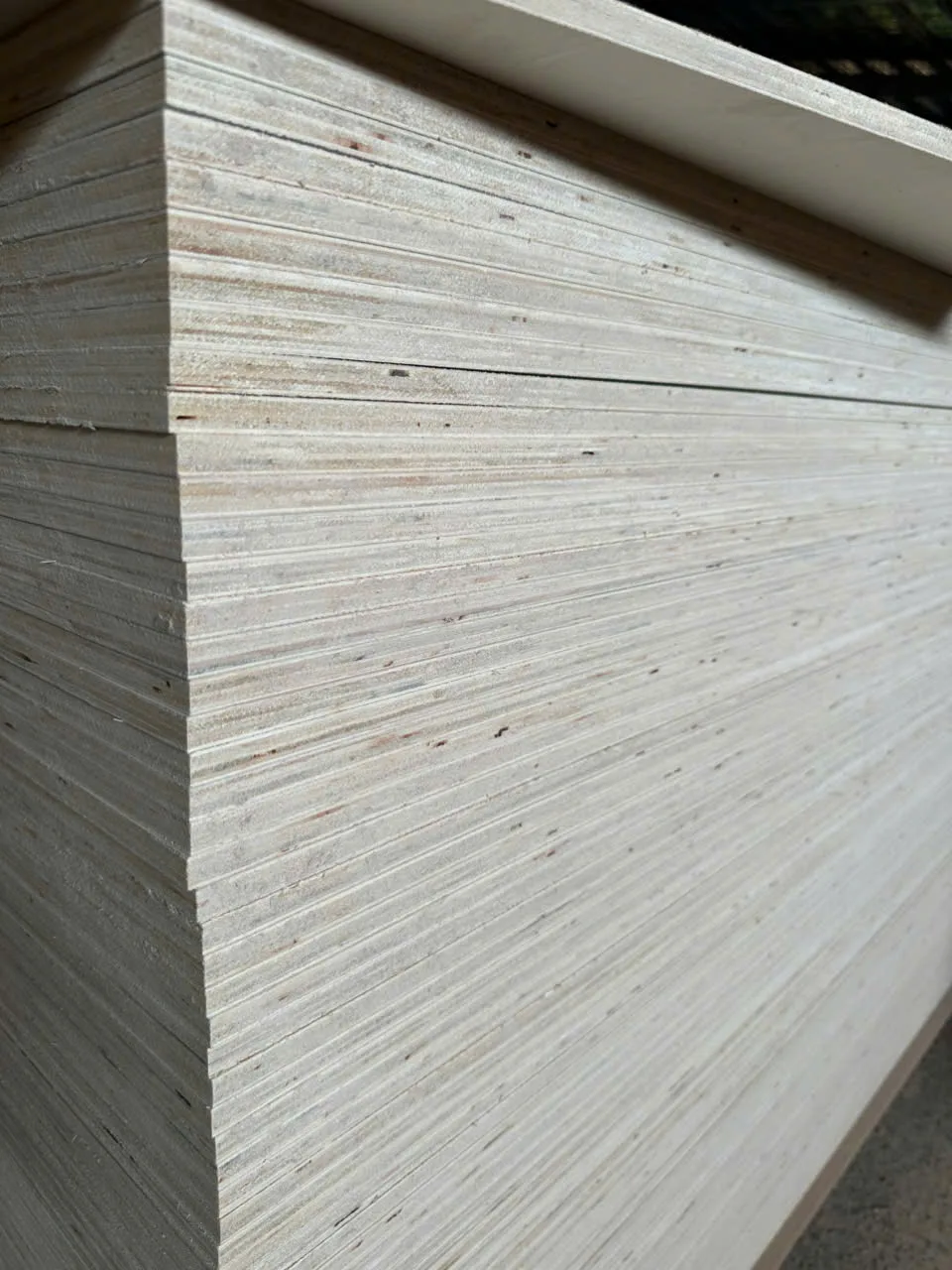
Visual delamination check: QC staff inspect edges of a sample from each stack. Visible gap between layers, bubbling, or surface lifting = fail. The entire stack associated with the failing press load is quarantined.
What Happens on Failure
Press load quarantine. The production supervisor reviews press parameters — temperature logs, pressure records, press time. If the glue spread was insufficient, the entire batch may be scrapped. If press cycle was the issue, parameters are corrected, the press re-calibrated, and production resumes after a trial run passes testing.
Buyers requesting factory QC documentation should ask specifically for press log records and boiling test results. These documents exist in any factory with real process control.
📊 Stage 2: Post-Sanding QC — Thickness & Surface Grade
After pressing, panels pass through a wide-belt sanding machine that calibrates thickness and creates a smooth face. This step is critical for furniture-grade plywood where thickness tolerance and surface smoothness directly affect downstream manufacturing.
Get a Free Quote for sanded furniture-grade plywood
5-Point Thickness Measurement
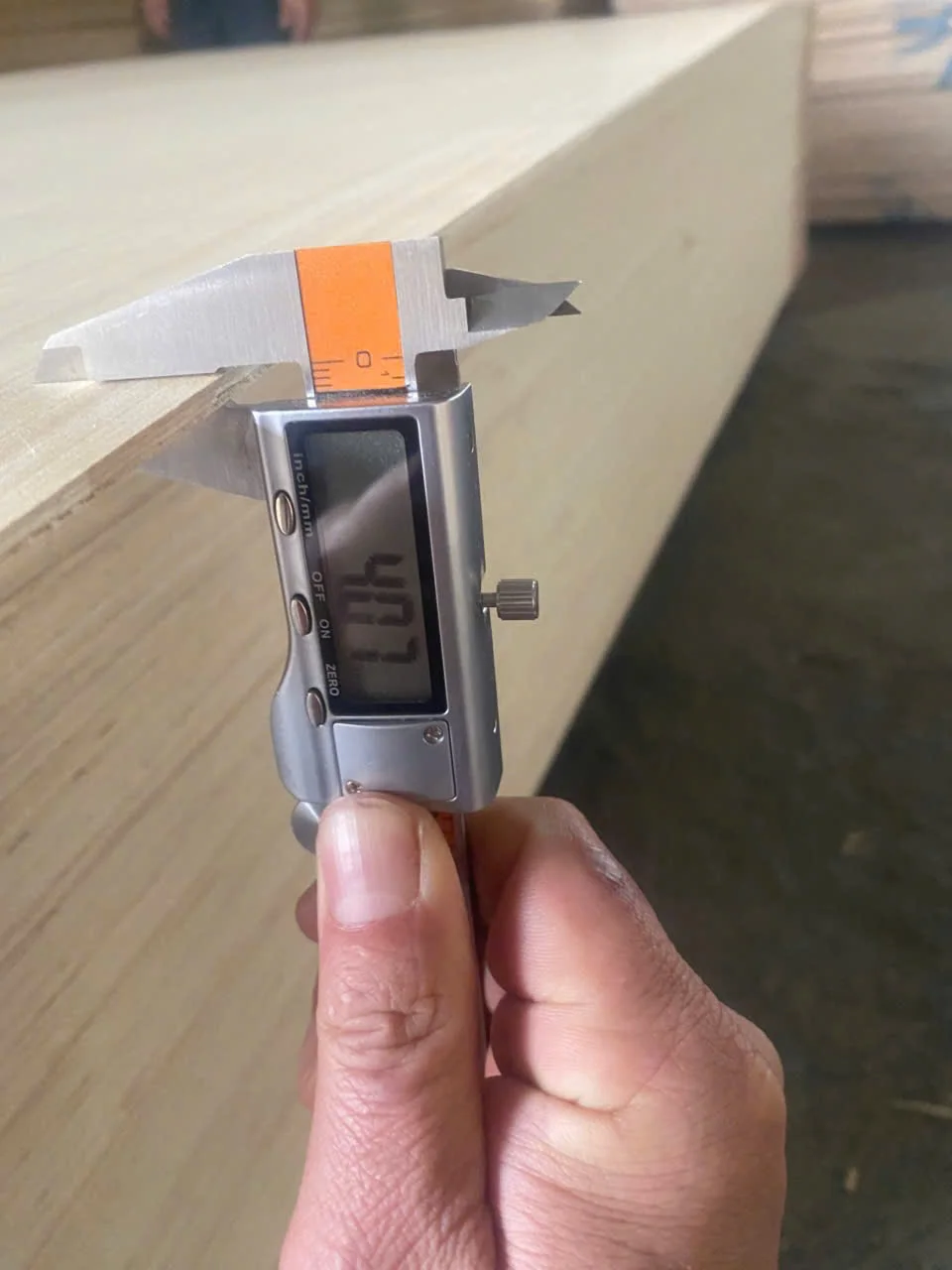
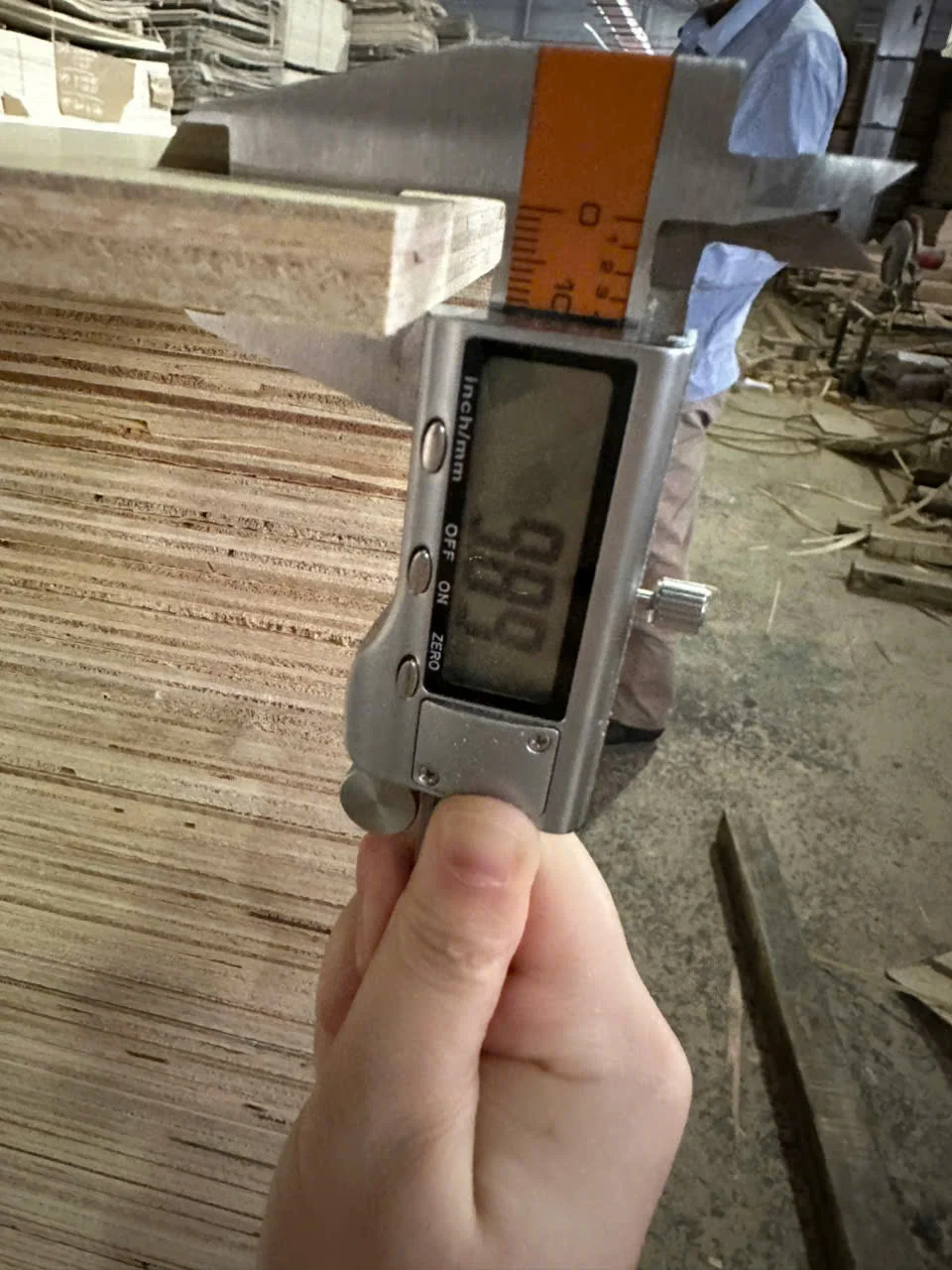
The industry standard for thickness measurement on plywood panels is five points: four corners (inset 50–100mm from each edge) and the center. This pattern catches both taper defects — where thickness varies corner to corner — and crown or cup across the panel face.
| Measurement Point | Acceptable Variance from Nominal |
|---|---|
| All 5 points | Within ±0.3mm (standard export grade) |
| All 5 points | Within ±0.2mm (Japan/Korea premium grade) |
| Any 1 point outside | Sheet downgraded or re-sanded |
Digital calipers or calibrated thickness gauges are used, not rulers. Readings are logged per batch. (HCPLY production data, 2026)
Surface Grade Assessment
Post-sanding QC inspects face and back veneers against the contracted grade specification. For furniture plywood, this means checking for:
- Knots and voids: Acceptable sizes defined by grade (A/B face = tighter limits)
- Sanding marks: Circular machine marks from belt misalignment = fail for A-grade
- Roughness: Measured qualitatively; furniture-grade requires smooth hand-feel
- Glue stains: Surface contamination from glue squeeze-out during pressing
- Core telegraphing: Visible core veneer joint lines showing through face — common in thin panels with insufficient face thickness
“Thickness consistency is the first thing a furniture manufacturer checks on delivery. If our 18mm panels vary by more than 0.3mm corner to corner, the buyer’s CNC machine will produce inconsistent output. We reject anything outside spec before it reaches packing.” — Lucy, International Sales Manager, HCPLY
Sanded vs Unsanded: Different QC Criteria
Not all plywood is sanded. Film-faced, packing grade, and anti-slip plywood skip the sanding stage — their QC checks for surface flatness and film adhesion instead of smoothness. Construction-grade panels are checked for squareness and edge quality rather than surface finish. Understanding which criteria apply to which product type is essential when reviewing any factory’s QC procedure. See plywood sizes and thickness specifications for full tolerance data by product type.
🔧 Stage 3: Pre-Loading QC — Final Count & Packing
The third stage occurs at the packing area, after panels have been counted into pallets and before the container is loaded. This is the last internal checkpoint before the shipment leaves the factory’s control.
What Stage 3 Checks
Panel count: Physical count of sheets per pallet, pallets per container. Discrepancies between packing list and actual count are caught here, not at the buyer’s warehouse.
Final visual grade: A sample from each pallet top is inspected for surface defects that might have developed during handling between sanding and packing — edge chips, forklift damage, moisture exposure.
Moisture re-check: Any pallet that has been stored longer than expected (weather delays, production scheduling) is re-tested for moisture before packing.
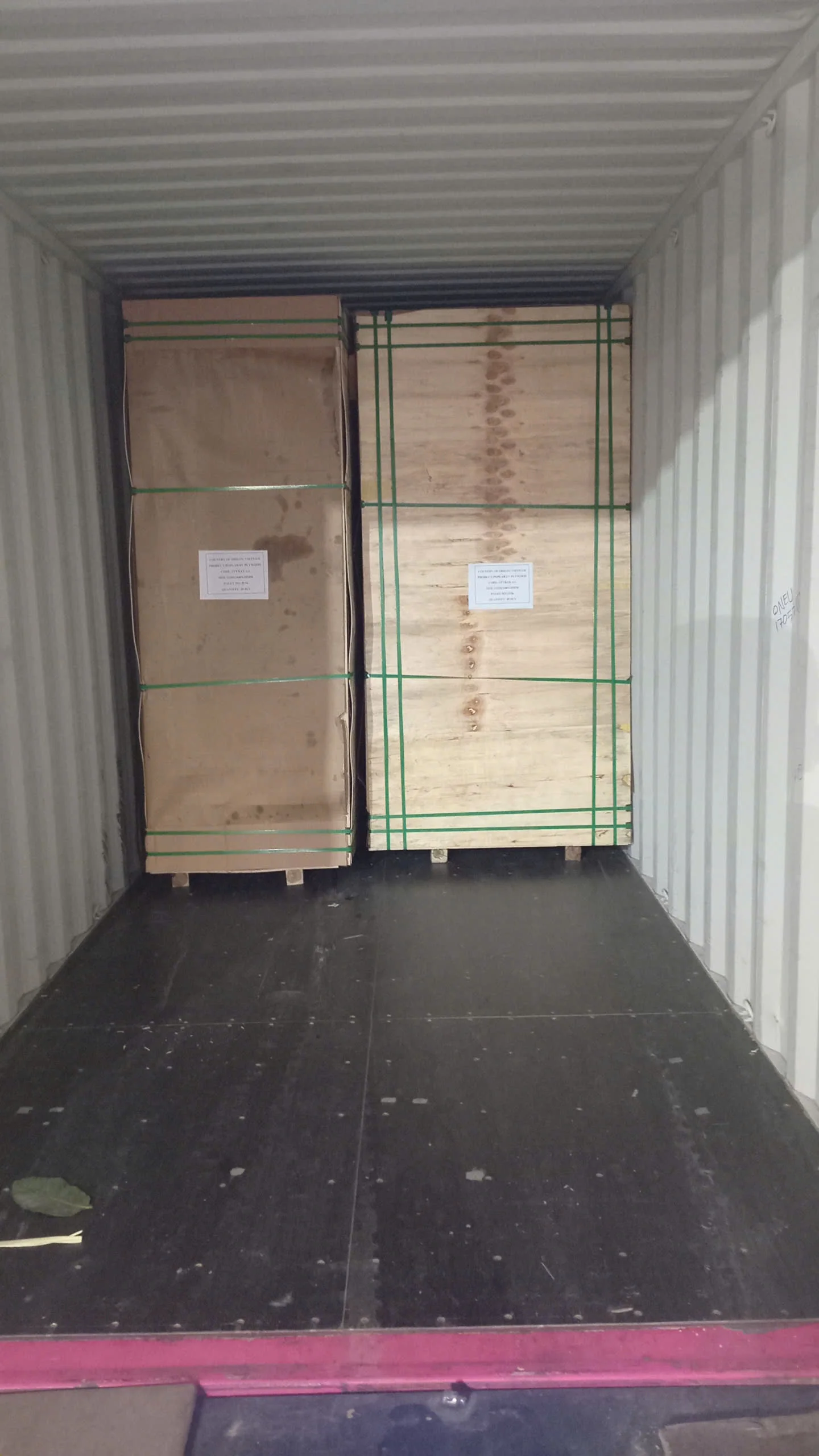
Packing condition: Pallet height within 1000mm limit, strapping secure, corner protectors in place, edge bands where specified. The plywood container packing calculation determines how many pallets fit in the container by core species and thickness — packing QC confirms this layout was actually followed.
Labeling accuracy: Each pallet label is checked against the order: grade, size, thickness, species, glue type, emission class, and order reference number.
Documentation Released at This Stage
A complete factory QC package for export includes:
- Packing list with actual per-pallet counts
- Quality inspection certificate (signed by QC supervisor)
- Moisture content test report
- Boiling test certificate (for WBP/MR grade)
- Emission test certificate (E0/E1/CARB P2 as applicable)
- FSC Chain of Custody certificate (where ordered)
Third-party inspection companies (SGS, Bureau Veritas, Intertek) can be engaged to witness the pre-loading stage independently. HCPLY works with all major inspection bodies. See quality certifications and export documentation for the full certificate list.
🔍 How to Verify a Supplier’s QC System Before Ordering
Most Vietnamese plywood suppliers claim “strict quality control” in their marketing. The claim costs nothing. Actual QC costs time and labor. Here is how to separate real from performative:
Ask for production records, not just certificates. Press log sheets, moisture meter readings with timestamps, sanding calibration records. A factory with real QC has these routinely. A factory without them cannot produce them on demand.
Ask who performs QC — production staff or dedicated QC team. Self-inspection by production workers has inherent conflict-of-interest. An independent QC team with authority to quarantine batches is the factory equivalent of separation of duties.
Request a factory visit. The HCPLY factory in Phu Tho, Northern Vietnam accepts buyer visits and third-party audits. Buyers are welcome to observe all three QC stages in operation. The factory inspection photos gallery shows QC activities if a visit is not possible before initial orders.
Check ISO 9001 certification validity. ISO 9001 requires documented quality management procedures and annual surveillance audits by an accredited certification body. The certificate has an issue date, expiry date, and certifying body name. Verify directly with the certifying body if needed.
Request factory audit documentation from HCPLY
📐 Common Plywood QC Defects — Reference Table
| Defect | Stage Detected | Pass/Fail Criteria | Action |
|---|---|---|---|
| Delamination | Stage 1 | Any separation = fail | Batch quarantine, press review |
| High moisture (>12%) | Stage 1 | Above 12% = hold | Redrying before sanding |
| Thickness out of tolerance | Stage 2 | Outside ±0.3mm = fail | Re-sand or downgrade |
| Surface knots/voids | Stage 2 | Per grade spec | Downgrade or patch |
| Sanding marks | Stage 2 | Visible marks = fail A-grade | Re-sand or downgrade |
| Core telegraphing | Stage 2 | Per face veneer spec | Grade assessment |
| Count mismatch | Stage 3 | Any discrepancy = recount | Recount, relabel |
| Edge chips | Stage 3 | Per grade spec | Trim or downgrade |
| Pallet damage | Stage 3 | Structural = reject | Repack |
✅ Conclusion
Plywood quality control is not a single inspection — it is a structured sequence of checkpoints designed to catch different failure modes at the point where they originate. Post-press QC stops bonding failures. Post-sanding QC controls dimensional accuracy. Pre-loading QC ensures what was ordered is what gets loaded.
A factory running all three stages with documented records, independent QC staff, and clear quarantine procedures represents a fundamentally different risk profile from one that only checks panels at the door before loading. This distinction matters whether you are sourcing for a furniture factory in Korea, a construction site in the UAE, or a cabinet workshop in Europe.
The full HCPLY manufacturing process covers how each production stage connects to the QC checkpoints described here. For buyers wanting to verify bonding quality specifically, the plywood boiling test guide explains what the test actually measures and how to interpret results from different glue grades.
Request an inspection report for your next order from HCPLY — we provide QC certificates, moisture readings, and packing photos with every shipment.