

Factory reference issued by HCPLY Vietnam — based on real container loading programs, not theoretical spreadsheets.
Pallet configuration is the structural foundation of every plywood export container. Get it wrong and the consequences appear as payload overruns, forklift incidents at the port, or customs audit flags after arrival.
— David Duc Do, Export Project Leader, HCPLY Vietnam (10+ years, 1000+ containers loaded)
📋 What Is Plywood Pallet Configuration?
Plywood pallet configuration is the set of physical rules that govern how sheets are stacked, secured, and arranged on each pallet before loading into a 40HC container.
It defines three things simultaneously:
- Pallet footprint — the base dimensions that determine how pallets physically fit inside a container
- Stacking height — how many sheets stack vertically before the pallet becomes unsafe for forklift handling
- Weight per pallet — the result of height × sheet density, which sets whether the full container stays under the 28.5 MT payload ceiling
Every number in a packing list — sheets per pallet, pallets per container, total CBM, total weight — flows directly from these three inputs. An error in any one of them creates a chain of errors across every export document.
Understanding plywood pallet configuration is therefore not optional for B2B importers placing repeat orders. It is the only reliable way to verify whether a supplier’s packing list matches what will actually arrive at your port (HCPLY production data, 2026).
📦 Standard Pallet Dimensions for Plywood Export
Plywood sheets are produced in two dominant sizes: 1220×2440mm (4×8 ft) and 1250×2500mm (metric). Pallet footprint is designed around these sheet dimensions.
📌 Footprint for 1220×2440mm Sheets
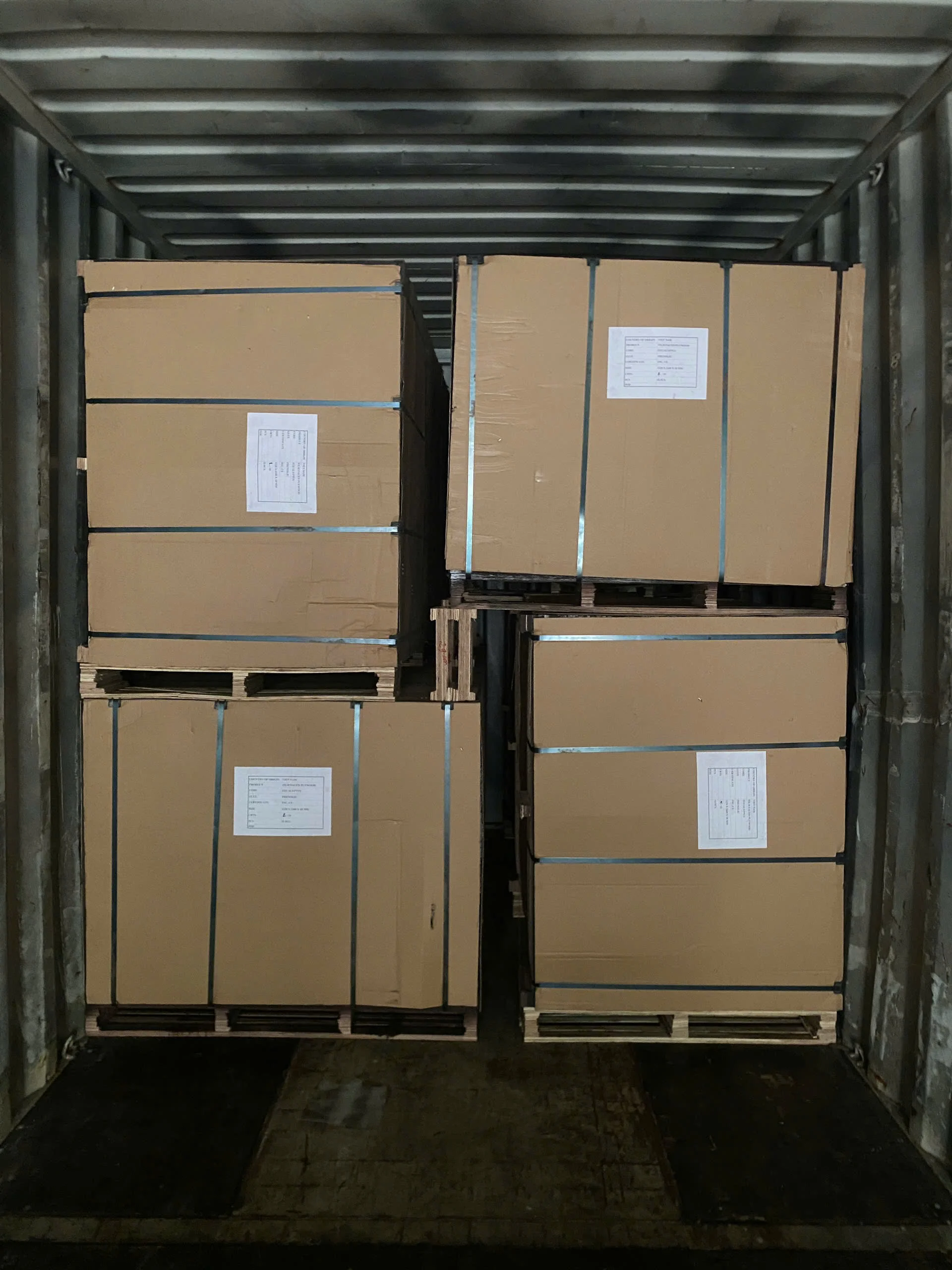
For the most common 4×8 ft sheet size, HCPLY uses a pallet base of 1220×2440mm — the same footprint as the sheet itself. This one-to-one match eliminates overhang risk, prevents corner damage in transit, and simplifies the container geometry calculation.
Inside a 40HC, the internal width is approximately 2,350mm. Two 1220mm pallets side by side span 2,440mm — which exceeds the container width. The factory solution is a 4-wide × 4-deep arrangement (16 flat pallets) plus 2 pallets loaded vertically at the front of the container, giving 18 total positions for styrax core configurations.
📌 Footprint for 1250×2500mm Sheets
Metric EU-size sheets follow the same pallet footprint logic, but the extra 30mm width and 60mm length per sheet means slightly higher CBM per pallet at the same stacking height. Pallet count per 40HC remains consistent (18 for styrax core), but total CBM runs approximately 5% higher per container (HCPLY production data, 2026).
| Sheet Size | Pallet Footprint | CBM vs 1220×2440 |
|---|---|---|
| 1220×2440mm | 1220×2440mm | Baseline |
| 1250×2500mm | 1250×2500mm | +4.8% per pallet |
📐 Pallet Stacking Height — The 1000mm Rule
1000mm is the standard maximum stacking height for a plywood export pallet at HCPLY Vietnam.
This number is not arbitrary. It is the result of three overlapping constraints that factories have tested across thousands of containers:
Constraint 1 — Forklift stability. A pallet stacked higher than 1000mm becomes progressively harder to handle with standard 2.5-ton forklifts. The center of gravity rises, creating tipping risk on uneven port floors or during ship loading operations.
Constraint 2 — Payload ceiling. The 40HC hard payload limit is 28.5 MT. For eucalyptus core plywood (density ~700 kg/CBM), each additional 50mm of stacking height per pallet adds approximately 80–90 kg of total container weight. Increasing stacking height without recalculating total weight risks a payload overrun that customs authorities flag during port inspection.
Constraint 3 — Packing list consistency. Every document in an export shipment — packing list, invoice, bill of lading — must reflect the same pallet height. Deviating from the stated height creates audit discrepancies that delay release or trigger re-inspection fees at destination ports (HCPLY production data, 2026).
⚠️ Important: Some suppliers and online calculators use 900mm as the stacking height reference. HCPLY uses 1000mm because the pallet base (typically 100–120mm) is excluded from the stacking height count. Always confirm whether a supplier’s stated height includes or excludes the pallet base — the gap can shift your sheet count by 5–10 sheets per pallet.
⚙️ Sheets Per Pallet by Thickness
The number of sheets per pallet is calculated with a single formula:
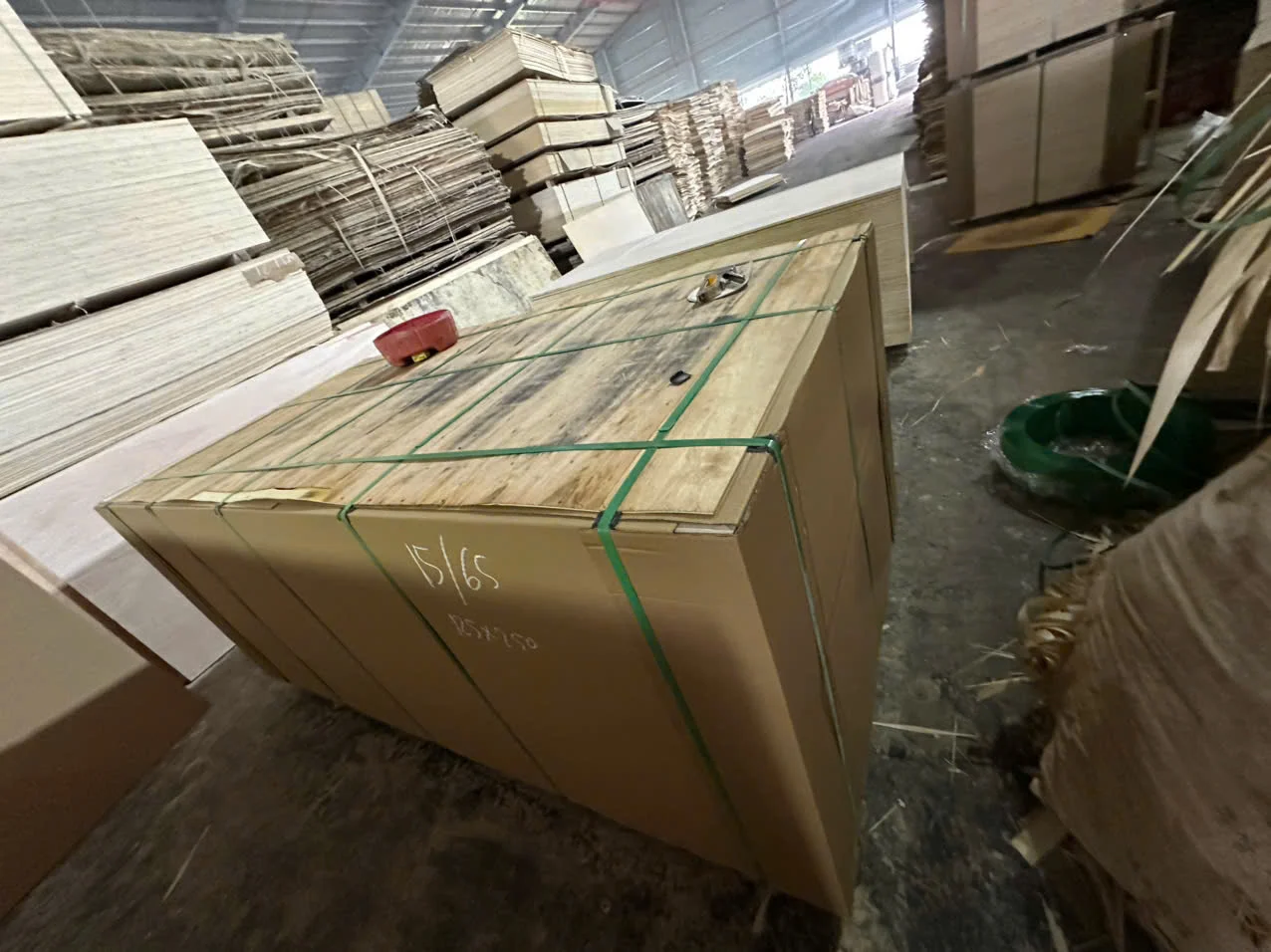
Sheets per Pallet = ROUNDDOWN(1000 ÷ Thickness_mm)ROUNDDOWN is mandatory. Packing must never exceed the 1000mm height limit, so partial sheets are excluded — not rounded up.
Standard Thickness Reference Table
| Thickness (mm) | Sheets per Pallet | Pallet Height (mm) |
|---|---|---|
| 3mm | 333 | 999 |
| 5mm | 200 | 1000 |
| 6mm | 166 | 996 |
| 9mm | 111 | 999 |
| 12mm | 83 | 996 |
| 15mm | 66 | 990 |
| 18mm | 55 | 990 |
| 21mm | 47 | 987 |
| 25mm | 40 | 1000 |
Note: actual loaded height may vary by ±5mm due to sheet thickness tolerance (±0.3mm per sheet), but the ROUNDDOWN formula absorbs this variance at the pallet level.
This table directly links to the plywood container packing calculation guide which extends these per-pallet figures to full container totals including CBM and weight.
🏭 Pallet Count per 40HC — Core Species Determines the Limit
Plywood pallet configuration does not work in isolation. The total number of pallets per container is determined by which core species the plywood uses — because density varies significantly, and the 28.5 MT payload limit applies before CBM volume is even considered.
| Core Species | Density (kg/CBM) | Max Pallets per 40HC | Total CBM | Approx Weight |
|---|---|---|---|---|
| Styrax | ~500 | 18 | ~53 CBM | ~26.5 MT |
| Acacia | ~580 | 16 | ~47.5 CBM | ~27.5 MT |
| Eucalyptus | ~700 | 15 | ~44.5 CBM | ~28.0 MT |
These figures apply to 1220×2440mm sheets. For 1250×2500mm, pallet count remains the same but total CBM is approximately 5% higher.
Importers who regularly source different core species must treat these as separate packing configurations — never blend pallet counts from two core types into one container calculation.
🔧 Forklift Requirements and Safe Handling
Every plywood pallet in a properly configured 40HC load must be handled by forklift — floor loading without pallets is not standard practice for plywood export. This creates practical forklift requirements that affect both the factory dispatch floor and the importer’s receiving warehouse.
Standard forklift capacity needed: 2.5-ton forklifts handle the full range of plywood pallets at 1000mm stacking height. The heaviest single pallet in a standard load is a 15mm eucalyptus core pallet: approximately 1,750–1,850 kg depending on exact density.
Fork insertion: Standard 1200mm forks insert from the 2440mm side of the pallet. This orientation also aligns with the container loading sequence, where pallets enter front-to-back along the container length.
Container floor load: The 40HC floor has a maximum point load rating of approximately 7.2 MT per axle pair. With 15–18 pallets distributed across 12 meters of container length, average floor pressure per pallet is well within safe limits (HCPLY production data, 2026).
⚠️ Note: Importers unloading at destinations with smaller forklifts (1.5-ton units are common at smaller warehouses in India and the Middle East) should confirm capacity against actual pallet weights before the container arrives. Requesting pallet weight data from the supplier at the time of booking avoids delays at unloading.
📊 How Pallet Configuration Affects Freight Cost
Plywood pallet configuration is a direct freight cost variable. The relationship works in two directions:
Direction 1 — More pallets = more CBM = lower cost per sheet. A styrax core container carrying 18 pallets at 18mm thickness contains 990 sheets. An acacia core container at the same thickness carries 880 sheets (16 pallets). The 110-sheet difference at the same freight rate reduces cost per sheet by approximately 11%.
Direction 2 — Heavier core = fewer pallets = higher cost per CBM. Eucalyptus core hits the 28.5 MT ceiling at only 15 pallets, leaving 8–10 CBM of container volume unused. Freight cost per CBM rises because the denominator (CBM) is smaller while fixed freight costs remain constant.
For importers optimizing landed cost, selecting styrax core plywood for furniture applications delivers two simultaneous advantages: maximum pallet count per container and the lowest density penalty on freight calculation.
The full cost model — FOB + freight + pallet count efficiency — is covered in the plywood quotation guide, which walks through how experienced importers compare supplier quotations on a true landed cost basis.
🔗 Pallet Layout Inside the 40HC Container
The physical arrangement of pallets inside a 40HC follows a specific geometry. This is not optional — the layout determines whether all pallets fit without forcing or wasted space.
Standard layout for 1220×2440mm sheets:
- 16 pallets flat — arranged in a 4-wide × 4-deep configuration along the container floor
- 2 pallets vertical — loaded upright against the container front wall, using the remaining space efficiently
- Total: 18 positions (styrax and acacia base configurations use 16 flat pallets; 2-vertical applies to styrax)
The 2-pallet-vertical method is used specifically when the container geometry allows the additional weight without exceeding the 28.5 MT ceiling. Acacia core’s higher density means 16 flat pallets already approaches the payload limit — vertical loading is not typically used.
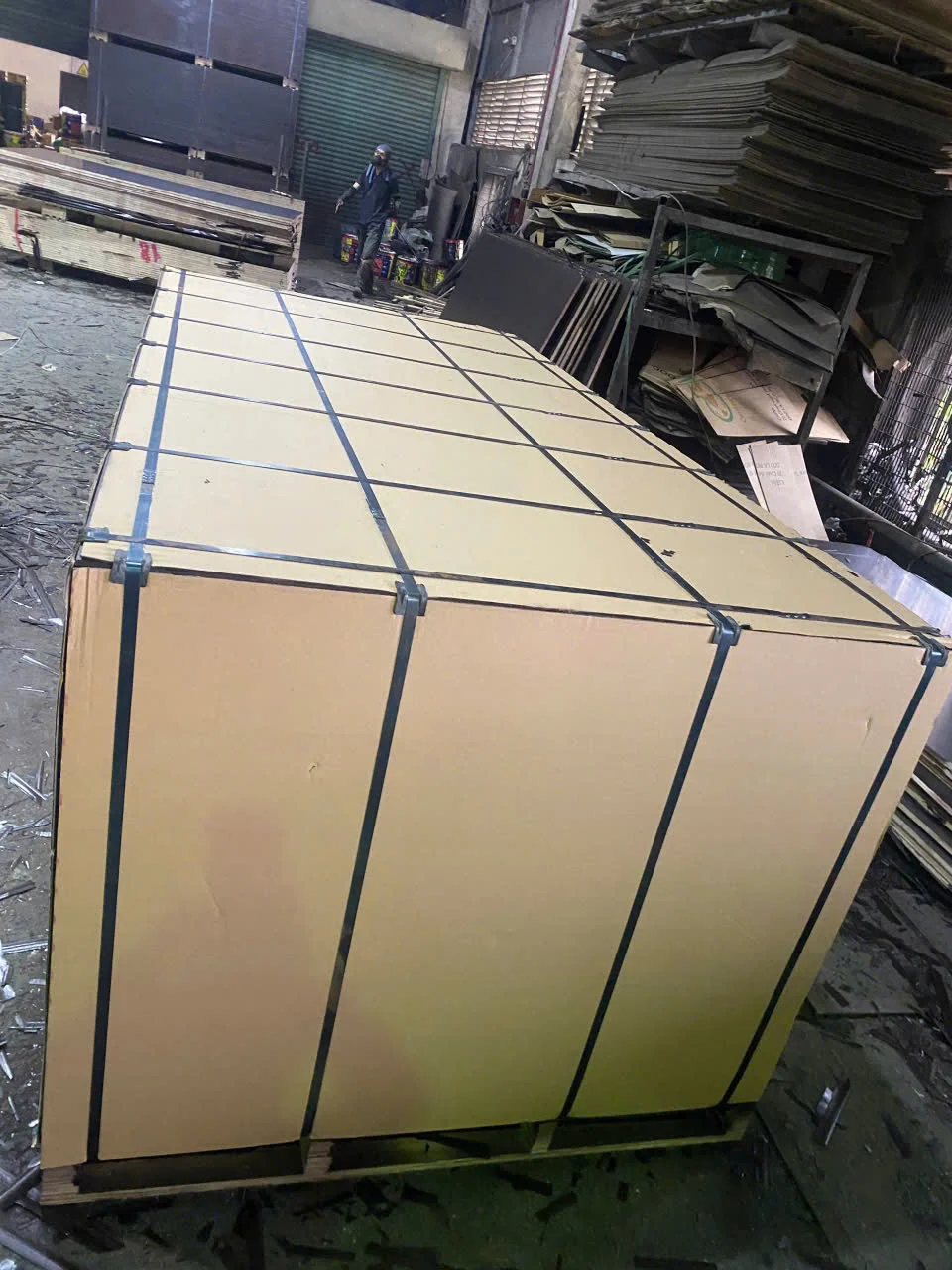
Pallet strapping: All pallets at HCPLY are secured with steel strapping across the top of the stack before loading. This prevents sheet movement during sea transit and ensures the pallet survives the vibration and motion of ocean freight without delaminating the face veneer. The strapping pattern is a standard cross-strap configuration with corner protectors on all four vertical edges (HCPLY production data, 2026).
🔍 Common Pallet Configuration Errors to Avoid
Based on HCPLY’s inspection of re-exports and returned shipments, the most frequent pallet configuration errors fall into three patterns:
Error 1 — Using volume limits as the stacking target instead of weight limits. Factories optimizing for maximum CBM without checking payload can stack pallets to 1100–1200mm. At eucalyptus core density, this pushes containers past 28.5 MT. The overrun is invisible until customs scales at the destination port trigger a penalty.
Error 2 — Mixing core species in a single container without recalculating. A container with 8 acacia pallets and 8 eucalyptus pallets does not simply average the two core densities. The correct approach is to calculate weight per pallet independently for each core, then sum to total container weight. Mixing without recalculation is one of the most cited causes of payload certificate discrepancies in Vietnamese export audits.
Error 3 — Ignoring pallet base height in the stacking height statement. If a supplier states “900mm stacking height” and your calculation expects 1000mm, you are losing approximately 10% of sheets per pallet — a meaningful difference at full container scale. Always confirm: is the stated height sheet-only or does it include the pallet base?
“These three errors are predictable and preventable,” notes Lucy, International Sales Manager, HCPLY. “We catch them during packing list preparation because we run the payload check before issuing any shipping document — not after the container is sealed.”
✅ Plywood Pallet Configuration Checklist
Before confirming a packing specification with your supplier, verify:
- Pallet footprint matches sheet dimensions (no overhang)
- Stacking height stated as sheet-only or including pallet base (specify which)
- Sheets per pallet calculated using ROUNDDOWN(1000 ÷ thickness), not rounded up
- Total container weight calculated per core species density — not blended average
- Pallet count per container matches the core species limit (styrax 18, acacia 16, eucalyptus 15)
- Forklift capacity at destination confirmed against heaviest pallet weight
- Strapping method confirmed (steel strap + corner protectors for ocean transit)
- All packing data consistent across packing list, invoice, and bill of lading
📦 Conclusion
Plywood pallet configuration is the link between factory production and freight cost. The standard 1000mm stacking height, the ROUNDDOWN formula for sheets per pallet, and the core-species-based pallet count per 40HC are not guidelines — they are the physical rules that determine whether a container ships clean, arrives without claims, and delivers a predictable landed cost.
Every importer placing repeat orders at scale should have this data verified before signing a supply contract. A one-pallet discrepancy in a monthly program adds up to missed CBM, excess freight cost, and documentation risk across a full year of shipments.
Request Factory Packing Data for Your Order — HCPLY provides complete packing list documentation including per-pallet weight, stacking height, and CBM breakdown for every confirmed order. No commitment required.