

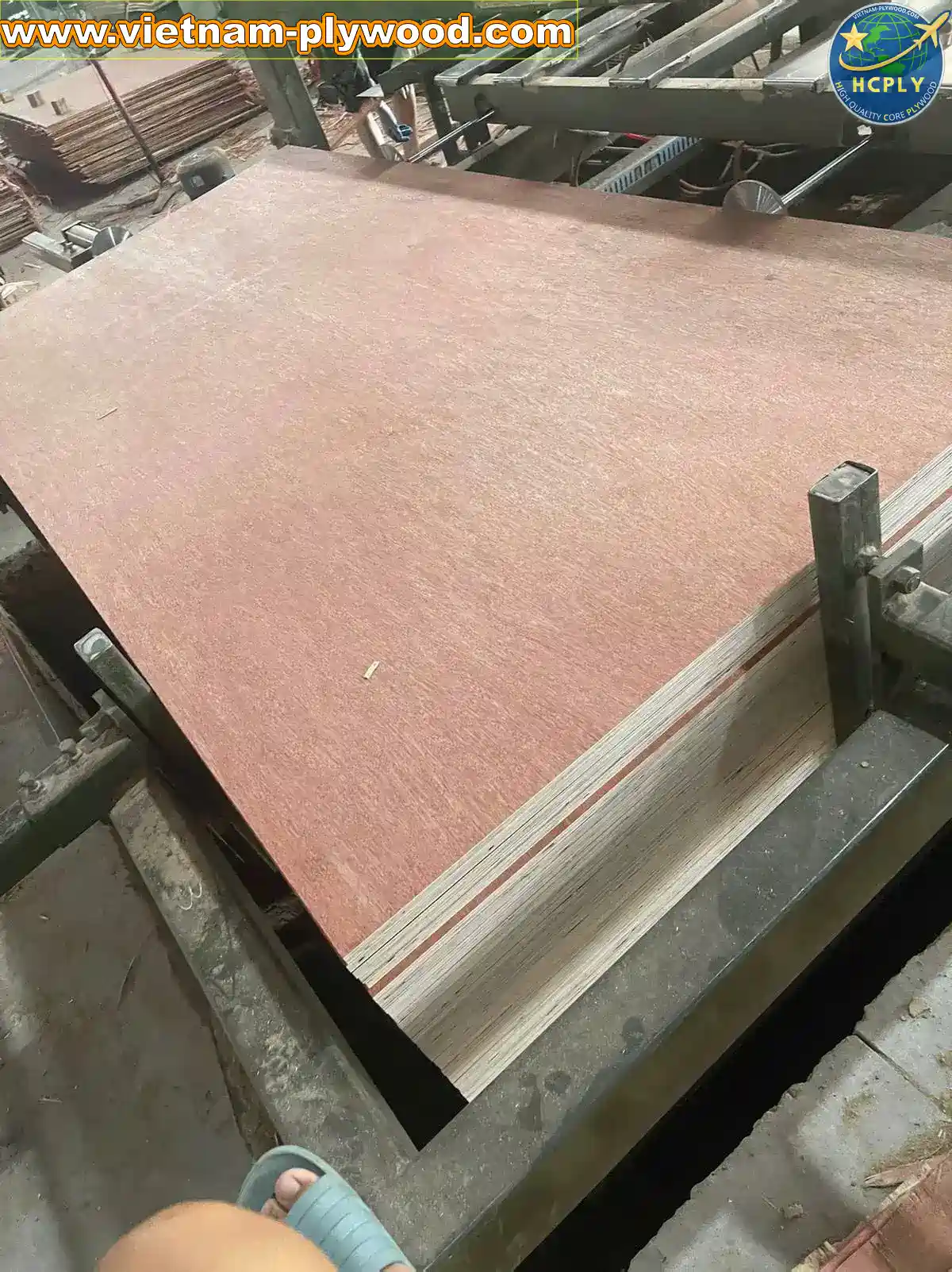
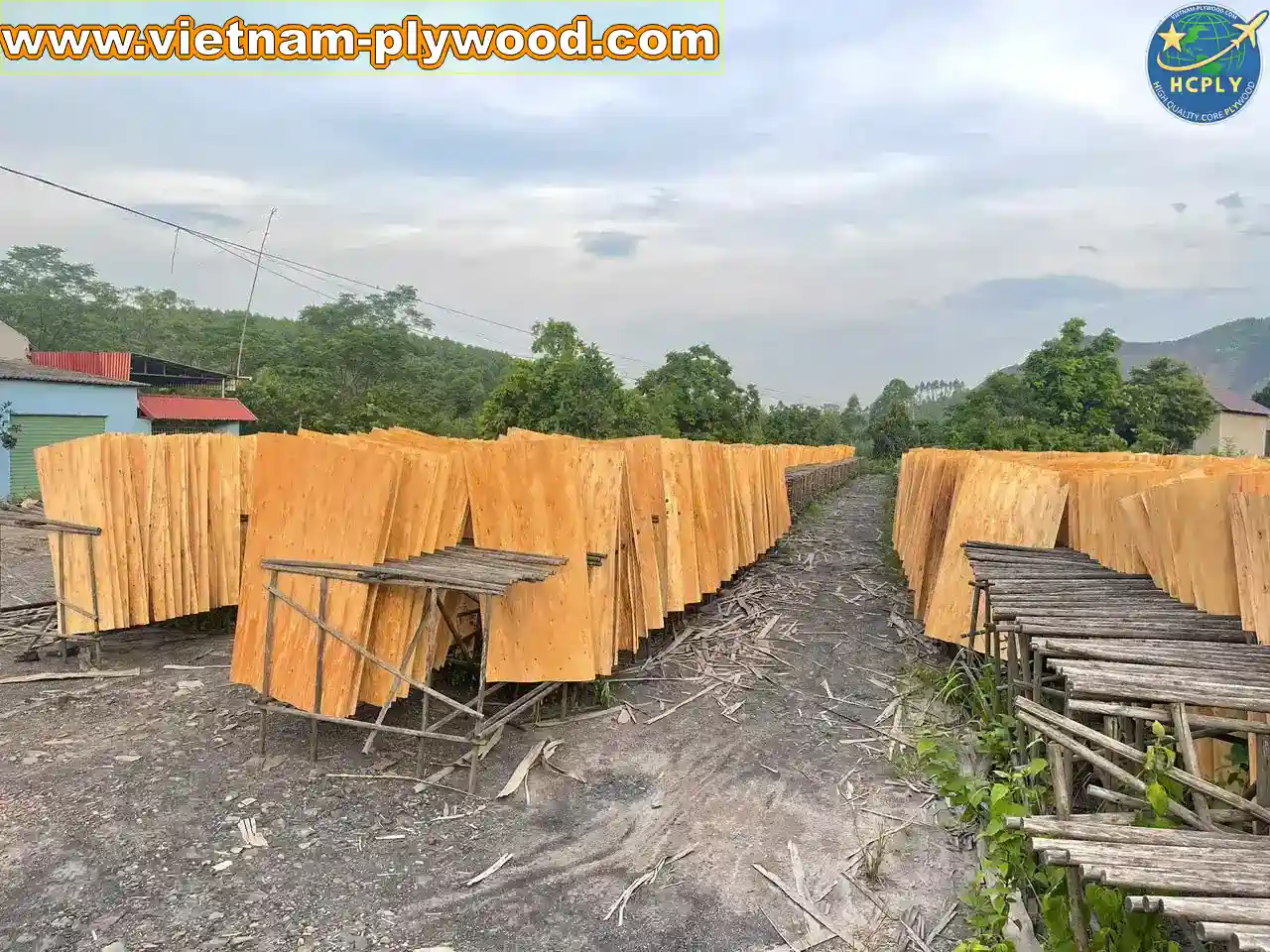

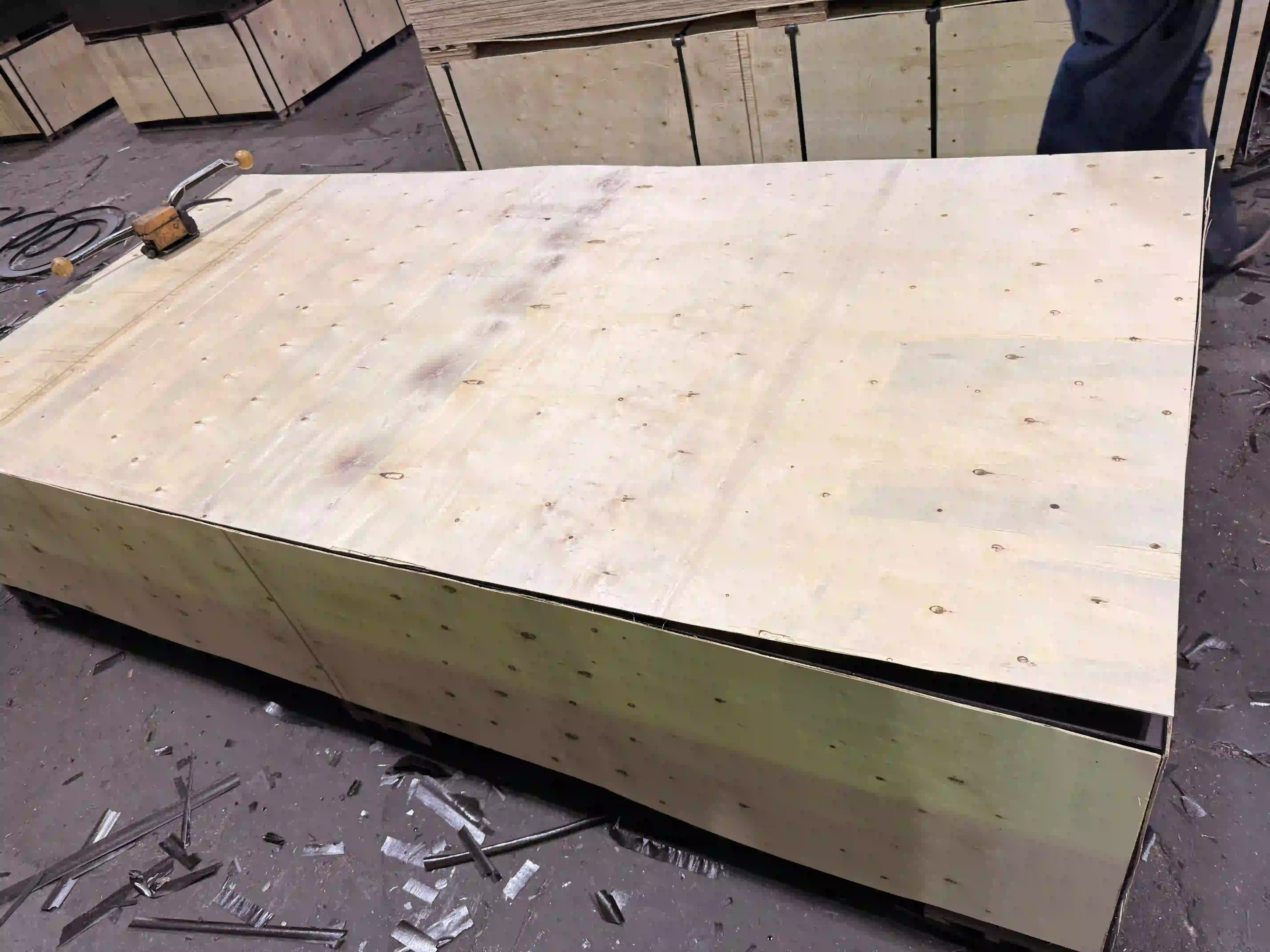
Most buyers asking about plywood MOQ minimum order vietnam get a one-liner answer: 1 container. That tells you nothing useful. What you actually need to know is what minimum quantities and container loads mean in practice, what flexibility exists within that plywood MOQ, how to negotiate, and what happens on your first order when everything is still unknown.
This guide has the minimum order quantities for Vietnam plywood explained from a factory-direct exporter — no padding, no vague reassurances.
📦 What Is the Standard Plywood MOQ from Vietnam?
The standard MOQ for Vietnamese plywood exporters is 1×40HC container.
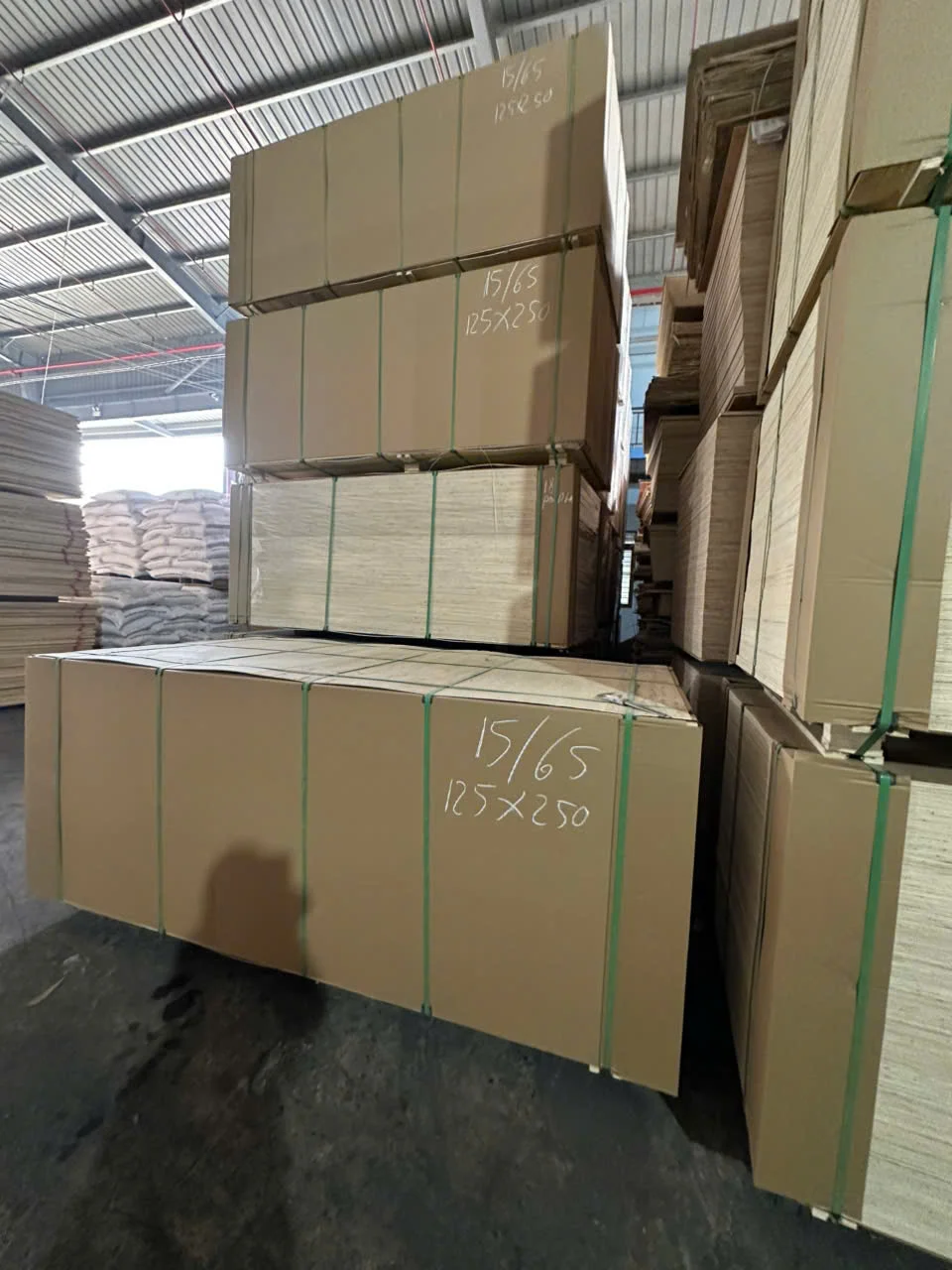
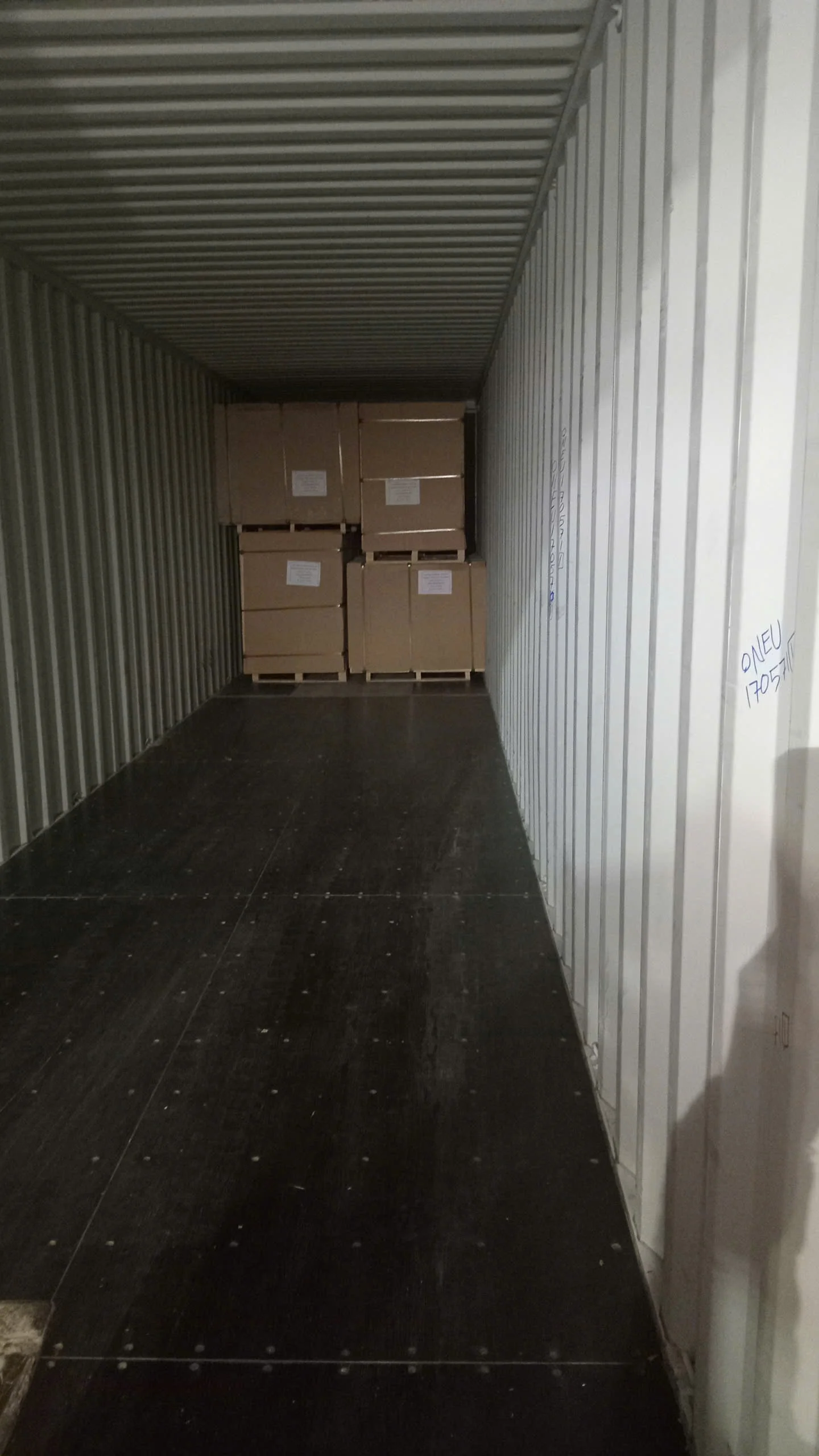
A 40HC (40-foot high-cube) container holds between 40 and 53 CBM of plywood, depending on core species and sheet thickness (HCPLY production data, 2026). That translates to roughly:
- 18 pallets for styrax-core panels (lighter, ~480–500 kg/m³)
- 16 pallets for acacia-core panels (~580 kg/m³)
- 15 pallets for eucalyptus-core panels (heaviest, ~650–750 kg/m³)
Payload ceiling for a 40HC is 28.5 MT. That constraint determines pallet count before CBM does.
For detailed container loading tables by thickness and core species, see the plywood container packing calculation guide for 40HC.
Why one container? The economics are straightforward. Below a full container, per-unit costs rise sharply. Factory setup, quality control, documentation, and logistics are mostly fixed per order. A half-container does not cost half as much to produce and ship — it costs about 70–80% as much while delivering half the volume.
Key Insight: Vietnam’s plywood MOQ of 1×40HC is not a hard wall — it is the price-efficiency threshold. Factories will discuss smaller volumes, but expect pricing to reflect the fixed-cost structure.
📊 Mixed-Spec Containers: The Real MOQ Flexibility
The most practical MOQ flexibility comes from mixed-spec containers, not from reducing total container volume.
A single 40HC can carry:
- Multiple thicknesses of the same product (e.g., 12mm + 18mm + 21mm film-faced plywood)
- Multiple face veneer types (e.g., bintangor + okoume within the same container)
- Multiple product categories (e.g., furniture-grade birch plywood alongside packing-grade panels)
The typical minimum per spec line is 1 pallet — roughly 50–100 sheets depending on thickness. At 9mm, one pallet holds around 111 sheets (ROUNDDOWN of 1000mm ÷ 9mm). At 18mm, that drops to 55 sheets per pallet.
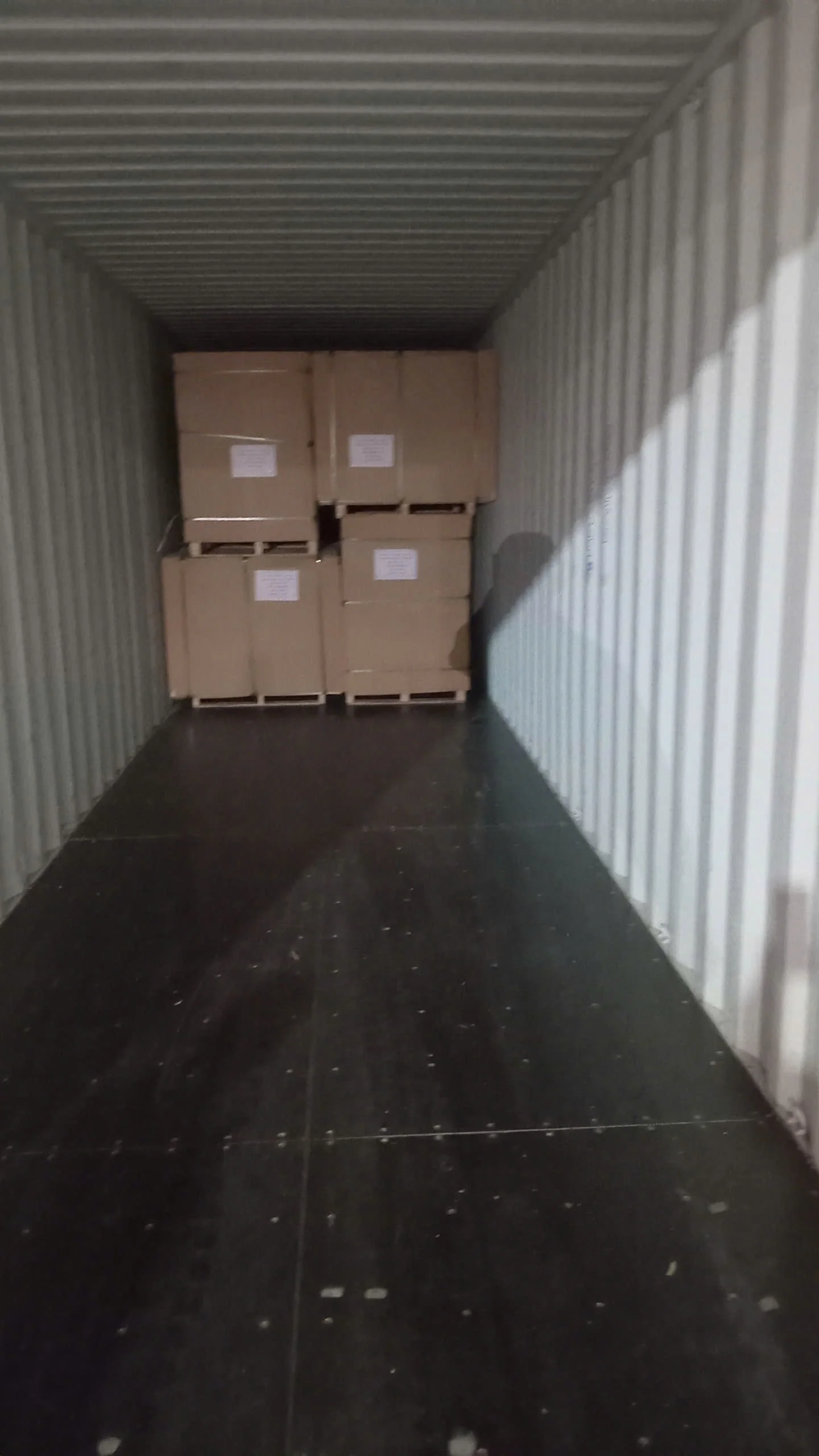
This structure matters for buyers who need product variety rather than a single-product truckload. A distributor entering a new market can place a mixed container carrying 4–6 product types, test market response, and sharpen their next order based on real sales data.
“The mixed-container option solves the problem most new importers face — they don’t want 1,000 sheets of one grade, they want 200 sheets each of five grades to show their customers what’s available.” — Lucy, International Sales Manager, HCPLY
🔧 How to Structure Your First Order Within MOQ
New importers frequently over-engineer their first order. The practical approach is simpler.
Step 1: Anchor on one or two core products. Choose the highest-volume product you can sell, then fill remaining space with secondary items. This keeps your primary spec line well above the minimum-per-pallet threshold and reduces QC complexity.
Step 2: Specify exactly what you need. Vague orders produce vague results. For each spec line, define: face veneer type, core species, glue type (Melamine MR or Phenolic WBP), emission standard (E0, E1, or E2), thickness, sheet size, surface finish (sanded or unsanded), and quantity in sheets or CBM.
The plywood quotation guide — what to know before requesting a price covers the full specification checklist before you send your inquiry.
Step 3: Confirm total CBM and weight. Mixed containers require recalculation. If your heaviest spec line is eucalyptus-core at 15 pallets, it already pushes toward the 28.5 MT payload limit. Adding more items requires careful weight accounting, not just CBM math.
Step 4: Lock documentation requirements early. For US market buyers: CARB P2 compliance must be declared upfront. For EU buyers: FSC chain-of-custody and EUDR traceability documentation are required before production. Retroactive certification requests are not possible. Documentation aligns with factory segment — premium furniture-grade facilities carry FSC and CARB P2; commercial-grade factories typically do not.
💡 Negotiating MOQ with Vietnamese Suppliers
Vietnam’s plywood industry has hundreds of factories and exporters. Most are small to mid-sized operations with genuine flexibility on plywood MOQ structure — if you approach the conversation correctly.
What works:
Written commitment on volume. Suppliers respond to buyers who say: “I need a trial container at a slightly smaller volume. If quality meets specification, I commit to X containers over the next 12 months.” A signed letter of intent or a framework agreement shifts the conversation from a one-off request to a commercial relationship.
Technical specificity. A buyer who arrives with a detailed spec sheet signals seriousness. Suppliers know that vague inquiries rarely convert into orders. Specific requests — exact thickness tolerances, confirmed emission grade, declared certification requirements — reduce factory risk and increase willingness to accommodate smaller opening orders.
Payment terms trade. MOQ flexibility and payment terms often move together. A buyer offering 30% T/T advance plus confirmed LC is a lower-risk customer than one requesting net-60 open account. Suppliers absorb more MOQ flexibility when payment risk is lower.
What does not work:
Pressure tactics and ultimatums rarely succeed with Vietnamese manufacturers. The plywood export market is competitive, but factories here hold their quality standards with significant pride. Buyers who push purely on price or demand exceptions without offering anything in return typically receive politely noncommittal responses — and lose ground to buyers who build relationships.
⚠️ Important: Never approach a premium furniture-grade factory expecting commercial-grade pricing, or vice versa. Vietnam’s factory segments are structurally separate. Mixing segment expectations is the most common error international buyers make — and no amount of MOQ negotiation bridges that gap. See the Vietnam plywood factory types and industry segmentation guide for context.
📐 Sample Orders Before Committing to MOQ
Before placing a container order against your plywood MOQ, requesting physical samples is standard practice — and expected.
Standard HCPLY sample procedure (2026):
| Item | Details |
|---|---|
| Sample size | Typically 300×300mm or 600×600mm per spec |
| Sheets per spec | 1–2 sheets, full thickness |
| Courier cost | Paid by buyer on first request |
| Lead time for samples | 5–7 working days after confirmation |
| Credit on first bulk order | Sample cost credited toward first container |
Physical samples let you evaluate face veneer grade, core construction quality, thickness calibration (±0.3mm tolerance), glue bond integrity, and surface finish. These are things no photograph conveys accurately.
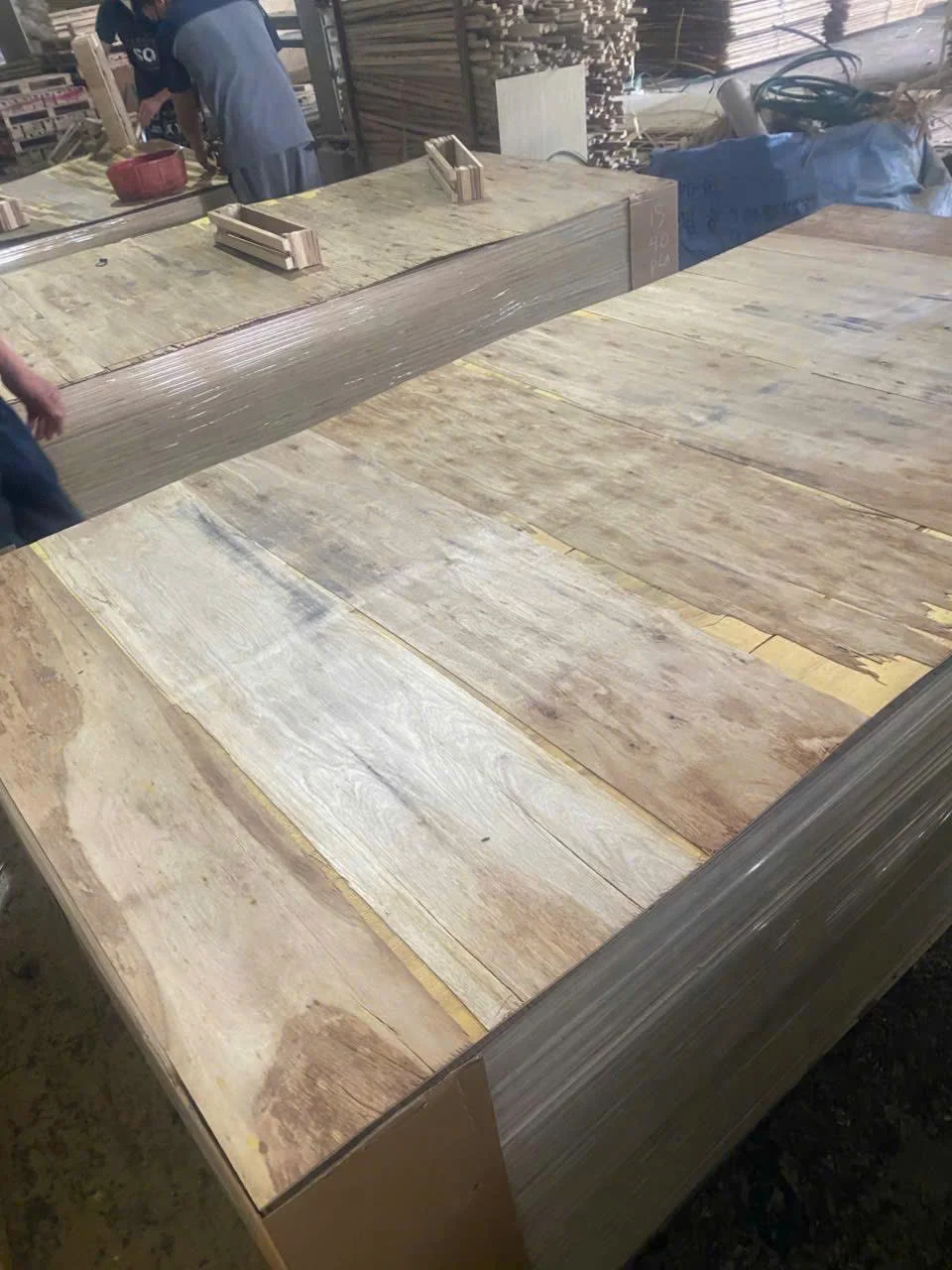
For buyers evaluating multiple suppliers in parallel, requesting identical spec samples from each — same thickness, same face, same emission class — creates a clean side-by-side comparison. Differences in surface smoothness, edge quality, and core density become immediately apparent when you hold two panels from different factories.
📦 LCL Orders: When You Cannot Meet Container MOQ
If a full container plywood MOQ is genuinely not viable — new market, limited warehouse space, regulatory testing period — LCL (Less than Container Load) consolidation is the alternative.
In LCL, your cargo shares container space with other shipments. A freight forwarder consolidates multiple small shipments into one container and deconsolidates at destination.
LCL realities for plywood buyers:
- Cost: Typically 2–3× higher per CBM than FCL (Full Container Load)
- Lead time: Longer — depends on consolidation schedule at origin port
- Damage risk: Higher — plywood edges and face veneers are susceptible to handling damage when adjacent to dissimilar cargo
- Minimum volume: No factory-side minimum, but freight forwarder may set a floor (often 1–2 CBM)
For most serious B2B plywood buyers, LCL is a one-time solution for initial samples or market testing — not a long-term procurement strategy. The cost differential makes it structurally uncompetitive against FCL beyond the trial phase.
🏭 MOQ by Supplier Type: What to Expect
Not all Vietnamese plywood suppliers have the same plywood MOQ structure. Understanding who you’re dealing with affects what flexibility is genuinely available.
| Supplier Type | Typical MOQ | Mixed-Spec | Flexibility |
|---|---|---|---|
| Large manufacturer-exporter | 1–2×40HC | Limited | Low — production runs planned in advance |
| Multi-facility export operator (e.g., HCPLY) | 1×40HC | Yes, per pallet | Moderate — multi-segment access |
| Trading company | 0.5–1×40HC | Yes, wide range | High — but margin layers built in |
| Small factory direct | 1×40HC | Rarely | Low — single-product specialists |
Trading companies often advertise the lowest MOQs. They can do this because they aggregate multiple buyers into factory runs. The trade-off: pricing includes a margin layer that factory-direct exporters do not carry. Over the long term, that layer compounds into significant landed cost differences.
HCPLY operates as a multi-facility export operator — factory-direct documentation and pricing across 3 specialized production facilities covering furniture-grade, commercial/packing, and premium film-faced segments. No VAT overhead, no trading company margin layer. View our full product range at HCPLY — Plywood Manufacturer in Vietnam.
✅ MOQ Checklist for New Importers
Before submitting your first inquiry, confirm:
- Total CBM estimate: Do you know approximately how many CBM you need?
- Spec completeness: Face veneer, core species, glue, emission, thickness, size, finish
- Certification requirements: CARB P2? FSC? CE? EUDR? (declare upfront — not retroactively)
- Destination port and Incoterms: FOB Hai Phong is standard; CIF available
- Sample requirements: Which specs do you need physical samples for before order placement?
- Payment terms: T/T advance, LC, or other arrangement?
- Timeline: When does cargo need to arrive at destination?
With these answers in hand, a first inquiry produces a real quotation — not an exchange of round-trip clarifying questions that delays your sourcing by weeks.
🔗 Conclusion: MOQ Is a Starting Point, Not a Wall
The standard plywood MOQ minimum order from Vietnam is 1×40HC container. For most B2B importers, that is the right entry point — the economics are sound, documentation is clean, and factory-direct pricing is available from suppliers like HCPLY.
Where flexibility exists is in spec composition within that container, not in reducing total volume below a container. Mixed-spec containers, per-pallet minimums, and structured sample programs give buyers meaningful options for their first order.
The best first move is always a specific, well-documented inquiry. Factories respond in kind — with precise quotations, production timelines, and real capacity data. Generic requests produce generic responses.
Request a Quote with Your MOQ Requirements — HCPLY responds to all inquiries with full spec quotation, packing data, and lead time within 24 hours on business days. No commitment required to receive a detailed price.
For more on preparing your first plywood order from Vietnam, see the complete buyer’s quotation guide — what to know before requesting a price.