





Plywood carries a load according to its tested bending properties, thickness, unsupported span, support layout and load position; there is no universal kilogram rating for a sheet. Choosing from thickness alone can mean sagging cabinet shelves, rejected specifications or costly replacement work. At HCPLY, we start with the finished application and the span before selecting a panel build.
How much weight can plywood hold?
The allowable weight is the lowest load permitted by bending strength, deflection, shear and the complete supporting assembly. A 12 mm sheet spanning between two rails cannot be assigned a safe kilogram figure without its test properties, rail spacing, panel direction and load footprint. Ask for a load-span calculation tied to the actual installation.
For related dimensions, start with our plywood sizes and thickness specification guide and the Sizes & Specs library.
How do thickness and span change the answer?
A thicker panel usually resists bending more effectively when the core construction and test properties remain comparable. Longer clear spans increase bending demand and visible sag. Adding an intermediate support can therefore change the selection more than changing the face veneer.
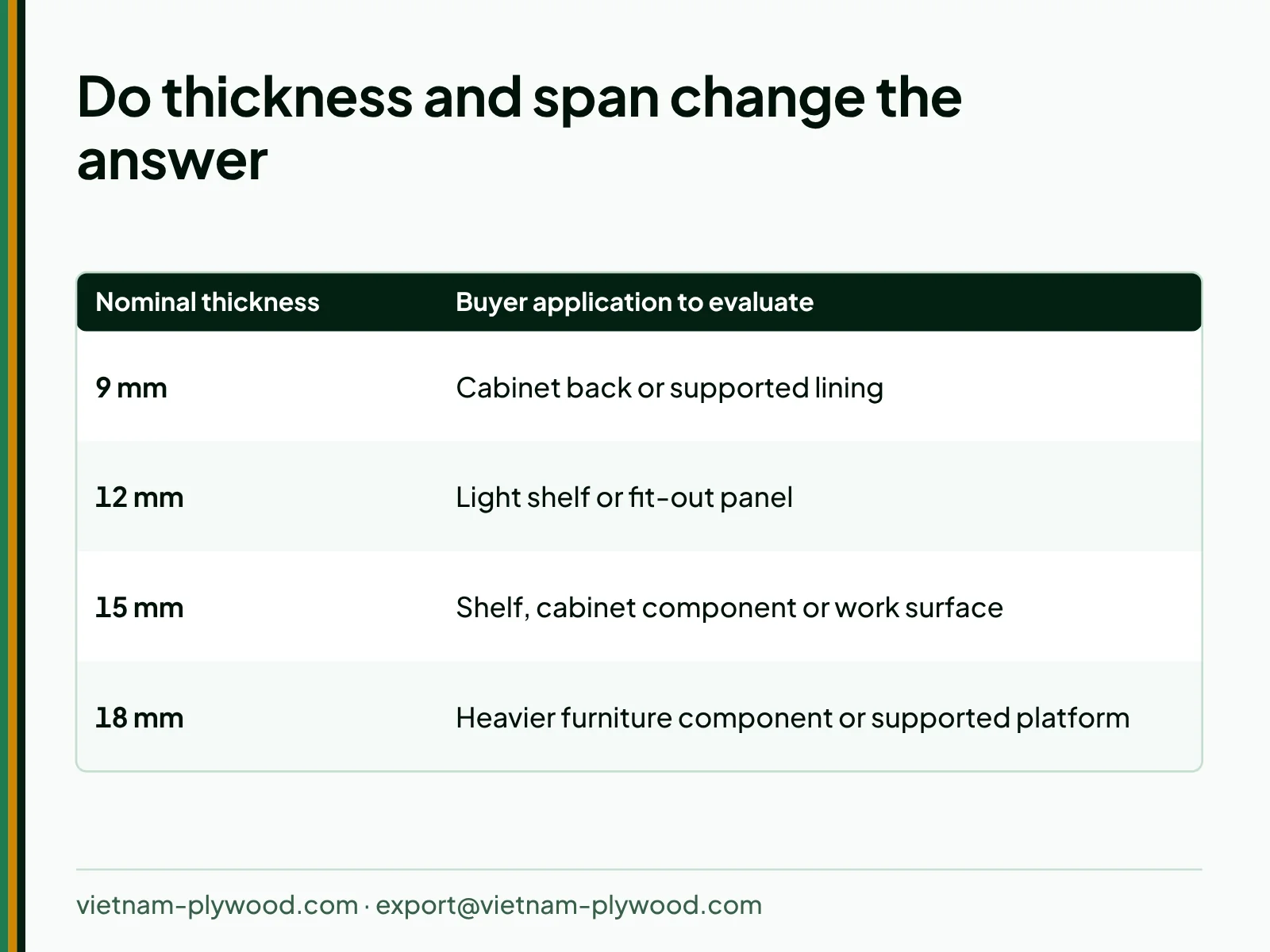
| Nominal thickness | Buyer application to evaluate | Span information needed | Decision before ordering |
|---|---|---|---|
| 9 mm | Cabinet back or supported lining | Distance between rails and fastener positions | Check panel restraint and local loads |
| 12 mm | Light shelf or fit-out panel | Clear shelf span and loaded area | Request bending and deflection evidence |
| 15 mm | Shelf, cabinet component or work surface | Support spacing and edge detail | Compare tested stiffness with the deflection limit |
| 18 mm | Heavier furniture component or supported platform | Span, loading pattern and bearing length | Review full assembly rather than thickness alone |
| 21 mm | Long or heavily loaded component | Actual span and connection details | Compare stiffness, weight and support changes |
| 25 mm | Special heavy-duty panel design | Structural arrangement and point-load footprint | Obtain application-specific calculation |
These are specification pathways, not rated loads. HCPLY manufactures thicknesses from 3–40 mm, including the listed common sizes; the right thickness still follows the required performance. See how to check plywood strength before buying for the inspection sequence.
What do bending strength, stiffness and deflection mean?
Bending strength indicates the stress at which a tested specimen fails; modulus of rupture (MOR) is a common reporting measure. Modulus of elasticity (MOE) describes bending stiffness, which governs how far a panel bends under a given load. A panel can remain intact while sagging beyond a cabinet maker’s acceptable limit.
Ask the testing laboratory to identify specimen dimensions, support span, loading direction, conditioning, test method and the number of specimens. Compare results for the same test arrangement; a single maximum breaking force without those details is difficult to transfer into a shelf design.
How much weight can 1/2 plywood hold?
Half-inch plywood is a nominal trade description close to 12 mm, but it does not define one safe load. The same panel can work in a closely supported cabinet component and deflect excessively across a longer open shelf. Specify the actual measured thickness, span and test direction before asking for kilograms or pounds.
Is 1/2 plywood strong enough to walk on?
Walking on a 12 mm panel requires an approved floor or temporary-platform design covering supports, concentrated foot loads, edge support and fasteners. Thickness by itself cannot establish walking safety. A loose panel over widely spaced supports must never be treated as a rated access platform.
The 2024 technical note Q225 from APA — The Engineered Wood Association describes uniform load tables for qualifying structural panels. Its tables distinguish span, panel orientation and deflection limits; those published ratings apply to the specified qualifying panels, not automatically to HCPLY furniture plywood. See the APA load-span technical note.
For floors and access surfaces, use the applicable destination-market building code and a panel whose documented structural classification that code accepts.
Which of our lines would build the panel?
Our furniture line is the starting point for a sanded, full-stitched shelf or cabinet component. Our commercial and packing line makes acacia-core panels for packing and commercial uses, while our construction line presses film-faced panels for formwork-related applications.
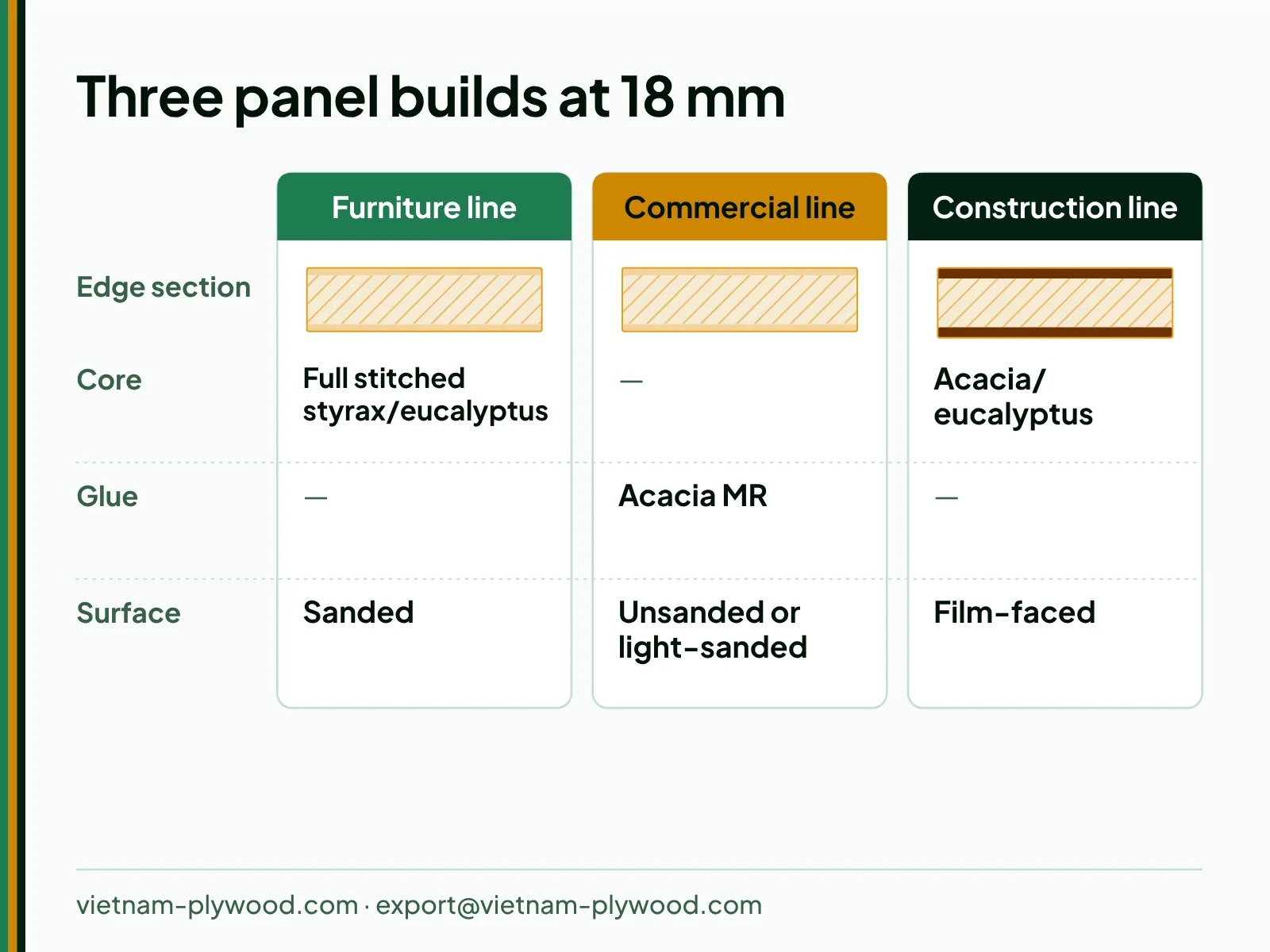
| Same nominal 18 mm thickness | Core and construction | Surface and process | Appropriate buyer evaluation |
|---|---|---|---|
| Furniture line | Styrax or eucalyptus, full stitched | Sanded; E0/E1 emission class | Cabinet stiffness, finish and dimensional fit |
| Commercial and packing line | Acacia; MR adhesive | Unsanded or light-sanded | Crate or packing assembly and bearing supports |
| Construction line | Acacia or eucalyptus | Phenolic or melamine film; unsanded | Formwork support geometry and wet-service handling |
These builds are not interchangeable strength grades. The furniture plywood range and packing or commercial plywood range show the different purchasing purposes. Glue type and emission class are separate specification fields: MR describes a moisture-resistant bond, while E0 and E1 describe emission classes.
What makes one plywood panel stronger than another?
Core continuity, veneer orientation, bond integrity, thickness and panel geometry influence performance. Full-stitched cores reduce internal gaps compared with loose-laid cores, while veneer species alone cannot establish an allowable shelf load. A face named birch or okoume describes the visible veneer rather than the density of the entire board.
HCPLY uses styrax, acacia and eucalyptus cores, with reference densities of 500, 580 and 650 kg/m³ respectively. Density helps estimate shipment mass; it is not an MOR or MOE result. Our 18 mm panels contain 11–13 plies according to core veneer thickness, so ply count alone is an incomplete strength ranking.
For core and shipment mass, consult the plywood weight table and styrax core density comparison.
How should a buyer calculate a design load?
A defensible load assessment starts with the actual component, then applies a documented material property and the relevant design method. Use this numbered workflow before committing a large order.
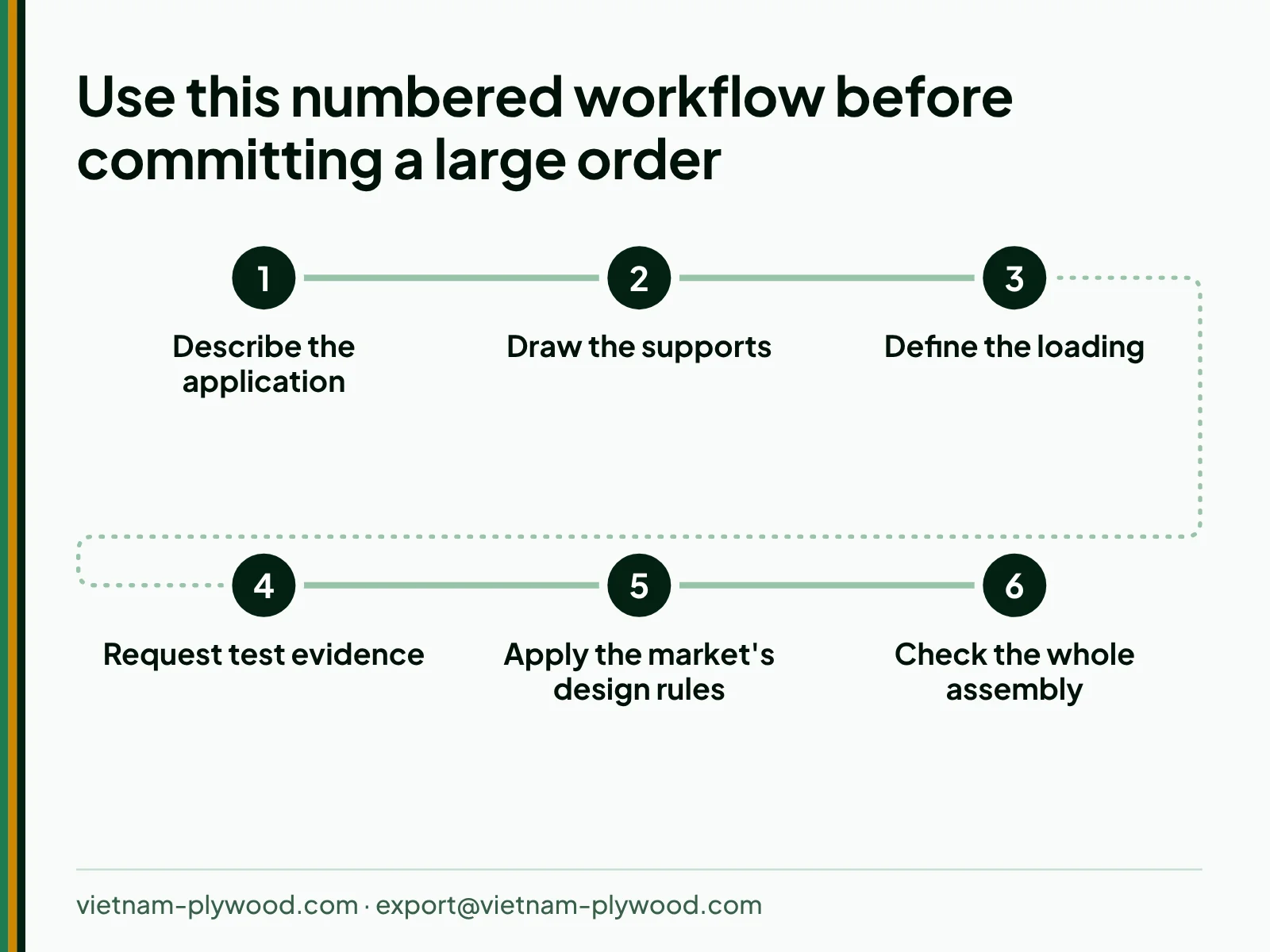
- Describe the application. Record shelf, partition, packing base or supported work surface, including its expected service conditions.
- Draw the supports. Mark clear span, support width, edge restraint, fasteners and the direction of the panel’s strength axis.
- Define the loading. Separate evenly distributed loads from concentrated feet, wheels, stacked goods and impact loads.
- Request test evidence. Obtain MOR, MOE and relevant shear or bond results for the agreed build and test direction.
- Apply the market’s design rules. Use the destination code, its accepted product classification and its serviceability limits; involve a qualified designer for safety-related applications.
- Check the whole assembly. Verify deflection, bending, shear, local bearing, connections and the supporting frame before approving the specification.
Why must the span table come from the destination market?
A span table is valid only for the product classification, test basis, loading assumptions and installation conditions stated by its publisher. Building codes can differ in accepted panel grades, live-load categories, deflection limits and fastening details. Importers therefore need the destination-market design basis before treating any table as a procurement requirement.
APA’s 2024 Q225 technical note explicitly limits its tables to qualifying trademarked structural panels manufactured under specified standards. Its official plywood guidance explains how span ratings relate to roof and subfloor support spacing. These references explain a method; they are not product approvals for the panels on this page.
What can an inspector check at the producing factory?
An inspector can witness dimensional measurements, edge and core examination, sample selection and identification of the agreed build. For a bending claim, the inspection plan should connect the sampled batch to a laboratory test report with its test method and specimen orientation.
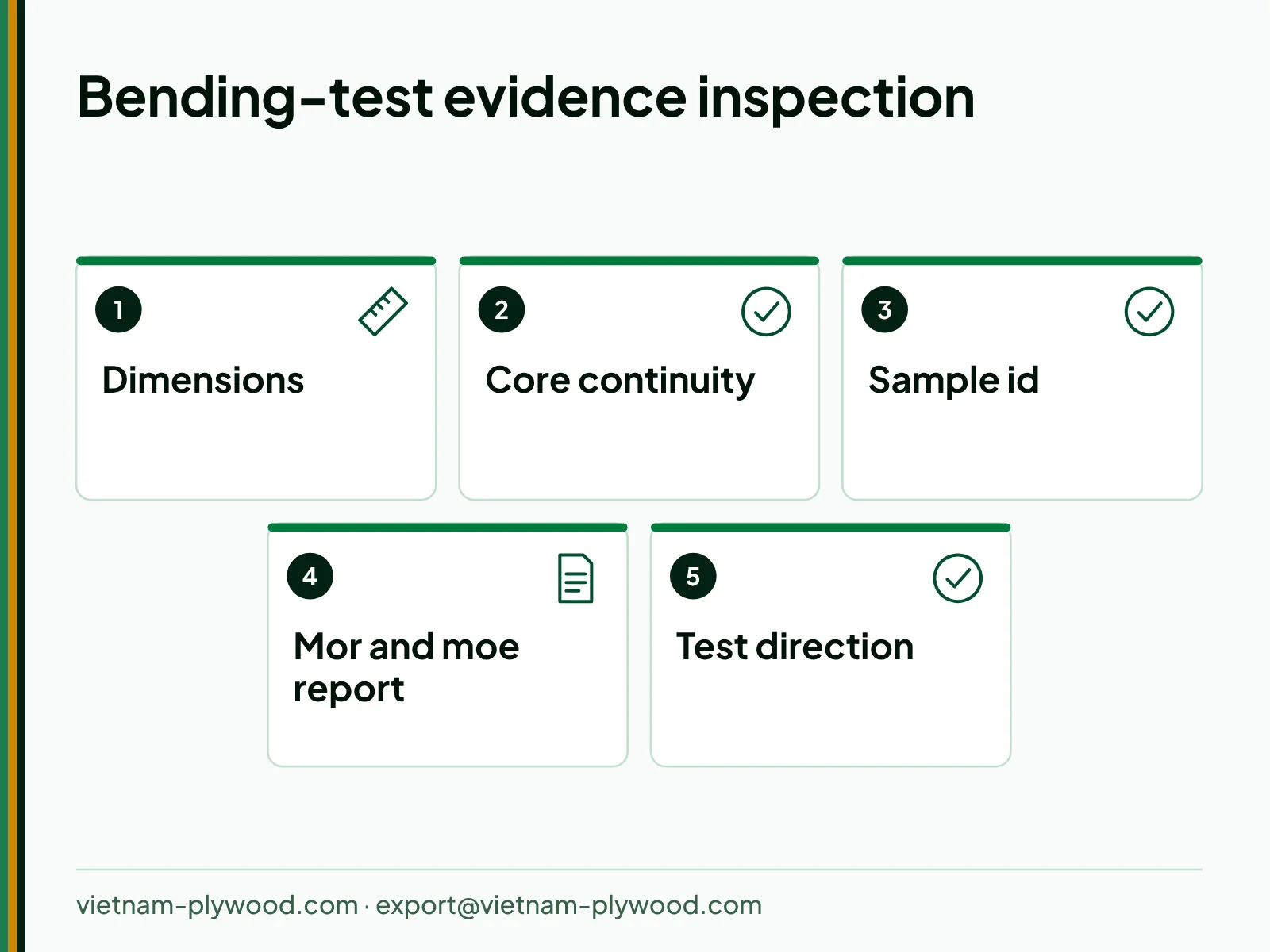
At the producing factory, buyers can examine stitching continuity, voids at cut edges, face defects and panel flatness. Our furniture line can be checked against the ordered sanded thickness tolerance of ±0.2 or ±0.3 mm; commercial and film-faced tolerances are ±0.5 mm, while packing tolerance is ±0.5–1.0 mm. Length and width tolerance is ±2 mm.
HCPLY coordinates on-site quality control, loading and the export paperwork. Order-specific test reports belong with the certificate documents in the shipment’s document set, alongside the invoice, packing list and bill of lading. Factory-held FSC, CARB P2, ISO 9001 and CE documents are shown with factory details masked, on request; none substitutes for a project load calculation.
Does stronger plywood change container planning?
Core density and thickness change freight mass even where the required bending performance is still being assessed. For 18 mm sheets at 1220 × 2440 mm, the reference weights are 26.79 kg for styrax, 31.08 kg for acacia and 34.83 kg for eucalyptus. These are sheet weights, not supported-load ratings.
A full 40HC reference load at that thickness is 990 styrax sheets (26.52 t), 880 acacia sheets (27.35 t) or 795 eucalyptus sheets (27.69 t). The payload limit is 28.5 t, and mixed specifications can share a container within that limit. For example, a mix of 55 styrax sheets and 55 acacia sheets weighs 1.47 t plus 1.71 t, approximately 3.18 t in panel mass; pallet and other loading allowances must still be accounted for.
Our mixed-container loading guidance covers combining specifications; the container packing reference owns the full loading calculations. ---
What should go into a load-capacity enquiry?
Send the component drawing, support spacing, loading pattern, allowable deflection and destination-market acceptance standard with the plywood specification. For a cabinet or fit-out order, HCPLY can match the requested face and core construction to the relevant factory line and arrange samples for evaluation.
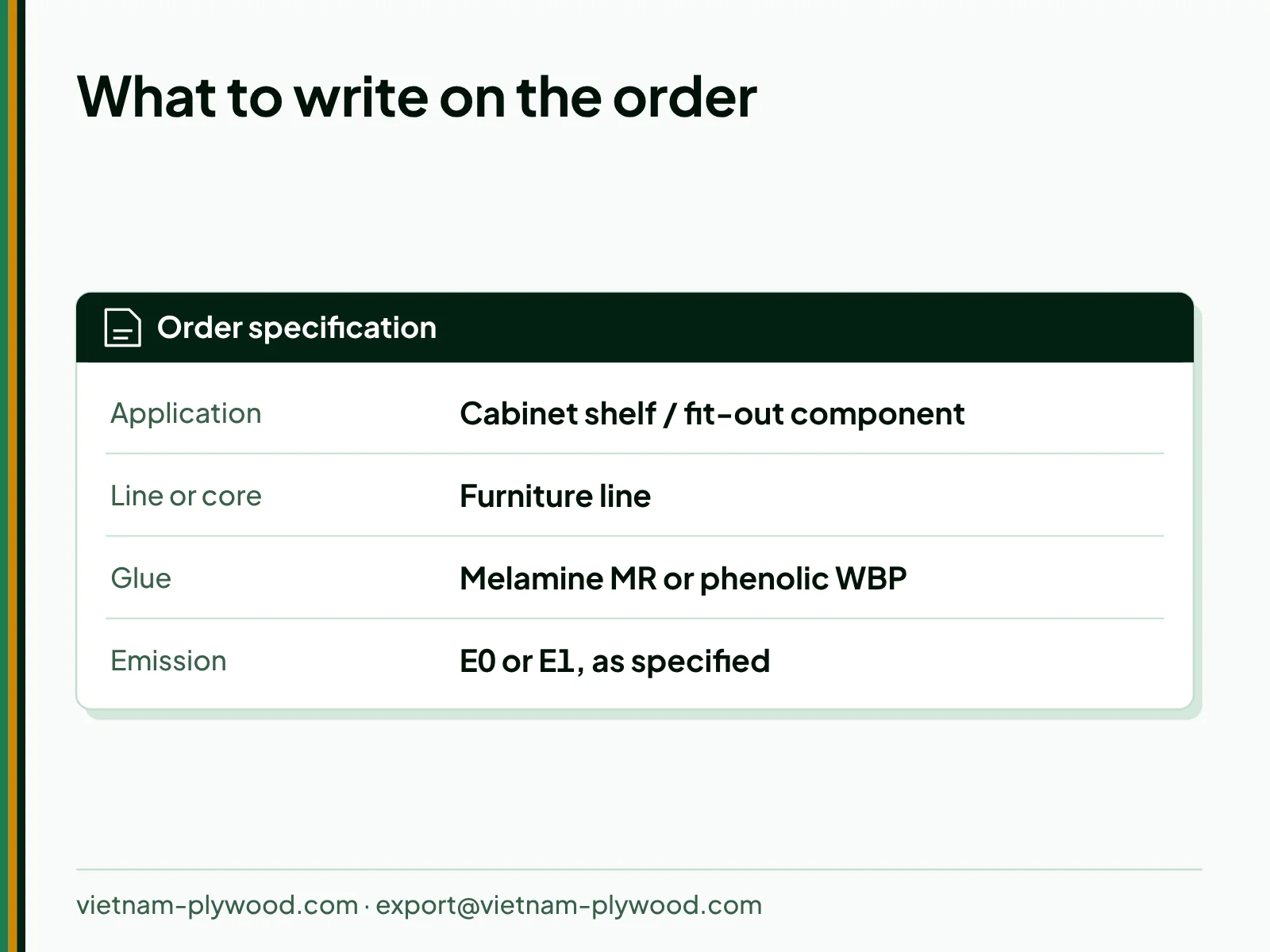
The minimum order is one 40HC, with mixed specifications permitted within its payload limit. For a written quotation, include the intended application and test requirements rather than requesting a generic kilogram rating. Send the following to Lucy at export@vietnam-plywood.com:
Application: cabinet shelf / fit-out component; drawing and load case attached
Line or core: furniture line; styrax or eucalyptus core
Glue: melamine MR or phenolic WBP, as specified
Emission: E0 or E1, as specified
Face and grade: [face veneer] / A or B
Thickness and tolerance: [mm] / [ordered tolerance]
Size: [length × width, mm]
Quantity: [sheets or m³; mixed-load breakdown if applicable]
Destination port: [port and country]
Support and loading: [clear span, supports, point/uniform loads, deflection limit]
Test evidence requested: [MOR, MOE, test method, orientation, acceptance criteria]
Ask for a sample set through our contact page before approving the production specification.