

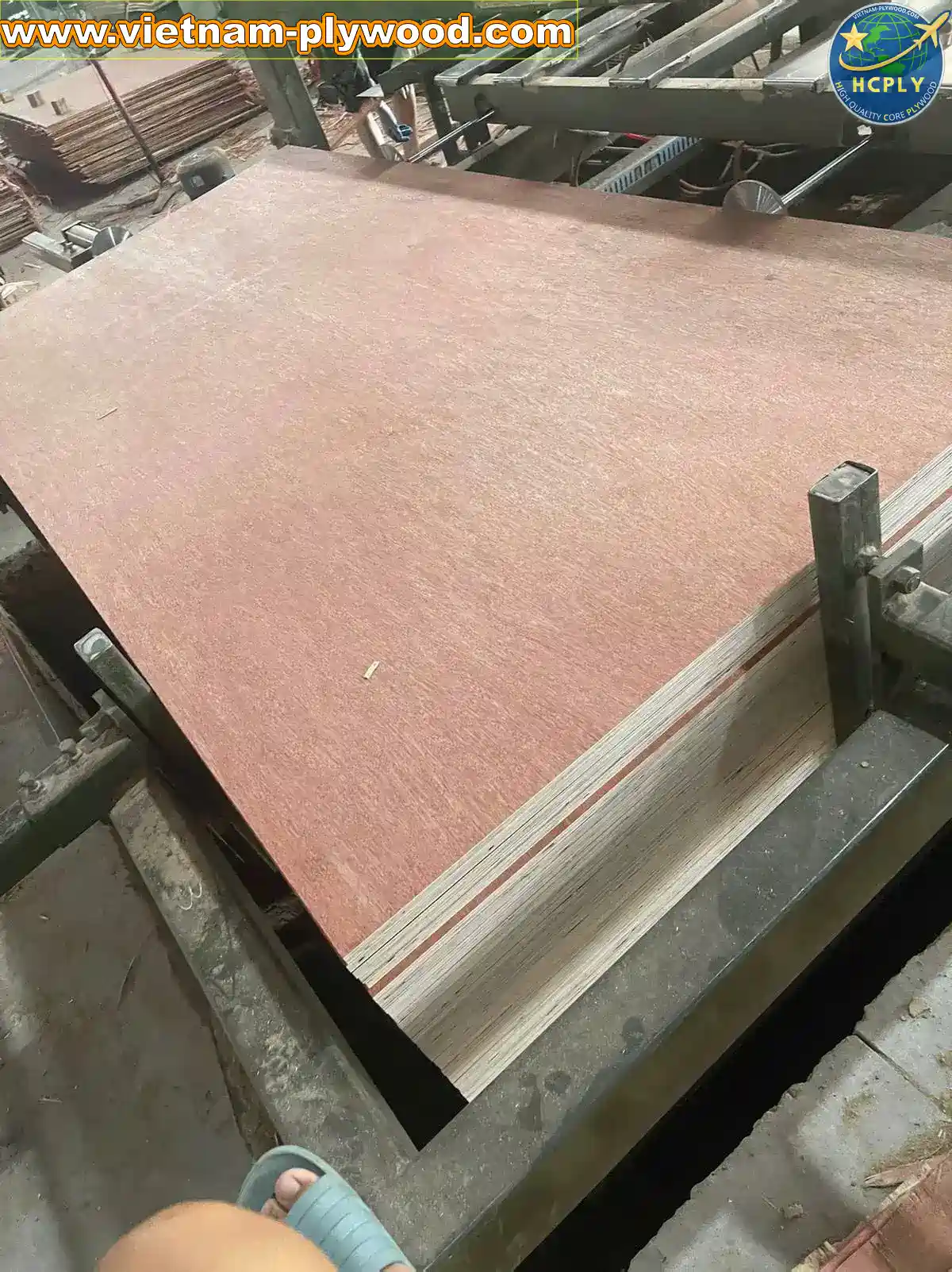

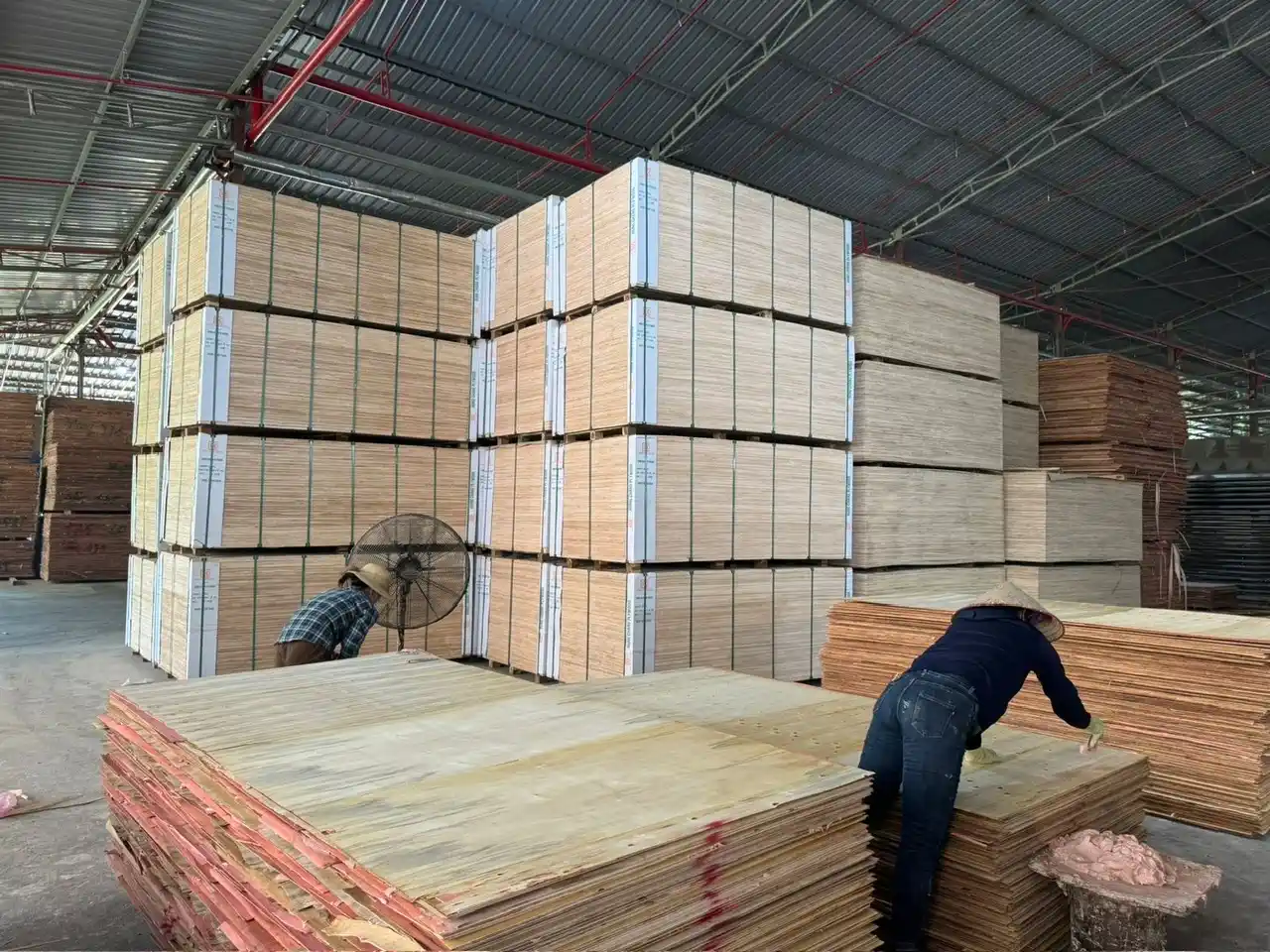
Hot press parameters are where plywood quality is either locked in or lost. Three variables — temperature, time, and pressure — must be dialed in together, and they change depending on whether you are running melamine (MR) or phenolic (WBP) glue. Get any one wrong and you get delamination, surface blistering, or failed boil tests at the inspection stage.
This guide covers the specific parameter ranges used in Vietnamese plywood production, cross-referenced against published wood science research, with notes on how core species density affects pressure settings.
⚠️ Important: These parameters apply to standard multi-ply structural plywood. Film-faced overlay pressing and short-cycle laminate pressing use different equipment and have different parameter windows.
🔧 What the Hot Press Actually Does
The hot press applies heat and pressure simultaneously to a glued veneer stack. Its job is to cure the adhesive bond between each veneer layer — not simply to press them flat.
The three variables:
Temperature: Heat drives chemical cross-linking in the adhesive. Too low = incomplete cure. Too high = veneer scorch, emission spike during production.
Time: The press holds the stack under heat until the core layer — the center of the thickest panel — reaches adhesive cure temperature. Heat must travel through each veneer layer. Thicker panels require longer cycles.
Pressure: Forces veneers into intimate contact, closing any surface gaps. Pressure must be high enough to eliminate voids but low enough to avoid crushing low-density core species.
These three interact. Higher temperature can shorten time. Higher pressure can compensate slightly for uneven veneer surfaces. In Vietnamese production (as of 2026), most factories use multi-opening hot presses loading 10–20 panels simultaneously, with parameters set per run spec (HCPLY production data, 2026).
🌡️ Temperature Settings by Glue Type
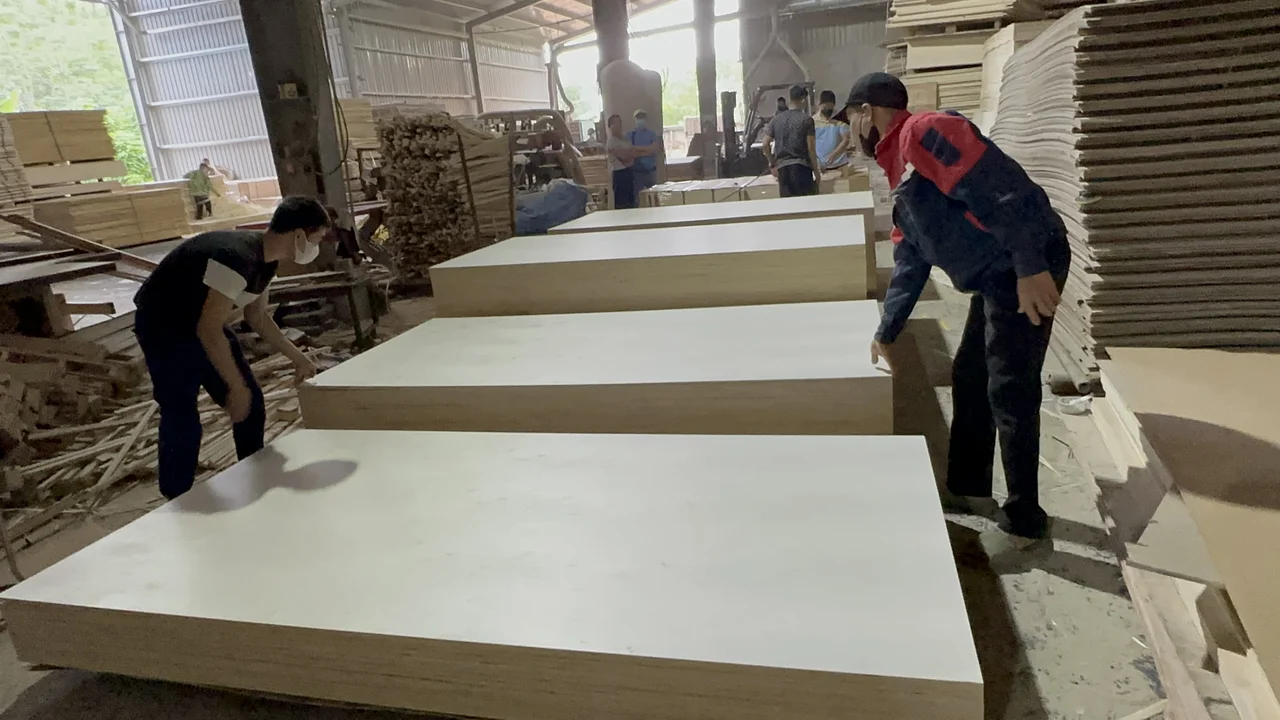
Temperature is the most glue-specific variable. The two main adhesive systems — melamine-urea (MR) and phenol-formaldehyde (PF/WBP) — have fundamentally different cure chemistry.
Melamine (MR) Plywood: 110–120°C
Melamine-urea formaldehyde resin activates around 100–110°C at the glue line. Vietnamese furniture and commercial plywood factories typically run platen temperatures of 110–120°C for MR grade production.
Why this range works:
- Resin cures completely without scorching light-colored veneers (birch, okoume, EV)
- Press cycle is shorter — lower energy = faster throughput per shift
- Stays within E0 emission window when resin formulation is optimized
What MR at 110–120°C produces: Standard 12-hour boil test performance (EN 314-1 Class 2 / MR grade). Suitable for furniture, cabinetry, interior fitout, and commercial plywood destined for markets where WBP is not required.
Phenolic (WBP) Plywood: 130–145°C
Phenol-formaldehyde resin requires higher energy to achieve full cure than melamine. Published research confirms that to obtain adequate bond strength in PF-bonded plywood, the core layer temperature must exceed 100°C — which means platens must run hotter to drive heat through the stack (BioResources, 2020, “Effects of Selected Parameters on the Bonding Quality and Temperature Evolution Inside Plywood During Pressing”).
Vietnamese factories producing film-faced plywood, anti-slip plywood, and marine-grade panels typically run 130–145°C.
Why this higher range is necessary:
- PF resin will not fully cross-link at lower temperatures — partial cure leads to delamination under the 72-hour boil test
- Phenolic bonds at full cure are inherently low-formaldehyde — the cross-linked matrix traps formaldehyde molecules (PMC, 2022, “Eco-Friendly Phenol–Urea–Formaldehyde Co-condensed Resin Adhesives”)
- Higher temperature does not cause veneer damage because film-faced and construction plywood typically uses eucalyptus or acacia core — darker, denser species that tolerate heat better than pale furniture veneers
Key Insight: The temperature difference between MR and WBP press settings reflects the cure activation energy difference between urea-formaldehyde and phenol-formaldehyde chemistry. Trying to run WBP glue at MR temperatures will produce a panel that looks fine but fails the 72-hour boil test during import inspection.
⏱️ Press Time — Per-Millimeter Reference
Press time is calculated from panel thickness, not total stack count. Heat must travel from the platen surface to the center of the panel. The thicker the panel, the longer heat transfer takes.
Production reference values (HCPLY factory data, 2026):
| Glue Type | Press Time Formula | 12mm Panel | 18mm Panel | 21mm Panel |
|---|---|---|---|---|
| Melamine (MR) | ~40–50 sec/mm | 8–10 min | 12–15 min | 14–18 min |
| Phenolic (WBP) | ~45–60 sec/mm | 9–12 min | 14–18 min | 16–21 min |
Notes on this table:
- Values are production averages calibrated at HCPLY facilities. Individual factory settings vary by press model, platen conductivity, and veneer moisture content going in
- Higher moisture content in veneers increases press time — water must be driven out before the core reaches cure temperature
- Multi-opening presses load all panels simultaneously, so cycle time = longest panel spec in that run
Published guidance from Shandong Minghung Wood Machinery gives a reference of approximately 1 minute 6 seconds per millimeter for standard hot pressing — consistent with the upper range in the table above (plywoodmachineline.com).
🏋️ Pressure Settings by Core Species
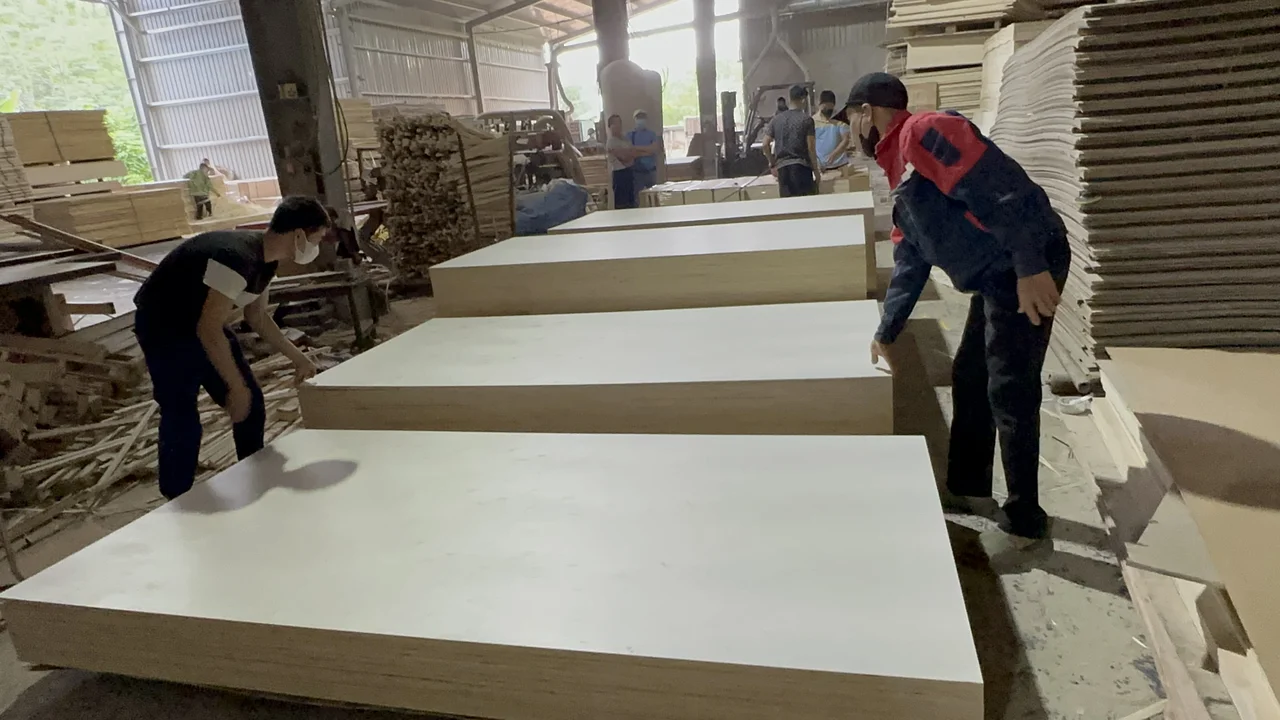
Pressure forces veneer surfaces into contact for bonding. The right pressure depends on core species density — pressing too hard collapses lightweight styrax fibers; pressing too lightly leaves voids in dense eucalyptus panels.
| Core Species | Density | Recommended Pressure | Notes |
|---|---|---|---|
| Styrax | 480–500 kg/m³ | 1.0–1.3 MPa | Lightweight — over-pressure crushes cell structure |
| Acacia | ~580 kg/m³ | 1.2–1.6 MPa | Medium density, standard range |
| Eucalyptus | 650–750 kg/m³ | 1.5–2.0 MPa | Dense — higher pressure needed for void-free bond |
General reference ranges from published literature: standard hot press pressure for plywood is 2.5–3.5 MPa for high-strength applications, with 1.0–1.5 MPa for standard softwood-equivalent cores (Qianhui Plywood Machine Technical Notes). Vietnamese core species all fall within or below standard ranges, which is why quality control after pressing is critical to catch any under-pressure voids.
“Pressure calibration is done per run at our facilities — you cannot use the same pressure setting for a styrax-core furniture batch and a eucalyptus-core film-faced run. The density difference is significant enough that one setting will either under-press or damage the other.” — Lucy, International Sales Manager, HCPLY
📊 Two-Stage vs. One-Stage Hot Pressing
Vietnamese plywood factories use two main pressing sequences depending on product grade:
One-stage hot pressing: Veneers go directly from glue-spreading to hot press. Faster, lower cost. Used for commercial and packing grade plywood where cosmetic precision is secondary.
Two-stage pressing (pre-press + hot press): Veneer stack first passes through a cold pre-press at 0.8–1.2 MPa for 5–15 minutes. Pre-pressing compresses the stack and eliminates air pockets before heating begins. Then the pre-pressed stack enters the hot press at full temperature and pressure.
Why two-stage matters for premium products:
Pre-pressing significantly reduces the risk of blisters and delamination bubbles in the finished panel. Furniture-grade plywood and premium film-faced panels almost always use two-stage pressing. The additional step adds time but reduces defect rates — particularly relevant when pressing thin veneers (0.2–0.4mm face veneers standard in Vietnam) where air entrapment is more likely.
For film-faced plywood specifically, pre-pressing before the film overlay run is standard practice at HCPLY — the film-facing step is effectively a third press cycle on top of the core panel pressing.
❌ Common Parameter Errors and Their Consequences
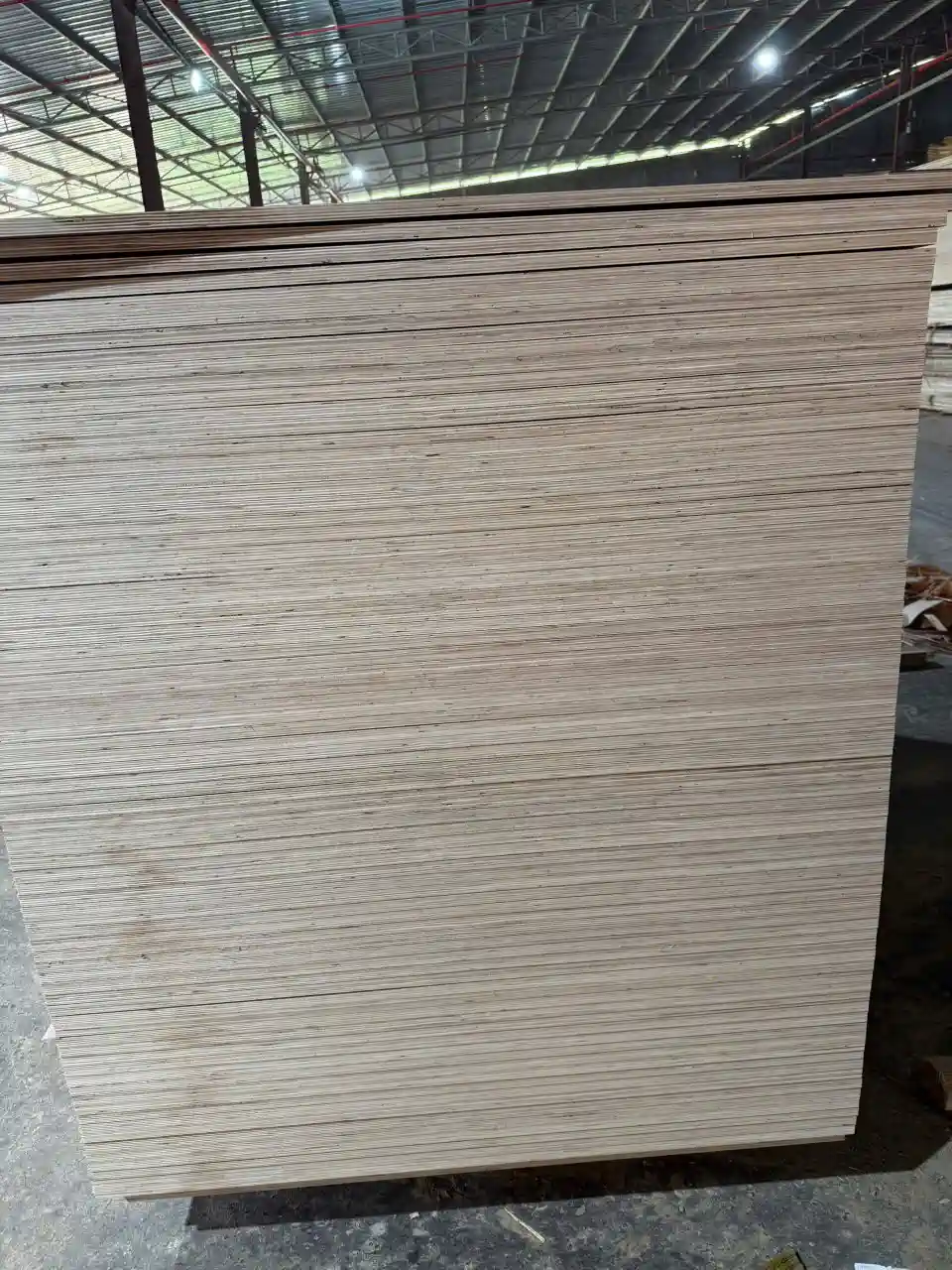
Understanding correct parameters means understanding what goes wrong when they drift.
| Error | Cause | Result |
|---|---|---|
| Temperature too low (MR) | Press startup before platens reach setpoint | Incomplete cure → delamination at humidity test |
| Temperature too low (WBP) | Running phenolic at MR settings | 72-hour boil test failure, import rejection |
| Press time too short | Operator rushing throughput | Core layer never reaches cure temperature |
| Press time too long | Forgotten batch or timer error | Veneer discoloration, surface darkening, emission spike |
| Pressure too low | Wrong setting for high-density eucalyptus | Bond voids, internal gap delamination |
| Pressure too high | Same setting applied to lightweight styrax | Crushed core, reduced panel stiffness |
These errors show up either at the quality control inspection stage after pressing, or later during shipping boil tests at the destination port. Both are preventable with proper parameter discipline per run.
🏭 How HCPLY Sets Press Parameters
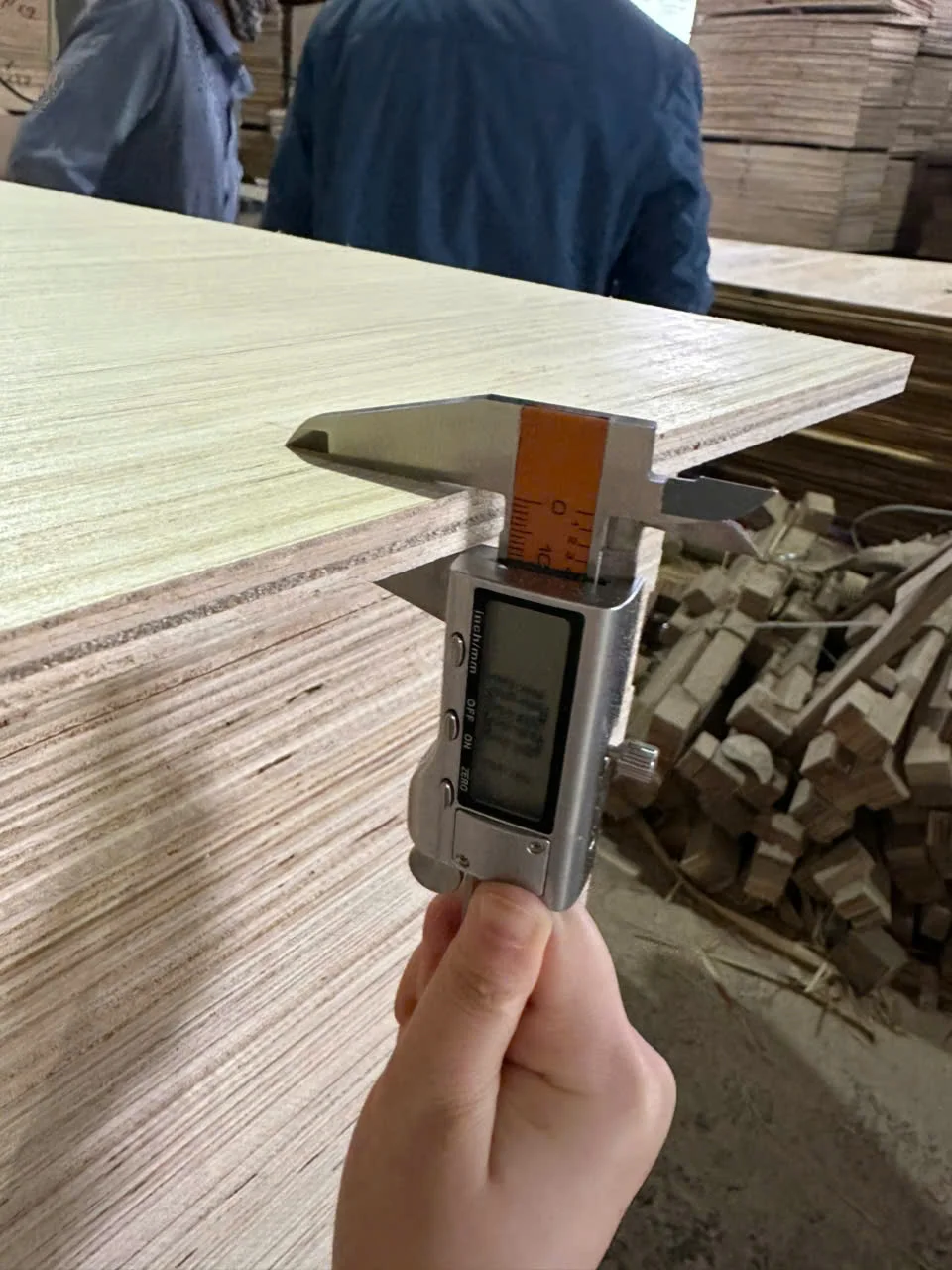
HCPLY operates 3 specialized production facilities in Northern Vietnam, each purpose-built for different product categories. Parameters are not universal across facilities:
Facility 1 (Furniture / Premium): Styrax and eucalyptus core, melamine MR E0. Press temperature held at 110–120°C with strict pre-press step. Focus on dimensional stability for furniture export to EU and US.
Facility 2 (Commercial / Packing): Acacia core, melamine MR E1/E2. One-stage hot pressing at 110–120°C, higher throughput priority.
Facility 3 (Film-Faced / Construction): Eucalyptus and acacia core, phenolic WBP. Hot press at 130–145°C, two-stage pressing for film overlay. AICA film quality requires precise temperature window — too low and film adhesion fails; too high and film surface becomes brittle.
This segmentation means quality specifications for each facility match the product category. It is not possible to run film-faced parameters on the furniture facility press — the equipment, glue systems, and operator calibration are optimized for different output.
For a full overview of the manufacturing sequence that precedes hot pressing — from log to veneer — see the Vietnam plywood manufacturing process guide.
✅ Specifying Press Parameters in Your Purchase Order
When sourcing plywood, buyers rarely specify press parameters directly. However, understanding them helps you validate the glue and emission specifications you do specify:
-
“MR grade, E0” → requires melamine MR glue cured at correct temperature with low-formaldehyde resin formulation. If a supplier offers this at unusually low price, ask for test reports — under-curing is one way to reduce press time and cost.
-
“WBP phenolic” → requires hot press temperature of 130–145°C and full cure time. If boil test certificates are not available, specify that test reports accompany shipment.
-
“Film-faced, 15+ reuse” → requires premium AICA film pressed at correct temperature. Cheap alternatives use lower-quality film at lower temperatures — they achieve adhesion initially but fail after 4–8 uses instead of 15+.
For the relationship between glue type, emission standard, and how to specify both correctly, the plywood glue types and emission standards guide covers the full specification framework.
Request Factory Samples — Melamine or Phenolic Plywood — HCPLY ships test samples for quality evaluation before order placement. No commitment required.
📐 Quick Reference: Hot Press Parameters Summary
| Parameter | Melamine (MR) | Phenolic (WBP) |
|---|---|---|
| Temperature | 110–120°C | 130–145°C |
| Press time | ~40–50 sec/mm | ~45–60 sec/mm |
| Pressure (styrax) | 1.0–1.3 MPa | 1.0–1.3 MPa |
| Pressure (acacia) | 1.2–1.6 MPa | 1.2–1.6 MPa |
| Pressure (eucalyptus) | 1.5–2.0 MPa | 1.5–2.0 MPa |
| Pressing stages | 1 (commercial) / 2 (premium) | 2 (standard) |
| Boil test result | 12h pass (EN 314-1 Class 2) | 72h pass (WBP standard) |
| Typical application | Furniture, cabinets, commercial | Film-faced, anti-slip, marine |
🔗 Related Technical Guides
- Plywood glue types and emission standards — MR vs WBP, E0/E1/E2 explained
- Melamine MR grade plywood for furniture — boiling test and emission guide
- Vietnam plywood manufacturing process — from log to container
- Film-faced plywood Vietnam — formwork grade manufacturer
- Plywood quality control — factory inspection process
Hot press parameters are the last step where glue chemistry becomes physical bond strength. Temperature, time, and pressure must be matched to the adhesive system and core species in every run. The 40°C difference between MR and WBP settings is not a minor preference — it reflects the cure chemistry requirements of two fundamentally different resins.
HCPLY calibrates press parameters per facility, per product category, with quality control checks after every pressing cycle. Contact HCPLY for factory-direct pricing and technical specifications — samples shipped for pre-order evaluation.