






Plywood began as layered woodwork in ancient Egypt, became an industrial material in the nineteenth century, and entered mass construction in the twentieth. Choosing a modern panel by its historical name alone can cost a furniture importer rejected sheets or days of rework. HCPLY applies the manufacturing lessons of veneer selection, cross-lamination and controlled pressing to export plywood from northern Vietnam.
When was plywood invented?
The answer to when was plywood invented has three dates rather than one: layered woodwork existed in ancient Egypt around 2600 BC; industrial plywood developed from the 1850s; and the American softwood plywood industry began in 1905. The dates describe different milestones, so none alone identifies the first plywood sheet.
The Victoria and Albert Museum’s 2024 history places early layered woodwork around 2600 BC and industrial use in the 1850s. Ancient laminated objects show the concept of bonding thin wood pieces. Industrial plywood adds repeatable veneer preparation, cross-grain assembly and pressing. Modern buyers should recognize the difference between an old manufacturing idea and a panel made to a written specification.
Who invented plywood?
No single inventor created every part of modern plywood. Samuel Bentham is associated with an 1797 patent describing laminated veneers; nineteenth-century furniture makers then developed practical moulded constructions. John Henry Belter patented a furniture-moulding method in 1858, according to the Victoria and Albert Museum’s 2024 account.
Veneer cutting, adhesive chemistry and press control advanced separately. A patent date cannot establish the quality of a current panel.
The museum also documents a moulded plywood railway demonstration in 1867. That prototype illustrates how engineers tested the material beyond furniture long before plywood became an ordinary building sheet.
When did plywood become common?
Plywood became widely established during the early twentieth century, with construction adoption accelerating through the 1930s and post-war housing demand. Its earlier industrial markets included furniture, doors, transport equipment and moulded products. The 1905 start of American softwood production was a manufacturing milestone rather than the date all markets adopted plywood.
Standard sheet formats helped purchasing departments compare material across jobs. Improved adhesive formulations extended applications beyond protected interiors. The 1930s brought experimental houses, broader sheathing uses and factory-made building assemblies. After the Second World War, expanding housing programs gave panel manufacturers a larger, more regular market.
This history explains why the word plywood now covers markedly different constructions. A visible cabinet door, a shipping crate and a concrete form face do not need identical veneers or surface treatment. The Plywood Types collection separates those buying decisions.
When was plywood first used in houses?
Plywood appeared in building interiors before it became an established sheathing material, but experimental whole-house systems became prominent in the 1930s. The U.S. Forest Products Laboratory tested plywood sheathing in the late 1920s and built an experimental stressed-skin house in 1935. A 1937 prefabricated house then demonstrated engineered plywood panel construction.
The U.S. Department of Agriculture Forest Service’s 2021 chapter, Use of Wood in Buildings and Bridges, describes the shift from traditional board sheathing toward structural panels in light-frame construction. That long transition helps explain why an early interior plywood panel and a later structural roof panel cannot be treated as interchangeable products.
House construction also made bond durability more visible. Interior joinery can be protected from weather, while exposed sheathing requires a different performance basis. A structural or marine specification should be evaluated against a test report the buyer accepts; a historical construction example is not a substitute for that report.
Which inventions made factory plywood practical?
Rotary peeling, cross-grain lay-up and controlled hot pressing made repeatable factory plywood practical. The important sequence is a manufacturing process, not a single discovery.
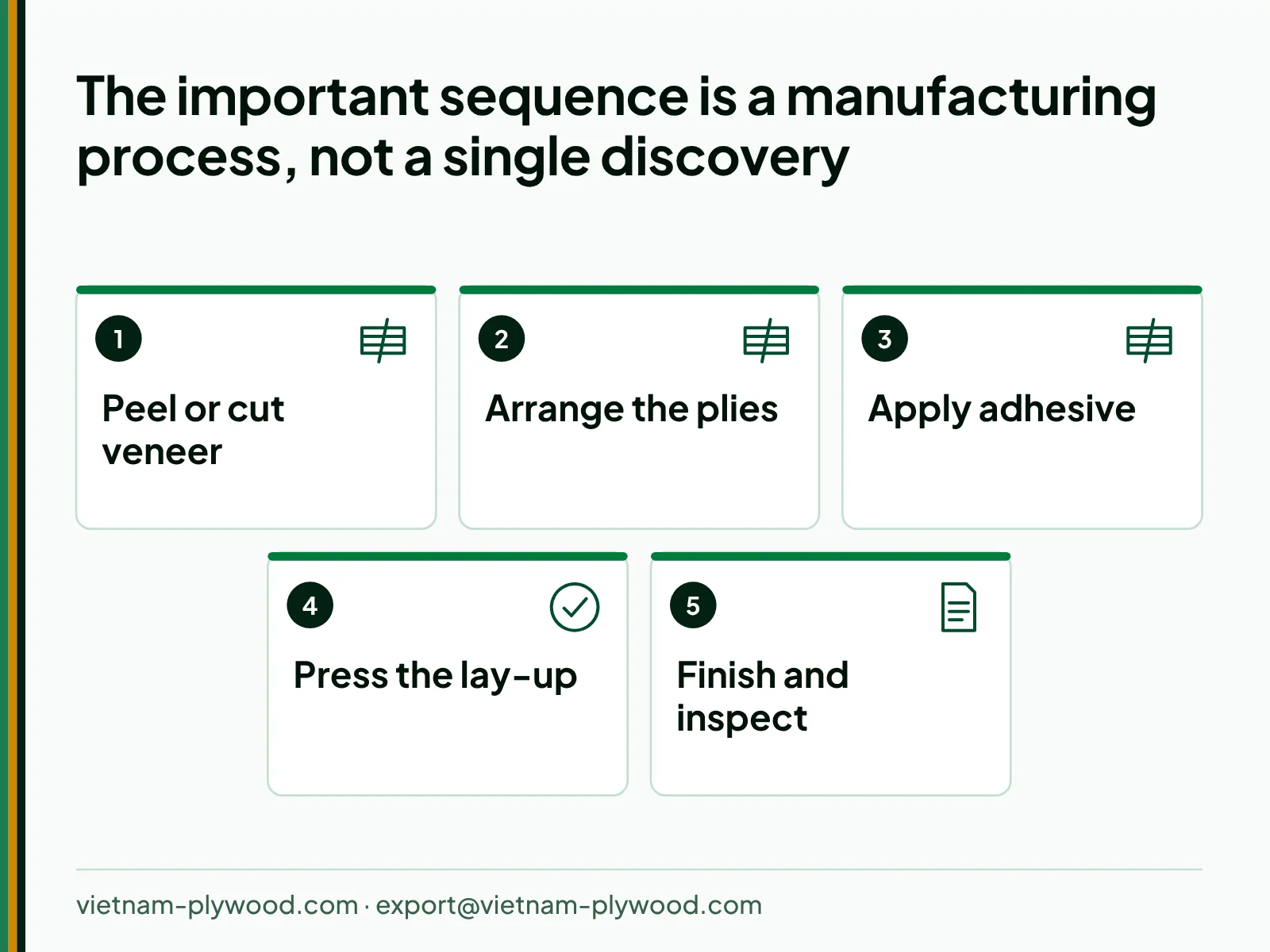
- Peel or cut veneer: a log yields thin sheets that can be dried and graded before assembly.
- Arrange the plies: alternating grain directions distribute movement and support a more stable sheet.
- Apply adhesive: the specified glue system is spread between prepared veneers.
- Press the lay-up: heat and pressure consolidate the assembly into a bonded panel.
- Finish and inspect: sanding, sizing and edge inspection establish the delivered dimensions and visible quality.
Phenolic resin technology expanded the range of moisture-exposed applications, while melamine-based systems serve different specified bond requirements. Modern rotary peeling also allows plantation-grown logs to become consistent veneer inputs. The face still determines the commercial product name, while the core contributes most of the sheet’s density.
The 2024 museum history records water-resistant moulded canoes from 1917 and the later role of synthetic glues in exterior applications. Aircraft shells, transport bodies and moulded furniture show the same manufacturing principles adapted to very different shapes.
How did northern Vietnam become part of this history?
Northern Vietnam’s plantation-core plywood production applies industrial veneer and pressing methods to acacia, eucalyptus and styrax resources. This connection is about manufacturing inputs and export specifications rather than a claim that Vietnam invented plywood. Factories can allocate different core builds to furniture, packing and formwork uses.
The shift from craft lamination to controlled production makes core preparation and documentation central to export purchasing. A cabinet importer evaluates surface appearance and thickness. A packing company focuses on fit and handling. A formwork yard considers the film, bonding system and edge protection.
Vietnam’s export presence is measurable beyond factory descriptions. The Vietnam agriculture information portal’s 2025 presentation, calculated from General Department of Customs data, records US$32.3 million in plywood exports to the United States in December 2024. That is a monthly country-destination figure, not a total for all Vietnamese plywood exports. It gives context for an established export trade without implying a market share for HCPLY.
How do three present-day plywood lines differ?
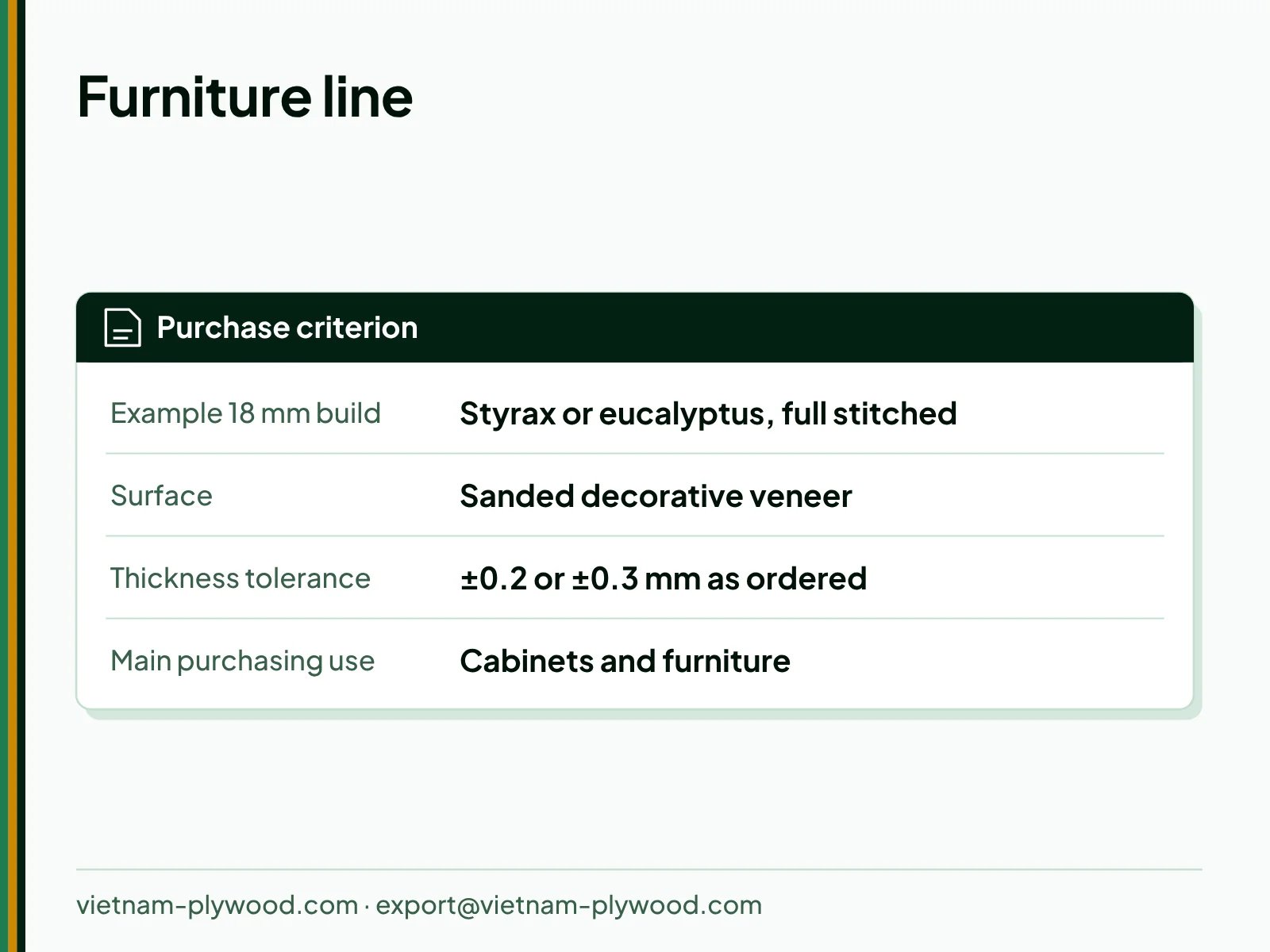
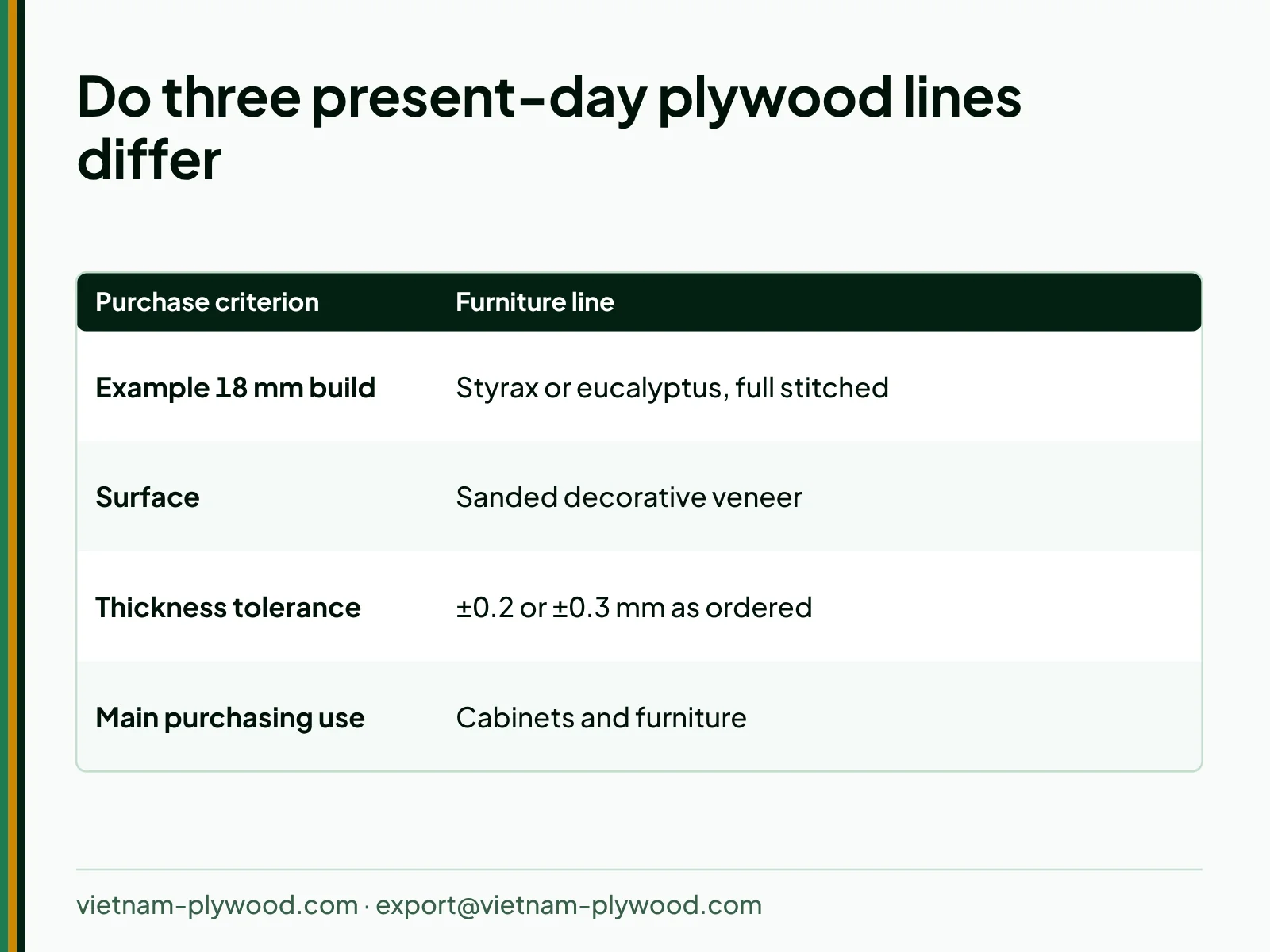
Our furniture line presses a sanded, full-stitched styrax or eucalyptus core; our commercial and packing line builds acacia-core utility panels; our construction line presses film-faced panels for formwork. These are distinct manufacturing answers to the same nominal thickness.
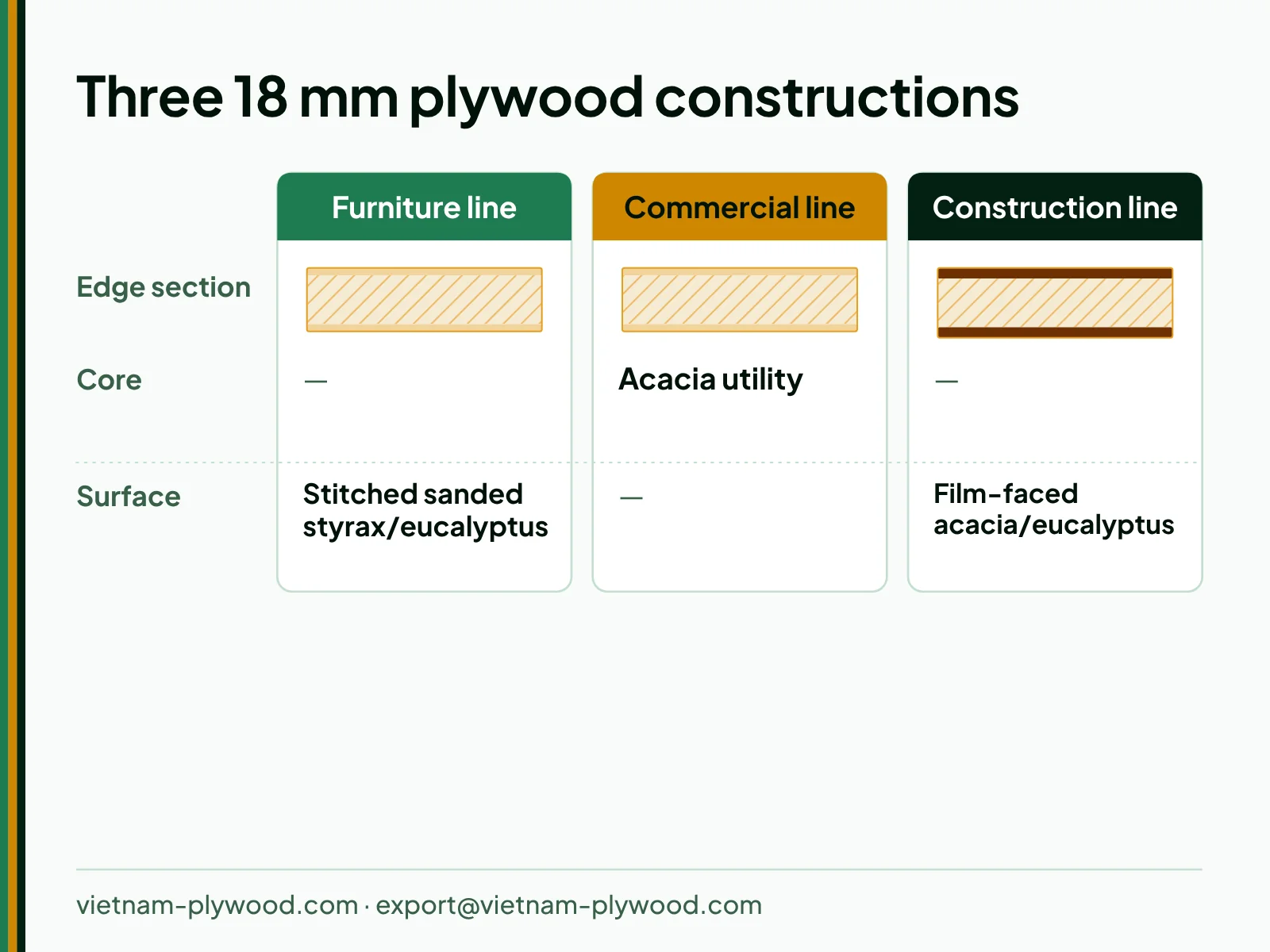
| Purchase criterion | Furniture line | Commercial and packing line | Construction line |
|---|---|---|---|
| Example 18 mm build | Styrax or eucalyptus, full stitched | Acacia, utility core | Acacia or eucalyptus, film faced |
| Surface | Sanded decorative veneer | Unsanded or light-sanded | Phenolic, melamine or anti-slip film |
| Thickness tolerance | ±0.2 or ±0.3 mm as ordered | Commercial ±0.5 mm; packing ±0.5–1.0 mm | ±0.5 mm |
| Main purchasing use | Cabinets and furniture | Crates and commercial utility | Concrete formwork |
For example, an 18 mm cabinet component calls for controlled sanding and a suitable visible face. The same thickness on the packing line prioritizes a different surface and core arrangement. On the construction line, film selection and the formwork application drive the build.
Our furniture plywood page addresses decorative applications, while packing or commercial plywood explains utility panels. For raw, unfaced material, see matt plywood.
What can a factory inspector actually check?
An inspector can witness veneer grading, core lay-up, pressing records, sheet measurement and finished-stack inspection at the producing factory. The most useful checks link a written specification to physical sheets, rather than relying on a product label.
For a cabinet order, inspect face matching, visible defects, sanding and caliper readings across sample panels. For packing plywood, examine core gaps, edge joints and the specified unsanded or light-sanded finish. For film-faced boards, inspect film coverage, edge sealing and the stated glue system against the agreed test evidence.
Core construction also deserves attention. Full-stitched veneers differ from stitched outer layers with edge-trimmed inner veneers, finger-jointed material and loose-laid layers. A cut edge reveals construction details that a finished face can conceal.
HCPLY coordinates on-site quality control and loading across our three factories. Buyers can visit the factory office and inspect goods where their order is produced. The commercial plywood export-readiness guide explains related inspection and shipment checks.
How does the old sheet format affect today’s container order?
Standard sheet dimensions still connect production planning to freight. For 1220 × 2440 mm, 18 mm panels, a full 40HC reference load is 990 styrax-core sheets at 26.52 tonnes, 880 acacia-core sheets at 27.35 tonnes, or 795 eucalyptus-core sheets at 27.69 tonnes. The payload limit is 28.5 tonnes.
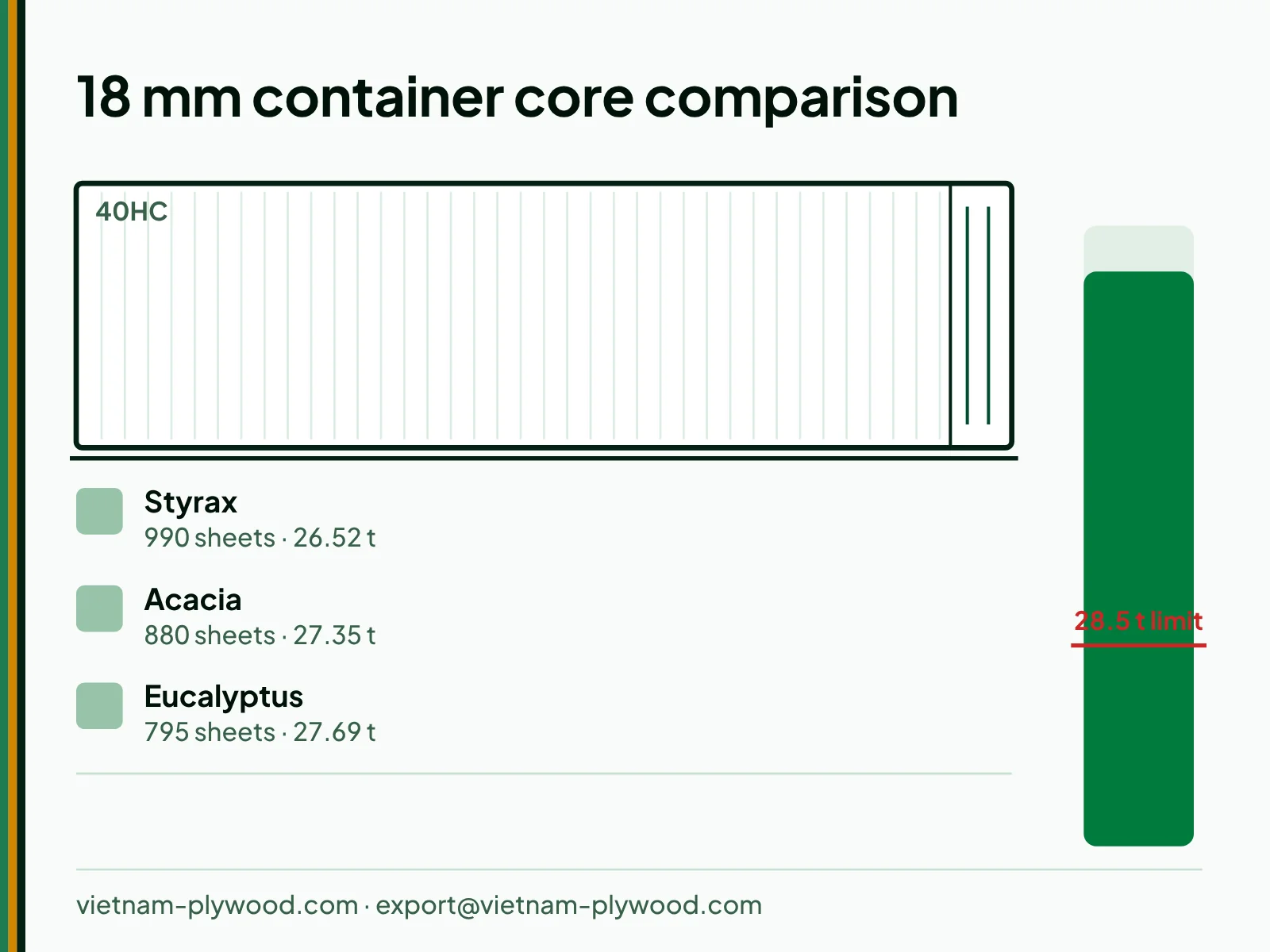
The difference comes from core density and pallet allocation, even though thickness and face dimensions match. A mixed order can combine specifications within the payload limit; its actual pallet and weight plan must be checked before loading. The container-loading reference covers sheet counts in greater detail.
Standard sheet dimensions permit freight planning, but core density determines weight.
Which specification and documents belong on the order?
A written specification should identify application, core, bond system, emission class, face, dimensions and quantity before production. Glue and emission are separate fields: melamine MR or phenolic WBP describes the bond system; E0, E1 and E2 are emission classes. CARB P2 and TSCA Title VI concern a US emissions limit and third-party certification.
For shipments, the commercial invoice and packing list identify the contracted goods and quantities. The bill of lading records carriage; the certificate of origin and order-specific test or emission documents address different compliance questions. For EU lots, the documentation can include EUR.1 and the EUTR/EUDR file set. Factory certificates and supporting records are shown with factory details masked, on request.
A furniture buyer comparing veneer names can consult bintangor versus okoume and gurjan versus bintangor. The historical name of a wood species is less useful than a clear face grade and an agreed inspection method.
What should an importer take from plywood history?
The lesson of plywood history is to specify the manufactured build rather than buy from a date, invention story or broad grade label. Industrial plywood became useful when factories could repeat veneer preparation, glue application and panel dimensions. Importers can apply the same discipline when reviewing samples and shipment documents today.
For an initial specification, choose the application first and then assign the suitable core and surface. Put the tolerance and bond system in writing, and agree on what will be inspected before loading. Retain those fields for repeat orders.
Application: cabinet components / commercial packing / formwork
Line or core: furniture—styrax or eucalyptus / packing—acacia / construction—acacia or eucalyptus
Glue: melamine MR / phenolic WBP, as specified
Emission: E0 / E1 / E2, as specified
Face and grade: named veneer A/B or specified film; birch D/E/F only
Thickness and tolerance: 18 mm; furniture ±0.2 or ±0.3 mm / commercial or film ±0.5 mm / packing ±0.5–1.0 mm
Size: 1220 × 2440 mm
Quantity: one 40HC, with mix and payload plan if applicable
Destination port: [insert port]
To review the build in person, book a factory visit with Lucy at export@vietnam-plywood.com.