

Most plywood specifications sheets list glue type and emission class side-by-side — and most buyers assume they are the same thing. They are not. This single point of confusion causes more specification errors than any other technical misunderstanding in plywood procurement. Buyers order “MR E0” as if those two codes describe the same property. They do not. Getting plywood glue types wrong leads to delamination failures, formaldehyde test rejections at customs, furniture returns from end customers, and failed building inspections.
This guide separates the two axes clearly, explains what each specification actually measures, provides the comparison tables you need for procurement decisions, and translates regional standards so you know exactly what plywood glue types and emission class to request from your supplier.
⚠️ Important: All technical data in this article comes from verified manufacturing specifications, regional regulatory standards, and factory-direct production data. We do not fabricate specs. Where regional standards have transition dates (such as the EU REACH update in August 2026), those dates are included explicitly.
“Plywood glue types and emission classes are the two most misquoted specifications in the entire industry. We see spec sheets mixing them up every week. Before you sign a purchase order, make sure your supplier can clearly state the glue chemistry AND the emission test result as two separate line items.” — Ms. Lucy Pham, International Sales Manager, HCPLY
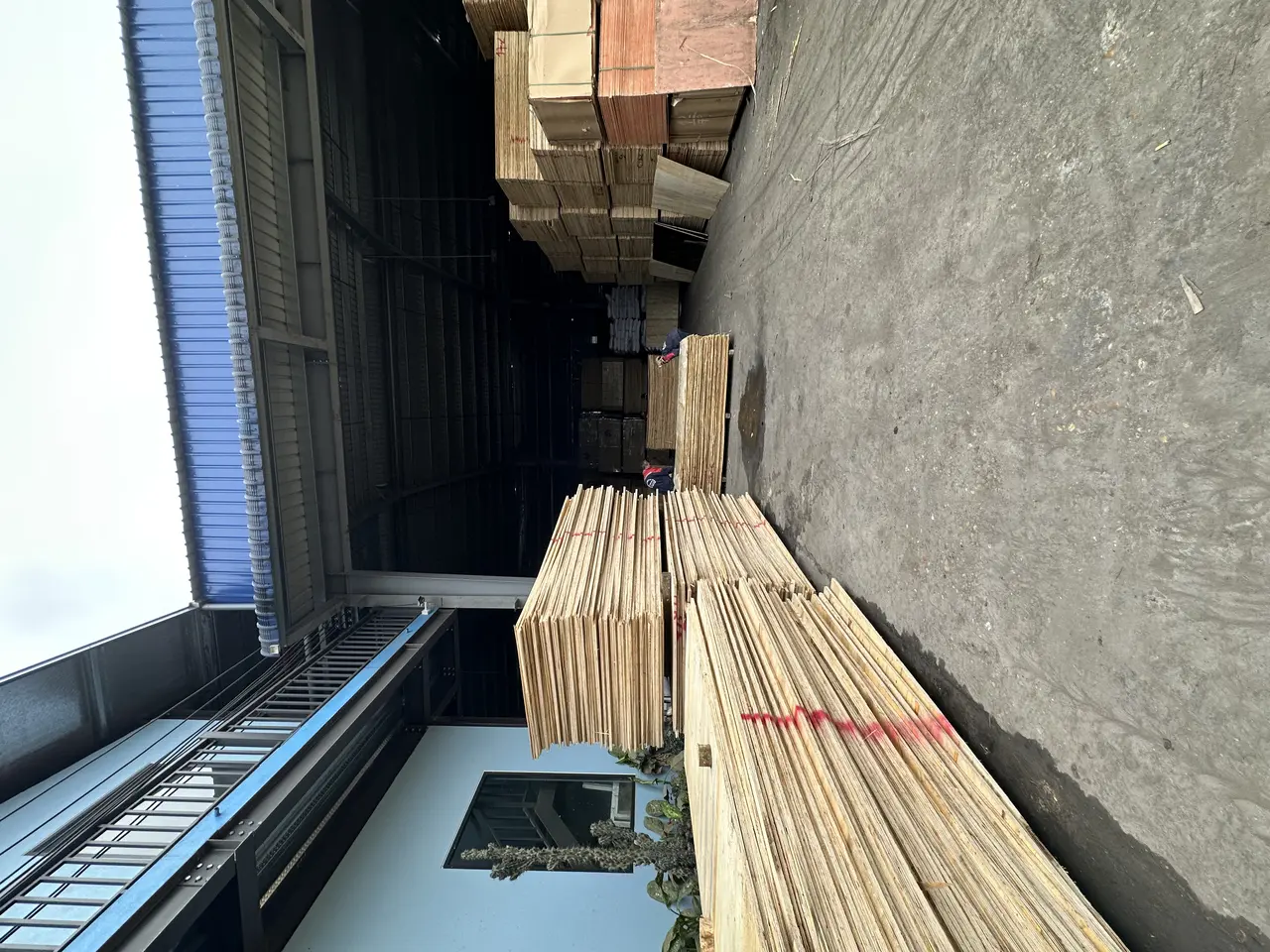
🔑 Why Plywood Glue Type ≠ Emission Standard
This is the single most important section of this guide. Read it before everything else.
Plywood has two independent adhesive-related specifications:
| Axis | What It Measures | Test Method | Values |
|---|---|---|---|
| Glue Type | Water resistance of the bond | Boiling water immersion test | MR (12h) / WBP (72h) |
| Emission Class | Formaldehyde gas release from the panel | Chamber test or perforator method | E0 / E1 / E2 / CARB P2 |
These two axes are completely independent. You can have:
- MR glue + E0 emission (standard premium furniture plywood)
- MR glue + E1 emission (standard commercial plywood)
- MR glue + E2 emission (budget commercial / packaging plywood)
- WBP glue + E0 emission (premium phenolic construction plywood)
- WBP glue + E1 emission (standard film-faced formwork plywood)
The same melamine resin adhesive can produce E0, E1, or E2 panels depending on the resin formulation, glue spread rate, and manufacturing process — not just the glue type label.
📌 The Error Most Suppliers Make
Across the industry, supplier spec sheets frequently list specifications like: "Glue: MR, E0, E2" — mixing glue type and emission class in the same field. This is incorrect. The correct format is:
Glue: Melamine (MR) | Emission: E0Glue: Phenolic (WBP) | Emission: E1
When you see a spec sheet that mixes these categories, it signals the supplier does not understand their own product specifications. Request clarification before ordering.
⚠️ Note: “E0 glue” does not exist as a product category. E0 is an emission class. Any supplier listing “E0 glue” is using incorrect terminology. Ask them to specify the actual glue chemistry (melamine or phenolic) and provide separate emission test documentation.
Need plywood with CARB P2 or E0 emission certification? Contact HCPLY — we provide full glue and emission documentation for all export specifications, including third-party lab reports.
⚙️ Plywood Glue Types: MR vs WBP Explained
Plywood adhesive systems are classified by their performance under the boiling water test — a standardized method that measures bond durability under the most extreme moisture conditions.
The Boiling Water Test
The test submerges glued plywood specimens in boiling water (100°C) for the specified duration, then measures whether the bond delaminates. Passing the test at 72 hours (WBP) demonstrates far superior moisture resistance compared to passing at 12 hours (MR).
| Property | MR — Melamine Resin | WBP — Phenolic Resin |
|---|---|---|
| Full name | Moisture Resistant / Melamine-Urea-Formaldehyde | Water-Boiling Proof / Phenol-Formaldehyde |
| Boiling test duration | 12 hours | 72 hours |
| Water resistance | Interior / protected exposure | Exterior / marine / continuous wet |
| Color | Light / off-white | Dark brown / black |
| Typical cost | Base price | 10–20% premium over MR |
| Primary applications | Furniture, cabinets, interior joinery | Concrete formwork, marine, outdoor construction |
| Emission note | Can be E0, E1, or E2 | Can be E0, E1 — depends on formulation |
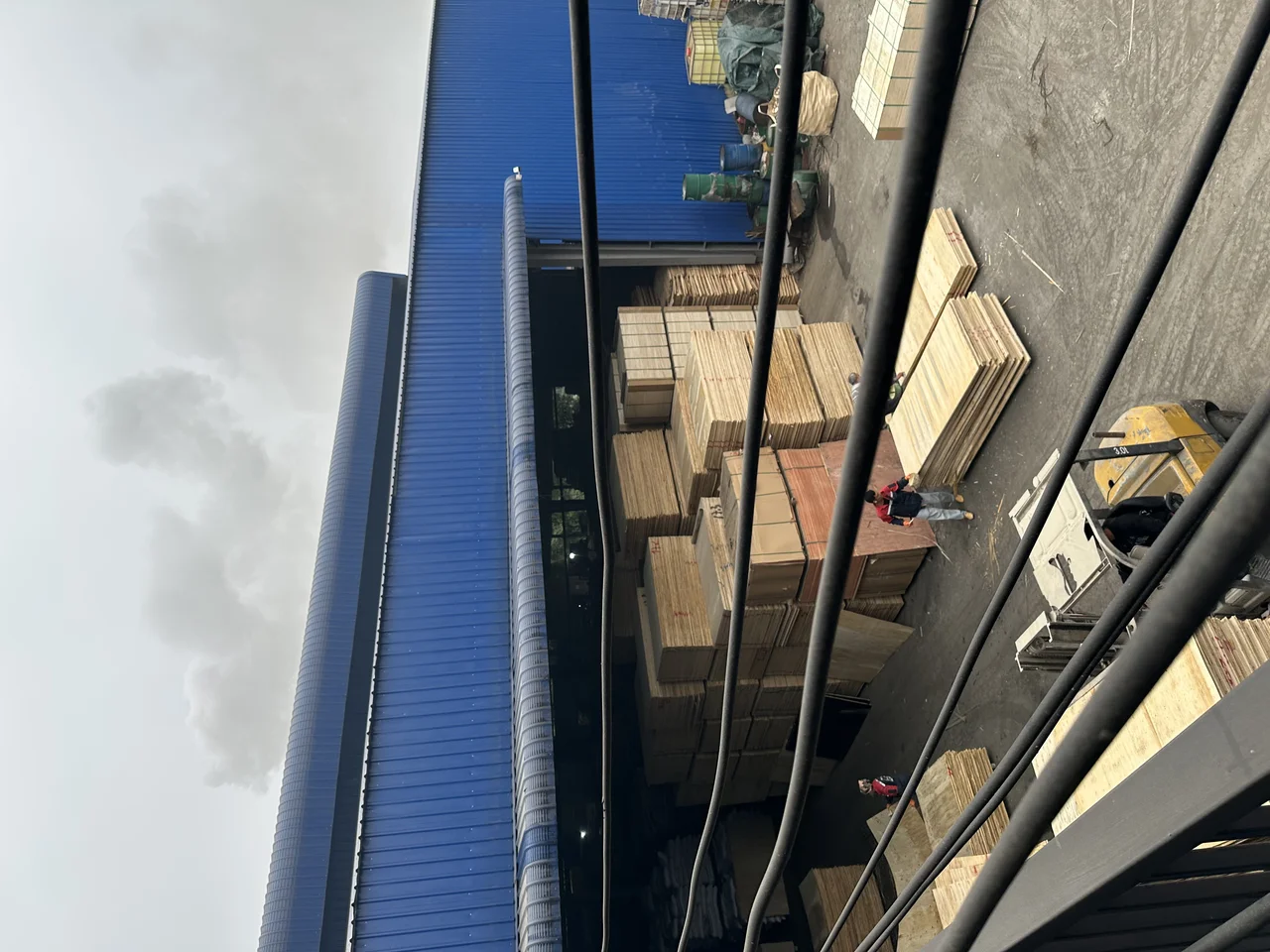
MR Melamine Glue — Interior Standard
MR glue is the industry standard for furniture-grade plywood. The melamine-urea-formaldehyde (MUF) resin creates a strong, moisture-resistant bond suitable for all interior applications where the panel is not exposed to standing water or prolonged humidity.
Birch plywood produced for the EU and US furniture markets uses MR glue with E0 emission certification as the standard specification. Matt plywood (unfaced raw core substrate used for lamination) is also typically MR glue, as it serves exclusively as an interior substrate.
WBP Phenolic Glue — Exterior and Construction
WBP phenolic resin creates a waterproof, fully crosslinked bond that withstands 72 hours of continuous boiling water immersion without delamination. This bond performance is essential for:
- Concrete formwork (film-faced plywood) — direct contact with wet concrete, steam-cured panels, repeated wet-dry cycles
- Marine applications — direct water contact
- Exterior structural use — exposed to weather without cladding protection
- Anti-slip plywood — truck floors and scaffolding exposed to rain
⚠️ Key point: WBP describes the test result, not a specific adhesive brand. Phenolic resins inherently pass the WBP test. Premium melamine formulations can also pass WBP when engineered for it — but standard MR melamine does not. When a supplier offers “WBP melamine,” ask for the test certificate, not just the claim.
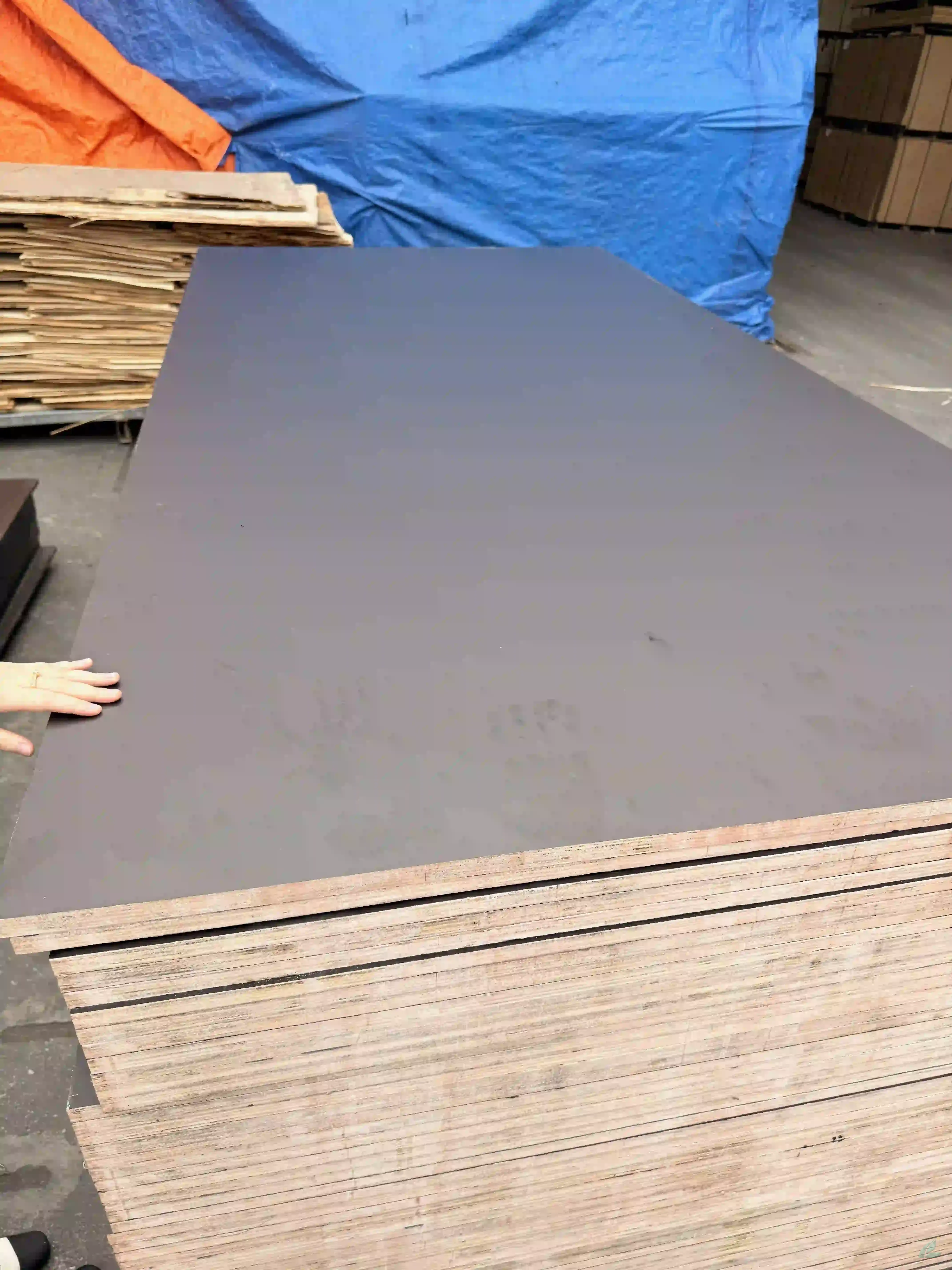
📊 Emission Standards: E0 vs E1 vs E2 Comparison
Emission class measures how much free formaldehyde a plywood panel releases into the surrounding air. Formaldehyde is a volatile organic compound (VOC) naturally present in wood and synthetic resins. At high concentrations, it irritates mucous membranes and is classified as a probable human carcinogen by the IARC.
The three major emission classes — E0, E1, and E2 — set progressively stricter limits on formaldehyde release, measured by the perforator method (mg per 100g of dry wood) or the gas analysis method (mg/m³ air concentration).
| Grade | Formaldehyde Limit | Approx. Air Conc. | Regional Market | Cost vs E1 | Primary Applications |
|---|---|---|---|---|---|
| E0 | ≤0.5 mg/L | ≤0.03–0.05 ppm | US (CARB P2), EU premium, Japan, Korea | +15–20% | Premium furniture, children’s products, healthcare |
| E1 | ≤1.5 mg/L | ≤0.1 ppm | EU standard, most Asia export | Base price | Standard furniture, commercial interior, cabinets |
| E2 | ≤5.0 mg/L | ≤0.3 ppm | Some Asia domestic, packaging | −5–10% | Commercial non-interior, packaging, temporary construction |
CARB P2 / TSCA note: The US CARB P2 standard sets the limit at ≤0.05 ppm for hardwood plywood — this is approximately equivalent to E0 by European standards. CARB P2 is the mandatory US national standard (via TSCA Title VI) for any composite wood product used in furniture, cabinetry, or flooring underlayment sold in the United States.
⚠️ Heads up: E2 plywood cannot be legally used in interior furniture or cabinetry in the US or EU. If a supplier offers E2 specification for a furniture application, this is either a specification error or an attempt to reduce costs with non-compliant material. Reject it and request E1 minimum (E0 for US market).
Emission Class Is Production-Controlled, Not Glue-Controlled
The emission class of a finished panel depends on:
- Resin formulation — lower formaldehyde content in the adhesive mix
- Glue spread rate — less adhesive per unit area = lower emission
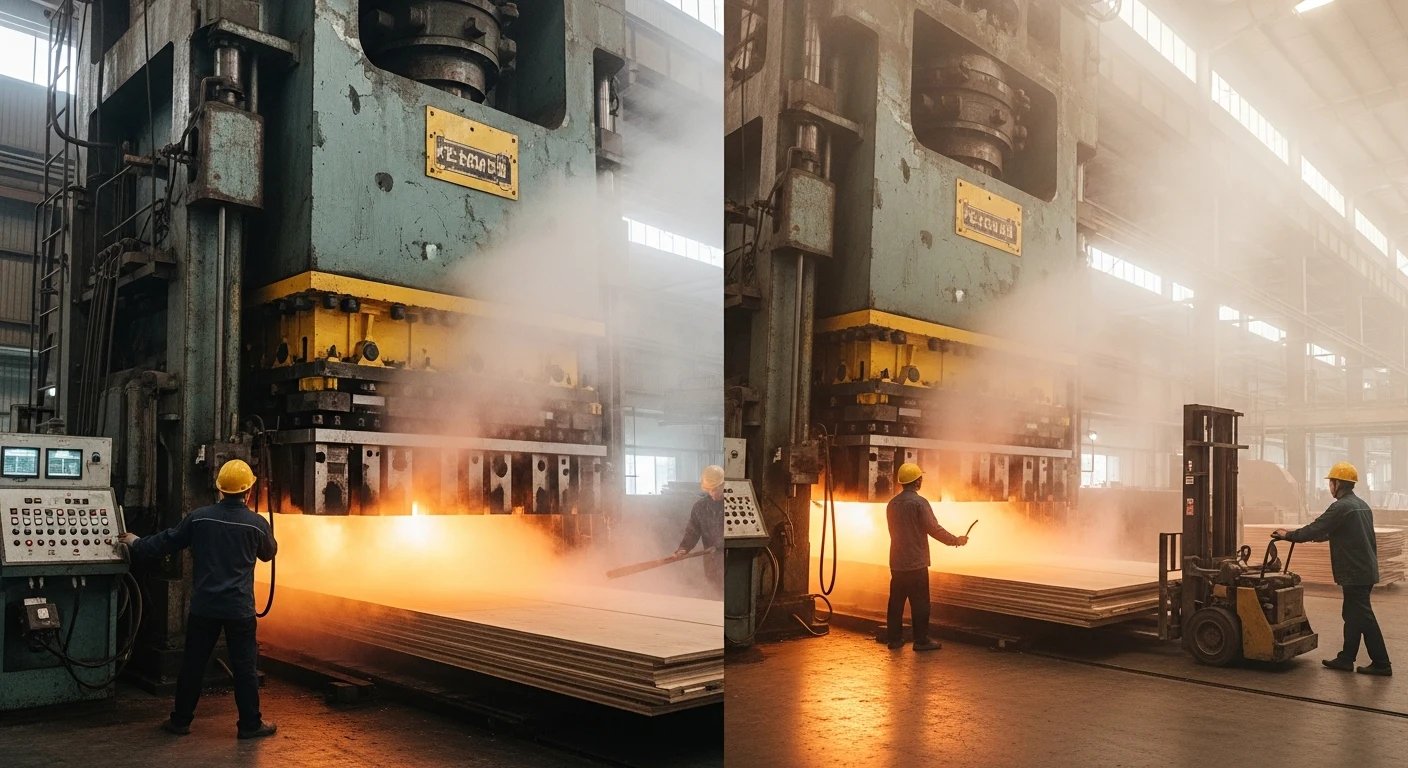
- Hot press parameters — higher temperature and longer press time cure more formaldehyde in the bond
- Raw material quality — lower-formaldehyde-content wood veneer
- Post-production treatment — some factories use ammonia fumigation or scavenger additives to reduce residual formaldehyde
A factory producing E0 panels is not simply using a different label — it requires tighter process control, higher-grade resin inputs, and calibrated press parameters. This is why E0 carries a legitimate production cost premium.
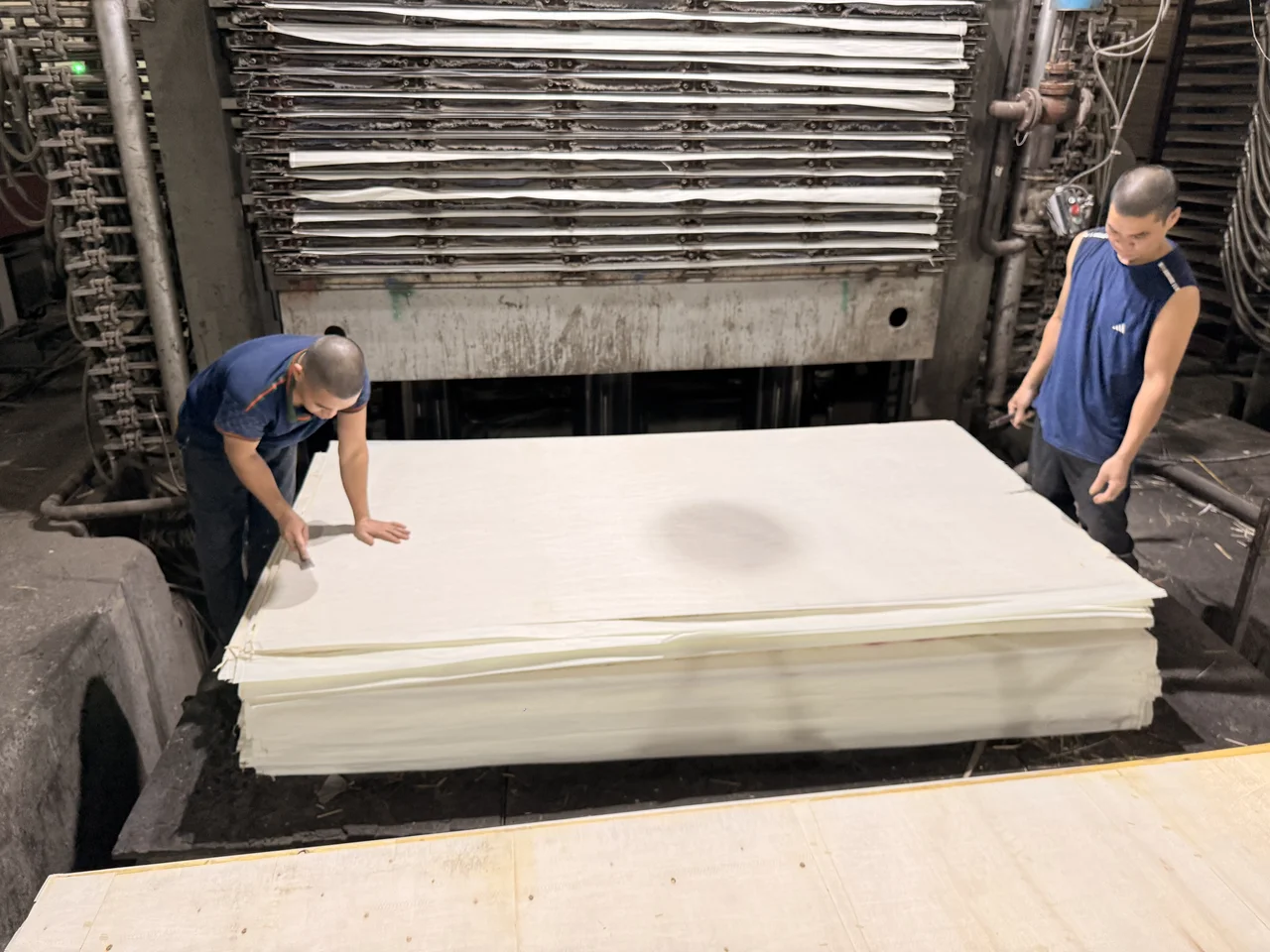
🌍 Regional Emission Requirements by Market
Different export markets enforce different formaldehyde emission standards. Sourcing for multiple markets simultaneously requires understanding the most restrictive requirement that applies.
| Market | Required Standard | Test Method | Notes |
|---|---|---|---|
| United States | CARB P2 / TSCA Title VI (≤0.05 ppm) | ASTM E1333 or ASTM D6007 | Mandatory for all composite wood products in furniture, cabinets, flooring. Third-party TPC required. See anti-dumping investigation article for broader US compliance context. |
| European Union | E1 (≤1.5 mg/L) minimum; E0 preferred | EN 717-1 (gas analysis) | E1 = legal minimum for CE marking. E0 preferred by major EU furniture buyers. From August 2026: new REACH regulation limits room air concentration to 0.062 mg/m³ (effectively E0 required for most interior products). |
| Japan | JIS F★★★★ (4-star) ≈ E0 | JIS A 1460 | Four-star (F4) is the strictest Japanese class. Equivalent to European E0. Required for most Japanese interior products. |
| South Korea | E0 or SE0 | KS F 3101 | Korean market is among the strictest globally. SE0 (Super E0) = ≤0.3 mg/L. Many Korean buyers require CARB P2 certification as proxy. |
| China (domestic) | GB 18580-2017 (≤1.5 mg/L) = E1 mandatory | GB/T 17657 | China raised domestic standard in 2017 to E1 minimum. E2 no longer accepted for indoor products within China. |
| India | IS 303 (structural) — no formaldehyde standard mandated | N/A | India does not currently mandate formaldehyde emission testing via BIS IS 303. Gurjan plywood destined for India typically ships E1 or unspecified emission — buyers importing into India for EU/US resale must specify E0/E1 explicitly. |
| Australia / NZ | E0 preferred; E1 acceptable | AS/NZS 2270 | No federal mandate equivalent to CARB P2, but major retailers require E0 for interior products. |
Dual-Market Sourcing Strategy
If you distribute plywood products across both the US and EU markets, specify CARB P2 + E1 minimum on your purchase orders. CARB P2 ≥ E0 by European standards, so CARB P2 certification satisfies EU E1 and E0 requirements simultaneously.
For manufacturers transitioning ahead of the EU’s August 2026 REACH update, begin specifying E0 now. The premium over E1 (15–20%) is lower than the cost of re-sourcing after the deadline.
Sourcing plywood for US or EU markets in 2026? Request HCPLY’s emission certification package — includes CARB P2 TPC authorization, EN 717-1 test report, and FSC chain-of-custody documentation.
💰 How Glue and Emission Choices Affect Your Cost
Specification choices directly impact procurement cost, lead time, and total project economics.
Cost Premium by Specification
| Specification | Premium vs Baseline (E1 MR) | Reason |
|---|---|---|
| E1 MR glue | Base (0%) | Standard production, no special process |
| E0 MR glue | +15–20% | Higher-grade resin, tighter process control, certification cost |
| WBP phenolic glue | +10–20% | Higher adhesive material cost, longer press cycle |
| WBP + E0 | +20–30% | Combined premium (film-faced construction plywood) |
| CARB P2 certified | +5–10% on E0 base | Third-party certification fee, TPC audit cost |
⚠️ Be aware: These premiums are approximate ranges based on standard Vietnam export pricing. Actual premiums depend on panel species, thickness, order volume, and current resin market prices. Always request a specific quote for each specification combination.
Application Matrix — When to Specify What
| Application | Recommended Glue | Recommended Emission | Reasoning |
|---|---|---|---|
| Premium furniture (EU/US) | MR Melamine | E0 / CARB P2 | US mandatory; EU preferred; health compliance |
| Children’s furniture | MR Melamine | E0 | Stricter health standards for children’s environments |
| Commercial cabinets (EU) | MR Melamine | E1 minimum | Legal minimum; upgrade to E0 for brand positioning |
| Commercial cabinets (US) | MR Melamine | CARB P2 / E0 | TSCA Title VI mandatory for US market |
| Kitchen cabinets | MR Melamine | E0 / CARB P2 | Enclosed space + humidity + food proximity |
| Concrete formwork | WBP Phenolic | E1 (E0 not required) | Water resistance critical; emission less relevant for exterior |
| Outdoor construction | WBP Phenolic | E1 or above | WBP mandatory; emission class secondary for exterior |
| Packing / crating | MR Melamine | E2 acceptable | Temporary use; no indoor air exposure |
| Export packaging | MR Melamine | E2 acceptable | Structural only; not interior building product |
Furniture-grade plywood destined for EU or US markets should always be specified E0 or CARB P2. Okoume plywood and bintangor plywood are commonly used for commercial furniture at E1 specification — acceptable for most Asian and some EU markets, but not for US distribution.
ROI Calculation: When E0 Premium Is Justified
Consider a furniture manufacturer producing 100 kitchen cabinet sets per month, each using approximately 15 sheets of 18mm birch plywood:
- E1 specification: 1,500 sheets/month at base price
- E0 specification: 1,500 sheets/month at base + 17% = $1,500 additional/month (approx.)
Against this cost, weigh:
- Risk of US customs rejection for CARB non-compliance: entire container liability
- EU market access for products requiring E0 CE marking
- Brand positioning premium that E0 certification allows in retail pricing
- Liability exposure if tenant or consumer claims formaldehyde illness
For any product entering the US or premium EU market, E0 specification is not optional — it is the minimum viable specification. The cost premium is a compliance cost, not a luxury upgrade.
🏭 What Vietnam Factories Actually Produce
Understanding what Vietnam’s plywood industry actually manufactures — and at what emission specification — is essential for setting realistic procurement expectations.
Production Reality by Factory Segment
Vietnam’s export plywood industry divides into four factory segments (see the Vietnam plywood factory types guide for full detail). Each segment has a distinct glue and emission profile:
| Factory Segment | Typical Glue | Typical Emission | Target Market |
|---|---|---|---|
| Premium furniture (Segment A) | MR Melamine | E0 / CARB P2 | EU, US, Japan, Korea, Australia |
| Commercial / packing (Segment B) | MR Melamine | E1 / E2 | Southeast Asia, Middle East, Africa |
| Premium film-faced (Segment C) | Phenolic WBP | E0 / E1 | EU, Korea, Japan, Australia |
| Budget film-faced (Segment D) | Melamine / phenolic blend | E2 | Southeast Asia, Africa |
The critical point: You cannot place an E0 order with a budget commercial factory and receive E0 product. The factory’s equipment, resin procurement, and process calibration are built around its target specification. A factory that produces E2 commercially does not have the process controls to reliably deliver E0. See the Vietnam plywood supplier types guide for how to verify which segment your supplier actually operates in.
HCPLY Specification Range
HCPLY manages 3 specialized production facilities in Northern Vietnam:
- Furniture facility — MR melamine, E0 / CARB P2 certified, sanded, full stitched core. Species: birch plywood, okoume, EV, gurjan, pine, poplar, eucalyptus. Available with FSC chain-of-custody.
- Commercial / packing facility — MR melamine, E1 / E2. Species: bintangor, poplar, acacia core. Optimized for cost-competitive commercial and packaging applications.
- Premium film-faced facility — Phenolic WBP (and premium melamine), E0 / E1. Film-faced plywood with AICA film 135gsm minimum, 15+ reuse cycles for EU and Korean construction markets.
Full emission test reports (third-party laboratory certified) are available for all specifications. Request test reports via the contact form.
Certification Documentation for Export
For markets requiring certified emission compliance, the following documentation chain is standard:
- Factory test report — internal QC measurement per batch
- Third-party laboratory certificate — required for CARB P2/TSCA Title VI and EU CE marking
- TPC (Third Party Certifier) authorization — required for CARB P2 specifically
- Test validity period — CARB P2 certificates require annual re-testing; EU EN 717-1 test validity varies by certifying body
When sourcing from Vietnam for the US or EU market, request all four documents. A factory that can only provide item 1 (internal factory test) is not CARB P2 compliant, regardless of what the spec sheet states.
🔧 Practical Specification Guide
Use this decision tree for procurement:
Step 1 — Define water resistance requirement:
- Indoor furniture, cabinets, interior joinery → MR Melamine
- Outdoor, marine, concrete formwork, wet exposure → WBP Phenolic
Step 2 — Define emission requirement by destination market:
- US (any state) → CARB P2 / TSCA Title VI (= E0 equivalent)
- EU (post August 2026) → E0 strongly recommended
- EU (pre August 2026) → E1 minimum, E0 preferred
- Japan / Korea → E0 / F★★★★ / SE0 as applicable
- China domestic → E1 minimum
- India, Southeast Asia, Africa → E1 standard; E2 for packaging
Step 3 — Match factory segment to specification:
- E0 + MR → Premium furniture segment factory (Segment A)
- E0 + WBP → Premium film-faced factory (Segment C)
- E1 + MR → Commercial factory acceptable
- E2 + MR → Budget commercial factory
Step 4 — Request documentation:
- Factory production spec sheet (listing glue type AND emission class separately)
- Third-party emission test certificate (not just factory internal report)
- TPC authorization letter (for CARB P2)
- FSC chain-of-custody (if required for EUDR or buyer policy)
For the quality control process HCPLY applies at the factory level — including emission verification — see the QC documentation section.
When reviewing supplier quotations, the two most common specification errors are: (1) treating MR and E1 as synonymous when they describe different properties entirely, and (2) accepting a factory’s internal emission declaration as equivalent to third-party certification. Both errors carry real financial exposure — failed customs inspections, product returns, or legal liability in regulated markets.
The plywood industry would benefit from cleaner specification language. Until that standardization occurs, buyers who understand the two-axis framework — glue type for water resistance, emission class for formaldehyde — are systematically better positioned to source correctly the first time.
HCPLY provides full specification transparency on every order: glue chemistry identified, emission class stated separately, and third-party test documentation available before shipment. For export orders requiring CARB P2 or EU E0 compliance, contact us to receive the full certification package including TPC authorization, third-party test reports, and chain-of-custody documentation.
Also relevant: the container packing calculation guide covers how emission specification interacts with container load planning — E0 premium specifications typically come from the premium furniture factory segment, which uses styrax core (18 pallets/40HC) vs acacia core (16 pallets/40HC), affecting both CBM and weight calculations.