





Interior design with plywood works when the face, core, glue and thickness match the finished component. A wrong selection can mean rejected visible panels, extra machining or a delayed fit-out. HCPLY builds decorative furniture panels and simpler utility sheets on separate production lines, so the order should describe the job rather than just request “interior plywood.”
What should a fit-out maker specify first?
Start with the component and its visible surfaces: cabinet door, carcass, wall lining, ceiling, partition or concealed backing. Then state whether edges remain exposed, whether the face will be clear-coated or painted, and whether panels must match across adjoining bays. A sample that looks acceptable alone can still show mismatched grain across a wall.
For visible joinery, specify a face species and grade alongside the core construction. For hidden backing, prioritize the required thickness, bonding and workable surface over decorative veneer. Separate the drawing’s finished dimensions from the raw panel dimensions: trimming and edge finishing consume material. Our plywood wall panelling overview covers the broader lining decision.
Which production line fits the same 18 mm requirement?
An 18 mm callout does not identify one interchangeable panel. Our furniture line presses sanded, full-stitched styrax- or eucalyptus-core sheets for visible cabinet and furniture components. Our commercial and packing line makes acacia-core MR-glue sheets for simpler backing and packing work. Our construction line presses film-faced acacia- or eucalyptus-core panels for concrete-forming applications.
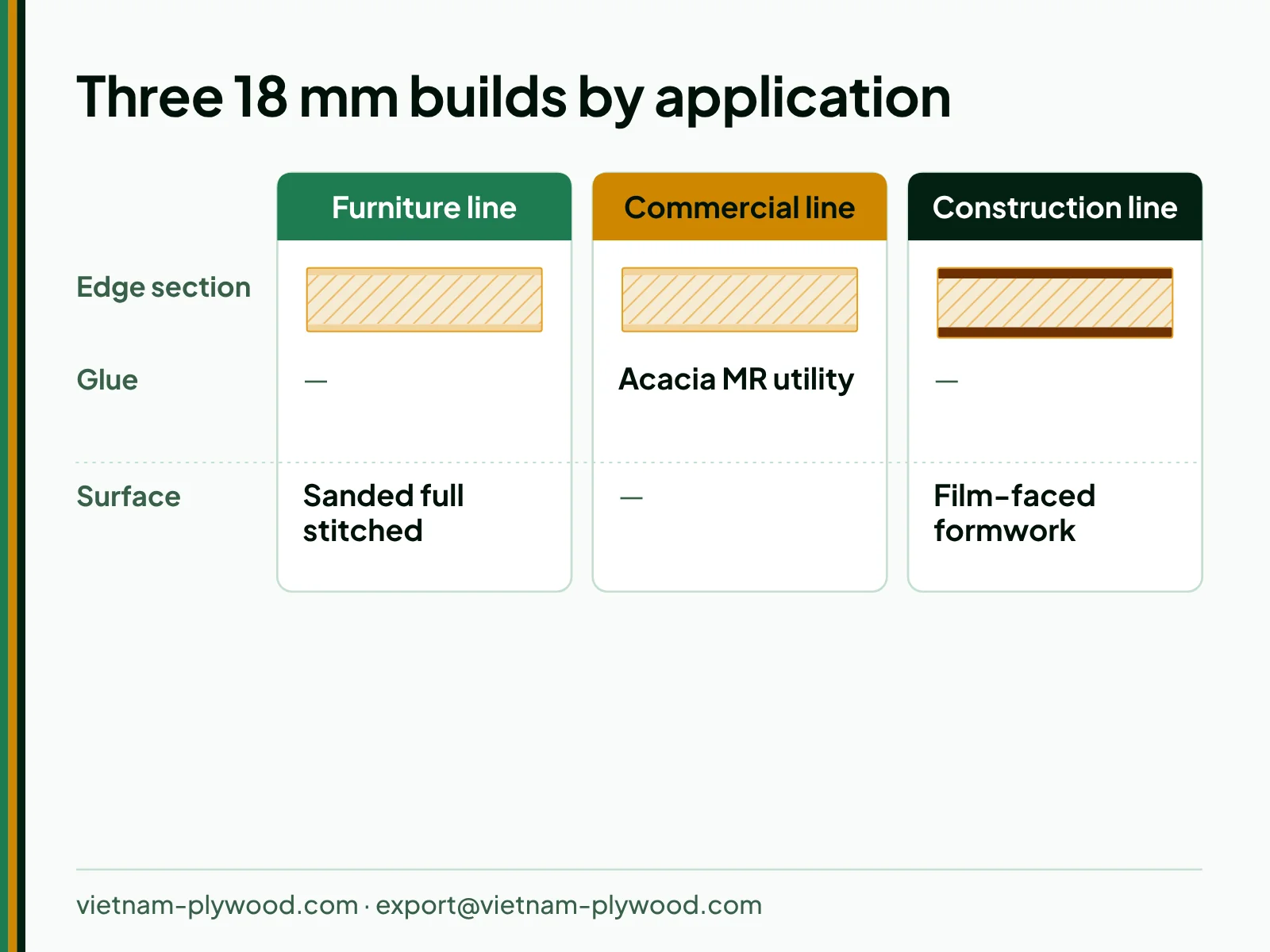
| 18 mm comparison | Furniture line | Commercial and packing line | Construction line |
|---|---|---|---|
| Intended fit-out role | Visible cabinetry and joinery | Concealed dry backing where specified | Formwork, rather than decorative lining |
| Core and surface | Styrax/eucalyptus; sanded, full stitched | Acacia; unsanded or light-sanded | Acacia/eucalyptus; unsanded, film face |
| Thickness tolerance | ±0.2 or ±0.3 mm as ordered | ±0.5 mm commercial; ±0.5–1.0 mm packing | ±0.5 mm |
| Decision | Choose for finish-critical work | Choose for utility work | Keep for its construction application |
The same face name can hide a different core build. For a clean exposed edge, specify full stitched construction rather than relying on a decorative face grade alone. The commercial versus packing plywood distinction matters when utility panels enter a fit-out bill of materials.
Which veneer face and grade belong on the drawing?
Select the face for the visual result and the core for the machining and weight requirement. Our face choices include bintangor, okoume, engineered veneer (EV), gurjan, pine, poplar, eucalyptus, birch and sapele. A matt panel means an unfaced raw core. Common face veneer thickness is 0.2–0.4 mm.
A/B face grades can be specified for applicable faces; birch is offered only in D/E/F grades. Do not write “A-grade birch” into an HCPLY order. For a repeated visual pattern, EV plywood is a useful comparison with natural veneer. Ask for a physical face sample and an agreed finish reference before releasing the cutting schedule.
Bookmatching, staining and coating are fabrication decisions: tell the joinery shop how the visible sequence will be arranged. A veneer face alone does not define the final coating or the installed colour. Mark which faces are exposed, which can be backing grade and whether edges will be banded.
How should thickness, size and edge details be written?
Write the nominal thickness together with its permitted variation. HCPLY thicknesses run from 3–40 mm; common choices are 3, 5, 9, 12, 15, 18, 21 and 25 mm. For sanded furniture plywood, specify either ±0.2 or ±0.3 mm; length and width tolerance is ±2 mm.
Available formats include 1220×2440, 1250×2500, 1220×2135, 1220×1830, 915×2440, 915×2135 and 915×1830 mm, with custom cutting available. Set the panel orientation on elevation drawings so the grain runs consistently. Where a reveal is narrow, allow for trimming before edge-banding.
An 18 mm panel has 11–13 plies because individual core veneers are 1.4–2.0 mm. Ply count by itself is therefore a poor substitute for an agreed core-construction standard. For decorative grooves and repeated reveals, compare the V-groove plywood panels detail before approving tooling.
What changes between cabinets, walls, ceilings and partitions?
Cabinet fronts and exposed shelving place the highest emphasis on face selection, sanded thickness control and edge appearance. Cabinet carcasses need consistent machining and an emission specification appropriate to the destination. Do not infer shelf span or load rating from thickness alone; the furniture maker must design the support and connection details.
Wall panels need coordinated grain, joints, backing and fixing access. Ceiling panels add overhead support and service-access questions, so use the ceiling plywood guide for that assembly. Partitions require a separate assessment of framing, fixings and any project fire or acoustic specification; a decorative face does not establish those performances.
For humid rooms, define the exposure, edge sealing and ventilation strategy at the design stage. The bathroom wall plywood panels page addresses that narrower use. For battens and concealed lining, coordinate with the plywood pattress and drylining detail. HCPLY does not offer a fire-rated panel claim.
How do glue and emission requirements differ?
Glue describes the bond system; emission describes formaldehyde classification. They are separate order fields. Melamine glue is MR with a 12-hour boil specification; phenolic glue is WBP (weather and boil proof) with a 72-hour boil specification. E0, E1 and E2 are emission classes, while CARB Phase 2 and Toxic Substances Control Act (TSCA) Title VI concern the US regulatory limit and third-party certification.
For US-bound regulated hardwood plywood, the US Environmental Protection Agency’s 2025 Code of Federal Regulations, 40 CFR Part 770, specifies a 0.05 ppm formaldehyde emission limit for hardwood plywood and a third-party certification framework. Read the official 2025 regulation when drafting an import compliance clause. State the destination requirement in the order and request the applicable member-factory certificate, shown with factory details masked, on request.
FSC, CARB P2, ISO 9001, CE and EUTR/EUDR documents are associated with the member factories and shown with factory details masked, on request. Match any requested documentation to the actual producing factory and agreed build. A generic statement about “interior grade” is insufficient for a regulated shipment.
What should an inspector check at the producing factory?
An inspector should compare the signed sample with panels from the actual lot. At the producing factory, witness face appearance under consistent lighting, exposed-edge voids, sanding quality and thickness measurements across selected sheets. Check the package markings against the written face, core, glue, emission, grade and size specification.
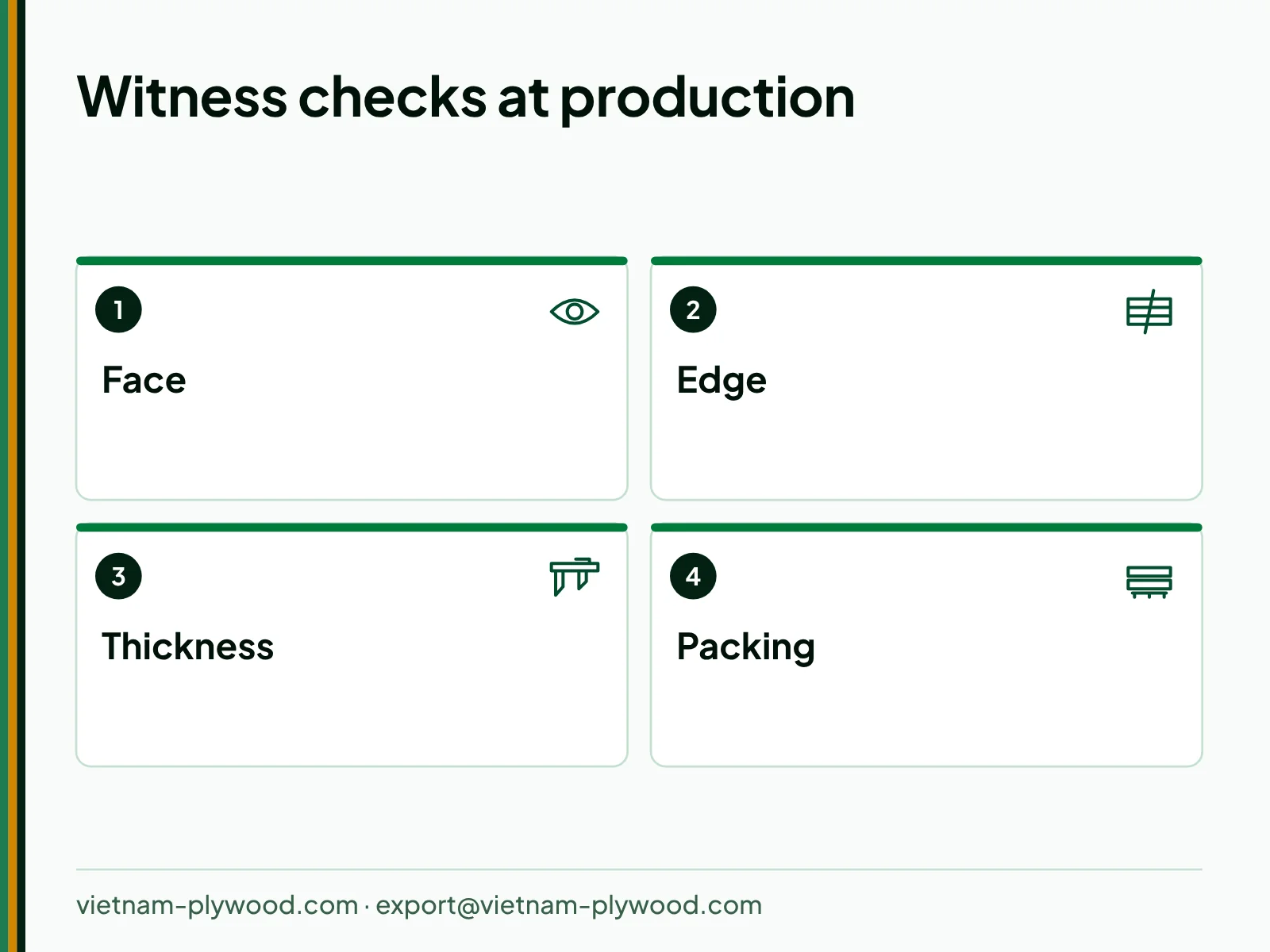
A useful inspection sequence is:
- Match the order and approved sample to the production lot.
- Check face grading, grain direction and defects on visible surfaces.
- Measure thickness at agreed points and inspect cut edges for core gaps.
- Verify packing marks, quantities and the agreed certificate documents before loading.
Buyers can visit the factory office and inspect goods where the order is produced. HCPLY manages specification, on-site quality control, export paperwork and loading. These checks catch problems before a cabinet shop commits its machining schedule.
Can decorative and utility sheets travel together?
A mixed container can combine furniture plywood with commercial backing sheets if the written specification and payload permit it. The minimum order is one 40HC, with a 28.5 t payload limit. Different cores have different densities: styrax 500 kg/m³, acacia 580 kg/m³ and eucalyptus 650 kg/m³.
For 18 mm, 1220×2440 sheets, the full-container reference is 990 styrax sheets at 26.52 t, 880 acacia sheets at 27.35 t or 795 eucalyptus sheets at 27.69 t. These are separate full-load configurations, not quantities to add together. A mixed plan must recalculate volume and mass for each group, then check pallets and the total payload. See container loads for the dedicated loading method.
The broader several plywood types in one order approach can reduce separate purchasing schedules. Keep each specification identifiable on its pallet so a receiving warehouse can route decorative sheets away from utility stock.
What determines the price of fit-out plywood?
Furniture plywood starts from US$350/m³ FOB Hai Phong (October 2026); commercial plywood starts from US$250/m³ FOB Hai Phong (October 2026). A sanded, full-stitched furniture build costs more than a simpler commercial build because it requires tighter surface and core preparation.
For a specific fit-out quotation, the principal drivers are the required build and face grade, then thickness and dimensions, followed by the agreed emission documentation and order mix. Price the visible and concealed components separately rather than over-specifying all panels to one finish. HCPLY quotes against the written bill of materials.
Which export terms and papers should the purchase order carry?
Specify FOB Hai Phong, CFR (CNF) or CIF and name the destination port. Factory lead time runs 15–45 days from receipt of the 30% deposit; the exact figure depends on order size, line loading and what the contract fixes. The balance is 70% against the scanned bill of lading (B/L), by telegraphic transfer (T/T) or irrevocable letter of credit (L/C) at sight.
The shipment document set includes commercial invoice, packing list, B/L, certificate of origin (EUR.1 for EU lots), phytosanitary and fumigation papers, insurance under CIF, agreed certificate or test documents, and the EUTR/EUDR file set for EU lots. After loading, the draft shipping documents come to you for approval. The packing list is the document that should distinguish the visible-face sheets from concealed backing stock.
What should a fit-out maker send for sampling?
Send one specification per distinct component, identifying visible faces and acceptable core construction. HCPLY offers free samples; a first-time buyer pays the courier, and that charge comes off the first confirmed order. Compare the samples after the intended finishing process, especially where panels will sit side by side.
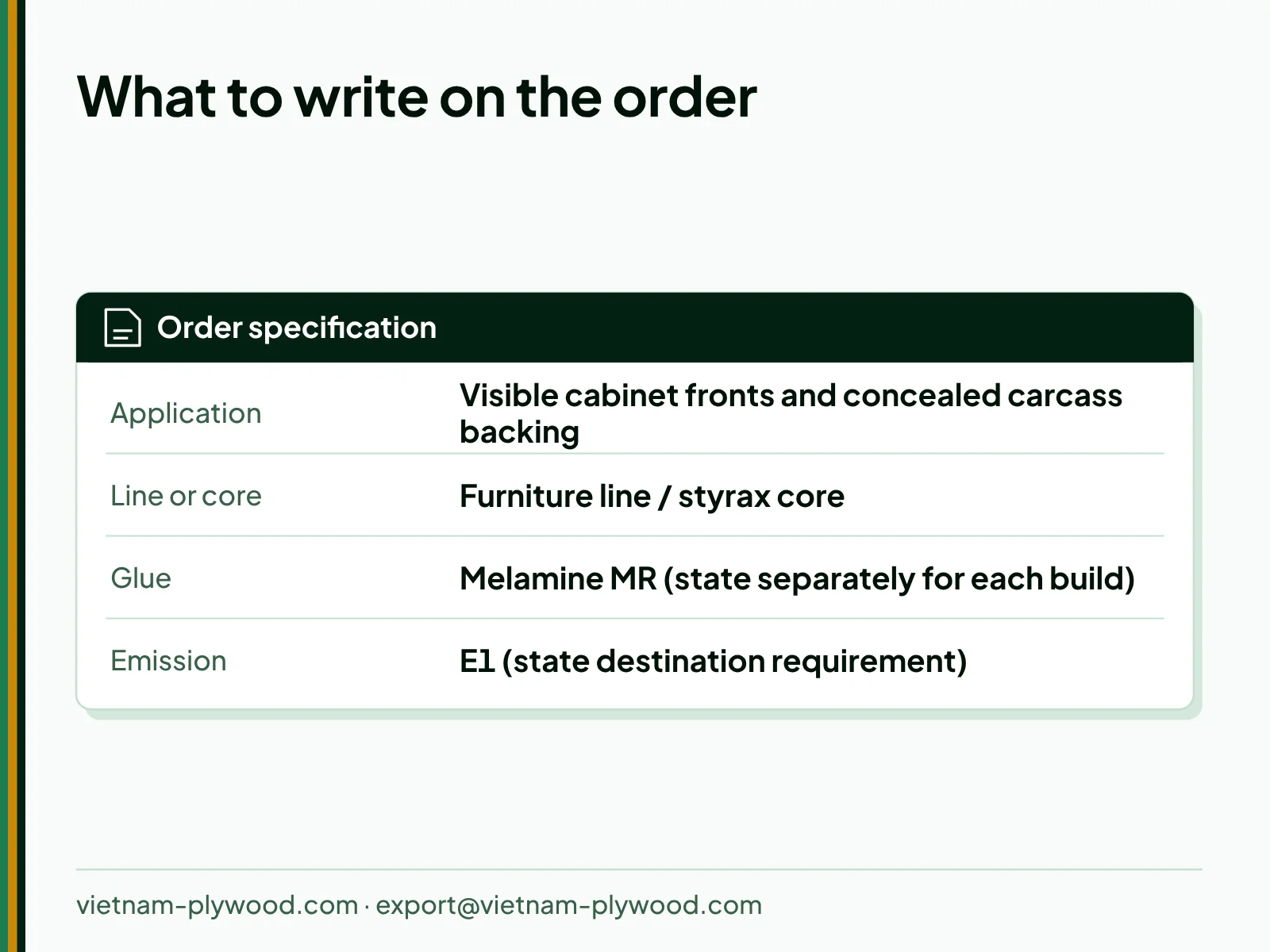
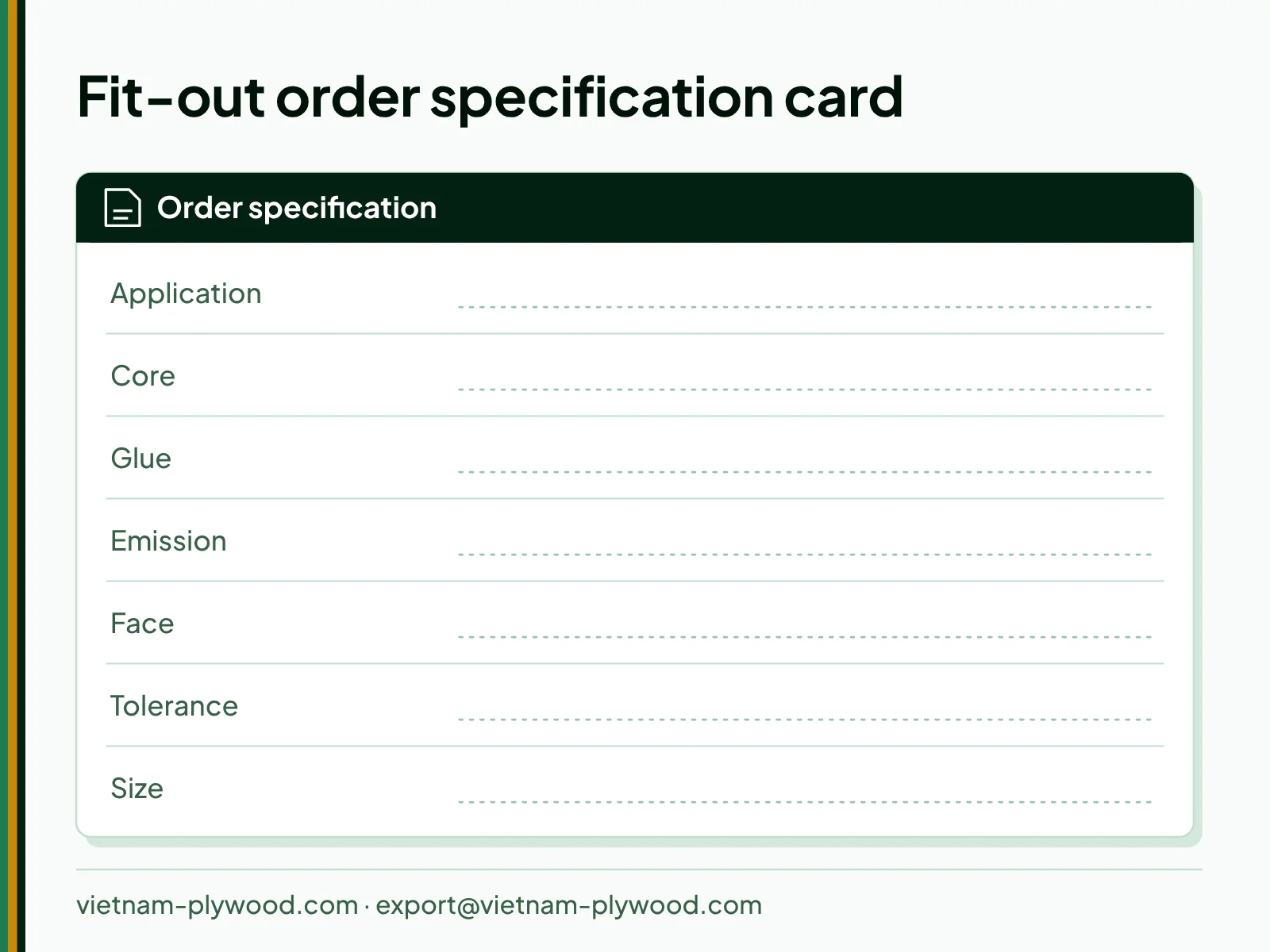
Use this order skeleton to avoid an ambiguous “interior plywood” enquiry:
Application: visible cabinet fronts and concealed carcass backing
Line or core: furniture line / styrax core; commercial line / acacia core
Glue: melamine MR (state separately for each build)
Emission: E1 (state destination requirement)
Face and grade: EV A/B for visible faces; matt for concealed backing
Thickness and tolerance: 18 mm ±0.2 mm visible; 18 mm ±0.5 mm commercial
Size: 1220×2440 mm
Quantity: state sheets by specification, within one 40HC
Destination port: [port, country]
Ask Lucy at export@vietnam-plywood.com for a sample set against the component schedule through contact.