

Most buyers inspect the face veneer. Few inspect the core. That blind spot is where quality separates — and where substitution happens between shipments.
Plywood core construction — the method by which inner veneer strips are assembled before pressing — is the single biggest determinant of panel flatness, dimensional stability, and long-term delamination resistance. It is invisible once the panel is pressed, which is why it is so easy to swap between orders.
This guide explains the four core construction methods used in Vietnamese plywood factories, when each is appropriate, and how to specify the right method for your application.
📋 Core Construction at a Glance
Plywood core construction refers to how individual core veneer strips are joined — or not joined — before the panel is assembled and hot-pressed. Each method produces different results in flatness, surface consistency, screw-holding, and gap tolerance.
| Construction Method | Gap Risk | Flatness | Cost | Typical Application |
|---|---|---|---|---|
| Full Stitched | None | Highest | Highest | Premium furniture, E0 grade |
| Stitched Outer + Edge-Trimmed Inner | Minimal | High | Mid-High | Quality furniture, export B2B |
| Finger-Jointed | Low–None | High | Mid | Film-faced, structural |
| Loose-Laid | Medium–High | Lower | Lowest | Commercial, packing |
The construction method is independent of core species. An acacia core can be full stitched or loose-laid. A styrax core can be edge-trimmed or finger-jointed. Species affects density and colour; construction method determines structural quality.
🔧 Full Stitched Core — Maximum Quality
Full stitched core is the highest-grade core construction available from Vietnamese plywood factories. Every veneer strip in every core layer is joined edge-to-edge with a fine plastic thread before the panel is laid up.
The stitching thread melts during hot-pressing, leaving no residue. What remains is a continuous, gap-free core layer across the entire panel. There is no space for air pockets, no weakness at strip joints, and no surface telegraphing through thin face veneers.
Why it matters for furniture manufacturers:
When a CNC machine cuts across a full-stitched core panel, the blade encounters uniform resistance throughout. With a loose-laid or poorly trimmed core, gaps create micro-vibrations that chip edges on thin overlays and leave uneven surfaces after lamination.
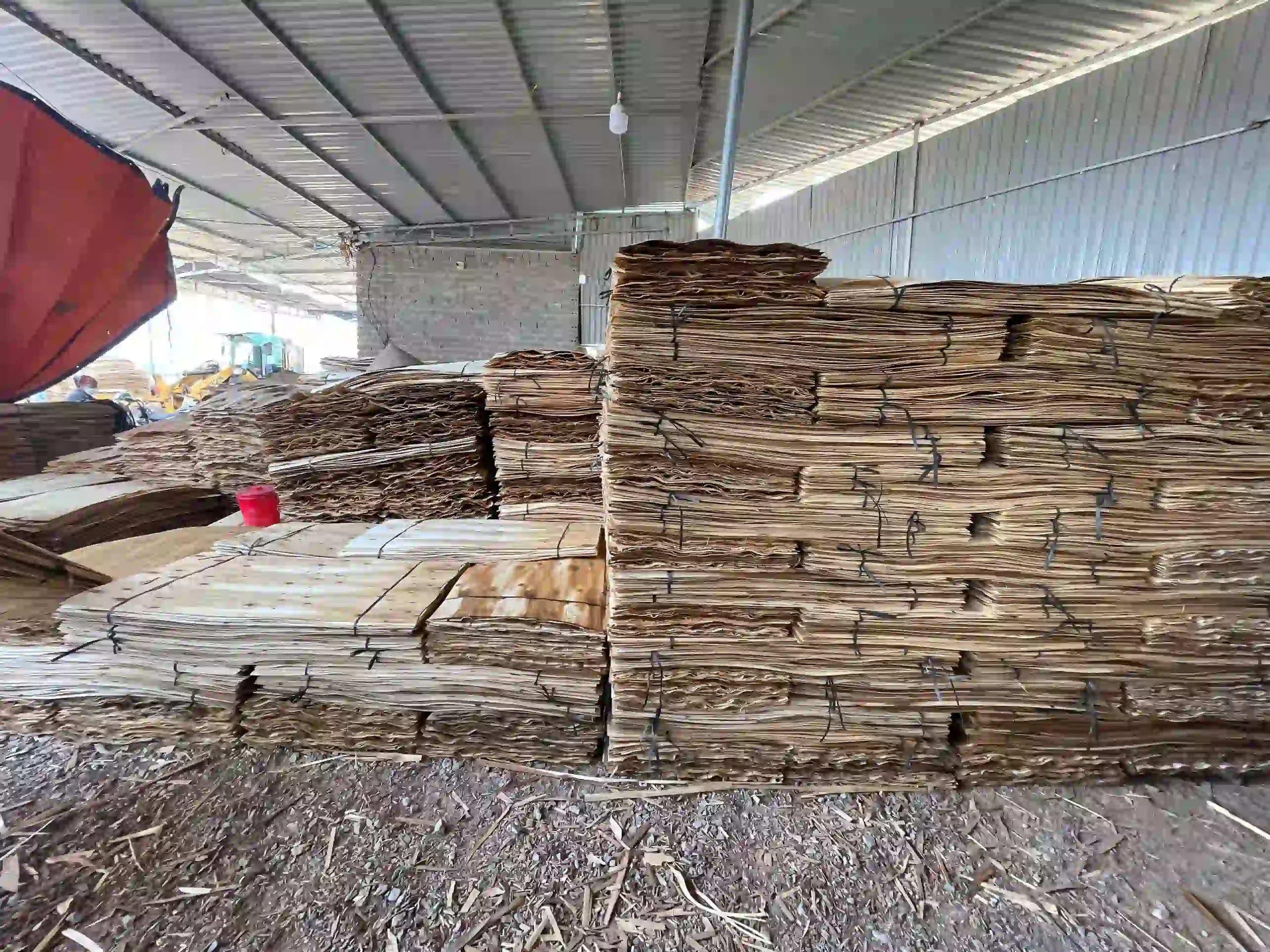
HCPLY’s Premium Furniture Facility (Facility 1) uses full stitched construction as standard on all styrax and eucalyptus core panels destined for E0, CARB P2, and EU markets. Face veneer species — birch, okoume, EV, gurjan, pine, poplar — are applied over this construction.
Key Insight: Full stitched core is mandatory for any plywood that will undergo: HPL lamination, PVC wrapping, CNC routing on exposed edges, or laminate flooring underlayment. Gaps in the core will read through the surface finish within months of installation.
Cost premium: Full stitched adds approximately 8–15% to core processing cost versus loose-laid, due to stitching machine time and skilled operator requirement. This is recovered immediately if delamination rejects are avoided (HCPLY production data, 2026).
✂️ Stitched Outer + Edge-Trimmed Inner
This construction is the most common choice for quality export B2B plywood at competitive pricing. The outer core layers (those closest to the face veneers) are fully stitched. The inner core layers are edge-trimmed — veneer strips are precisely cut to width and butted tight, but not stitched.
“Edge-trimmed” means the strips are squared with a precision saw, producing a tight butt joint. Under hot press pressure, the glue bonds across these joints. Gaps are smaller than loose-laid and typically close during pressing.
The rationale is straightforward: the outer layers influence surface telegraphing and face-veneer bonding. Inner layers primarily contribute to bending stiffness and thickness. Stitching the outer layers where it matters most, and trimming the inner layers to control cost, is the engineering trade-off chosen by most quality Vietnamese factories.
Performance: Panels built this way achieve flatness within 2–3 mm over a 2440 mm length, adequate for cabinet carcasses, shelving systems, and most B2B furniture applications where lamination is the final step.
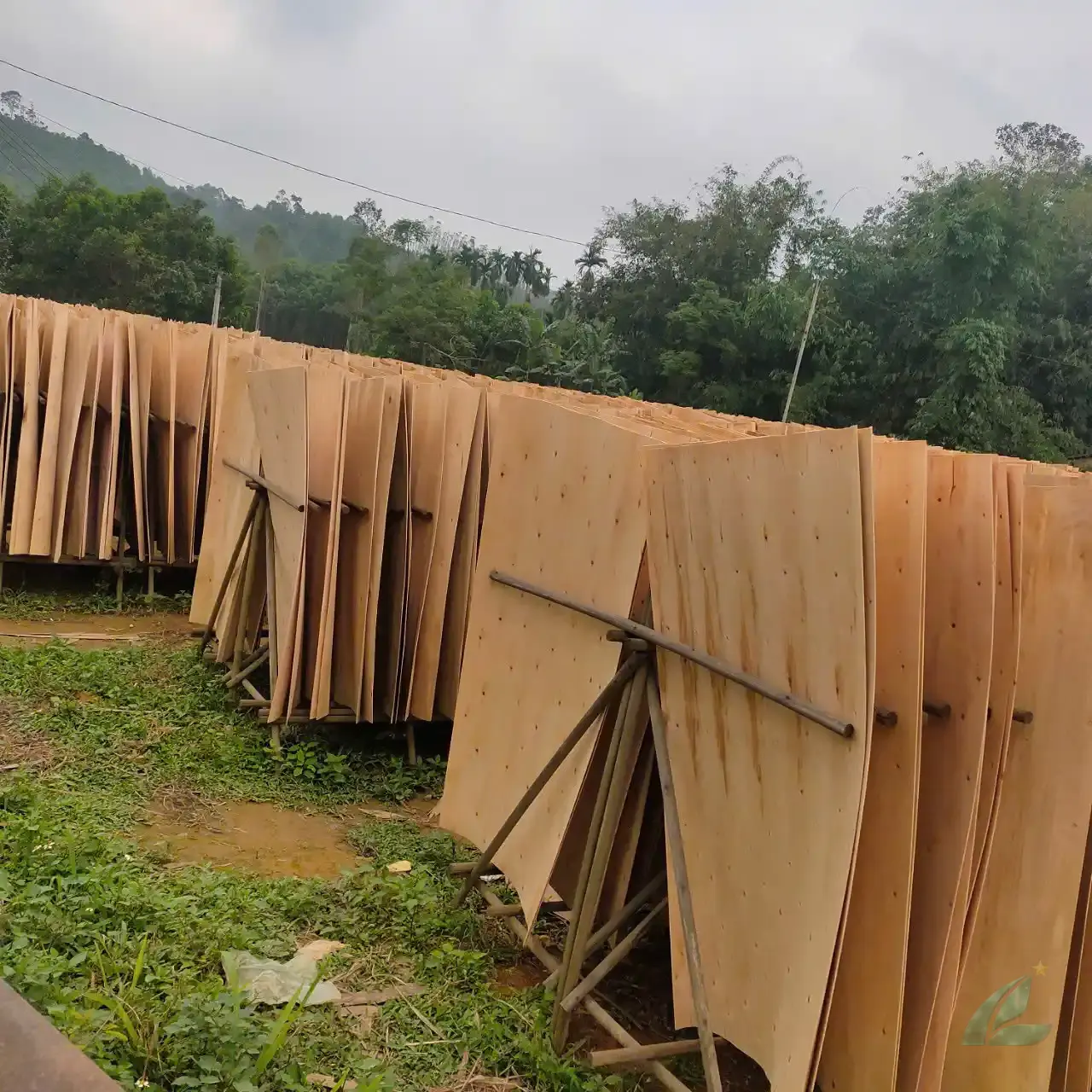
“When buyers specify ‘stitched core’ without further detail, we quote stitched outer + edge-trimmed inner as the standard. Full stitched is specified explicitly for customers doing HPL or paint-grade finishing.” — Lucy, International Sales Manager, HCPLY
When to choose this construction: Standard export furniture, kitchen cabinet carcasses, commercial interior fitout, any application where E1 emission and MR glue are acceptable.
🔩 Finger-Jointed Core
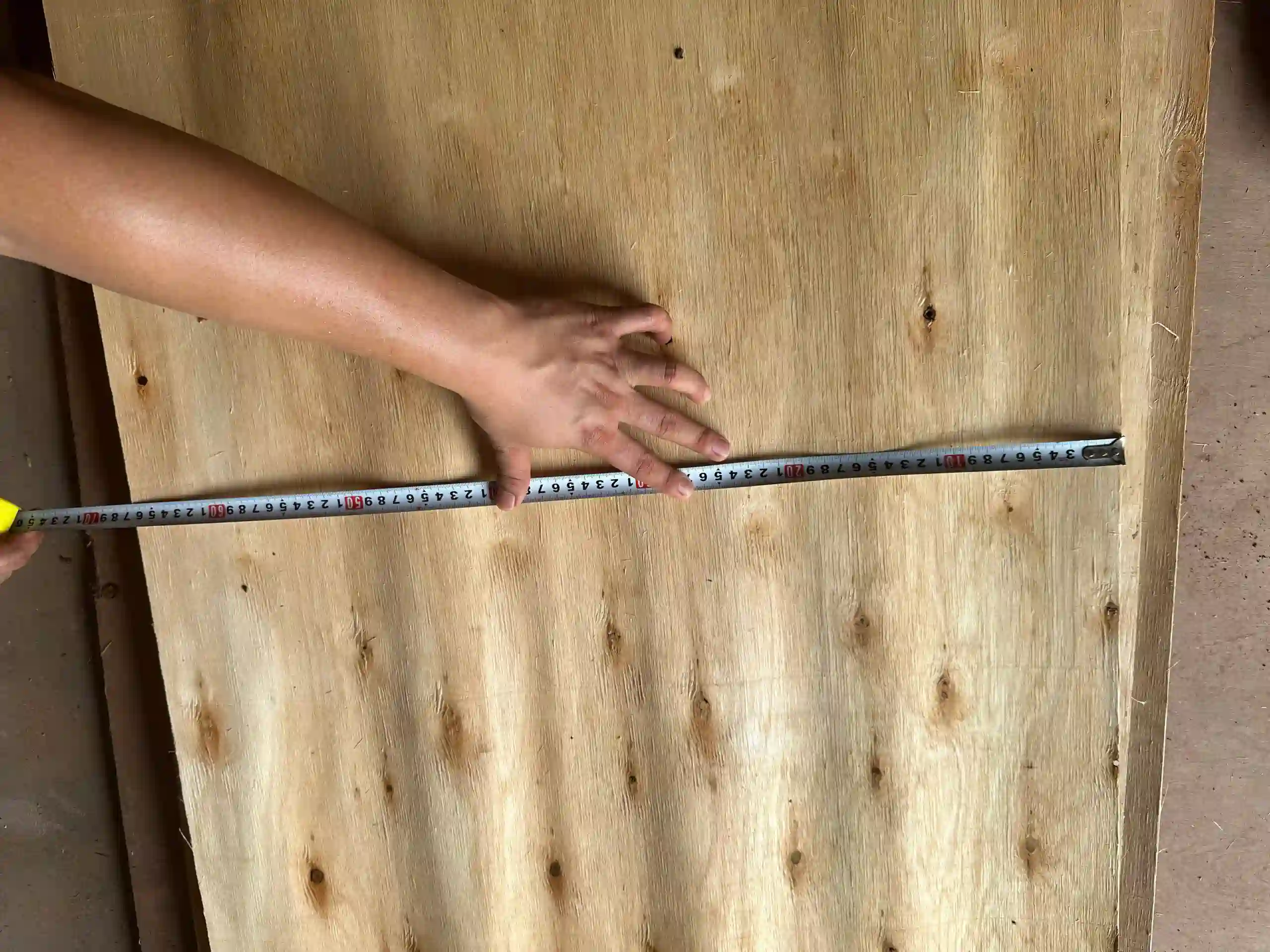
Finger-jointing is a different joining technique. Rather than sewing strips edge-to-edge, a router cuts interlocking rectangular teeth (fingers) along the strip edges. Adjacent strips mesh together, are glued, and the joint is clamped before pressing.
This produces a strong, mechanically interlocked joint that can handle higher stress than edge-trimmed construction. It also allows shorter veneer pieces to be utilised — offcuts and shorter sections that would otherwise be waste are jointed into full-length core strips.
Where finger-jointing is common in Vietnam:
- Film-faced plywood core, particularly for mid-grade formwork products
- Structural applications where bending resistance is specified
- Facilities producing to EN 314-2 Class 3 bonding requirements (phenolic WBP glue)
Limitations: Finger joints add a slight thickness variation at joint lines. For thin plywood (under 9 mm), this can create minor surface unevenness. Premium furniture factories avoid finger-jointed core on panels under 12 mm for this reason.
⚠️ Important: Finger-jointed core and finger-jointed solid-wood board are different products. Finger-jointed core refers to veneer strips joined this way within a plywood panel — not solid finger-jointed wood used as a structural member.
Cost position: Slightly higher than edge-trimmed alone due to routing and clamping time, but often similar because it enables waste utilisation. Finger-jointed core is common in mid-range film-faced plywood from Northern Vietnam factories (States Industries Core Comparison, 2022).
📦 Loose-Laid Core — Budget Grade
Loose-laid core construction — also called “lay-up” core in some factory specifications — means core veneer strips are placed side by side on the lay-up table without any joining. Strips may or may not be precisely butted; gaps between strips are common.
During hot-pressing, glue migrates into small gaps and the panel bonds. But gaps larger than 2–3 mm often remain as internal voids. These voids reduce screw-holding capacity at affected zones, create delamination initiation points under cyclic load or moisture exposure, and can telegraph through thin face veneers as surface depressions.
Where loose-laid core is appropriate:
- Packing plywood and export crating (internal voids have no structural consequence at these loads)
- Low-grade commercial plywood for markets where E2 emission and basic bending stiffness are sufficient
- Film-faced plywood for single-use or low-reuse formwork applications (4–8 cycles)
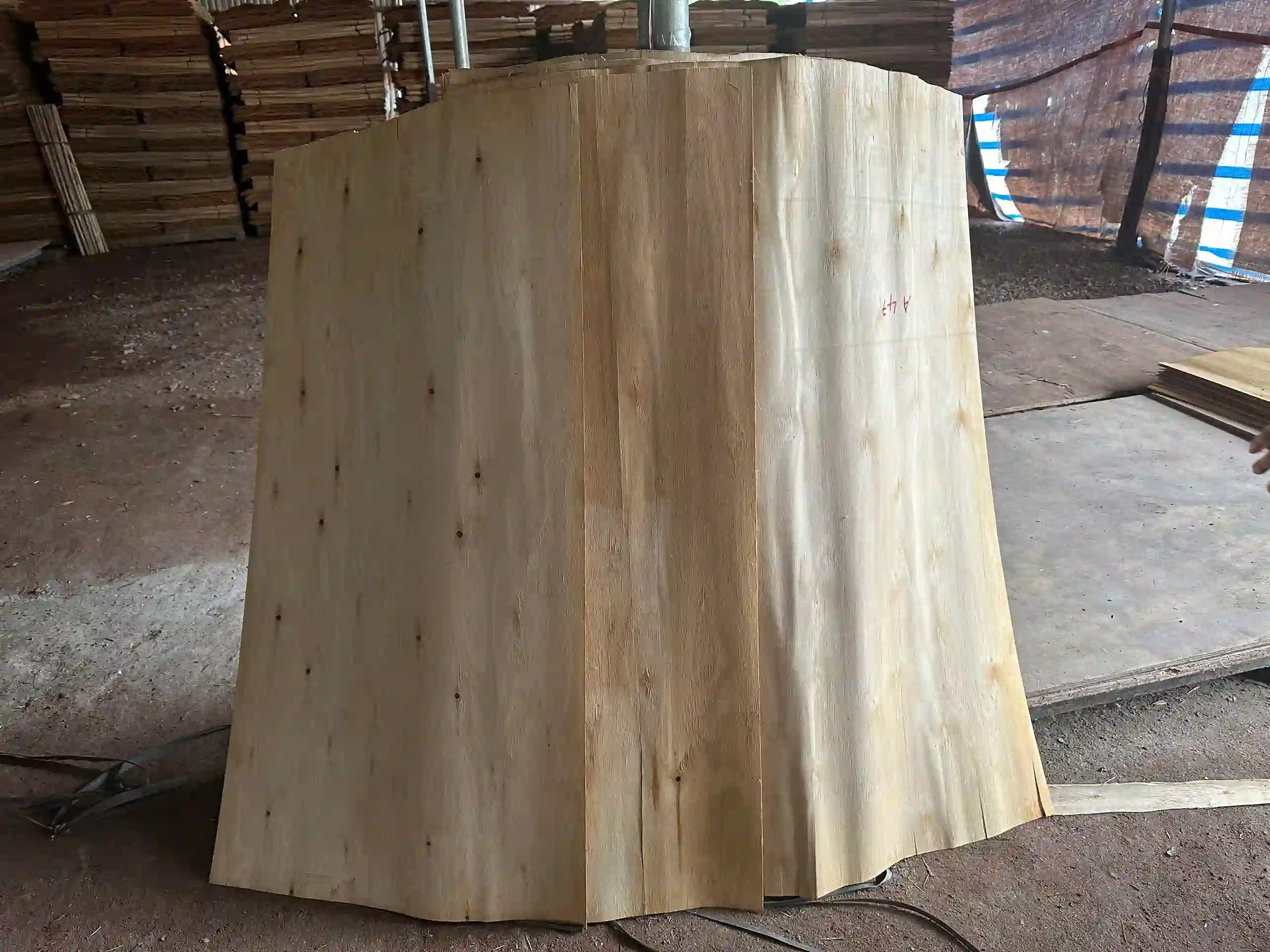
The substitution risk: The key risk with loose-laid core is that it is visually identical to edge-trimmed or stitched core on the finished panel surface. Buyers who do not inspect cross-sections or specify construction method explicitly are routinely supplied loose-laid core panels when they ordered “quality” plywood.
This is the most common complaint in Vietnam plywood B2B disputes: face veneer as specified, but core construction downgraded between sampling and production orders (HCPLY export records review, 2026).
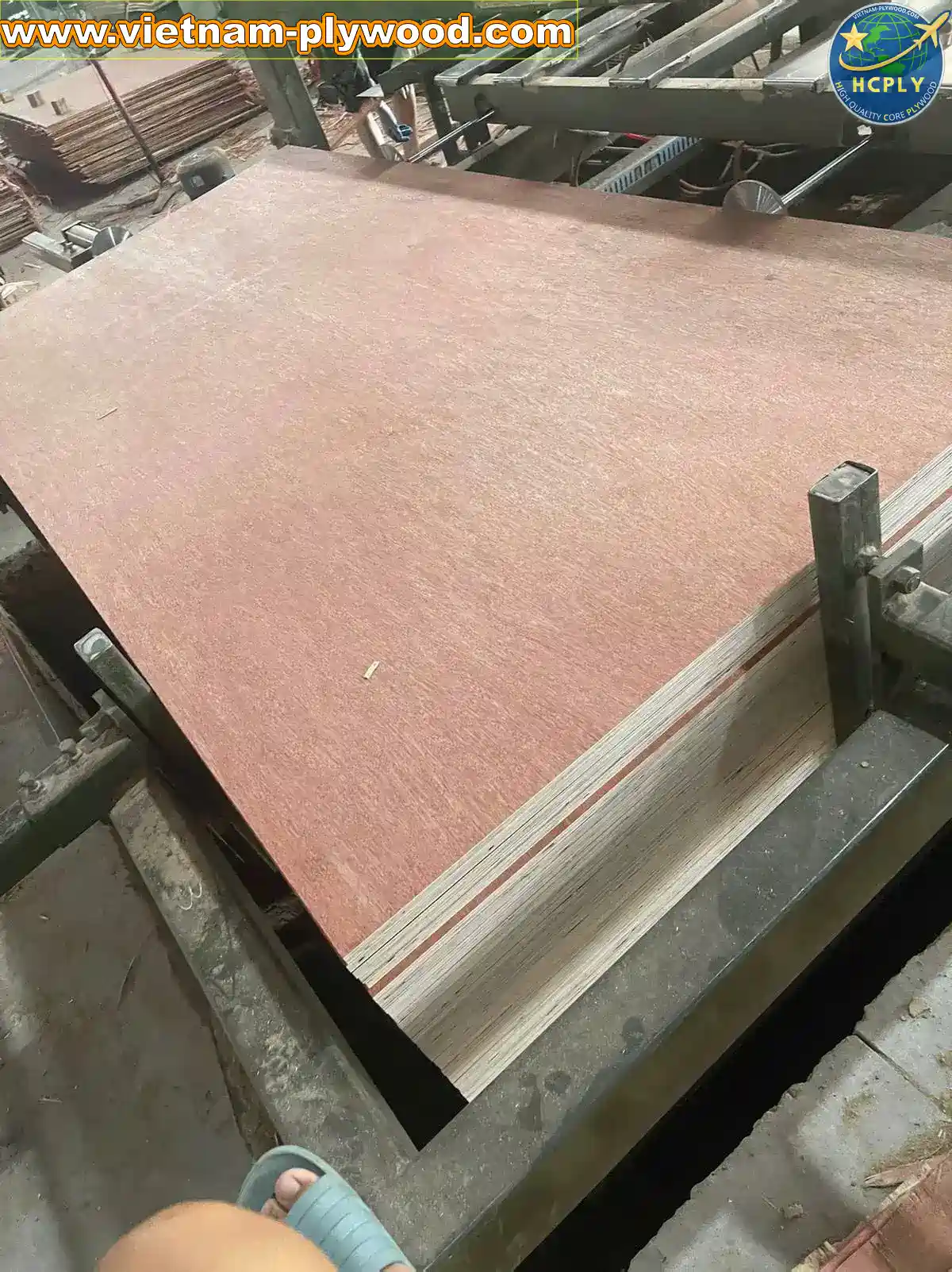
How to detect loose-laid core: Request a cross-section cut from a production sample. Gaps larger than 1 mm at any core layer interface indicate loose-laid construction. Internal photographs from factory QC can also reveal gap patterns before shipment.
📊 Which Construction for Which Application?
Key Insight: The factory segment determines default core construction. Furniture-grade factories default to stitched; commercial-grade factories default to loose-laid. The same product name — e.g., “bintangor plywood 12mm” — can come from either factory type with radically different construction.
| Application | Minimum Required | Preferred |
|---|---|---|
| Premium furniture, cabinet carcasses for EU/US | Stitched Outer + Edge-Trimmed Inner | Full Stitched |
| HPL lamination, paint-grade furniture | Full Stitched | Full Stitched |
| Kitchen cabinet (E0, CARB P2) | Full Stitched | Full Stitched |
| Standard export furniture (E1, MR) | Stitched Outer + Edge-Trimmed Inner | Stitched Outer + Edge-Trimmed Inner |
| Film-faced formwork, 15+ reuse | Stitched Outer minimum | Full Stitched where budget allows |
| Film-faced formwork, 4–8 reuse | Finger-Jointed or Edge-Trimmed | — |
| Commercial interior, general use | Edge-Trimmed | Stitched Outer |
| Packing, crating, industrial packaging | Loose-Laid acceptable | — |
Specifying construction in your purchase order: Always include core construction method in your technical specification. Use the exact terms above. A clause such as “core construction: full stitched, all layers” leaves no ambiguity for factory production and QC teams.
Request a Quotation with Core Construction Specifications
🏭 How Vietnam Factory Segments Map to Construction Methods
Understanding Vietnam plywood factory types is the fastest way to predict default core construction from a new supplier.
Segment A — Premium Furniture Factories (Northern Vietnam, Phu Tho, Ha Noi): Default to full stitched or stitched outer + edge-trimmed inner. These facilities have stitching machines, precision-width veneer lines, and QC staff who check gap tolerance at each layer. Certifications: FSC, CARB P2, E0, ISO 9001. HCPLY’s Facility 1 falls in this segment.
Segment B — Commercial/Packing Factories: Default to loose-laid or edge-trimmed. Lower capital equipment, faster throughput, focused on price-competitive segments. Certifications minimal or absent.
Segment C — Premium Film-Faced Factories: Use stitched core for high-reuse products, finger-jointed or edge-trimmed for standard ranges.
Segment D — Budget Film-Faced Factories: Loose-laid core with acacia Grade B, minimal stitching. Reuse 4–8 cycles only.
For a full breakdown of these factory segments, see the guide on plywood core types — acacia, eucalyptus, and styrax from Vietnam.
🔍 Verifying Core Construction Before You Order
Three practical steps to verify core construction without visiting the factory:
-
Cross-section sample request. Ask for a 50×100 mm cross-section cut from the centre of a production panel — not an edge offcut. Photograph under natural light. Full stitched cores show no visible gaps between strips. Loose-laid cores show gaps 1–5 mm wide.
-
Factory QC documentation. Request internal QC checklist showing “core gap check” as a production step. Factories running stitched core have this documented. Factories without gap inspection are not running stitched core.
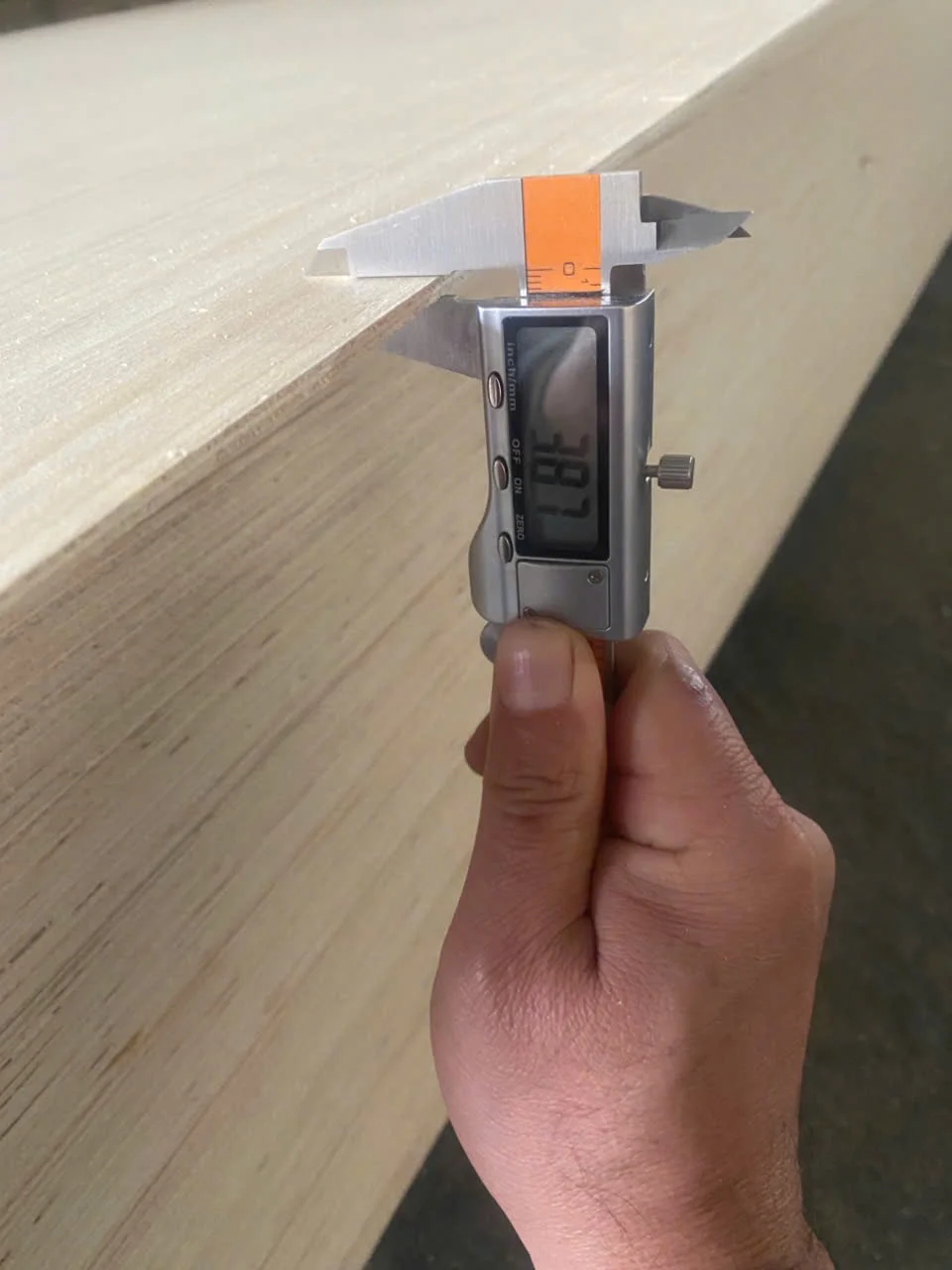
- Third-party inspection at time of loading. Instruct your inspection agency to cut 2–3 panels from each production batch during loading inspection and photograph cross-sections. Include this in your LC or contract inspection scope. HCPLY supports and welcomes third-party inspection at all facilities — see our quality control process for standard inspection access.
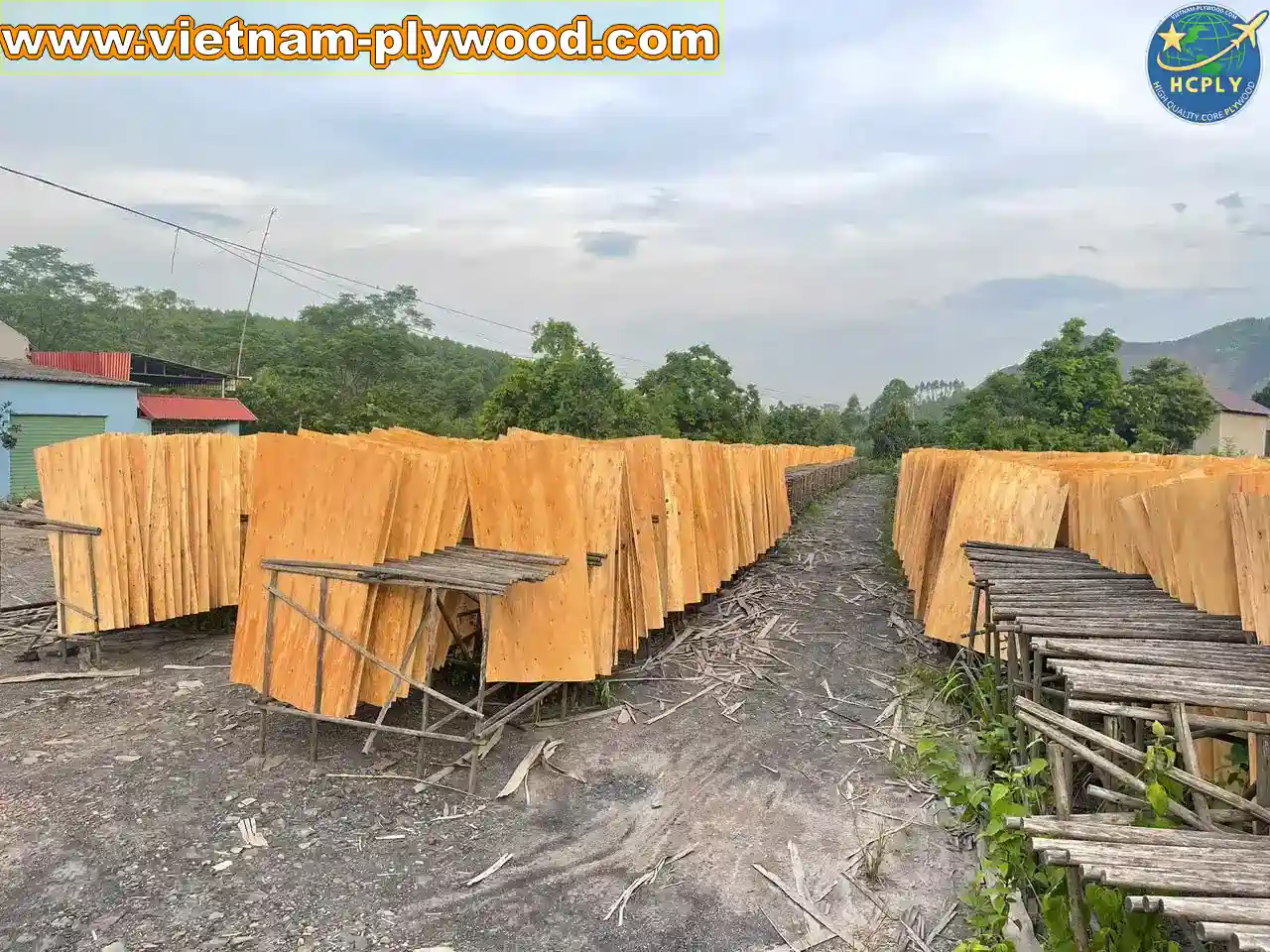
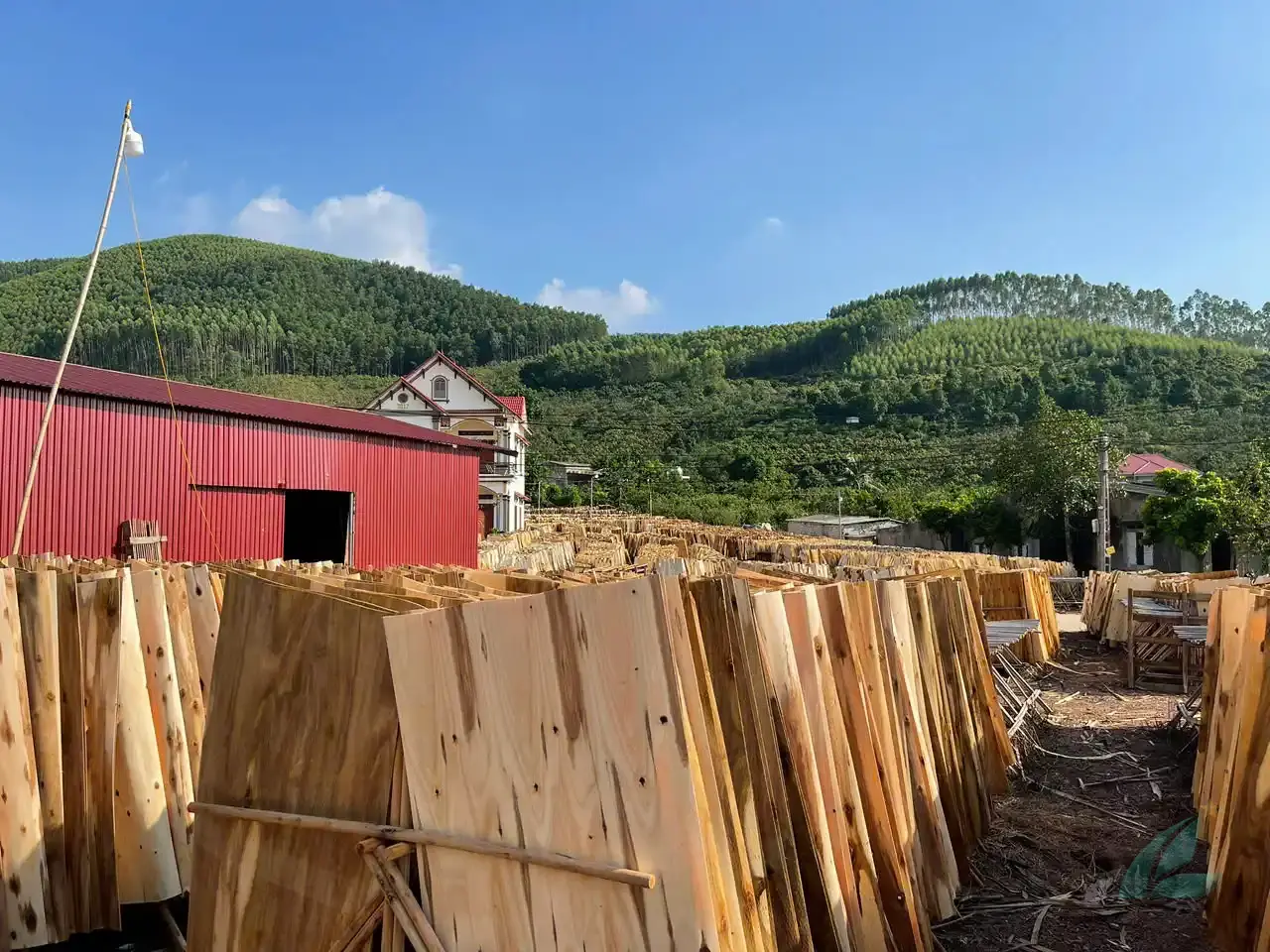
For raw core veneer supply (if you manufacture plywood yourself), HCPLY exports acacia and eucalyptus core veneer sheets in Grade A. See core veneer Vietnam for specifications.
📐 Core Construction and Emission Standards
There is a common misconception that E0 emission implies full stitched construction. It does not. Emission standard (E0/E1/E2) refers to formaldehyde release from the glue — a chemistry specification. Core construction is a physical manufacturing specification. They are independent variables.
You can have:
- E2 emission + full stitched core (possible but unusual — low-quality glue, premium construction)
- E0 emission + loose-laid core (common from factories that invest in glue chemistry but not core equipment)
- E0 emission + full stitched core (standard at premium furniture factories — HCPLY Facility 1)
When specifying for EU or US market furniture, both specifications are required: emission class AND core construction method. Specifying only E0 is incomplete.
📌 Conclusion
Plywood core construction is one of the most consequential — and least understood — variables in the B2B plywood supply chain. Four methods exist: full stitched, stitched outer + edge-trimmed inner, finger-jointed, and loose-laid. Each has legitimate applications; the error is using a lower-grade method for applications that require higher.
For premium furniture, HPL lamination, and paint-grade applications, full stitched core is the only construction that reliably produces gap-free, flat, delamination-resistant panels. For standard export furniture, stitched outer + edge-trimmed inner delivers the right quality-to-cost ratio. Loose-laid core belongs in packing and budget commercial applications — not in furniture supply chains.
Specify construction method explicitly in every purchase order. Request cross-section samples before production begins. Verify with third-party inspection at loading. These three steps close the gap between what buyers specify and what factories ship.
Contact HCPLY to Specify Core Construction for Your Next Order
No commitment required. Our team provides sample cross-sections and written confirmation of construction method before production begins.