





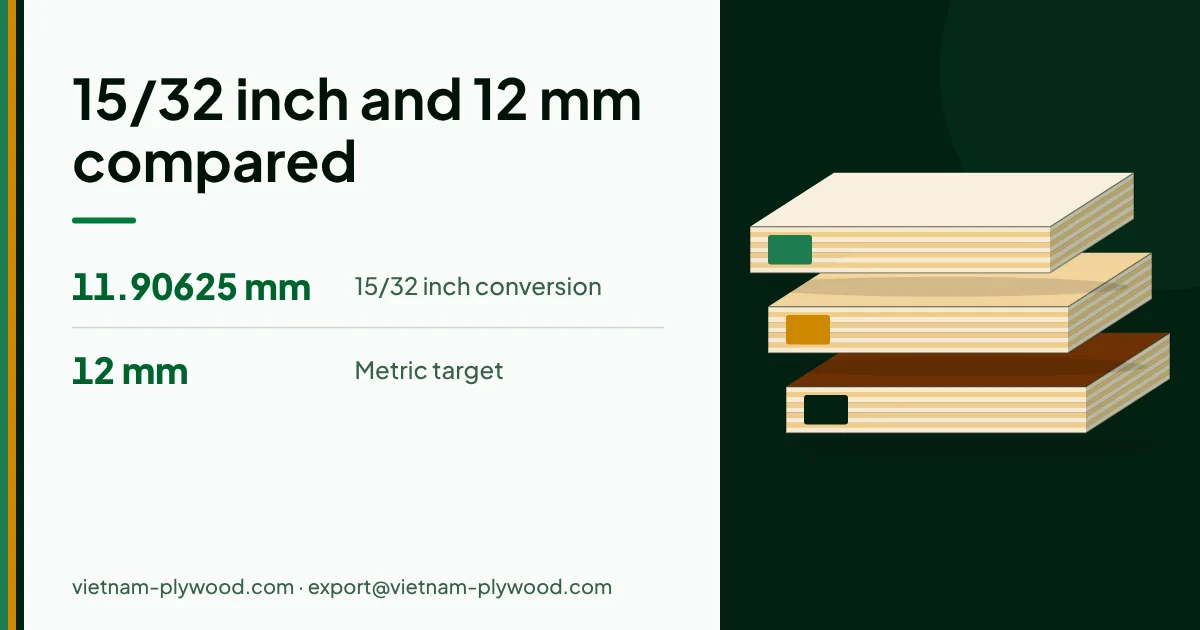
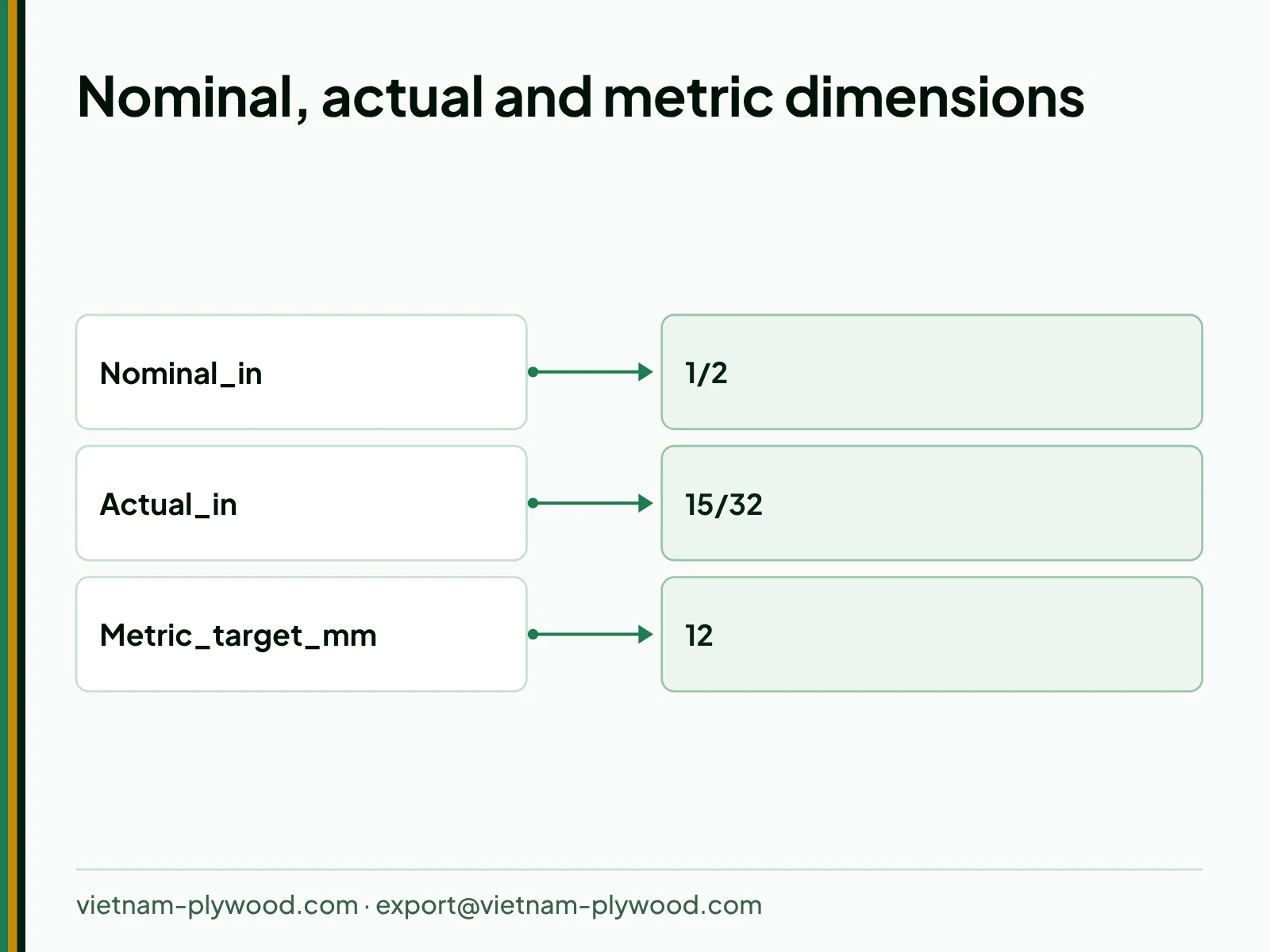
15/32 plywood is the common US actual-size reference for nominal 1/2-inch panels, close to the 12 mm metric sheet HCPLY presses. Confusing the nominal name with an exact finished dimension can waste machining time or lead to rejected cabinet components. The order should identify the metric target, tolerance and application.
What does 15/32 plywood mean?
15/32 plywood is an inch-based panel thickness designation equal to 11.90625 mm mathematically. In US purchasing, it often identifies the actual category associated with nominal 1/2-inch plywood, while a metric factory commonly quotes 12 mm. HCPLY presses 12 mm panels; the purchase order must state whether 12 mm with a defined tolerance meets the buyer’s fit and performance requirements.
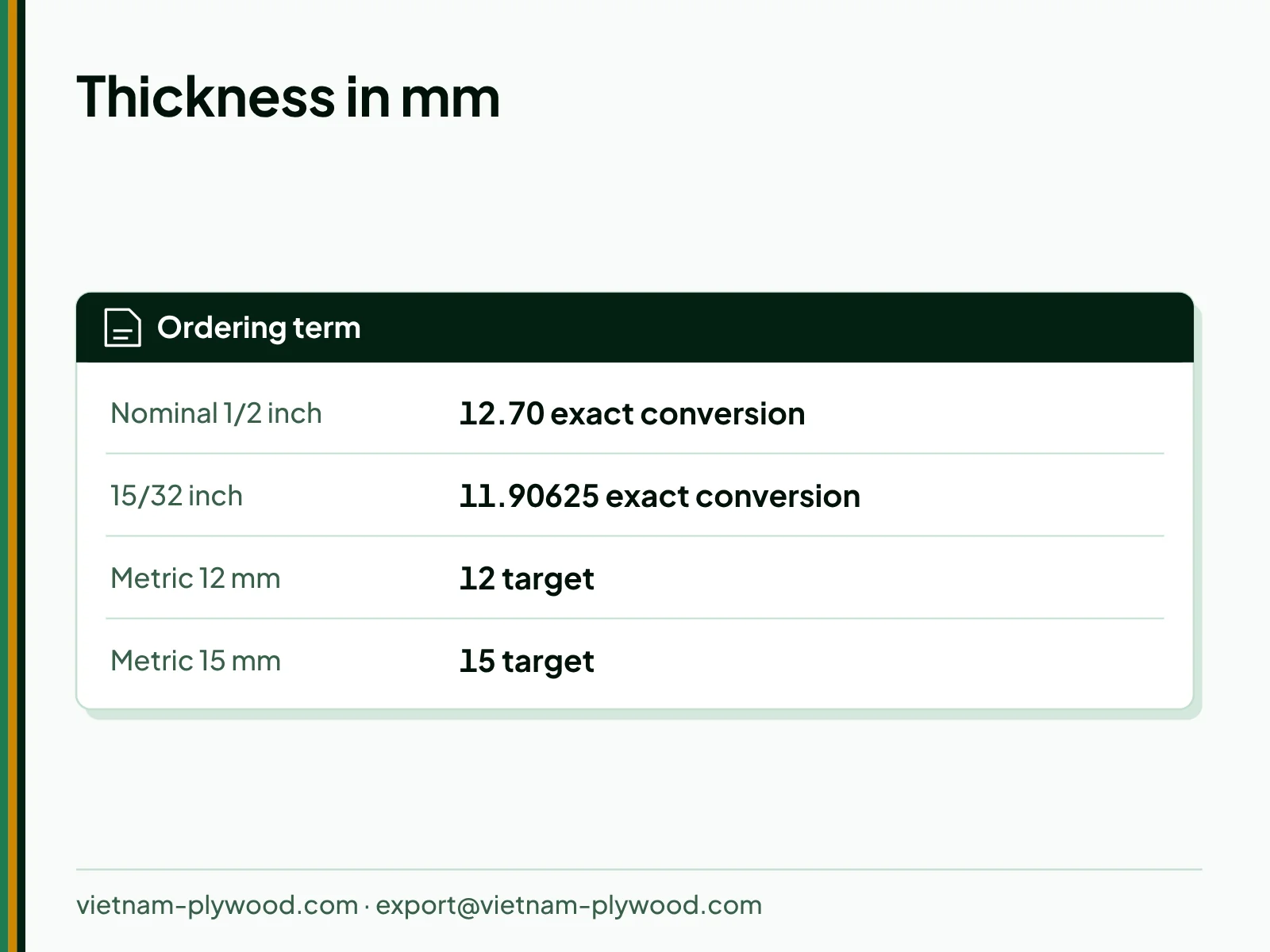
The distinction matters because 1/2 inch converts to 12.70 mm, whereas 15/32 inch converts to 11.90625 mm. A 12 mm target is 0.09375 mm above the latter, but 0.70 mm below the former. Neither conversion alone defines an acceptable finished panel. The broader plywood sizes and thickness specification guide covers dimension conventions across the range.
How does 12 mm compare with nominal 1/2 inch?
A 12 mm metric panel is close to 15/32 inch in target thickness, but its purchase tolerance and grading system must be specified separately. The following comparison distinguishes arithmetic from product designations.
| Ordering term | Thickness in mm | What a buyer should write | Verdict by use |
|---|---|---|---|
| Nominal 1/2 inch | 12.70 exact conversion | State intended performance category and required measured thickness | Incomplete alone for machining or structural approval |
| 15/32 inch | 11.90625 exact conversion | State the inch designation and acceptable measured range | Useful US reference; verify fit |
| Metric 12 mm | 12 target | State 12 mm and ordered tolerance | Direct factory specification for cabinets and fit-out |
| Metric 15 mm | 15 target | Request a separate thicker build | Consider when design calls for more material, not as a substitute |
Which HCPLY line presses a 12 mm order?
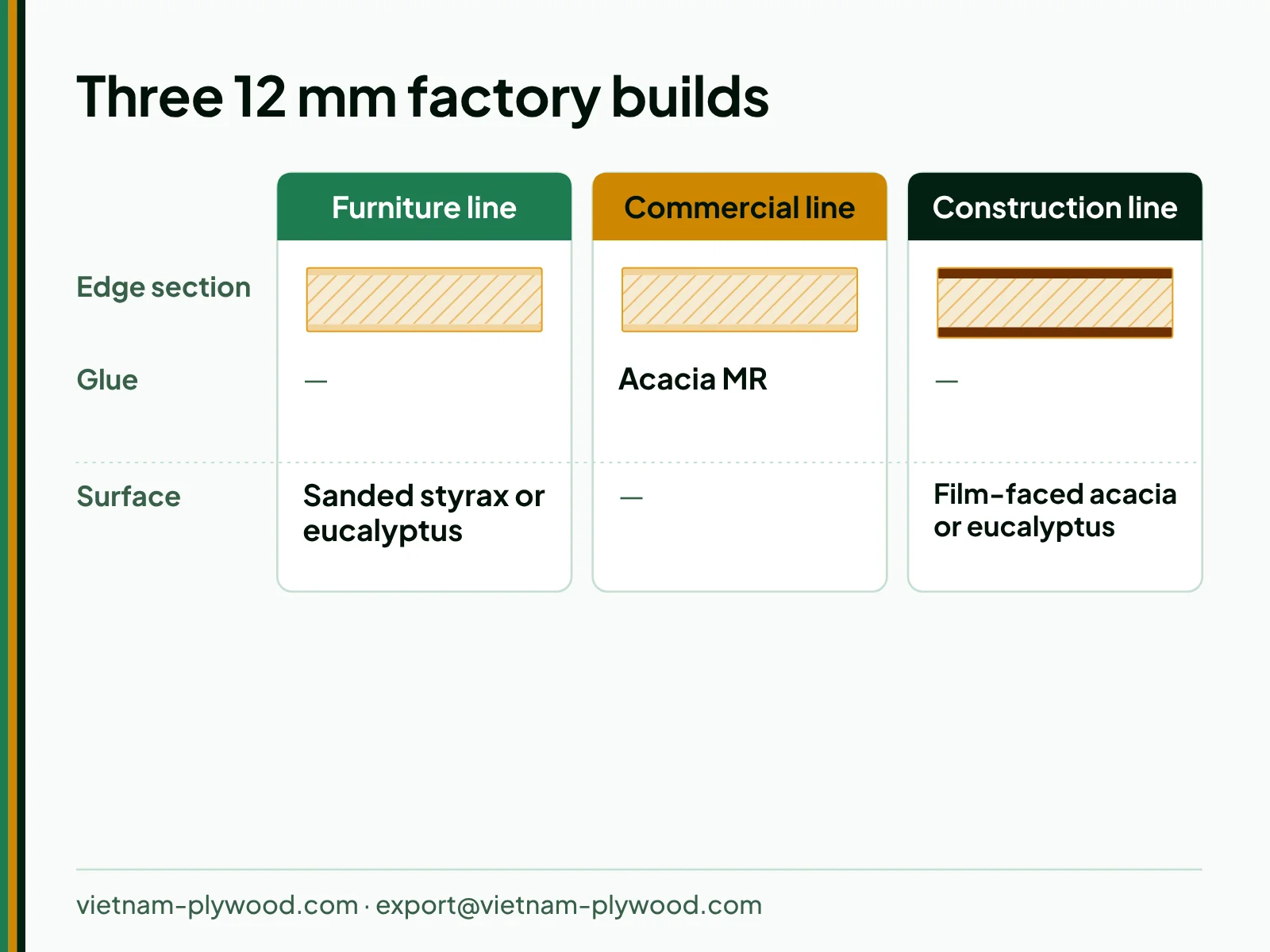
Our furniture line presses sanded 12 mm panels for cabinet and fit-out work, with a styrax or eucalyptus core. Our commercial and packing line instead builds acacia-core panels for commercial or packing use; our construction line makes film-faced panels for formwork requirements. Each is a distinct specification, even when the nominal thickness matches.
| Line | 12 mm build | Surface and tolerance | Buying decision |
|---|---|---|---|
| Furniture | Full-stitched styrax or eucalyptus core; E0 or E1 emission class | Sanded; ±0.2 or ±0.3 mm as ordered | Cabinet parts, furniture and visible fit-out |
| Commercial and packing | Acacia core, moisture-resistant (MR) glue | Unsanded or light-sanded; commercial ±0.5 mm, packing ±0.5–1.0 mm | Commercial stock and packing components |
| Construction | Acacia or eucalyptus core with phenolic or melamine film | Unsanded; ±0.5 mm | Formwork panels against the job specification |
Face names describe veneer appearance, while core choice determines the listed density. For a finished cabinet face, see furniture plywood; for utility applications, compare packing and commercial plywood.
What thickness tolerance belongs on the purchase order?
Write the finished thickness and its permissible deviation together, rather than leaving the tolerance to an inch conversion. For a sanded furniture panel, HCPLY offers 12 mm with ±0.2 mm or ±0.3 mm as ordered. Commercial and film-faced panels use ±0.5 mm; packing uses ±0.5–1.0 mm.
A cabinet maker should check the entire permitted range against groove width, edge treatment and adjoining parts. A buyer requesting 15/32-inch finished thickness exactly should specify that target explicitly for quotation instead of assuming the standard 12 mm target satisfies it. Length and width tolerance is ±2 mm.
Sanding matters because it determines the final surface and the thickness measured after finishing. Specify the inspection point as the finished, conditioned panel and agree a measurement method in the order. The factory inspector can witness readings at agreed positions on representative sheets.
What should cabinet and furniture buyers choose?
For cabinet components, specify 12 mm sanded furniture plywood with the core, face grade and thickness tolerance matched to the machining drawing. Our furniture line uses full-stitched cores and offers E0 or E1 emission classes. Glue chemistry and emission classification are separate order fields.
A face can be bintangor, okoume, engineered veneer (EV), gurjan, pine, poplar, eucalyptus, birch or sapele; an unfaced raw core is called matt. Common face veneer thickness is 0.2–0.4 mm. A/B face grades are available across the relevant face range, while birch faces are graded D/E/F.
Can 15/32 plywood be used as roof or wall sheathing?
A 15/32 designation alone cannot establish roof, wall or floor sheathing suitability. Structural use requires an applicable rating and supporting test report accepted by the buyer. A 12 mm furniture or commercial panel does not acquire a US span rating through dimensional similarity.
APA – The Engineered Wood Association explains on its plywood standards and selection page that span ratings identify recommended support spacing, while performance categories identify nominal thickness for building-code reference. Its page identifies PS 1 and PS 2 as standards for structural wood panels; the 2022 PS 1 edition is listed there. A structural buyer should state the required governing standard, grade, support spacing, loading and accepted test evidence.
HCPLY quotes structural use only against a test report the buyer accepts. The specification must also identify exposure conditions and the responsible designer’s acceptance criteria. Phenolic weather-and-boil-proof (WBP) glue describes bond resistance; it is not itself a structural approval. Our construction line’s film-faced products address formwork specifications rather than an assumed US sheathing classification.
How much does a 12 mm container carry?
At 1220 × 2440 × 12 mm, the stated full 40HC lookup is 1,494 styrax-core sheets, 1,328 acacia-core sheets or 1,200 eucalyptus-core sheets. The corresponding gross panel masses, excluding packaging and film, are 26.68 t, 27.51 t and 27.86 t. The payload limit is 28.5 t.
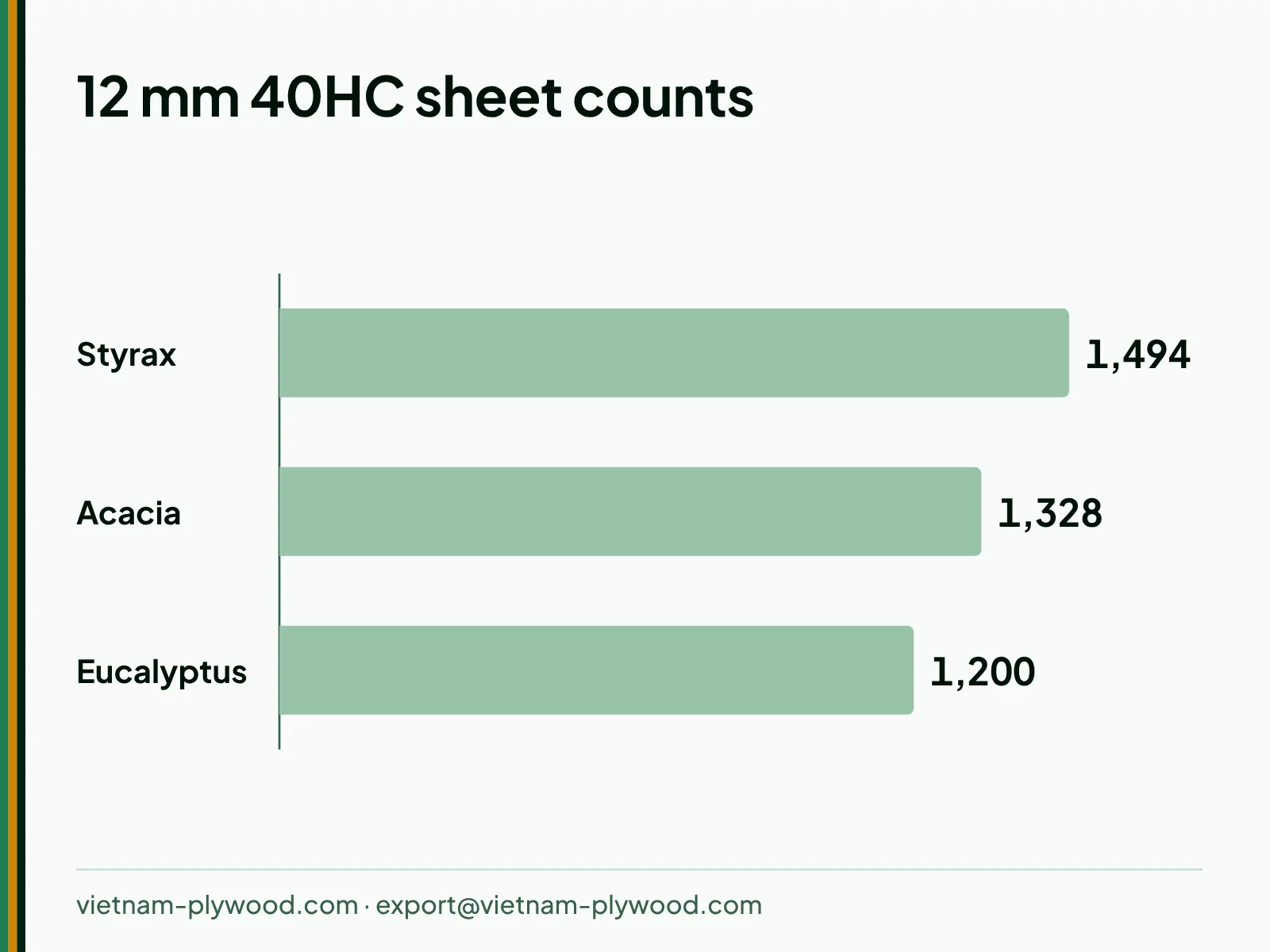
These figures describe separate full-container core scenarios; they should not be added together. For example, 83 styrax sheets per pallet across 18 pallets gives 1,494 sheets, while 83 acacia sheets across 16 pallets gives 1,328. A mixed specification load must be planned against total payload and pallet layout, with the mix agreed before packing.
HCPLY can combine specifications in a container within that payload limit. For a full loading method rather than this thickness example, see container loads and packing.
Which sheet dimensions and core details matter?
The standard 12 mm quotation should state sheet dimensions separately from thickness. Available sizes are 1220 × 2440, 1250 × 2500, 1220 × 2135, 1220 × 1830, 915 × 2440, 915 × 2135 and 915 × 1830 mm; custom cutting is available.
Core density is 500 kg/m³ for styrax, 580 kg/m³ for acacia and 650 kg/m³ for eucalyptus. Density follows the core rather than the face veneer. Ply count changes with veneer thickness, so buyers should request the agreed core construction instead of assuming every 12 mm sheet has an identical layer count.
What can an inspector verify at the producing factory?
An inspector can witness finished-thickness measurement, surface grading, core construction at cut edges and packing counts at the producing factory. Agree the sampling plan and acceptance limits before production, especially when an inch designation appears on the buyer’s drawing.
First, compare the order’s thickness target and tolerance with gauge readings from the finished sheets. Second, inspect edge sections for core gaps and verify the ordered full-stitched or other core arrangement. Third, compare the face against the approved grade sample and inspect packing labels against the approved specification.
The buyer can visit the factory office and inspect goods where they are produced. HCPLY manages on-site quality control, export paperwork and loading; after loading, the draft shipping documents come to you for approval. Certificates from member factories, including FSC, CARB P2, ISO 9001 and CE, are shown with factory details masked, on request.
What documents should match the thickness specification?
The commercial invoice and packing list should identify the agreed panel build and dimensions consistently with the purchase order. Shipping paperwork includes the bill of lading (B/L), certificate of origin, phytosanitary and fumigation papers, and any agreed test or emission documents.
For European Union lots, the certificate of origin may be EUR.1 and the EUTR/EUDR file set accompanies the shipment. CIF shipments include insurance documents. A factory certificate or test report belongs to the agreed build and should be reviewed for its actual scope, especially when a buyer requests structural evidence.
A US importer should keep the inch description and metric manufacturing dimensions unambiguous across the specification, inspection record and shipping papers. This avoids a warehouse receiving a nominal half-inch item while the cutting program expects an exact 12.70 mm board.
What drives the quotation for a 12 mm build?
For 12 mm furniture plywood, the indicative starting price is from US$350/m³ FOB Hai Phong (October 2026). For commercial plywood, it is from US$250/m³ FOB Hai Phong (October 2026). These starting points apply to their respective product categories, while the written build determines the quotation.
Core construction and surface requirements are the primary differentiators: a full-stitched sanded furniture build costs more than a simpler unsanded commercial build because it requires tighter core selection and finishing. Face veneer selection, ordered tolerance, glue system, sheet size and volume further change the quote. Film-faced and other specialized builds require a specification-based quotation without a listed starting figure.
The minimum order is one 40HC, with mixed specifications permitted within the payload limit. Factory lead time runs 15–45 days from receipt of the 30% deposit; the exact figure depends on order size, line loading and what the contract fixes. The remaining 70% is paid on the scan of the bill of lading, by T/T, or by irrevocable sight L/C. We ship FOB Hai Phong, or CFR (CNF) or CIF to your port.
How should a buyer send a 15/32 specification?
Send a written 12 mm specification that states the intended use, finished tolerance and whether 15/32 is merely a US naming reference. Include the drawing’s clearance requirement and any structural test-report acceptance criteria before requesting a production quote.
Samples cost nothing: a first-time buyer pays the courier, and that charge comes off the first confirmed order. Lucy at export@vietnam-plywood.com can review the specification through the contact page. The producing factory is selected to match the agreed construction.
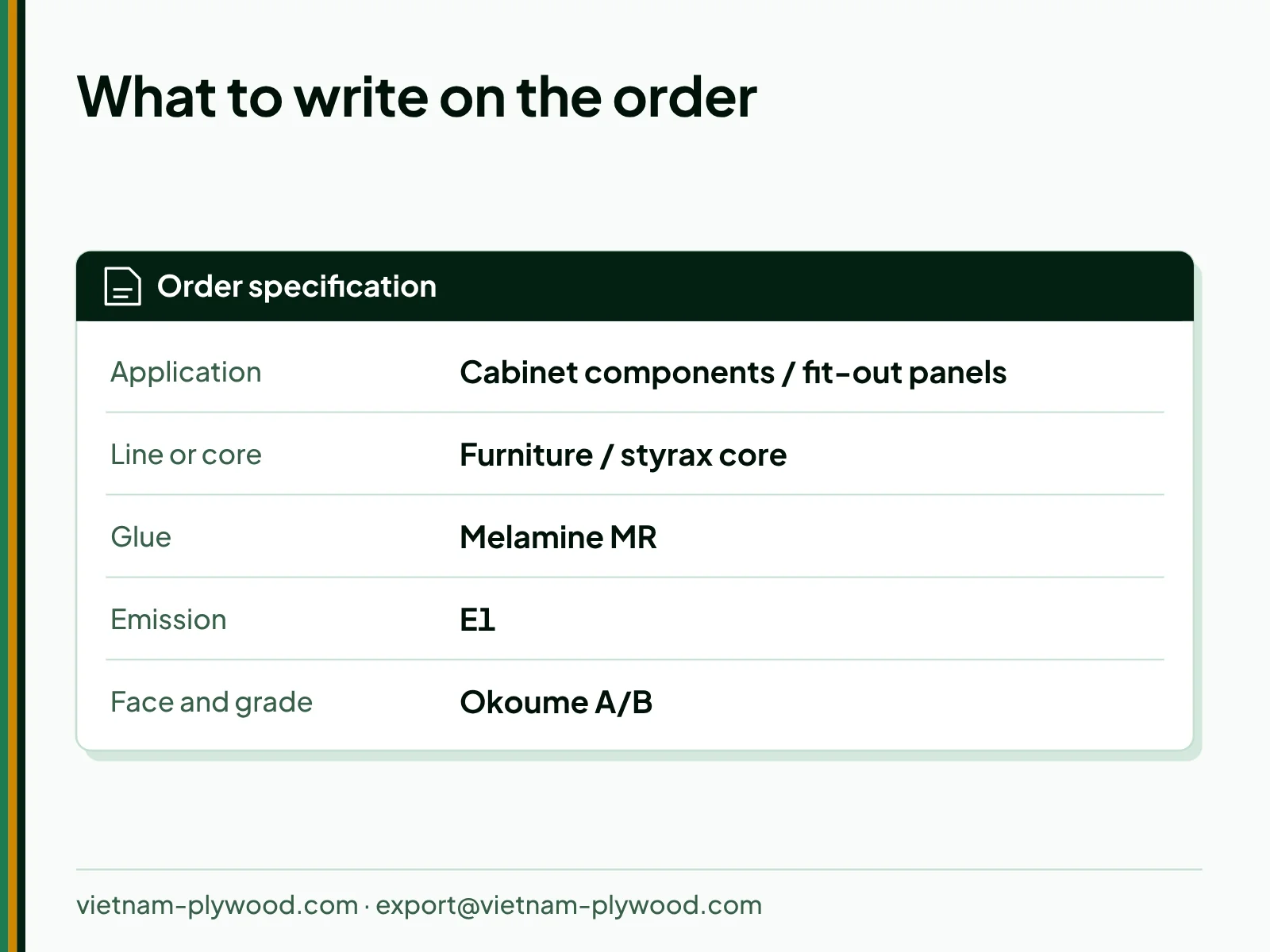
Application: cabinet components / fit-out panels
Line or core: furniture / styrax core
Glue: melamine MR
Emission: E1
Face and grade: okoume A/B
Thickness and tolerance: 12 mm finished, ±0.2 mm; 15/32 inch reference only
Size: 1220 × 2440 mm
Quantity: one 40HC, packing plan to be agreed
Destination port: [buyer to enter]
Next step: plan a trial container against the approved specification.