





Does a plywood phytosanitary certificate apply to every shipment?
A plywood phytosanitary certificate is required when the importing authority regulates the particular shipment or an import permit calls for one. Processed plywood is treated differently from raw timber and solid-wood packaging. A bank may separately require the document under a letter of credit. HCPLY checks the destination rule and payment documents before arranging the container.
A wrong document decision can delay clearance, add inspection costs or cause a bank to reject the presentation. A phytosanitary certificate is an official plant-health document issued by the exporting country’s National Plant Protection Organization (NPPO). It is distinct from a manufacturer’s quality report and from evidence of fumigation.
The International Plant Protection Convention (IPPC) ISPM 12 listing, published in 2023, describes the preparation and issuance of export and re-export phytosanitary certificates. The relevant question is whether the destination regulates the commodity and shipment, rather than whether the product contains wood. See our essential plywood import documents for the wider shipping file.
Which destinations require a certificate for plywood?
There is no reliable country-wide yes/no list for every plywood build and entry point. The importer should check the destination’s current official commodity conditions, port or regional rules, import permit and intended end use before the sales documents are finalized.
The International Plant Protection Convention (IPPC), in its 2023 ISPM 12 listing, places export phytosanitary certification within the national plant-protection system. The importer should obtain written commodity conditions from the destination authority, including any regional permit requirements, before requesting the certificate.
For US, European, Middle Eastern, African, Japanese or other destinations, the importer should obtain the relevant current official import conditions for the exact commodity and packaging. A requirement for logs or sawn wood should never be copied automatically onto processed plywood. Likewise, an exemption for plywood packaging under ISPM 15 does not cancel a separate commodity-specific import condition.
How do plywood and solid-wood skids differ?
Plywood sheets, plywood-only packing pieces and raw solid-wood skids need separate checks. The IPPC’s 2021 ISPM 15 description expressly excludes packaging made from processed wood such as plywood, while covering raw-wood packaging and dunnage.
| Item in the container | Plant-health question | Practical action |
|---|---|---|
| Plywood sold as cargo | Does the destination regulate this commodity? | Check the official import rule and permit |
| Packing panel wholly made of plywood | Is it processed-wood packaging under ISPM 15? | Record its construction; check other import conditions |
| Solid-wood skid or pallet | Does ISPM 15 apply to its raw-wood components? | Inspect treatment mark and construction |
| Mixed plywood-and-solid-wood skid | Are raw-wood supports present? | Check the raw-wood parts and mark |
A plywood deck fixed to untreated solid-wood runners is not a plywood-only packaging unit. The raw-wood members still need the relevant ISPM 15 treatment and marking. The mark addresses wood packaging compliance; it does not replace a phytosanitary certificate when a certificate is independently required for the commodity.
How is a phytosanitary certificate issued in Vietnam?
The competent Vietnamese plant-quarantine authority assesses the registered consignment and issues the certificate when the applicable requirements are met. Our export team prepares the shipment identity and coordinates the inspection point with the producing factory.
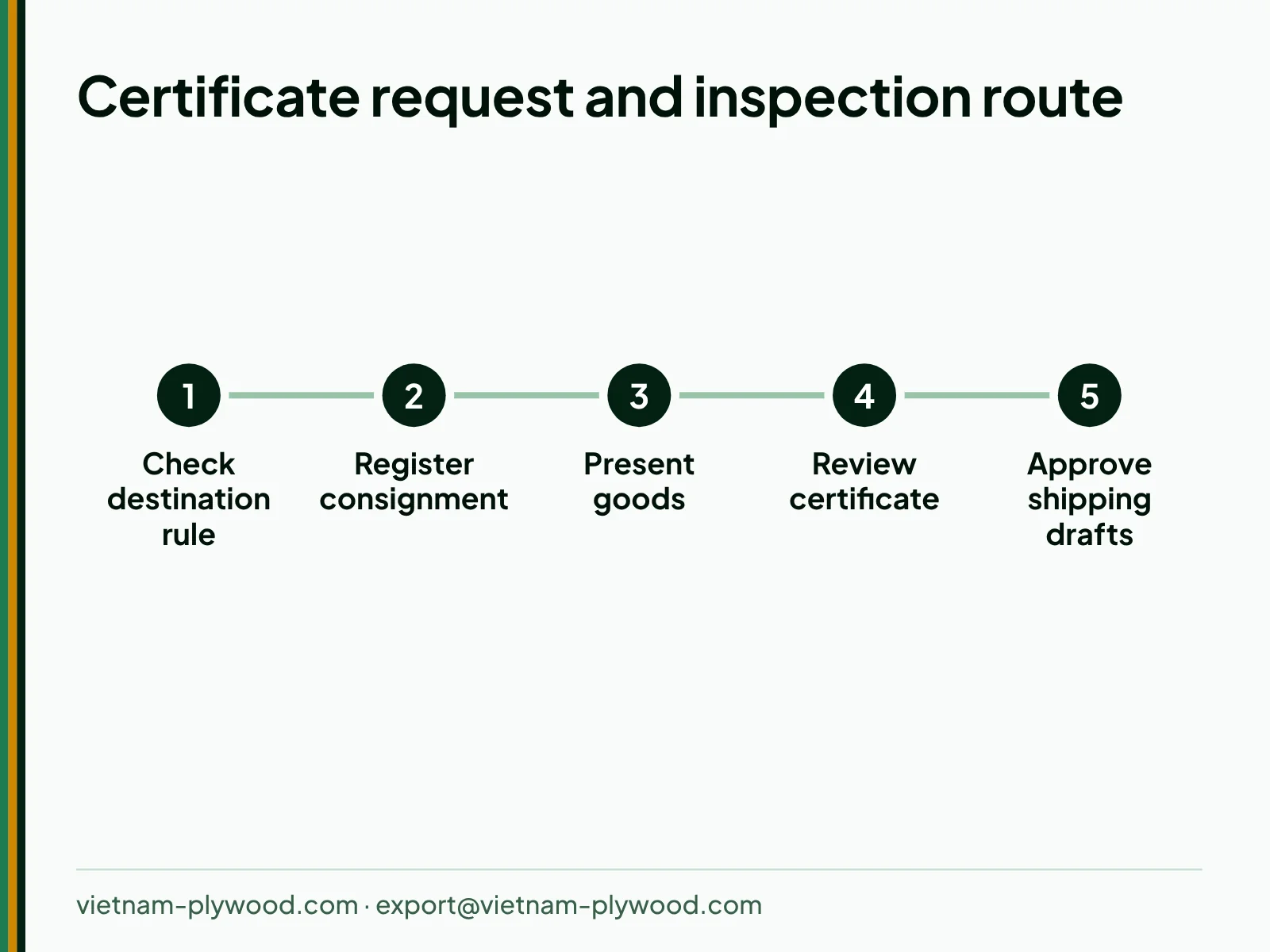
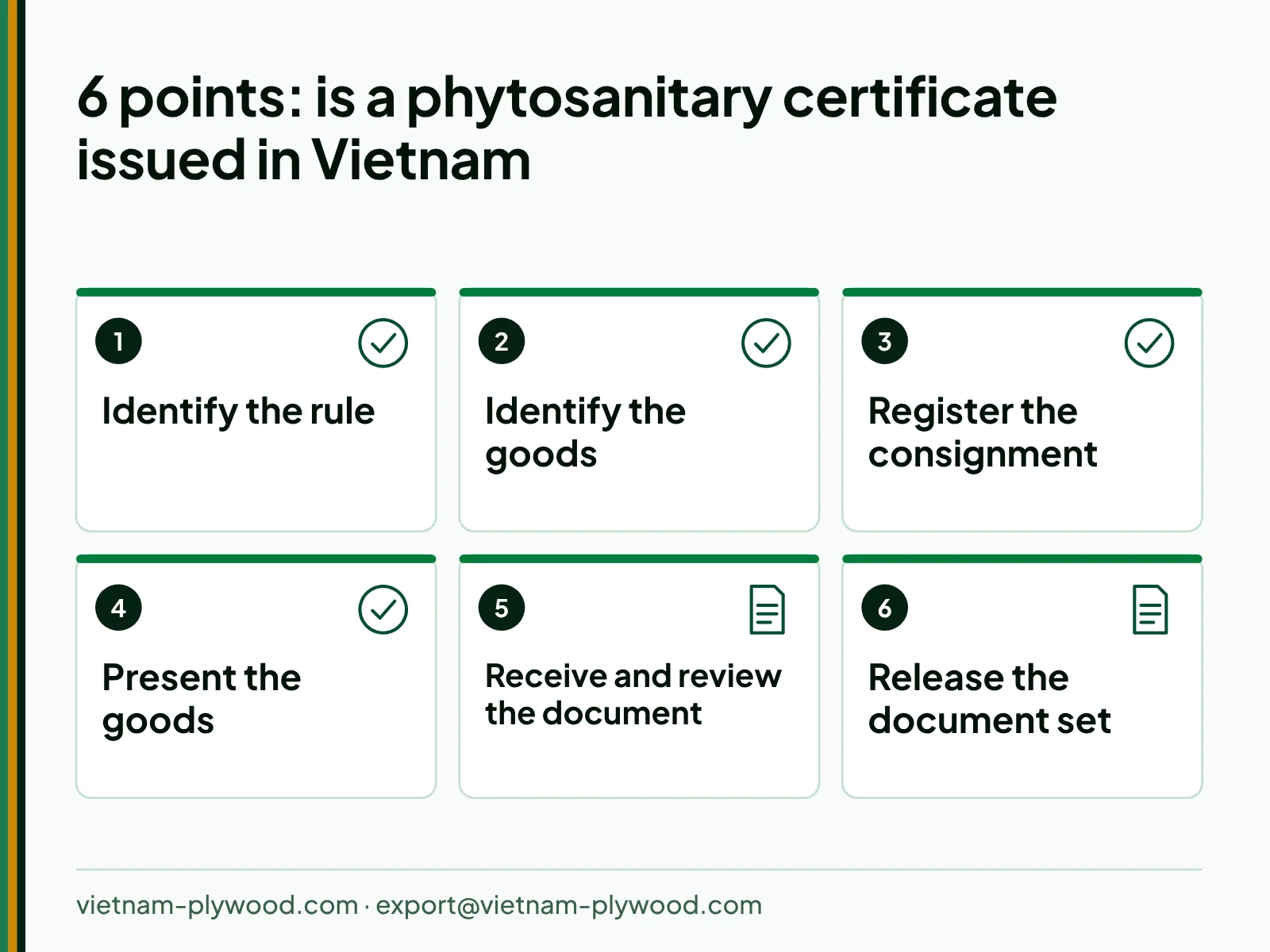
- Identify the rule. Obtain the importing country’s requirement, any import permit and any exact certificate wording in the letter of credit.
- Identify the goods. Match the invoice description, plywood type, quantity, packing arrangement, destination and intended shipment to the application.
- Register the consignment. Submit the relevant application to Vietnam’s competent plant-quarantine office using its current procedure.
- Present the goods. Make the packed or accessible shipment available for the authority’s required inspection and any ordered checks.
- Receive and review the document. Compare the issued certificate’s consignee, product description, quantities, origin and destination against the approved shipping drafts.
- Release the document set. Send the draft shipping documents to the buyer for approval after loading and arrange originals or accepted electronic documents according to the transaction.
The IPPC’s 2023 ISPM 12 listing describes the national plant protection organization as responsible for the phytosanitary certification system. The issuing officer, rather than the plywood factory, makes the official certification decision. Obtain the current Vietnamese authority application instructions and inspection appointment for the actual shipment.
Why does a letter of credit ask for this document?
A letter of credit can require a phytosanitary certificate because its documentary conditions were drafted for wood products broadly or copied from a previous transaction. The International Chamber of Commerce (ICC), in its 2007 UCP 600 Articles 5 and 14, directs banks to examine documents against the credit rather than inspect the goods.
Before production, the buyer should compare the credit’s wording with the importing authority’s rule. If the credit demands a document that the authority will not issue for this commodity, request an amendment through the applicant and issuing bank before shipment. Do not substitute a fumigation invoice, factory statement or ISPM 15 pallet mark for an expressly named phytosanitary certificate.
Ask whether the credit requires an original, specific issuer, exact goods description, named consignee or particular declaration. These details can decide whether a valid plant-health document is also a compliant banking presentation.
Do packing panels or skids change the requirement?
Yes, solid-wood supports can add a separate wood-packaging obligation even when the plywood cargo itself needs no phytosanitary certificate. Plywood-only packing panels and solid-wood skids should therefore be listed separately on the packing instruction.
Our commercial and packing line builds acacia-core packing plywood with MR glue and an unsanded or light-sanded surface. A buyer specifying packing plywood from Vietnam should distinguish the purchased panels from any temporary pallet, runner or brace added for shipment. The comparison with packing or commercial plywood helps identify the product, while the shipping team records the supports actually used.
The IPPC’s 2024 ISPM 15 implementation page describes its 2023 guide on treatment options, marking and import inspection for regulated wood packaging. For a solid-wood skid, request the supplier’s treatment and marking evidence and inspect the visible mark before loading. A fumigation paper documents a treatment event; it does not itself establish that a mark or commodity certificate meets every destination rule.
What can an inspector witness at the producing factory?
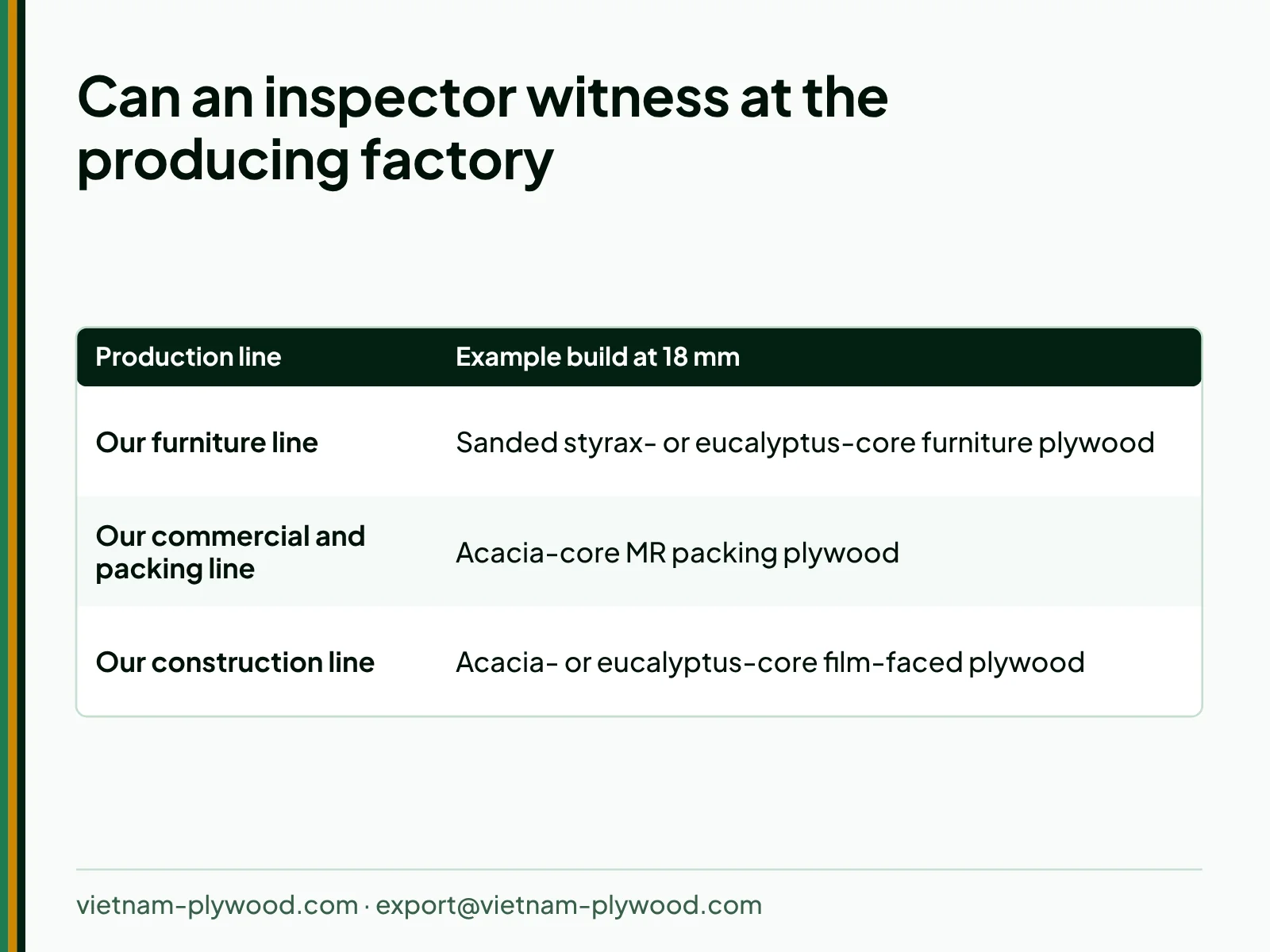
An inspector can compare the physical cargo and its packaging with the intended certificate description before the container is sealed. At the producing factory, the check should cover plywood identity, packing-panel material, skid runners, pallet marks, visible contamination and the count shown on the packing list.
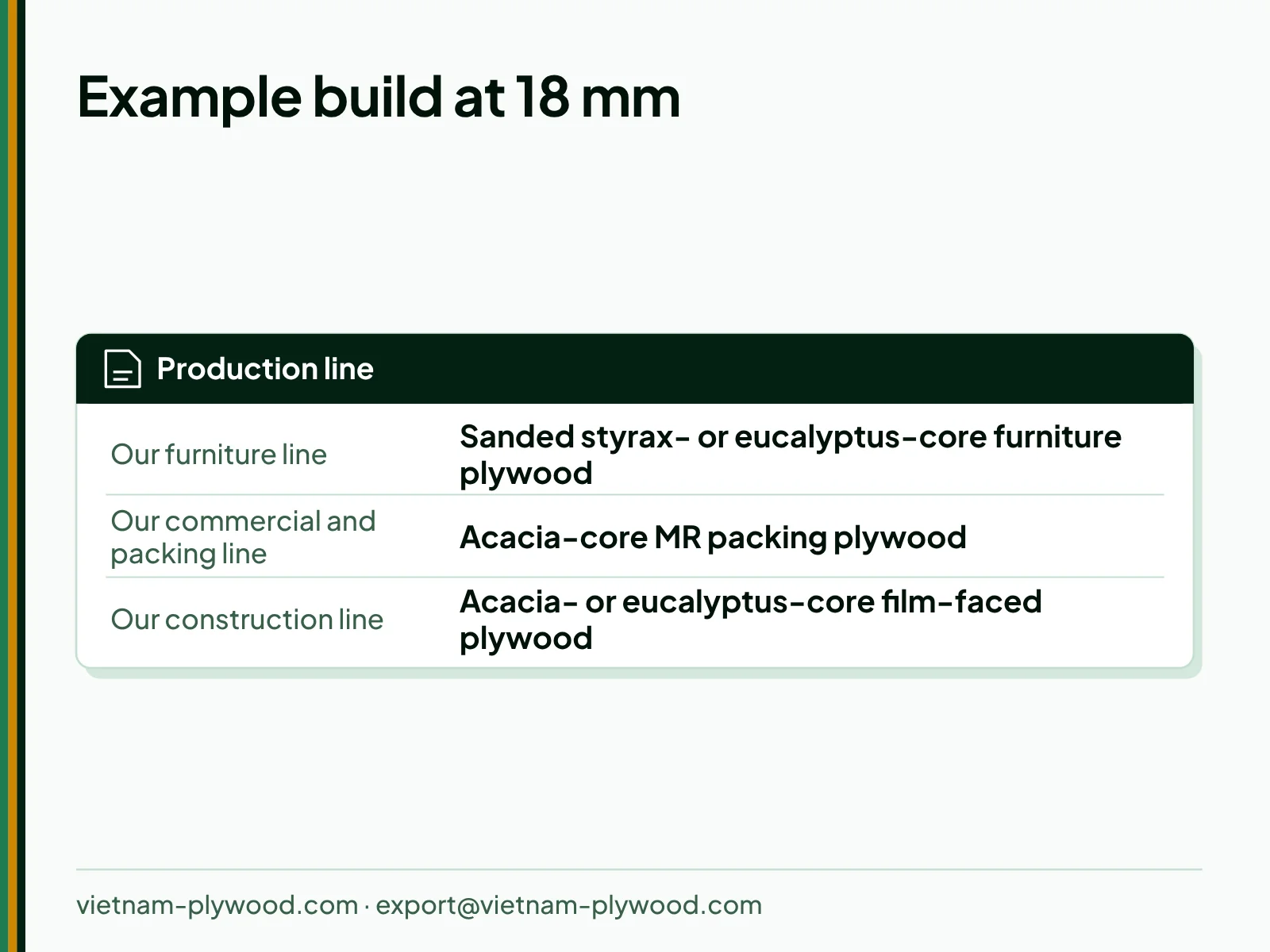
| Production line | Example build at 18 mm | What the inspection separates |
|---|---|---|
| Our furniture line | Sanded styrax- or eucalyptus-core furniture plywood | Finished plywood cargo versus supporting skids |
| Our commercial and packing line | Acacia-core MR packing plywood | Packing panels versus raw-wood pallet members |
| Our construction line | Acacia- or eucalyptus-core film-faced plywood | Film-faced cargo versus temporary bracing |
HCPLY has three member factories in Phu Tho and Hai Phong, and each order ships from the factory that presses its specification. The buyer can visit the factory office and inspect the goods at that location. Our export team records the actual build and packaging rather than treating all wood visible inside the container as one commodity.
Can packing plywood share a container with another build?
Different plywood specifications can share one 40HC when the combined load stays within the 28.5 t payload limit. For example, the 18 mm, 1220 × 2440 mm reference loads are 880 acacia-core sheets at 27.35 t, or 990 styrax-core sheets at 26.52 t when each fills its own reference load.
Those are alternative full-load examples, not quantities to add together. The weight budget for a mixed order must account for each sheet group and the physical pallets, skids and other packing. Our container loading reference covers the sheet counts; the phytosanitary decision still follows the commodity and wood-packaging classification. Confirm the mixed packing arrangement before requesting inspection so the certificate description matches the final consignment.
Which papers belong in the export document set?
The phytosanitary and fumigation papers sit alongside commercial documents, but they serve different functions. HCPLY prepares the commercial invoice, packing list, bill of lading and certificate of origin, with EUR.1 for EU lots; CIF shipments include insurance.
The order can also require a factory-specific certificate document, an emission certificate or an agreed-build test report. EU lots include the relevant EUTR/EUDR file set. Member-factory certificates such as FSC, CARB P2, ISO 9001 and CE are shown with factory details masked, on request. None of these papers substitutes for an official plant-health certificate when the importing rule requires one.
Our export team handles the specification, on-site quality control, documentation and loading, with FOB Hai Phong, CFR (CNF) or CIF terms. Document titles and descriptions should match across the set. A missing original or mismatched cargo description can create a problem even where the goods themselves meet the specification.
What should the buyer settle before loading?
Settle the destination rule, the exact documentary wording and the packaging construction before loading begins. A practical instruction names the import permit reference, whether a certificate is required for the plywood cargo, and how any solid-wood supports will comply with ISPM 15.
If the shipment contains both packing panels and saleable plywood, identify which is cargo and which is transport packaging. If a certificate is required, agree how the cargo will be accessible for official inspection. If a letter of credit is involved, obtain the bank-approved wording early enough to correct it before the container is sealed.
For product selection, We can build against the written specification on the appropriate line. The plant-health decision then uses the actual goods, destination and packing arrangement, rather than a generic certificate checklist.
What specification should the importer send?
Send the plywood specification together with the destination and packing instructions. State whether the load uses plywood-only supports or solid-wood skids, and attach any import-permit condition or letter-of-credit clause that names a phytosanitary certificate.
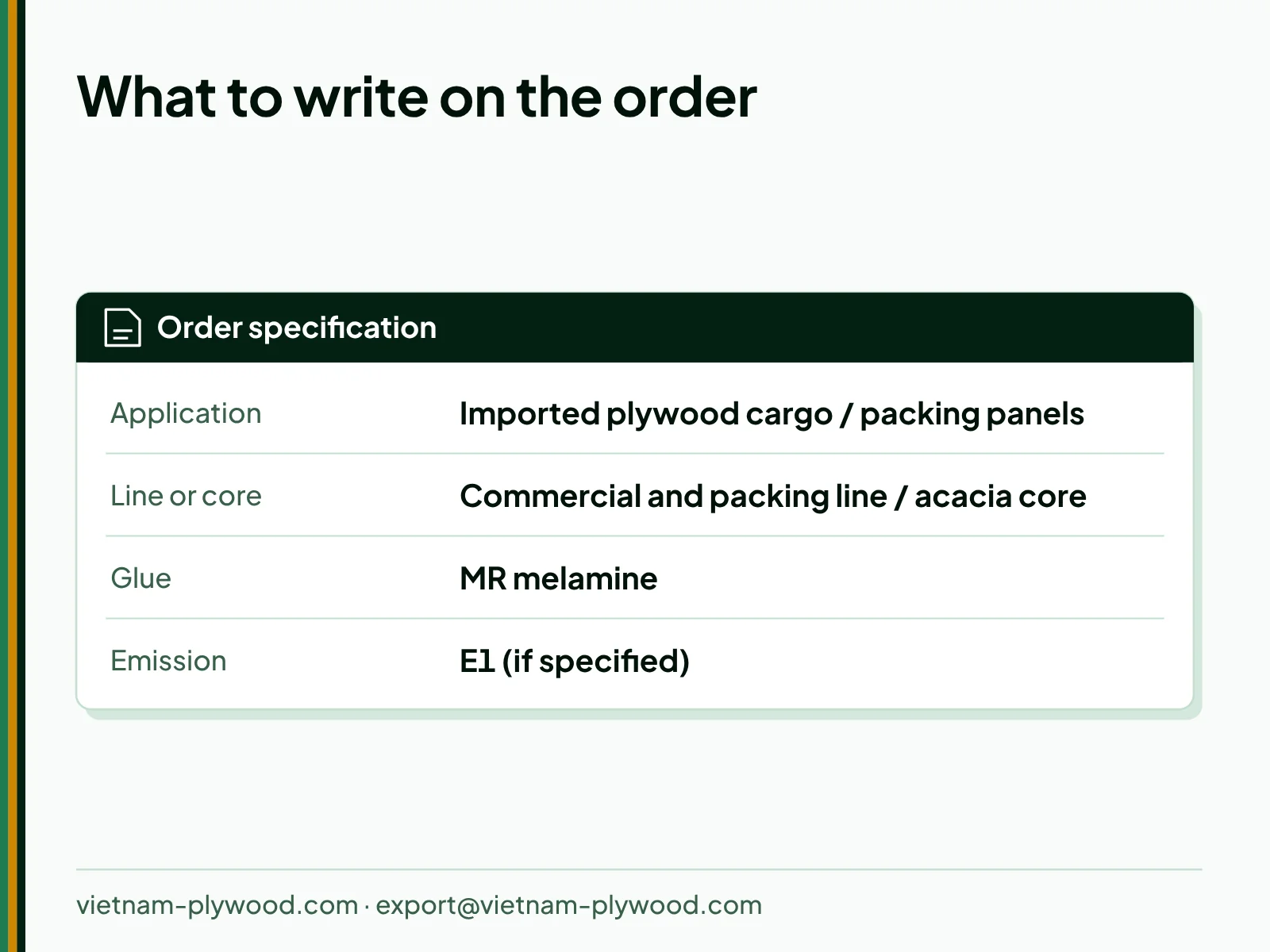
Application: imported plywood cargo / packing panels
Line or core: commercial and packing line / acacia core
Glue: MR melamine
Emission: E1 (if specified)
Face and grade: matt, unfaced raw core / grade as agreed
Thickness and tolerance: 18 mm / ±0.5 mm
Size: 1220 × 2440 mm
Quantity: 40HC, mixed specifications if required
Destination port: [port and country]
Packaging: plywood-only supports or solid-wood skids [specify]
Phytosanitary requirement: [import permit / authority condition / L/C clause]
Ask Lucy at our contact page or export@vietnam-plywood.com for a sample set matched to that specification.