





What is phenolic coated plywood?
Phenolic coated plywood is a plywood panel with a resin-treated film pressed onto its face for repeated contact with wet concrete. On a US purchase order, the term usually points to film-faced formwork plywood, but it does not identify the adhesive, core, or overlay weight by itself. HCPLY presses this construction product on our construction line.
The coating is a surface layer. The glue bonds the wood veneers inside the panel. A buyer who specifies only “phenolic coated” leaves two separate decisions unresolved: the film that touches concrete and the adhesive that holds the core together. The film-faced plywood overview explains the wider product family.
A phenolic film can cover plywood whose internal adhesive is melamine or phenolic. The surface name therefore cannot establish a 72-hour boil bond. Request separate entries for overlay, core species, internal adhesive and dimensions before comparing quotations.
Is phenolic coated plywood the same as film-faced plywood?
For our construction range, phenolic coated plywood usually means smooth film-faced plywood when the order describes the actual film and adhesive. Film-faced is the broader product description; phenolic coated is a buyer’s description of its resin-treated surface. An anti-slip face belongs to the same broad construction family but serves a different contact requirement.
| Purchase-order wording | Surface to specify | Internal bond to specify | Buying verdict |
|---|---|---|---|
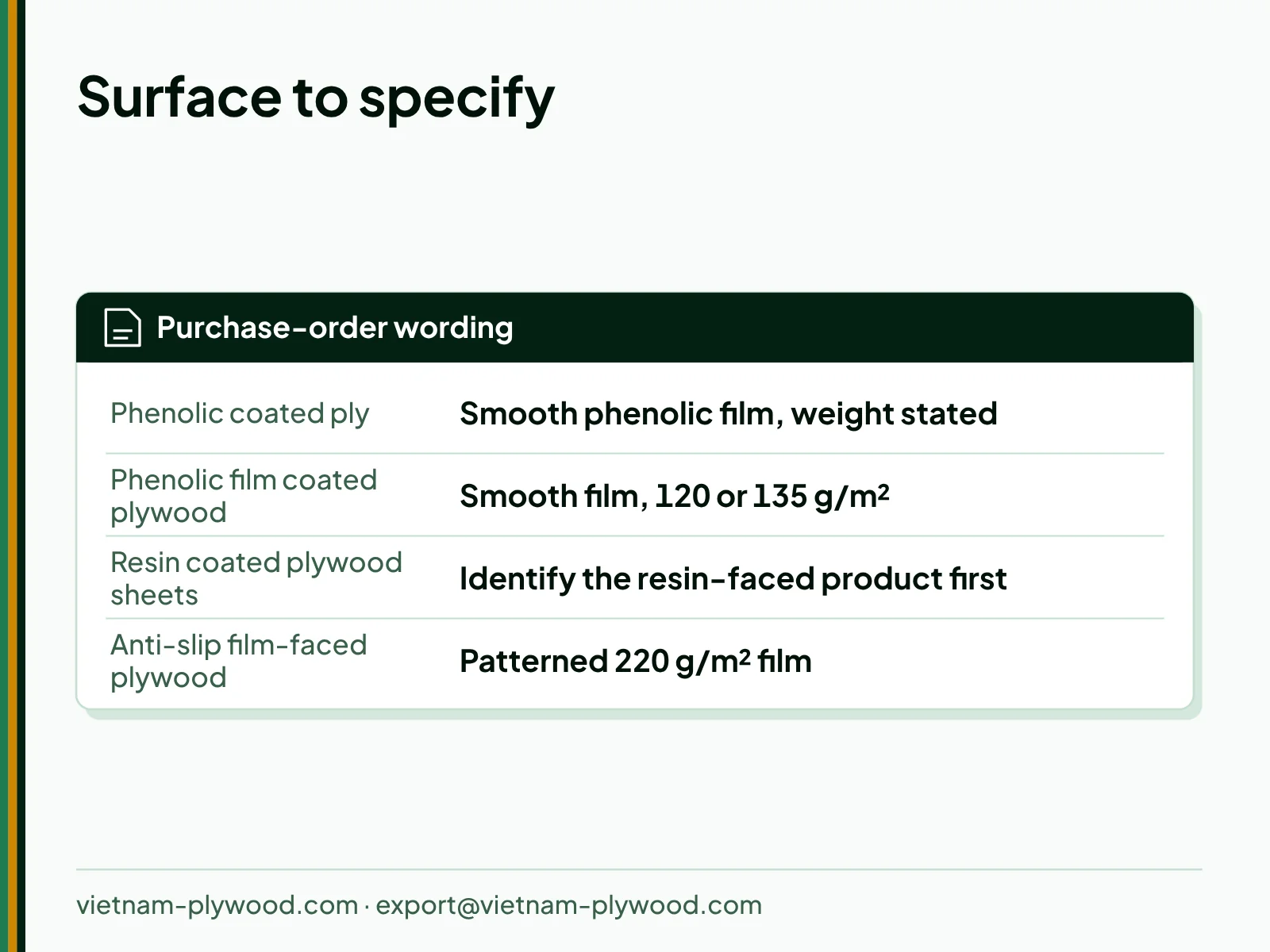
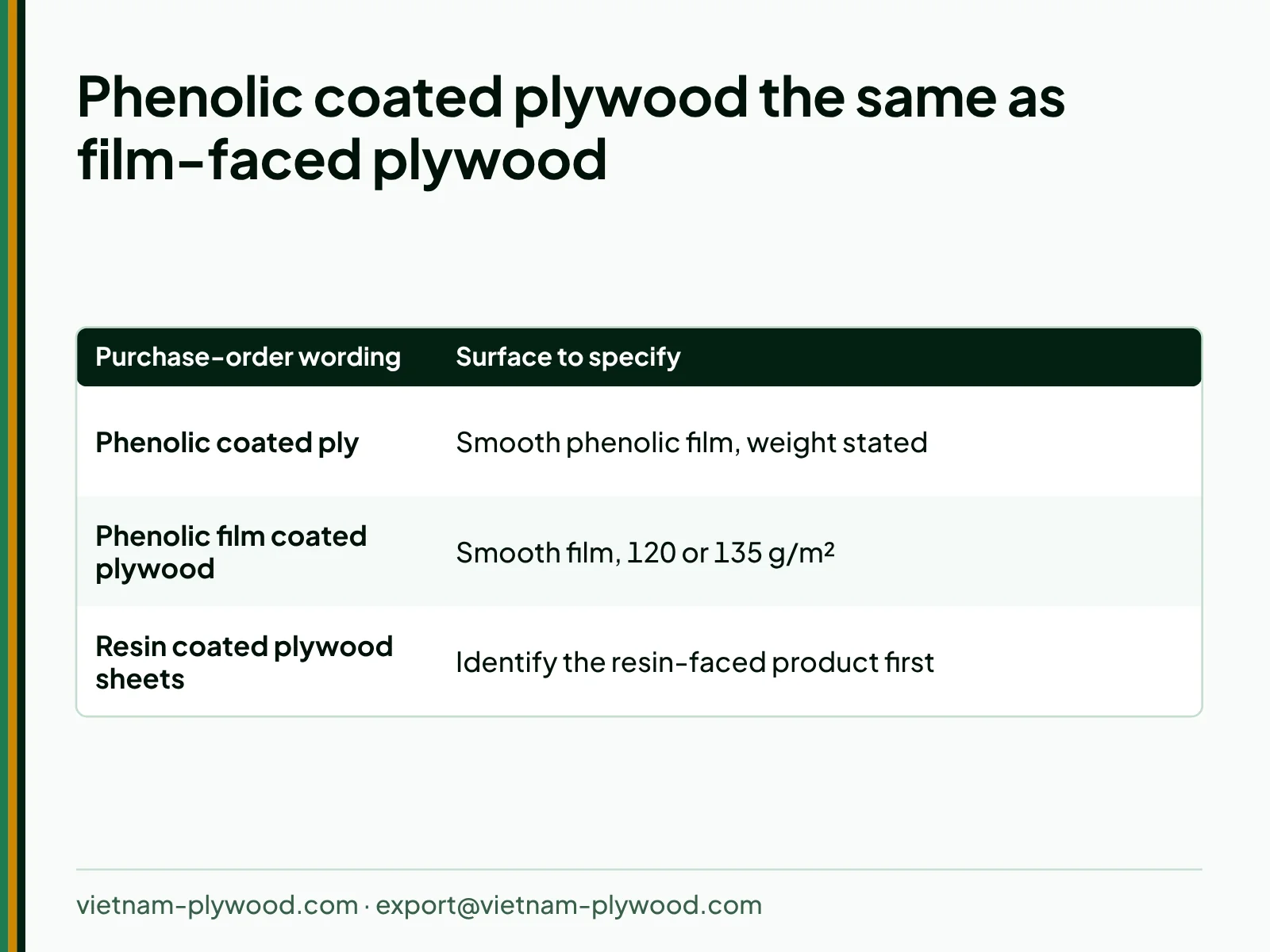
| Phenolic coated ply | Smooth phenolic film, weight stated | Melamine MR or phenolic WBP | Suitable wording for concrete forms after specification |
| Phenolic film coated plywood | Smooth film, 120 or 135 g/m² | Specify independently | Closest description of our smooth construction panel |
| Resin coated plywood sheets | Identify the resin-faced product first | Specify independently | Too broad alone for purchase approval |
| Anti-slip film-faced plywood | Patterned 220 g/m² film | Specify independently | For grip-oriented applications, not a smooth form face |
| HDO or MDO | Resin-impregnated fiber overlay grade | Grade-specific construction | Different product; do not substitute our film-faced panel |
The phenolic film-faced plywood specification develops the smooth-film build. A film description should state which side contacts concrete and whether both faces carry the specified coating.
What does resin coated plywood mean on a US order?
Resin coated plywood is an umbrella description, so a purchasing team must translate it into a named surface construction. “Phenolic resin coated plywood” and “phenolic covered plywood” can describe film-faced panels, but neither phrase fixes film mass or internal glue. “Concrete coated plywood” also needs a stated application and surface finish.
Read the order from application backward: a smooth concrete face calls for a smooth overlay, while a grip requirement points toward an anti-slip pattern. Ask whether the quoted product is a film bonded to plywood or a resin-impregnated fiber overlay sold under another grade designation. Those constructions should appear on separate comparison lines.
Do not use the face color as an adhesive test. A dark surface cannot identify the veneer bond beneath it. Instead, put overlay weight, adhesive class and core species on the purchase order and matching inspection sheet.
Is HDO plywood the same as phenolic film-faced plywood?
No. High Density Overlay (HDO) and Medium Density Overlay (MDO) refer to resin-impregnated fiber overlay products with their own grade conventions. Our construction line presses film-faced plywood; we do not press HDO or MDO. A request naming either product should remain a distinct specification rather than being relabeled as our film-faced build.
APA – The Engineered Wood Association describes HDO and MDO as resin-impregnated fiber-faced panels on its MDO/HDO Panels page (2026). APA distinguishes HDO concrete-form surfaces from the matte finish associated with MDO. See the APA explanation of HDO and MDO overlays for those product distinctions.
A US buyer asking for HDO might be seeking a particular concrete finish, an overlay construction, or a specified grade. Obtain the exact requirement before quoting a substitute. Our film-faced product should be offered by its own construction details and a test report the buyer accepts where a structural claim is required.
Which film, glue and core match a US phenolic coated spec?
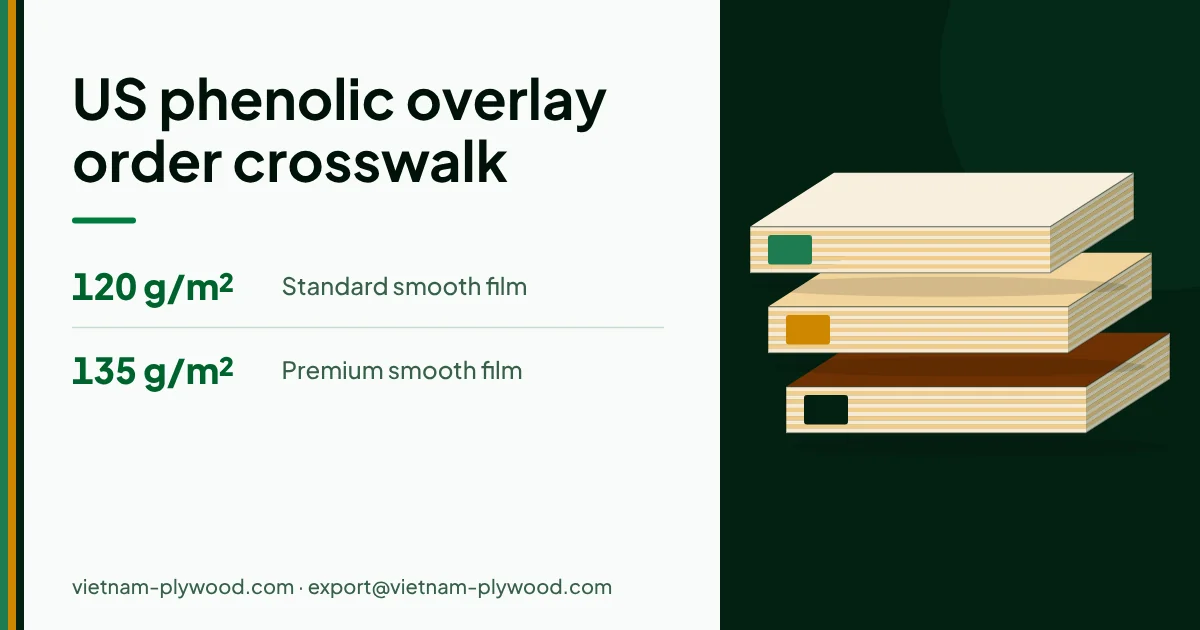
Our construction line pairs smooth phenolic or melamine film with an acacia or eucalyptus core. Standard film weight is 120 g/m²; premium film weight is 135 g/m². The 220 g/m² film is reserved for anti-slip panels, not smooth concrete faces.
The internal adhesive choice is separate: melamine MR is described by a 12-hour boil, while phenolic weather and boil proof (WBP) is described by a 72-hour boil. Construction panels are unsanded, and their thickness tolerance is ±0.5 mm. Length and width tolerance is ±2 mm. These entries belong in the order rather than being inferred from the term “phenolic coated.”
Core density follows the wood, not the face: acacia is 580 kg/m³ and eucalyptus is 650 kg/m³. At 18 mm and 1220 × 2440 mm, the corresponding sheet weights are 31.08 kg and 34.83 kg, excluding film weight. Specify the core before planning handling and freight.
An 18 mm build has 11–13 plies because core veneer thickness ranges from 1.4 to 2.0 mm. Specify the required core construction as well: full stitched, stitched outer layers with edge-trimmed inner, finger-jointed or loose-laid. These are different assembly choices even at identical nominal thickness.
How do the three production lines treat an 18 mm request?
An 18 mm thickness does not identify a construction line. The end use and face specification determine which factory produces the order. HCPLY has separate lines for construction, furniture, and commercial or packing applications.
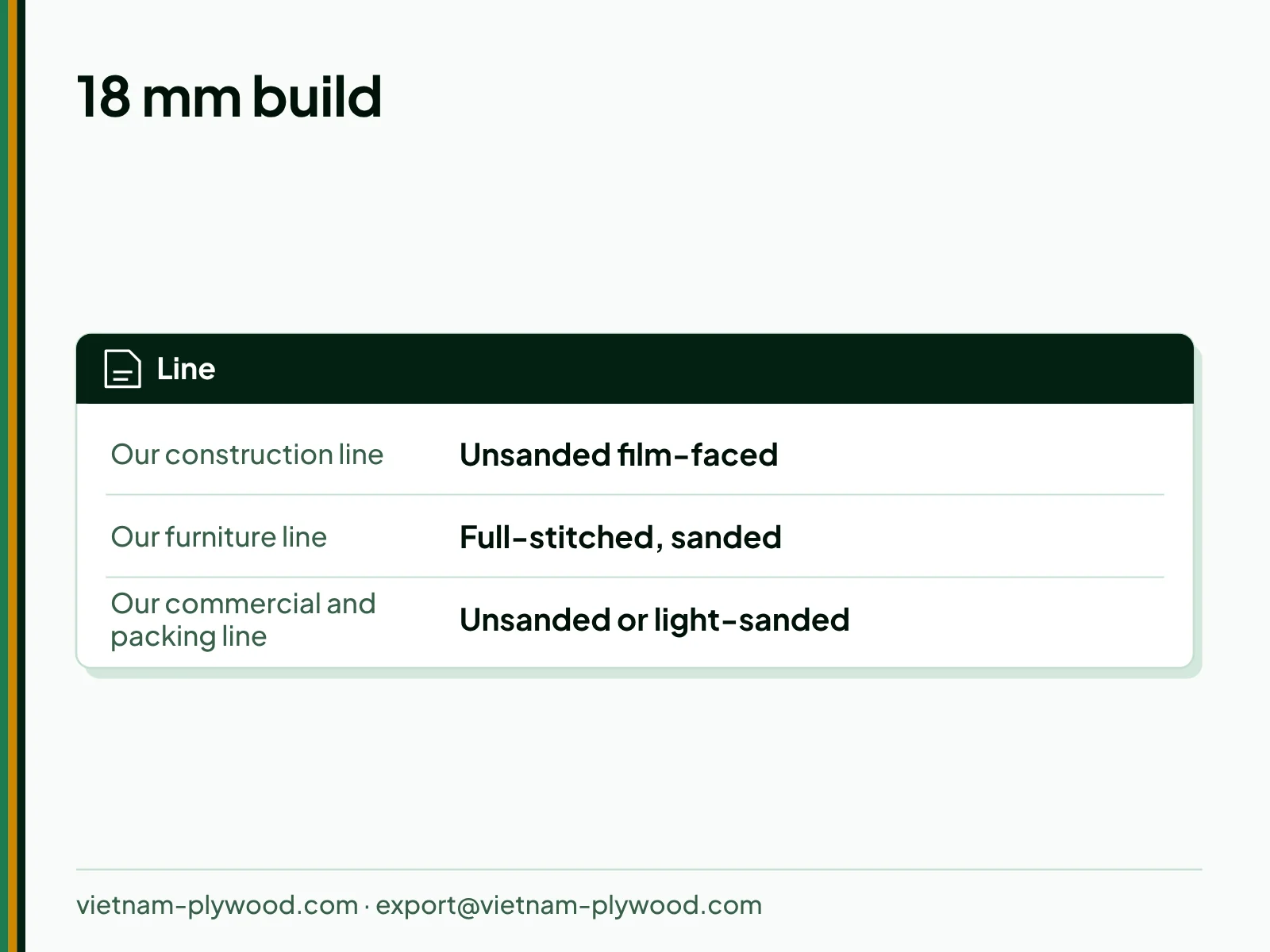
| Line | 18 mm build | Face and core | Tolerance | Suitable order |
|---|---|---|---|---|
| Our construction line | Unsanded film-faced | Smooth film; acacia or eucalyptus | ±0.5 mm | Concrete formwork |
| Our furniture line | Full-stitched, sanded | Veneer face; styrax or eucalyptus | ±0.2 or ±0.3 mm as ordered | Furniture and cabinets |
| Our commercial and packing line | Unsanded or light-sanded | Acacia core, MR glue | ±0.5 mm commercial; ±0.5–1.0 mm packing | Packing or commercial use |
The furniture line works with E0 or E1 emission classes; those are emission designations rather than glue names. For the packing alternative, see packing or commercial plywood. The buyer should identify the application before requesting an 18 mm price comparison.
Is phenolic coated plywood used for concrete forms?
Yes. Smooth phenolic film-faced panels are used as concrete form faces where the contractor wants a consistent contact surface and repeated stripping. The formwork engineer still selects panel thickness, support spacing and loading for the actual pour. A surface film alone cannot establish a structural grade.
APA’s Concrete Forming guidance, © 2026, identifies concrete pressure, panel selection and support spacing as form-design considerations. It also advises cleaning panels after stripping and applying a release agent before reuse. See APA concrete forming guidance.
With proper handling, a release agent on every pour and sealed edges, including cut edges, melamine-glue film-faced panels yield about 12–15 pours; phenolic-glue panels reach up to about 25 pours. These figures describe handling-dependent reuse, rather than an overlay grade. Keep a record of edge damage and face wear between pours.
The intended finish matters as much as the pour count. A smooth film belongs on a smooth concrete contact face; the anti-slip pattern changes the imprint. A contractor should agree on a sample face and acceptance criteria before ordering volume.
What should an inspector witness at the producing factory?
The producing factory should present the agreed film, adhesive, core and dimensions as separate inspection points. A buyer visiting the factory office can inspect the panels where the order is made. HCPLY coordinates on-site quality control and loading.
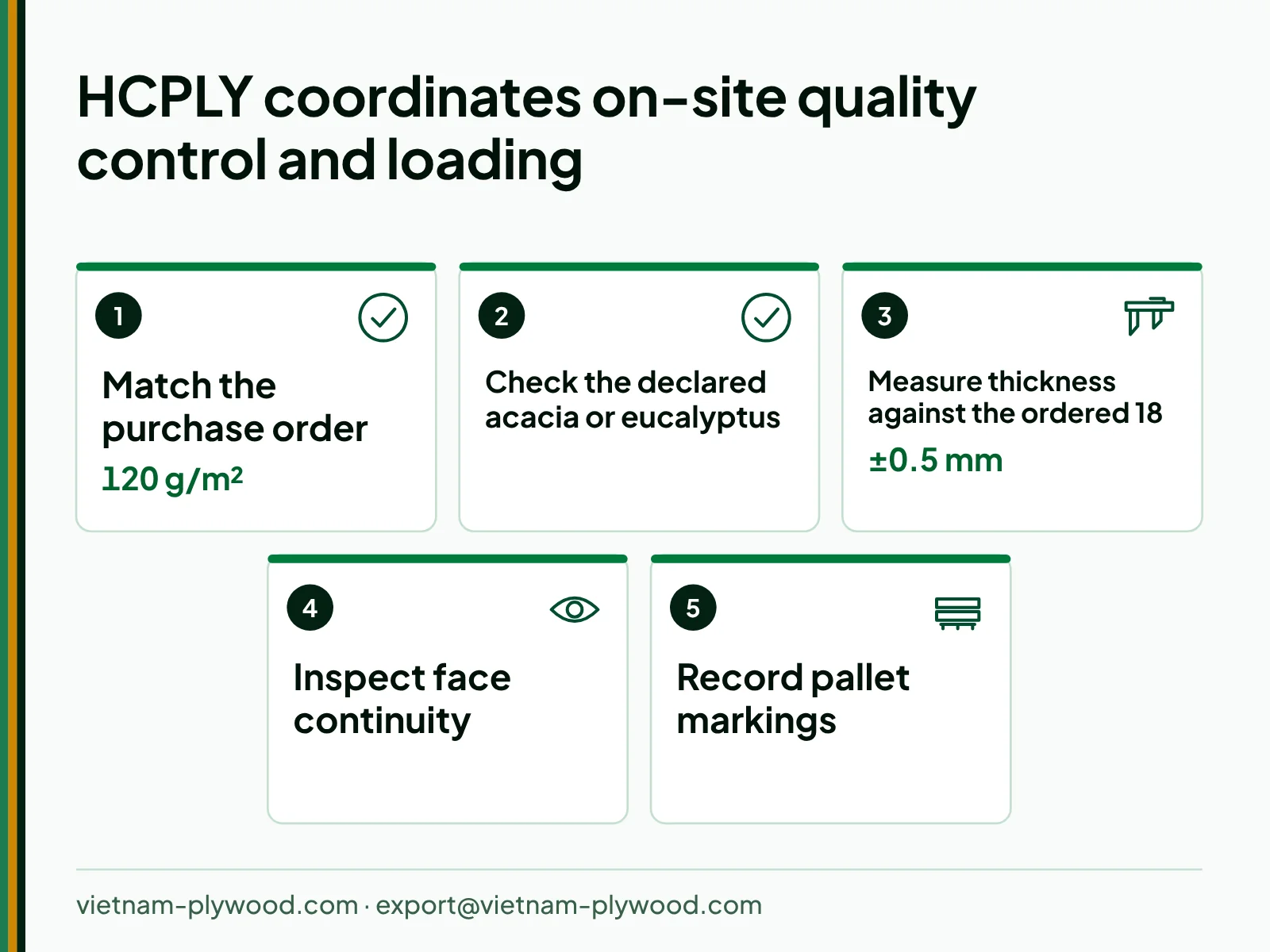
- Match the purchase order to the film designation: 120 g/m² standard or 135 g/m² premium for smooth film.
- Check the declared acacia or eucalyptus core against the agreed construction and examine exposed edges for gaps.
- Measure thickness against the ordered 18 mm example and ±0.5 mm construction tolerance; check length and width against ±2 mm.
- Inspect face continuity, edge sealing and any cut edges before packing.
- Record pallet markings, bundle counts and the lot reference against the packing list.
The film and core can be examined directly, but a visual inspection cannot establish a bond-boil result. Where a buyer requires a test outcome, agree on the test report and its acceptance criteria before production. Certificate documents from member factories are shown with factory details masked, on request.
Can phenolic coated panels share a 40HC container?
Yes. Specifications can be mixed in a 40HC within its 28.5 t payload limit. The quantity calculation should use each core’s density and the packing arrangement, rather than assuming every 18 mm sheet weighs the same.
For 1220 × 2440 × 18 mm sheets, an acacia-core load has 55 sheets per pallet across 16 pallets: 880 sheets, 47.15 m³ and 27.35 t. The eucalyptus-core arrangement has 53 sheets per pallet across 15 pallets: 795 sheets, 42.60 m³ and 27.69 t. Those calculated weights exclude film mass.
A mixed shipment should list each build and its sheet quantity separately, then check the combined payload against the limit. The mixed-container order process covers combining specifications. For the full container quantity reference, see plywood container packing.
What documents and quotation details belong on the order?
The written quotation should separate film mass, glue choice, core, thickness, size and destination. Film selection and core construction change material cost; phenolic internal adhesive is a different build from melamine MR. A thicker or denser panel changes material usage and transport weight. Request a quotation against the exact build rather than a generic resin-coated label.
Minimum order is one 40HC. Factory lead time runs 15–45 days from receipt of the 30% deposit; the exact figure depends on order size, line loading and what the contract fixes. The remaining 70% is paid on the scan of the bill of lading, by T/T, or by irrevocable sight L/C. We ship FOB Hai Phong, or CFR (CNF) or CIF to your port.
The shipment document set includes the commercial invoice, packing list, bill of lading (B/L), certificate of origin, phytosanitary and fumigation papers, insurance under CIF, and agreed certificate or test documents. After loading, the draft shipping documents come to you for approval. For a US order, the packing list is the practical cross-check for build descriptions, pallet quantities and loaded goods.
How should a US buyer write the final specification?
A US purchase order should name film-faced construction plywood and then state the exact overlay, adhesive and core. Avoid substituting “HDO” for film-faced plywood or using “phenolic” as the sole adhesive description. The written build also needs a destination port and an agreed acceptance check.
The example below is an order template, not a fixed stock item. Choose one of the alternatives on each line before sending it to Lucy at export@vietnam-plywood.com. HCPLY can discuss the sample and the producing-factory inspection during specification review.
Application: Smooth concrete formwork face
Production line / core: Construction line / acacia or eucalyptus
Glue: Melamine MR (12-hour boil) or phenolic WBP (72-hour boil)
Emission: State required class separately (E0 / E1 / E2, if applicable)
Face and grade: Smooth phenolic film, 120 or 135 g/m²; agreed face acceptance
Thickness and tolerance: 18 mm, ±0.5 mm
Size: 1220 × 2440 mm, ±2 mm length and width
Quantity: State sheets and pallets; minimum order one 40HC
Destination port: State US destination port
Next step: book a factory visit to inspect the agreed build at the producing factory.