





Marine plywood vs pressure treated plywood is a choice between two protections: one specifies bond and veneer performance, while the other adds decay-resistant preservative treatment. Confusing them can mean rejected loads, replacement cost and lost production days. HCPLY quotes marine-type construction against a buyer-accepted test report and keeps treatment evidence as a separate purchasing requirement.
Is marine plywood vs pressure treated plywood the same?
Marine plywood and pressure-treated plywood protect against different failure mechanisms. Marine-type construction focuses on a water-resistant glue line and controlled veneer quality; pressure treatment introduces a preservative to resist biological decay and insects.
HCPLY builds marine-type and exterior plywood against an agreed specification and a test report the buyer accepts. The exterior plywood range is the starting point for comparing face, core and glue options. Pressure-treated plywood requires a separately documented preservative process; the marine-type description alone does not include that treatment.
What is the difference in performance and evidence?
The deciding metric is the failure mode in the actual service environment. A panel can resist delamination yet remain vulnerable to fungi, while a treated panel can resist decay yet have an unsuitable bond for repeated wetting.
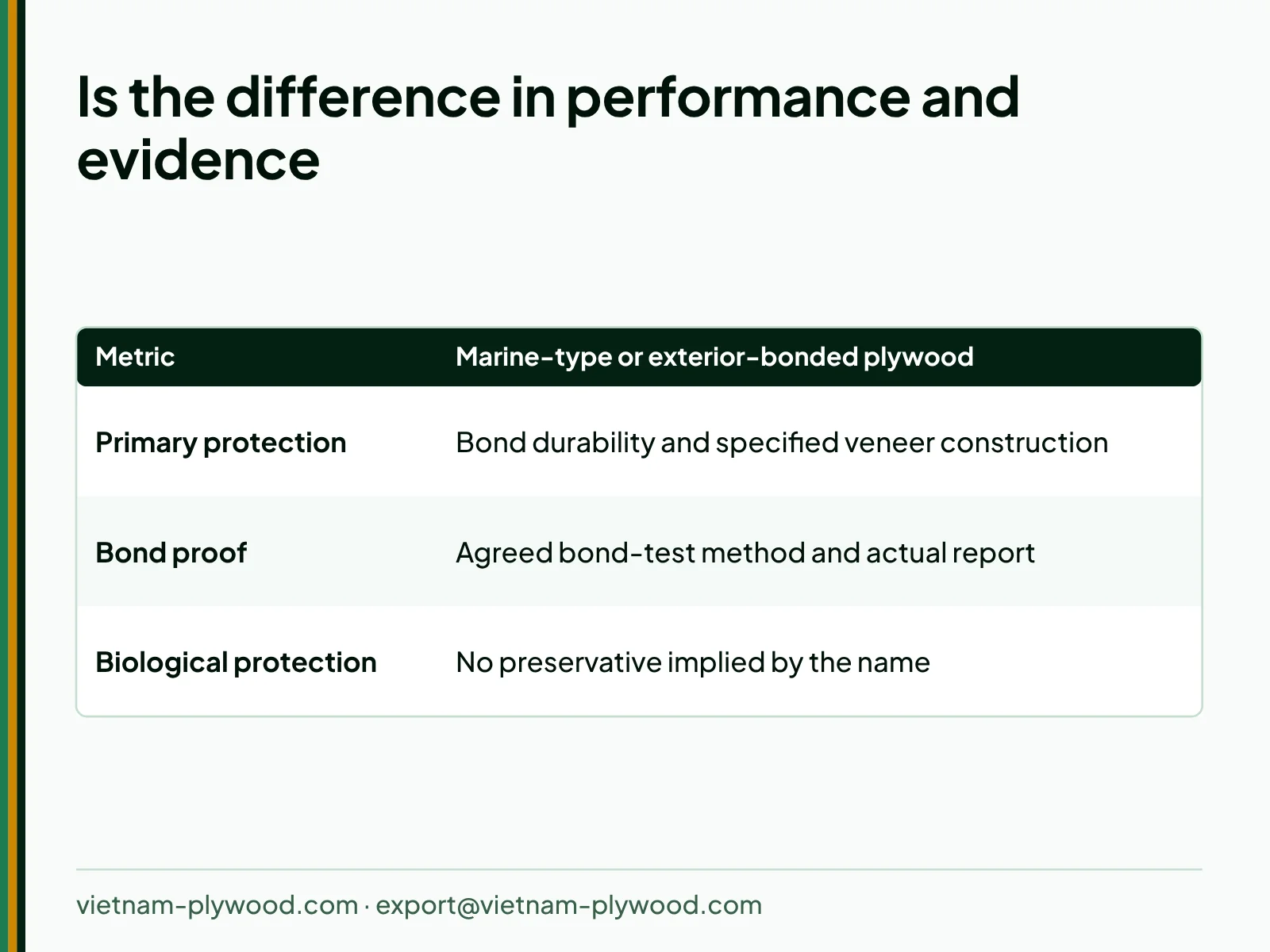
| Metric | Marine-type or exterior-bonded plywood | Pressure-treated plywood | Verdict by use |
|---|---|---|---|
| Primary protection | Bond durability and specified veneer construction | Preservative against fungi and insects | Wet bond exposure: marine-type; decay hazard: treated |
| Bond proof | Agreed bond-test method and actual report | Separate bond report needed | Repeated wetting: require bond evidence for either |
| Biological protection | No preservative implied by the name | Treatment chemistry, penetration and retention specified | Ground contact: treatment evidence required |
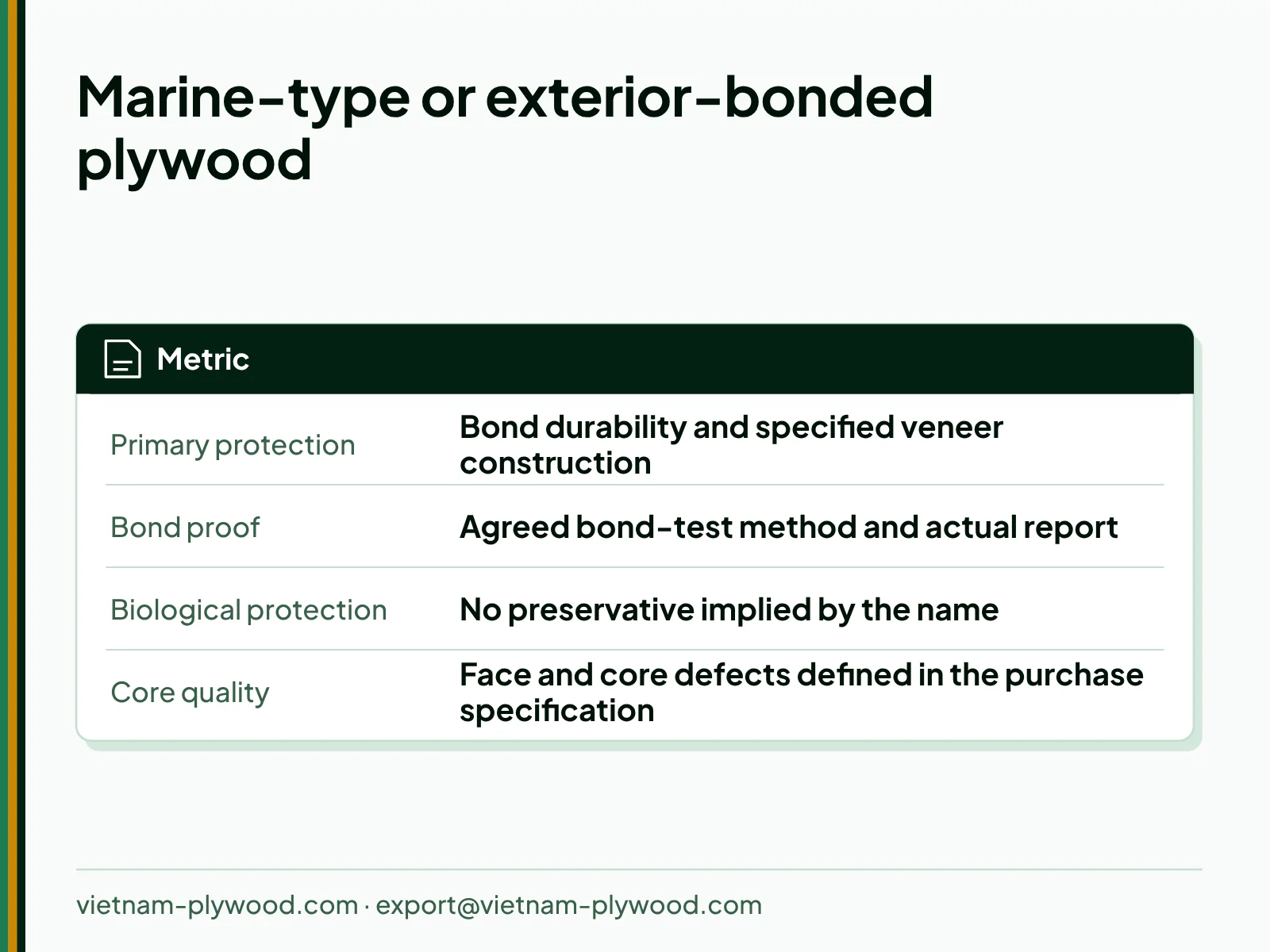
| Core quality | Face and core defects defined in the purchase specification | Depends on the underlying plywood grade | Visible fit-out: specify face and core separately |
| Exposure class | Tested bond and design details for wet exposure | Treatment use category matched to site | Persistent decay hazard: select treatment category |
| Edge treatment | Seal exposed and cut edges for service | Apply the approved end-cut treatment where required | Site cuts: follow the selected system |
| Acceptance record | Lot-linked bond report and inspection record | Lot-linked treatment certificate and treatment marking | Reject substitution without matching records |
| Typical purchase | Wet-area joinery, marine-type fit-out or exterior panels | Outdoor sheathing and ground-contact applications where specified | Match the exposure and governing project specification |
A claim of “waterproof plywood” is too broad for either option. The adhesive, core, face, edge detailing and intended service all need their own specification.
How do the two protections work?
A phenolic weather-and-boil-proof (WBP) glue line is designed to maintain veneer bonding through demanding moisture exposure. HCPLY’s phenolic option uses a 72-hour boil designation; melamine moisture-resistant (MR) glue uses a 12-hour boil designation. These are glue descriptions, not preservative-treatment certificates.
Pressure treatment is a separate industrial process that introduces preservative into wood under controlled conditions. Treatment quality is assessed through the specified chemical, penetration, retention and applicable use category. Treatment does not automatically improve the original plywood adhesive or remove core gaps.
The American Wood Protection Association’s Use Category System (2026 website) says that specifiers first select expected service conditions and then match product, species and preservative to the application. See the AWPA Use Category System. This is the practical reason a generic “PT plywood” line on a purchase order is incomplete.
Which HCPLY line builds the requested panel?
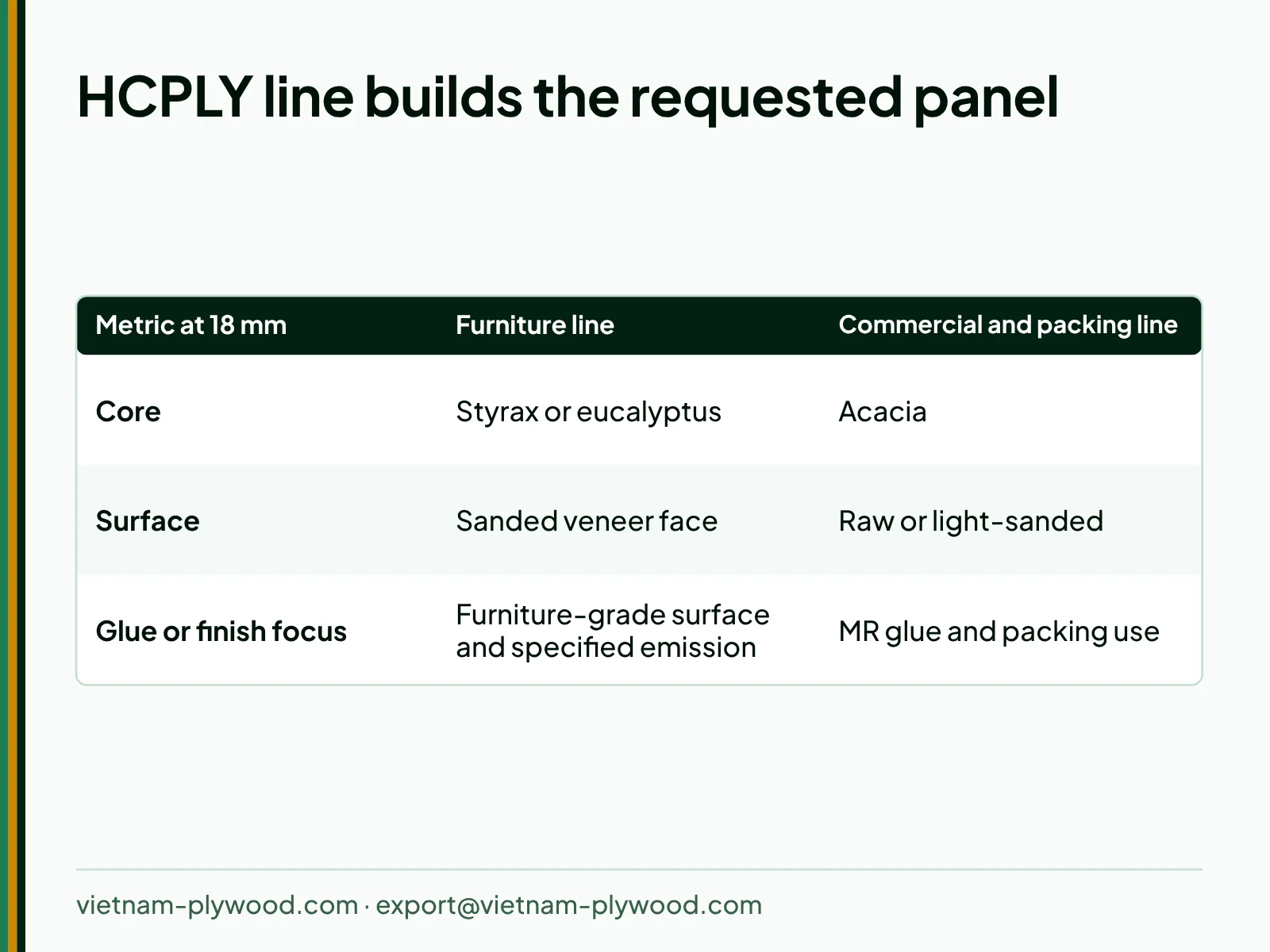
Our furniture line handles sanded, full-stitched styrax or eucalyptus-core plywood with E0 or E1 emission classes. Our commercial and packing line builds acacia-core MR plywood with an unsanded or light-sanded surface. Our construction line presses phenolic- or melamine-film plywood with acacia or eucalyptus core for formwork uses.
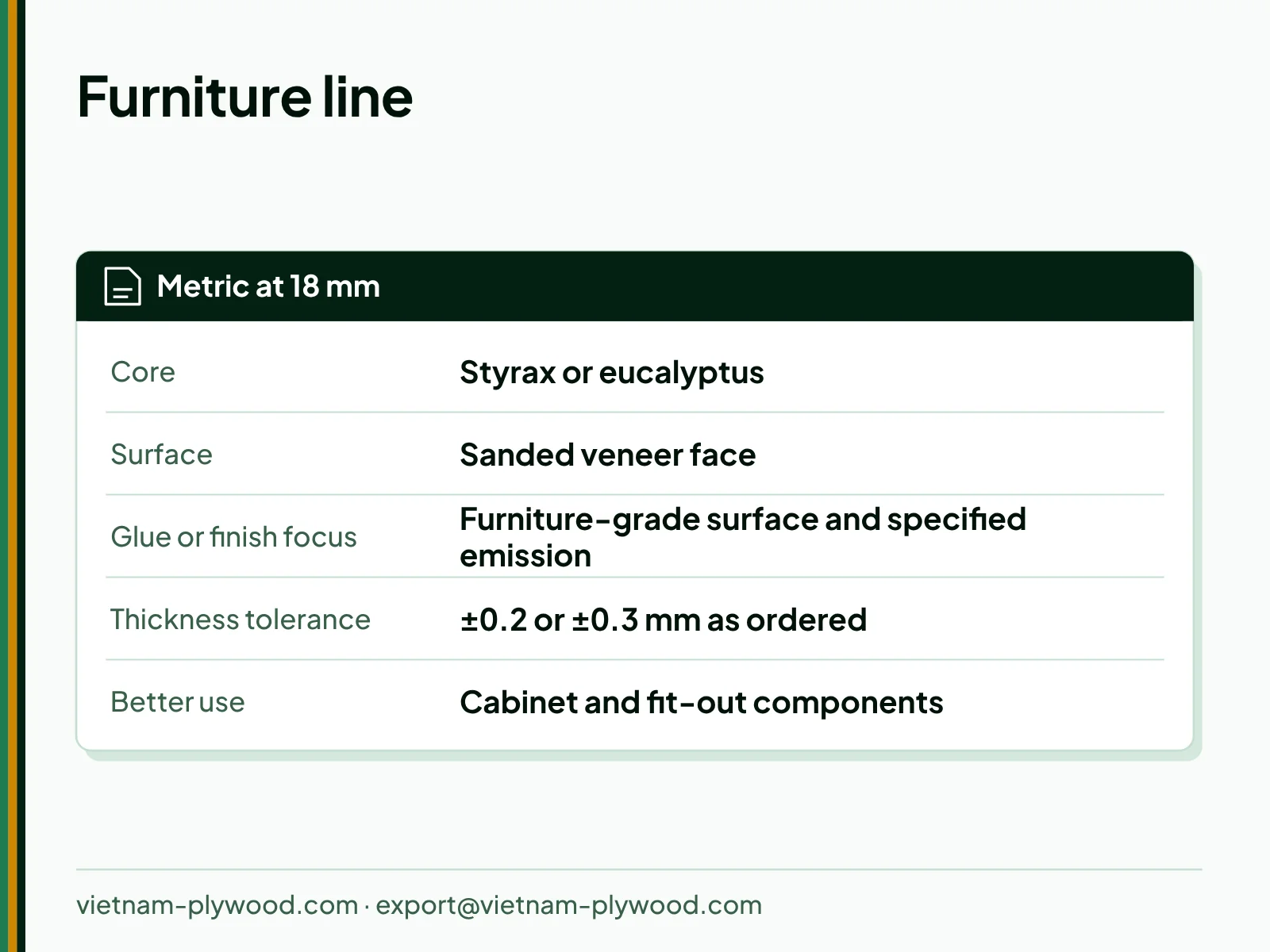
| Metric at 18 mm | Furniture line | Commercial and packing line | Construction line |
|---|---|---|---|
| Core | Styrax or eucalyptus | Acacia | Acacia or eucalyptus |
| Surface | Sanded veneer face | Raw or light-sanded | Film-faced, including anti-slip option |
| Glue or finish focus | Furniture-grade surface and specified emission | MR glue and packing use | Film and concrete-contact surface |
| Thickness tolerance | ±0.2 or ±0.3 mm as ordered | ±0.5 mm commercial; ±0.5–1.0 mm packing | ±0.5 mm |
| Better use | Cabinet and fit-out components | General commercial or packing | Formwork and temporary concrete-facing work |
For a marine-type request, we identify the producing factory and agree the exterior bond, veneer construction and accepted test report before quoting. None of these line descriptions is a preservative-treatment designation. The comparison of plywood types helps separate these manufacturing routes.
When should I order marine-type plywood?
Order marine-type plywood when the specification prioritizes bond integrity, controlled core construction and an appropriate finish in wet service. Define the wetting cycle, whether the panel carries load, and whether its face remains visible. A boat component or continuously exposed assembly may require a formal marine standard and additional engineering review.
BS 1088 is a marine plywood specification, but a product should be described against BS 1088 only with a test report the buyer accepts. A WBP glue designation alone is insufficient evidence of compliance with every requirement of that standard. The marine plywood buying guide covers the requested face, core and test documents.
For cabinet and fit-out orders, specify the surface grade and emission class separately from the bond.
When should I order treated plywood?
Order pressure-treated plywood when the design identifies fungal decay or insect attack as a governing risk and calls for a preservative-treated product. Ground-contact use, exposed outdoor sheathing and certain damp assemblies can require different treatment categories.
The AWPA system distinguishes hazard categories and the treatment requirements associated with them. A borate-treated panel for protected service cannot simply replace a panel specified for ground contact. For a treated order, request the applicable treatment standard, chemical, use category, retention, penetration and lot-linked treatment certificate.
Fire-retardant-treated plywood is a separate category from decay-resistant treated plywood. A decay-treatment certificate does not establish a fire rating, and HCPLY does not offer a fire-rated panel claim.
What dimensions and core details should buyers lock?
Specify the finished sheet rather than assuming that a product name fixes its construction. HCPLY offers 3–40 mm thickness, including common 9, 12, 15, 18 and 21 mm orders, and 1220 × 2440 mm or 1250 × 2500 mm formats among other sizes. Length and width tolerance is ±2 mm; the applicable thickness tolerance follows the producing line.
At 18 mm, the construction can have 11–13 plies because individual core veneers are 1.4–2.0 mm thick. Ask for the core lay-up and acceptable gaps or repairs in the purchase specification. Full-stitched core construction is different from finger-jointed or loose-laid construction, even when the final nominal thickness matches.
Density follows the core species, rather than the decorative face. A marine-type quote should identify the core and the actual face grade, as well as the bond requirement.
Which document proves the marine bond or preservative?
A lot-linked bond test report against the buyer’s accepted method supports the specified marine-type glue-line performance. A treatment certificate identifying preservative, use category, penetration and retention supports pressure-treatment claims. Neither document replaces the other.
At the producing factory, a buyer or inspector can witness sheet measurements, inspect exposed edges for voids, compare the face against the agreed grade and select marked samples for the agreed bond test. For treated material, the inspection plan additionally needs traceability to the treatment plant’s certificate and any required marking. Visual colour is not an acceptance test for chemical retention.
HCPLY handles the export documents, including the commercial invoice, packing list, bill of lading and certificate of origin. Order-specific test reports belong with the certificate documents. After loading, the draft shipping documents come to you for approval; this paperwork is distinct from the technical proof of treatment.
Can marine-type and other plywood share a container?
Specifications can be mixed in one 40HC container within its 28.5 t payload limit.
For 18 mm, 1220 × 2440 mm plywood, the reference full-load quantities are 990 styrax-core sheets at 26.52 t, 880 acacia-core sheets at 27.35 t and 795 eucalyptus-core sheets at 27.69 t. These figures exclude film weight. A mixed load needs a fresh weight and pallet plan for the actual split; the full-load quantities cannot simply be added.
Use the container loading guide for the detailed sheet-count question, or review commercial and packing plywood for a companion specification.
What changes the quote and inspection scope?
Bond chemistry, veneer selection, core construction, face grade and test scope are the main cost drivers for a marine-type comparison. A tightly controlled full-stitched, graded-face, phenolic-bonded build normally costs more to manufacture than a basic loose-laid MR commercial build because material selection and inspection are more demanding. A preservative-treatment quotation adds chemical processing and treatment verification as distinct cost items.
For a marine-type or treated-grade request, send a written specification for a quotation rather than using a general price per sheet. The minimum order is one 40HC, with mixed specifications possible within the payload limit. HCPLY quotes FOB Hai Phong, CFR (CNF) or CIF according to the destination and agreed shipment scope.
Production takes 15–45 days from the 30% deposit, set by order size, line loading and the contract. The remaining 70% is paid on the scan of the bill of lading, by T/T, or by irrevocable sight L/C. Samples are free; new buyers book their courier, and that cost can be credited against a real order.
Can an exterior or marine-type panel be quoted as treated?
An exterior or marine-type panel should be quoted as pressure-treated only when the ordered build actually includes the specified preservative process and its supporting treatment records. Phenolic bonding, a smooth face or a water-resistant film is not evidence of chemical impregnation.
For a buyer requesting both protections, keep two acceptance lines: one for bond performance and one for preservative treatment. Where treatment is a mandatory condition, do not substitute an untreated exterior panel.
For film-faced construction work, the film is a working surface for concrete rather than a preservative. HCPLY’s construction products can be specified for that purpose, but film weight or a boil-test description does not convert them into treated plywood.
What specification should I send Lucy?
Send the application and expected exposure first, followed by the panel build and separate proof requirements. Mark the treatment field explicitly as “required” or “not required”; a blank field invites a mismatched quotation.
Application / exposure: [wet-area fit-out, exterior joinery, ground contact, etc.]
Line or core: [furniture / commercial / construction; styrax / acacia / eucalyptus]
Glue: [MR melamine / WBP phenolic; accepted bond-test method]
Emission: [E0 / E1 / E2 or destination requirement]
Face and grade: [species, A/B or applicable birch D/E/F]
Thickness and tolerance: [mm; agreed tolerance]
Size: [length × width, mm]
Preservative: [none / required; chemistry, use category, retention, penetration]
Evidence: [bond report; treatment certificate if treatment is required]
Quantity: [sheets and container mix]
Destination port: [port and country]
Request the specification sheet from Lucy at export@vietnam-plywood.com through contact.