





LVL container loading starts with the measured mass of each bundle, its section and length, and the space available beside plywood. A wrong density assumption can leave paid freight space unused or produce a rejected load. HCPLY plans mixed shipments around a 40-foot high-cube (40HC) payload limit of 28.5 tonnes, with packing weight counted before the final load is approved.
How does LVL container loading limit m³ per 40HC?
The LVL volume limit by weight is the remaining cargo mass divided by the LVL’s measured density. Start with 28,500 kg as the 40HC payload ceiling, deduct pallets, straps, dunnage and any plywood, and divide the balance by kilograms per cubic metre. The resulting volume is an upper mass-based estimate; whole-bundle geometry can reduce it.
For example, a buyer should enter the actual weighed mass and cubic volume of a production bundle, rather than apply a generic LVL per 40HC figure. The volume-only calculation does not account for container door clearance, floor loading, axle restrictions or securing. The 40HC plywood packing calculation explains the panel side of the load.
Use this planning equation: LVL volume (m³) = (28,500 kg − plywood mass − packing and securing mass) ÷ measured LVL density (kg/m³). Then round down to whole packs and recheck actual mass. Never round the pack count upward to fill the last gap.
How much does LVL weigh per cubic metre?
LVL weight per cubic meter is its measured density multiplied by the ordered cubic volume. Laminated veneer lumber (LVL) is built from bonded veneers, so the actual result depends on veneer composition, glue content and moisture condition. A quoted LVL timber weight needs a build-specific density or a weighed sample bundle.
Our plywood core reference densities are 500 kg/m³ for styrax, 580 kg/m³ for acacia and 650 kg/m³ for eucalyptus. These are plywood core planning figures, not LVL product specifications or tested LVL densities. A buyer cannot substitute them for a supplier’s LVL packing declaration.
Request the net LVL wood volume, gross bundle mass and packaging mass separately. If a supplier states only a theoretical density, weigh a representative completed bundle before finalising the load diagram.
Does core species change LVL weight per container?
Species changes the expected mass per cubic metre, but LVL density must be established for the actual laminated build. Two equal-volume bundles can reach the payload limit at different points. Resin, veneer selection and moisture condition also affect the finished bundle mass.
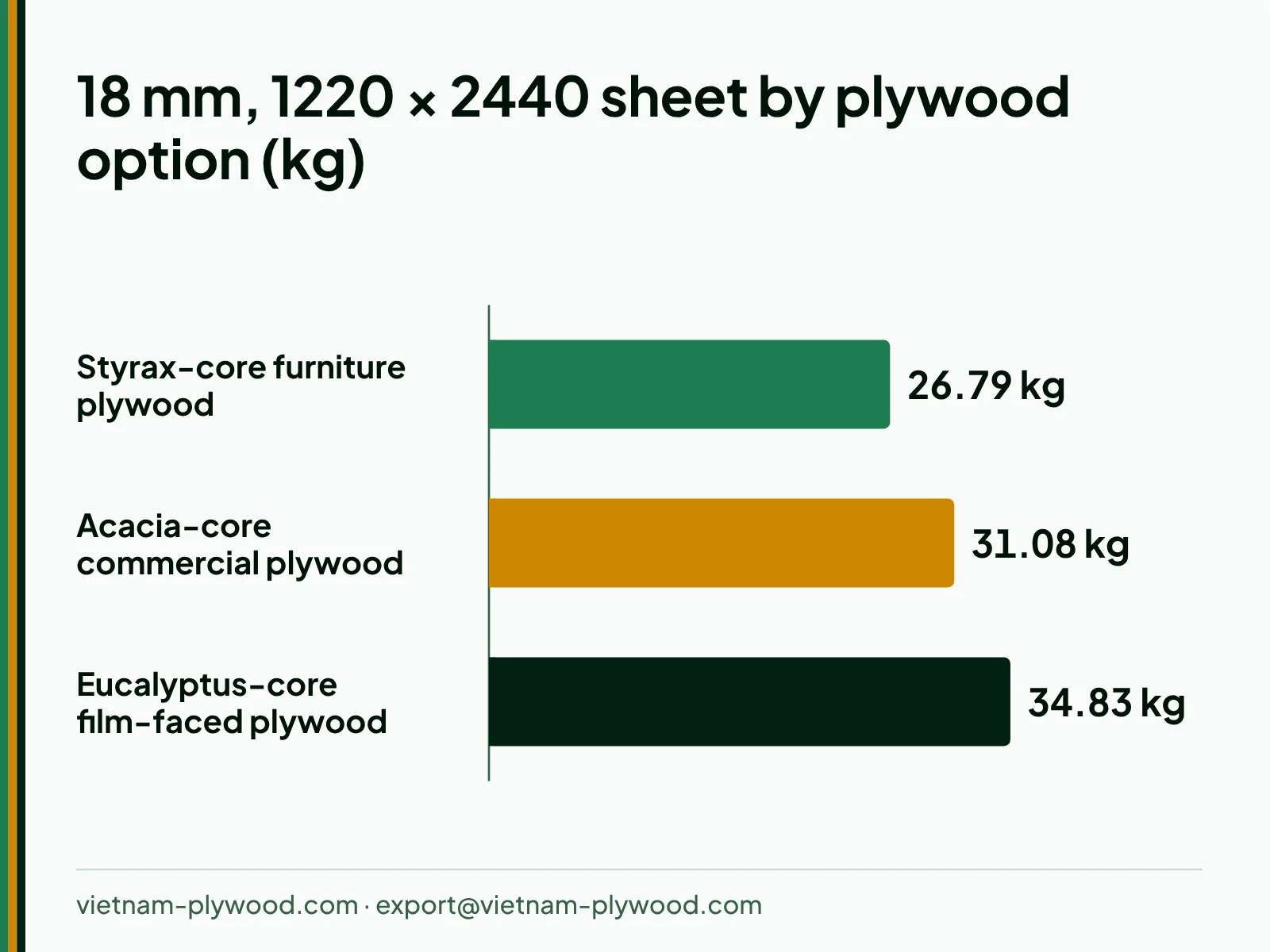
For plywood sharing that space, the species comparison is already concrete. At 18 mm and 1220 × 2440 mm, a styrax-core sheet weighs 26.79 kg, an acacia-core sheet 31.08 kg, and a eucalyptus-core sheet 34.83 kg. These are plywood sheet figures excluding film weight; they illustrate why a mixed load needs a species-specific tally.
How do section and length change LVL bundles per container?
Section and length determine the packing footprint and the number of pieces that can form a stable bundle. A narrow member can pack into more pieces per layer; a longer member can lose usable floor length when bundles cannot be staggered safely. Count complete bundles by measured outer dimensions, including wrap and strapping.
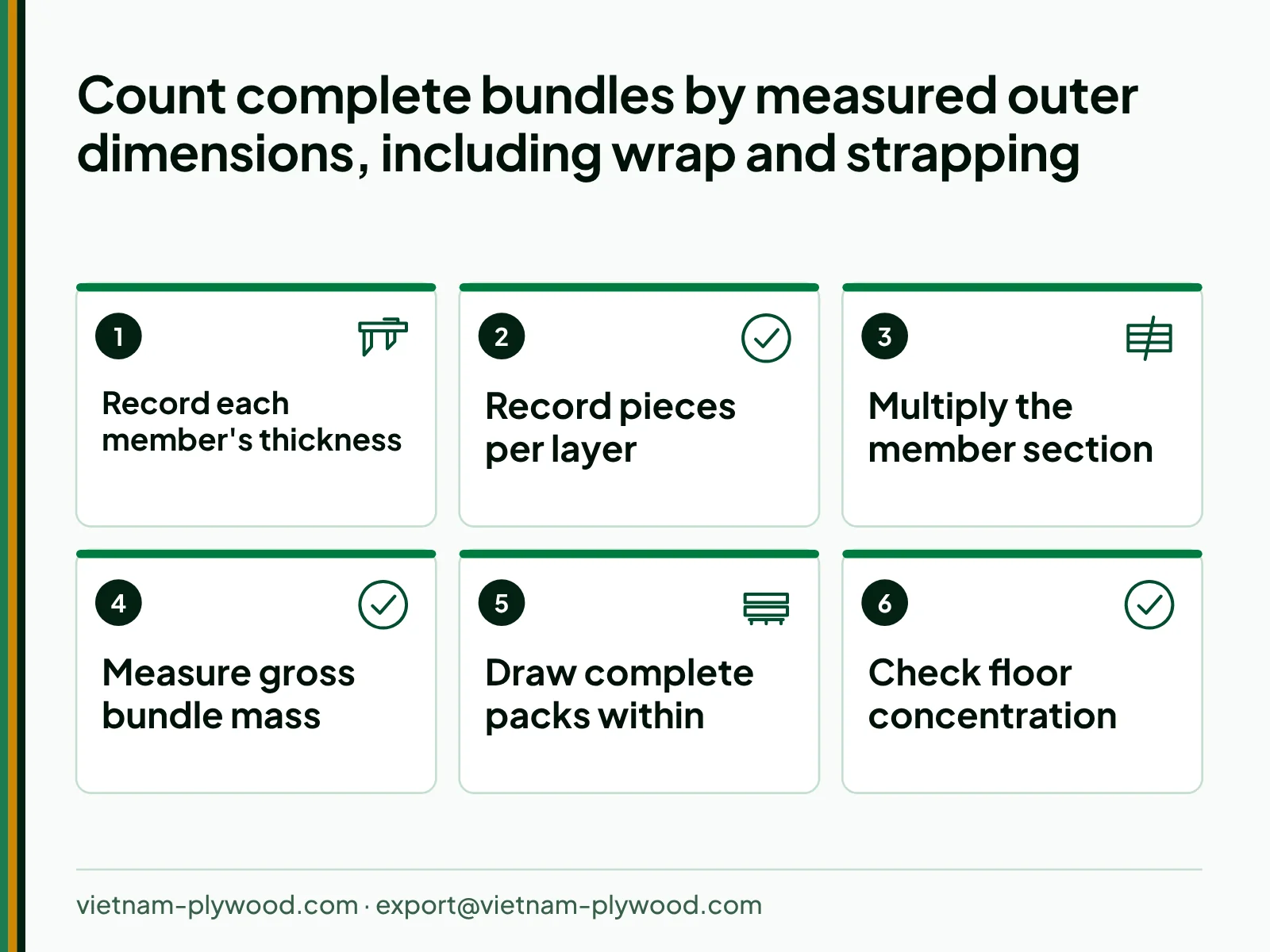
- Record each member’s thickness, width and cut length in millimetres.
- Record pieces per layer, layers per bundle and the actual bundle dimensions.
- Multiply the member section by length and pieces to obtain net wood cubic metres per bundle.
- Measure gross bundle mass, including all packing, and set handling orientation.
- Draw complete packs within the container’s measured internal dimensions and door opening.
- Check floor concentration, securing access and gross mass before approving the LVL bundles per container.
For a rectangular member, net m³ per piece = thickness (m) × width (m) × length (m). Multiply by pieces per bundle and the number of complete bundles. The number of LVL m3 per container is the lesser of this physical packing result and the weight-limited volume.
Can LVL and plywood share one 40HC?
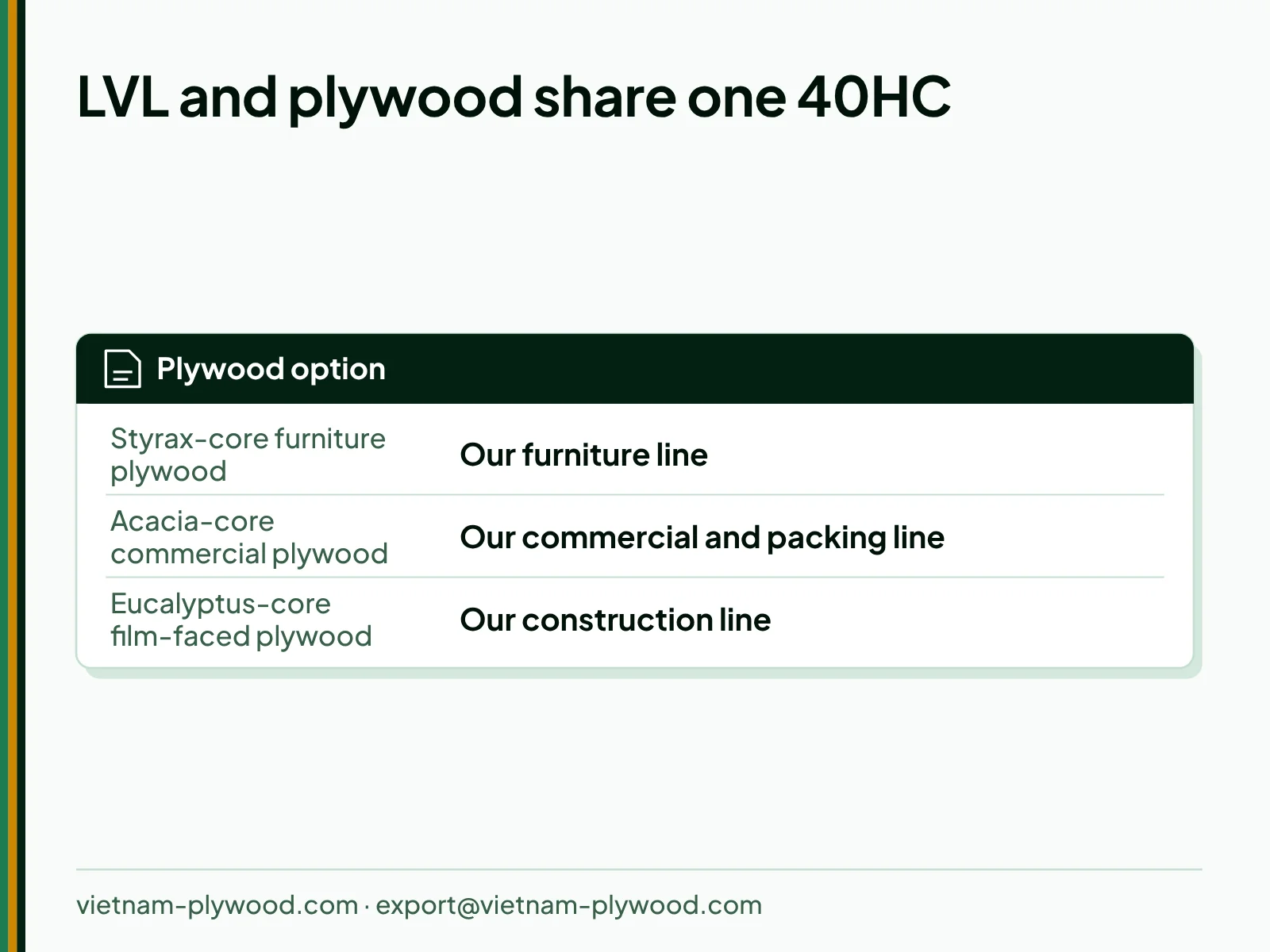
LVL and plywood can share a 40HC when their complete packages fit the floor plan and the combined mass stays within the payload. Our three factories serve different plywood builds, and the producing factory is selected against the agreed plywood specification. An LVL component needs its own supplier’s dimensions and weighed bundle data before it enters the same plan.
| Plywood option | Producing line | 18 mm, 1220 × 2440 sheet | Full plywood-only 40HC reference | Use beside LVL |
|---|---|---|---|---|
| Styrax-core furniture plywood | Our furniture line | 26.79 kg | 990 sheets; 26.52 t | Lower mass per sheet; check protected faces |
| Acacia-core commercial plywood | Our commercial and packing line | 31.08 kg | 880 sheets; 27.35 t | Packing panels; check bundle height |
| Eucalyptus-core film-faced plywood | Our construction line | 34.83 kg | 795 sheets; 27.69 t | Protected film surfaces; allow for film mass |
The full-container values are plywood-only references, excluding film weight. They cannot be added to an LVL order as though spare payload remained. For a partial plywood order, use the actual packed pallet mass, deduct it from available payload, and then calculate the LVL allowance.
Our commercial and packing line can provide packaging plywood for the specified packing application. The mixed plywood container arrangements page covers the broader loading approach, while several plywood types in one order explains how the plywood builds differ.
How is LVL export packing arranged from Hai Phong?
LVL export packing begins with a written bundle schedule and a secure, inspectable stow plan. For LVL supplied alongside our plywood, the LVL supplier must identify each pack’s net wood volume, gross weight, section, length and handling points. HCPLY coordinates the plywood shipment and its loading documentation from the producing factory, FOB Hai Phong.
Protect exposed edges from handling damage, keep packs off standing water and specify restraint against sliding or tipping. Do not rely on straps alone as container securing. The 2014 International Maritime Organization (IMO), International Labour Organization and United Nations Economic Commission for Europe (UNECE) Cargo Transport Units Code describes a non-mandatory framework for cargo packing and securing; see the IMO’s CTU Code explanation.
For mixed cargo, position heavy, stable units where floor loads and restraint can be managed, then protect plywood faces from direct LVL bundle contact. Record the final arrangement with the pack IDs visible before closing the doors.
What is checked on LVL packs before loading?
The loading inspector checks actual section, length, count, gross bundle mass and package condition against the approved schedule. A buyer or appointed inspector can witness the plywood checks at the producing factory and compare the packed goods with the packing list. LVL checks require access to the LVL packs and their own production records.
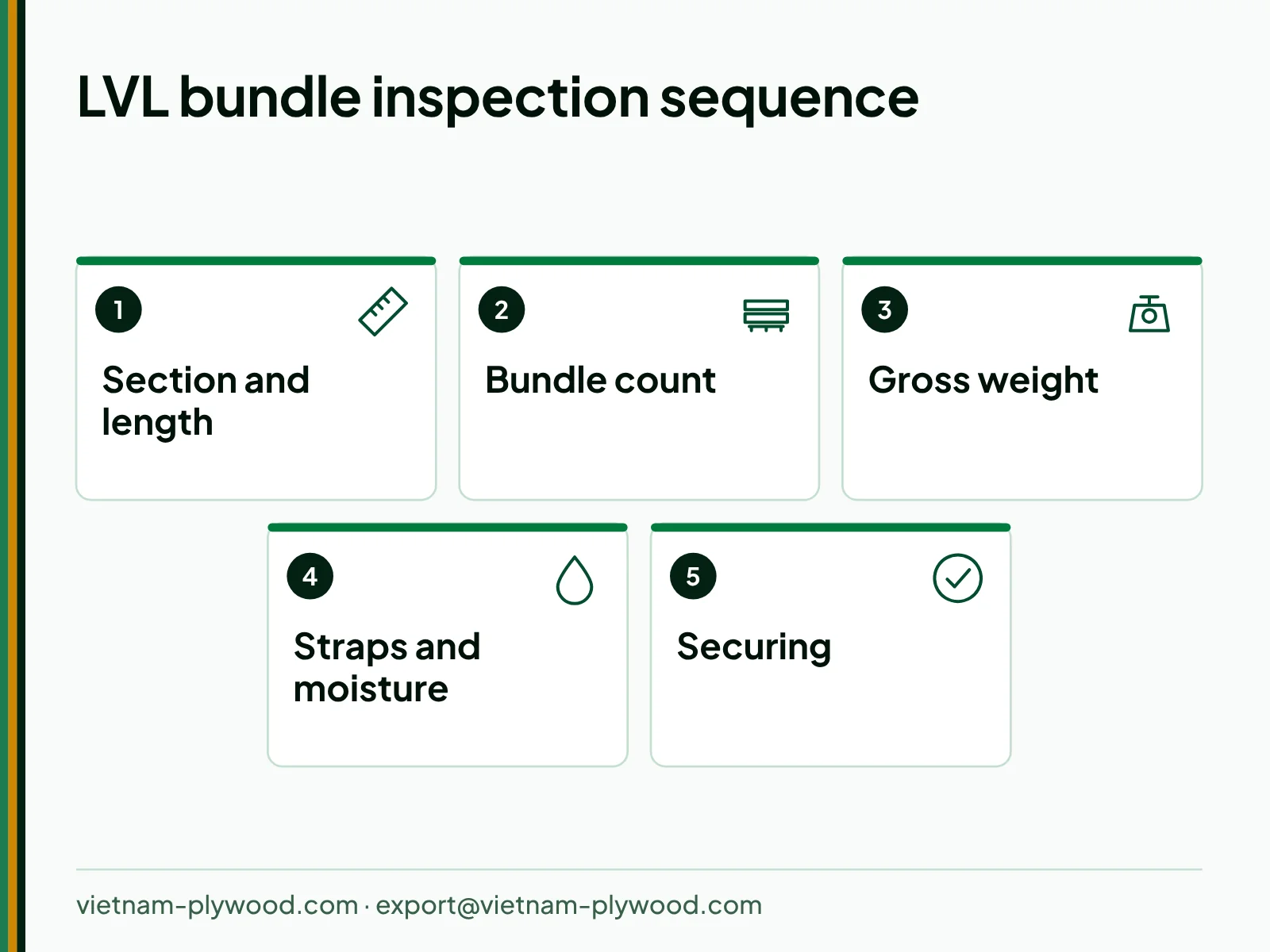
Check label-to-order identity, strap condition, end protection, wet or damaged packaging, bundle squareness and forklift access. Compare the measured bundle dimensions with the stow drawing. Inspect the container floor, doors and lashing points before the first pack enters.
The 2014 IMO/ILO/UNECE CTU Code’s safety principles address overloading, uneven mass distribution and cargo movement. The 2014 IMO CTU Code overview gives the packing framework; it is guidance rather than a product certification.
What weight must be declared before the vessel loads?
The shipper must provide verified gross mass (VGM) for the packed container before ship loading. VGM includes the cargo, pallets, securing materials and container tare. It differs from the 28.5-tonne cargo payload used in the loading arithmetic.
The IMO’s 2016 SOLAS implementation guidance explains two routes: weigh the packed container, or sum certified package and packing masses plus container tare under an approved method. See the IMO verified gross mass guidance. The United Kingdom Maritime and Coastguard Agency’s 2020 gross-mass guidance likewise distinguishes weighing a sealed unit from summing cargo, dunnage and tare.
Record the actual container plate and booking restrictions before loading. A mathematical payload check cannot replace the final verified weight or the carrier’s acceptance of the stow.
Which export papers record a mixed LVL and plywood load?
The packing list records the separate LVL bundle descriptions and plywood pallet quantities against the loaded shipment. Our export team prepares the commercial invoice, packing list, bill of lading (B/L), certificate of origin, phytosanitary and fumigation papers, and order-specific certificate documents as applicable. Insurance is included under CIF; EU lots also require the agreed EUTR/EUDR file set and EUR.1 where applicable.
After loading, the draft shipping documents come to you for approval. The pack IDs, gross masses and product descriptions should agree with the loading record, while VGM follows the applicable shipper declaration process. Factory certificates and test reports can be shown with factory details masked, on request.
What should the buyer send for a workable load plan?
A workable load plan starts with an LVL bundle schedule, the intended plywood build and the destination’s handling limits. We can review the plywood portion against our line specifications and identify the weights still needed from the LVL producer. One 40HC is the minimum order, and specifications can be mixed within its payload limit.
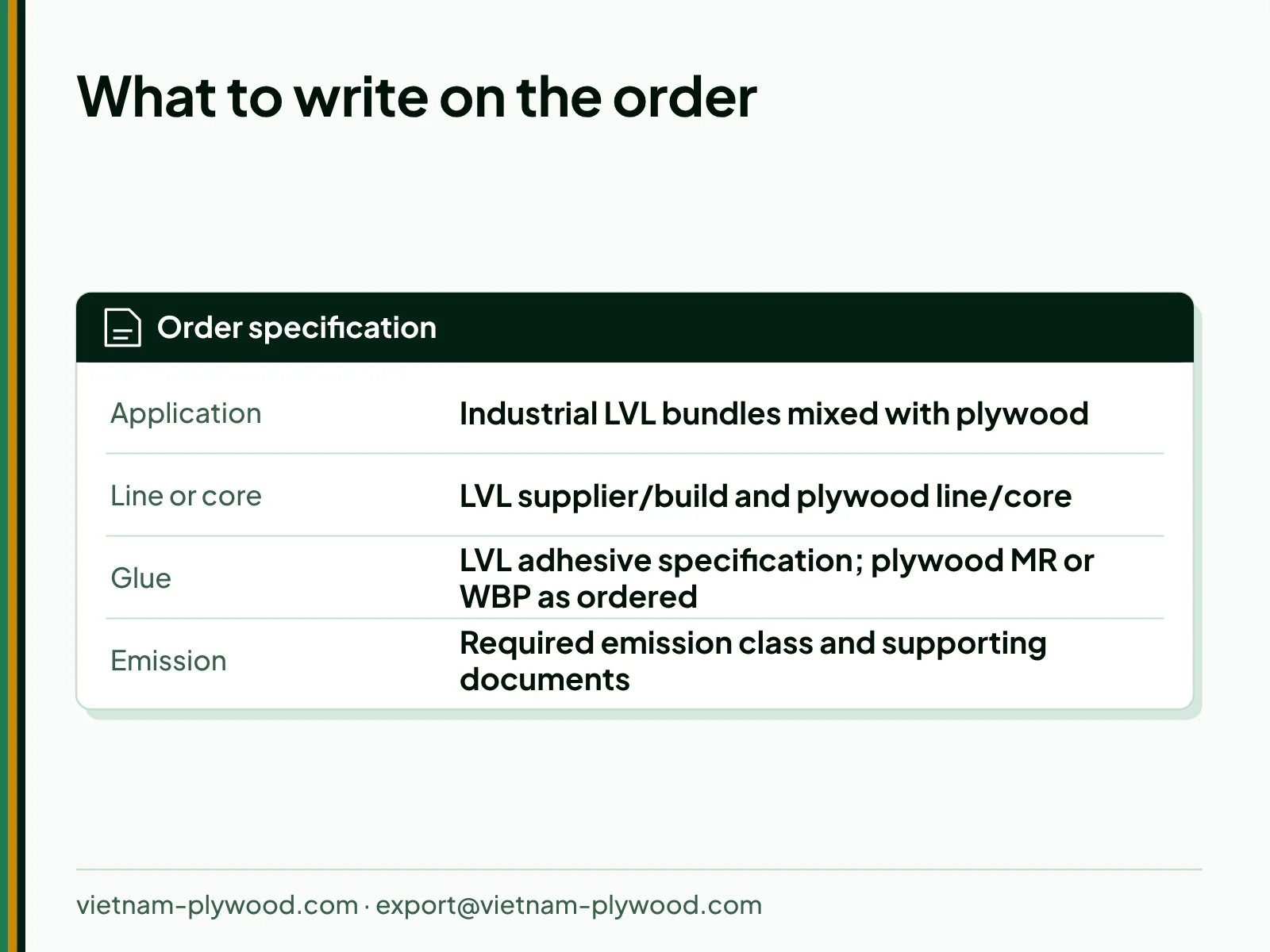
Specify the discharge port, any inland weight restriction, the preferred orientation of long bundles and whether forklifts can unload complete packs. For the plywood quantity check, use the container loading reference. For a written specification, send the details to Lucy at export@vietnam-plywood.com.
Application: Industrial LVL bundles mixed with plywood
Line or core: LVL supplier/build and plywood line/core
Glue: LVL adhesive specification; plywood MR or WBP as ordered
Emission: Required emission class and supporting documents
Face and grade: Plywood face species and A/B grade, or film specification
Thickness and tolerance: LVL section; plywood thickness and tolerance
Size: LVL cut length and bundle dimensions; plywood sheet size
Quantity: LVL pieces/bundles/net m³/gross kg; plywood sheets/pallets
Destination port: [port and country]
Book a factory visit to inspect the plywood build and its prepared load at the producing factory.