

Specify the wrong plywood for kitchen cabinets and the result shows up two years later — swollen doors, failing hinges, delaminated shelves. Buyers who import cabinet-grade plywood from Vietnam frequently encounter this problem when they treat all plywood as interchangeable and optimise only on price.
The four variables that determine cabinet performance are face veneer grade, core species, glue type, and formaldehyde emission class. This grade and spec selection guide walks through each specification in sequence, with the thresholds that matter for kitchen and bathroom applications specifically.
🪵 Why Kitchen Cabinets Demand Specific Plywood
Kitchen environments are demanding. Humidity cycles between 30% and 80% depending on season and cooking activity. Steam, cleaning chemicals, and prolonged exposure to indirect moisture test glue lines and core density in ways that dry office furniture never will.
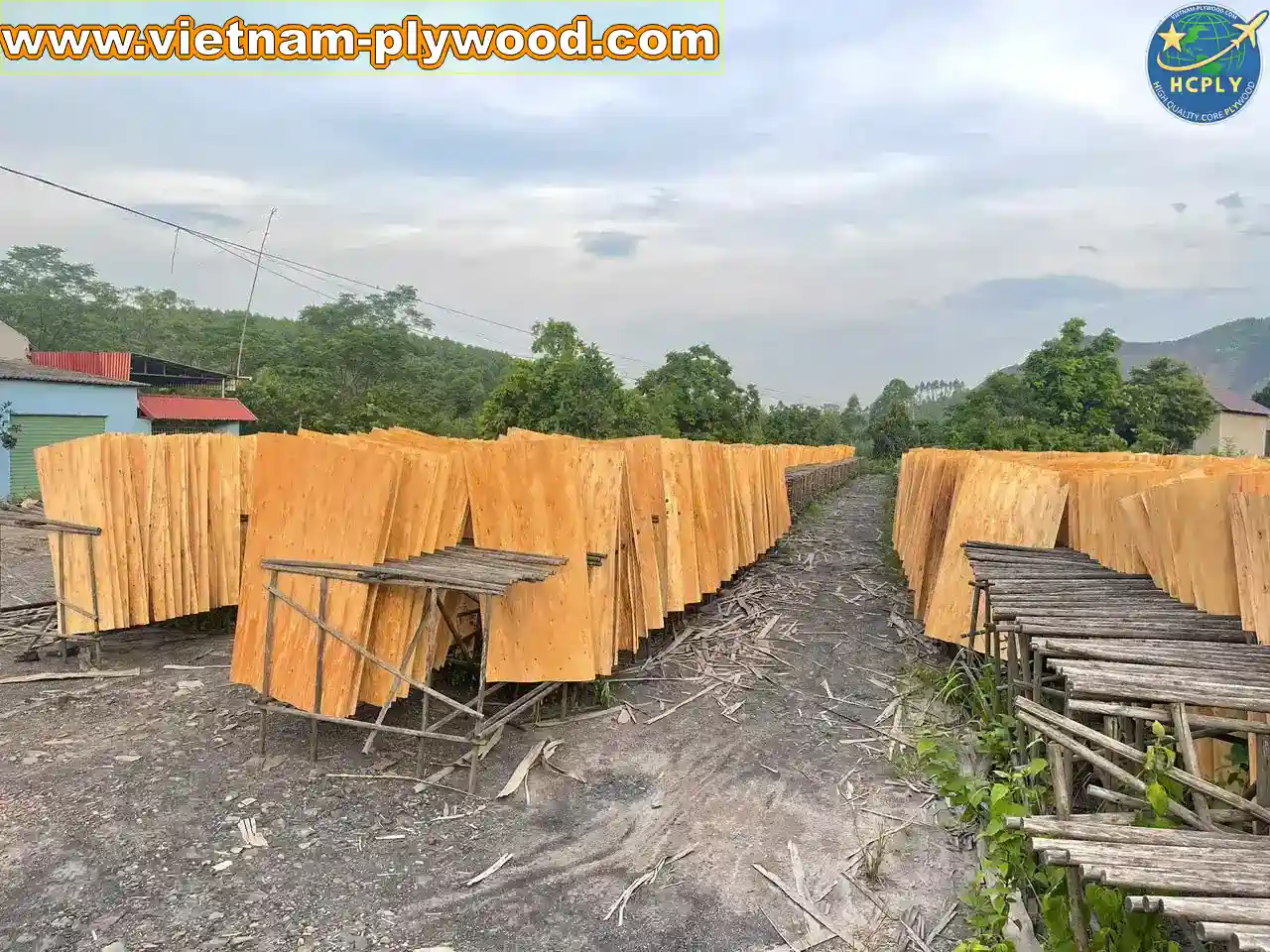
Standard commercial plywood — loose-laid acacia core, E2 emission, MR glue — is built for one-time interior fitouts or packing crates. It survives months of indoor exposure, then begins to show core gaps as adhesion fails at the weakest joints.
Cabinet-grade plywood is a different product category, not simply a higher grade of the same material. The core construction, glue formulation, face sanding, and emission class are all specified from the outset for furniture-quality performance.
Key Insight: Formaldehyde emission class (E0, E1, E2) and glue type (MR melamine, WBP phenolic) are two entirely separate specifications. “E0 glue” is a common misuse of the term. You can have MR glue with E0 emission, or MR glue with E1 emission — the difference lies in the resin formulation, not the glue category.
📋 Face Veneer: Grades That Work for Cabinets
The face veneer determines visible surface quality, workability, and finishing options. For cabinet applications, the face must be sanded smooth, free of open knots or splits, and dimensionally stable enough to accept paint, stain, or lamination without telegraphing core defects.
Birch Plywood (Grade D/E/F)
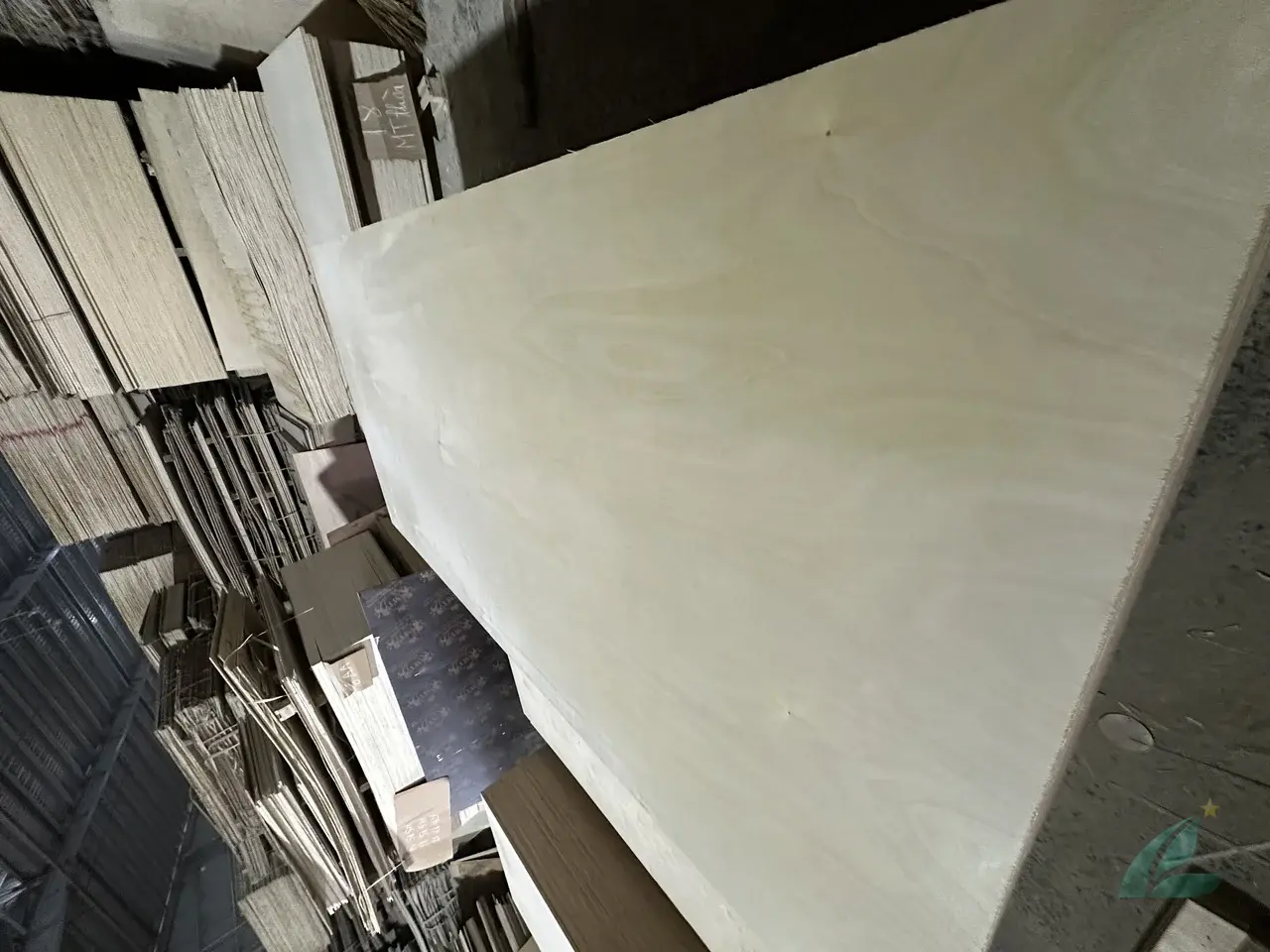
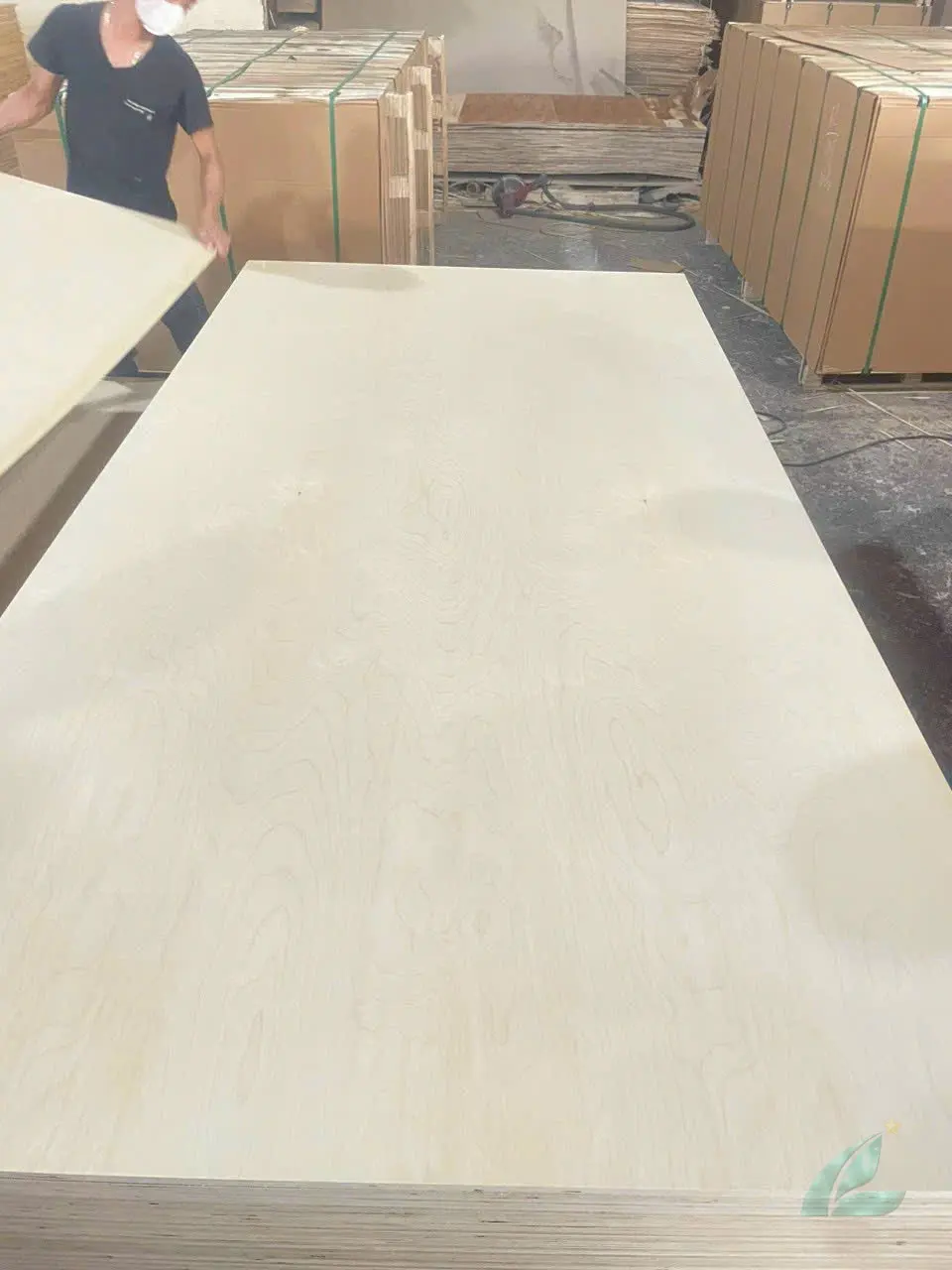
Birch plywood from Vietnam uses imported Baltic birch veneer applied over a styrax or eucalyptus core. Birch grading in the Vietnamese production system follows the D/E/F classification — not the A/B/C scale used in some North American references. Grade D is the cleanest available from Vietnamese factories.
Birch face is hard (Janka hardness ~1260 lbf for yellow birch), takes paint without visible grain raise, and provides tight, consistent grain that machines without tearout. These properties make it the benchmark face for cabinet doors, exposed carcass panels, and any visible application where a paint-ready surface is required.
Thickness range: 4–30mm. Cabinet standard: 18mm carcass, 12mm shelves.
EV (Engineered Veneer) Plywood
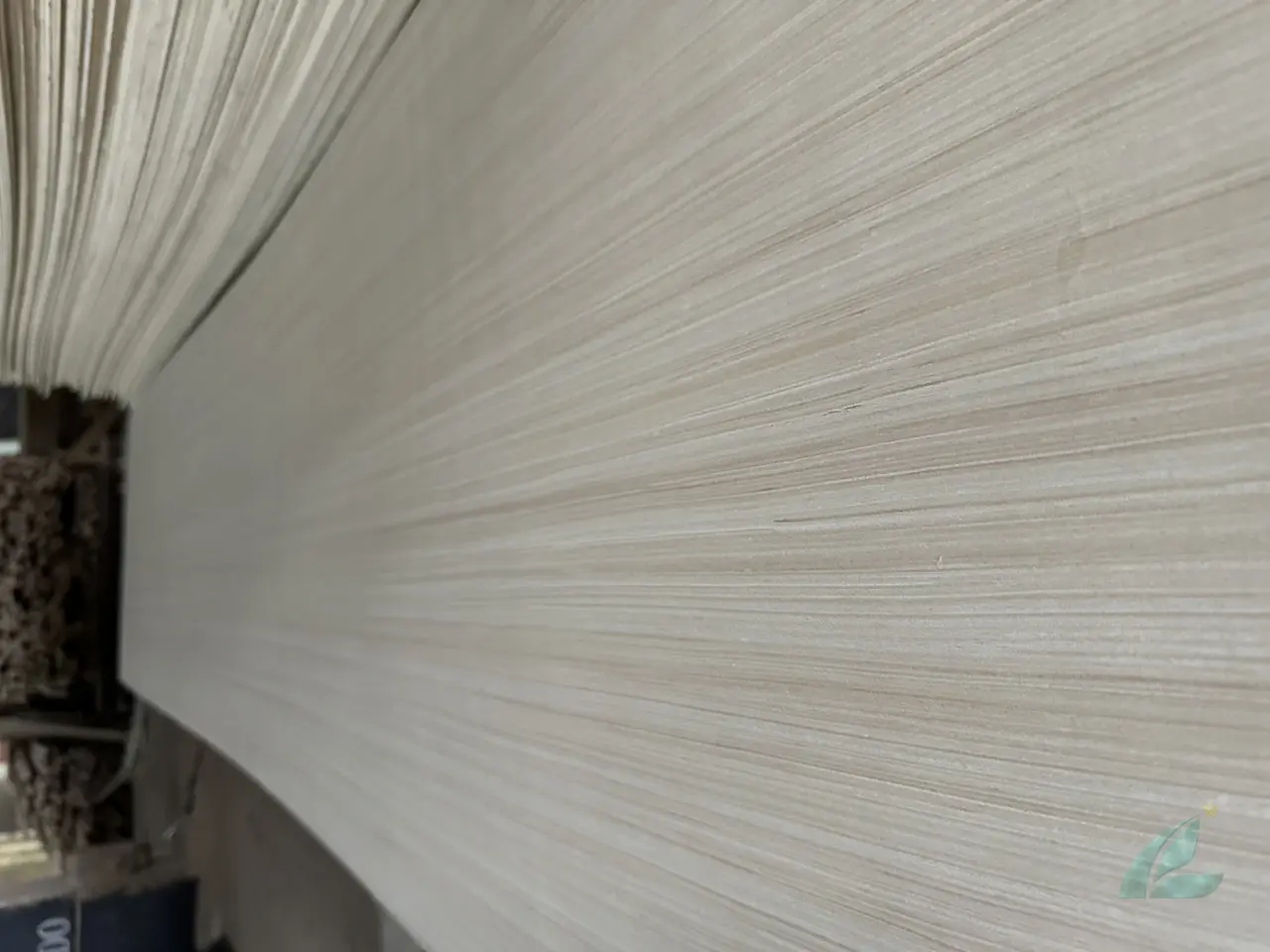
EV plywood uses a reconstituted engineered veneer — poplar wood sliced, re-pressed, and textured to produce a completely uniform grain pattern. The result is zero natural defects, zero color variation between sheets, and consistent face quality across an entire container.
EV face accepts lamination and painting equally well as birch, and is preferred by cabinet manufacturers who need identical surface appearance across multiple batches. FOB price is typically lower than birch for equivalent emission spec.
Summary:
| Property | Birch (Grade D) | EV Plywood |
|---|---|---|
| Natural grain | Yes | Engineered (uniform) |
| Paint-ready surface | Yes | Yes |
| Color consistency batch-to-batch | Good | Excellent |
| Hardness | High (~1260 Janka lbf) | Medium |
| FOB price vs equivalent spec | Higher | Lower |
| Best application | Premium doors, exposed panels | High-volume production, consistent finish |
Request samples of birch and EV plywood for cabinet evaluation
⚙️ Core Species: What Drives Cabinet Performance
The core species determines density, screw-holding capacity, and overall structural performance. Three core species are produced in Northern Vietnam: acacia, eucalyptus, and styrax.
Styrax Core — Preferred for Furniture
Styrax (bồ đề) at 480–500 kg/m³ is the standard core for cabinet-grade plywood from Vietnamese premium furniture factories. It is lightweight, pale in color (similar to Baltic birch), and holds screws cleanly for hinge mounting without pre-drilling. Styrax machines with minimal tearout and does not warp across thickness when properly kiln-dried.
Styrax is Vietnam’s functional substitute for the Baltic birch core used in European and North American cabinet manufacturing. No birch core is produced in Vietnam — buyers specifying “birch core” receive styrax as the technical equivalent.
Eucalyptus Core — Structural Applications
Eucalyptus core at 650–750 kg/m³ is the heaviest and strongest Vietnamese core species. It suits floor panels, structural carcass work requiring maximum rigidity, and applications where weight is acceptable. For upper wall cabinets or lightweight drawer construction, eucalyptus adds unnecessary mass.
Acacia Core — Not Suitable for Quality Cabinets
Acacia at ~580 kg/m³ is the budget core for commercial and packing plywood. Commercial factories building furniture-quality cabinets do not use acacia core — the density variation and surface quality are optimised for cost, not performance. Specifying acacia core in a cabinet order communicates that price is the primary variable, which typically means loose-laid construction and E1/E2 emission.
🔧 Glue & Emission: The Specification Pair That Matters
MR Melamine — Minimum for Cabinets
MR (Melamine Resin) adhesive is the minimum glue specification for kitchen cabinet plywood. It passes a 12-hour boiling test and provides adequate resistance to the humidity cycles present in kitchen environments. MR is not waterproof — sustained direct water contact will eventually cause delamination — but for indirect moisture exposure typical of enclosed cabinet interiors, it performs reliably for 10+ years.
WBP Phenolic — Wet Area Applications
For bathroom vanity units, under-sink cabinets, or any application with direct water exposure risk, WBP (Weather and Boil Proof) phenolic adhesive provides a 72-hour boil test performance. WBP is mandatory for film-faced and anti-slip plywood used in construction, but can also be specified for furniture-grade panels in wet locations.
E0 Emission — The Correct Standard for Kitchens
E0: ≤0.5 mg/L formaldehyde — this is the threshold that matters for kitchen cabinet plywood. HCPLY produces E0-certified plywood across birch, EV, and other furniture-grade products (HCPLY production data, 2026).
Why E0 rather than E1 for kitchens:
- Kitchen cabinets are in continuous human proximity, often in enclosed spaces with limited ventilation
- Cooking and humidity increase off-gassing rates from lower-grade panels
- US CARB Phase 2 compliance requires ≤0.05 ppm (roughly equivalent to E0) — without E0 certification, product cannot be imported into the US market
- European buyers increasingly require E0 as a baseline, not E1
E1 (≤1.5 mg/L) remains acceptable for wardrobes, office furniture, and non-kitchen interior applications. E2 (≤5.0 mg/L) is exterior and industrial use only — not suitable for any indoor furniture in regulated markets (European Union Health and Environment Alliance, 2024).
📐 Thickness Specifications for Cabinet Components
| Cabinet Component | Recommended Thickness | Notes |
|---|---|---|
| Box sides, top, base | 18mm | Standard carcass — supports countertop load |
| Interior shelves | 12mm | Sufficient for typical kitchen loads |
| Back panel | 6mm or 9mm | Structural support only, not load-bearing |
| Door panel (framed) | 12–18mm | Depends on door design |
| Drawer box sides | 12mm | Dovetail or cam-lock joinery |
| Toe kick | 12mm | Aesthetic, low-stress |
Thickness tolerance for cabinet-grade plywood from HCPLY’s premium furniture facility is ±0.3mm. This is critical for cabinet manufacturing: a ±1.0mm variation on box sides produces visible gaps at joining and misaligned door reveals (HCPLY production data, 2026).
🏭 Factory Segment: Why Source Matters
Not all Vietnamese plywood factories produce cabinet-grade material. The industry divides clearly into production segments — and a furniture factory cannot produce the same product as a packing factory, regardless of what is written on the order.
HCPLY manages 3 specialized production facilities in Northern Vietnam. The premium furniture facility operates with full stitched core construction, E0 emission, calibrated sanding to ±0.3mm, and FSC/CARB P2/ISO 9001 certification. This is the facility that produces birch and EV plywood for cabinet export.
“Cabinet-grade plywood ordered from a commercial facility — loose-laid acacia core, E1 emission, nominal sanding — will fail visible inspection at the destination. The surface telegraphs every core gap through the face veneer within 12 months of humidity cycling.” — Lucy, International Sales Manager, HCPLY
Buyers who request cabinet-grade specifications but accept the lowest FOB quote without verifying factory segment are the most common source of quality complaints in the Vietnam plywood export market.
View our quality certifications and factory inspection process for documented verification of the specifications described above.
📊 Specification Summary: Cabinet Plywood Order Checklist
Before placing an order for kitchen cabinet plywood, confirm the following with your supplier:
| Specification | Cabinet Standard | Red Flag |
|---|---|---|
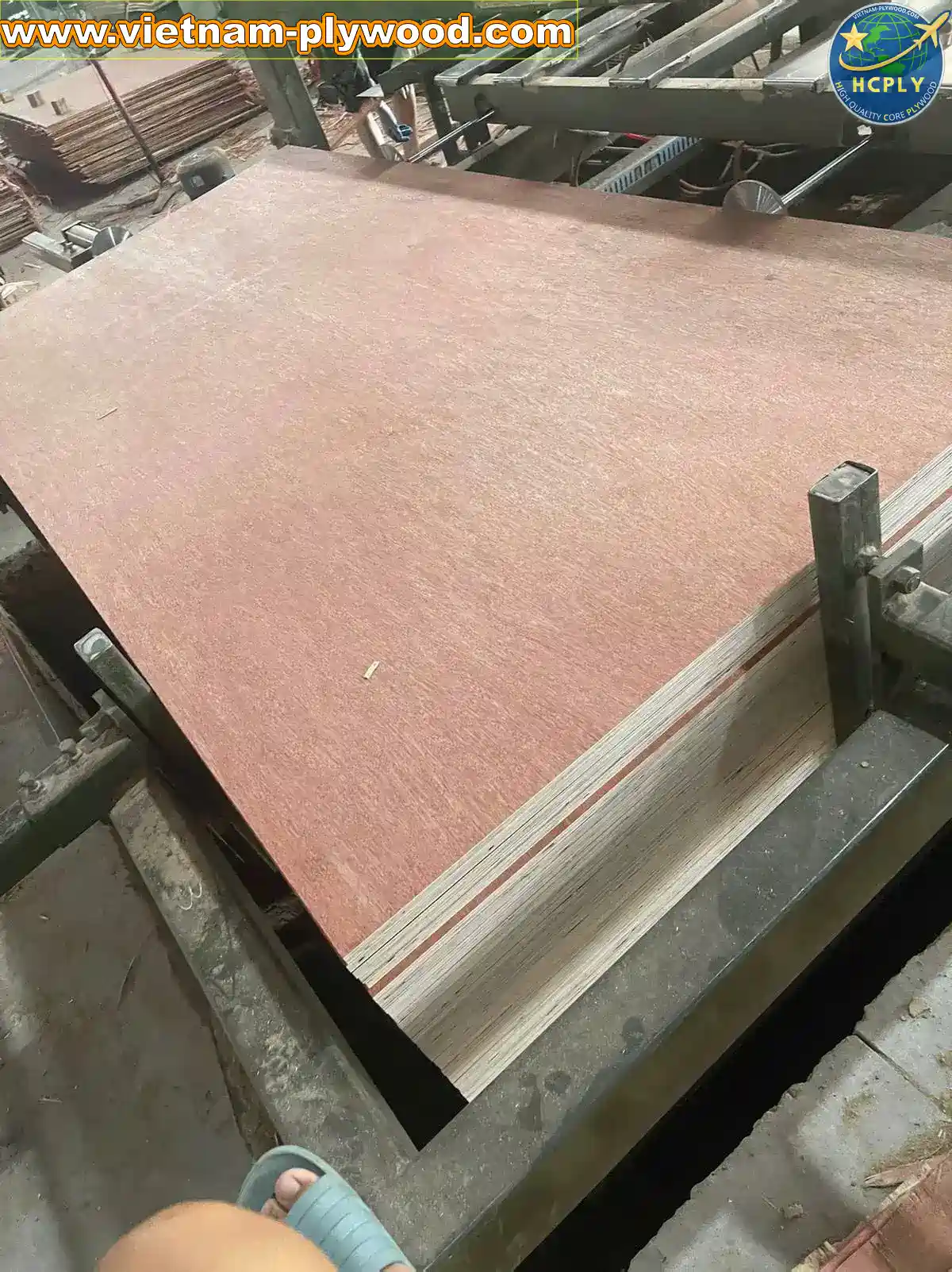
| Face veneer | Birch D-grade or EV, sanded | Bintangor face = commercial grade, not cabinet |
| Core species | Styrax (preferred) or Eucalyptus | Acacia core = commercial/packing segment |
| Core construction | Full stitched or stitched outer layers | Loose-laid = gap risk under face veneer |
| Glue | Melamine MR minimum | E2 emission = industrial/exterior only |
| Emission class | E0 (≤0.5 mg/L) | E2 in a kitchen order = compliance failure |
| Thickness tolerance | ±0.3mm | ±1.0mm or unspecified = production issues |
| Surface treatment | Calibrated sanding, both faces | Unsanded = needs field sanding, costs more |
| Certifications | FSC, CARB P2, ISO 9001 | No certifications = factory segment mismatch |
This checklist maps directly to the order specifications HCPLY uses when processing cabinet-grade export orders. Any item marked as a “red flag” warrants a direct conversation with the factory before committing volume.
Download our cabinet plywood spec sheet and request a FOB quotation
🔗 Related Product Pages
- Birch Plywood Vietnam — Premium D/E/F Grade
- EV Plywood Vietnam — Engineered Veneer Manufacturer
- Matt Plywood Vietnam — Unfaced Raw Core Substrate (for lamination-ready cabinet boards)
- Plywood Manufacturer in Vietnam — All Products
✅ Summary
Plywood for kitchen cabinets requires a specific combination of face veneer, core species, glue type, and emission class — not simply the highest price per sheet. The practical standard is: Recommended cabinet spec.
Sourcing from the correct factory segment is as important as the written specification. Vietnam’s premium furniture facilities produce to this standard as their baseline production. Commercial and packing facilities do not.
For bulk cabinet plywood orders (MOQ 1×40HC), HCPLY provides full factory documentation including CARB P2 certificate, FSC chain-of-custody, thickness test reports, and pre-shipment inspection photos.
If you are sourcing specifically for painted or lacquered kitchen cabinets, see the dedicated spec guide: Birch Plywood for Kitchen Cabinets — Vietnam Spec Guide.
Contact HCPLY for cabinet-grade plywood samples and FOB quotation