





Import plywood from Vietnam to India with an ASEAN–India Free Trade Area (AIFTA) Form AI when the shipment qualifies for preferential origin treatment; use ASEAN Trade in Goods Agreement (ATIGA) Form D for qualifying ASEAN destinations. Choosing the wrong origin document can cost an importer the tariff preference or delay clearance. HCPLY prepares the shipment papers against the agreed build and destination.
How do I import plywood from Vietnam to India?
To import plywood from Vietnam to India, first identify the Indian tariff classification and applicable product controls, then agree on a panel specification and purchase terms. Check eligibility for AIFTA preference before production, arrange Form AI and shipping papers, and have the Indian importer lodge the entry and claim the applicable treatment.
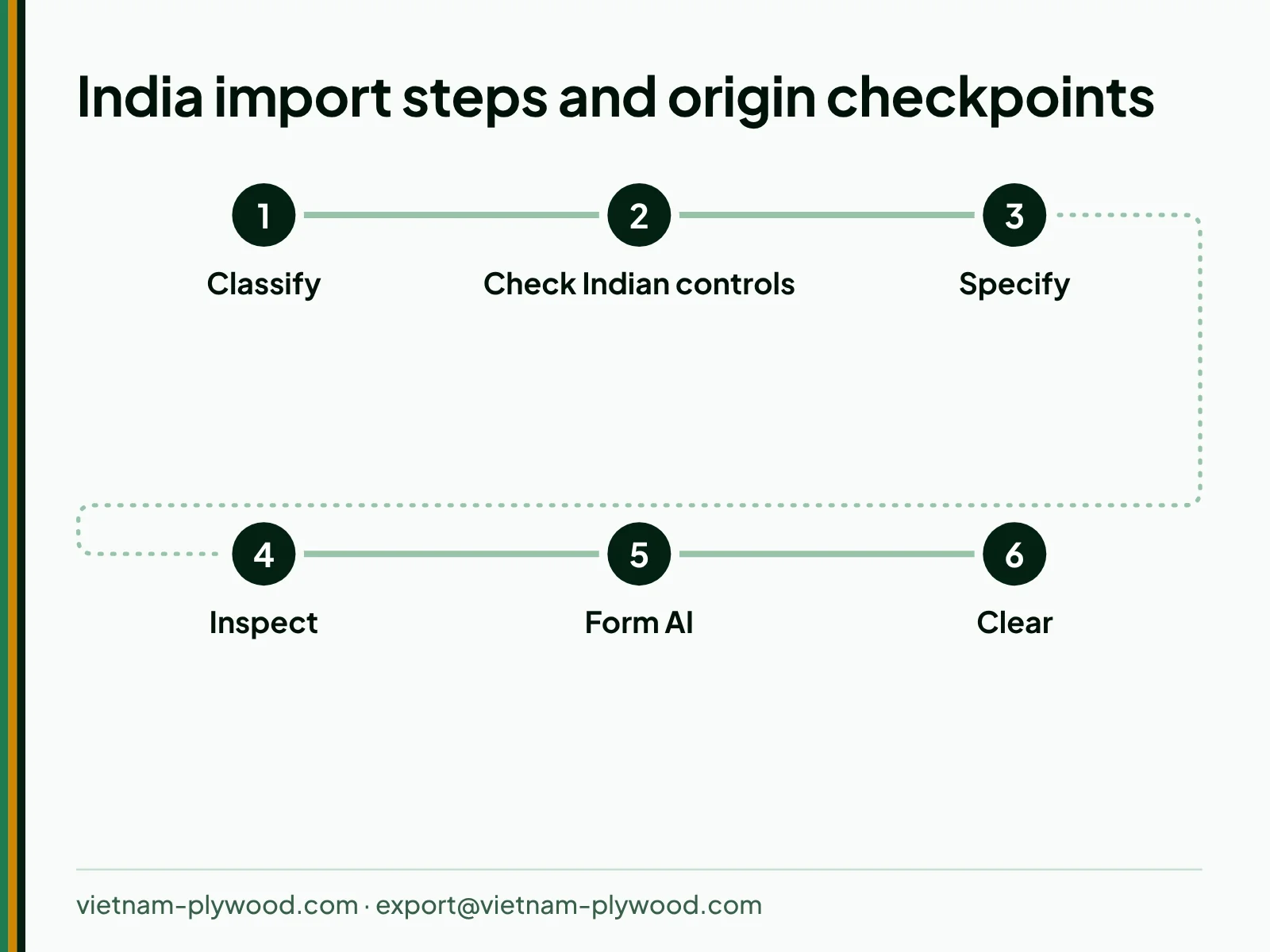
- Classify the exact panel. Give the Indian customs team its construction, face, glue and intended application. Plywood sits within heading 4412, but the national tariff line determines the rate and controls.
- Check market access before paying a deposit. Match the product against Indian Standards and compulsory certification rules, including any applicable exemptions. A certificate of origin does not replace product compliance.
- Set the build and inspection criteria. Record core, face, glue, emission class, dimensions, tolerances and packing in the purchase order.
- Choose the commercial term. We quote FOB Hai Phong, CFR (CNF) or CIF, with freight and insurance allocated by the chosen term.
- Check origin eligibility. Ask the Indian importer to validate the AIFTA tariff line and origin criterion before Form AI is requested.
- Inspect and load. Our export team coordinates on-site quality control and loading at the producing factory.
- Approve documents and clear the cargo. The importer compares the origin certificate, invoice, packing list and bill of lading (B/L) before filing the Indian import declaration.
For the broader buying workflow, see how to import plywood from Vietnam. The importer’s customs broker should establish the final tariff treatment from the actual Indian entry line.
Which certificate of origin does India require?
Form AI is the preferential certificate of origin for qualifying shipments under AIFTA. The ASEAN Secretariat’s ASEAN–India agreement materials identify it as the ASEAN-India Free Trade Area Preferential Tariff Certificate of Origin; the form records the consignee, route, HS number, origin criterion and invoice.
Under the ASEAN Secretariat’s AIFTA operational certification procedures, the exporting country’s government issuing authority certifies origin. HCPLY’s export team prepares the origin application details for the agreed shipment, while the authorized issuing authority certifies origin. The Indian importer must hold the supporting origin information required for its preferential claim. An invoice saying “Made in Vietnam” alone is insufficient for the Form AI preference.
How much import duty can Form AI save in India?
The saving is the applicable normal customs-duty rate minus the applicable AIFTA preferential rate, multiplied by the customs value on which that duty is assessed. A percentage cannot be stated for all plywood: the Indian tariff subheading, effective tariff schedule, origin qualification and entry date control the answer.
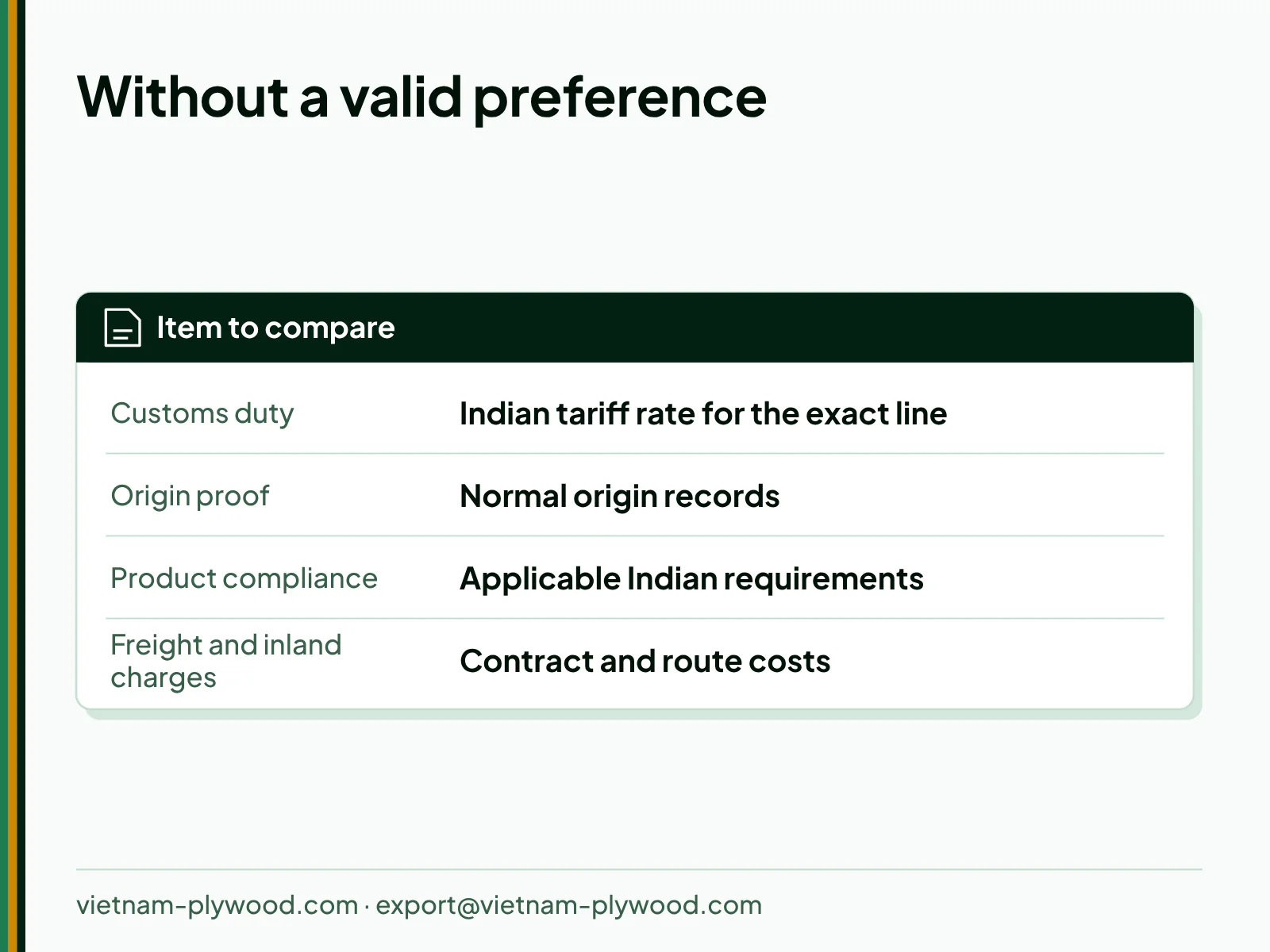
| Item to compare | Without a valid preference | With qualifying Form AI | Buyer action |
|---|---|---|---|
| Customs duty | Indian tariff rate for the exact line | AIFTA rate for the same line | Obtain both dated rates |
| Origin proof | Normal origin records | Form AI and supporting origin evidence | Match the origin criterion |
| Product compliance | Applicable Indian requirements | Same applicable Indian requirements | Check before contracting |
| Freight and inland charges | Contract and route costs | Same contract and route costs | Quote separately |
What Indian plywood controls should be checked first?
Check whether the specific plywood falls under an Indian compulsory-standard requirement before committing the order. The Bureau of Indian Standards (BIS) publishes IS 303:2024, Plywood for General Purposes – Specification. Other uses can fall under different standards and orders.
BIS marking is a separate legal and licensing question from origin certification. Buyers needing mandatory Indian marking should resolve licensing and conformity requirements before placing an order. Check the latest order, effective dates, product scope and any import exemption directly with Indian authorities.
Our furniture line builds sanded, full-stitched styrax- or eucalyptus-core panels with E0/E1 emission classes. Our commercial and packing line presses acacia-core MR-glue panels; our construction line presses film-faced panels with acacia or eucalyptus cores. The compliance decision must follow the actual product, not the broad word “plywood.”
Which origin form applies to ASEAN shipments?
ATIGA Form D, normally exchanged electronically as e-Form D, is the preferential origin route for eligible Vietnam-to-ASEAN shipments. The ASEAN Secretariat’s ATIGA Tariff Finder identifies Form D as the certificate for preferential tariff claims.
Singapore Customs stated in its July 2026 electronic Form D guidance that all ASEAN member states implemented full electronic transmission from January 2024, and an importing customs administration can reject a paper Form D for a preference claim. Arrange the electronic origin transmission with the export documents rather than relying on a paper original.
India is outside ATIGA, so Form D is not the Indian preference document. Conversely, Form AI is the AIFTA route, not the standard ATIGA proof for intra-ASEAN trade. Ask the importing customs team which agreement it will claim before our export team prepares the origin details.
How much duty can Form D save in ASEAN?
ATIGA savings equal the destination’s ordinary customs duty less its ATIGA preferential duty on the same classified goods and customs value. A qualifying Form D can reduce duty where a positive ordinary rate and a lower preferential rate apply. It cannot reduce a duty already assessed at zero.
For Singapore, the customs-duty saving on ordinary plywood is zero, because Singapore treats products outside its four dutiable categories as non-dutiable. The origin form therefore does not remove Singapore import Goods and Services Tax (GST).
What freight and duty apply to Vietnam–Singapore plywood?
Singapore plywood imports have no customs duty, but import GST and freight still affect landed cost. Singapore Customs’ June 2026 import-procedures guidance lists the dutiable categories as alcohol, tobacco, motor vehicles and petroleum products; other goods incur GST rather than customs duty.
Singapore Customs’ June 2026 import guidance states that GST is levied on the CIF value, including applicable duties and incidental delivery costs. The importer needs a customs permit and must account for import tax. Freight depends on carrier, routing, equipment availability and whether the quote is FOB, CFR or CIF; request a dated booking quote rather than using an assumed freight figure.
Which factory line should produce the order?
The application selects the producing line, and the panel’s core determines density. The comparison below uses the same 18 mm, 1220 × 2440 mm format to show what each line would build.
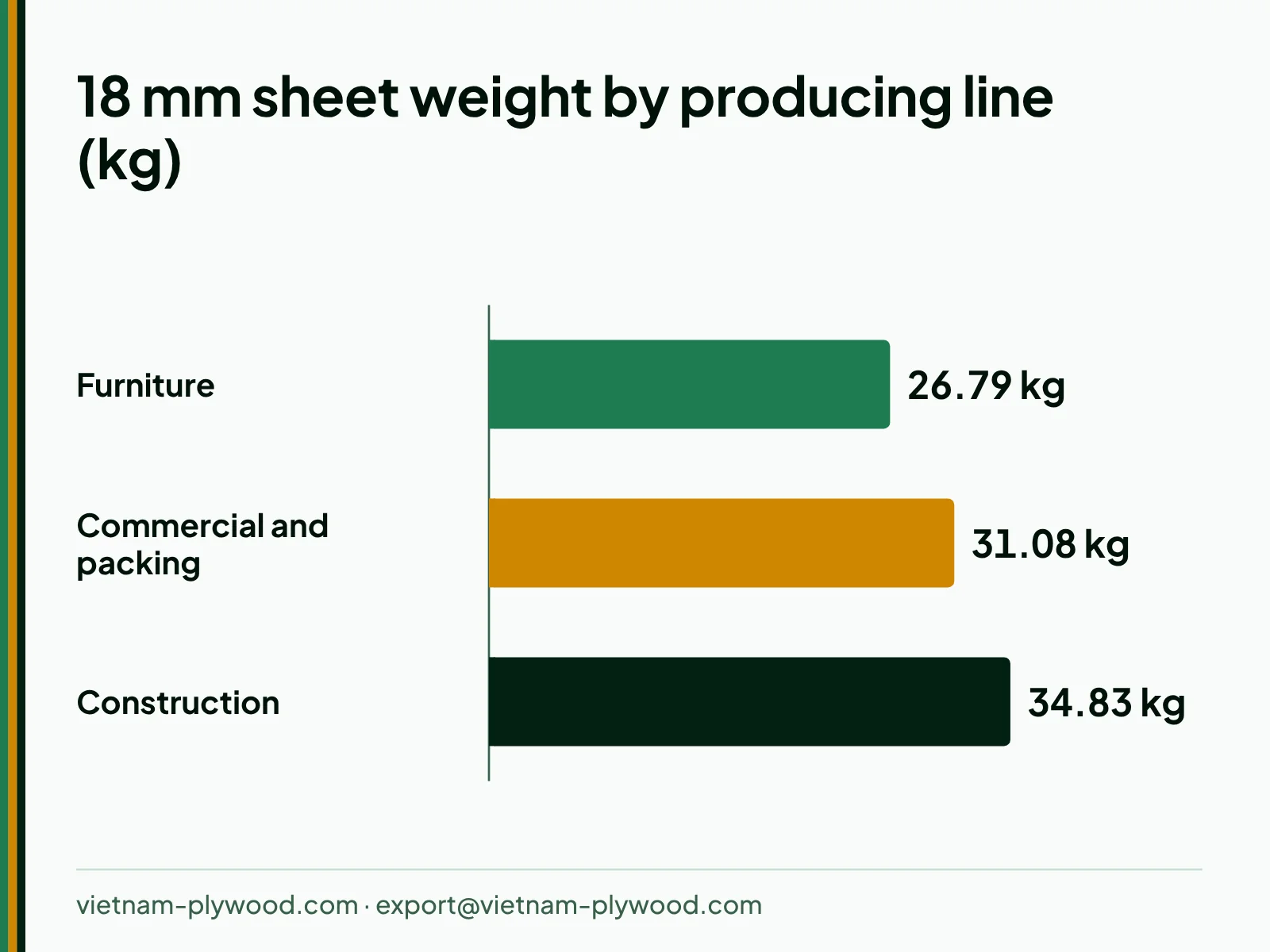
| Producing line | Core and finish | Glue or emission field | Thickness tolerance | 18 mm sheet weight |
|---|---|---|---|---|
| Furniture | Styrax, full stitched, sanded | E0/E1 emission | ±0.2 or ±0.3 mm as ordered | 26.79 kg |
| Commercial and packing | Acacia, unsanded or light-sanded | MR glue | ±0.5 mm commercial; ±0.5–1.0 mm packing | 31.08 kg |
| Construction | Eucalyptus, film-faced, unsanded core | Phenolic or melamine film build | ±0.5 mm | 34.83 kg |
These are alternative builds, not interchangeable compliance classifications. We check thickness, edge construction, face condition and packing against the signed specification at the producing factory. Buyers or their inspectors can witness those checks before loading.
For more on our plywood manufacturing range and several plywood types in an order, compare the intended use before choosing the face and core.
Can different plywood specifications share a container?
Yes. Our minimum order is one 40HC, and specifications can be mixed within its 28.5 t payload limit. Mixed loading needs a weight plan because the same thickness occupies different payload allowances with different cores.
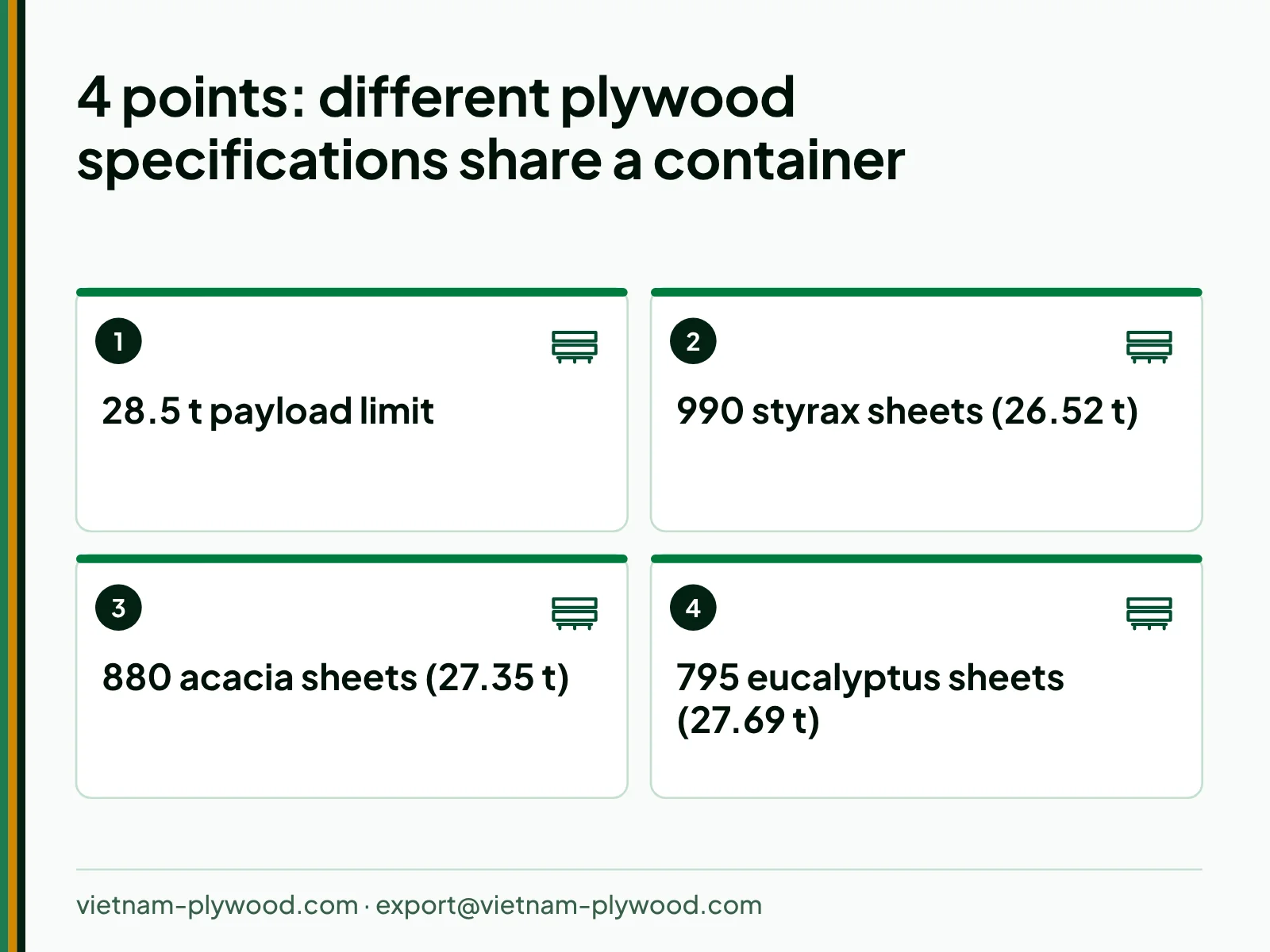
At 18 mm and 1220 × 2440 mm, the full-container reference loads are 990 styrax sheets (26.52 t), 880 acacia sheets (27.35 t) or 795 eucalyptus sheets (27.69 t). These are separate full-load examples; a mixed order needs its own pallet allocation and total-weight check. The figures exclude film weight.
We agree the mix by specification and pallet count before loading. The 40HC container-load reference covers the detailed loading arithmetic; an inspector can compare pallet labels and tally sheets against the packing list.
Which documents travel with the shipment?
The shipment paperwork comprises the commercial invoice, packing list, B/L, applicable certificate of origin, phytosanitary and fumigation papers, and insurance under CIF. Order-specific certificates and test reports accompany the agreed build. After loading, the draft shipping documents come to you for approval.
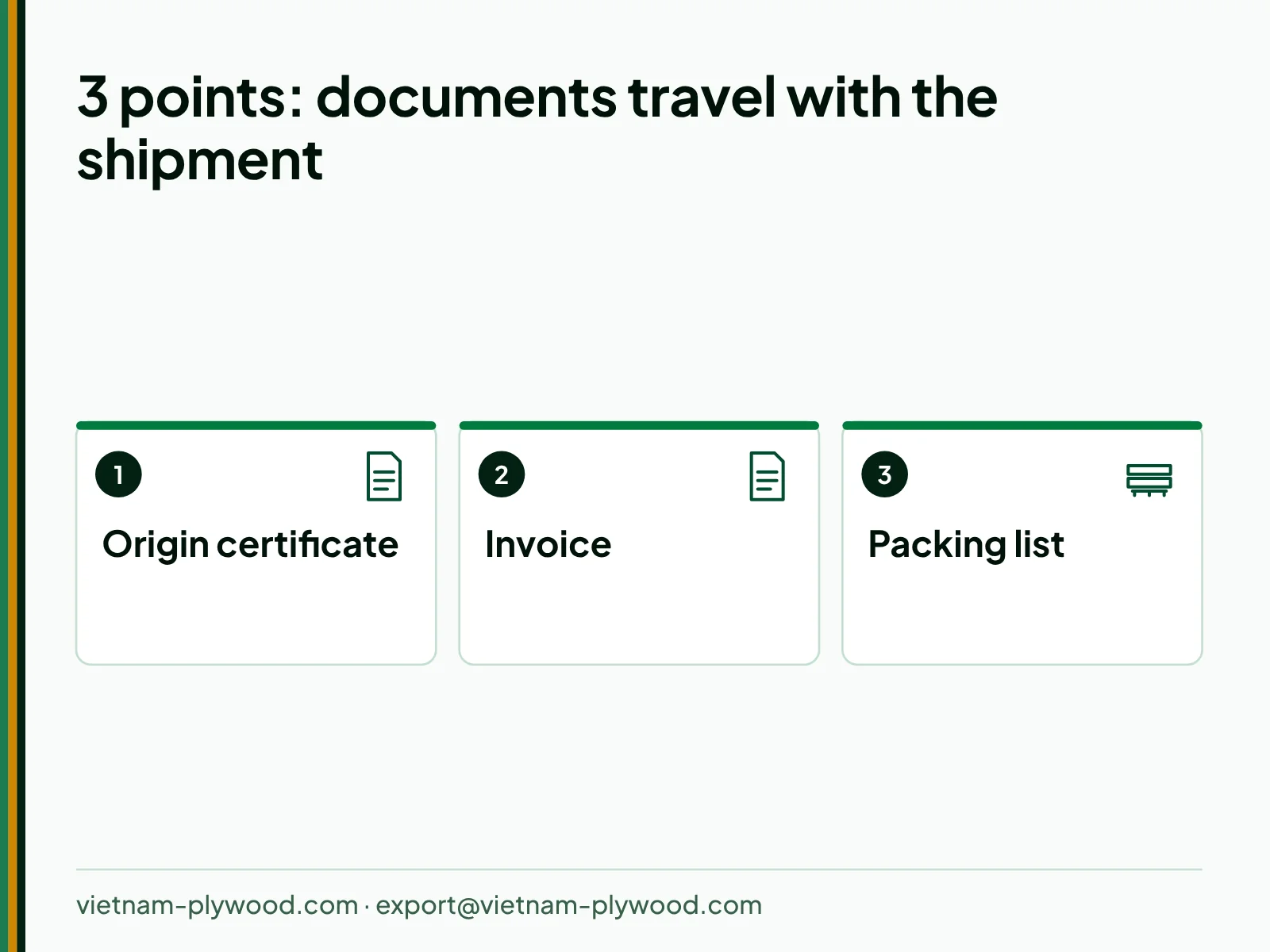
The origin certificate is the document tied to the preferential-duty question; the invoice establishes the transaction description and value, while the packing list identifies quantities and packages. Cross-check marks, dimensions, consignee, origin criterion and invoice references before the import declaration.
How long does shipping from Vietnam to India take?
A fixed Hai Phong-to-India ocean-transit figure is unavailable for this order; request a carrier itinerary for the named Indian discharge port. Vessel connections, transshipment, sailing frequency and customs release can change the arrival schedule. The South-East Asia reference is 5–12 days at sea from Hai Phong, by carrier and route; that regional figure is not an India estimate.
Production is 15–45 days after the 30% deposit, depending on quantity, production conditions and agreement. The balance is 70% against the scanned B/L, by T/T or irrevocable L/C at sight. Keep production time, ocean transit and destination clearance as separate schedule lines.
What should the importer send to start a trial order?
Send one complete panel specification, destination port and the preference route the importing customs team plans to claim. HCPLY can then align the producing line, inspection checkpoints, loading plan and export papers with the order.
Application: importer/distributor resale or named end use
Line or core: furniture / commercial and packing / construction; styrax / acacia / eucalyptus
Glue: MR melamine / WBP phenolic as applicable
Emission: E0 / E1 / E2 as specified
Face and grade: species or film finish; A/B or birch D/E/F as applicable
Thickness and tolerance: ___ mm; ___ mm
Sheet size: ___ × ___ mm
Quantity: ___ sheets / pallets; one 40HC minimum
Destination port: ___, India or ASEAN country
Origin preference requested: Form AI / ATIGA e-Form D / none
Plan a trial container with Lucy at export@vietnam-plywood.com through our contact page, attaching the specification and intended import tariff line.