





HCPLY can supply plywood from Vietnam to Australia with agreed shipment papers and test reports; an Australian Standards mark is not part of our offer. A wrong biosecurity classification can hold a container and add inspection charges. This import plywood from vietnam to australia workflow begins with entry conditions.
How do I import plywood from Vietnam to Australia?
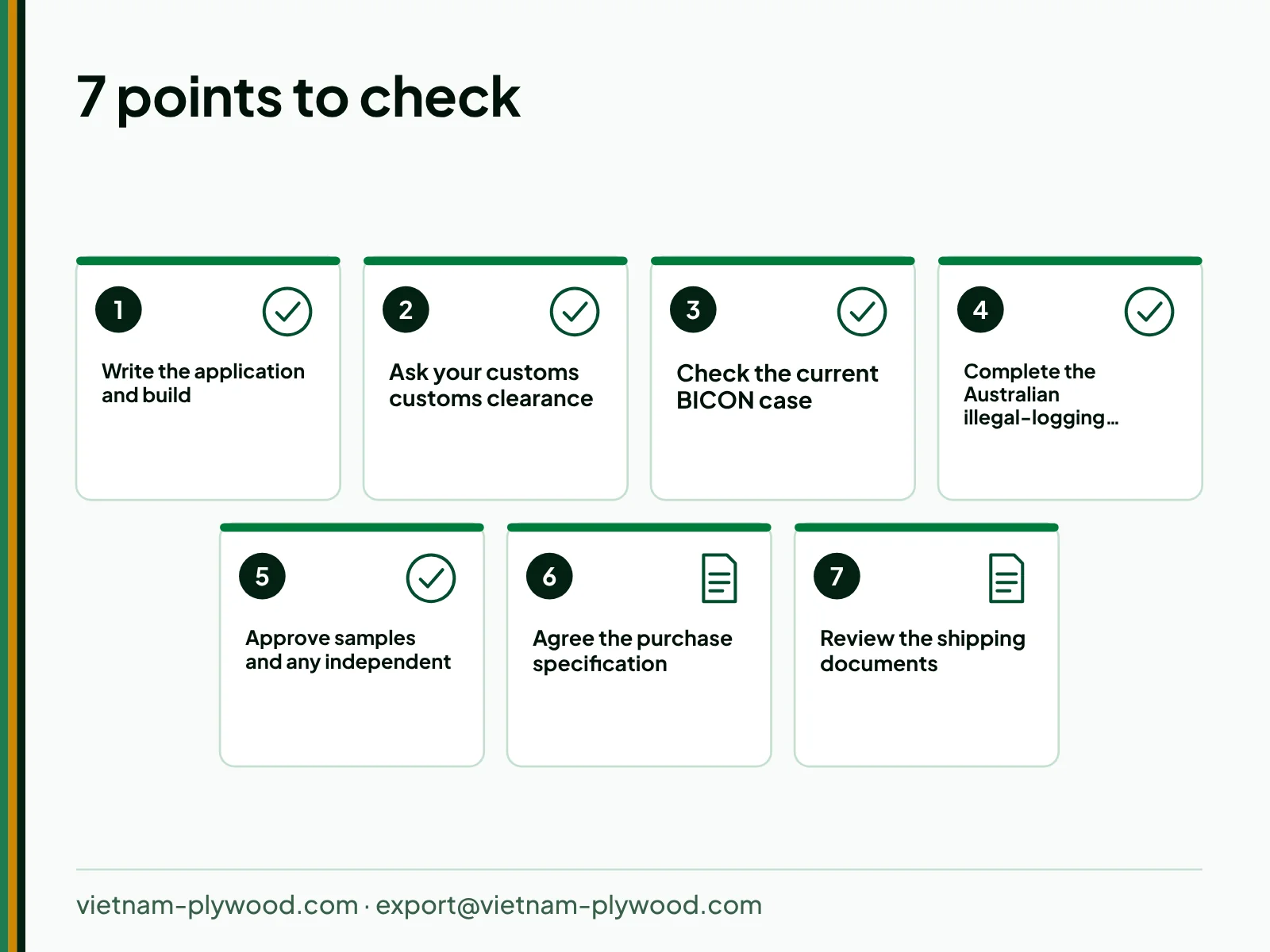
To import plywood from Vietnam to Australia, classify the exact panel and packaging, check Australia’s Biosecurity Import Conditions (BICON), settle the intended use and test evidence, approve a sample, then agree freight and documents. The Australian importer handles entry and local clearance; HCPLY manufactures, checks and loads the agreed panels at Hai Phong.
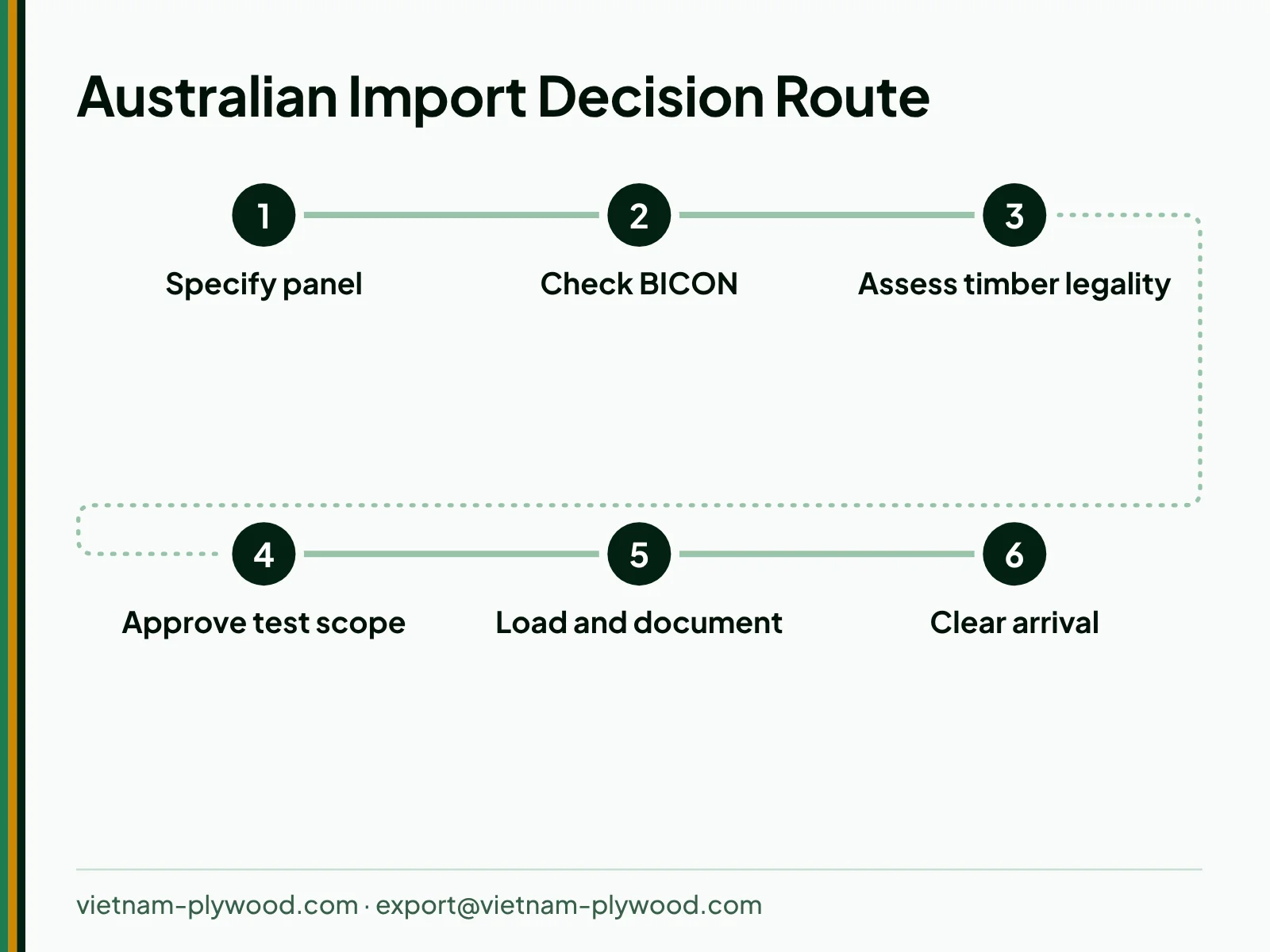
- Write the application and build: furniture, packing or formwork; face, core, glue, emission class, dimensions and tolerance.
- Ask your customs customs clearance provider to classify the goods under the appropriate Australian tariff item, commonly within heading 4412 for plywood, and calculate applicable duty and goods and services tax. Do not assume a six-digit subheading settles the Australian tariff line.
- Check the current BICON case for the panel, any solid timber pallets and container packing. Record its documentary, treatment and permit conditions before shipment.
- Complete the Australian illegal-logging due-diligence assessment where the product is regulated, using species, harvest-origin and supplier evidence.
- Approve samples and any independent test-report scope needed for the intended market application.
- Agree the purchase specification, shipment term and container loading plan; inspect production and packing.
- Review the shipping documents, lodge import entries and arrange any biosecurity inspection and release at the destination port.
The general Vietnam import sequence covers purchase stages shared by other markets. Australia adds a separate biosecurity and timber-legality decision before loading.
Which biosecurity papers does plywood need to enter Australia?
Australian entry requirements come from the BICON scenario for the exact goods and their packaging. Use the Department of Agriculture, Fisheries and Forestry Biosecurity Import Conditions (BICON) case for the specific plywood build and packing materials; obtain the applicable written conditions before dispatch. A phytosanitary paper or fumigation paper from the exporter is part of our shipping file, but its presence alone does not replace the applicable BICON decision.
Before booking, identify whether the panels are processed plywood, whether the load uses solid timber pallets, and whether there is loose timber dunnage. Ask the customs clearance provider to match each component to its BICON conditions. Keep the processing description, treatment evidence where called for, clean-container inspection records and packing details together. DAFF can assess documents and inspect cargo on arrival.
What wood declaration does Australian customs ask for?
There is no universal document called a plywood wood declaration that substitutes for Australian customs entry, biosecurity declarations and illegal-logging due diligence. The importer and customs clearance provider must identify which declarations apply to the shipment and provide the product description and supporting evidence required by the relevant system. The Australian Border Force import-declaration guidance describes the importer’s customs declaration and tariff-value details.
Australia’s Illegal Logging Prohibition Act 2012 (2025 compilation) requires a written due-diligence system for regulated timber imports; the Illegal Logging Prohibition Rules 2024 specify the process. Before each relevant import, gather reasonably practicable information about timber species, country and area of harvest, processing country, supplier, quantity and sales records. Assess illegal-harvest risk and retain the prescribed records.
Does packaging compliance Australia wooden box differ from plywood panels?
Yes. Solid-wood pallets, crates and dunnage are treated differently from packaging made entirely of processed plywood. The International Plant Protection Convention’s 2021 ISPM 15 publication excludes packaging made from processed plywood from that raw-wood packaging standard. Other BICON and cleanliness requirements still apply.
Our commercial and packing line presses acacia-core packing panels with MR glue; it can provide cut sizes for box fabrication. A buyer commissioning boxes should specify whether the finished package will use additional solid timber. That decision belongs in the import packing plan, rather than being inferred from the plywood face.
Does a formply or structural order need a test report?
A formply or structural order needs a test report the buyer accepts for the proposed application, performance requirements and local approval process. HCPLY does not offer an AS/NZS stress-grade mark. Specify the applicable test method, sampling arrangement, laboratory, acceptance criteria and report recipient before production; a generic product brochure cannot establish structural suitability.
Our construction line presses film-faced plywood with an acacia or eucalyptus core and phenolic or melamine film. Standard film weight is 120 g/m², premium is 135 g/m² and anti-slip film is 220 g/m². Glue and emission class are separate fields: phenolic WBP refers to weather-and-boil-proof bonding, while E0, E1 and E2 describe emission classes. Film weight is a surface specification, not a load-bearing grade.
At the producing factory, a buyer’s inspector can witness panel thickness checks, film-face inspection, edge condition, bundle identification and sampling against the purchase specification. Agree which laboratory report will be used for the buyer’s formwork design or structural assessment before ordering. For on-site handling and acceptance, use the arrival inspection checklist.
Which factory line builds the Australian order?
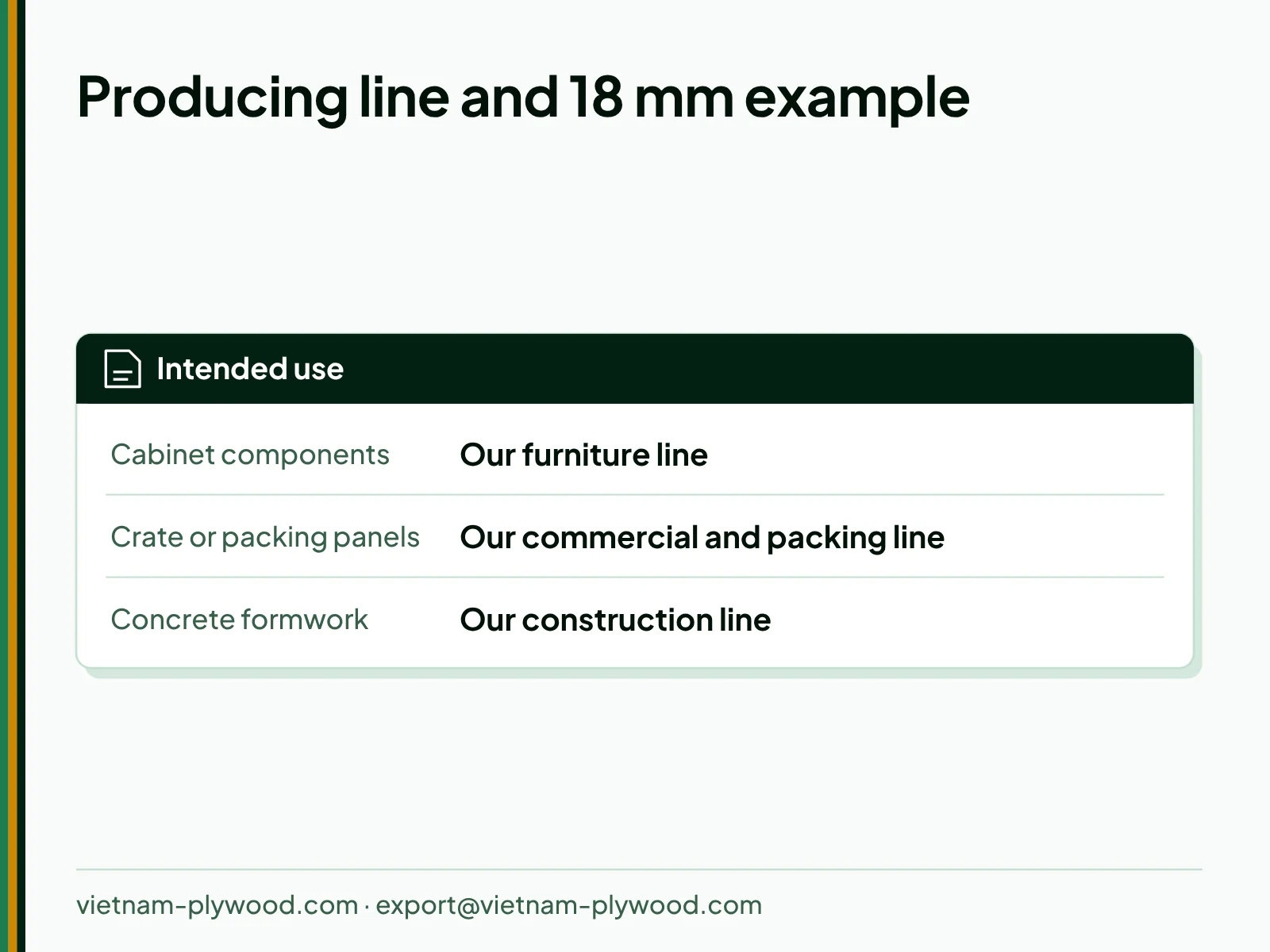
The application selects the production line, and each line has a different build even at the same nominal 18 mm thickness. The table below compares realistic specifications rather than treating plywood as one interchangeable commodity.
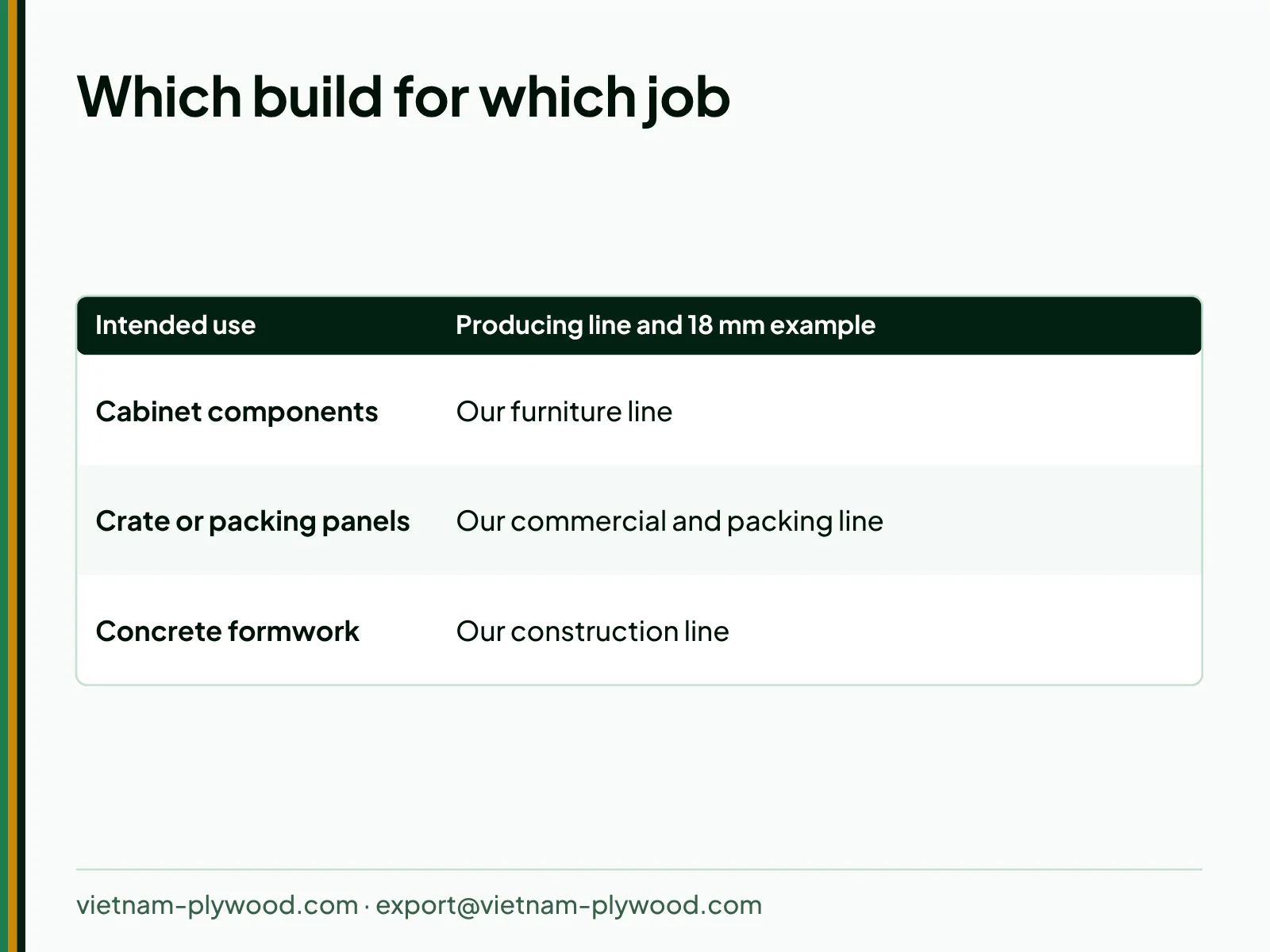
| Intended use | Producing line and 18 mm example | Core and finish | Inspection focus |
|---|---|---|---|
| Cabinet components | Our furniture line | Styrax or eucalyptus, full stitched, sanded; veneer face | Face grade, sanding and ordered ±0.2 or ±0.3 mm tolerance |
| Crate or packing panels | Our commercial and packing line | Acacia, MR glue, unsanded or light-sanded | Panel dimensions, edge construction and packing tolerance ±0.5–1.0 mm |
| Concrete formwork | Our construction line | Acacia or eucalyptus, film-faced, unsanded | Film condition, glue specification and ±0.5 mm tolerance |
Our furniture line can make furniture plywood with bintangor, okoume or other listed veneer faces. The commercial line instead builds panels for packing and general use; the construction line builds film-faced panels for concrete work. Each order is inspected and dispatched from its producing factory in Phu Tho or Hai Phong.
Factory-held FSC, CARB P2, ISO 9001 and CE documents can be shown with factory details masked, on request. The buyer should check the actual scope against the ordered build rather than reading a certificate name as an Australian product approval.
Can furniture and formwork panels share a container?
Yes. Different specifications can share one 40HC container within its 28.5 t payload limit, with loading calculated by core density, sheet dimensions and pallet layout. At 18 mm and 1220 × 2440 mm, a full styrax-core plan is 990 sheets and 26.52 t; the acacia-core plan is 880 sheets and 27.35 t; the eucalyptus-core plan is 795 sheets and 27.69 t. These calculations exclude film weight.
For a mixed load, request a pallet-by-pallet loading sheet identifying each core and thickness. Check the actual packed weight, pallet weight and any film weight against the payload limit before loading. See container load calculations for the full single-core pallet patterns.
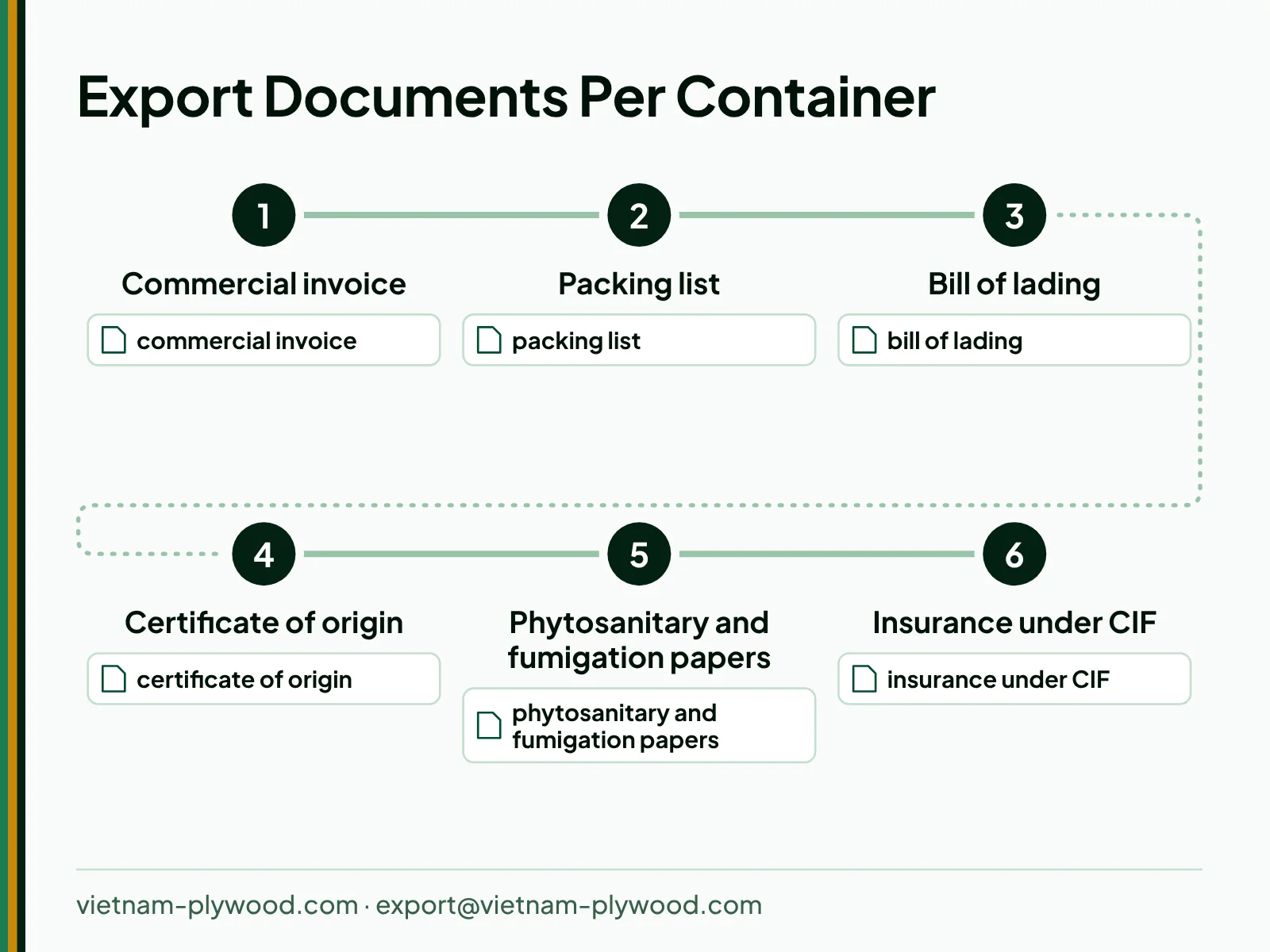
Which papers does the export team supply per container from Hai Phong?
Our export team prepares the commercial invoice, packing list, bill of lading, certificate of origin, phytosanitary and fumigation papers, plus insurance under CIF and the order’s agreed certificate or test-report documents. After loading, the draft shipping documents come to you for approval. Australian import-entry forms and importer due-diligence records remain the Australian buyer’s responsibility.
HCPLY runs specification coordination, on-site quality control, export documents and loading. The purchase order should identify the required certificate-of-origin scheme rather than assuming preferential duty from a generic origin paper. Have the customs clearance provider assess eligibility under the applicable agreement and Australian tariff schedule.
Delivery can be FOB Hai Phong, CFR (CNF) or CIF. The minimum order is one 40HC. Factory lead time runs 15–45 days from receipt of the 30% deposit; the exact figure depends on order size, line loading and what the contract fixes; the 70% balance is against the scanned bill of lading, by T/T or irrevocable letter of credit at sight. Free samples are available; new buyers book their own courier, whose cost can be credited against a real order.
How should an Australian importer compare landed costs?
Start with the written panel specification and the selected shipment term, then add freight, insurance where applicable, customs duty, taxes, port handling, biosecurity examination and domestic delivery. For commercial plywood the indicative starting point is from US$250/m³ FOB Hai Phong (October 2026); for furniture plywood it is from US$350/m³ FOB Hai Phong (October 2026). Formply requires a quotation against the agreed build and test scope.
For formwork, film specification, core and testing scope drive the quote. Use the landed-cost worksheet to separate customs assumptions from factory price.
How does importing plywood into New Zealand differ?
New Zealand uses Ministry for Primary Industries (MPI) import health standards for wood products rather than Australia’s BICON cases. An importer must identify the relevant MPI standard, meet its treatment and certification conditions, and arrange entry with New Zealand Customs. Plywood packaging and any solid-wood pallets require separate attention under New Zealand rules.
New Zealand’s Ministry for Primary Industries lists a dedicated wooden-panels import health standard. Ask the receiving clearance provider to obtain the current standard and identify the required evidence for the specific panels. A phytosanitary certificate, where required by the applicable standard, is obtained through the exporting country’s national plant protection organisation. An Australian biosecurity clearance or a test report for formwork is not a substitute for New Zealand’s plant-health entry decision.
What should be approved before the trial container?
Approve the physical sample, destination-specific biosecurity classification, timber-legality information request, packing construction and any structural test-report acceptance criteria before the order enters production. Name the Australian receiving port and customs clearance provider on the shipment instructions, and agree who will handle any arrival inspection.
Buyers can inspect goods at the producing factory. Lucy can coordinate the build sheet, sample and loading-document review at export@vietnam-plywood.com. Distributors can review several plywood types under one order.
Send the following specification to contact our export team:
Application: Australian import — cabinet / packing / formwork
Line or core: furniture styrax/eucalyptus / packing acacia / construction acacia/eucalyptus
Glue: melamine MR / phenolic WBP
Emission: E0 / E1 / E2 (specify required class)
Face and grade: veneer species and A/B; or film type and film weight
Thickness and tolerance: ___ mm; ___ mm
Size: ___ × ___ mm
Quantity: ___ sheets / pallets / 40HC
Destination port: ___, Australia
Plan a trial container with the approved specification, destination paperwork checklist and agreed inspection scope.