


Most international buyers overpay for Vietnam plywood — not because prices are high, but because they negotiate the wrong things. After processing thousands of export orders from our facilities in Phu Tho Province, the pattern is clear: buyers who focus on the headline FOB number rarely get the best deal. Buyers who understand what actually drives factory pricing walk away with 8–15% lower landed costs.
This guide breaks down what works, what wastes time, and the seven tactics that genuinely move prices with Vietnam plywood suppliers in 2026.
📊 What Drives Plywood Prices in Vietnam — The Factory View
Before you can negotiate effectively, you need to understand the real cost structure. Vietnam plywood price is not a single number — it is a stack of five inputs, each of which you can influence independently.
The five cost components:
| Component | % of FOB Price | Buyer Influence |
|---|---|---|
| Core veneer (species + construction) | 35–45% | High |
| Face veneer (species + grade) | 15–25% | High |
| Glue + emission standard | 8–15% | Medium |
| Processing (sanding, pressing, film) | 10–15% | Medium |
| Overhead, margin, export docs | 10–18% | Low |
The practical implication: every dollar you save should come from the top three rows — spec decisions — not from squeezing a supplier’s margin to the point where quality suffers.
💡 Key Insight: A buyer who switches from eucalyptus core to acacia core for packing plywood saves $10–20/CBM structurally. That is worth more than six months of price emails.
🔧 Tactic 1 — Send a Complete, Precise Specification
Incomplete RFQs (requests for quotation) are the single biggest driver of inflated quotes. When a supplier receives a vague inquiry — “12mm birch plywood, 40HC, price please” — they quote conservatively. They assume premium core construction, top emission standard, and sanded face because assuming less creates quality risk and claim liability.
A complete specification forces an accurate quote:
Product: Birch face plywood
Face: Birch D/E grade
Core: Styrax (loose-laid acceptable)
Glue: Melamine (MR)
Emission: E1
Thickness: 12mm ±0.3mm
Sheet size: 1220×2440mm
Surface: Lightly sanded, S2S
Quantity: 1×40HC
Destination: FOB Hai Phong
Documents required: Phytosanitary, CO Form D, Commercial Invoice, B/L
This specification will receive a quote $15–25/CBM lower than a vague inquiry for the same product, because the supplier is now pricing what you actually need rather than what they fear you might complain about.
⚠️ Important: For furniture-grade plywood targeting the US or EU, do not relax emission standards. CARB P2 and E0 are non-negotiable for those markets. Save on emission only for applications where E1 or E2 is genuinely acceptable — packing, construction, industrial use.
💰 Tactic 2 — Understand FOB Benchmark Ranges Before You Call
Negotiation without a benchmark is guessing. As of Q1 2026, factory-level FOB Hai Phong price ranges for standard 18mm product (1220×2440mm, 1×40HC) are approximately:
| Product Type | Core | FOB Range (USD/CBM) |
|---|---|---|
| Bintangor commercial plywood | Acacia | $190–230 |
| Okoume furniture plywood | Styrax | $240–290 |
| Birch plywood D/E grade | Styrax | $310–370 |
| Film-faced plywood (black) | Acacia | $220–270 |
| Gurjan plywood (India grade) | Acacia/Eucalyptus | $270–340 |
| EV plywood CARB P2 | Styrax | $320–390 |
(HCPLY production data, Q1 2026 — prices vary with raw material cycles)
These ranges represent the realistic market. If a supplier quotes you $180/CBM for birch plywood with styrax core and E0 emission, either the spec is being changed without disclosure, or the production standard is below what you expect. For current market data, see our Vietnam plywood price list with updated FOB rates.
How to use this benchmark: Quote the range when asking for pricing. “We’re seeing $310–370/CBM for birch D/E grade in the market — where does your current production land?” This signals you are an informed buyer, not a first-time inquiry.
📦 Tactic 3 — Volume is the Most Powerful Lever
Vietnam plywood factories run at 10,000–50,000 CBM/month capacity. A single 40HC container represents roughly 45–53 CBM — less than 1% of a mid-size factory’s monthly output. A single order gives you almost no pricing power.
The volume thresholds where pricing moves:
| Order Volume | Realistic Discount vs Single-Container Quote |
|---|---|
| 1 container | Benchmark / list price |
| 3 containers/month | 2–4% |
| 5+ containers/month | 5–8% |
| Annual contract (60+ containers) | 8–15% + priority scheduling |
The most effective approach for small-to-medium importers: consolidate orders. Instead of ordering 1 container of birch and 1 container of okoume separately, combine into a mixed container load. You receive volume pricing while maintaining product diversity. HCPLY allows mixed specifications within a single container at no extra charge, provided the weight constraint is respected (28.5 MT maximum payload for a 40HC).
“Buyers who commit to a rolling 3-month schedule consistently get better rates than those who come back with one-off orders. Factories plan production by the month — showing up in their production calendar is worth real money.” — David, Export Project Leader, HCPLY
📋 Tactic 4 — Negotiate Specification, Not Just Price
The most experienced importers treat specification as the primary negotiation variable. Here are four spec switches that reduce cost without sacrificing fitness for purpose:
📌 Core Construction
Full stitched → edge-jointed: For commercial and packing grades, the premium for full stitched core ($8–15/CBM extra) is only justified for furniture requiring zero-gap face bonding. Packing crates and construction shuttering do not need full stitching.
📌 Core Species
Eucalyptus → acacia for commercial grades: Eucalyptus core at 650–750 kg/m³ density adds weight (higher freight per CBM) and cost compared to acacia at ~580 kg/m³. For non-structural furniture and commercial plywood, acacia core plywood delivers adequate performance at $10–20/CBM less.
Eucalyptus → styrax for premium furniture: Styrax at 480–500 kg/m³ is lighter than eucalyptus, white in color, and the preferred substrate for furniture markets requiring lower weight without sacrificing face quality. Styrax also fits more sheets per container (18 pallets vs 15 for eucalyptus in a 40HC), which reduces freight per sheet. See plywood container packing calculation for 40HC and the CBM per thickness table for detailed packing tables.
📌 Emission Standard
E0 → E1 for non-US/EU applications: E0 (formaldehyde ≤0.5 mg/L, equivalent to CARB P2) adds $3–8/CBM over E1. If your market is South Asia, Middle East, or Southeast Asia — where E0 is not mandated — you are paying for a certification premium you do not need. Confirm market requirements before locking in emission spec. See the glue types and emission standards guide for market-by-market requirements.
📌 Face Grade
A grade → B grade for non-visible panels: Many furniture manufacturers use plywood for back panels, shelving, and internal structures where surface appearance is irrelevant. Switching face grade from A to B for non-visible applications can save $5–10/CBM per order.
⏱️ Tactic 5 — Timing Matters More Than Most Buyers Realize
Vietnam plywood factories are export-driven. Seasonal demand patterns create genuine price variation across the calendar year:
Lower demand periods (better pricing):
- January–February: Chinese New Year slowdown across Asian supply chains. Factories have excess capacity. Buyers who place orders in early January for February/March production often secure 3–6% lower rates (Vietnam Timber and Forest Product Association export data, 2024–2025).
- August–September: Northern Hemisphere summer slowdown in furniture manufacturing reduces European and American orders.
Higher demand, tighter supply:
- March–May: Post-Lunar New Year rush. India, Korea, and Middle East buyers restocking simultaneously. Lead times stretch to 25–35 days and pricing firms up.
- October–November: Pre-Christmas container rush. Freight rates spike 20–40% and FOB prices rise as factories carry less risk on tight delivery schedules.
A buyer with flexible lead time who schedules production in January or August will consistently outperform one ordering at peak season — with zero negotiation required.
💳 Tactic 6 — Payment Terms as a Negotiation Lever
The standard payment structure for Vietnam plywood is 30% deposit, 70% balance against copy of Bill of Lading (B/L). This is the baseline. There is room to move in both directions:
Improve pricing with better terms:
| Payment Term | Typical Supplier Response |
|---|---|
| 50% deposit upfront | $3–8/CBM discount available |
| 100% TT in advance (repeat buyers with trust) | $8–15/CBM below standard rate |
| Letter of Credit (LC at sight) | No discount — adds banking cost $300–600/shipment |
| 30/70 standard | Benchmark rate |
| 30/70 with B/L release before payment | Supplier declines or quotes higher |
The reasoning: Vietnamese factories operate on tight working capital. A higher upfront deposit means they can purchase raw materials — particularly face veneers, which are often imported — without bank financing. The interest saving passes to the buyer.
Do not pursue LC unless your bank requires it. An LC adds cost and processing delay (3–5 days for document checking) that most Vietnam suppliers price into their quote. For established relationships with traceable delivery history, TT payment is cleaner and cheaper for both parties.
⚠️ Note: Improving payment terms only makes sense after at least 2–3 successful orders with the supplier. Never send 50%+ deposit to a new supplier without a factory visit, reference check, or third-party verification. See how to evaluate a plywood supplier for a 20-point checklist.
🔍 Tactic 7 — Use Certification and Documentation as Price Anchors
Certifications add real cost to production. A supplier with FSC chain-of-custody certification carries a $2–5/CBM premium in raw material sourcing. CARB P2 testing requires $500–1,500 per batch in third-party lab fees. CE marking requires regular factory audits averaging $1,500–3,000/year.
This creates a negotiation opportunity in both directions:
When you need certifications: Bundle certification requirements into your spec from the first inquiry. Do not add FSC or CARB requirements after you have agreed a base price — this creates a price increase discussion mid-process. Agree total documented cost upfront. HCPLY’s certifications — FSC, CARB P2, CE, ISO 9001, EUDR, EUTR — are included in our standard export pricing, not quoted as add-ons.
When you don’t need certifications: Be explicit. A Middle East buyer purchasing film-faced formwork plywood for a single construction project may have no regulatory requirement for FSC certification. Removing FSC from your specification removes raw material cost from the equation. Ask suppliers: “Can you quote with and without FSC? I want to see the cost difference.” Suppliers who cannot separate the pricing do not actually understand their own cost structure — a useful screening signal.
For a full breakdown of what each certification covers and which markets require it, see the plywood certifications and export documentation guide.
📊 The Negotiation Mistake That Costs the Most
The most expensive mistake international buyers make is comparing prices from different market segments as if they are equivalent.
A factory producing full stitched, E0, sanded furniture plywood in Northern Vietnam cannot match the per-CBM price of a commercial-grade factory producing loose-laid, E2, unsanded packing plywood — even for the same nominal product description. The cost structures are entirely different (HCPLY production data, 2026).
When buyers receive dramatically low quotes from unknown suppliers, the gap is almost always explained by:
- Core construction downgrade (full stitched → loose-laid, -$12/CBM)
- Emission downgrade (E0 → E2, -$6/CBM)
- Face grade downgrade (A → B or C, -$5/CBM)
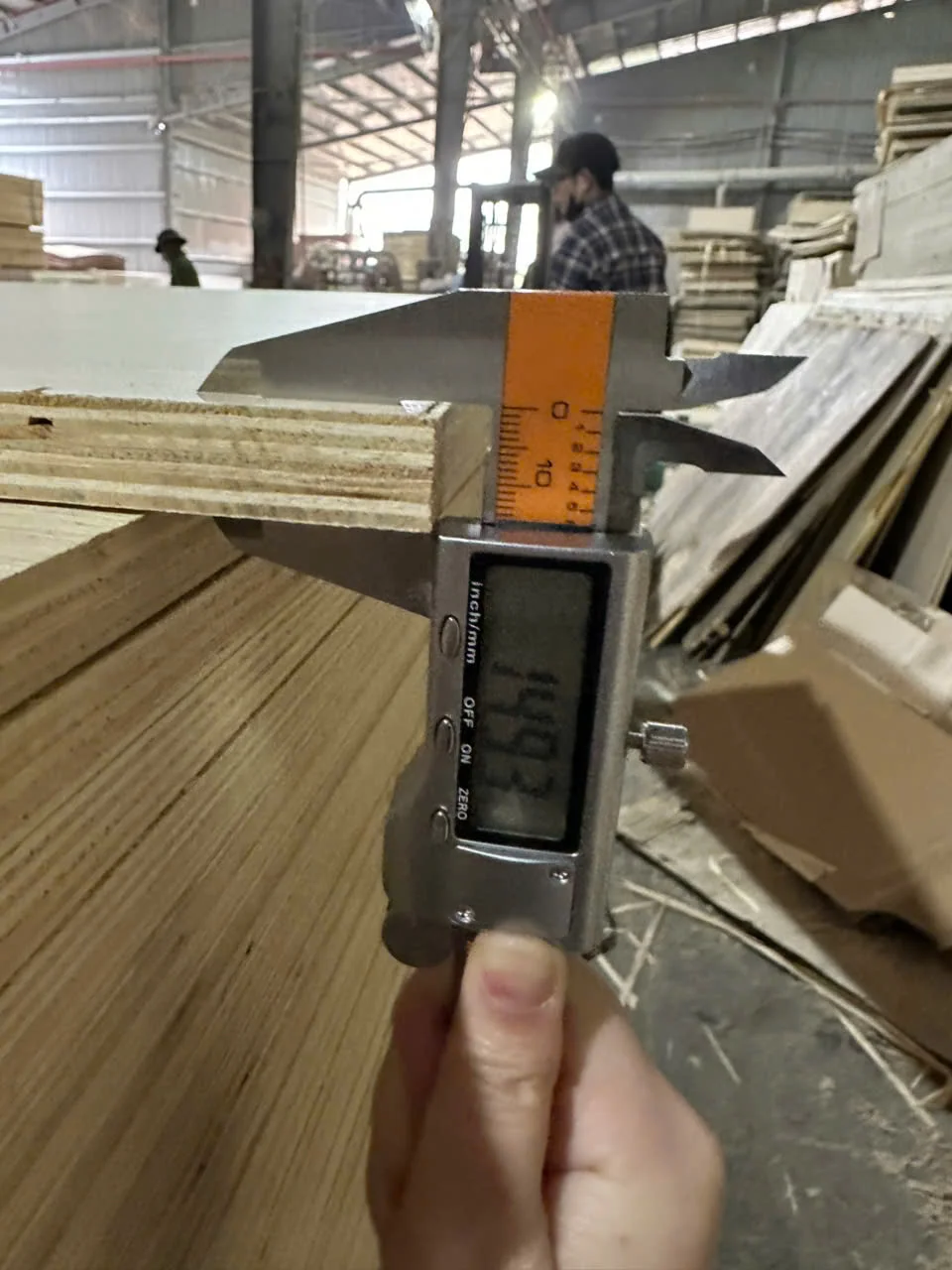
- Thickness shaving (claimed 18mm, actual 17.2mm, -$8/CBM)
The mathematical reality: a competitor quoting $30/CBM below your trusted supplier is often delivering $25–35/CBM less product quality. The apparent saving disappears on arrival.
“In ten years of export work, I’ve never seen a sustainable price gap larger than 10–15% between two suppliers producing genuinely equivalent specifications. When someone quotes 25% below market, something in the spec is different.” — David, Export Project Leader, HCPLY
✅ Putting It Together — The Negotiation Checklist
Before your next Vietnam plywood inquiry, work through this sequence:
- Define your complete specification — face species + grade, core species + construction, glue type, emission standard, surface finish, size, thickness
- Confirm which certifications you actually need — FSC, CARB P2, CE, EUDR (per market, not per habit)
- Research FOB benchmark — know the current market range for your spec before calling
- Calculate your volume — can you consolidate orders or commit to a 3-month schedule?
- Choose your Incoterm — FOB is almost always better for cost control. See FOB vs CIF for Vietnam plywood for landed cost calculations
- Offer a payment term improvement — if you are a repeat buyer, 50% deposit opens a real discount conversation
- Time the order — if your lead time is flexible, target January–February or August–September production
Buyers who approach HCPLY with a complete specification, realistic volume commitment, and a professional payment term routinely achieve pricing in the lower quartile of the market — without adversarial negotiation.
Request a factory-direct quote from HCPLY — send your specification and we will respond with itemized pricing within 24 hours.
Disclosure: This article is published by HCPLY, a Vietnam-based plywood manufacturer and export operator. While we aim to provide objective industry guidance, readers should consider our perspective as a market participant when evaluating recommendations.
🔗 Related Articles
- Plywood Quotation Guide — Everything You Need Before Requesting a Price
- Vietnam Plywood Supplier Types — Buyer’s Due Diligence Guide
- How to Buy Plywood from Vietnam — Complete Buyer Journey Guide — step-by-step from first inquiry to delivered container
- Plywood Supplier Evaluation Checklist — 20-Point Verification
- Plywood Container Packing Calculation — 40HC Factory Tables