


Plywood quality problems rarely surface at the destination port. By then, containers are unloaded, payments are settled, and dispute resolution is expensive. The only reliable protection is a structured quality check at the source — before the container seals.
This guide covers every stage of professional plywood inspection in Vietnam, with the exact tolerances and test methods used by experienced importers sourcing from factories in Phu Tho and Hanoi.
📋 Why Pre-Shipment Inspection Saves More Than It Costs
Key Insight: Based on HCPLY’s order dispute tracking across 50+ export markets (2024–2026), quality disputes ranked among the top three causes of buyer complaints — and the majority were traceable to defects detectable with standard pre-shipment inspection methods.
A rejected container costs $3,000–8,000 in return freight alone, plus customs delays, production downtime at your facility, and lost client confidence. A professional inspection service in Vietnam costs $200–600 for a full container check.
The math is straightforward. The question is not whether to inspect — it is how to inspect effectively.
Get a Free Quote + QC Photo Package from HCPLY
🔍 Step 1: Visual Surface Inspection
Surface inspection is the first and fastest filter. It takes 30 minutes and catches the most visible defects before any instruments are needed.
Inspect under strong, raking light (angled, not direct overhead). This reveals surface irregularities invisible under flat lighting.
What to look for:
- Grain consistency — uniform direction and color tone across the sheet. Patches of different color or grain reversal indicate veneer repairs or mismatched splices.
- Open joints — visible gaps at splice lines on decorative faces (Okoume, Birch, Bintangor). Any open joint wider than 1mm is a defect on Grade A/B faces.
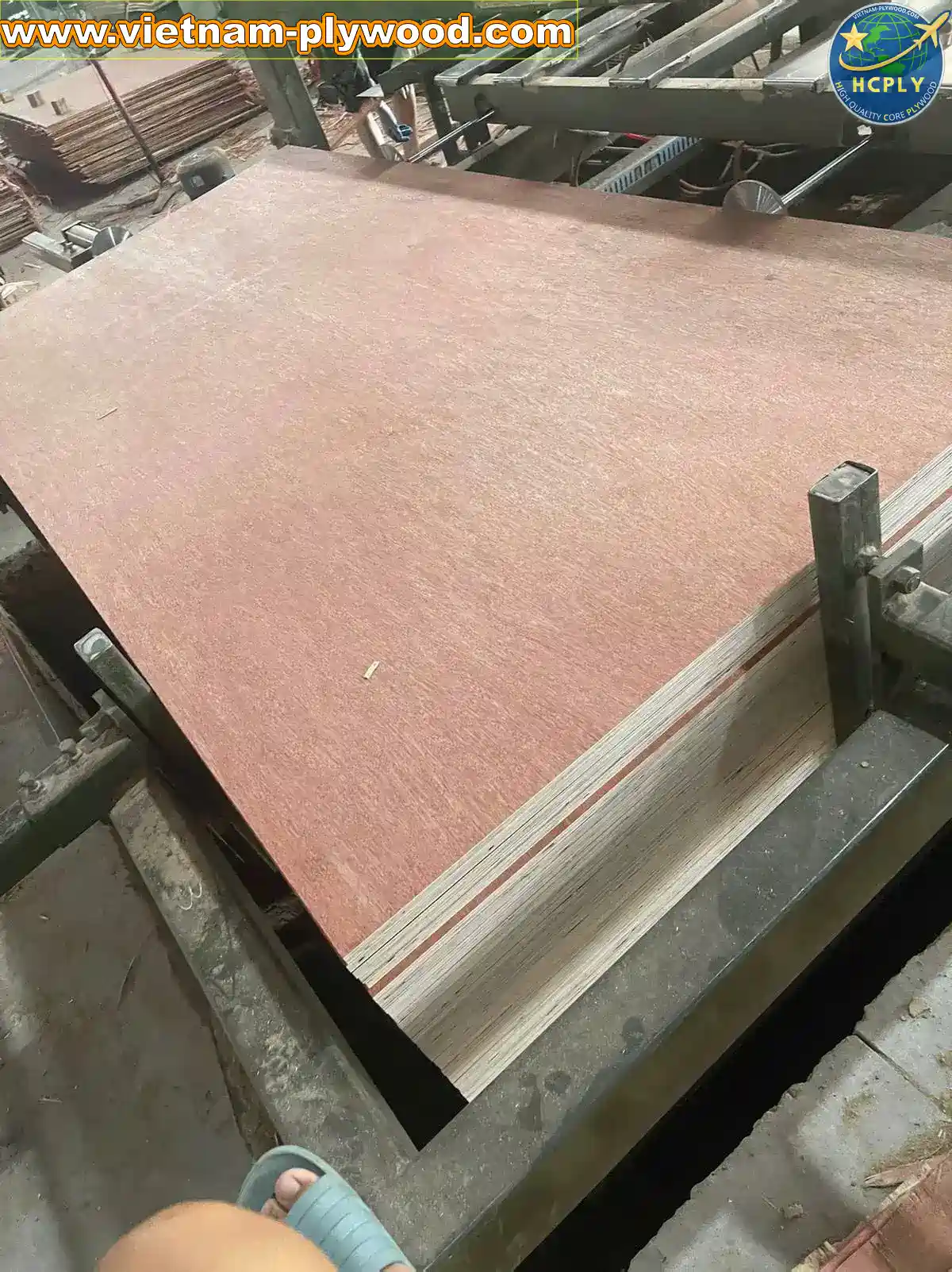
- Sanding marks — circular or linear scratches from calibration sanders. Minor marks acceptable on commercial grade; none acceptable on furniture-grade sanded faces. See our face defect inspection guide for full visual reference.
- Veneer overlaps — where two veneer strips are pressed on top of each other instead of edge-to-edge. Creates a ridge visible under raking light.
- Filler patches — discolored spots where putty or filler was applied over knots or surface voids. Acceptable count per sheet depends on grade specification — confirm with your order specification sheet.
- Delamination at edges — any visible separation of face veneer from core at sheet corners indicates glue or pressing failure.
For premium decorative faces — Birch (D/E/F grade), Okoume, EV (Engineered Veneer) — compare against physical grade samples agreed during order confirmation. Grade descriptions without reference samples are subjective.
📐 Step 2: Thickness and Dimension Accuracy
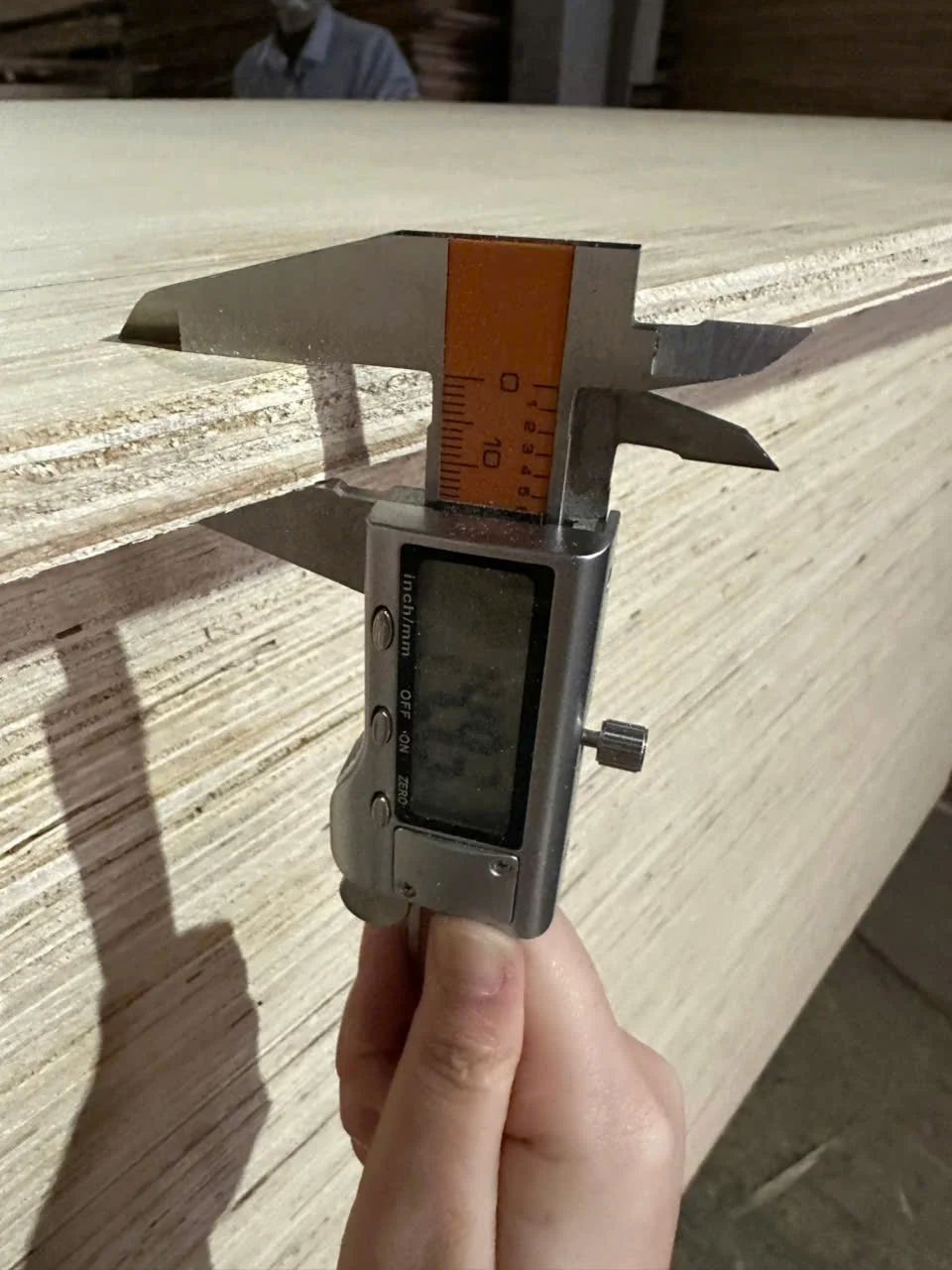
Thickness accuracy is the most frequent source of furniture manufacturer complaints. A 0.8mm deviation in 18mm plywood produces visible steps in assembled cabinet carcasses.
Measurement protocol:
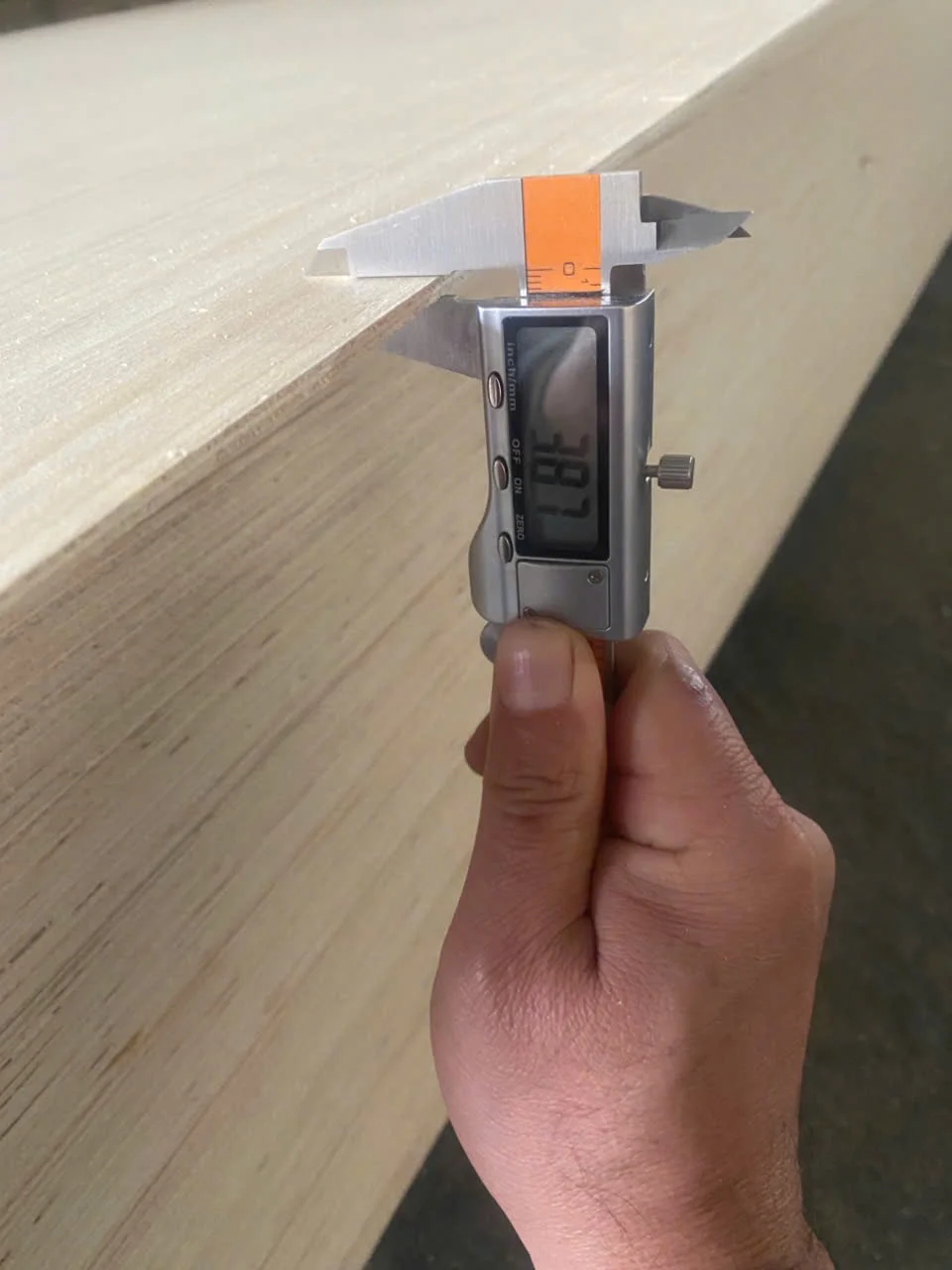
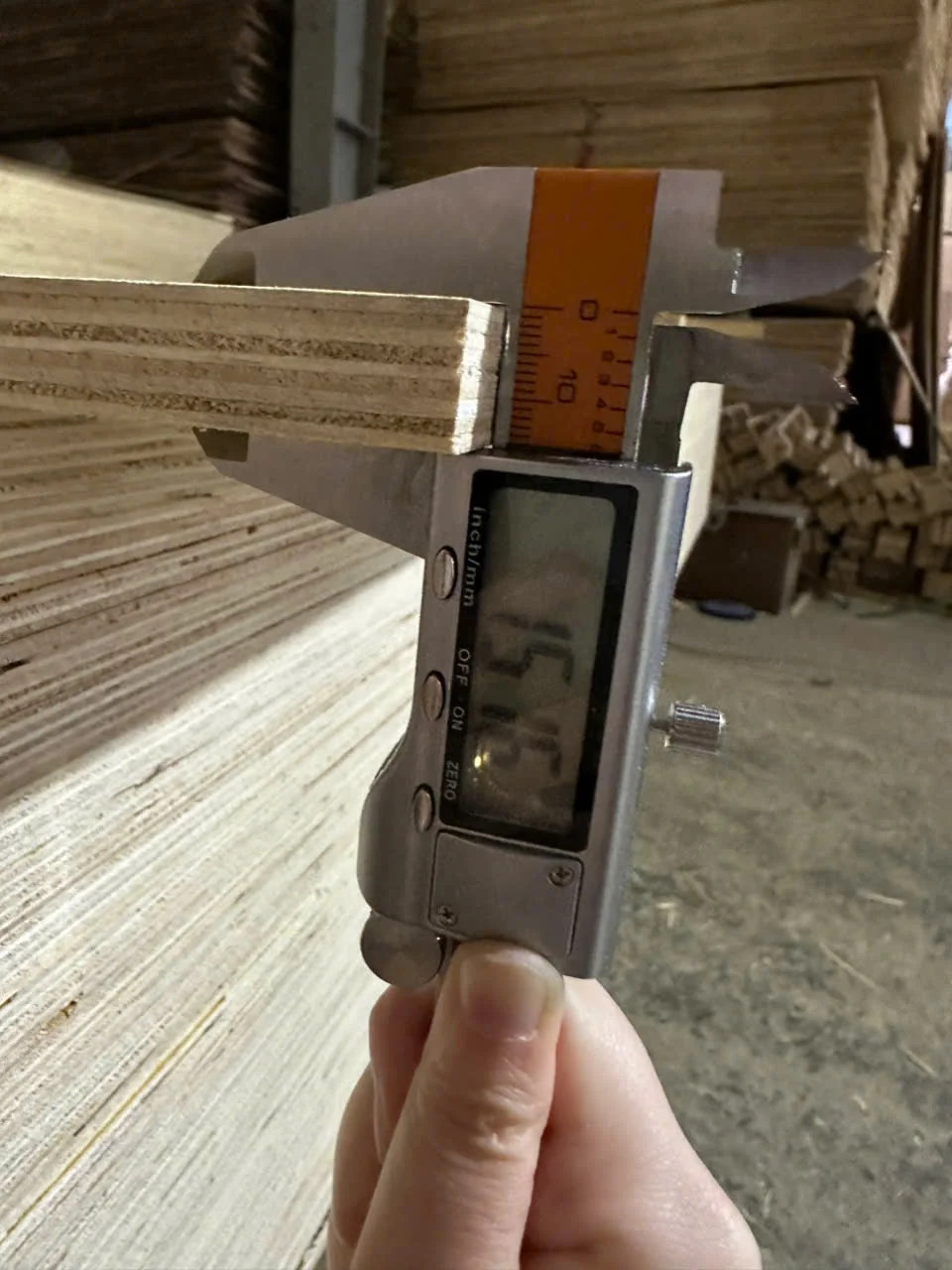
Use a calibrated digital caliper (not a manual vernier caliper — the contact pressure varies). Measure at 5 points minimum per sheet: four corners (50mm from each corner) and the center.
For export-grade Vietnam plywood, the acceptable tolerance is ±0.3mm from the nominal thickness (Vietnamese Standard TCVN 7756:2007). For furniture applications requiring even tighter thickness tolerance, premium facilities can achieve ±0.2mm. Measure at least 5–10 sheets per pallet from different positions in the stack — not just the top sheet, which may have been selectively placed.
Dimension checks:
| Measurement | Tolerance |
|---|---|
| Thickness | ±0.3mm (export grade) |
| Length / Width | ±2mm |
| Squareness (diagonal difference) | ≤3mm for 1220×2440 sheets |
Out-of-square sheets cause assembly problems in CNC-machined furniture. Check by measuring both diagonals — the difference should be under 3mm on standard 1220×2440mm sheets.
⚠️ Important: Calibration sanding removes 0.2–0.5mm from nominal thickness. A 18mm order often ships at 17.6–17.8mm after sanding — this is normal for sanded product. Confirm whether your specification is pre-sanding or post-sanding nominal. For details on thickness specifications and ply count standards, see our complete sizing guide.
🏭 Step 3: Core Quality and Construction
The core is invisible in the finished panel, which is exactly why suppliers can substitute lower-quality core construction without detection — unless you specifically check.
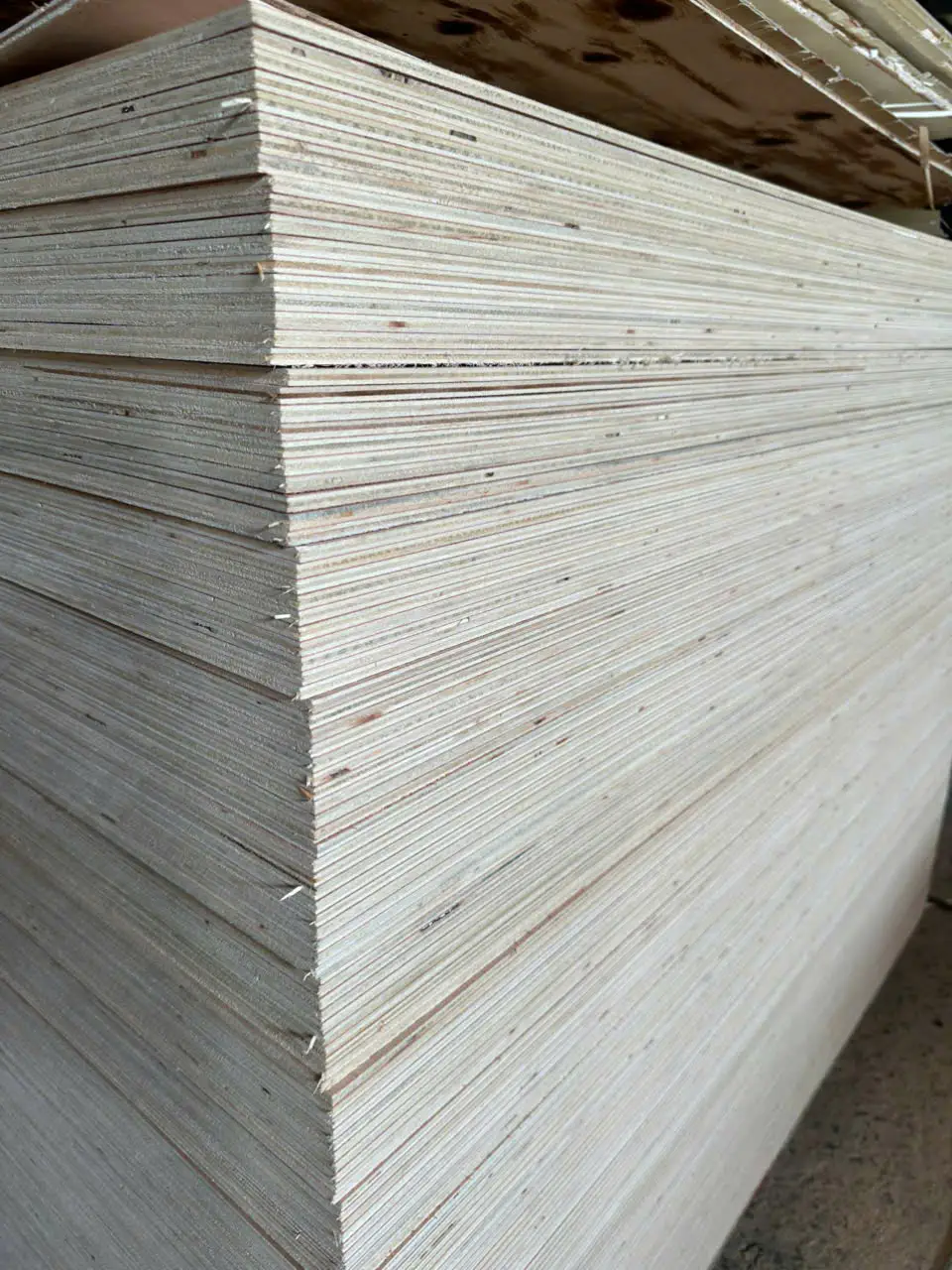
Request a cross-section cut sample before loading. One sheet cut transversally with a circular saw reveals the full core construction.
Core construction types (quality ranking, high to low):
| Construction | Description | Use Case |
|---|---|---|
| Full stitched | All veneer strips sewn together — no gaps, no overlaps | Premium furniture, E0 specification |
| Edge-jointed | Core pieces trimmed and butted edge-to-edge | Commercial grade |
| Loose-laid | Core pieces placed flat without joining | Packaging, structural (not furniture) |
For furniture and cabinet-grade plywood, full stitched construction is the minimum standard. Loose-laid cores with visible gaps transfer load unevenly and create voids that cause face veneer telegraphing and delamination under humidity cycles.
Core species verification:
Vietnam produces three core species for export plywood: acacia (~580 kg/m³), eucalyptus (650–750 kg/m³), and styrax (480–500 kg/m³). The cross-section cut reveals core color — styrax is white/pale, acacia is darker brown, eucalyptus is pale yellow to orange.
Density matters for container loading calculations and structural applications. If you ordered styrax core for weight optimization and received acacia, your freight efficiency drops significantly. For the full breakdown of core type differences and container packing implications, read our core types guide.
“We require buyers to approve a cross-section sample photo before every production run starts — not after pressing. This lets us catch core substitution at the input stage, not at final QC.” — Lucy, International Sales Manager, HCPLY
💧 Step 4: Moisture Content Testing
High moisture content causes warping and mold during transit. Low moisture causes cracking when panels reach humid destination climates. Both are quality failures.
Target moisture range: 8–14% for export plywood (TCVN 7756:2007).
Practical targets by destination market:
| Destination | Target Moisture |
|---|---|
| Southeast Asia, Middle East | 8–10% |
| Europe, US | 10–12% |
| Japan, Korea (strict) | 8–10% |
Use a digital pin-type or pinless moisture meter. Test sheets from multiple pallets — including pallets from the interior of the stack, which dry more slowly than those at the edges. Test at least 3 points per sheet: center and two edges.
⚠️ Note: Moisture testing should happen after the panels have been stacked in the warehouse for 24–48 hours — not immediately after pressing. Post-press temperature artificially lowers meter readings.
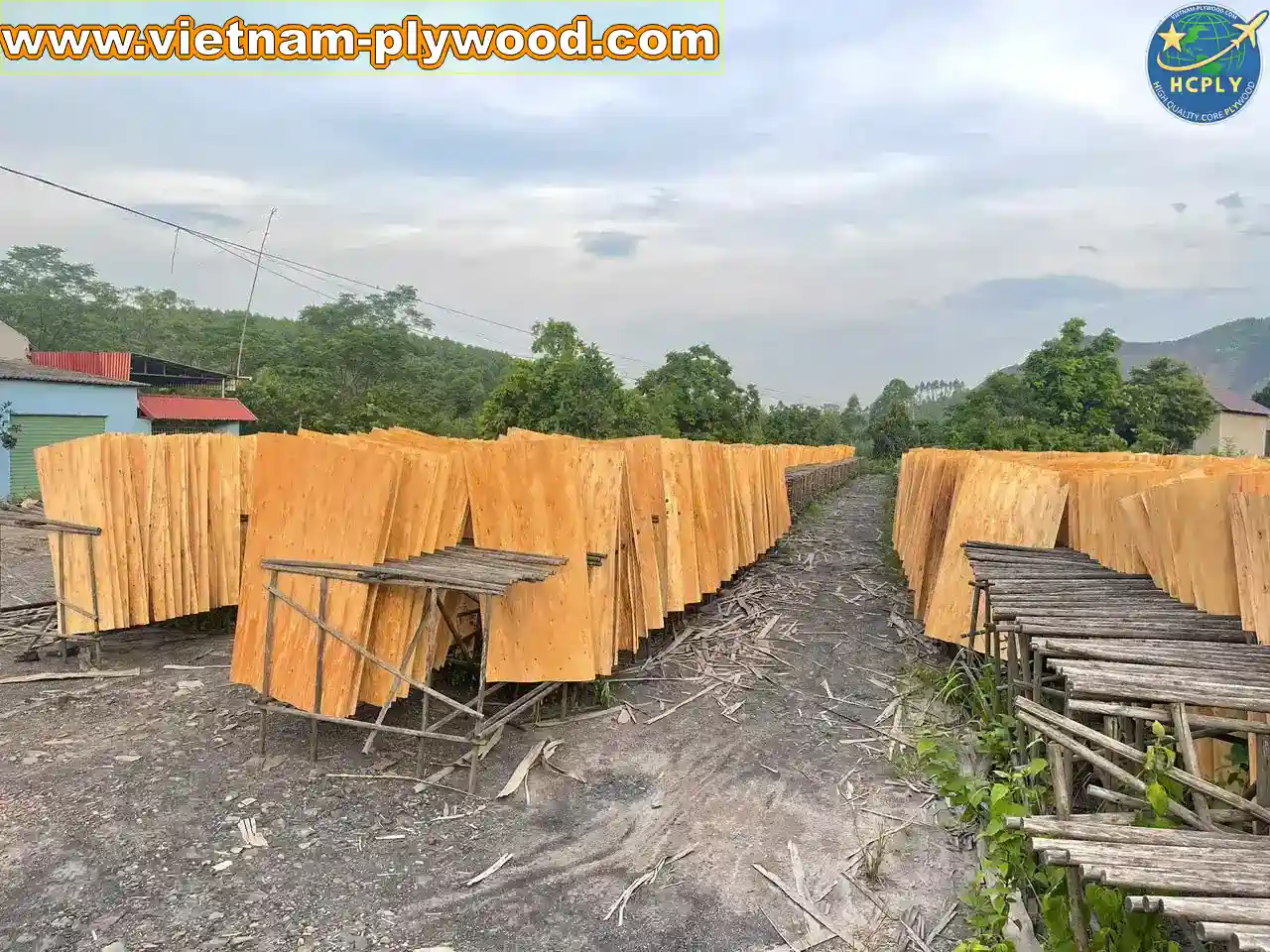
High moisture often indicates inadequate veneer drying before glue application — a process failure, not just a storage issue. For context on how this fits into the full Vietnam plywood manufacturing process, see our factory process guide.
⚙️ Step 5: Glue Bond and Boil Test Verification
Glue type and emission standard are two separate specifications — a common confusion that creates costly mismatches.
Glue type determines water resistance:
- Melamine (MR) — 12-hour boil test. Interior and moisture-resistant applications.
- Phenolic (WBP) — 72-hour boil test. Exterior, marine, construction.
Emission standard determines formaldehyde content:
- E0 / CARB P2 — ≤0.5 mg/L. Required for US, EU furniture imports.
- E1 — ≤1.5 mg/L. Standard EU grade.
- E2 — ≤5.0 mg/L. Industrial/exterior use only.
For the complete guide to glue types and emission standards including how to read certificates, see our dedicated guide.
Field boil test for WBP verification:
Cut a 300×75mm sample. Submerge in boiling water for 72 hours (WBP specification). At 72 hours, the bond should remain fully intact with any failure occurring in the wood fiber, not at the glue line. Photograph results for your QC documentation.
MR-grade plywood will delaminate within 6–24 hours — this is expected behavior, not a defect. The problem occurs when WBP is specified but MR is supplied. Boil test results from certified labs (SGS, Bureau Veritas) are available in test reports — request these documents as part of your shipment documentation.
📦 Step 6: Edge, Corner, and Packing Inspection
Edge quality predicts how well the panel handles downstream processing. Chipped or frayed edges cause tearout in CNC routing, and delaminated corners mean the first layer of veneer is already separating.
Edge inspection checklist:
- Edges trimmed cleanly — no fraying, tearout, or ragged cuts
- Corners intact — no crushing or chipping (check all four corners of each bundle top sheet)
- No visible delamination starting at edges (the most common transit damage origin point)
- Edge sealing present if specified — painted or wax-sealed edges protect against moisture absorption during sea transit
Packing verification:
| Packing Element | Minimum Standard |
|---|---|
| Pallet condition | No broken slats, flush support across sheet footprint |
| Wrapping | Waterproof plastic film — fully sealed, no open seams |
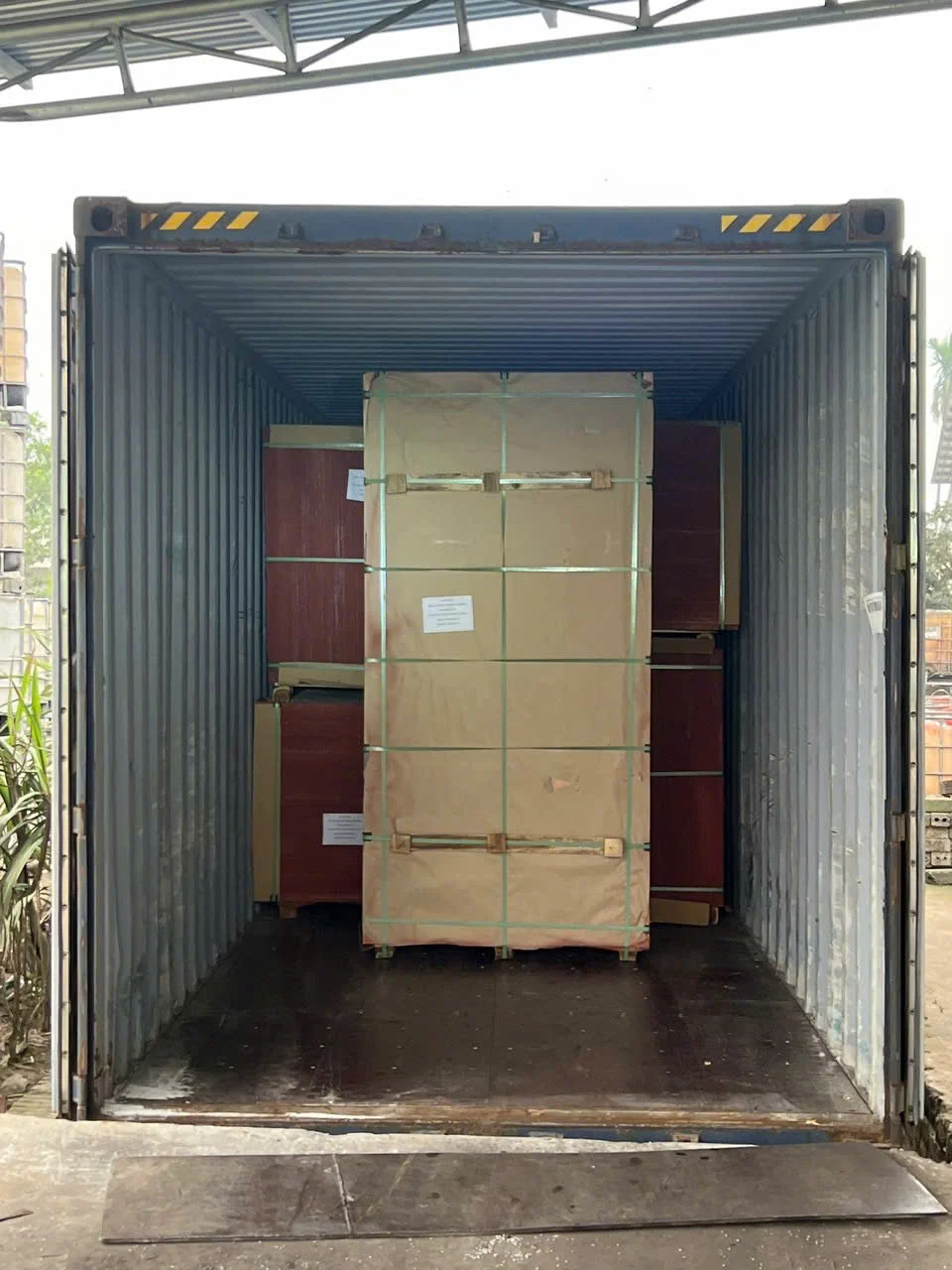
| Strapping | Steel or PP band, minimum 4 bands per pallet |
| ISPM 15 marking | Heat-treatment stamp on all pallet wood — required for most importing countries |
| Labels | Product name, size, grade, quantity, production batch per bundle |
Verify ISPM 15 compliance on every pallet — this is a phytosanitary requirement enforced at customs in the US, EU, Australia, and most other major importing markets. Missing or invalid stamps can hold an entire container at customs. For export documentation requirements including phytosanitary certificates, see our certifications guide.
🔗 Step 7: Third-Party Inspection Services
If you cannot visit the factory, a third-party pre-shipment inspection is the closest equivalent to being there.
Established inspection companies operating in Vietnam:
- SGS Vietnam — full dimensional, moisture, visual, and mechanical testing
- Bureau Veritas — ISO-accredited, widely accepted by EU and US customs
- Intertek — specialized in CARB P2 and formaldehyde emission testing
A standard pre-shipment inspection for one 40HC container covers: random sampling protocol (typically 5–10% of bundles), dimensional measurement, visual grading, moisture spot testing, and packaging check. Cost: $300–600 depending on scope and location.
HCPLY coordinates directly with third-party inspectors — providing QC access, technical documentation, and dedicated factory floor time. Inspection scheduling should be agreed 5–7 days before the planned loading date to avoid conflicts with production schedules.
💡 Tip: For first-time supplier relationships, request inspection on Day 1 of loading — not Day 3. This allows time to reject and re-source defective bundles before the container fills.
🏭 A Professional 3-Stage Quality Control System
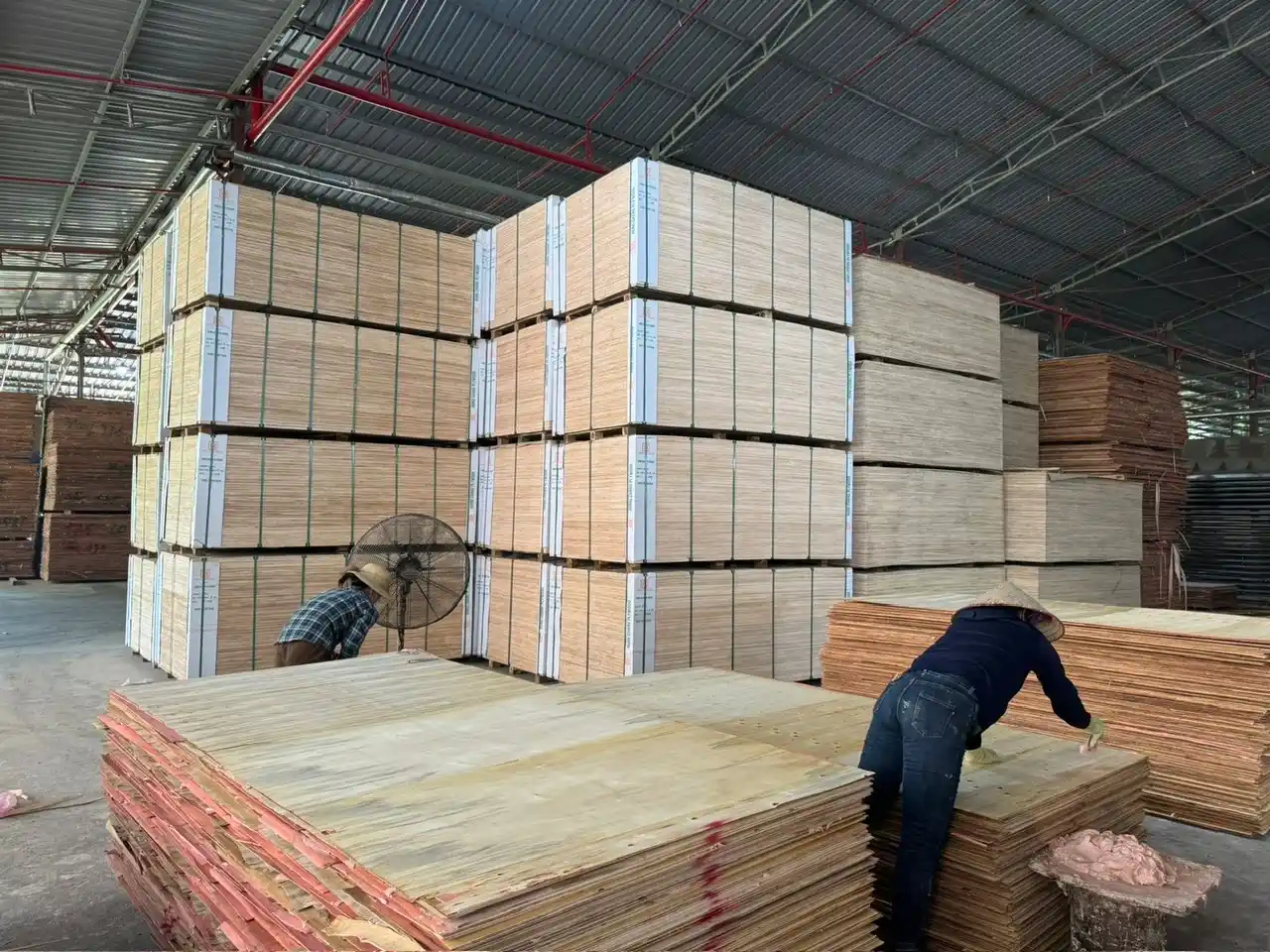
HCPLY operates a documented 3-stage quality control process across all three production facilities in Northern Vietnam:
Stage 1 — Post-Press (In-Line)
- Thickness measurement every 20 panels
- Surface visual inspection under raking light
- Bond line check: cross-section samples from press batches
Stage 2 — Post-Sanding (Before Stacking)
- Calibration verification: digital caliper spot check
- Surface grade confirmation against order specification
- Moisture content measurement: 3 points per sheet, multiple sheets per pallet
Stage 3 — Pre-Loading (Container Inspection)
- Final dimensional check: random bundles per container
- Packing verification: wrap, strapping, ISPM 15 stamps, label accuracy
- QC photo documentation sent to buyer before container seals
Buyers receive a QC photo report — covering thickness measurements, core cross-sections, surface grades, and packing — before the final balance payment is requested. For visual examples of these checks in action, browse our factory inspection videos.
Contact HCPLY Now for a QC Photo Package + Free Sample
✅ Conclusion: The Pre-Shipment QC Checklist
A complete Vietnam plywood quality check before shipping covers eight verification points:
- Surface inspection — grade confirmation, defect detection under raking light
- Thickness accuracy — ±0.3mm tolerance, 5-point measurement per sheet
- Dimensions and squareness — ±2mm length/width, diagonal difference ≤3mm
- Core construction — stitched vs loose-laid confirmed by cross-section sample
- Core species — visual color check (styrax=white, acacia=dark, eucalyptus=yellow)
- Moisture content — 8–14% target, tested across multiple pallets
- Glue bond — boil test (72h for WBP, 12h for MR), lab certificate verification
- Packing — ISPM 15 stamps, waterproof wrap, steel strapping, accurate labels
Every one of these checks can be completed before the container seals. None require specialized equipment beyond a digital caliper and a moisture meter. Combined with a third-party inspection for higher-value orders, this process eliminates the most common causes of post-shipment quality disputes (HCPLY production data, 2026).
For buyers working with HCPLY, Steps 1–3 are documented with photos sent at Day 1 of loading. As of 2026, we have shipped to 20+ countries with zero FOB-stage quality claims on certified orders.
Disclosure: This article is published by HCPLY, a Vietnam-based plywood manufacturer and export operator. While we aim to provide objective industry guidance, readers should consider our perspective as a market participant when evaluating recommendations.
Get a Free Sample + QC Documentation Package from HCPLY
For the complete purchasing process including supplier selection and logistics, see our guide to buying plywood from Vietnam. Learn more about our quality control process and quality certifications.