

Vietnam ships over 200 containers of plywood daily to 50+ countries — yet most international buyers still approach their first purchase with incomplete information, vague specifications, and no structured process. The result is predictable: mismatched quality, disputed invoices, containers held at customs, and damaged business relationships that could have been avoided with proper preparation.
This guide documents the complete buyer journey for purchasing plywood from Vietnam — from defining your first specification sheet to optimizing repeat orders for better pricing. Every step is based on HCPLY’s direct experience processing thousands of export orders from our production facilities in Northern Vietnam to buyers across India, the UAE, Europe, Korea, and 30+ other markets.
Whether you are a furniture manufacturer learning how to buy plywood from Vietnam for CNC production (birch plywood is the standard choice), a construction company importing film-faced plywood for formwork, or a trading company building a multi-product container — the 8-step framework below applies. Follow it in sequence. Skip no steps. The cost of skipping even one step (particularly Step 4: Sample Evaluation) is almost always higher than doing it right from the start.
This guide complements our Plywood Quotation Guide (the 12-factor specification checklist) and our Vietnam Plywood Supplier Types analysis. Read all three for a complete purchasing framework.
📋 Step 1: Define Your Requirements
The single most expensive mistake in international plywood procurement is requesting a quotation before your specification is complete. When you ask for a price on “birch plywood 18mm” without specifying core species, emission standard, glue type, face grade, core construction quality, and certifications — you receive a number that means nothing. Two factories can legitimately quote prices 40–60% apart for products they both call “birch plywood 18mm.”
Before contacting any supplier, define these six specification dimensions.
📌 Face Veneer Type and Grade
Vietnam manufactures plywood with 10+ face veneer options: bintangor (most affordable), okoume (lightweight, marine-suitable), birch (premium furniture, D/E/F grade), gurjan (Indian market standard), pine, poplar, eucalyptus, EV (engineered veneer), film-faced (construction formwork), and anti-slip (scaffolding, truck floors).
Your target market determines face veneer selection:
| Target Market | Preferred Face Veneer | Reason |
|---|---|---|
| EU furniture | Birch, Okoume, EV | Neutral tone, smooth grain, paintable |
| India, South Asia | Gurjan, Bintangor | Traditional preference, darker tones |
| Construction (global) | Film-faced, Anti-slip | Phenolic/melamine overlay for reuse |
| Commercial/packaging | Bintangor, Poplar | Cost-effective, functional |
| Marine | Okoume, Birch | WBP-bonded, lightweight |
📌 Core Species
Vietnam produces plywood on three core species only — this is a hard constraint of Vietnamese plantation forestry:
- Acacia core (~580 kg/m3) — most affordable, darker color, commercial and packaging applications
- Styrax core (480–500 kg/m3) — lightest, best for furniture and CNC, birch-core alternative
- Eucalyptus core (650–750 kg/m3) — heaviest and strongest, premium construction and structural
Core species determines panel density, panel weight, container loading capacity, screw-holding strength, and price. It is the single most important cost driver in a plywood specification — more important than face veneer type. For detailed core analysis, read our factory types guide which explains how different factories specialize in different core segments.
Glue Type and Emission Standard
These are two separate specifications — a common source of confusion.
Glue type determines water resistance:
- Melamine (MR) — passes 12-hour boil test, suitable for interior furniture and dry conditions
- Phenolic (WBP) — passes 72-hour boil test, required for construction, marine, and exterior exposure
Emission standard determines formaldehyde off-gassing:
- E0 / CARB P2 — lowest emission, mandatory for US/EU/Japan furniture export
- E1 — standard for European general interior use
- E2 — budget grade, limited to packaging and industrial applications
A correct specification reads: “Glue: Melamine (MR). Emission: E0.” Never combine these into a single line like “MR E0 glue” — they are independent parameters. Our glue and emission guide covers this distinction in full technical detail.
Size, Thickness, and Quantity
Standard sizes: 1220 x 2440mm (4x8ft, most common globally) or 1250 x 2500mm (metric, preferred in Europe). Custom cutting is available but adds cost.
Thickness range: 3–40mm. Common export thicknesses: 3, 5, 9, 12, 15, 18, 21, 25mm. Thickness tolerance is ±0.3mm; length/width tolerance is ±2mm.
Quantity: The standard MOQ is 1 x 40HC container. A 40HC carries 40–53 CBM depending on core species — styrax core loads approximately 53 CBM (18 pallets), acacia approximately 47.5 CBM (16 pallets), eucalyptus approximately 44.5 CBM (15 pallets). For full container loading calculations, see our container packing guide.
Price breaks typically apply at 5+ containers per order and 20+ containers per month for contract pricing.
Target Market Certifications
Certification requirements are non-negotiable — get them wrong and your container cannot clear customs:
| Destination | Required Certifications |
|---|---|
| USA | CARB P2 (formaldehyde), Lacey Act PPQ 505, TSCA Title VI |
| EU | CE marking, FSC (preferred), EUDR due diligence documentation |
| India | BIS IS 303 certification (mandatory for plywood imports) |
| Japan | JAS (Japan Agricultural Standards), F4-star emission |
| Korea | E0 emission compliance, KS F 3113 standard |
| Australia | AS/NZS 2269, phytosanitary compliance |
| All markets | Certificate of Origin, Phytosanitary Certificate, Fumigation Certificate |
For full regulatory details by market: US compliance guide, India BIS guide, EUDR guide.
🔍 Step 2: Find and Evaluate Suppliers
Vietnam has hundreds of plywood-related businesses visible online. Most are not what they appear to be. Understanding the four supplier types is the single most important due diligence step you can take.
Four Supplier Types in Vietnam
Type 1: Trading Company (~80% of search results) Buys OEM from factories, resells with markup. Adds VAT 8% to the price chain. Large sales teams, strong SEO presence. Risk: may show you a premium factory but ship from a cheaper one.
Type 2: Manufacturer-Exporter (few) Owns one factory plus an export sales team. Direct quality control but limited to one factory’s product range and capacity (typically 30–100 containers/month).
Type 3: Broker (small, informal) One or a few individuals connecting buyers to small OEM factories. Low overhead means competitive pricing (typically $5–10/CBM markup). Risk: limited QC influence at the factory.
Type 4: Multi-Facility Export Operator (HCPLY model) Independent export operation managing dedicated production across multiple specialized facilities. Factory-direct documentation and pricing. No VAT overhead. On-site QC team at each facility. Multi-segment product coverage from one contact point.
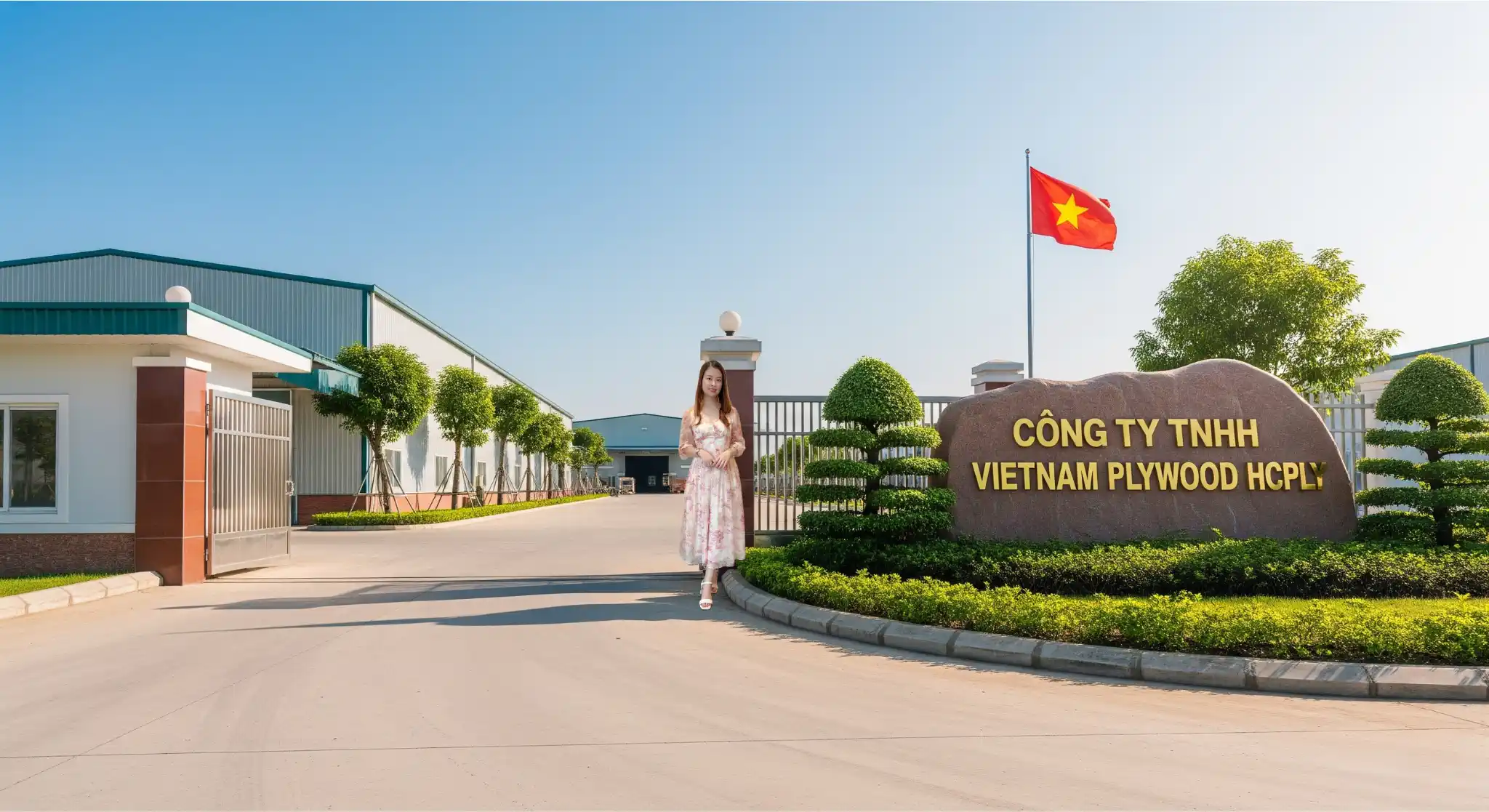
HCPLY operates as Type 4 — managing 3 specialized production facilities in Northern Vietnam: one for premium furniture-grade plywood (styrax/eucalyptus core, E0, full stitched, sanded), one for commercial and packing grades (acacia core, competitive pricing), and one for premium film-faced plywood (AICA film, phenolic/melamine, reuse 15+).
Red Flags — Warning Signs of Unreliable Suppliers
Watch for these patterns during initial communication:
- VAT 8% visible in pricing breakdown — indicates a trading company buying from factories, not a direct manufacturer
- No factory photos with timestamps — stock photos or photos from factories they do not control
- Copied or borrowed certificates — FSC or ISO certificates showing a different company name
- Vague answers about core species — “mixed tropical hardwood” instead of specifying acacia, styrax, or eucalyptus
- No named QC contact — unable to introduce the person responsible for quality at the production facility
- Refusal or deflection of factory visit requests — a genuine manufacturer invites you to visit
- Quoting a price significantly below market — if styrax-core birch plywood at 18mm is $250/CBM when market is $380–580, the specification is not what you think it is
- No test reports available — inability to provide emission testing, glue bond testing, or moisture content verification
Green Flags — Signs of a Reliable Supplier
- Factory visit invitation with specific address and contact person
- Named QC contacts you can communicate with directly
- Third-party test reports from accredited laboratories
- Real production photos and videos showing your product type being manufactured
- Clear answers about core species, glue type, and emission standard as separate parameters
- Willingness to ship samples before bulk order commitment
- Verified reviews from international buyers — HCPLY has 669+ verified reviews across 30+ countries
- Transparent pricing structure with specification-by-specification breakdown
💰 Step 3: Request Quotation
A quotation request (RFQ) is only as good as the specification sheet behind it. Our Plywood Quotation Guide covers all 12 pricing factors in detail. Here is the practical process.
What to Include in Your RFQ
Send your supplier a complete specification sheet. At minimum:
- Face veneer — species, grade (e.g., Birch D grade, Okoume A/B)
- Core species — acacia, styrax, or eucalyptus
- Core construction — full stitched, edge-jointed, or loose-laid
- Glue type — Melamine (MR) or Phenolic (WBP)
- Emission standard — E0, E1, or E2
- Thickness — each thickness required, with approximate quantity per thickness
- Sheet size — 1220x2440mm or 1250x2500mm
- Total quantity — in containers (e.g., 1 x 40HC, 5 x 40HC)
- Certifications required — FSC, CARB P2, CE, BIS, or none
- Destination port — for CIF/CFR quotation
- Incoterm preference — FOB Hai Phong, CIF, or CFR
Incomplete RFQs receive incomplete quotes. A supplier quoting on “birch plywood 18mm” without knowing your core species, emission standard, and certifications is guessing — and the guess will almost certainly not match what you need.
Understanding FOB, CIF, and CFR Pricing
| Incoterm | Seller Covers | Buyer Covers | Best For |
|---|---|---|---|
| FOB Hai Phong | Production + inland transport + port loading | Ocean freight + insurance + destination costs | Experienced importers with freight forwarders |
| CFR (destination port) | FOB + ocean freight | Insurance + destination costs | Buyers who want freight included, handle own insurance |
| CIF (destination port) | FOB + ocean freight + insurance | Destination costs only | First-time buyers who want all-in pricing |
FOB Hai Phong is the standard Incoterm for Vietnam plywood exports. It gives the buyer full transparency on the product price versus freight cost, and the flexibility to negotiate freight rates independently.
Sample Request Process
Before committing to a full container, request production samples. Standard practice:
- Sample cost: typically free for 2–3 small pieces; $50–200 for a full sample set (multiple face veneers, thicknesses, core options)
- Shipping: air freight via DHL or FedEx, 5–7 days to most destinations
- Sample credit: reputable suppliers credit sample and shipping costs against the first container order
- What to request: at least one sample per face/core/thickness combination you plan to order, plus one competitor sample for benchmarking if available
When requesting samples, specify that you want production-grade samples (cut from regular production stock), not special-grade samples (prepared specifically to impress). This distinction matters.
🔬 Step 4: Sample Evaluation
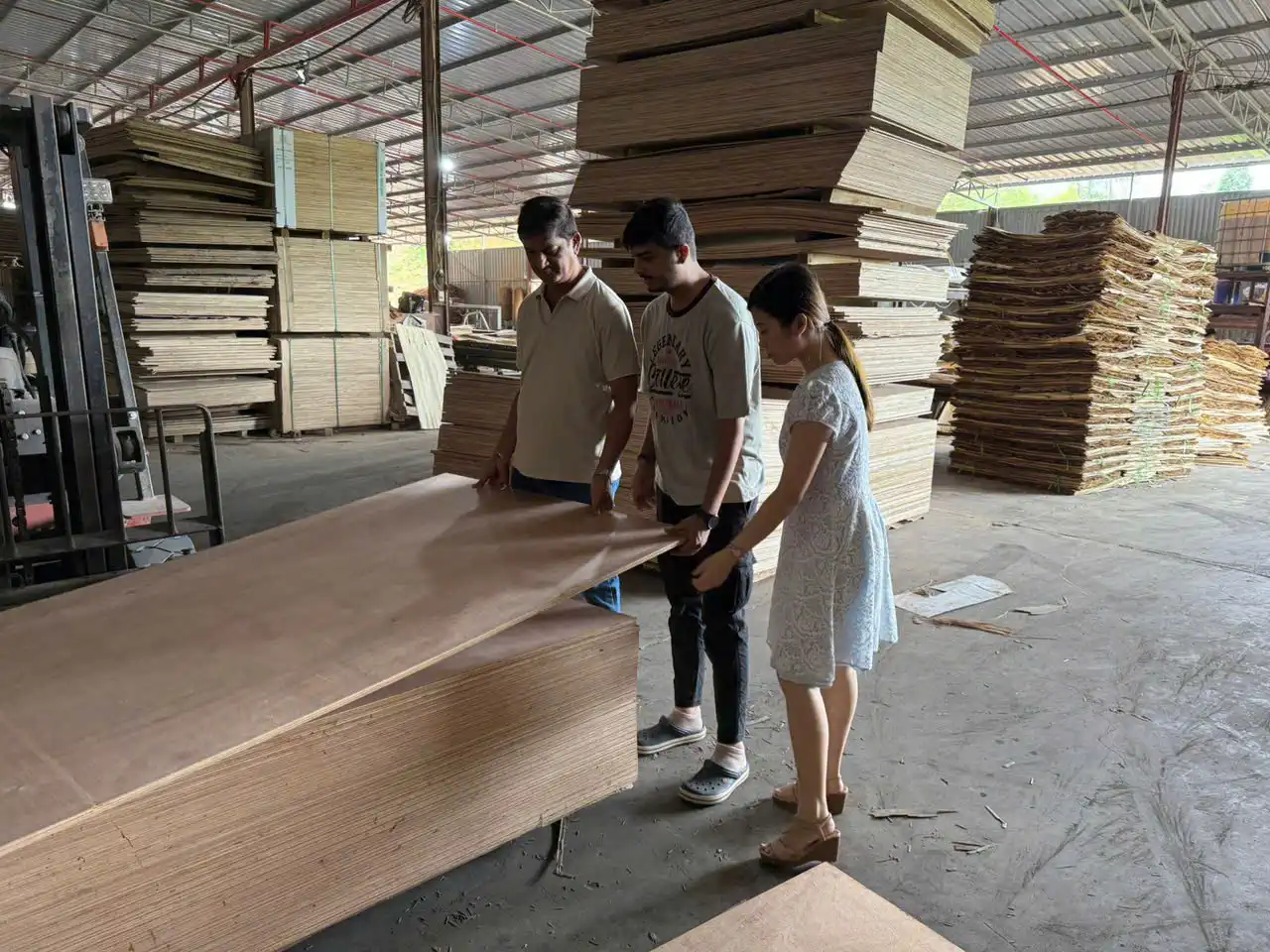
Sample evaluation is the step most first-time buyers rush through — and the step that prevents the most problems. Do not skip this. Do not accept photos instead of physical samples. The cost of evaluating samples ($50–200 plus a week of your time) is negligible compared to the cost of rejecting a container ($15,000–30,000 in product, freight, and lost time).
What to Check on Physical Samples
Thickness verification: Measure at 8+ points across the panel using a digital caliper. Tolerance should be within ±0.3mm of stated thickness. Variation beyond this indicates inconsistent pressing or calibration issues.
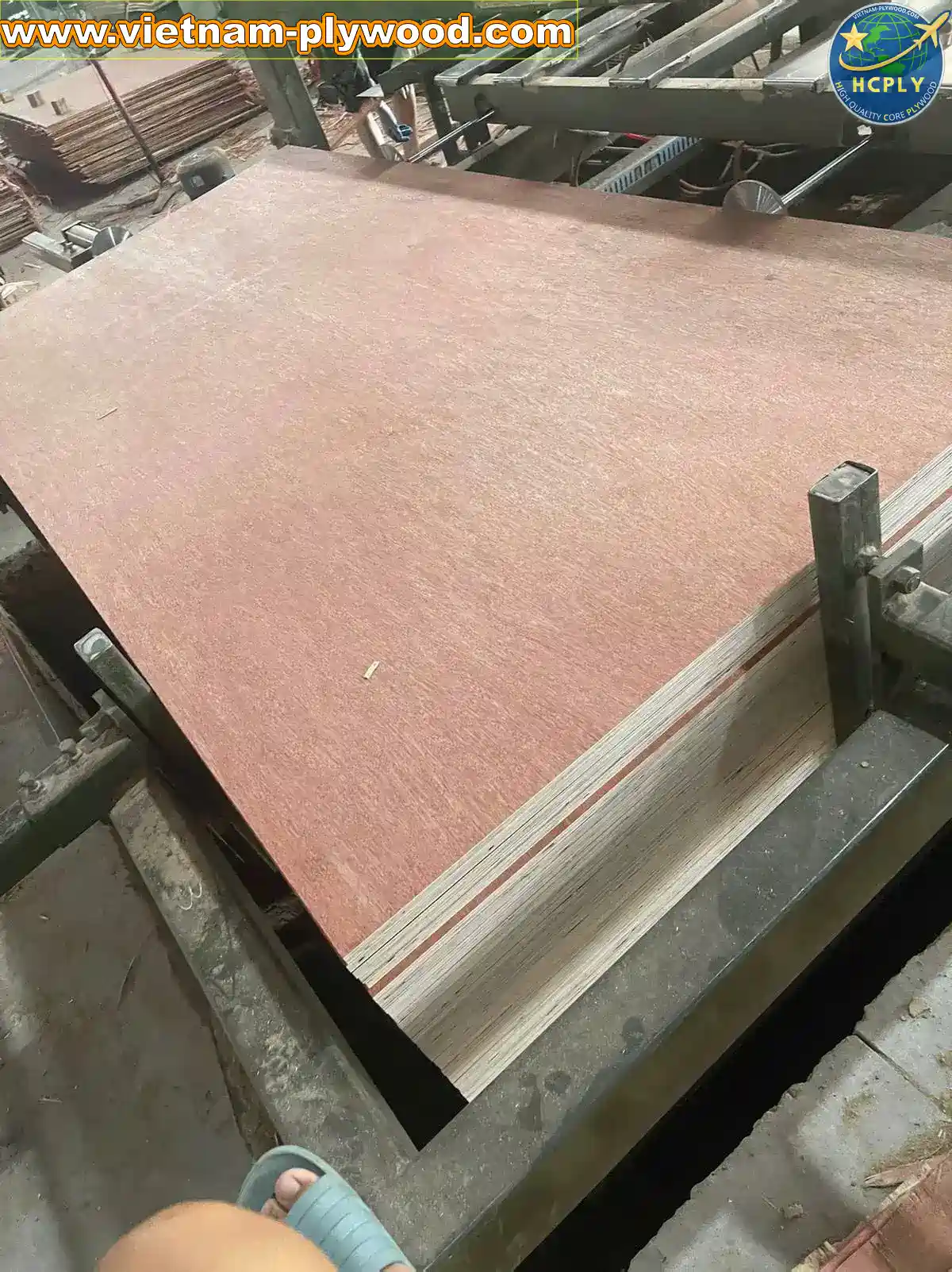
Surface quality: Inspect the face veneer for knots, patches, splits, sanding marks, and color consistency. For furniture grades (birch, okoume, EV), the face should be smooth enough to accept paint or lacquer without additional preparation. For construction grades (film-faced, anti-slip), check film adhesion and surface uniformity.
Core inspection: Examine the panel edges closely. Look for:
- Core gaps or voids between veneer layers (indicates loose-laid construction)
- Overlapping veneer pieces (indicates poor assembly)
- Consistent core species throughout all layers (no substitution)
- Glueline uniformity — no dry spots or excessive squeeze-out
Weight verification: Weigh the sample panel and calculate density against the specified core species. An 18mm panel at 1220x2440mm should weigh approximately:
- Styrax core: 25–28 kg
- Acacia core: 29–33 kg
- Eucalyptus core: 38–45 kg
Significant deviation from these ranges indicates a different core species than specified.
Bonding Test (Boil Test)
For WBP-specified panels, cut a 100x100mm piece and submerge in boiling water:
- WBP (Phenolic): should survive 72 hours of continuous boiling without delamination
- MR (Melamine): should survive 12 hours
For MR-specified panels, a 4-hour boil test is a practical field verification. Any delamination indicates bonding issues that will cause field failures.
Moisture Content
Use a pin-type moisture meter at 5+ points across the sample. Target: 12% or below. Panels shipping at above 12% moisture will warp, cup, or develop face checks during transit and acclimatization at destination. This is particularly critical for pale-faced species (birch, okoume, poplar) where moisture staining is visible.
Laboratory Testing
For regulated markets, laboratory testing of samples before bulk ordering is strongly recommended:
- Formaldehyde emission test — mandatory for CARB P2 (USA) and E0/E1 (EU). Request a test report from an accredited laboratory, not a self-declaration
- Glue bond shear test — verifies the strength of the glueline under load
- Species identification — confirms the actual face veneer and core species match the specification
Competitor Benchmarking
If you currently buy plywood from another supplier, send one of those panels to your prospective Vietnam supplier alongside your sample request. Ask them to produce a panel that matches or exceeds your current supply quality. This gives both parties a concrete reference point instead of abstract specifications.
📝 Step 5: Negotiate and Finalize Contract
Once samples are approved, the commercial negotiation follows a predictable structure in Vietnam plywood trade.
Payment Terms
| Buyer Type | Typical Payment Structure |
|---|---|
| First-time buyer | 30% T/T advance deposit + 70% against B/L copy |
| Repeat buyer (2–5 orders) | 30% T/T + 70% against B/L, or 100% L/C at sight |
| Established partner (10+ orders) | Negotiable — 20% deposit + 80% B/L, or 60-day L/C |
| High-volume contract | Framework agreement with rolling payment terms |
Warning: Any supplier requesting 100% advance payment on a first transaction is a significant risk. Standard practice in Vietnam plywood trade is a deposit (typically 30%) with the balance against shipping documents. This protects both parties.
Letter of Credit (L/C) at sight is the most secure instrument for both buyer and seller — the bank guarantees payment upon presentation of conforming documents. First-time buyers who are uncomfortable with T/T should request L/C terms.
Lead Time
| Phase | Duration |
|---|---|
| Order confirmation to production start | 2–3 days |
| Production | 15–25 days (thickness and volume dependent) |
| QC and packing | 2–3 days |
| Inland transport to Hai Phong port | 1–2 days |
| Port handling and vessel booking | 3–5 days |
| Total: order to vessel departure | 25–35 days |
Ocean freight adds:
- To Rotterdam / Hamburg: 28–35 days
- To Mumbai / Nhava Sheva: 12–18 days
- To Jebel Ali (UAE): 12–18 days
- To Melbourne / Sydney: 18–22 days
- To US West Coast: 22–28 days
- To US East Coast: 35–42 days
Contract Essentials
Your purchase contract (Proforma Invoice or formal Sales Contract) should explicitly cover:
- Complete specification — every parameter from Step 1, referenced to approved sample
- Quantity tolerance — standard is ±5% (factories cannot guarantee exact sheet counts to the piece)
- Quality clause — reference to approved sample, tolerance for face grade, thickness, moisture
- Inspection rights — buyer’s right to conduct or commission pre-shipment inspection
- Penalty clause — remedies for non-conforming goods (replacement, price reduction, or rejection)
- Document list — all export documents the seller must provide (B/L, Invoice, Packing List, C/O, Phytosanitary, Fumigation, certification documents)
- Shipping deadline — latest acceptable vessel departure date
- Force majeure — standard provisions for weather, port congestion, government restrictions
🏭 Step 6: Production and Quality Control
Production and QC is where the quality you specified on paper becomes the product you receive in a container. This phase is not passive — active buyer engagement during production significantly reduces quality issues.
Pre-Production Sample Approval
Before full production begins, your supplier should produce a pre-production sample (PPS) from the same material batch that will be used for your order. This is a panel (or set of panels) made with your exact specification — face veneer from the allocated batch, core veneer, glue type, pressing parameters.
Compare the PPS against your approved sales sample. If they match, confirm production to proceed. If they do not match, stop production until the issue is resolved. The cost of pausing production for 2–3 days is trivial compared to the cost of 40 CBM of non-conforming product.
In-Line Quality Checks
During production, quality control stations should monitor:
- Veneer sorting — face veneer grade compliance, back veneer grade
- Core assembly — stitched vs loose-laid verification, correct species
- Glue application — correct formulation (MR vs WBP), proper spread rate
- Pressing — temperature, pressure, and time per glue type specifications
- Sanding — calibration thickness and surface finish (for furniture grades)
- Moisture content — target 12% or below after pressing and conditioning
HCPLY stations QC personnel at each of our production facilities — not in a separate office, but on the production floor. This is a meaningful distinction. A QC team that inspects only finished panels catches defects too late. A QC team embedded in production prevents defects before they are pressed into a panel. Our quality control process documents the specific inspection stations and protocols.
Pre-Shipment Inspection (PSI)
Before container loading, conduct a formal pre-shipment inspection. Options:
Self-inspection: If your company has staff in Vietnam or can travel for the inspection, this provides the highest confidence level. HCPLY provides full factory access for buyer inspections.
Third-party inspection: Professional inspection firms (SGS, Bureau Veritas, Intertek) conduct pre-shipment inspections at the factory. Cost: $300–500 per shipment. They check 30+ quality points:
| Inspection Item | Acceptance Criteria |
|---|---|
| Thickness | ±0.3mm of specification |
| Sheet size | ±2mm length and width |
| Moisture content | ≤12% |
| Face veneer grade | Matches approved sample |
| Core construction | Matches specification (stitched/edge-jointed/loose-laid) |
| Bonding | No delamination on edge examination |
| Surface quality | No scratches, stains, pressing marks |
| Quantity | Within ±5% of ordered quantity |
Random sampling follows AQL (Acceptable Quality Level) standards — typically AQL 2.5 for major defects, AQL 4.0 for minor defects. The inspector randomly selects panels from the production batch for measurement and examination.
For first orders with any supplier, third-party inspection is strongly recommended. The $300–500 cost is the cheapest insurance available against a $15,000–30,000 container of non-conforming goods.
🚢 Step 7: Shipping and Documentation
Shipping and documentation are the phase where incomplete paperwork causes customs delays, additional charges, and sometimes container rejection at the destination port. Get the documents right before the container leaves Vietnam.
Container Loading Supervision
Container loading is the last point where quality can be verified before the goods leave the factory. Key checkpoints:
- Container condition — inspect the empty container for holes, rust, moisture, odor, and structural damage before loading
- Pallet arrangement — standard is 4x4 flat pallets + 2 upright pallets at the container door end (for 1220x2440mm panels)
- Stack height — 1000mm per pallet (forklift-safe, structurally stable)
- PE wrapping — moisture-barrier polyethylene film on each bundle
- Steel strapping — minimum 4-point configuration per bundle
- Corner protectors — protect edges during forklift handling
- Bundle marking — production batch code, thickness, grade, face veneer, glue type, emission class on each bundle
- Container sealing — record container number and seal number, photograph both
For detailed container packing specifications by core species, see our container packing calculation guide. Styrax core loads 18 pallets (~53 CBM), acacia loads 16 pallets (~47.5 CBM), eucalyptus loads 15 pallets (~44.5 CBM) per 40HC.
Required Export Documents
Every Vietnam plywood shipment requires this core document set:
| Document | Purpose | Who Issues |
|---|---|---|
| Bill of Lading (B/L) | Title to goods, required for customs clearance | Shipping line |
| Commercial Invoice | Transaction value for customs duty calculation | Seller (exporter) |
| Packing List | Bundle-level detail: quantity, weight, dimensions per bundle | Seller |
| Certificate of Origin (C/O) | Confirms Vietnamese origin for preferential duty rates | Chamber of Commerce |
| Phytosanitary Certificate | Confirms wood products are pest-free | Plant Protection Department |
| Fumigation Certificate | Confirms ISPM 15 heat treatment or methyl bromide treatment | Licensed fumigation company |
Market-Specific Additional Documents
| Destination | Additional Documents |
|---|---|
| USA | CARB P2 compliance certificate, TSCA Title VI label, Lacey Act PPQ 505 declaration |
| EU | CE marking documentation, EUDR due diligence statement, FSC certificate (if FSC-certified) |
| India | BIS IS 303 certificate of conformity |
| Japan | JAS certificate, F4-star emission documentation |
| Australia | AQIS import permit, ISPM 15 compliance marking |
Incoterms and Responsibility Split
Understanding which Incoterm governs your purchase determines who is responsible for what:
FOB Hai Phong (most common for Vietnam plywood):
- Seller: production, inland transport, export customs, port loading
- Buyer: ocean freight, insurance, destination customs, inland delivery
CIF (destination port):
- Seller: all of the above plus ocean freight and insurance
- Buyer: destination customs and inland delivery
CFR (destination port):
- Seller: production through ocean freight
- Buyer: insurance, destination customs, inland delivery
Under FOB, you arrange your own freight forwarder — this gives you control over carrier selection, transit routing, and insurance terms. Under CIF, the supplier arranges freight, which simplifies logistics but removes your ability to negotiate freight rates independently.
📦 Step 8: Post-Delivery and Long-Term Relationship
The buyer journey does not end when the container arrives at your warehouse. How you handle receiving, storage, and the ongoing relationship determines the long-term economics of your Vietnam plywood supply chain.
Receiving Inspection
When the container arrives:
- Photograph the container seal — verify it matches the seal number on the B/L
- Photograph the container interior — document condition before unloading
- Spot-check thickness and moisture — measure 5+ random panels per thickness specification
- Count bundles and verify against packing list — confirm quantity matches documentation
- Inspect face quality — check 3–5 panels per bundle for surface defects, scratches, moisture staining
- Check edges for transit damage — crushed corners, broken strapping, moisture ingress
Document everything with timestamped photographs. If you discover non-conforming goods, you have a claims window (typically 14–30 days from delivery, specified in your contract).
Proper Storage
Plywood quality degrades with improper storage — and improper storage voids any quality warranty:
- Store panels flat on level dunnage (not on bare concrete floor)
- Maintain a covered, ventilated warehouse environment
- Avoid direct sunlight exposure on panel stacks
- Keep minimum 100mm clearance between pallets and walls
- Do not stack different products on top of each other without separator boards
- For furniture grades (birch, okoume, EV): acclimatize panels in your workshop environment for 48–72 hours before machining
Claims Process
If you identify quality issues during receiving inspection:
- Document immediately — timestamped photos, measurement readings, affected bundle numbers
- Notify your supplier within 7 days — written notification via email with photo evidence
- Do not dispose of defective panels — the supplier or insurer may request independent inspection
- Negotiate resolution — options include price reduction on the affected portion, replacement in the next shipment, or insurance claim (for transit damage)
- Formalize the resolution — written agreement on credit amount, replacement timeline, or adjustment
With HCPLY, quality claims are handled directly by our export team — not routed through a customer service queue. Because our QC team supervised production and loading, we can trace any issue to its source and resolve it with specific corrective actions for the next order.
Building a Long-Term Supply Partnership
Once you know how to buy plywood from Vietnam, the economics of repeat procurement improve significantly with a stable supply relationship:
Price benefits: Repeat buyers receive better pricing than spot orders. Volume commitments (5+ containers/month) unlock contract pricing that can be 5–10% below single-container spot rates. Annual price agreements provide budget predictability for your production planning.
Quality consistency: A supplier who knows your specification, your quality expectations, and your end market delivers more consistent product than a supplier filling a one-time order. At HCPLY, repeat buyers have a designated contact who maintains their specification file, production notes, and quality history.
Priority scheduling: During peak export season (Q3–Q4), lead times at many Vietnam factories stretch beyond 25 days. Established partners receive production scheduling priority — HCPLY maintains a standard 15–20 day lead time for confirmed partners throughout the year.
Mixed-product optimization: Once your supply relationship is established, you can combine different product types in a single container. Birch plywood for your furniture line plus okoume plywood for your marine division plus film-faced plywood for your construction clients — all in one 40HC, all from one contact point, one invoice, one set of documents.
Repeat order optimization: After 2–3 orders, the process compresses. No more sample evaluation (your specification is locked). No more extended supplier vetting (trust is established). Just specification confirmation, deposit, production, QC photos, shipping. The cycle shortens from 8–12 weeks (first order) to 5–8 weeks (repeat orders).
📊 Buyer Journey Timeline: First Order vs Repeat Order
| Phase | First Order | Repeat Order |
|---|---|---|
| Define requirements | 1–2 weeks | 1 day (locked spec) |
| Find & evaluate suppliers | 1–2 weeks | Skipped |
| Request quotation | 2–3 days | 1 day |
| Sample evaluation | 1–2 weeks | Skipped (unless new spec) |
| Negotiate contract | 3–5 days | 1–2 days |
| Production & QC | 15–25 days | 15–20 days |
| Shipping & documentation | 3–5 days + transit | 3–5 days + transit |
| Total (excl. ocean transit) | 8–12 weeks | 4–5 weeks |
🔧 Common Mistakes to Avoid When Buying Plywood from Vietnam
Knowing how to buy plywood from Vietnam means knowing what NOT to do. After processing thousands of export orders, these are the patterns that consistently cause problems for buyers:
-
Specifying product name instead of full specification. “Birch plywood 18mm” is a category, not a product. Two factories quoting on this name may deliver panels with 50–60% price difference and completely different quality levels. Always specify all six dimensions from Step 1.
-
Choosing the cheapest quote without understanding why it is cheapest. A quote significantly below market rate means the specification is lower — loose-laid core instead of stitched, E2 instead of E0, acacia instead of styrax, unsanded instead of sanded. The cheap quote is accurate for what it describes; it simply does not describe what you need.
-
Skipping sample evaluation. “I have seen their website photos” is not quality verification. Physical samples reveal thickness tolerance, core construction quality, surface finish, moisture content, and bonding integrity — none of which are visible in a photograph.
-
Confusing glue type with emission standard. Melamine (MR) and Phenolic (WBP) are glue types (water resistance). E0, E1, E2 are emission standards (formaldehyde). These are independent specifications. “E0 glue” is not a valid specification — E0 is an emission class, not a glue.
-
Ignoring container weight limits. The 40HC payload limit is 28.5 MT — a hard stop, not a target. Eucalyptus-core plywood at full loading approaches this limit. Exceeding it results in overweight penalties at the port or, worse, rejected loading.
-
No pre-shipment inspection on first orders. Spending $300–500 on third-party inspection prevents $15,000–30,000 in quality disputes. There is no rational argument against inspection on a first order.
-
Not verifying supplier type. Over 80% of Vietnam plywood suppliers online are trading companies, not factories. This is not necessarily a problem — but it means VAT 8% is embedded in their price, and their quality control depends on their factory relationships, not their own production capability. Understanding what type of supplier you are dealing with changes your negotiation strategy.
✅ Your Action Checklist
Use this checklist to track your progress through the buyer journey:
- Step 1: Complete specification sheet (face, core, glue, emission, size, thickness, quantity, certifications)
- Step 2: Identify 2–3 shortlisted suppliers, verify supplier type, check for red flags
- Step 3: Send complete RFQ, receive comparable quotes, request samples
- Step 4: Evaluate physical samples (thickness, surface, core, weight, moisture, bonding)
- Step 5: Negotiate payment terms, finalize contract with quality clause and inspection rights
- Step 6: Approve pre-production sample, monitor production QC, conduct pre-shipment inspection
- Step 7: Verify all export documents, supervise container loading, confirm B/L details
- Step 8: Conduct receiving inspection, store properly, build long-term relationship
🏭 Why HCPLY for Your Vietnam Plywood Purchase
HCPLY manages 3 specialized production facilities in Phu Tho Province, Northern Vietnam — the center of Vietnam’s plywood export industry. Each facility is purpose-built for its product segment:
- Facility 1: Premium furniture plywood — styrax and eucalyptus core, E0 emission, full stitched construction, sanded finish. Produces birch, okoume, EV, gurjan, pine, and poplar plywood.
- Facility 2: Commercial and packing grade — acacia core, competitive pricing. Produces bintangor and packing plywood.
- Facility 3: Premium film-faced plywood — AICA film, phenolic/melamine glue, reuse 15+ times. Produces film-faced and anti-slip plywood.
Factory-direct documentation and pricing. No VAT overhead. No trading company margin. On-site QC at every facility. 669+ verified buyer reviews. Full certification portfolio: FSC, CARB P2, CE, ISO 9001, EUDR compliance. Production capacity: 10,000+ CBM/month, 200 containers/month.
View our factory and production gallery for real production photos — not stock images.
Ready to start your Vietnam plywood purchase? Contact HCPLY — Ms. Lucy, International Sales Manager, responds within 12 hours with a complete specification-based quotation. WhatsApp: +84-975807426. Email: [email protected].
🔗 Related Resources
- Plywood Quotation Guide — 12-Factor Specification Checklist
- Vietnam Plywood Supplier Types — Buyer Due Diligence
- Vietnam Plywood Factory Types — Industry Segmentation
- Vietnam Plywood Regional Map — North vs South
- Container Packing Calculation Guide — 40HC
- Glue Types and Emission Standards Guide
- How to Import Plywood from Vietnam — Documents and Customs
- CARB P2 / TSCA / Lacey Act — US Compliance
- BIS Certification for Plywood Import to India
- EUDR Due Diligence for EU Plywood Importers
- Anti-Dumping Investigation — Vietnam Plywood to US