

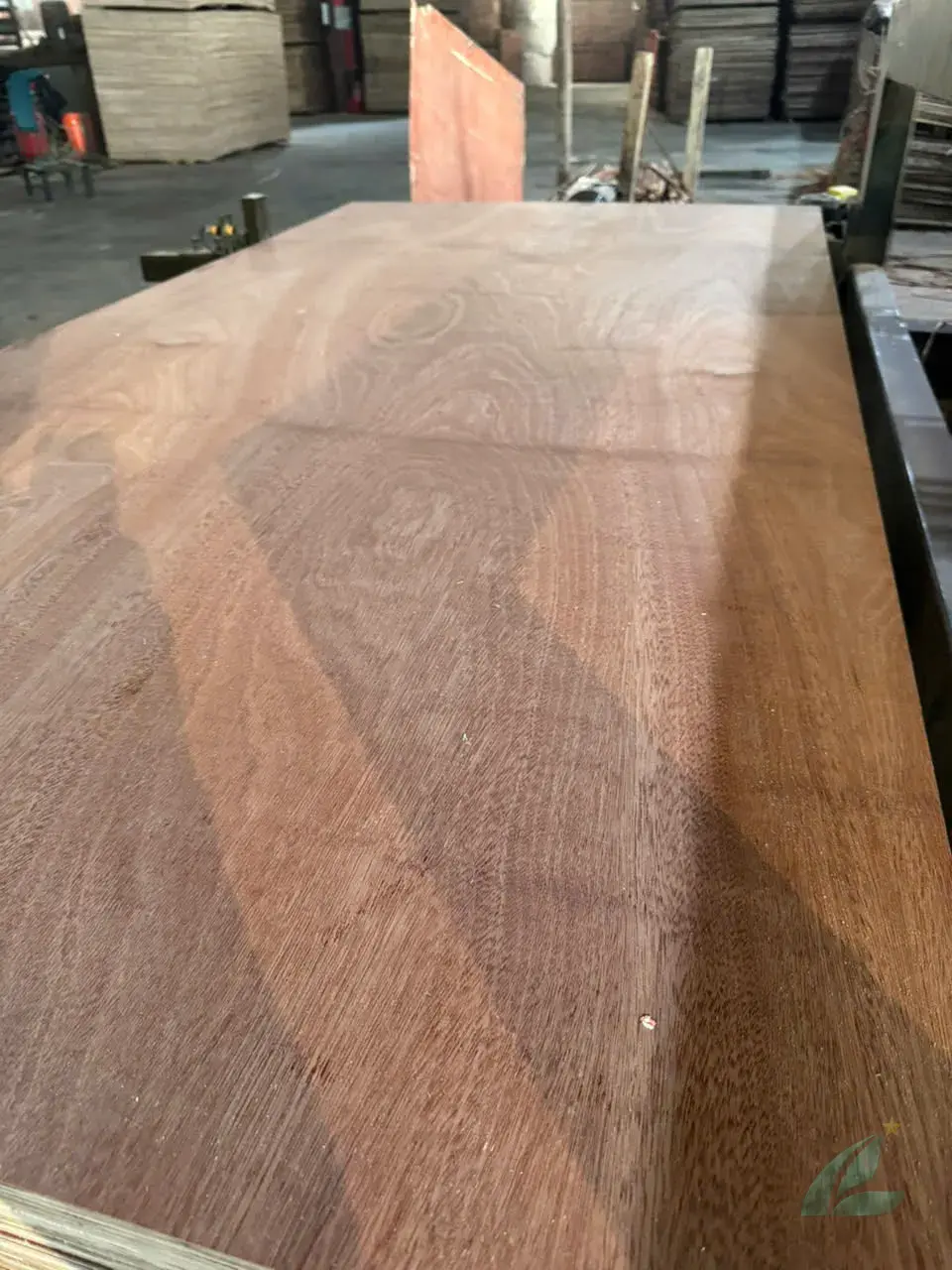
India imports more plywood from Vietnam than any other country. Within that trade flow, gurjan face plywood holds a specific and consistent position: it is the premium hardwood veneer face that Indian buyers specify when price-per-quality matters more than raw cost minimization.
This article answers the questions Indian importers ask before placing their first or next container order for gurjan face plywood in Vietnam — covering supplier selection, technical specifications, glue grades, core options, and how to verify genuine factory quality from 7,000 kilometers away.
The demand for gurjan plywood India imports from Vietnam has grown steadily since 2020, driven by furniture manufacturers in Gujarat, Maharashtra, and Rajasthan who prefer the hardwood surface over lower-cost alternatives. Understanding which gurjan face plywood suppliers in Vietnam operate factory-direct versus through trading intermediaries directly determines your price, quality consistency, and documentation reliability.
📌 What Is Gurjan Face Plywood (Not Full Gurjan Ply)
Before comparing suppliers, it is worth clarifying the terminology. “100% gurjan plywood” — also called full gurjan ply — means every layer, face and core, is made from gurjan (Dipterocarpus) timber. This product is made in India and Myanmar, where gurjan forests are present.
Gurjan face plywood is different: only the face veneers (top and bottom layers) are gurjan hardwood. The core layers use plantation species from Vietnam — acacia, eucalyptus, or styrax. This is the product Vietnam exports to India in volume.
The distinction matters for buyers in two ways:
- Price: Gurjan face plywood from Vietnam costs significantly less than full gurjan ply because the core uses lower-cost Vietnamese plantation timber.
- Density: Panel weight is determined by the core species, not the face. An acacia-core gurjan face panel (~580 kg/m³) weighs and handles differently than a eucalyptus-core panel (650–750 kg/m³). Both have identical face appearance and hardness.
⚠️ Important: When specifying “gurjan plywood” to a Vietnam supplier, always clarify whether you mean gurjan face + plantation core (standard export product) or full gurjan construction. Most Vietnamese factories only produce the former.
For a complete breakdown of face veneer types available from Vietnam, the Plywood Face Veneer Types Complete Guide covers specifications, pricing tiers, and market applications for all species.
🔧 Technical Specifications: Gurjan Face Plywood from Vietnam
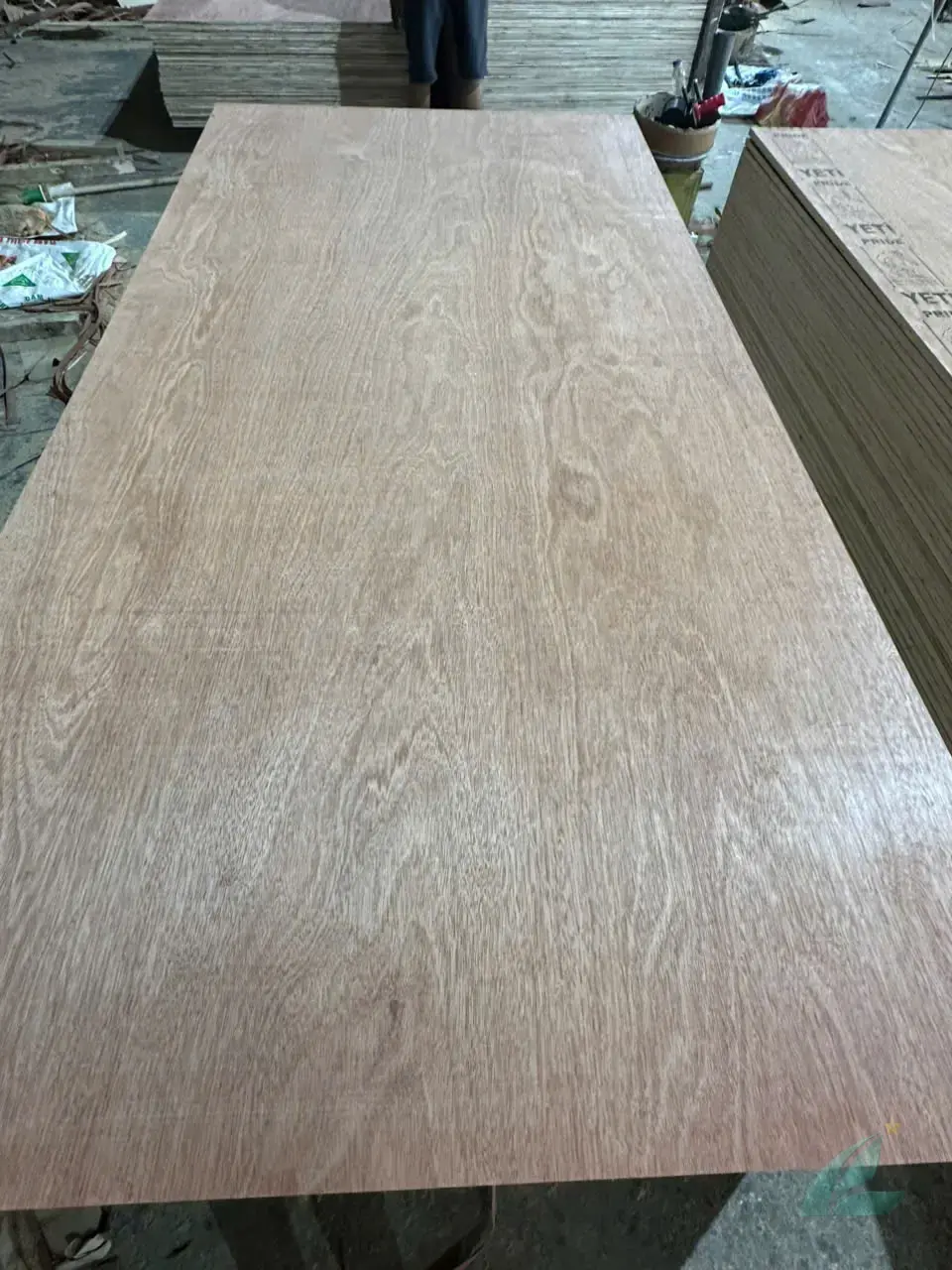
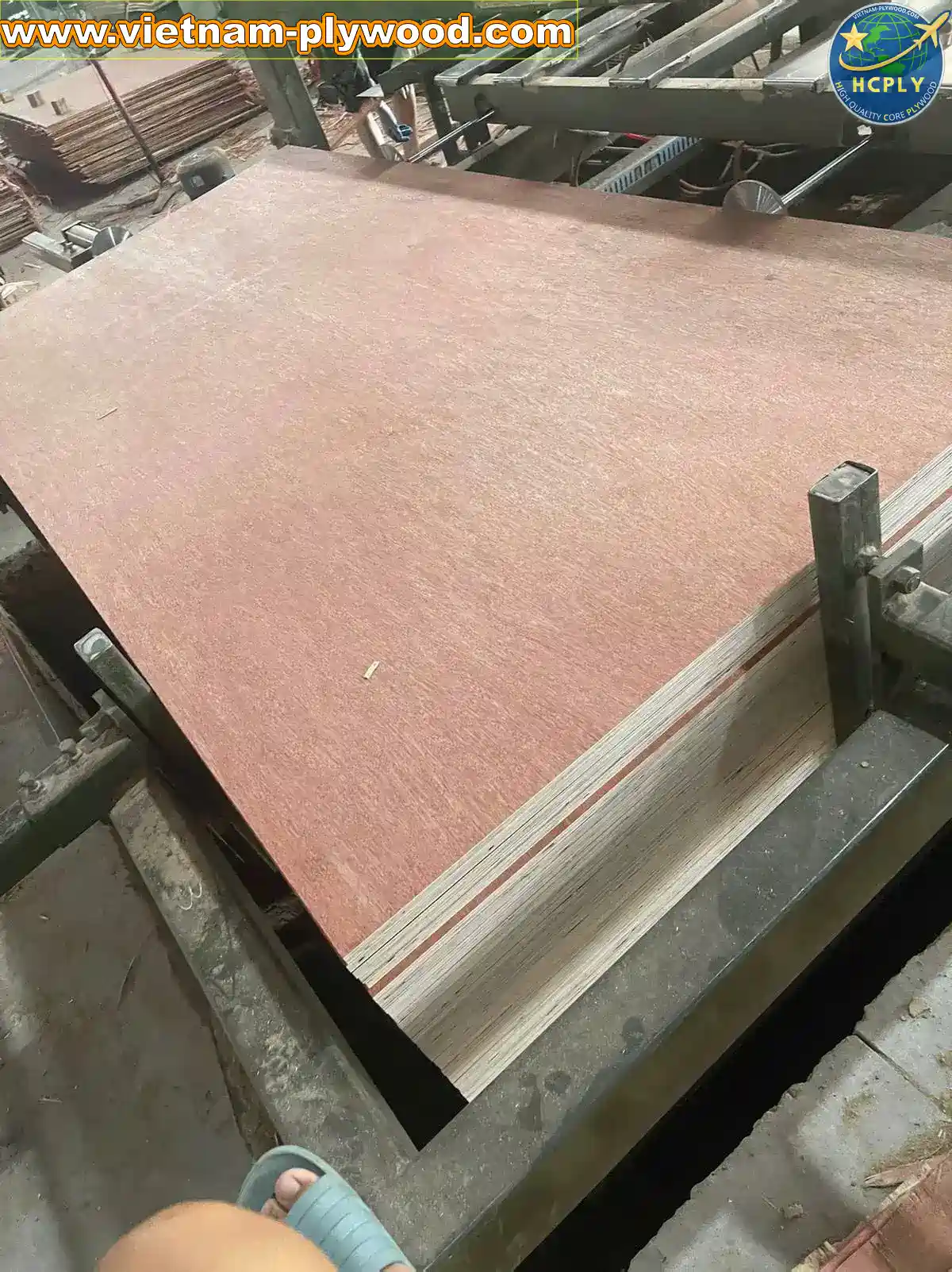
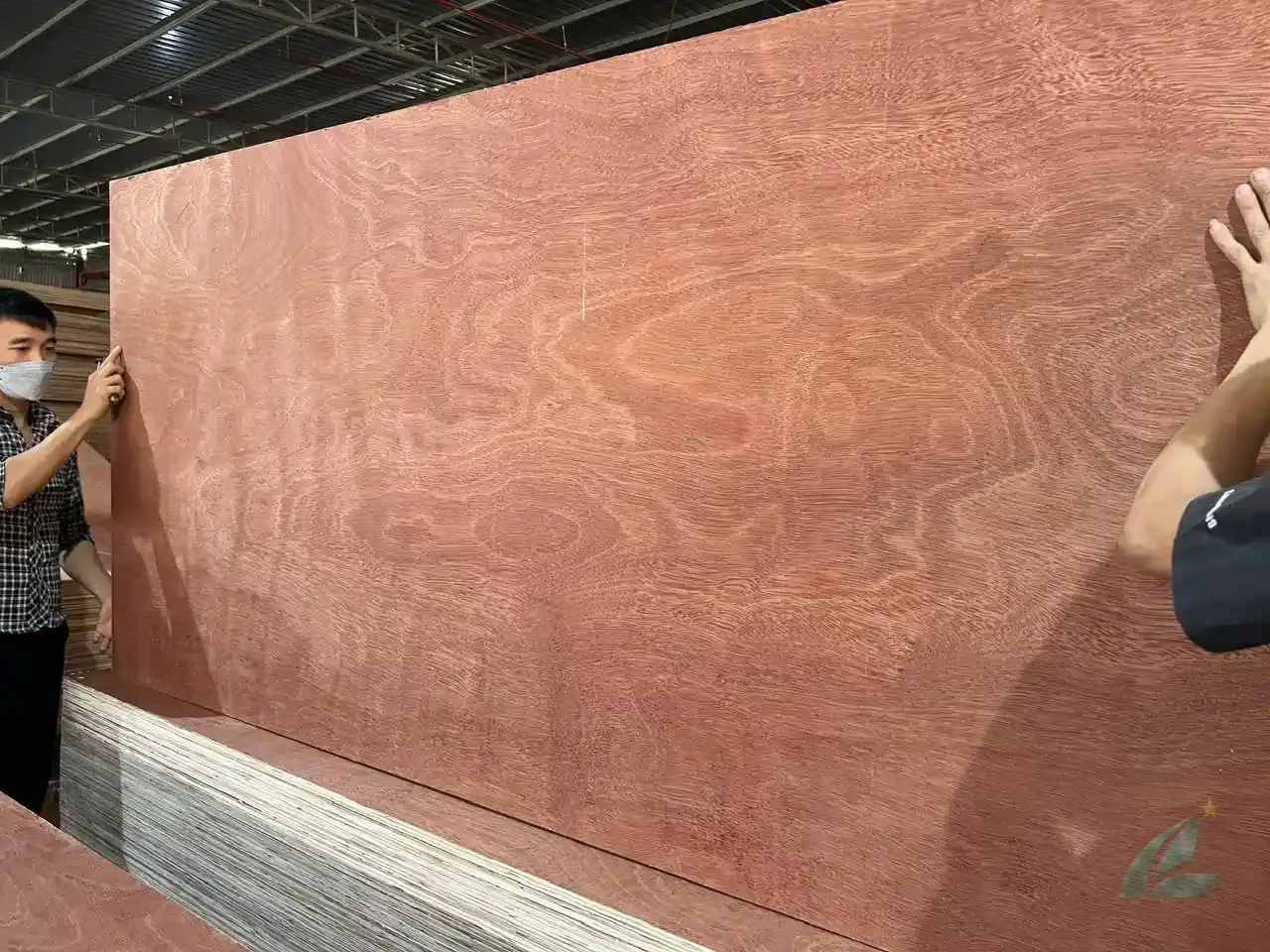
HCPLY gurjan face plywood — reddish-brown hardwood face veneer, sanded and calibrated for Indian furniture export.
The table below summarizes standard production parameters for gurjan face plywood exported from northern Vietnam (as of 2026, HCPLY production data):
| Parameter | Standard Range | Notes |
|---|---|---|
| Face veneer | Gurjan (Dipterocarpus spp.) | Imported veneer, 0.2–0.4mm thick |
| Face grade | A/B | Smooth, sanded, tight grain |
| Core species | Acacia, Eucalyptus, Styrax | Each affects density and price |
| Core density | Acacia ~580 / Eucalyptus 650–750 / Styrax 480–500 kg/m³ | Choose based on weight budget |
| Glue type | Melamine MR or Phenolic WBP | Two separate systems — see glue section |
| Emission | E0, E1, or E2 | Separate from glue type |
| Thickness | 4–25mm | Custom available |
| Sheet size | 1220×2440mm (4×8) or 1250×2500mm | Custom cutting available |
| Sanding | Yes — both faces | ±0.3mm thickness tolerance |
| Certifications available | FSC, CARB P2, ISO 9001 | Specify at order stage |
📌 Why Core Species Selection Matters for Indian Buyers
Indian buyers importing gurjan face plywood often default to “acacia core” because it is the most affordable option. That is a reasonable starting point, but the decision should be deliberate:
- Acacia core (~580 kg/m³): Budget-friendly, widely available, suitable for furniture and interior fitout where weight savings reduce handling costs. An acacia-core gurjan panel loads approximately 16 pallets per 40HC container — about 47.5 CBM.
- Eucalyptus core (650–750 kg/m³): Denser, heavier, stronger under load. Preferred for structural applications. Only 15 pallets per 40HC due to weight limits (payload approaches 28.5 MT maximum). Adds cost both in material and freight.
- Styrax core (480–500 kg/m³): Lightest core — 18 pallets per 40HC. Produces the best container utilization. Preferred for premium furniture where weight reduction is valued. Less common for Indian orders but available from HCPLY’s furniture-grade facility.
“Indian buyers shipping to metros where unloading is charged by weight often find styrax-core gurjan panels reduce landed cost meaningfully even when FOB is slightly higher.” — David, Export Project Leader, HCPLY
⚙️ Glue Grades: MR vs WBP for Indian Market
One of the most common specification errors Indian buyers make with Vietnam suppliers is conflating glue type with emission standard. These are two separate parameters.
Glue type determines moisture resistance:
- Melamine (MR): Passes 12-hour boiling test. Suitable for interior furniture, cabinets, interior joinery. Standard for most Indian furniture applications.
- Phenolic (WBP): Passes 72-hour boiling test. Required for exterior, construction, marine-adjacent, and high-humidity environments (kitchens with steam, bathrooms). WBP gurjan plywood from HCPLY is tested per IS 710 test protocols.
Emission standard determines formaldehyde off-gassing (independent of glue type):
- E1 (≤1.5 mg/L): Standard for India and most Asian markets. Acceptable for furniture sold domestically in India.
- E0 (≤0.5 mg/L): Required for export to Europe, US, Japan, Korea. Available from HCPLY’s premium furniture facility.
- E2 (≤5.0 mg/L): Budget grade, not suitable for interior human-occupied spaces in regulated markets.
A correct specification reads: “Gurjan face plywood, acacia core, 18mm, glue: WBP phenolic, emission: E1” — not “WBP E1 glue.”
For a detailed explanation of how glue and emission interact across Vietnam’s plywood range, see the Plywood Glue Types & Emission Standards Guide.
🏭 How to Evaluate Vietnam Gurjan Plywood Suppliers
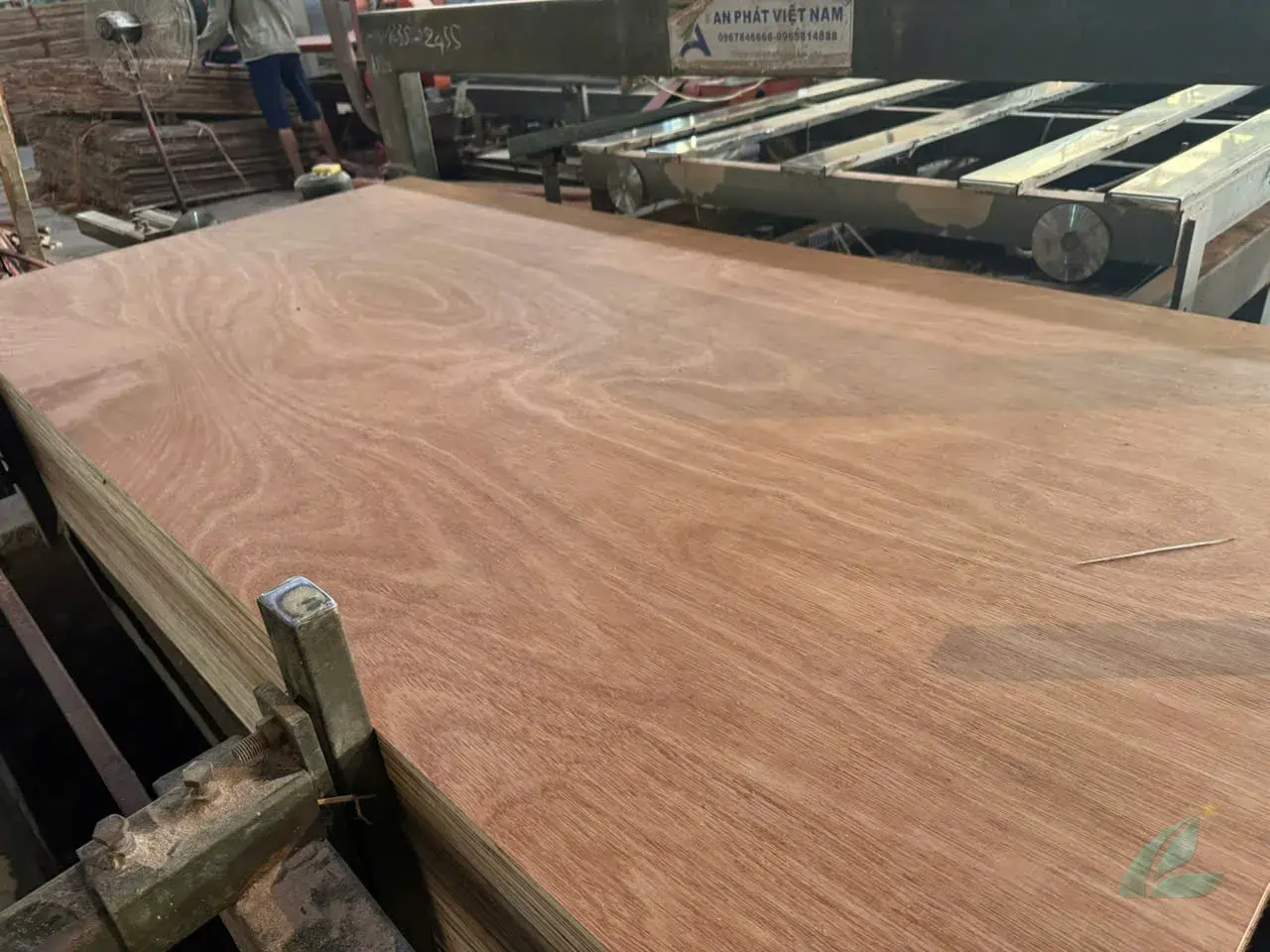
Quality control inspection of gurjan face plywood at HCPLY’s facility in Phu Tho Province, northern Vietnam.
Vietnam’s plywood export industry has four distinct supplier types, and each has different implications for an Indian buyer’s risk profile (Vietnam Plywood Association data, 2024):
Type 1 — Trading Companies (~80% of internet search results): These companies purchase OEM product from multiple factories and re-export. They carry VAT overhead of 8% on domestic purchases, which flows into FOB pricing. The risk: a buyer is shown a premium-facility sample, but the actual container ships from a different, lower-grade factory.
Type 2 — Manufacturer-Exporters: Factories with their own export sales teams. Quality control is direct, but single-facility capacity limits product range. They often buy OEM to supplement capacity, introducing some Type 1 risk.
Type 3 — Brokers: Small operations earning 5–10 USD/CBM as margin. Price advantage is real but factory relationship and QC oversight are limited.
📌 Four Verification Questions Before Ordering
- Can you provide mill test reports for this specific batch? A legitimate factory produces test reports per batch, not per model.
- Will the container load from the same factory that produced samples? Demand written confirmation in the proforma invoice.
- Can I receive loading videos and photos before the container seals? Standard at HCPLY; non-standard at trading companies.
- What is your boiling test result for this specific thickness and glue grade? Ask for the actual test documentation — not a generic product certificate.
For a complete supplier qualification process, the Plywood Supplier Evaluation Checklist covers 20 verification points for due diligence before commitment.
📊 Gurjan Plywood Specifications Indian Buyers Request Most
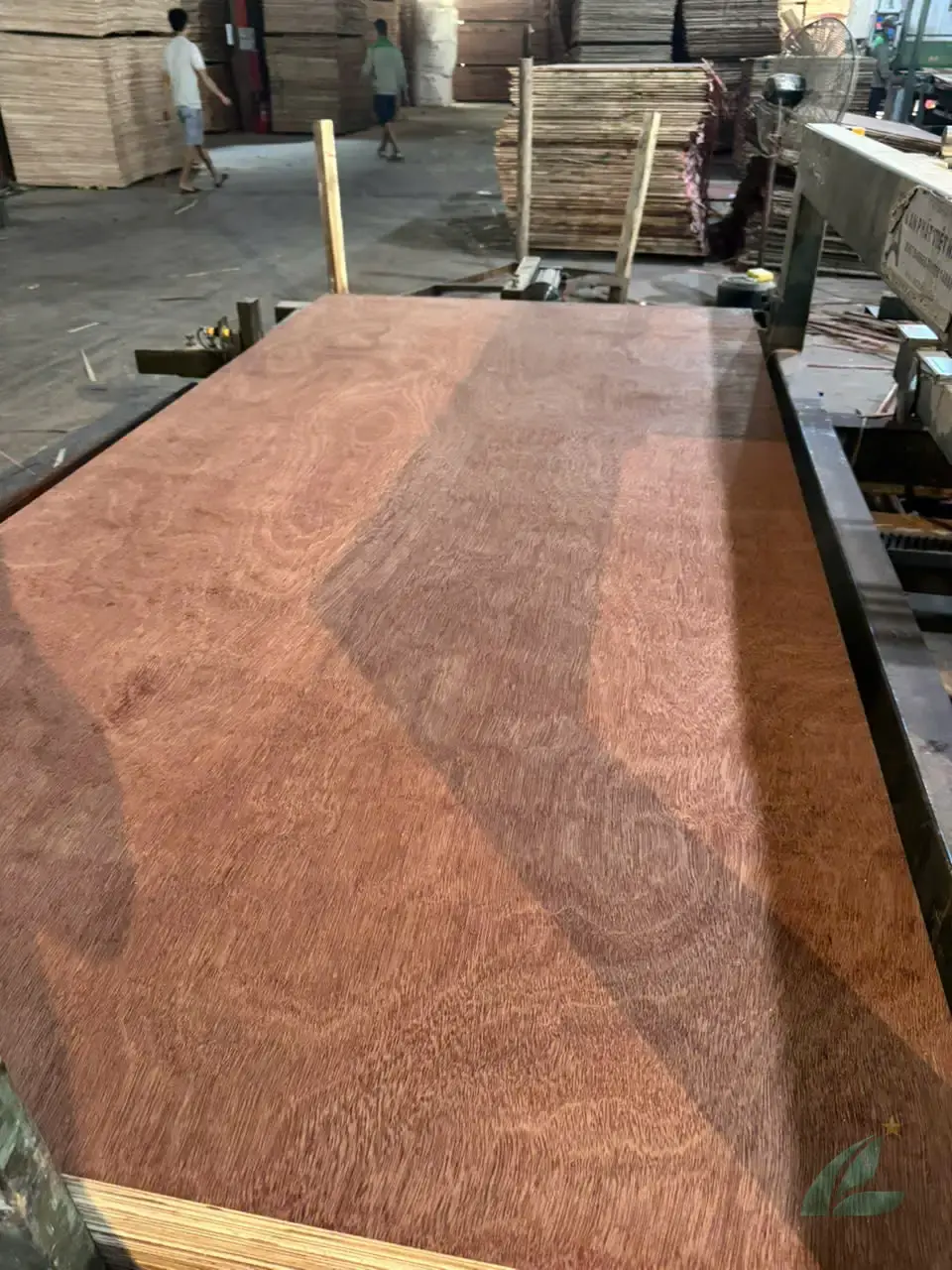
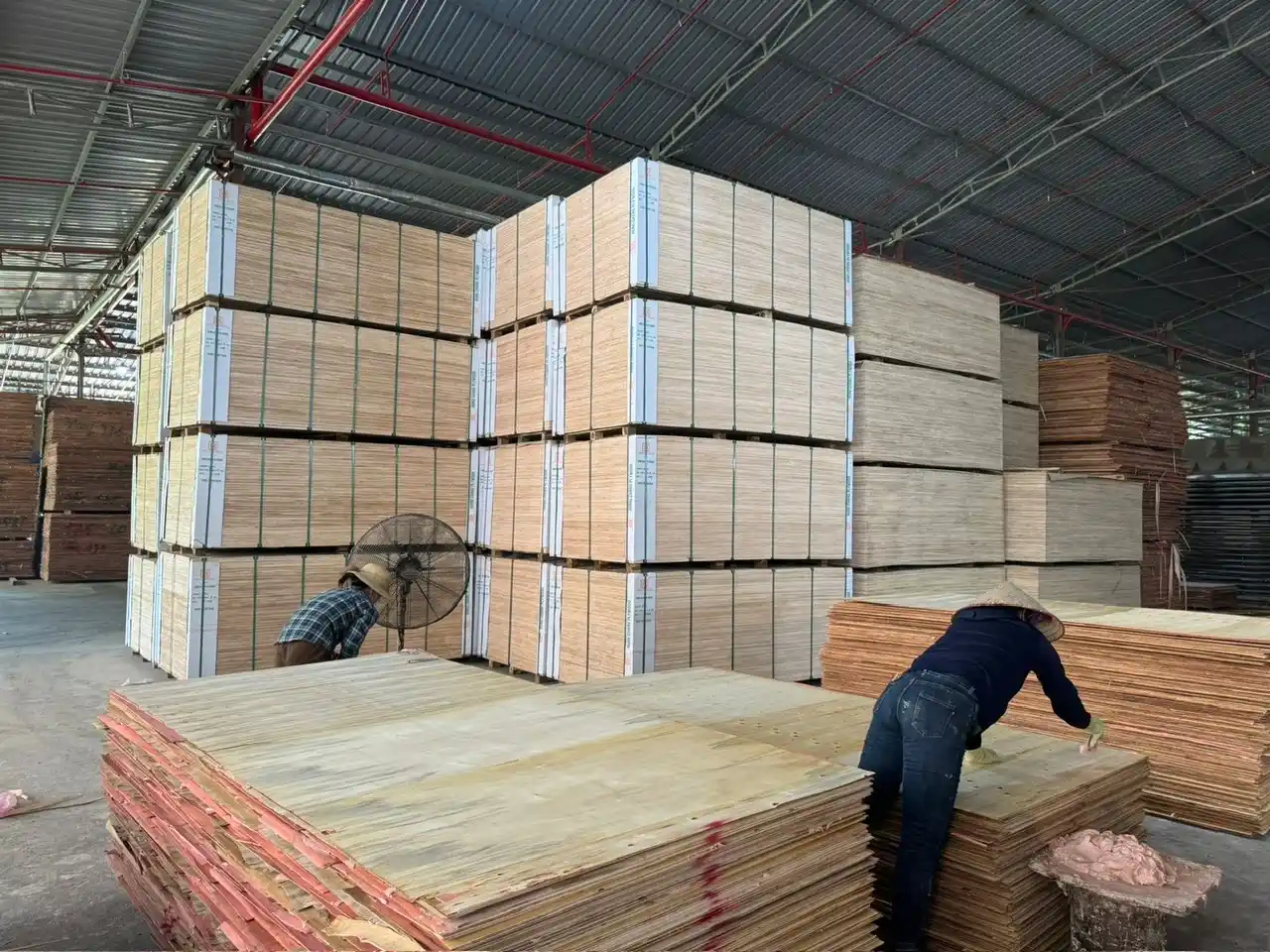
Stacked gurjan face plywood sheets at HCPLY — calibrated thickness, consistent face veneer grain.
Based on HCPLY’s India export orders (2024–2026), the most common gurjan face plywood specifications from Indian buyers cluster into three application categories:
Furniture & Interior Fitout (highest volume)
- Thickness: 12mm, 15mm, 18mm
- Core: Acacia or eucalyptus
- Glue: MR (Melamine)
- Emission: E1
- Sanding: Both faces, ±0.3mm
- Size: 1220×2440mm (4×8)
Kitchen Cabinets & Modular Furniture
- Thickness: 18mm, 25mm
- Core: Eucalyptus or styrax
- Glue: WBP (Phenolic) for moisture zones, MR for dry zones
- Emission: E0 or E1
- Sanding: Yes, calibrated
Marine-Adjacent & High-Humidity Installations
- Thickness: 6mm, 9mm, 12mm, 18mm
- Core: Eucalyptus (density critical for structural applications)
- Glue: WBP phenolic (mandatory — 72-hour boil test)
- Emission: E1
- Size: 1220×2440mm
💡 Tip: Indian buyers can mix specifications within a single 40HC container. A common approach combines 15mm and 18mm furniture-grade gurjan panels with a smaller quantity of WBP-glued panels for moisture-zone applications — all in one shipment to reduce per-CBM freight cost.
🔍 BIS Compliance and Export Documentation
Indian importers selling to organized retail, government projects, or branded furniture manufacturers increasingly require documentation that demonstrates IS 303 or IS 710 compliance for gurjan plywood.
Vietnam factories can produce plywood meeting the dimensional, bonding, and emission requirements of these Indian standards. However, IS certification (ISI mark) is issued by the Bureau of Indian Standards in India — not by the Vietnamese factory. What HCPLY provides:
- Mill test reports aligned with IS 303 / IS 710 test parameters (bond strength, moisture content, dimensional tolerance)
- Third-party inspection reports from SGS or Bureau Veritas (on request)
- FSC certificate (chain of custody, verifying legal wood sourcing)
- CARB P2 certificate (if E0 emission grade is specified)
- Standard export documents: Commercial Invoice, Packing List, Certificate of Origin (Form D or Form B), Phytosanitary Certificate, Fumigation Certificate, Bill of Lading
For buyers who need to support BIS product certification applications in India, the mill test reports from HCPLY provide the underlying material data needed by Indian testing labs to issue IS-aligned certification.
Full details on the complete import documentation set are covered in the Vietnam Plywood Export to India Buyer Guide.
📦 Container Loading: How Many Sheets Fit in a 40HC
HCPLY container loading at Hai Phong Port — gurjan face plywood pallets strapped and ready for India.
Container capacity for gurjan face plywood depends on core species (which determines panel weight) and sheet thickness (which determines sheets per pallet).
For a 40HC container with 1220×2440mm sheets, pallet stack height 1000mm:
| Core | Pallets/40HC | Approx CBM | Approx Weight |
|---|---|---|---|
| Styrax (480–500 kg/m³) | 18 | ~53 CBM | ~26.5 MT |
| Acacia (~580 kg/m³) | 16 | ~47.5 CBM | ~27.5 MT |
| Eucalyptus (650–750 kg/m³) | 15 | ~44.5 CBM | ~28 MT |
Sheets per pallet = ROUNDDOWN(1000mm ÷ panel thickness mm). For 18mm panels: 55 sheets/pallet. For 12mm panels: 83 sheets/pallet.
Mixed-core containers are possible but require weight recalculation per pallet position — HCPLY’s logistics team handles this at quotation stage.
🔗 Comparing Gurjan to Other Face Veneers for India
Indian buyers evaluating plywood faces from Vietnam often consider gurjan alongside bintangor and okoume. Each fills a different position in the market:
| Feature | Gurjan | Bintangor | Okoume |
|---|---|---|---|
| Surface hardness | High | Medium | Medium-low |
| Color | Reddish-brown | Light brown/tan | Pink-cream |
| Price (face premium) | High | Lowest | Low-medium |
| Indian market demand | Premium furniture, BIS-grade | Highest volume (commercial) | Low volume |
| Available from Vietnam | Yes | Yes | Yes |
| WBP glue option | Yes | Yes | Yes |
Gurjan commands a price premium of approximately 15–25% over bintangor face panels of equivalent specification (HCPLY production data, 2026). For applications where the hardness, appearance, and IS-standard documentation of gurjan justify the premium, it is the correct choice. For commercial fitout and packaging, bintangor delivers better cost efficiency.
For a detailed side-by-side analysis, see Gurjan vs Bintangor Plywood: Which Is Better for India?.
✅ How to Place an Order: Step-by-Step
Indian buyers new to sourcing from Vietnam often underestimate how fast the process moves when specifications are clear from the start.
Step 1 — Prepare your specification sheet. Include: face veneer (gurjan), core species preference, thickness(es), glue type (MR or WBP), emission standard (E0/E1), sheet size, quantity in CBM or number of sheets, and any certification requirements (FSC, CARB P2, IS 303-aligned test report).
Step 2 — Request quotation. Send specifications to HCPLY via WhatsApp or email. Response includes FOB price per CBM, production lead time (15–20 days standard), and available certification scope.
Step 3 — Review proforma invoice. Confirm the PI specifies the correct factory, core species, and glue grade — not just the product name. This is the contractual binding of specification.
Step 4 — Sample request (optional but recommended for new specifications). HCPLY ships 3–5 sheet samples before container orders for buyers specifying a new combination.
Step 5 — Production and QC. HCPLY’s on-site QC team conducts checks at three stages: post-pressing, post-sanding, and pre-loading. Loading photos and videos are sent before container sealing.
Step 6 — Shipping and documentation. Containers ship FOB Hai Phong Port. Full document set dispatched within 2 business days of vessel departure.
Get a Free Gurjan Plywood Quote for India
Related reading:
- View full product details on the gurjan plywood Vietnam product page.
- Also consider bintangor plywood for the Indian market.
- Browse Vietnam plywood companies supplying the Indian market.
🏁 Conclusion: Choosing a Vietnam Gurjan Plywood Supplier
Gurjan face plywood from Vietnam occupies a well-defined market position: premium hardwood face appearance at competitive FOB pricing, backed by plantation-species cores that are now produced to consistent quality in northern Vietnam’s export-grade facilities.
For Indian buyers, the key decisions are:
- Core species selection — determines container yield and landed weight cost
- Glue type — MR for furniture, WBP for moisture-exposed or marine applications
- Supplier type — factory-direct multi-facility operators offer better price and quality control than trading companies
Request a sample set or FOB quotation to verify quality before committing to a container.
Disclosure: This article is published by HCPLY, a Vietnam-based plywood manufacturer and export operator. While we aim to provide objective industry guidance, readers should consider our perspective as a market participant when evaluating recommendations.
Contact HCPLY for Gurjan Plywood — Factory Direct from Vietnam
For the complete picture of Vietnam’s export capabilities to India, including shipping costs, HS codes, and BIS documentation workflows, read the Vietnam Plywood Export to India Buyer Guide.