


FSC certified plywood from Vietnam costs 3–8% more than non-certified product from the same factory. For buyers shipping to the EU, US, or any green-building project, that premium is not optional — it is the price of market access.
This guide explains exactly how FSC chain-of-custody works inside a Vietnamese plywood factory — what buyers need to know — including the three FSC label types, how to verify a supplier’s certificate in 60 seconds, and what documentation to request before you place an order.
📋 What FSC Certification Actually Means for Plywood
FSC (Forest Stewardship Council) is an independent, non-profit body that sets standards for responsible forest management and tracks materials through the supply chain. Two separate certificates cover the plywood you buy:
- Forest Management (FM) Certificate — issued to the forest owner. Confirms trees are harvested according to FSC’s environmental and social standards.
- Chain-of-Custody (CoC) Certificate — issued to every company that processes or trades the wood, including the plywood factory. Confirms certified material was identified, tracked, and kept separate from non-certified material.
Both must be valid for a product to carry the FSC label. If a factory holds a CoC certificate but buys veneer from an uncertified forest, the output cannot be sold as FSC certified.
Key Insight: FSC CoC certification applies per facility and per product scope. A factory that produces birch plywood and film-faced plywood holds one FSC certificate with both product types listed in its scope. If your product type is not in scope, you cannot use the FSC label on that shipment — regardless of what the sales team tells you.
🔗 How FSC Chain-of-Custody Works at a Vietnam Factory
The chain of custody runs from the plantation through to the container. Here is how each stage works at HCPLY’s production facilities in Phu Tho Province, Northern Vietnam.
📌 Stage 1 — Veneer Procurement (Plantation to Gate)
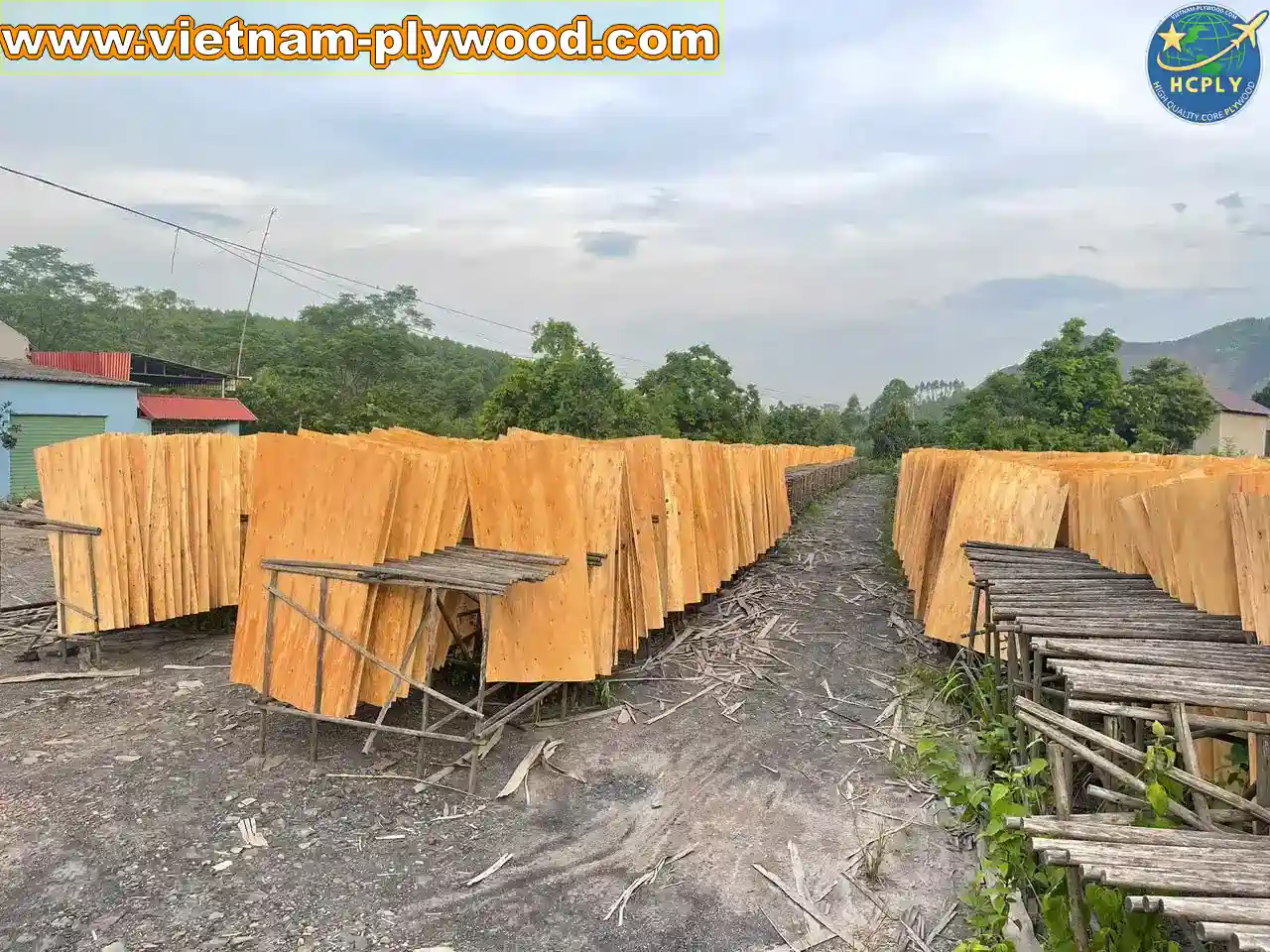
Vietnam’s plywood industry runs almost entirely on plantation timber. Core species — acacia (~580 kg/m³), eucalyptus (650–750 kg/m³), and styrax (480–500 kg/m³) — are all plantation-grown in Northern Vietnam’s forestry provinces (HCPLY production data, 2026).
FSC-certified raw material arrives at the factory gate with a Transaction Certificate (TC) from the selling party. The factory’s CoC system records the TC number, species, volume in m³, and FSC license code of the supplier. This intake log is the documentary foundation of the entire chain.
Non-certified material arriving at the same gate must be recorded separately. Physical separation during storage is required — certified veneer bundles carry colour-coded labels or tags under HCPLY’s internal tracking protocol.
📌 Stage 2 — Production Control (Gate to Finished Panel)
During pressing and assembly, the CoC system requires percentage calculation or physical separation to ensure the certified content claim is accurate. For HCPLY’s FSC 100% orders:
- Only veneer from FSC-certified intake lots enters the production run
- Work orders reference the TC numbers consumed
- Line supervisors verify at each stage: peeling, drying, glue spreading, pressing
This is the stage where most violations occur in factories with weak CoC systems. When an FSC auditor visits, they will cross-check the intake volume of certified material against the output volume of FSC-labelled product. The numbers must balance. Any factory that cannot produce these records is not running a genuine CoC program.
📌 Stage 3 — Finished Goods & Sales Records
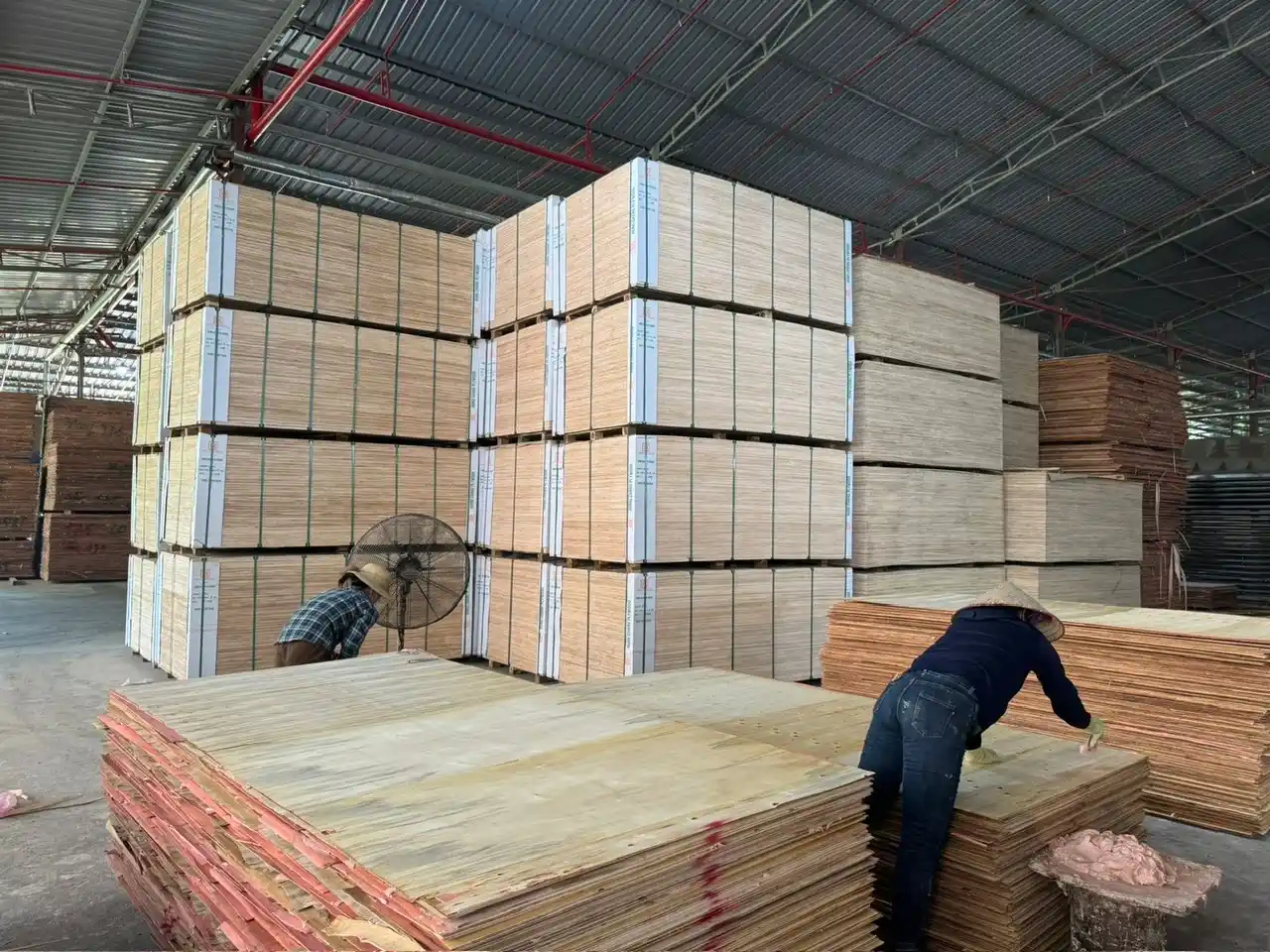
Finished FSC-certified panels are stored separately and invoiced with the FSC license code and product claim (FSC 100%, FSC Mix, or FSC Recycled). The Commercial Invoice and Packing List must state:
- FSC license code of the manufacturer
- Product claim type (FSC 100% / FSC Mix)
- FSC-certified volume/quantity
The FSC label printed on the panel edge or on the carton also carries the license code. This is what your receiving inspection team should check against info.fsc.org at the time of delivery.
Request FSC certified plywood samples and quotation — Contact HCPLY Now
📊 The 3 FSC Label Types — Which One to Specify
Not all FSC labels carry the same weight. Specifying the wrong type can create compliance issues downstream.
| FSC Label | Wood Source | Best For |
|---|---|---|
| FSC 100% | 100% from FSC-certified forests | EU EUDR compliance, premium projects, LEED Platinum |
| FSC Mix | Mix of certified, controlled wood, recycled | Standard green procurement, most EU retail chains |
| FSC Recycled | 100% post-consumer reclaimed material | Circular economy claims, packaging, sustainable branding |
For most buyers importing FSC certified plywood from Vietnam:
- EU buyers should specify FSC 100% or FSC Mix to satisfy EUDR traceability requirements. FSC Mix is acceptable under EUDR provided the controlled wood meets FSC’s Controlled Wood standard (which excludes illegal logging and GMO trees, among other criteria). (FSC International, 2024)
- US buyers under LEED v4 or LEED v4.1 — FSC 100% or FSC Mix both qualify for the Wood credit, but the material must be from a certified supplier with a current CoC. (US Green Building Council, 2024)
- Korean and Japanese buyers — domestic green labelling schemes accept FSC Mix at minimum.
⚠️ Important: If your buyer’s specification says “FSC certified” without specifying the label type, clarify before production. Substituting FSC Recycled for FSC 100% when the project requires certified virgin fibre is a non-conformance that can hold up payment.
🔍 How to Verify an FSC Certificate in 60 Seconds
Every FSC CoC certificate has a unique license code in the format FSC-C###### (e.g., FSC-C123456). Do this before you pay a deposit:
- Go to info.fsc.org
- Enter the supplier’s FSC license code
- Check three things:
- Certificate status: Must say “Active”. Suspended or expired = stop immediately.
- Product scope: Your plywood type (e.g., “Plywood — face veneer: birch”) must be listed.
- Certificate validity date: Confirm the certificate does not expire before your delivery date.
FSC CoC certificates are valid for 5 years, with mandatory annual surveillance audits conducted onsite by an accredited third-party body — typically lasting one to two working days per facility (FSC International, FSC-STD-40-004 V3-0). A supplier who refuses to provide their license code for public verification has a problem worth investigating.
📦 What FSC Documentation to Request
A complete FSC-compliant shipment from Vietnam requires these documents:
| Document | What to Check |
|---|---|
| Commercial Invoice | FSC license code + product claim stated |
| Packing List | FSC-certified quantity/volume listed separately |
| Transaction Certificate (TC) | Issued by the factory’s certification body for each shipment |
| FSC Sales Certificate | Confirms the factory was certified at time of sale |
| Certificate of Origin (CO) | Vietnam origin confirmed for customs |
The Transaction Certificate is the most important document. It is issued by the certification body (e.g., SGS, Bureau Veritas, TÜV SÜD) for each individual shipment and links the specific lot to the factory’s certificate. Without a TC, the buyer cannot prove the shipment was produced under a valid CoC program.
“Many buyers receive an FSC certificate copy but forget to request the Transaction Certificate. The TC is what auditors, customs authorities, and your own procurement compliance team will ask for first.” — Lucy, International Sales Manager, HCPLY
⚙️ FSC + EUDR: What Changes in 2025–2026
The EU Deforestation Regulation (EUDR) entered into force in 2024, with enforcement timelines that directly affect plywood buyers importing into Europe.
Under EUDR, operators placing plywood on the EU market must demonstrate due diligence that the product:
- Was not produced on land deforested after December 31, 2020
- Complies with the legislation of the country of production
FSC certification significantly simplifies EUDR due diligence. FSC’s Controlled Wood standard and FSC Forest Management certification both require legal harvest verification — evidence that auditors and EU customs authorities accept as substantive proof in the due diligence process. (European Commission, EUDR Guidance, 2024)
For Vietnam-origin plywood specifically, FSC certification combined with plantation-sourced raw material (acacia, eucalyptus, styrax) provides a defensible EUDR position. Vietnam’s plantation forestry sector operates under government concessions and National Forestry Program rules that align with EUDR’s no-deforestation test. However, buyers should still obtain the factory’s geolocation data for the source forest lots — EUDR requires coordinates, and FSC alone does not satisfy the geolocation requirement. (European Commission, Regulation (EU) 2023/1115)
For a full breakdown of EUDR compliance steps for plywood importers, see the EUDR guide for plywood importers.
🏭 How HCPLY Maintains FSC Certification Across 3 Facilities
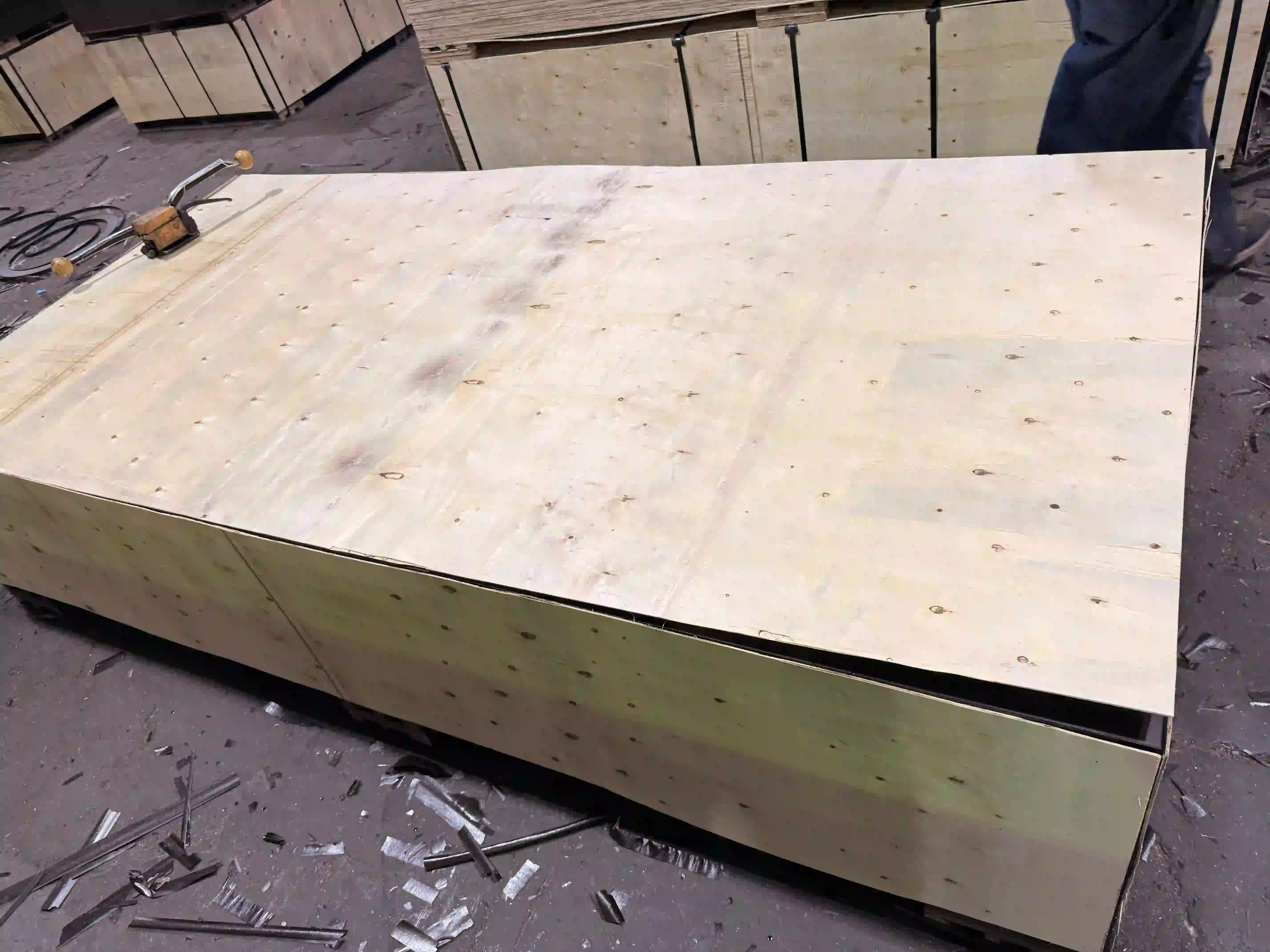
HCPLY manages 3 specialized production facilities in Northern Vietnam, each purpose-built for a different product category:
- Premium furniture facility — styrax/eucalyptus core, E0 emission, full stitched construction, sanded. Produces FSC 100% certified birch, okoume, EV, and gurjan plywood for EU and US furniture manufacturers.
- Commercial/packing facility — acacia core, MR glue. Produces FSC Mix certified bintangor and packing-grade plywood for commercial interior and packaging applications.
- Premium film-faced facility — eucalyptus/acacia core, AICA phenolic film, WBP glue, 15+ reuse cycles. Produces FSC Mix certified film-faced plywood for construction contractors.
Each facility operates under a single FSC CoC certificate with all three sites in scope. Annual surveillance audits cover all facilities in one audit cycle. On-site QC team and factory-direct documentation means every order ships with its own Transaction Certificate — buyers do not wait for third-party intermediaries to generate paperwork.
For a full list of certifications HCPLY holds — FSC, CARB P2, CE, EUDR, ISO 9001 — see the plywood certifications and export documentation guide.
For an overview of all Vietnamese plywood products available with FSC certification, visit the Vietnam plywood manufacturer page.
✅ Buyer’s Checklist: FSC Certified Plywood from Vietnam
Before confirming an FSC plywood order from any Vietnamese supplier:
- Request FSC license code — verify status, scope, and expiry at info.fsc.org
- Confirm label type (FSC 100% vs FSC Mix) matches your project specification
- Confirm product type is within the certificate’s scope
- Request Transaction Certificate issuance for your shipment
- Confirm Commercial Invoice and Packing List will state FSC license code and claim
- If EU market: confirm EUDR geolocation data for source forests is available
- Confirm annual surveillance audit date — avoid ordering in the 30-day window before audit if the factory is behind on corrective actions

📐 FSC Pricing Impact and What to Budget
FSC certified plywood from Vietnam carries a premium of 3–8% over identical non-certified product from the same factory. The variance depends on:
- Species and grade: Birch FSC 100% commands the highest premium (~6–8%) because certified birch veneer supply is limited. Bintangor FSC Mix runs closer to 3–4%.
- Volume: Orders below 1 × 40HC (one container) attract a higher per-m³ FSC premium because the factory needs to run a dedicated certified production batch.
- Certification body: Certificates from Bureau Veritas or SGS carry no price difference. Some buyers in regulated markets specify which certification body they accept — most accept all FSC-accredited bodies.
For current FOB pricing on FSC certified plywood from Vietnam, the fastest path is a direct inquiry. Lead times and certification documentation availability vary by product and season (HCPLY production data, 2026).
Get a Free Quote for FSC Certified Plywood
✅ Conclusion
FSC certification for plywood is not just a green label — it is a supply chain control system that runs from the plantation gate to your container. The key documents are the CoC certificate (verify at info.fsc.org before you pay a deposit), the Transaction Certificate for each shipment, and the Commercial Invoice with the license code and product claim stated.
For buyers targeting EU markets in 2025–2026, FSC certification is the most efficient path to EUDR compliance, but it does not replace the geolocation data requirement. Request both.
HCPLY holds a current FSC CoC certificate covering all 3 production facilities in Phu Tho Province, Northern Vietnam. Every FSC shipment includes a Transaction Certificate from the issuing body and complete commercial documentation.
Contact HCPLY for FSC certified plywood samples and documentation